
The Meaning of Einsteins Equation Partially based on
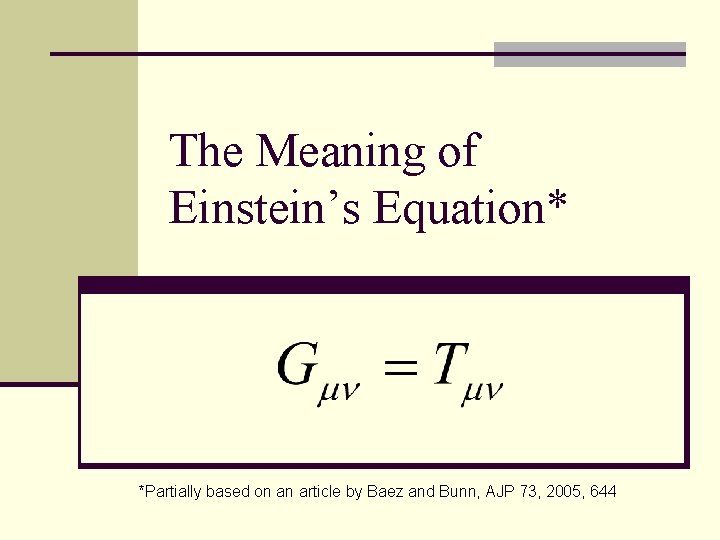
The Meaning of Einstein’s Equation* *Partially based on an article by Baez and Bunn, AJP 73, 2005, 644
Overview n Einstein’s Equation: Gravity = Curvature of Space n What Does Einstein’s Equation Mean? n Needs Full Tensor Analysis n Consequences n Tidal Forces and Gravitational Waves n Gravitational Collapse n Big Bang Cosmology … and more! n Stress and Curvature Tensors n What Have We Learned?
Preliminaries n Special Relativity n No absolute velocities n Described by 4 -vectors n Depends on inertial coordinate systems n General Relativity n Not even relative velocities n Except for two particles at same point Need effects of parallel transport n Curvature of spacetime n Relate to energy density n
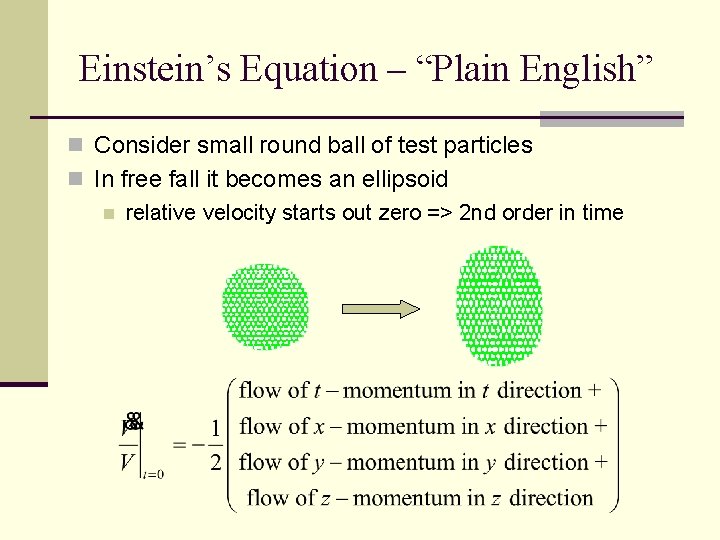
Einstein’s Equation – “Plain English” n Consider small round ball of test particles n In free fall it becomes an ellipsoid n relative velocity starts out zero => 2 nd order in time
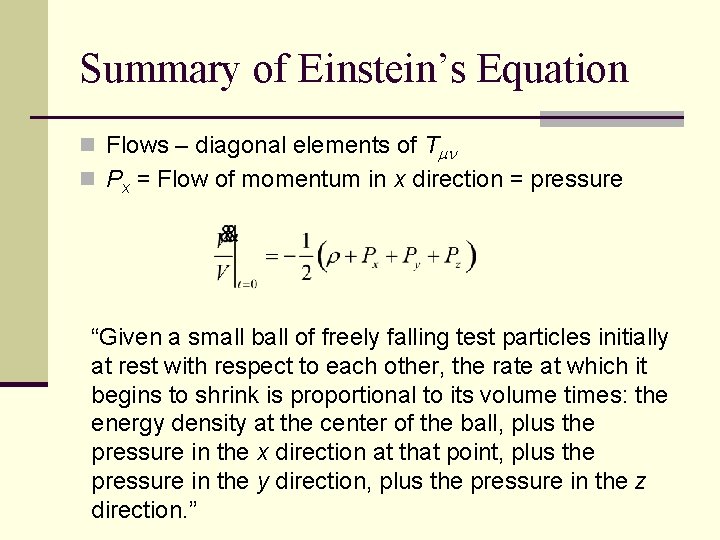
Summary of Einstein’s Equation n Flows – diagonal elements of Tmn n Px = Flow of momentum in x direction = pressure “Given a small ball of freely falling test particles initially at rest with respect to each other, the rate at which it begins to shrink is proportional to its volume times: the energy density at the center of the ball, plus the pressure in the x direction at that point, plus the pressure in the y direction, plus the pressure in the z direction. ”
Consequences n Gravitational Waves n Gravitational Collapse n The Big Bang n Newton’s Inverse Square Law
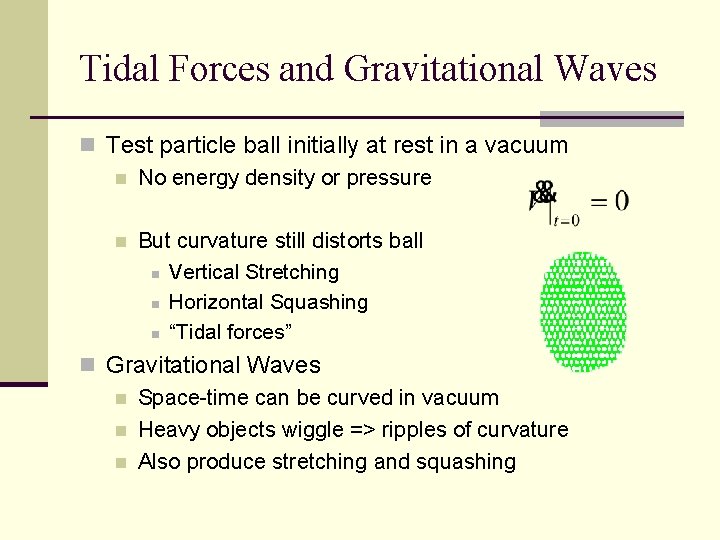
Tidal Forces and Gravitational Waves n Test particle ball initially at rest in a vacuum n No energy density or pressure n But curvature still distorts ball n Vertical Stretching n Horizontal Squashing n “Tidal forces” n Gravitational Waves n Space-time can be curved in vacuum n Heavy objects wiggle => ripples of curvature n Also produce stretching and squashing
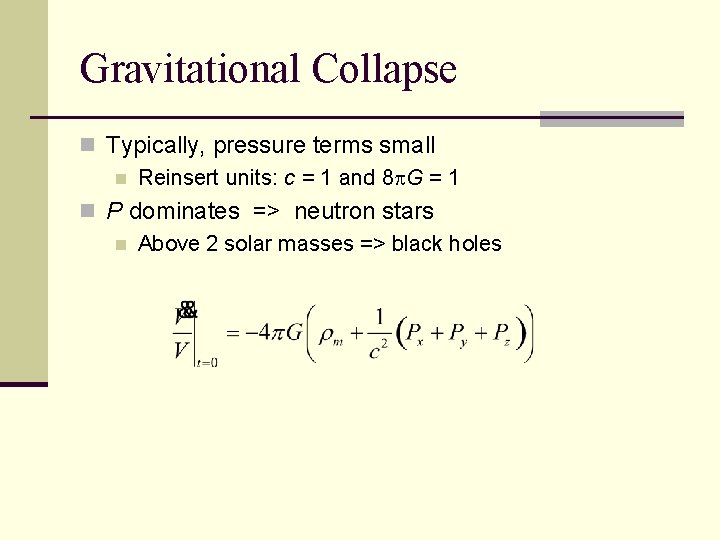
Gravitational Collapse n Typically, pressure terms small n Reinsert units: c = 1 and 8 p. G = 1 n P dominates => neutron stars n Above 2 solar masses => black holes
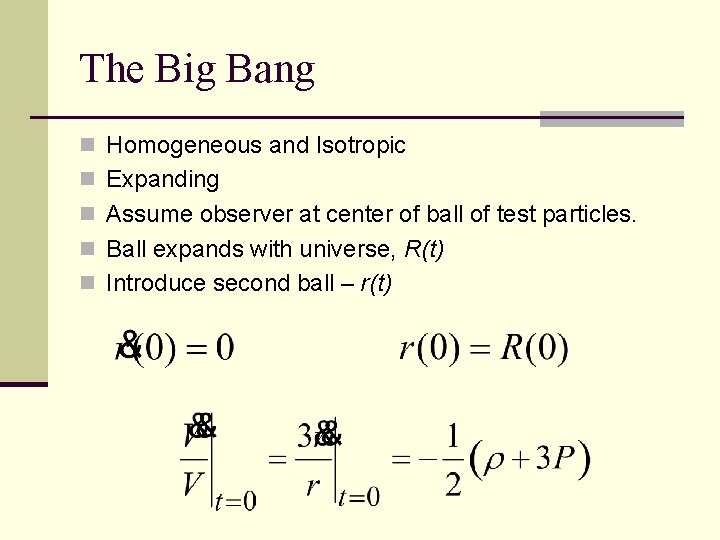
The Big Bang n Homogeneous and Isotropic n Expanding n Assume observer at center of ball of test particles. n Ball expands with universe, R(t) n Introduce second ball – r(t)

Equation for R n Equivalence Principle – “at any given location particles in free fall do not accelerate with respect to each other” n So, replace r with R. n Nothing special about t=0. n Assume pressureless matter n Universe mainly galaxies – density proportional to R-3 Get Newtonian Gravity!
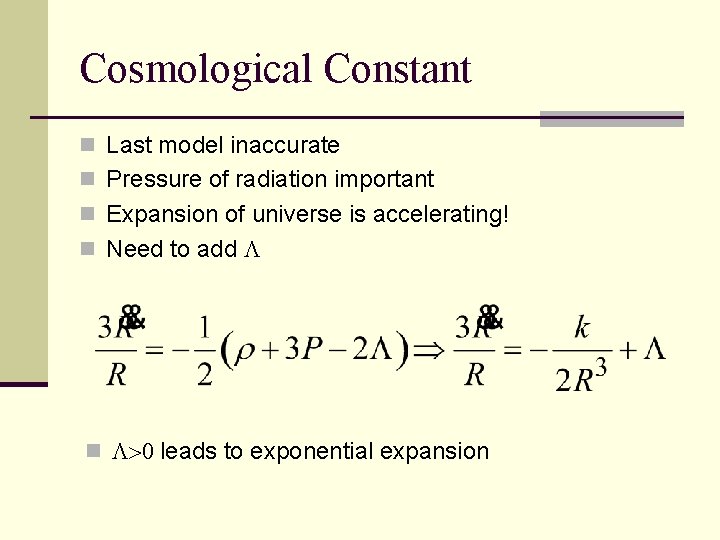
Cosmological Constant n Last model inaccurate n Pressure of radiation important n Expansion of universe is accelerating! n Need to add L n L>0 leads to exponential expansion
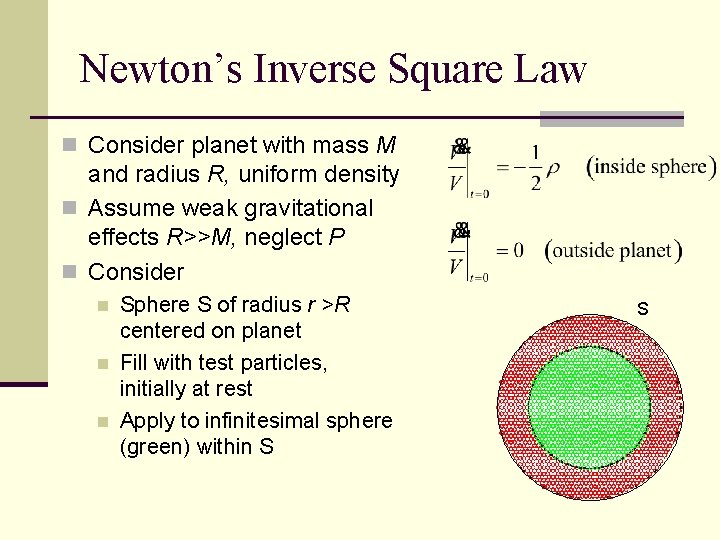
Newton’s Inverse Square Law n Consider planet with mass M and radius R, uniform density n Assume weak gravitational effects R>>M, neglect P n Consider n n n Sphere S of radius r >R centered on planet Fill with test particles, initially at rest Apply to infinitesimal sphere (green) within S S
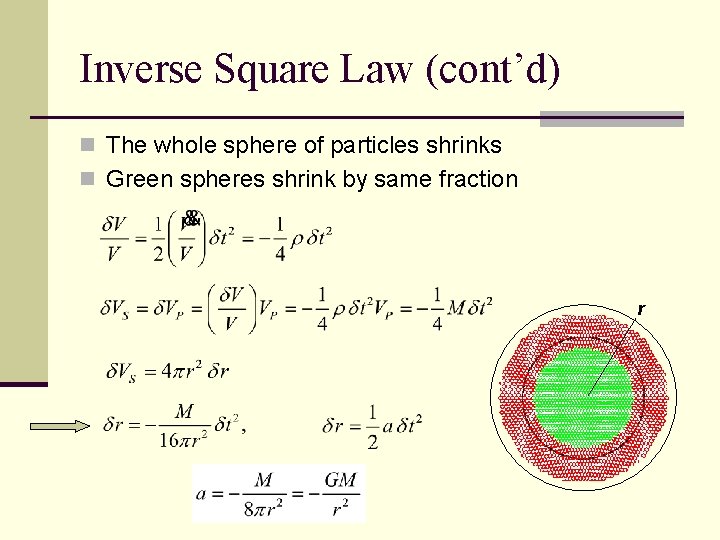
Inverse Square Law (cont’d) n The whole sphere of particles shrinks n Green spheres shrink by same fraction r
Mathematical Details n Parallel Transport n Measuring Curvature n Riemann Curvature Tensor n Geodesic Deviation n Stress Tensor n Connection to Curvature
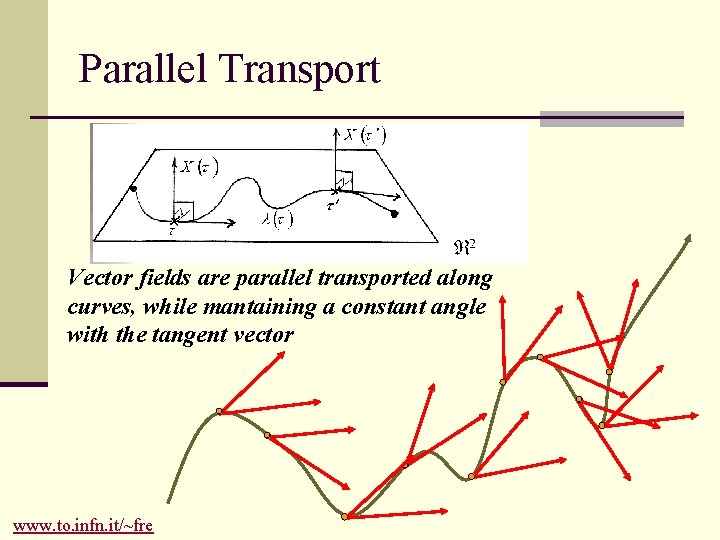
Parallel Transport Vector fields are parallel transported along curves, while mantaining a constant angle with the tangent vector www. to. infn. it/~fre
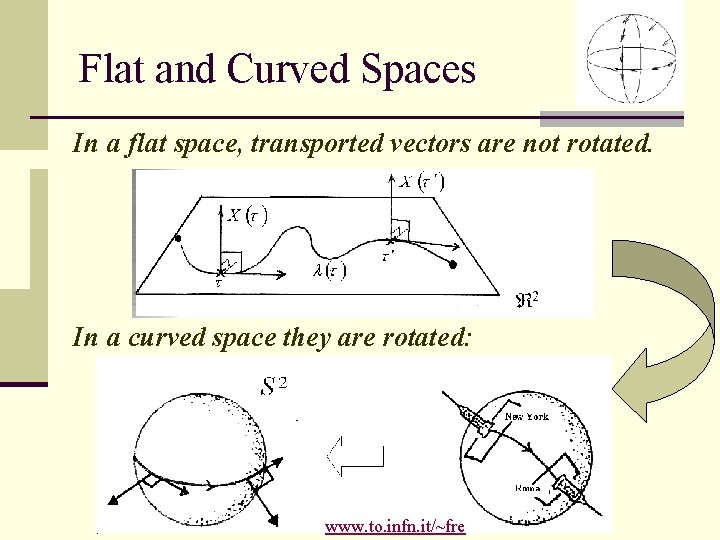
Flat and Curved Spaces In a flat space, transported vectors are not rotated. In a curved space they are rotated: www. to. infn. it/~fre
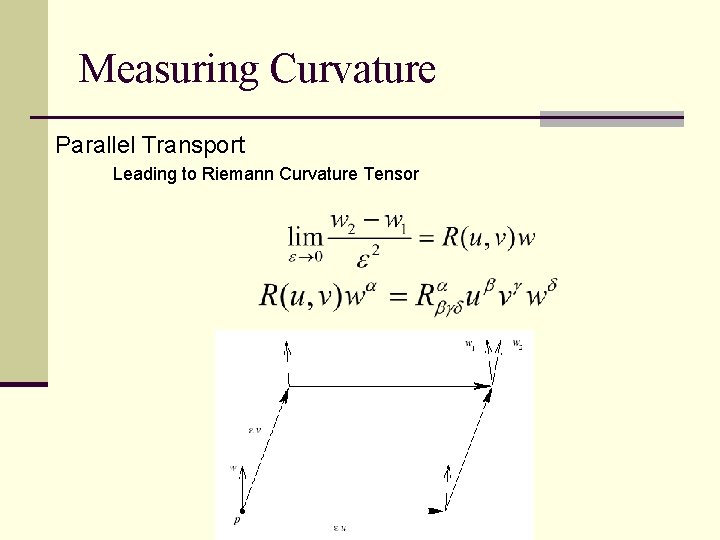
Measuring Curvature Parallel Transport Leading to Riemann Curvature Tensor
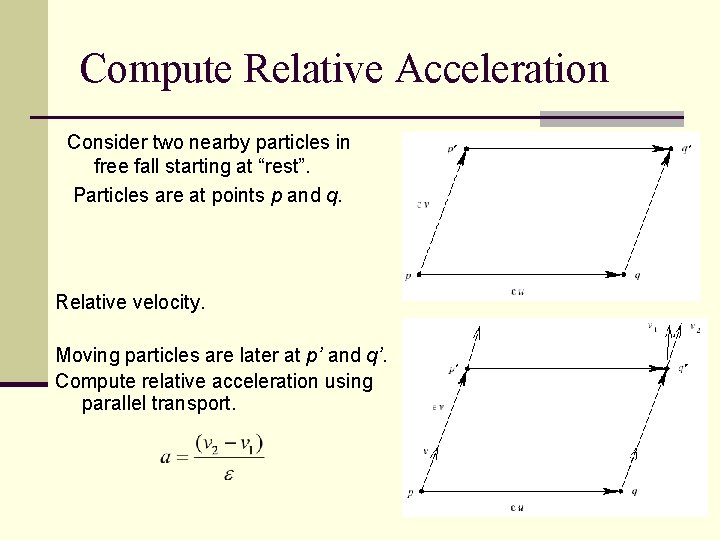
Compute Relative Acceleration Consider two nearby particles in free fall starting at “rest”. Particles are at points p and q. Relative velocity. Moving particles are later at p’ and q’. Compute relative acceleration using parallel transport.
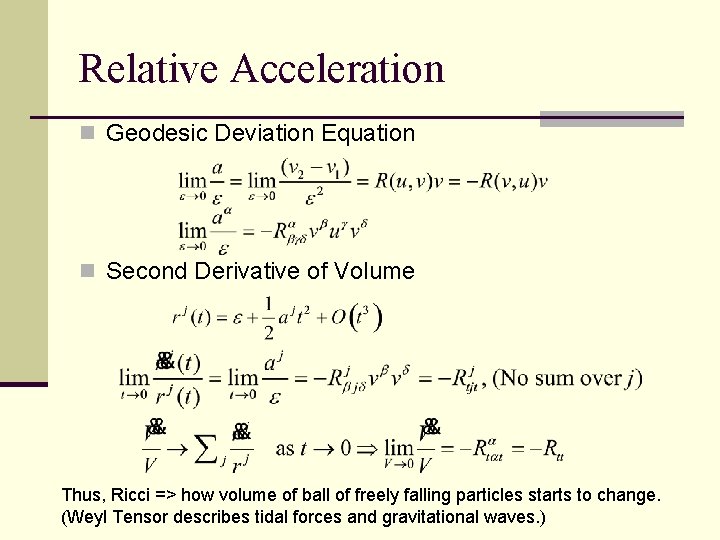
Relative Acceleration n Geodesic Deviation Equation n Second Derivative of Volume Thus, Ricci => how volume of ball of freely falling particles starts to change. (Weyl Tensor describes tidal forces and gravitational waves. )
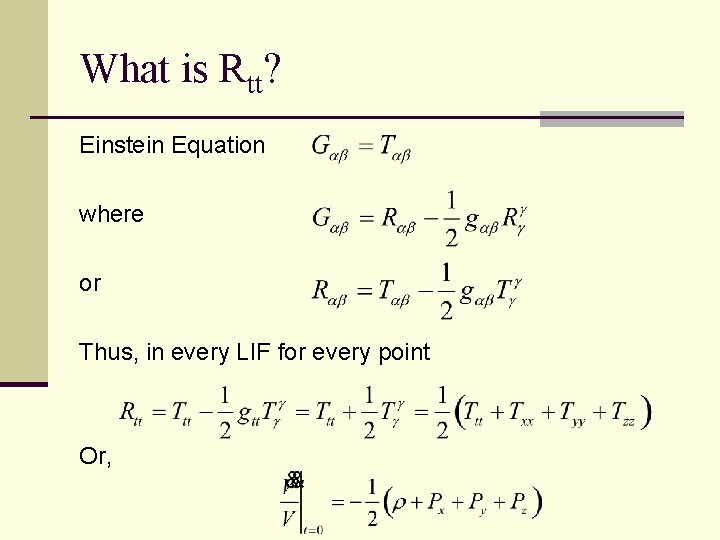
What is Rtt? Einstein Equation where or Thus, in every LIF for every point Or,
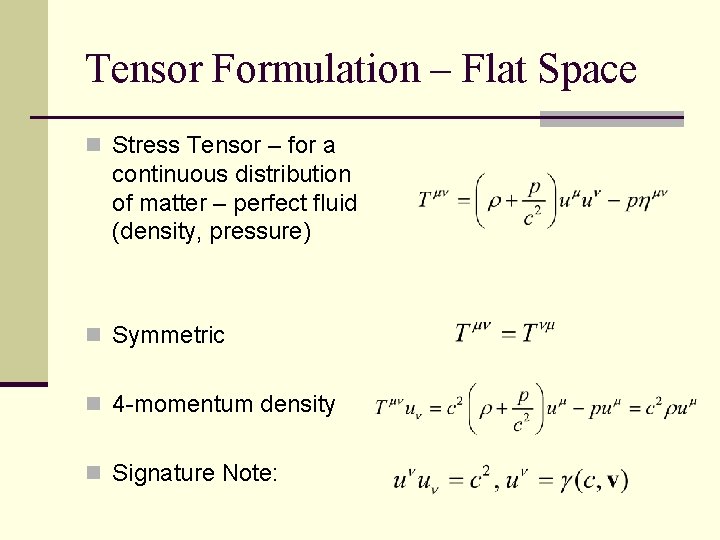
Tensor Formulation – Flat Space n Stress Tensor – for a continuous distribution of matter – perfect fluid (density, pressure) n Symmetric n 4 -momentum density n Signature Note:
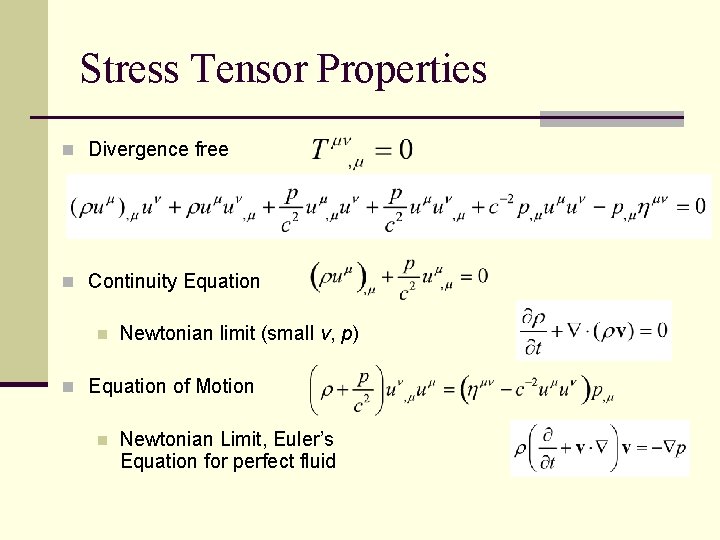
Stress Tensor Properties n Divergence free n Continuity Equation n Newtonian limit (small v, p) n Equation of Motion n Newtonian Limit, Euler’s Equation for perfect fluid
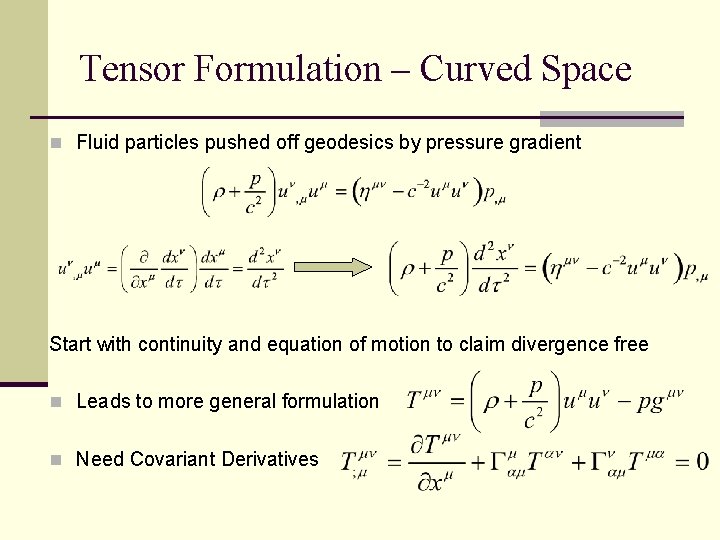
Tensor Formulation – Curved Space n Fluid particles pushed off geodesics by pressure gradient Start with continuity and equation of motion to claim divergence free n Leads to more general formulation n Need Covariant Derivatives
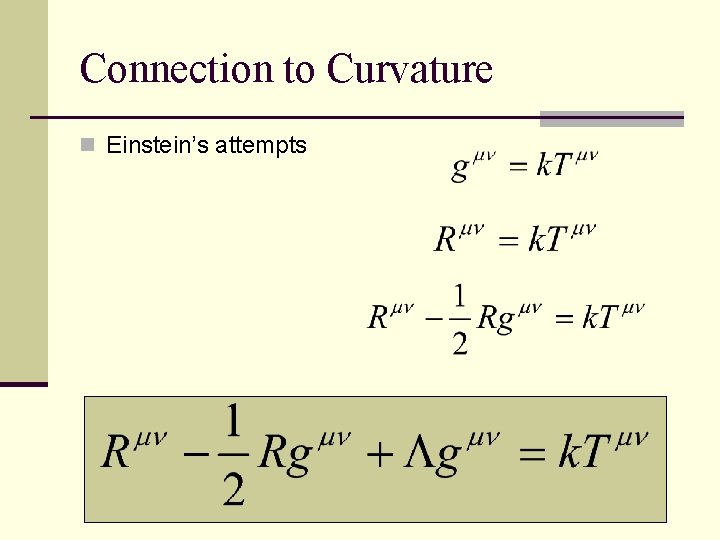
Connection to Curvature n Einstein’s attempts
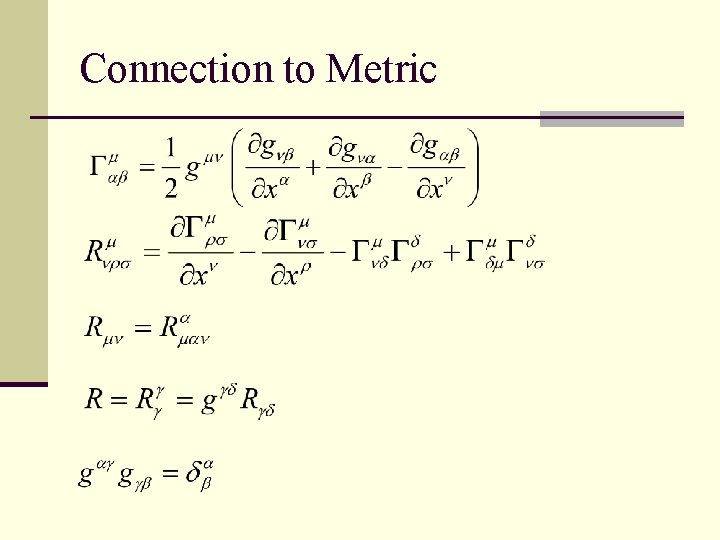
Connection to Metric
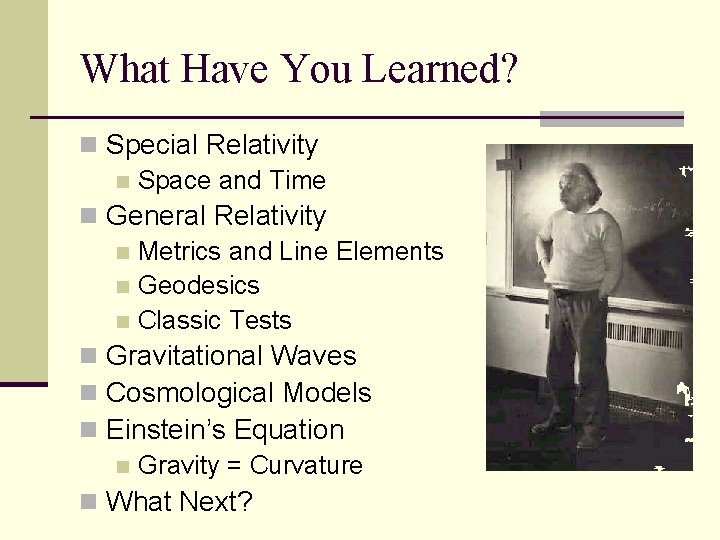
What Have You Learned? n Special Relativity n Space and Time n General Relativity n Metrics and Line Elements n Geodesics n Classic Tests n Gravitational Waves n Cosmological Models n Einstein’s Equation n Gravity = Curvature n What Next?
- Slides: 26