
The Me Too Movement A look at the
- Slides: 13
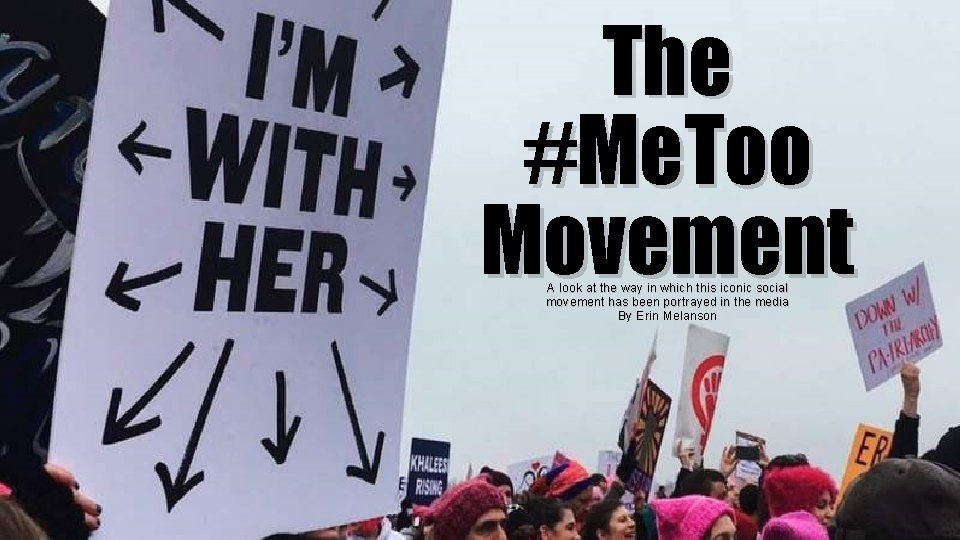
The #Me. Too Movement A look at the way in which this iconic social movement has been portrayed in the media By Erin Melanson
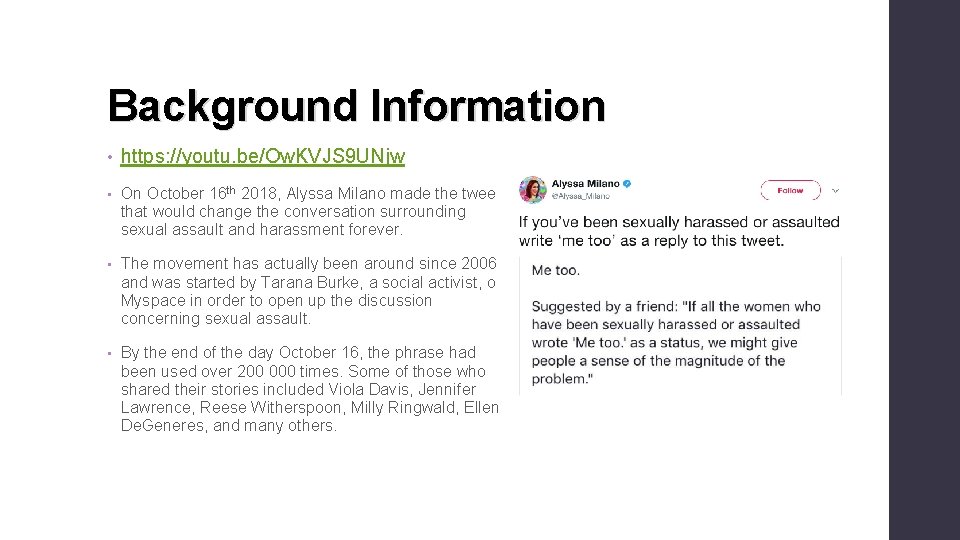
Background Information • https: //youtu. be/Ow. KVJS 9 UNjw • On October 16 th 2018, Alyssa Milano made the tweet that would change the conversation surrounding sexual assault and harassment forever. • The movement has actually been around since 2006 and was started by Tarana Burke, a social activist, on Myspace in order to open up the discussion concerning sexual assault. • By the end of the day October 16, the phrase had been used over 200 000 times. Some of those who shared their stories included Viola Davis, Jennifer Lawrence, Reese Witherspoon, Milly Ringwald, Ellen De. Generes, and many others.
Discussion • What do you already know (or think you know) about sexual harassment and the #Me. Too movement? • How do you feel about the movement? • Why might this be a difficult topic to discuss in a classroom setting? In any setting? • What progress has been made since people first started talking about sexual harassment in the workplace in the 1970 s? In your opinion, what still needs to be done and why? • What catalyzed the #Me. Too moment? Why is this suddenly in the news? • What effects have sexual harassment and misconduct in general had on society? What examples can you give?
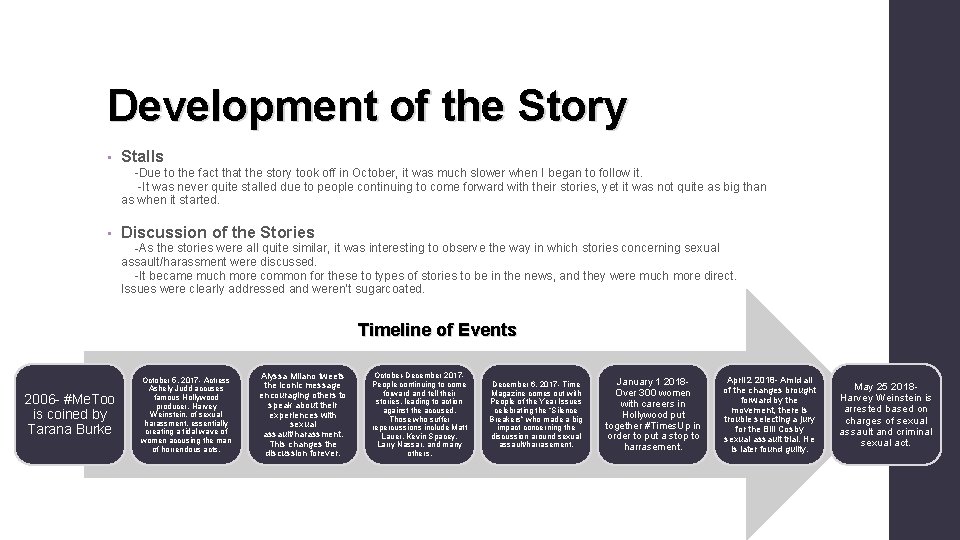
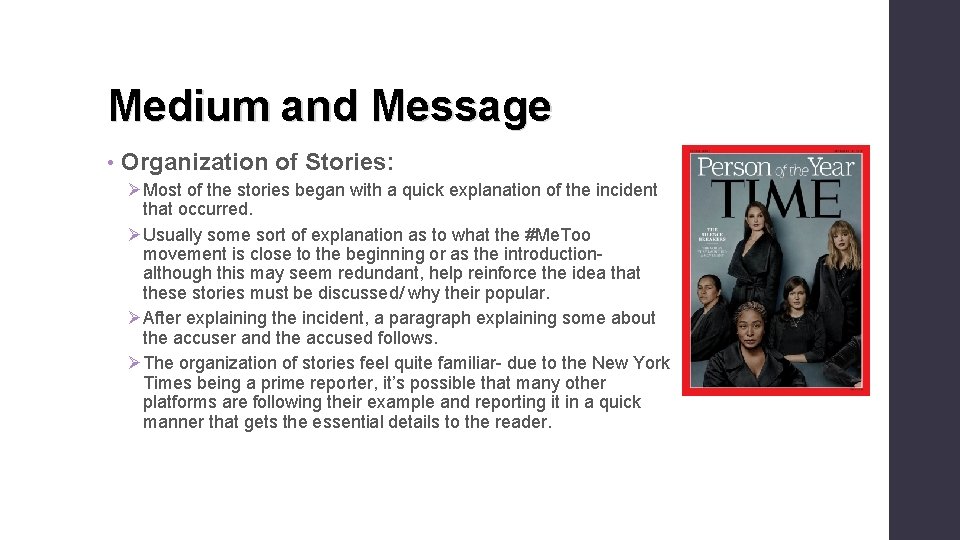
Development of the Story • Stalls -Due to the fact that the story took off in October, it was much slower when I began to follow it. -It was never quite stalled due to people continuing to come forward with their stories, yet it was not quite as big than as when it started. • Discussion of the Stories -As the stories were all quite similar, it was interesting to observe the way in which stories concerning sexual assault/harassment were discussed. -It became much more common for these to types of stories to be in the news, and they were much more direct. Issues were clearly addressed and weren’t sugarcoated. Timeline of Events 2006 - #Me. Too is coined by Tarana Burke October 5, 2017 - Actress Ashely Judd accuses famous Hollywood producer, Harvey Weinstein, of sexual harassment, essentially creating a tidal wave of women accusing the man of horrendous acts. Alyssa Milano tweets the iconic message encouraging others to speak about their experiences with sexual assault/harassment. This changes the discussion forever. October-December 2017 People continuing to come forward and tell their stories, leading to action against the accused. Those who suffer repercussions include Matt Lauer, Kevin Spacey, Larry Nassar, and many others. December 6, 2017 - Time Magazine comes out with People of the Year Issues celebrating the “Silence Breakers” who made a big impact concerning the discussion around sexual assault/harrasement. January 1 2018 Over 300 women with careers in Hollywood put together #Times. Up in order to put a stop to harrasement. April 2 2018 - Amid all of the changes brought forward by the movement, there is trouble selecting a jury for the Bill Cosby sexual assault trial. He is later found guilty. May 25 2018 Harvey Weinstein is arrested based on charges of sexual assault and criminal sexual act.
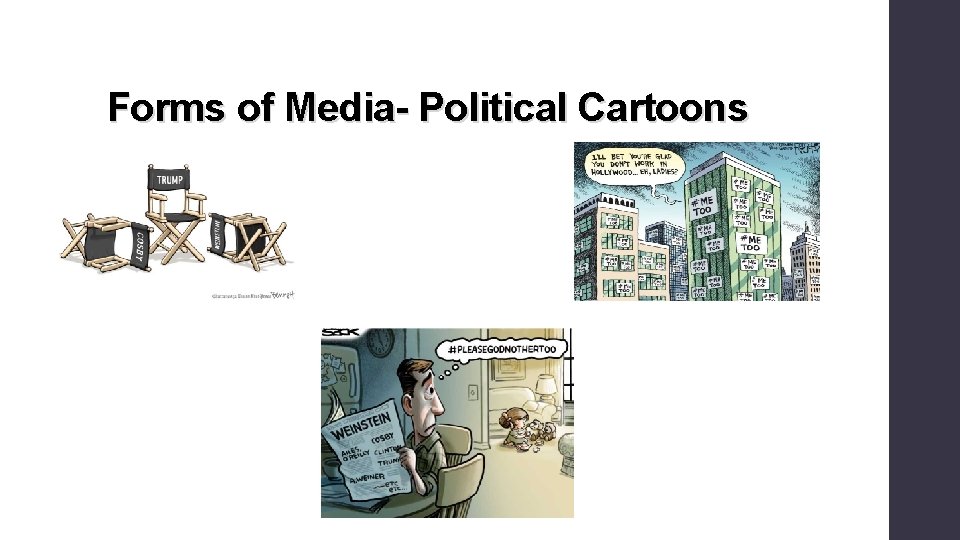
Forms of Media- Political Cartoons
Political Cartoon Discussion Questions • What techniques were used in your cartoon? (Symbolism, Exaggeration, Labelling, Analogy, and/or Irony) • Does the message manipulate reason, emotion, or both? How did the cartoon make you feel? • What is the message behind the cartoon? • Do you think an image is worth a thousand words? (Is it as impactful/more impactful as any other news article? ) • Is any bias apparent in the cartoon?
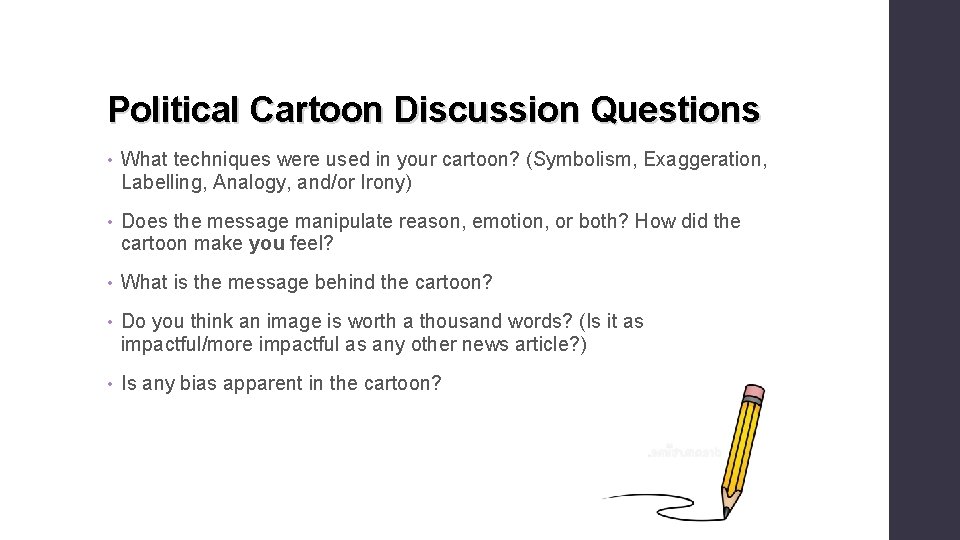
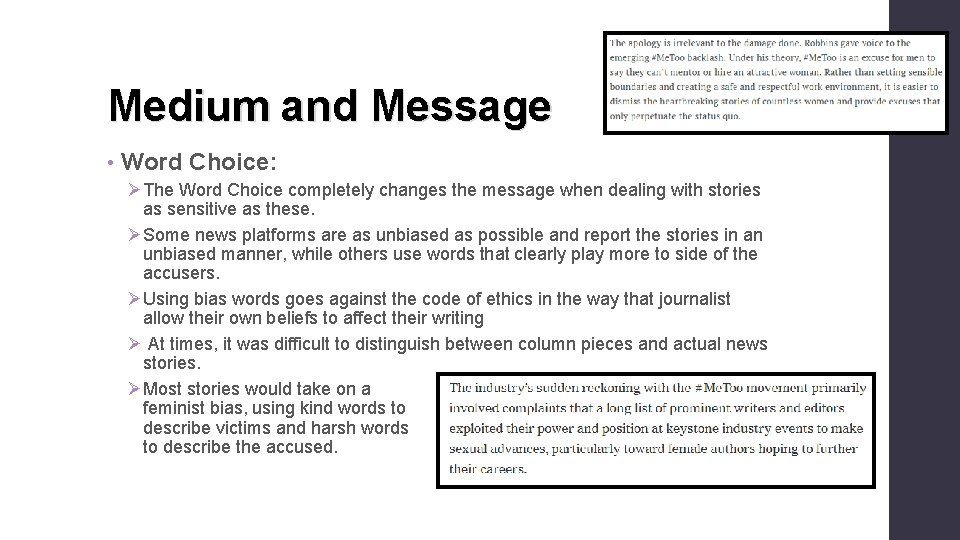
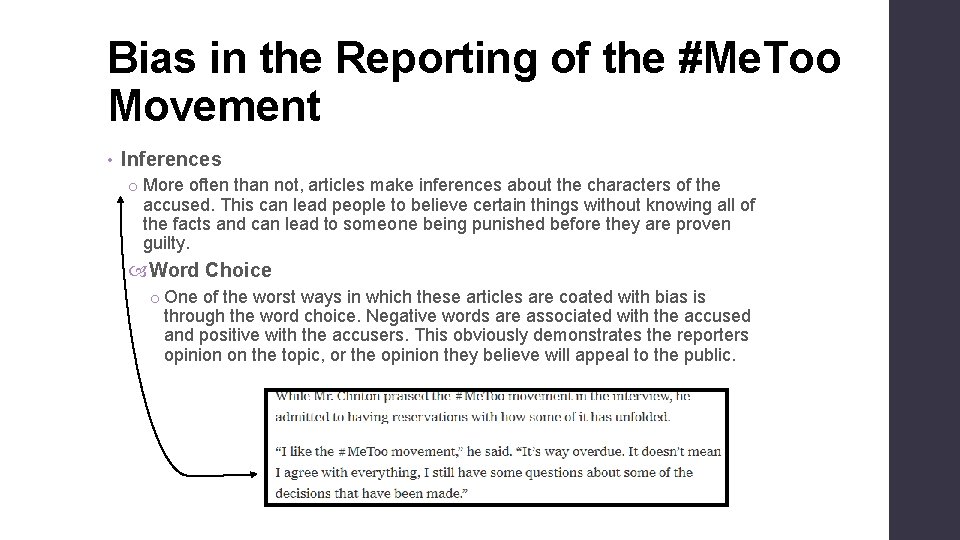
Medium and Message • Word Choice: ØThe Word Choice completely changes the message when dealing with stories as sensitive as these. ØSome news platforms are as unbiased as possible and report the stories in an unbiased manner, while others use words that clearly play more to side of the accusers. ØUsing bias words goes against the code of ethics in the way that journalist allow their own beliefs to affect their writing Ø At times, it was difficult to distinguish between column pieces and actual news stories. ØMost stories would take on a feminist bias, using kind words to describe victims and harsh words to describe the accused.
Medium and Message • Organization of Stories: ØMost of the stories began with a quick explanation of the incident that occurred. ØUsually some sort of explanation as to what the #Me. Too movement is close to the beginning or as the introductionalthough this may seem redundant, help reinforce the idea that these stories must be discussed/ why their popular. ØAfter explaining the incident, a paragraph explaining some about the accuser and the accused follows. ØThe organization of stories feel quite familiar- due to the New York Times being a prime reporter, it’s possible that many other platforms are following their example and reporting it in a quick manner that gets the essential details to the reader.
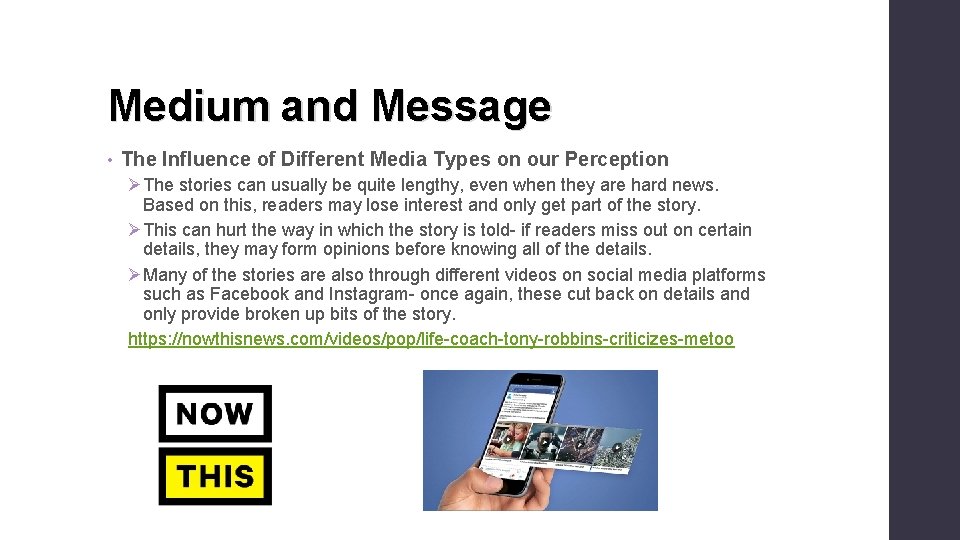
Medium and Message • The Influence of Different Media Types on our Perception ØThe stories can usually be quite lengthy, even when they are hard news. Based on this, readers may lose interest and only get part of the story. ØThis can hurt the way in which the story is told- if readers miss out on certain details, they may form opinions before knowing all of the details. ØMany of the stories are also through different videos on social media platforms such as Facebook and Instagram- once again, these cut back on details and only provide broken up bits of the story. https: //nowthisnews. com/videos/pop/life-coach-tony-robbins-criticizes-metoo
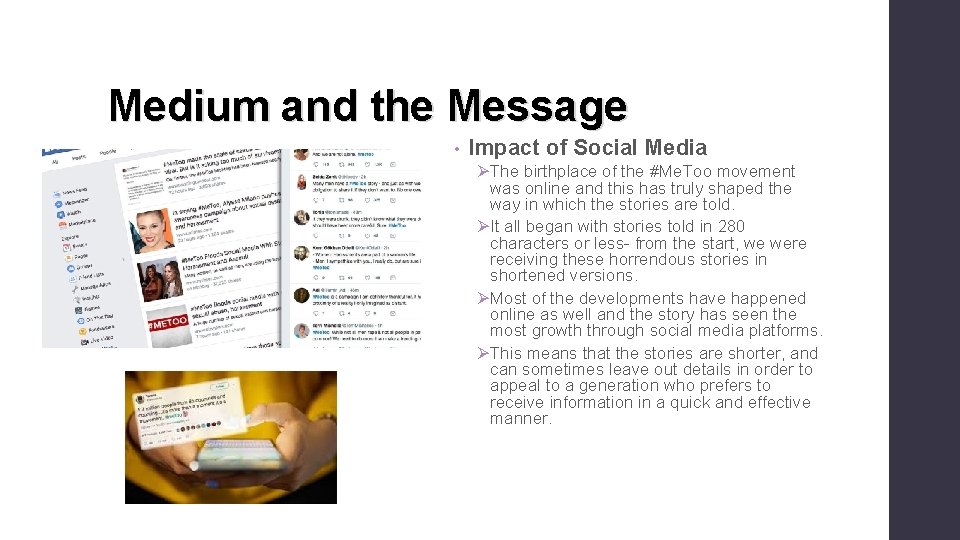
Medium and the Message • Impact of Social Media ØThe birthplace of the #Me. Too movement was online and this has truly shaped the way in which the stories are told. ØIt all began with stories told in 280 characters or less- from the start, we were receiving these horrendous stories in shortened versions. ØMost of the developments have happened online as well and the story has seen the most growth through social media platforms. ØThis means that the stories are shorter, and can sometimes leave out details in order to appeal to a generation who prefers to receive information in a quick and effective manner.
Bias in the Reporting of the #Me. Too Movement • Inferences o More often than not, articles make inferences about the characters of the accused. This can lead people to believe certain things without knowing all of the facts and can lead to someone being punished before they are proven guilty. Word Choice o One of the worst ways in which these articles are coated with bias is through the word choice. Negative words are associated with the accused and positive with the accusers. This obviously demonstrates the reporters opinion on the topic, or the opinion they believe will appeal to the public.
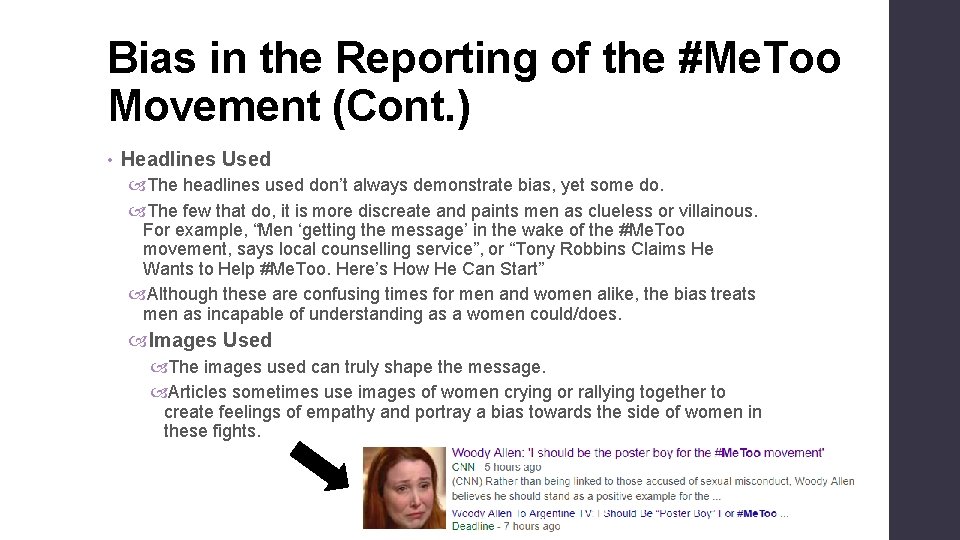
Bias in the Reporting of the #Me. Too Movement (Cont. ) • Headlines Used The headlines used don’t always demonstrate bias, yet some do. The few that do, it is more discreate and paints men as clueless or villainous. For example, “Men ‘getting the message’ in the wake of the #Me. Too movement, says local counselling service”, or “Tony Robbins Claims He Wants to Help #Me. Too. Here’s How He Can Start” Although these are confusing times for men and women alike, the bias treats men as incapable of understanding as a women could/does. Images Used The images used can truly shape the message. Articles sometimes use images of women crying or rallying together to create feelings of empathy and portray a bias towards the side of women in these fights.
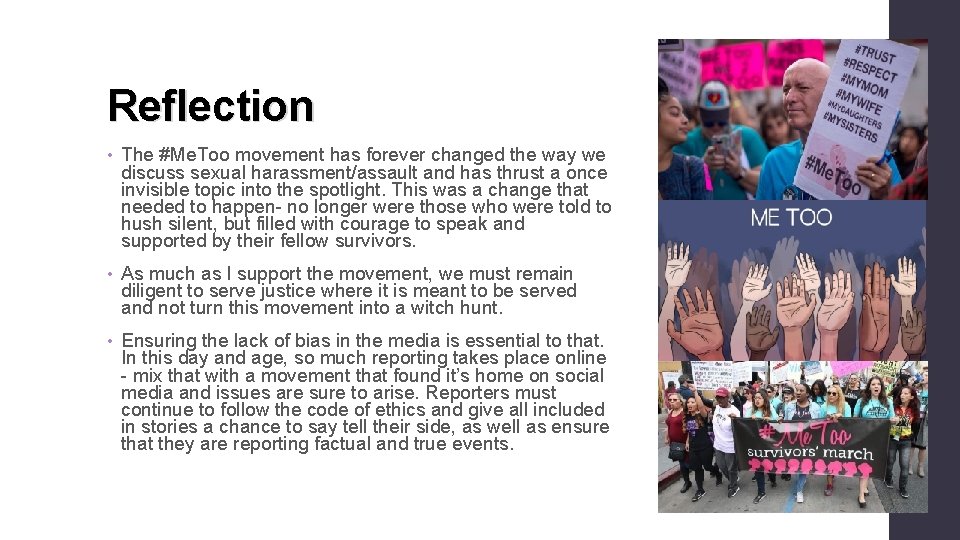
Reflection • The #Me. Too movement has forever changed the way we discuss sexual harassment/assault and has thrust a once invisible topic into the spotlight. This was a change that needed to happen- no longer were those who were told to hush silent, but filled with courage to speak and supported by their fellow survivors. • As much as I support the movement, we must remain diligent to serve justice where it is meant to be served and not turn this movement into a witch hunt. • Ensuring the lack of bias in the media is essential to that. In this day and age, so much reporting takes place online - mix that with a movement that found it’s home on social media and issues are sure to arise. Reporters must continue to follow the code of ethics and give all included in stories a chance to say tell their side, as well as ensure that they are reporting factual and true events.