
The MD 6 Hash Function aka Pumpkin Hash

![Simple compression function: Input: A[ 0. . 88 ] of A[ 0. . 16](https://slidetodoc.com/presentation_image_h2/05bbe6af6abdd18033959c3cf891ed01/image-30.jpg "Simple compression function: Input: A[ 0. . 88 ] of A[ 0. . 16")



- Slides: 56
The MD 6 Hash Function (aka “Pumpkin Hash”) Ronald L. Rivest MIT CSAIL CRYPTO 2008
MD 6 Team u u u u Dan Bailey Sarah Cheng Christopher Crutchfield Yevgeniy Dodis Elliott Fleming Asif Khan Jayant Krishnamurthy Yuncheng Lin Leo Reyzin Emily Shen Jim Sukha Eran Tromer Yiqun Lisa Yin u u u Juniper Networks Cilk Arts NSF
Outline u Introduction u Design considerations u Mode of Operation u Compression Function u Software Implementations u Hardware Implementations u Security Analysis
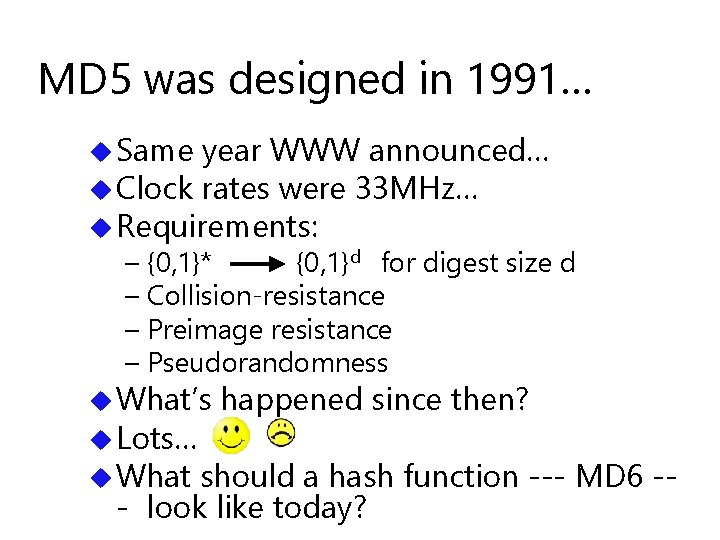
MD 5 was designed in 1991… u Same year WWW announced… u Clock rates were 33 MHz… u Requirements: – {0, 1}* {0, 1}d for digest size d – Collision-resistance – Preimage resistance – Pseudorandomness u What’s u Lots… u What happened since then? should a hash function --- MD 6 -- look like today?
NIST SHA-3 competition! u Input: 0 to 264 -1 bits, size not known in advance u Output sizes 224, 256, 384, 512 bits u Collision-resistance, preimage resistance, second preimage resistance, pseudorandomness, … u Simplicity, flexibility, efficiency, … u Due Halloween ‘ 08
Design Considerations / Responses
Wang et al. break MD 5 (2004) u Differential cryptanalysis (re)discovered by Biham and Shamir (1990). Considers step-by-step ``difference’’ (XOR) between two computations… u Applied first to block ciphers (DES)… u Used by Wang et al. to break collisionresistance of MD 5 u Many other hash functions broken similarly; others may be vulnerable…
So… MD 6 is… u provably resistant to differential attacks (more on this later…)
Memory is now ``plentiful’’… u Memory capacities have increased 60% per year since 1991 u Chips have 1000 times as much memory as they did in 1991 u Even ``embedded processors’’ typically have at least 1 KB of RAM
So… MD 6 has… u Large input message block size: 512 bytes (not 512 bits) u This has many advantages…
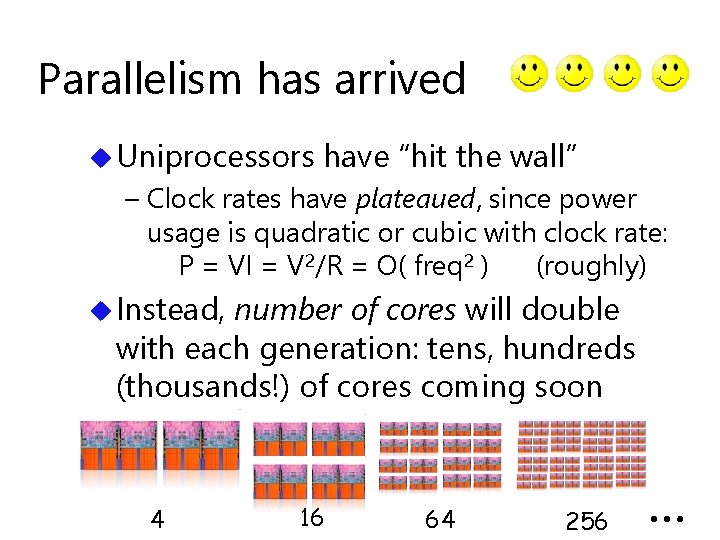
Parallelism has arrived u Uniprocessors have “hit the wall” – Clock rates have plateaued, since power usage is quadratic or cubic with clock rate: P = VI = V 2/R = O( freq 2 ) (roughly) u Instead, number of cores will double with each generation: tens, hundreds (thousands!) of cores coming soon 4 16 64 256 …
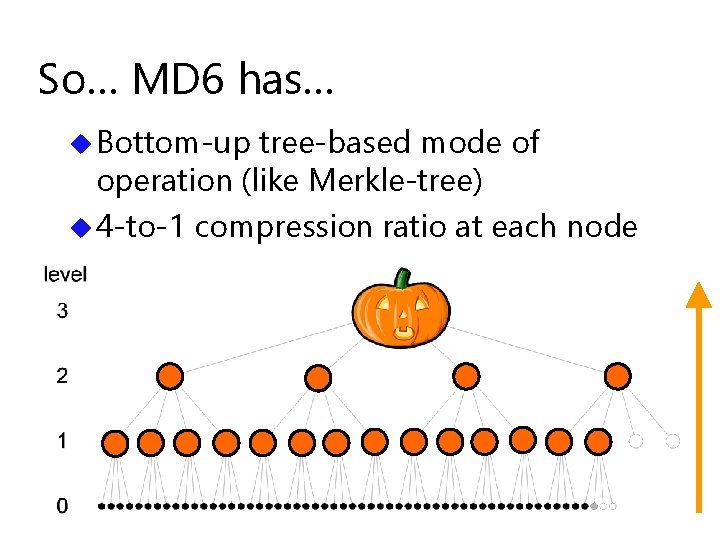
So… MD 6 has… u Bottom-up tree-based mode of operation (like Merkle-tree) u 4 -to-1 compression ratio at each node
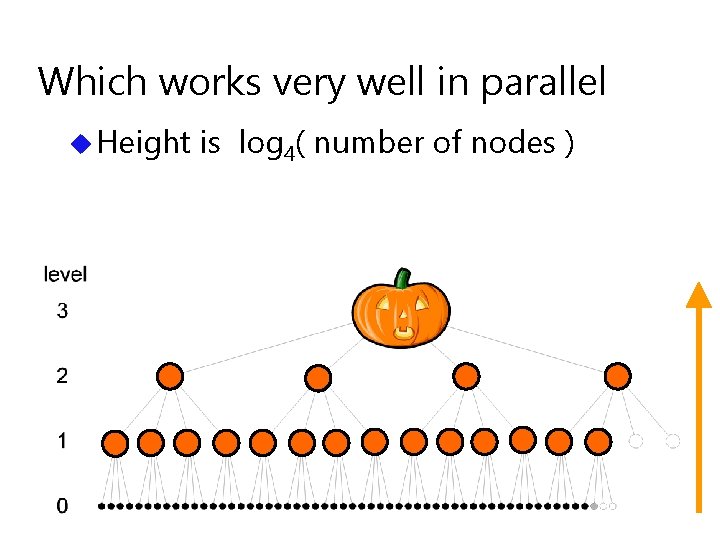
Which works very well in parallel u Height is log 4( number of nodes )
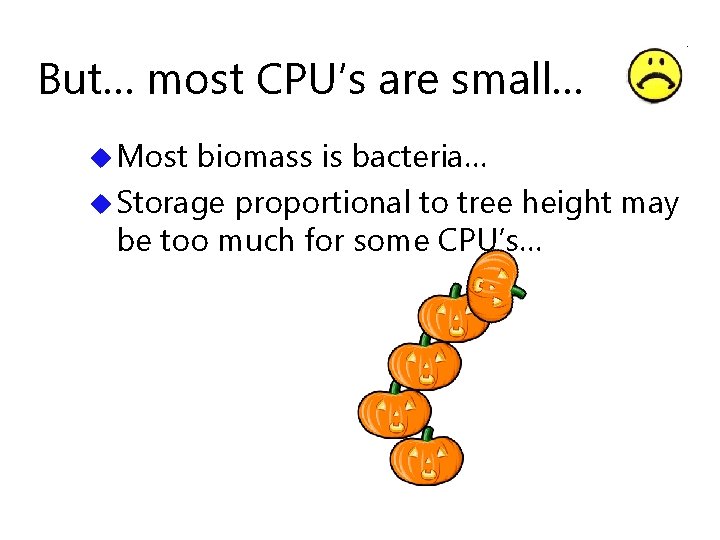
But… most CPU’s are small… u Most biomass is bacteria… u Storage proportional to tree height may be too much for some CPU’s…
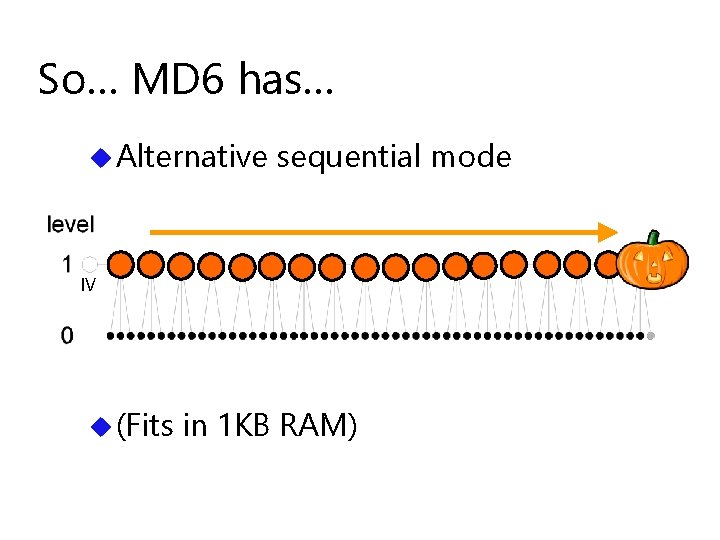
So… MD 6 has… u Alternative sequential mode IV u (Fits in 1 KB RAM)
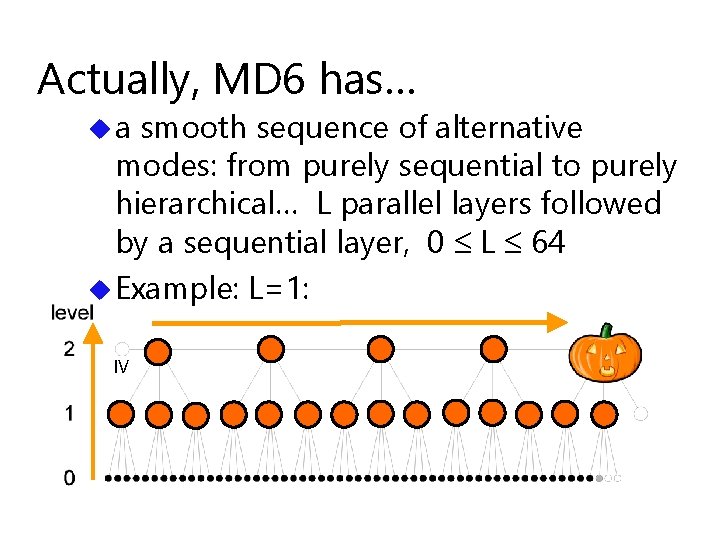
Actually, MD 6 has… ua smooth sequence of alternative modes: from purely sequential to purely hierarchical… L parallel layers followed by a sequential layer, 0 L 64 u Example: L=1: IV
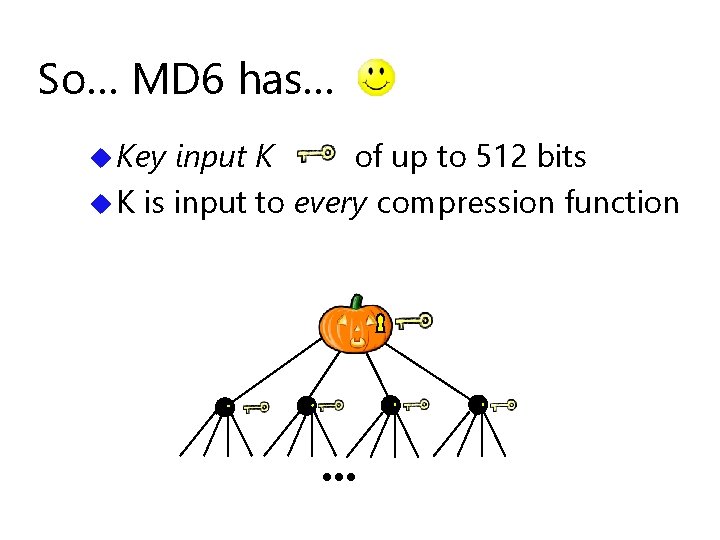
Hash functions often ``keyed’’ u Salt for password, key for MAC, variability for key derivation, theoretical soundness, etc… u Current modes are “post-hoc”
So… MD 6 has… u Key input K of up to 512 bits u K is input to every compression function
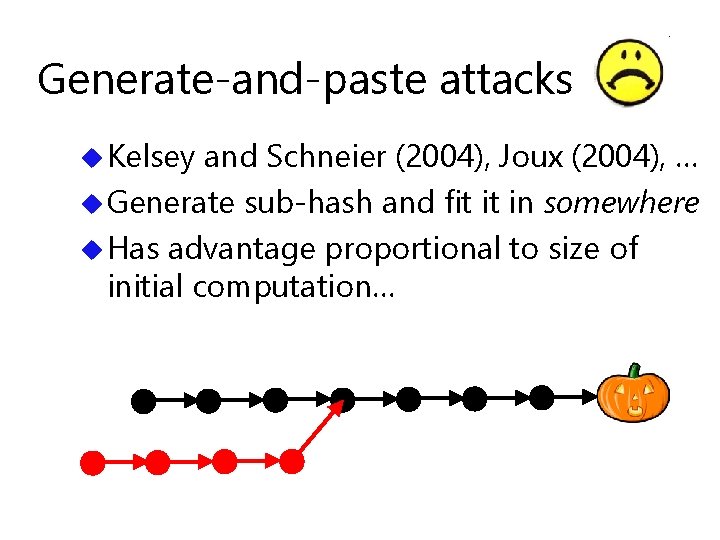
Generate-and-paste attacks u Kelsey and Schneier (2004), Joux (2004), … u Generate sub-hash and fit it in somewhere u Has advantage proportional to size of initial computation…
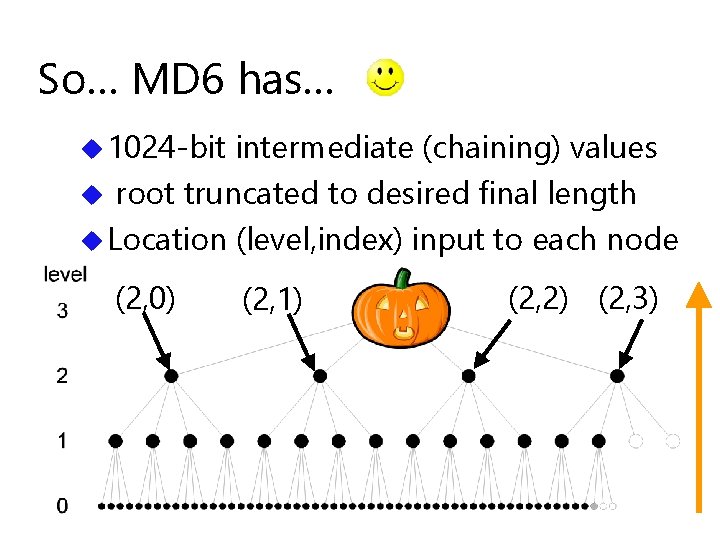
So… MD 6 has… u 1024 -bit intermediate (chaining) values u root truncated to desired final length u Location (level, index) input to each node (2, 0) (2, 1) (2, 2) (2, 3)
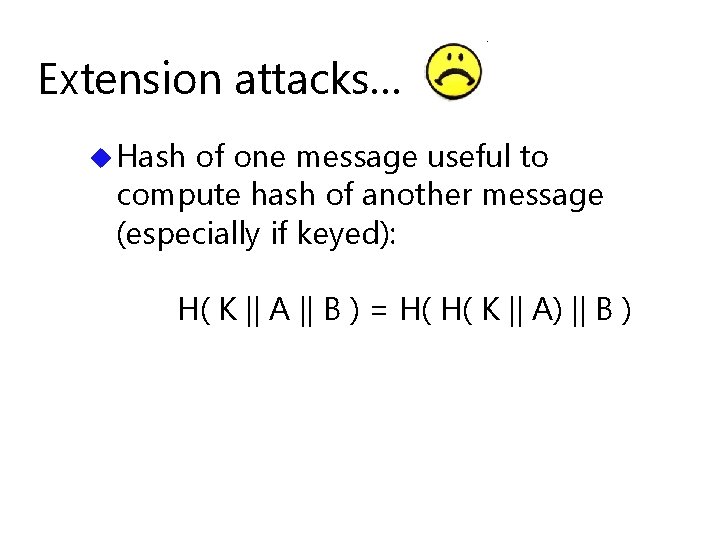
Extension attacks… u Hash of one message useful to compute hash of another message (especially if keyed): H( K || A || B ) = H( H( K || A) || B )
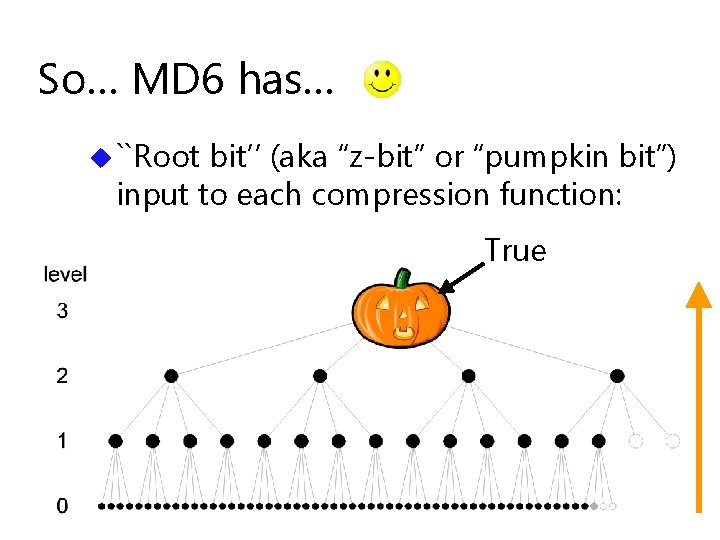
So… MD 6 has… u ``Root bit’’ (aka “z-bit” or “pumpkin bit”) input to each compression function: True
Side-channel attacks u Timing attacks, cache attacks… u Operations with data-dependent timing or data-dependent resource usage can produce vulnerabilities. u This includes data-dependent rotations, table lookups (S-boxes), some complex operations (e. g. multiplications), …
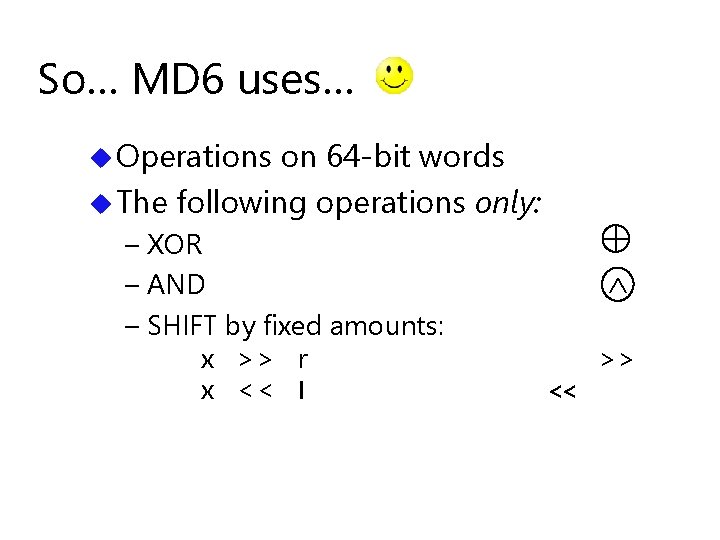
So… MD 6 uses… u Operations on 64 -bit words u The following operations only: – XOR – AND – SHIFT by fixed amounts: x >> r x << l >> <<
Security needs vary… u Already recognized by having different digest lengths d (for MD 6: 1 d 512) u But it is useful to have reduced-strength versions for analysis, simple applications, or different points on speed/security curve.
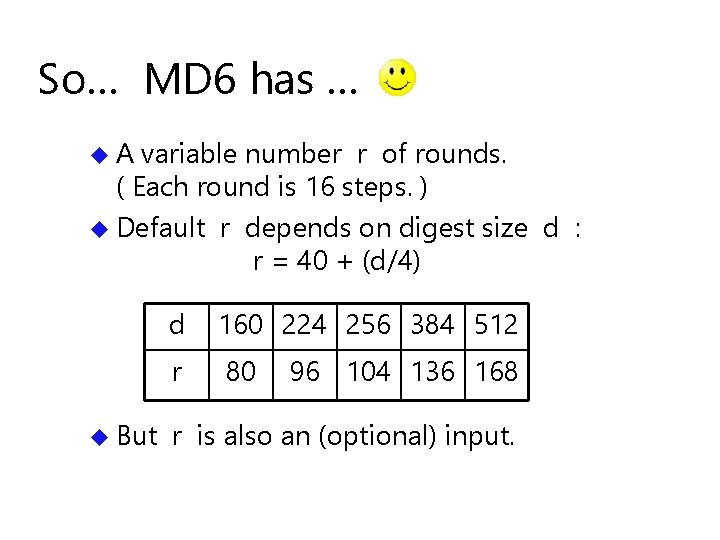
So… MD 6 has … u. A variable number r of rounds. ( Each round is 16 steps. ) u Default r depends on digest size d : r = 40 + (d/4) u But d 160 224 256 384 512 r 80 96 104 136 168 r is also an (optional) input.
MD 6 Compression function
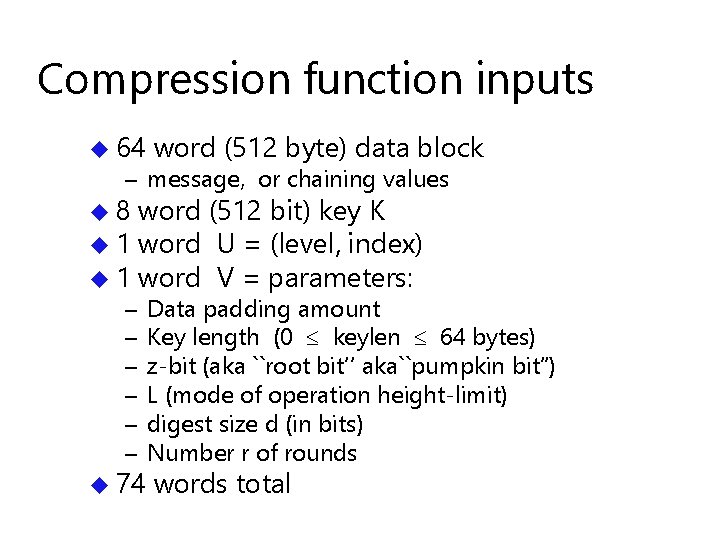
Compression function inputs u 64 word (512 byte) data block – message, or chaining values u 8 word (512 bit) key K u 1 word U = (level, index) u 1 word V = parameters: – – – u 74 Data padding amount Key length (0 keylen 64 bytes) z-bit (aka ``root bit’’ aka``pumpkin bit”) L (mode of operation height-limit) digest size d (in bits) Number r of rounds words total
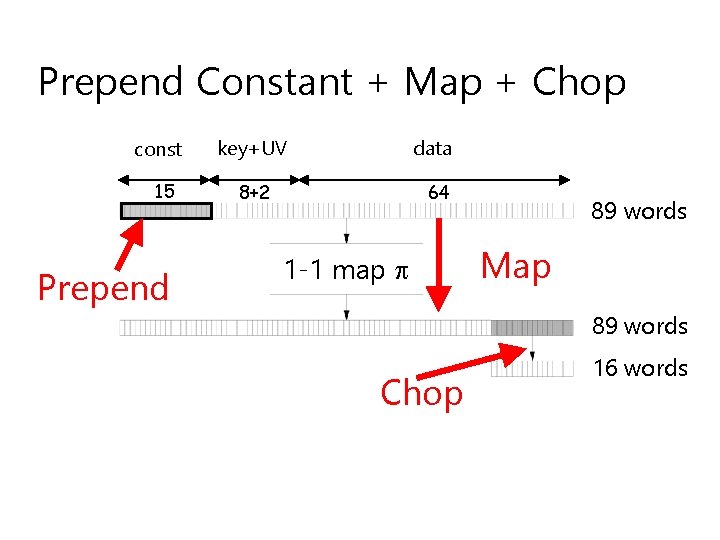
Prepend Constant + Map + Chop const 15 Prepend key+UV data 8+2 64 1 -1 map 89 words Map 89 Chop words 16 words
Simple compression function: Input: A[ 0. . 88 ] of A[ 0. . 16 r + 88] for i = 89 to 16 r + 88 : x = Si A[ i-17 ] A[ i-89 ] ( A[ i-18 ] A[ i-21 ] ) ( A[ i-31 ] A[ i-67 ] ) x = x ( x >> ri ) A[i] = x ( x << li ) return A[ 16 r + 73. . 16 r + 88 ]
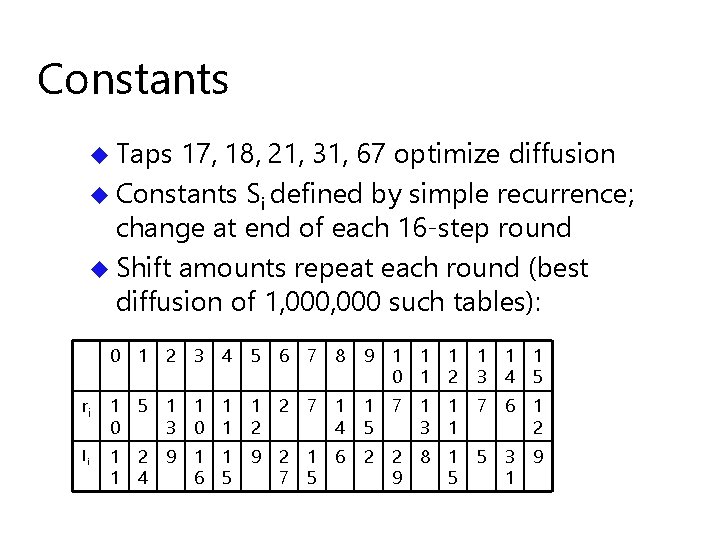
Constants u Taps 17, 18, 21, 31, 67 optimize diffusion u Constants Si defined by simple recurrence; change at end of each 16 -step round u Shift amounts repeat each round (best diffusion of 1, 000 such tables): 0 1 2 3 4 5 6 7 8 9 1 0 1 1 1 2 1 3 1 4 1 5 ri 1 0 5 1 3 1 0 1 1 1 2 2 7 1 4 1 5 7 1 3 1 1 7 6 1 2 li 1 1 2 4 9 1 6 1 5 9 2 7 1 5 6 2 2 9 8 1 5 5 3 1 9
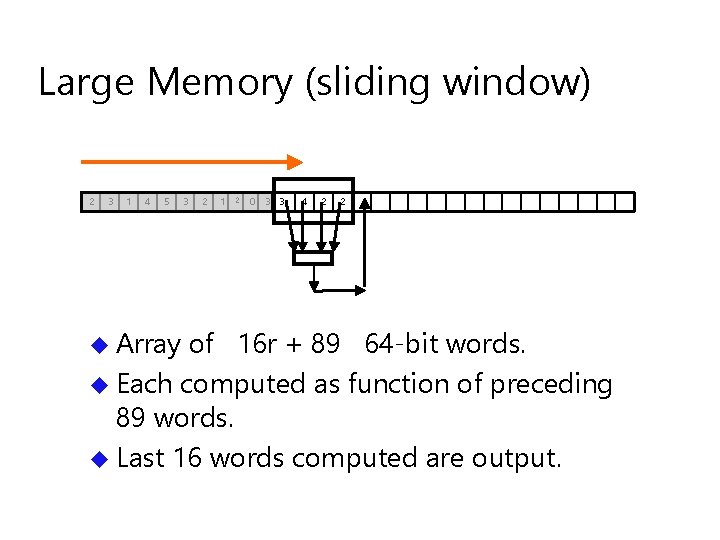
Large Memory (sliding window) 2 3 1 4 5 u Array 3 2 1 2 0 3 3 4 2 2 of 16 r + 89 64 -bit words. u Each computed as function of preceding 89 words. u Last 16 words computed are output.
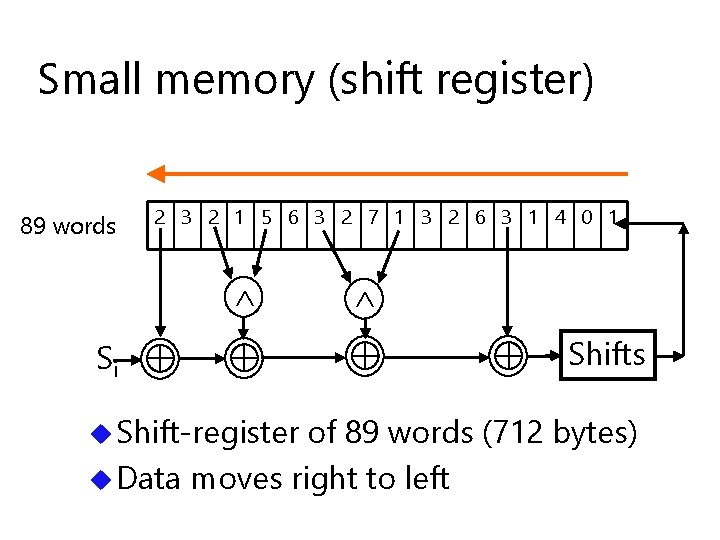
Small memory (shift register) 89 words 2 3 2 1 5 6 3 2 7 1 3 2 6 3 1 4 0 1 Si u Shift-register Shifts of 89 words (712 bytes) u Data moves right to left
Software Implementations
Software implementations u Simplicity of MD 6: – Same implementation for all digest sizes. – Same implementation for SHA-3 Reference or SHA-3 Optimized Versions. – Only optimization is loop-unrolling (16 steps within one round).
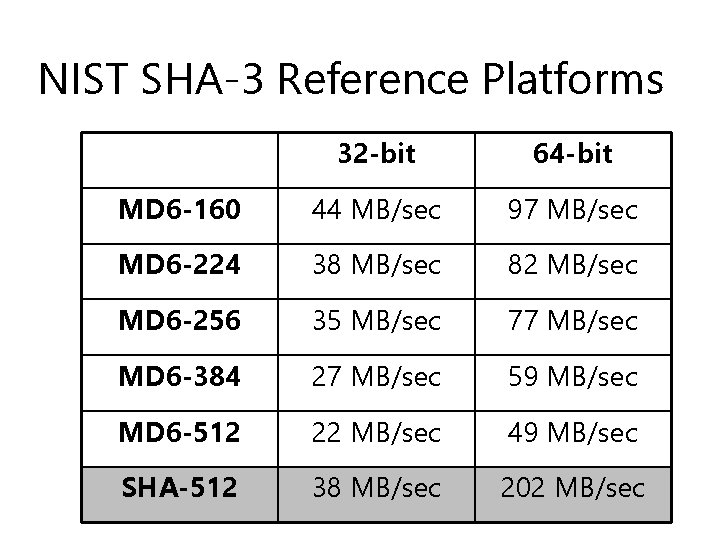
NIST SHA-3 Reference Platforms 32 -bit 64 -bit MD 6 -160 44 MB/sec 97 MB/sec MD 6 -224 38 MB/sec 82 MB/sec MD 6 -256 35 MB/sec 77 MB/sec MD 6 -384 27 MB/sec 59 MB/sec MD 6 -512 22 MB/sec 49 MB/sec SHA-512 38 MB/sec 202 MB/sec
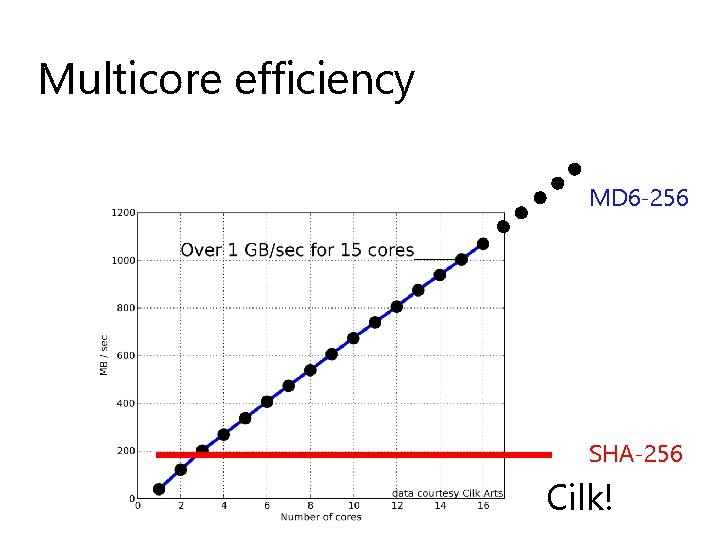
Multicore efficiency MD 6 -256 SHA-256 Cilk!
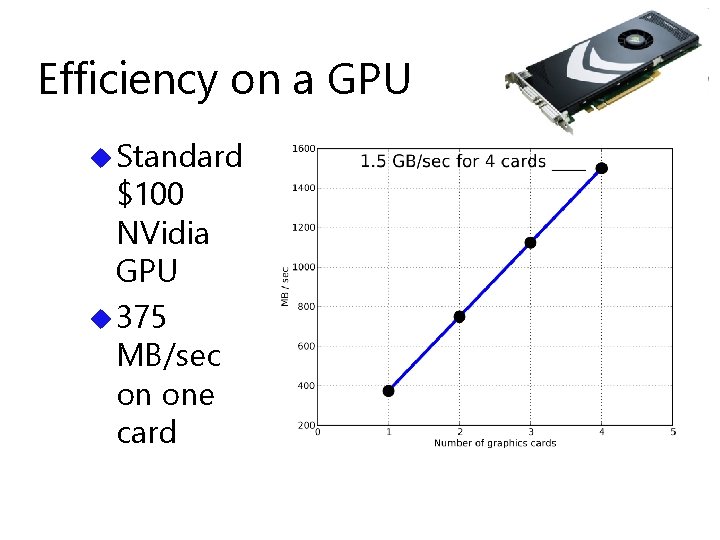
Efficiency on a GPU u Standard $100 NVidia GPU u 375 MB/sec on one card
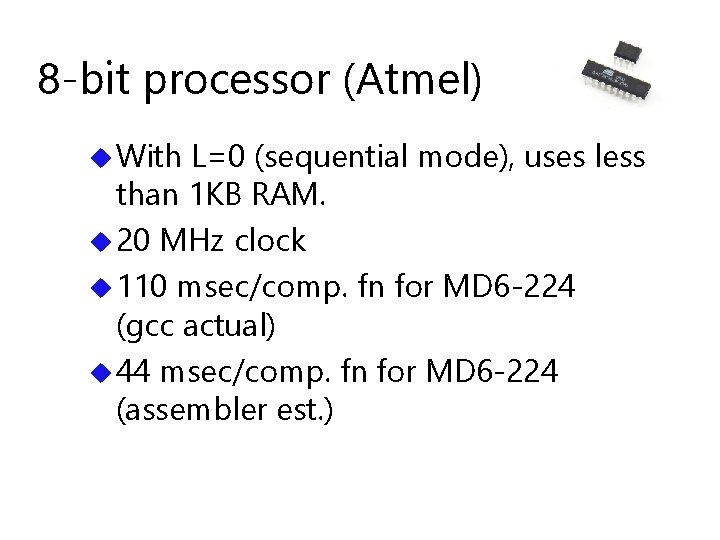
8 -bit processor (Atmel) u With L=0 (sequential mode), uses less than 1 KB RAM. u 20 MHz clock u 110 msec/comp. fn for MD 6 -224 (gcc actual) u 44 msec/comp. fn for MD 6 -224 (assembler est. )
Hardware Implementations
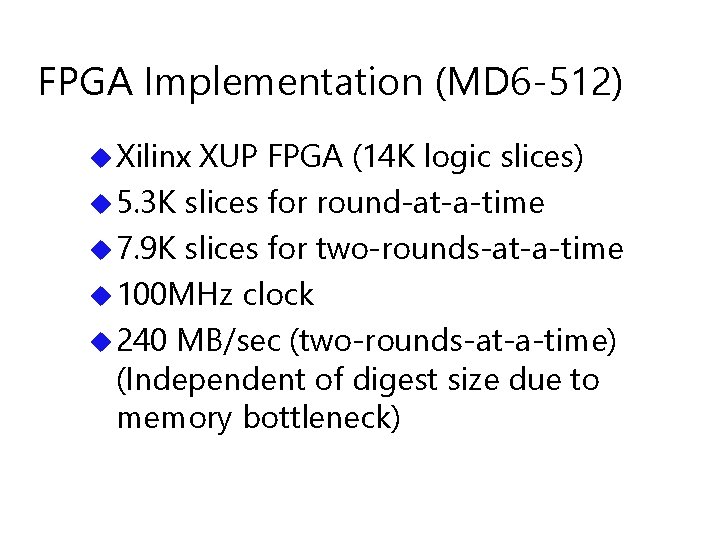
FPGA Implementation (MD 6 -512) u Xilinx XUP FPGA (14 K logic slices) u 5. 3 K slices for round-at-a-time u 7. 9 K slices for two-rounds-at-a-time u 100 MHz clock u 240 MB/sec (two-rounds-at-a-time) (Independent of digest size due to memory bottleneck)
Security Analysis
Generate and paste attacks (again) u Because compression functions are “location-aware”, attacks that do speculative computation hoping to “cut and paste it in somewhere” don’t work.
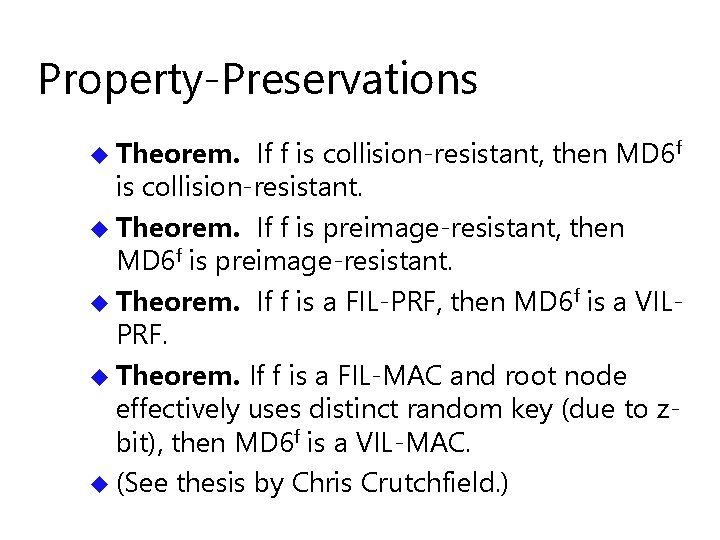
Property-Preservations u Theorem. If f is collision-resistant, then MD 6 f is collision-resistant. u Theorem. If f is preimage-resistant, then MD 6 f is preimage-resistant. u Theorem. If f is a FIL-PRF, then MD 6 f is a VILPRF. u Theorem. If f is a FIL-MAC and root node effectively uses distinct random key (due to zbit), then MD 6 f is a VIL-MAC. u (See thesis by Chris Crutchfield. )
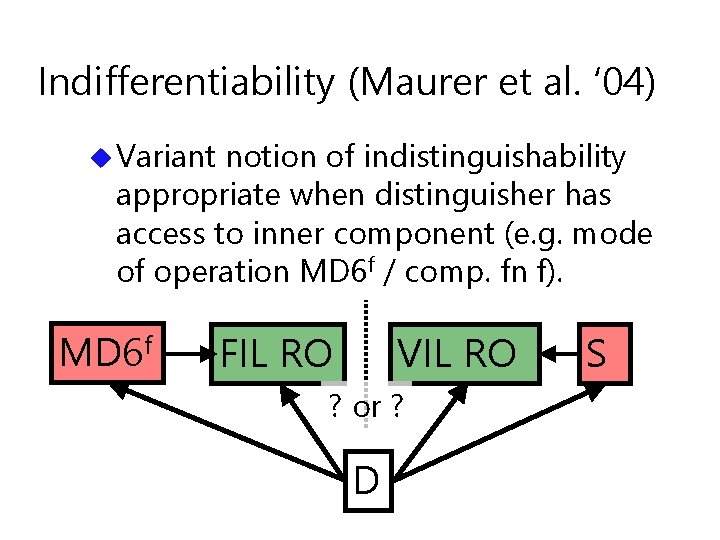
Indifferentiability (Maurer et al. ‘ 04) u Variant notion of indistinguishability appropriate when distinguisher has access to inner component (e. g. mode of operation MD 6 f / comp. fn f). MD 6 f FIL RO VIL RO ? or ? D S
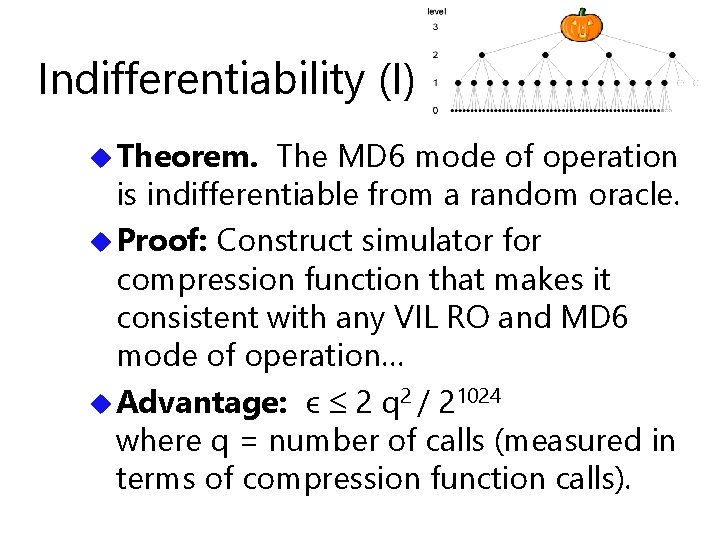
Indifferentiability (I) u Theorem. The MD 6 mode of operation is indifferentiable from a random oracle. u Proof: Construct simulator for compression function that makes it consistent with any VIL RO and MD 6 mode of operation… u Advantage: ϵ 2 q 2 / 21024 where q = number of calls (measured in terms of compression function calls).
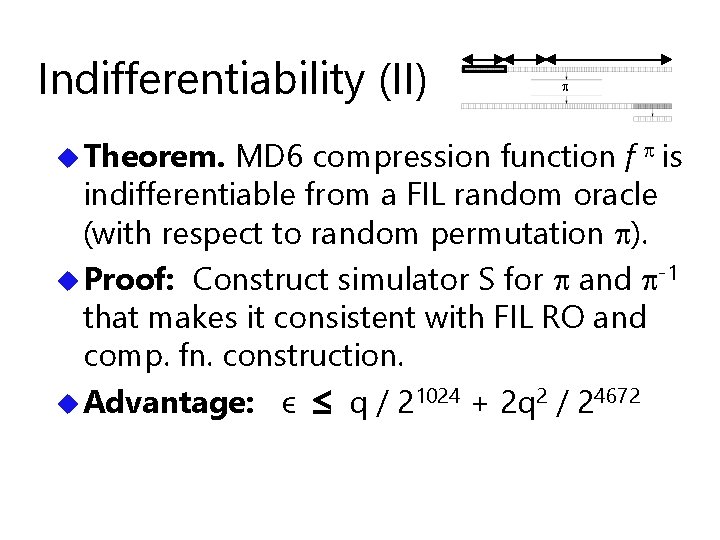
Indifferentiability (II) u Theorem. MD 6 compression function f is indifferentiable from a FIL random oracle (with respect to random permutation ). u Proof: Construct simulator S for and -1 that makes it consistent with FIL RO and comp. fn. construction. u Advantage: ϵ q / 21024 + 2 q 2 / 24672
SAT-SOLVER attacks u Code comp. fn. as set of clauses, try to find inverse or collision with Minisat… u With many days of computing: – Solved all problems of 9 rounds or less. – Solved some 10 - or 11 -round ones. – Never solved a 12 -round problem. u Note: 11 rounds ≈ 2 rotations (passes over data)
Statistical tests u Measure influence of an input bit on all output bits; use Anderson-Darling A*2 test on set of influences. u Can’t distinguish from random beyond 12 rounds.
Differential attacks don’t work u Theorem. Any standard differential attack has less chance of finding collision than standard birthday attack. u Proof. Determine lower bound on number of active AND gates in 15 rounds using sophisticated backtracking search and days of computing. Derive upper bound on probability of differential path.
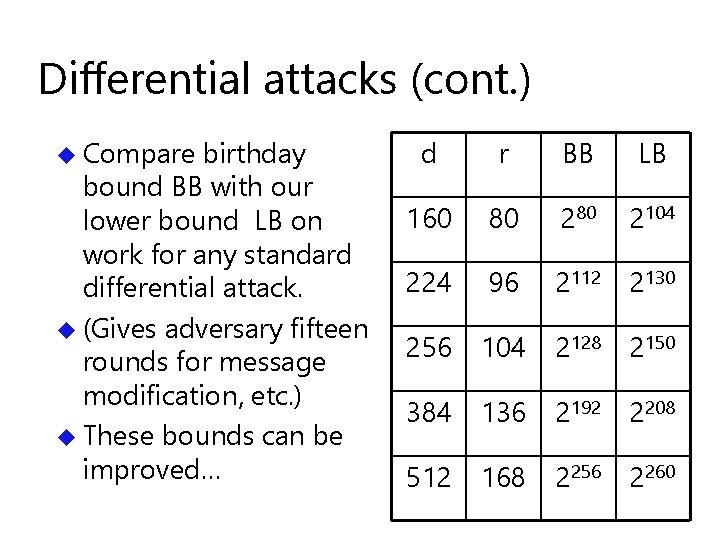
Differential attacks (cont. ) u Compare birthday bound BB with our lower bound LB on work for any standard differential attack. u (Gives adversary fifteen rounds for message modification, etc. ) u These bounds can be improved… d r BB LB 160 80 2104 224 96 2112 2130 256 104 2128 2150 384 136 2192 2208 512 168 2256 2260
Choosing number of rounds u We don’t know how to break any security properties of MD 6 for more than 12 rounds. u For digest sizes 224 … 512 , MD 6 has 80 … 168 rounds. u Current defaults probably conservative. u Current choice allows proof of resistance to differential cryptanalysis.
Summary u. MD 6 is: – Arguably secure against known attacks (including differential attacks) – Relatively simple – Highly parallelizable – Reasonably efficient
THE END MD 6 03744327 e 1 e 959 fbdcdf 7331 e 959 cb 2 c 28101166
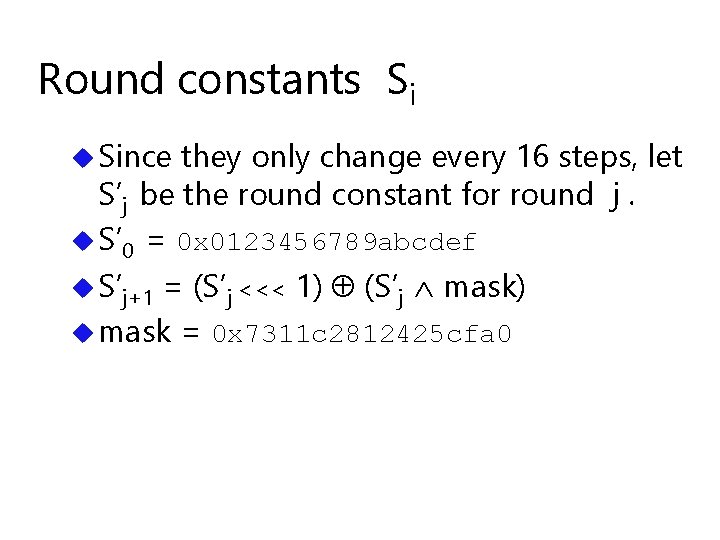
Round constants Si u Since they only change every 16 steps, let S’j be the round constant for round j. u S’ 0 = 0 x 0123456789 abcdef u S’j+1 = (S’j <<< 1) (S’j mask) u mask = 0 x 7311 c 2812425 cfa 0