
The Matroid Median Problem Viswanath Nagarajan IBM Research

The Matroid Median Problem Viswanath Nagarajan IBM Research Joint with R. Krishnaswamy, A. Kumar, Y. Sabharwal, B. Saha
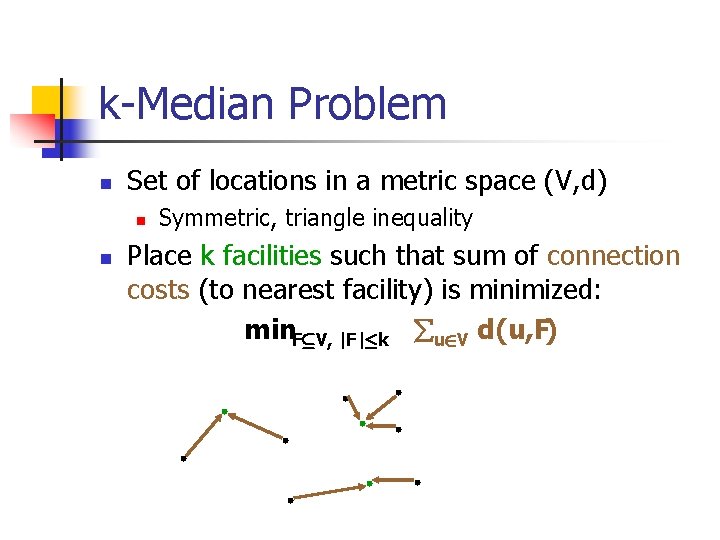
k-Median Problem n Set of locations in a metric space (V, d) n n Symmetric, triangle inequality Place k facilities such that sum of connection costs (to nearest facility) is minimized: min. FµV, |F|·k u 2 V d(u, F)
k-Median Results n n poly(log n) approx via tree embeddings [B ’ 96] LP rounding O(1)-approx [CGST ’ 99] Lagrangian relaxation + primal dual [JV ’ 01] Local search with p-exchanges [AGKMMP ’ 04] n n best known ratio 3+² Hardness of approximation ¼ 1. 46 [GK ’ 98]
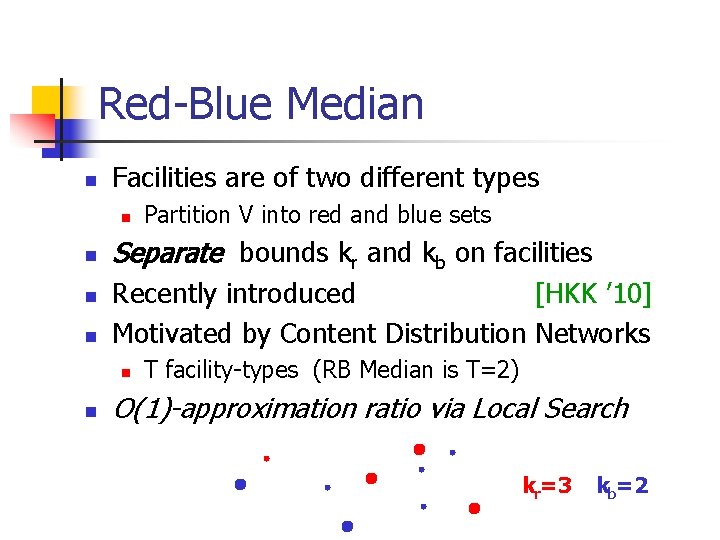
Red-Blue Median n Facilities are of two different types n n Separate bounds kr and kb on facilities Recently introduced [HKK ’ 10] Motivated by Content Distribution Networks n n Partition V into red and blue sets T facility-types (RB Median is T=2) O(1)-approximation ratio via Local Search kr=3 kb=2
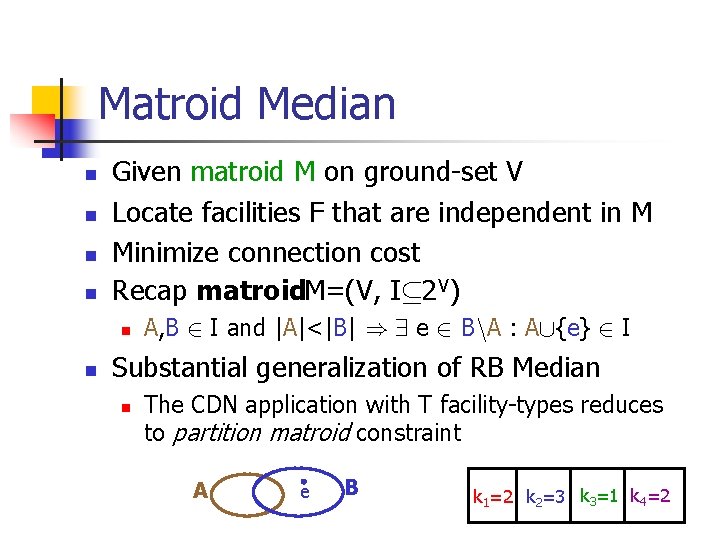
Matroid Median n n Given matroid M on ground-set V Locate facilities F that are independent in M Minimize connection cost Recap matroid. M=(V, Iµ 2 V) n n A, B 2 I and |A|<|B| ) 9 e 2 Bn. A : A[{e} 2 I Substantial generalization of RB Median n The CDN application with T facility-types reduces to partition matroid constraint A e B k 1=2 k 2=3 k 3=1 k 4=2
Talk Outline Thm: 16 -approximation for Matroid Median n Bad example for Local Search n LP relaxation n Phase I : sparsification n Phase II: reformulation
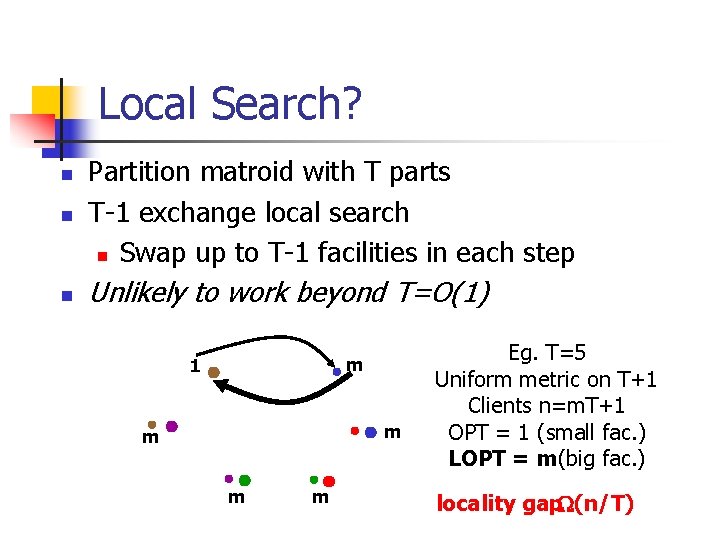
Local Search? n Partition matroid with T parts T-1 exchange local search n Swap up to T-1 facilities in each step n Unlikely to work beyond T=O(1) n m 1 m m Eg. T=5 Uniform metric on T+1 Clients n=m. T+1 OPT = 1 (small fac. ) LOPT = m(big fac. ) locality gap (n/T)
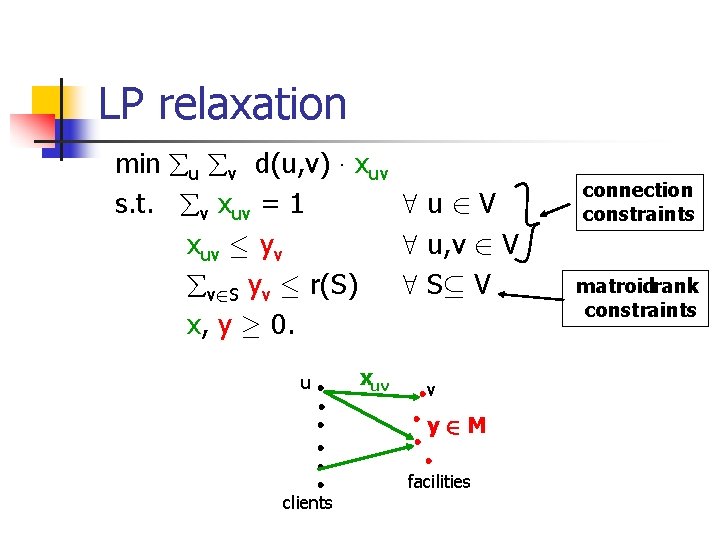
LP relaxation min u v d(u, v) ¢ xuv s. t. v xuv = 1 8 u 2 V xuv · yv 8 u, v 2 V v 2 S yv · r(S) 8 Sµ V x, y ¸ 0. u xuv v y 2 M clients facilities connection constraints matroidrank constraints
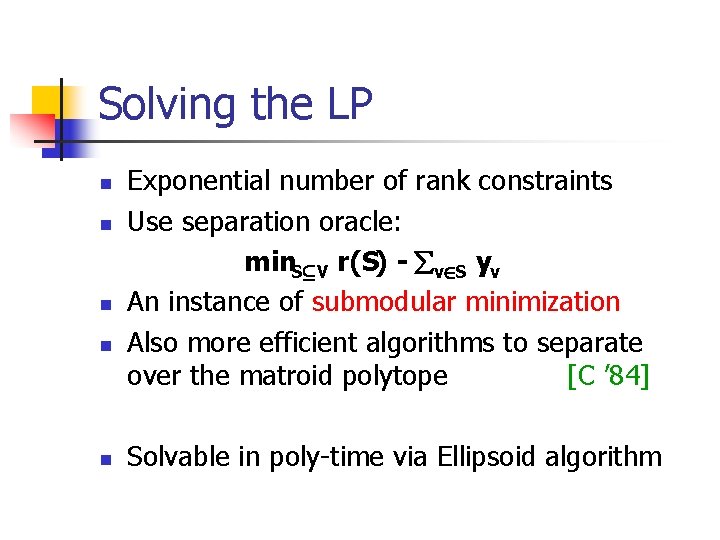
Solving the LP n n n Exponential number of rank constraints Use separation oracle: min. SµV r(S) - v 2 S yv An instance of submodular minimization Also more efficient algorithms to separate over the matroid polytope [C ’ 84] Solvable in poly-time via Ellipsoid algorithm
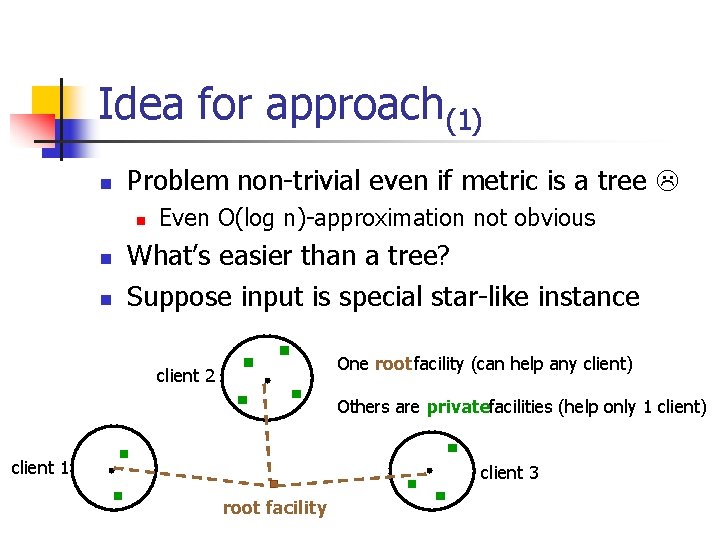
Idea for approach(1) n Problem non-trivial even if metric is a tree n n n Even O(log n)-approximation not obvious What’s easier than a tree? Suppose input is special star-like instance One root facility (can help any client) client 2 Others are privatefacilities (help only 1 client) client 1 client 3 root facility
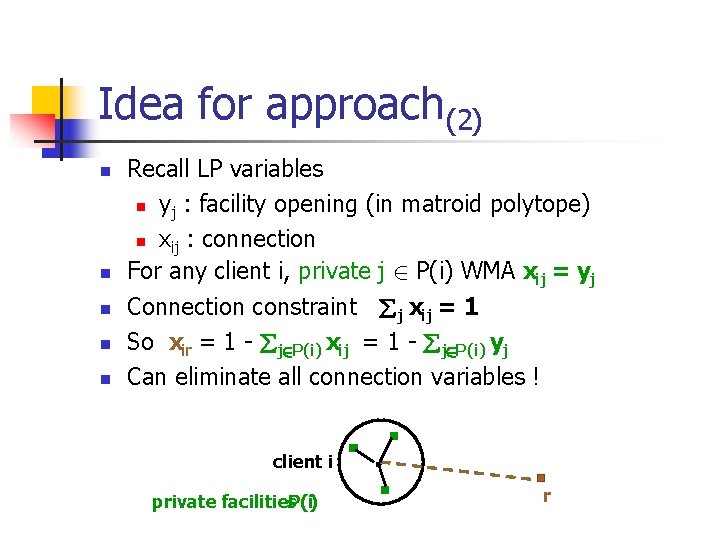
Idea for approach(2) n n n Recall LP variables n yj : facility opening (in matroid polytope) n xij : connection For any client i, private j 2 P(i) WMA xij = yj Connection constraint j xij = 1 So xir = 1 - j 2 P(i) xij = 1 - j 2 P(i) yj Can eliminate all connection variables ! client i private facilities P(i) r
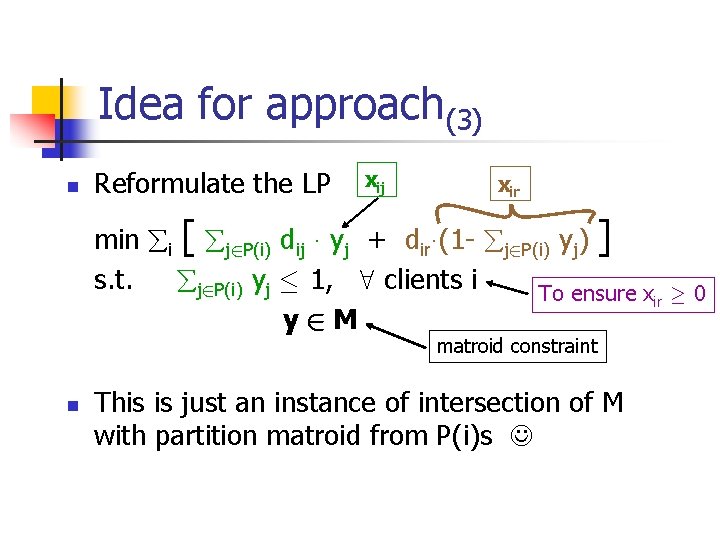
Idea for approach(3) n Reformulate the LP xij xir min i [ j 2 P(i) dij ¢ yj + dir¢(1 - j 2 P(i) yj) ] s. t. j 2 P(i) yj · 1, 8 clients i To ensure xir ¸ 0 y 2 M matroid constraint n This is just an instance of intersection of M with partition matroid from P(i)s
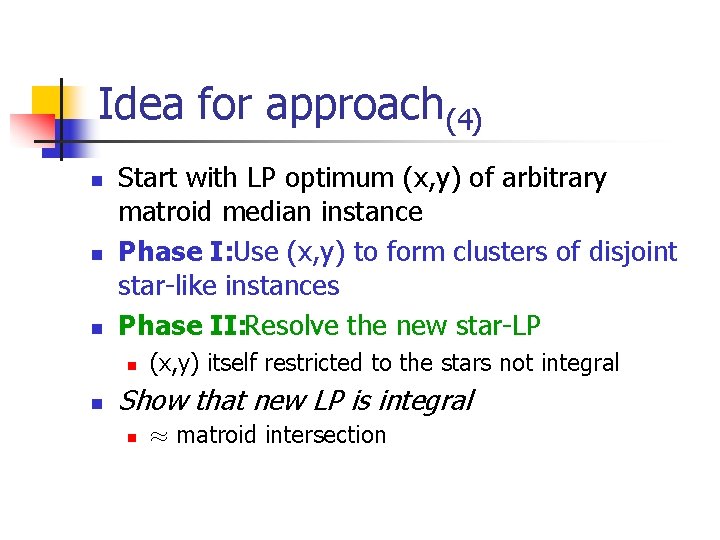
Idea for approach(4) n n n Start with LP optimum (x, y) of arbitrary matroid median instance Phase I: Use (x, y) to form clusters of disjoint star-like instances Phase II: Resolve the new star-LP n n (x, y) itself restricted to the stars not integral Show that new LP is integral n ¼ matroid intersection
Phase I: sparsify LP solution
Outline n Modify LP connections x in four steps n n Key: no change in facility variables y n n n Similar to [CGST ’ 99] Need to ensure y remains in matroid polytope Not true in [CGST ’ 99] Require some more (technical) work
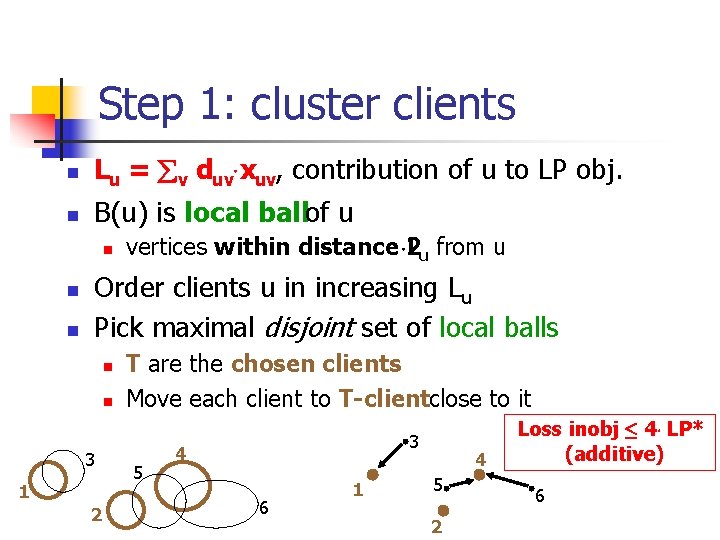
Step 1: cluster clients n Lu = v duv¢xuv, contribution of u to LP obj. n B(u) is local ballof u n n n vertices within distance ¢L 2 u from u Order clients u in increasing Lu Pick maximal disjoint set of local balls n n 3 1 2 T are the chosen clients Move each client to T-clientclose to it 5 3 4 6 1 4 5 2 Loss inobj · 4¢ LP* (additive) 6
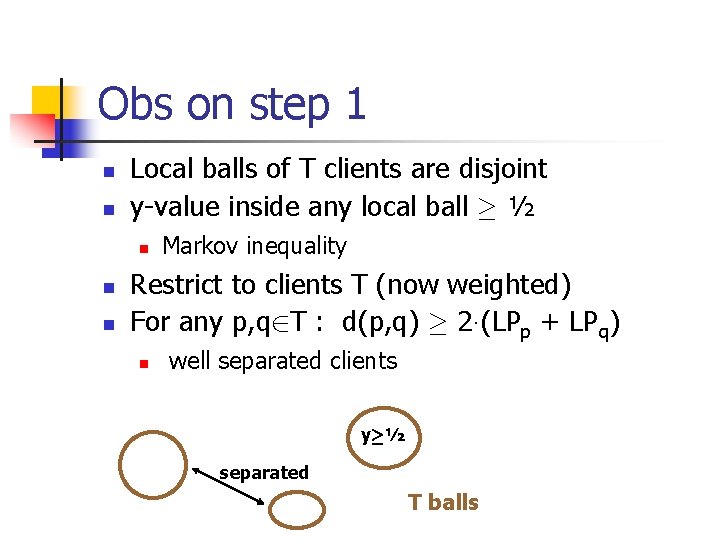
Obs on step 1 n n Local balls of T clients are disjoint y-value inside any local ball ¸ ½ n n n Markov inequality Restrict to clients T (now weighted) For any p, q 2 T : d(p, q) ¸ 2¢(LPp + LPq) n well separated clients y¸½ separated T balls
More obs on step 1 n Suppose y-value in each T’s local ball ¸ 1 Then instance of matroid intersection: n Matroid M and partition from local-ball(T) Resolving suitable LP ) integral soln n Will need intersection with `laminar’ constraints, not just partition matroid
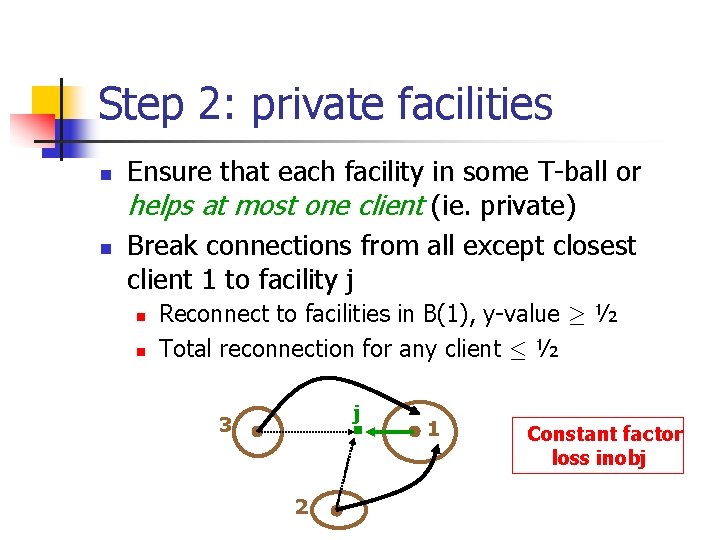
Step 2: private facilities n n Ensure that each facility in some T-ball or helps at most one client (ie. private) Break connections from all except closest client 1 to facility j n n Reconnect to facilities in B(1), y-value ¸ ½ Total reconnection for any client · ½ j 3 2 1 Constant factor loss inobj
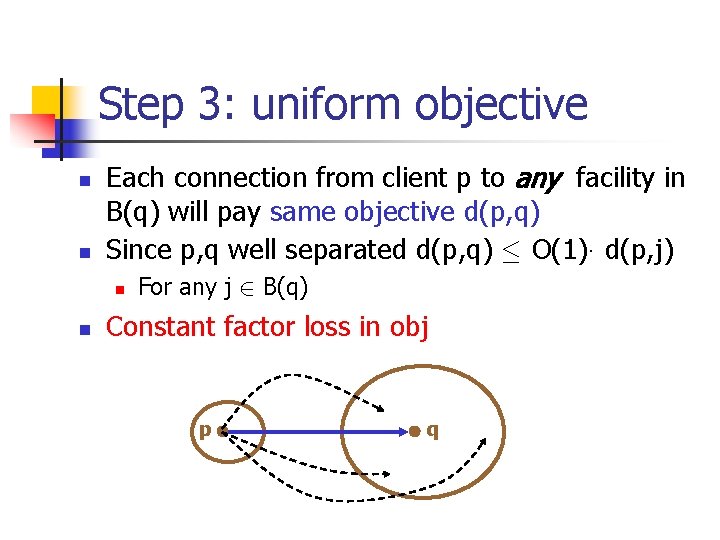
Step 3: uniform objective n n Each connection from client p to any facility in B(q) will pay same objective d(p, q) Since p, q well separated d(p, q) · O(1)¢ d(p, j) n n For any j 2 B(q) Constant factor loss in obj p q
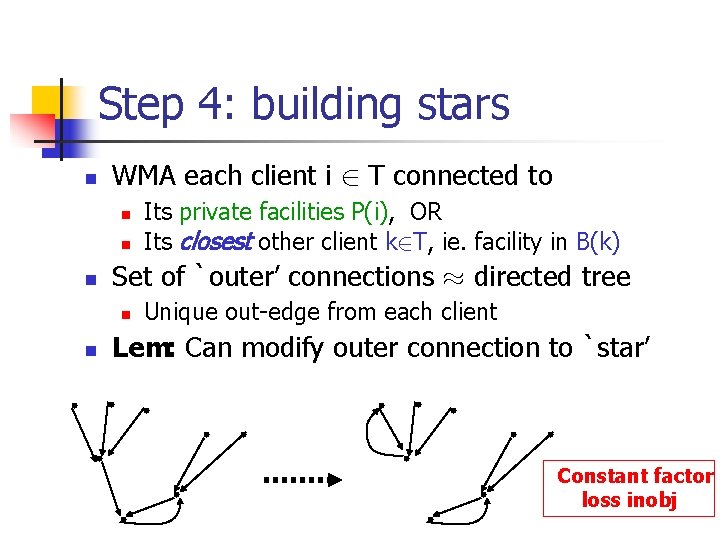
Step 4: building stars n WMA each client i 2 T connected to n n n Set of `outer’ connections ¼ directed tree n n Its private facilities P(i), OR Its closest other client k 2 T, ie. facility in B(k) Unique out-edge from each client Lem: Can modify outer connection to `star’ Constant factor loss inobj
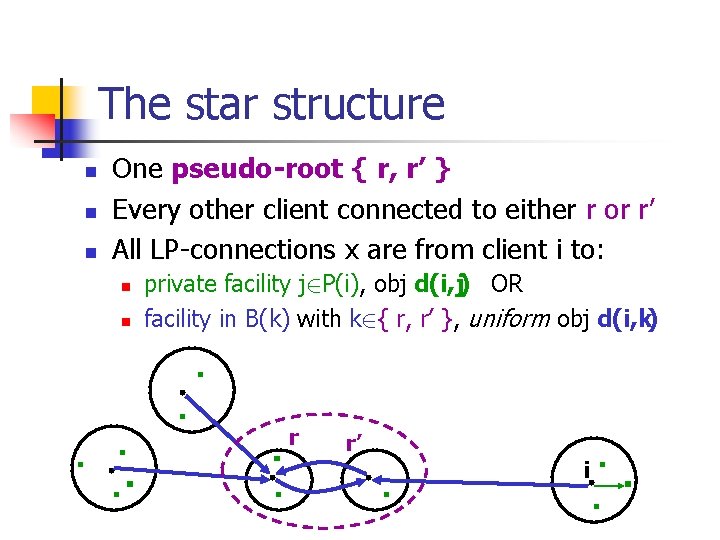
The star structure n n n One pseudo-root { r, r’ } Every other client connected to either r or r’ All LP-connections x are from client i to: n n private facility j 2 P(i), obj d(i, j) OR facility in B(k) with k 2{ r, r’ }, uniform obj d(i, k) r r’ i
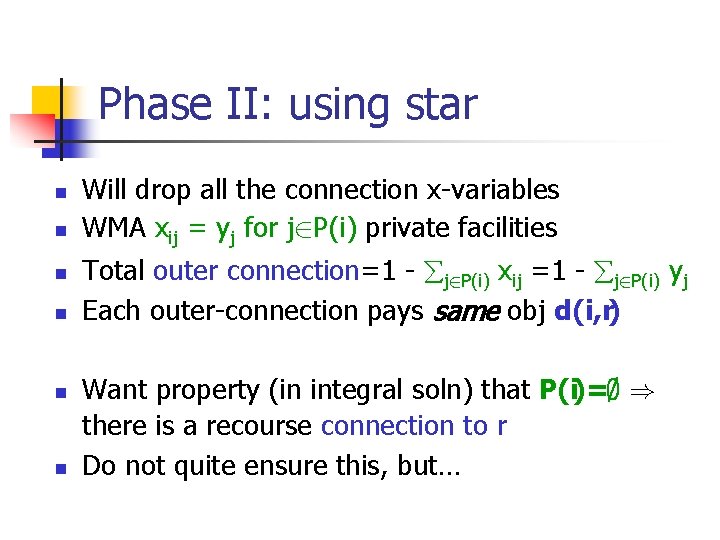
Phase II: using star n n n Will drop all the connection x-variables WMA xij = yj for j 2 P(i) private facilities Total outer connection=1 - j 2 P(i) xij =1 - j 2 P(i) yj Each outer-connection pays same obj d(i, r) Want property (in integral soln) that P(i)=; ) there is a recourse connection to r Do not quite ensure this, but…
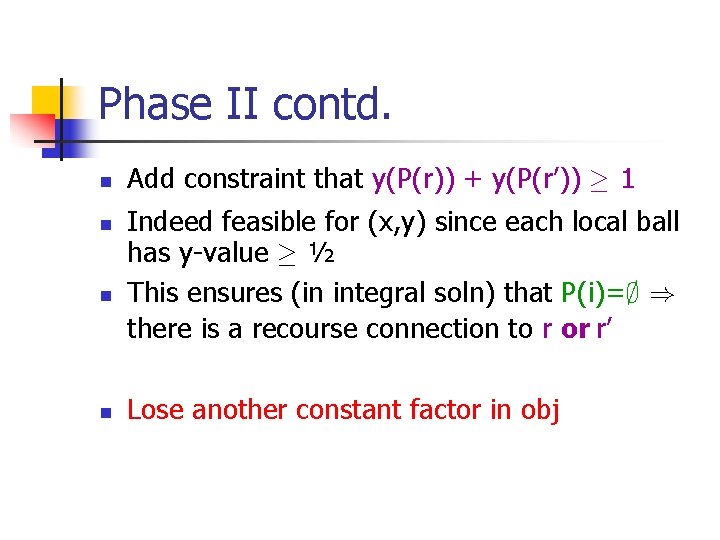
Phase II contd. n n Add constraint that y(P(r)) + y(P(r’)) ¸ 1 Indeed feasible for (x, y) since each local ball has y-value ¸ ½ This ensures (in integral soln) that P(i)=; ) there is a recourse connection to r or r’ Lose another constant factor in obj
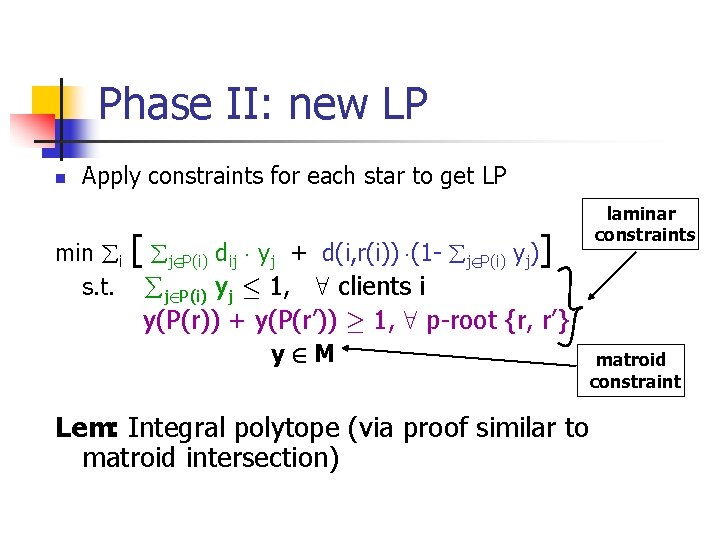
Phase II: new LP n Apply constraints for each star to get LP min i [ j 2 P(i) dij ¢ yj + d(i, r(i)) ¢(1 - j 2 P(i) yj)] s. t. j 2 P(i) yj · 1, 8 clients i laminar constraints y(P(r)) + y(P(r’)) ¸ 1, 8 p-root {r, r’} y 2 M Lem: Integral polytope (via proof similar to matroid intersection) matroid constraint
Summarize n n n Using LP solution and metric properties reduce to star-like instances Formulate new LP for star-like instances, with only facility variables New LP is integral
Other Results n n O(1)-approximation for prize-collecting version of matroid median Knapsack Median problem (knapsack constraint on open facilities) n n n Give bi-criteria approx, violate budget by wmax Can we get true O(1)-approx? Handle other constraints in k-median?

Thank You
- Slides: 28