
The Mathematics of the Flight of a Golf
- Slides: 35
The Mathematics of the Flight of a Golf Ball Mathematical Modeling Isabelle Boehling, John A. Holmes High Wen Huang, Junius H. Rose High 2008
Outline • • Questions Background Information The Math Side of the Flight of a Golf Ball Modeling the Flight Path – Using VPython – Data • Summary
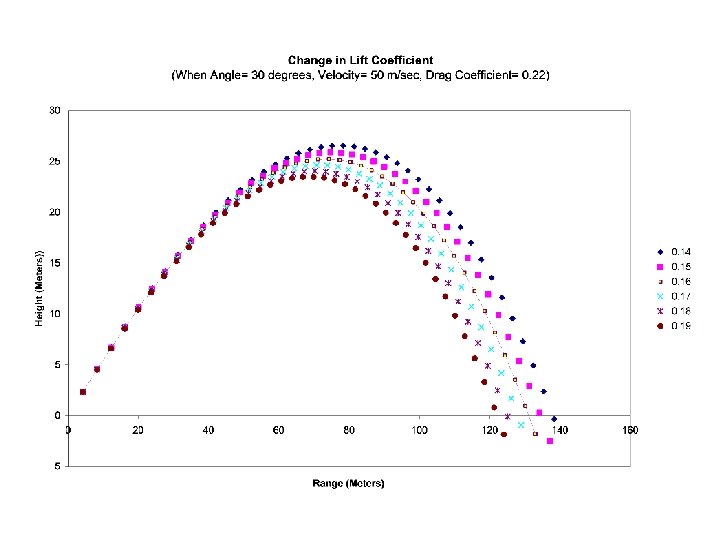
Problem How do the different launch angles and launch velocities of hitting a golf ball affect that path it takes? What are the effects of lift and drag on the distance and height of a golf ball of flight?
The Game of Golf ٠ Clubs with wooden or metal heads are used to hit a small, white ball into a number of holes (9 or 18) in progression, situated at a variety of distances over a course ٠ Objective: to get the ball into each hole in as few strokes as possible. ٠ Exact origins are uncertain: open to debate as being Chinese, Dutch, or Scottish. ٠ Most acknowledged golf history idea is that the sport began in Scotland in the 1100 s.
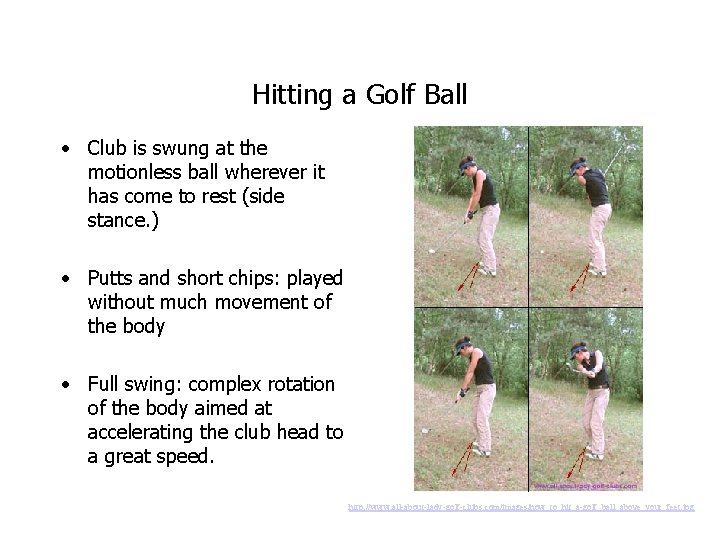
Hitting a Golf Ball • Club is swung at the motionless ball wherever it has come to rest (side stance. ) • Putts and short chips: played without much movement of the body • Full swing: complex rotation of the body aimed at accelerating the club head to a great speed. http: //www. all-about-lady-golf-clubs. com/images/how_to_hit_a-golf_ball_above_your_feet. jpg
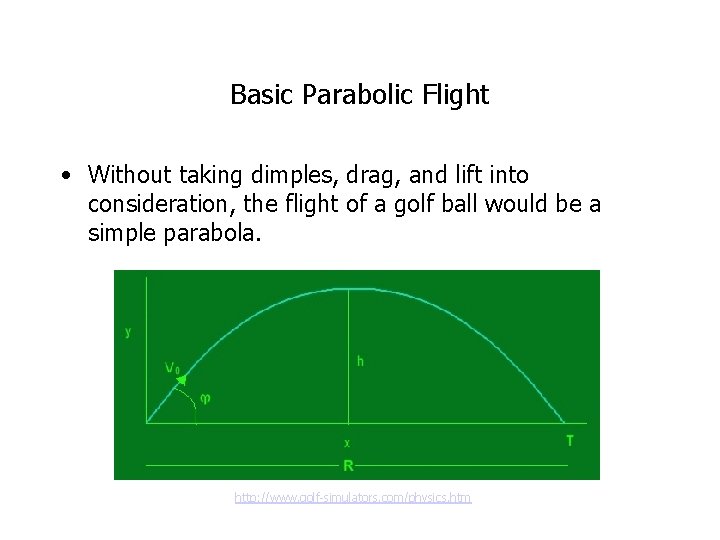
Basic Parabolic Flight • Without taking dimples, drag, and lift into consideration, the flight of a golf ball would be a simple parabola. http: //www. golf-simulators. com/physics. htm
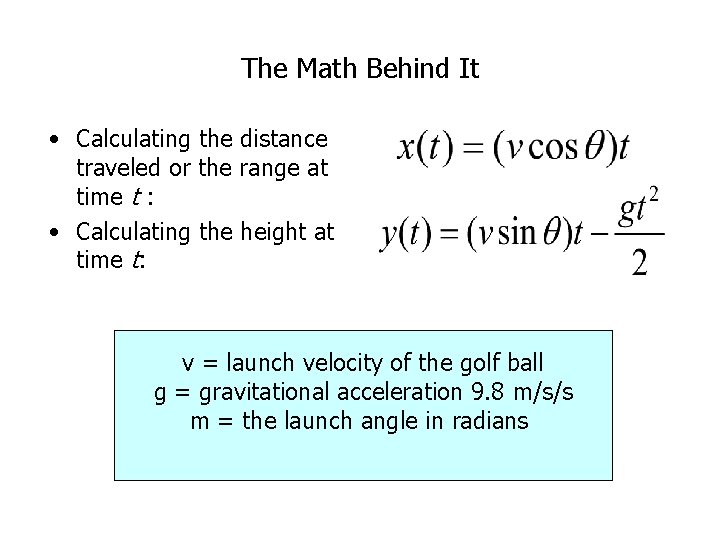
The Math Behind It • Calculating the distance traveled or the range at time t : • Calculating the height at time t: v = launch velocity of the golf ball g = gravitational acceleration 9. 8 m/s/s m = the launch angle in radians
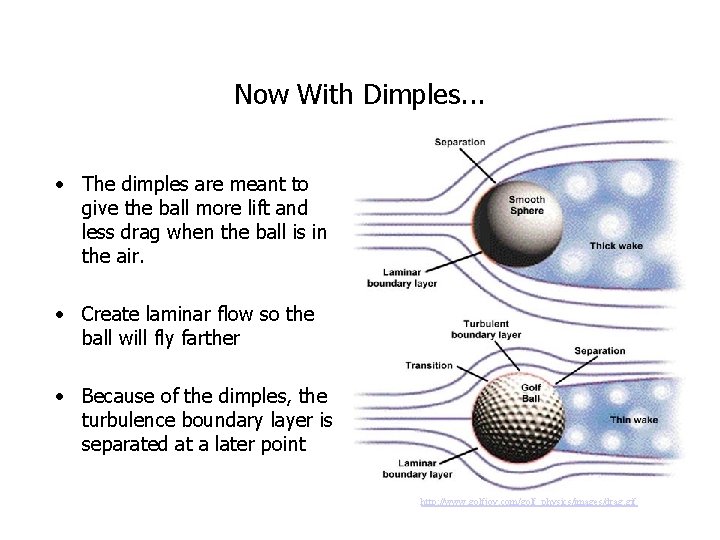
Now With Dimples. . . • The dimples are meant to give the ball more lift and less drag when the ball is in the air. • Create laminar flow so the ball will fly farther • Because of the dimples, the turbulence boundary layer is separated at a later point http: //www. golfjoy. com/golf_physics/images/drag. gif
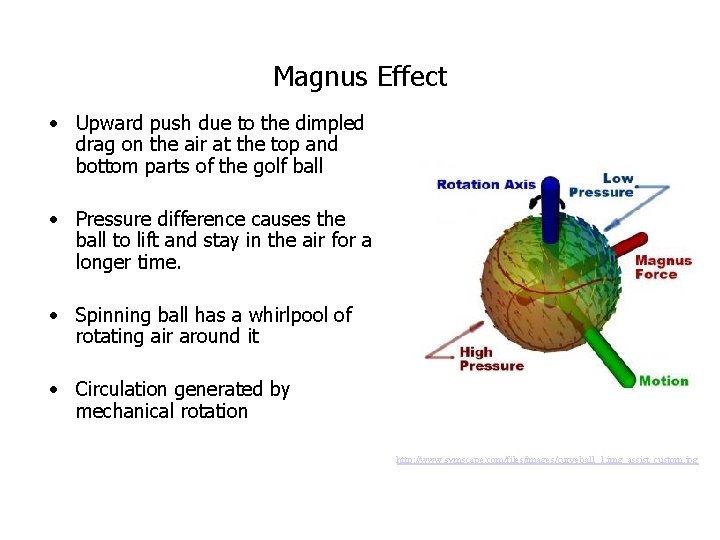
Magnus Effect • Upward push due to the dimpled drag on the air at the top and bottom parts of the golf ball • Pressure difference causes the ball to lift and stay in the air for a longer time. • Spinning ball has a whirlpool of rotating air around it • Circulation generated by mechanical rotation http: //www. symscape. com/files/images/curveball_1. img_assist_custom. jpg
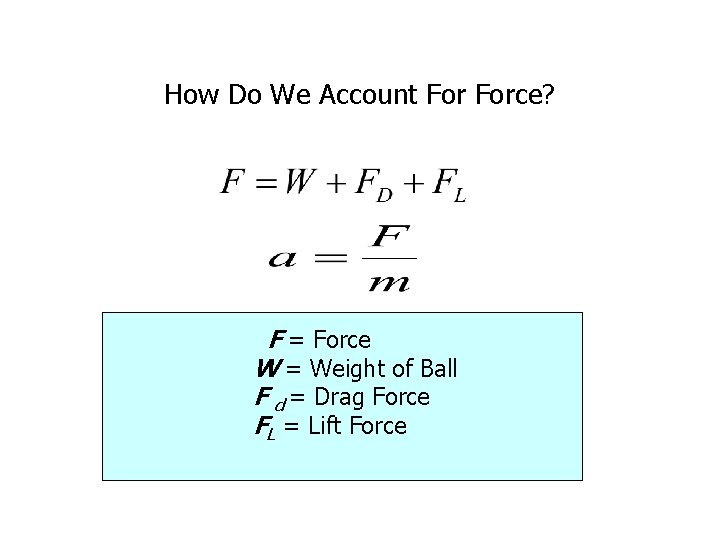
How Do We Account Force? F = Force W = Weight of Ball F d = Drag Force FL = Lift Force
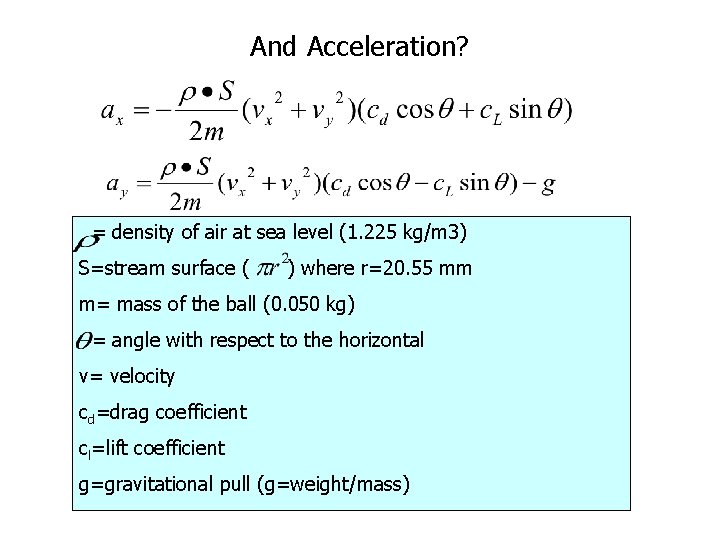
And Acceleration? = density of air at sea level (1. 225 kg/m 3) S=stream surface ( ) where r=20. 55 mm m= mass of the ball (0. 050 kg) = angle with respect to the horizontal v= velocity cd=drag coefficient cl=lift coefficient g=gravitational pull (g=weight/mass)
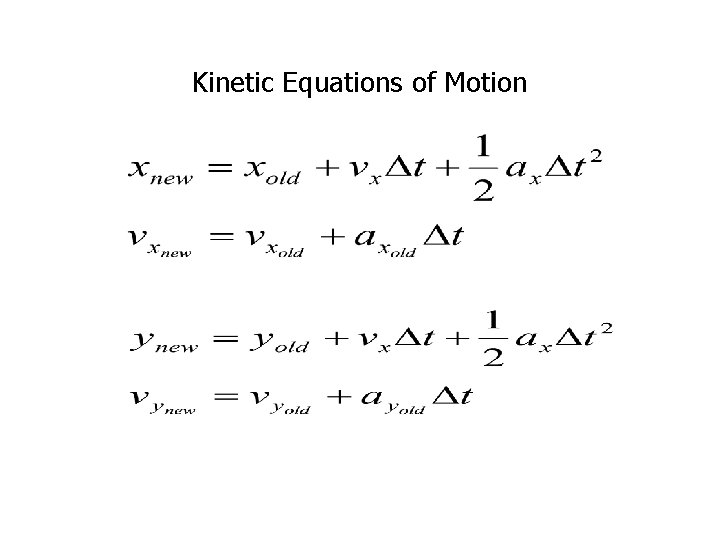
Kinetic Equations of Motion
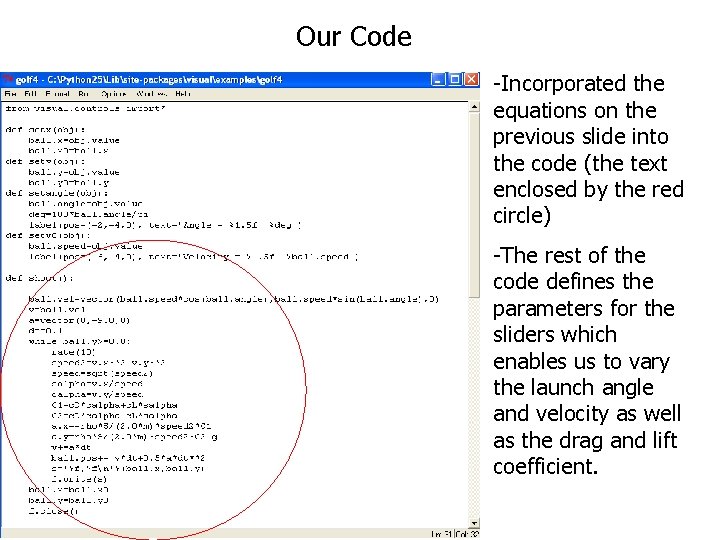
Our Code -Incorporated the equations on the previous slide into the code (the text enclosed by the red circle) -The rest of the code defines the parameters for the sliders which enables us to vary the launch angle and velocity as well as the drag and lift coefficient.
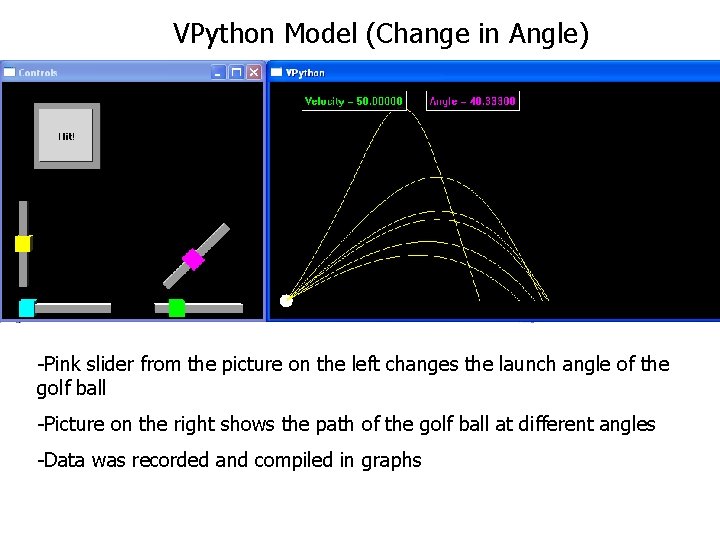
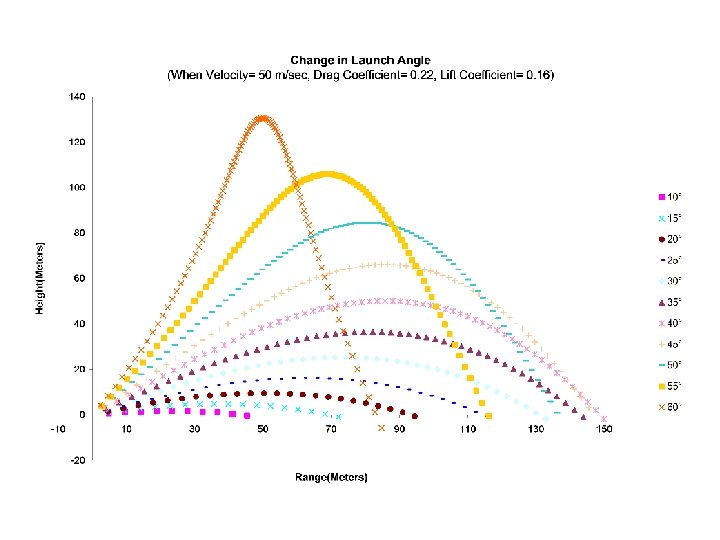
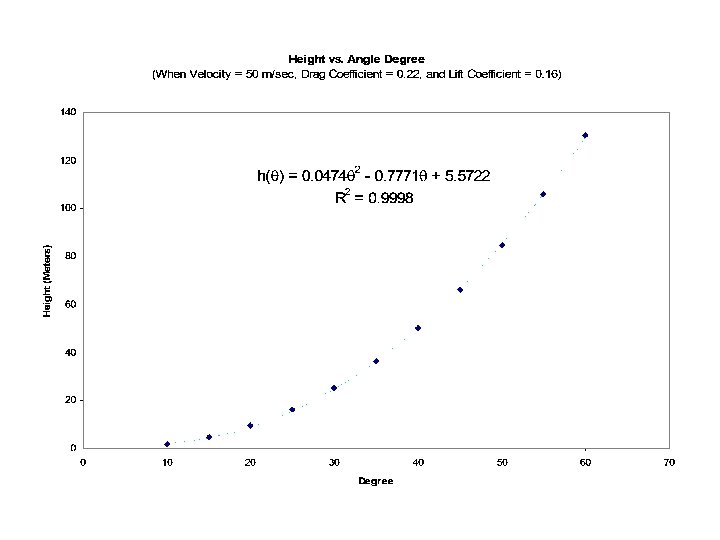
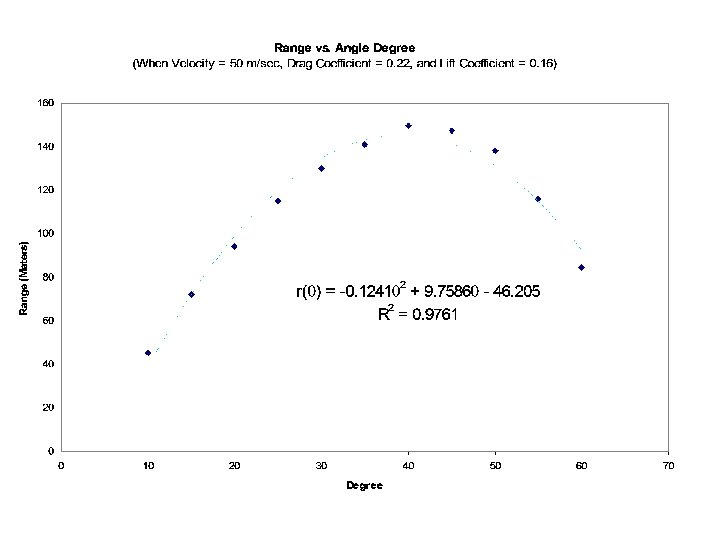
VPython Model (Change in Angle) -Pink slider from the picture on the left changes the launch angle of the golf ball -Picture on the right shows the path of the golf ball at different angles -Data was recorded and compiled in graphs
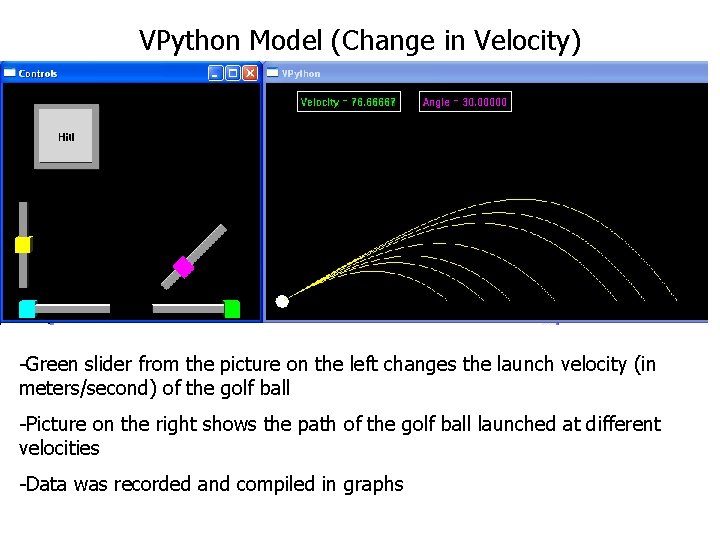
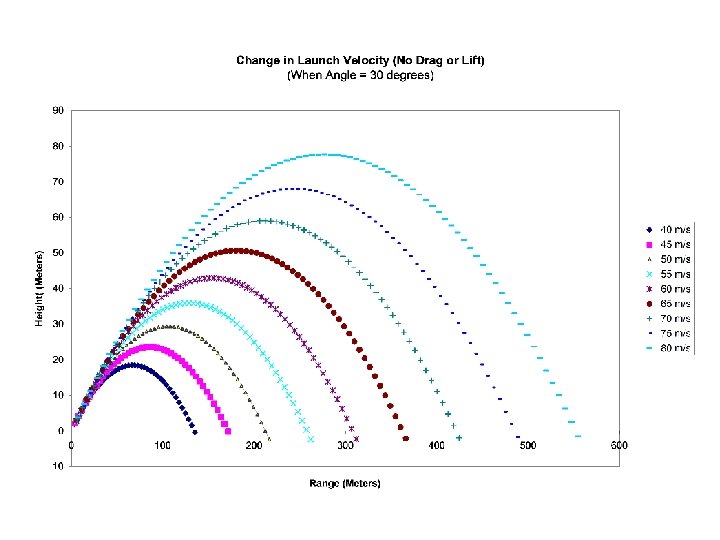
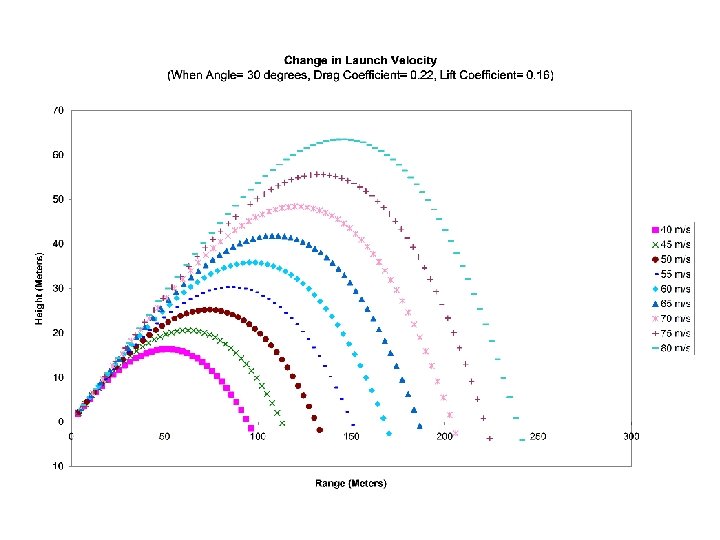
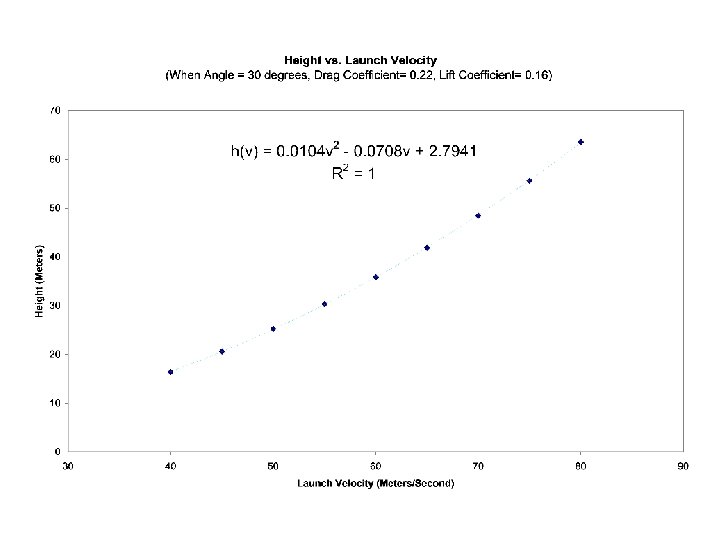
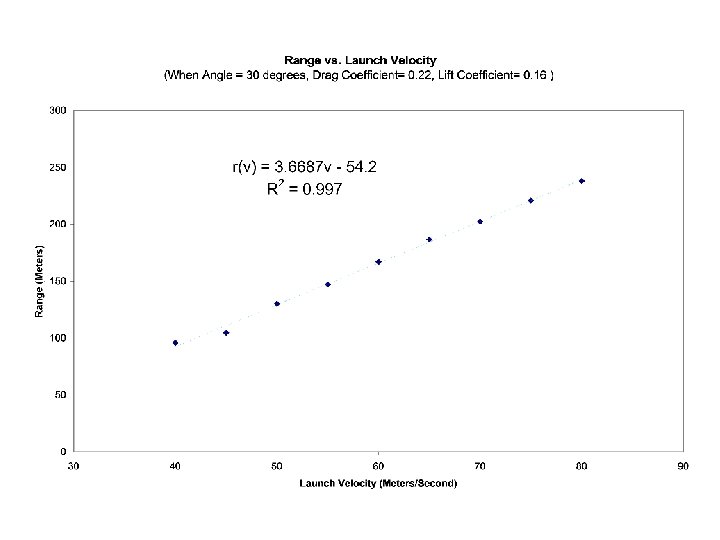
VPython Model (Change in Velocity) -Green slider from the picture on the left changes the launch velocity (in meters/second) of the golf ball -Picture on the right shows the path of the golf ball launched at different velocities -Data was recorded and compiled in graphs
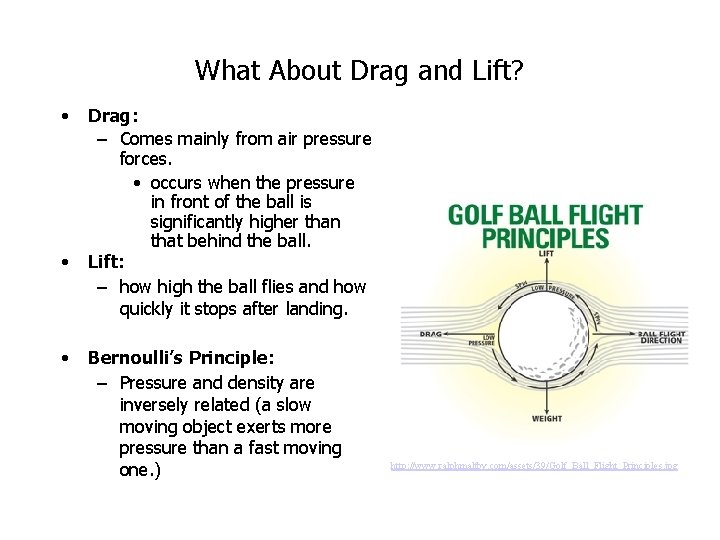
What About Drag and Lift? • • • Drag: – Comes mainly from air pressure forces. • occurs when the pressure in front of the ball is significantly higher than that behind the ball. Lift: – how high the ball flies and how quickly it stops after landing. Bernoulli’s Principle: – Pressure and density are inversely related (a slow moving object exerts more pressure than a fast moving one. ) http: //www. ralphmaltby. com/assets/39/Golf_Ball_Flight_Principles. jpg
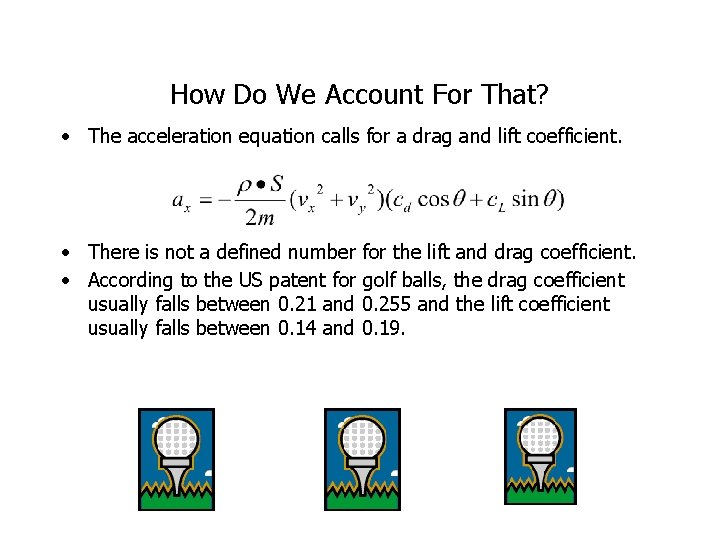
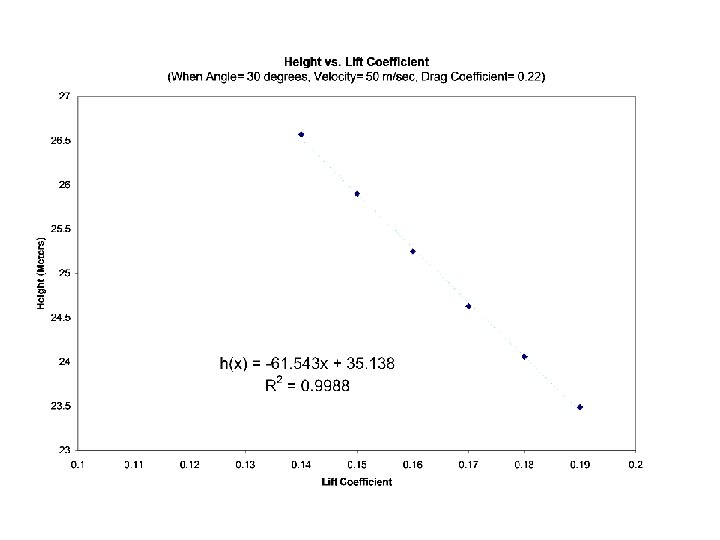
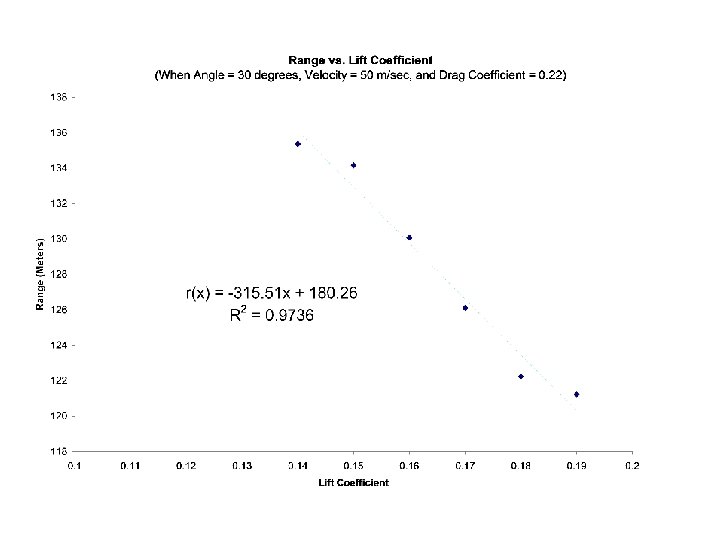
How Do We Account For That? • The acceleration equation calls for a drag and lift coefficient. • There is not a defined number for the lift and drag coefficient. • According to the US patent for golf balls, the drag coefficient usually falls between 0. 21 and 0. 255 and the lift coefficient usually falls between 0. 14 and 0. 19.
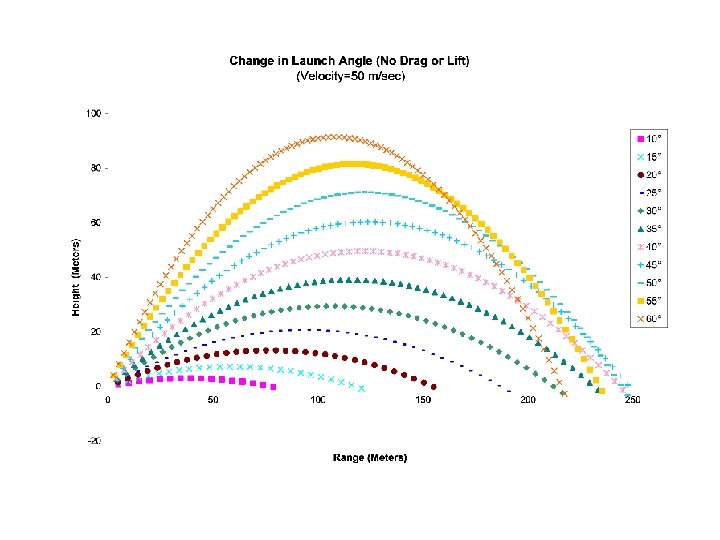
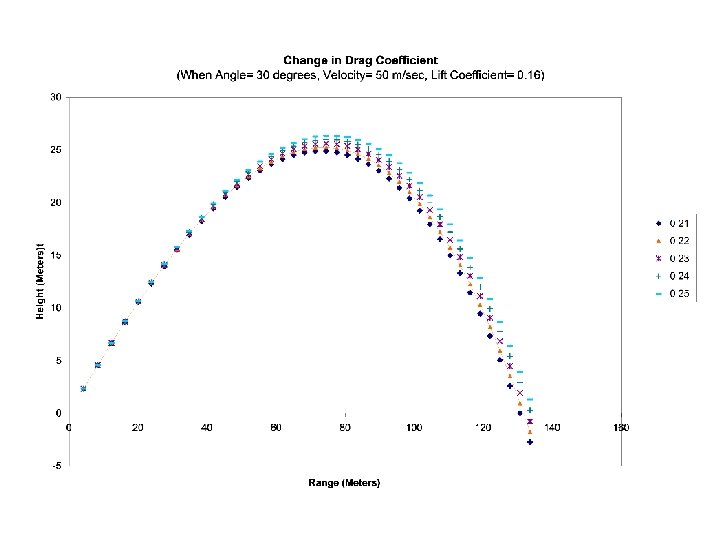
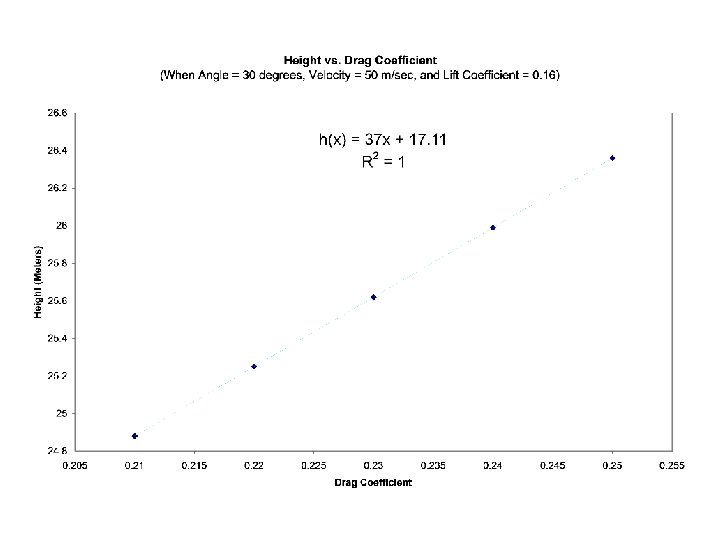
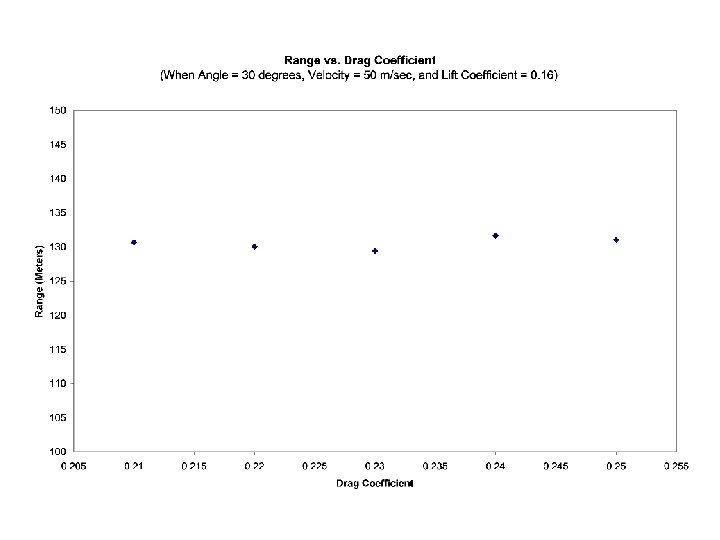
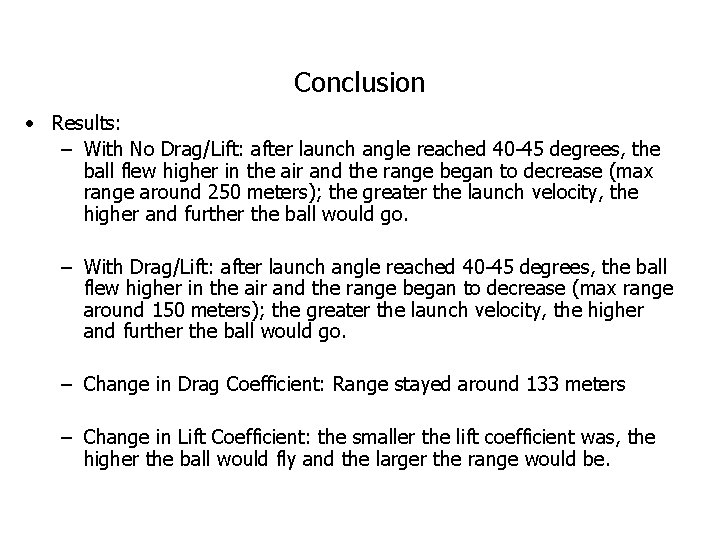
Conclusion • Results: – With No Drag/Lift: after launch angle reached 40 -45 degrees, the ball flew higher in the air and the range began to decrease (max range around 250 meters); the greater the launch velocity, the higher and further the ball would go. – With Drag/Lift: after launch angle reached 40 -45 degrees, the ball flew higher in the air and the range began to decrease (max range around 150 meters); the greater the launch velocity, the higher and further the ball would go. – Change in Drag Coefficient: Range stayed around 133 meters – Change in Lift Coefficient: the smaller the lift coefficient was, the higher the ball would fly and the larger the range would be.
Summary • Researched the distance, height, force, and acceleration formulae • Created VPython simulations with the final equations • Recorded data from the changing VPython models • Analyzed the data and transferred it to excel to create graphs of the path of the golf ball
Acknowledgements We would like to thank our Mathematical Modeling professor, Dr. Russell Herman, our teacher, Mr. David Glasier, Mr. and Mrs. Cavender, all the staff here at SVSM UNCW, and our parents. Thanks for this opportunity!
Bibliography • Aerodynamic Pattern for a Golf Ball. http: //www. patentstorm. us/patents/6464601/claims. html • Flight Dynamics of Golf Balls. http: //www. golfjoy. com/golf_physics/dynamics. asp • Golf Ball. http: //en. wikipedia. org/wiki/Golf_ball • The Pysics of Golf. http: //www. golf-simulators. com/physics. htm • Scott, Jeff. Golf Dimples and Drag. 2005. http: //www. aerospaceweb. org/question/aerodynamics/q 0215. shtml • Tannar, Ken. Probable Golf Instruction. 2001 -2008. http: //probablegolfinstruction. com/science_golf_ball_flight. htm • Werner, Andrew. Flight Model of a Golf Ball. http: //www. users. csbsju. edu/~jcrumley/222_2007/projects/awwerner/project. pdf • Wisse, Menko. Golf Ball Trajectory Simulation Applet. http: //www. ecs. syr. edu/centers/simfluid/red/golf. html