
THE MATH YOU NEED RATES OF CHANGE DRAWING
- Slides: 7
THE MATH YOU NEED: - RATES OF CHANGE - DRAWING TREND LINES - ANOMALIES Unit 2: Part 2 This work is supported by the National Science Foundation’s Transforming Undergraduate Education in STEM program within the Directorate for Education and Human Resources (DUE-1245025).
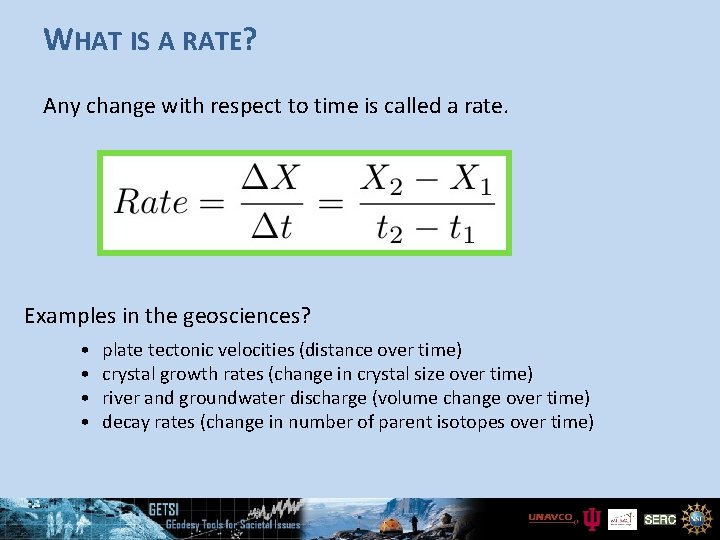
WHAT IS A RATE? Any change with respect to time is called a rate. Examples in the geosciences? • • plate tectonic velocities (distance over time) crystal growth rates (change in crystal size over time) river and groundwater discharge (volume change over time) decay rates (change in number of parent isotopes over time)
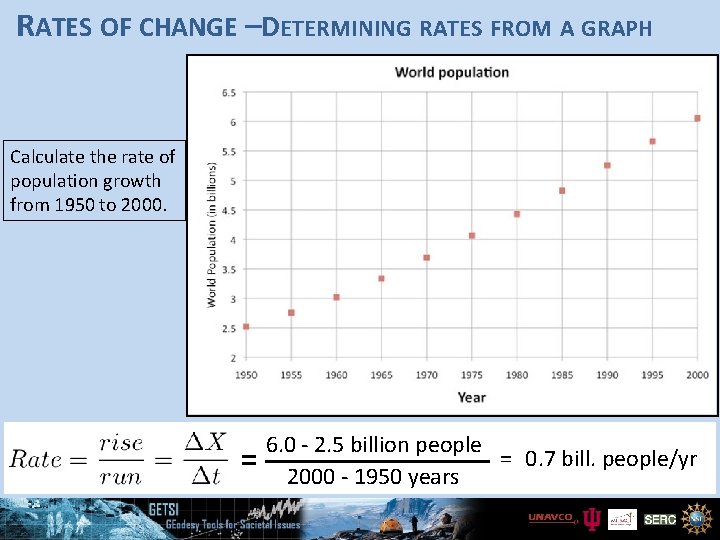
RATES OF CHANGE –DETERMINING RATES FROM A GRAPH Calculate the rate of population growth from 1950 to 2000. = 6. 0 - 2. 5 billion people = 0. 7 bill. people/yr 2000 - 1950 years
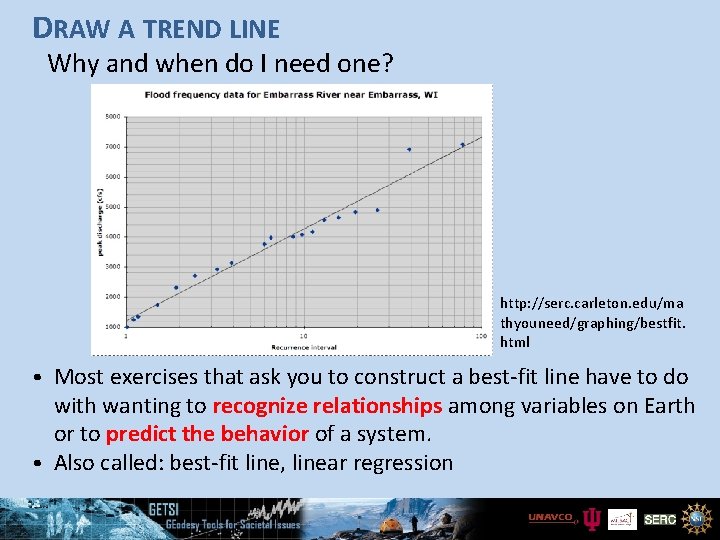
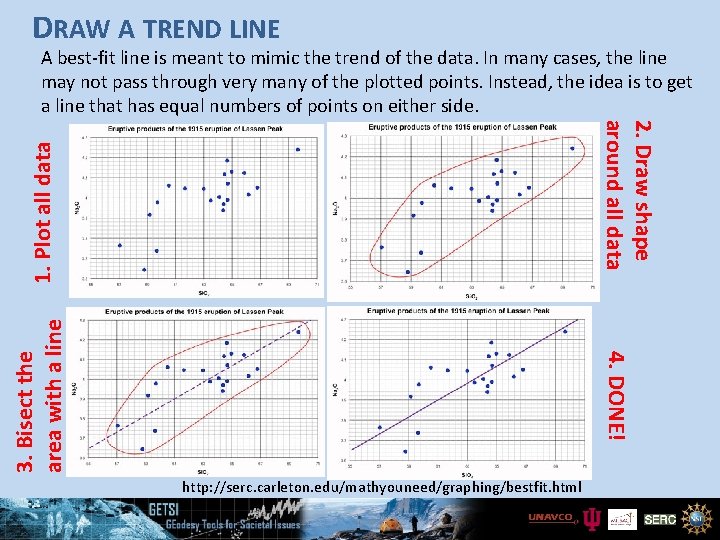
DRAW A TREND LINE Why and when do I need one? http: //serc. carleton. edu/ma thyouneed/graphing/bestfit. html • Most exercises that ask you to construct a best-fit line have to do with wanting to recognize relationships among variables on Earth or to predict the behavior of a system. • Also called: best-fit line, linear regression
DRAW A TREND LINE A best-fit line is meant to mimic the trend of the data. In many cases, the line may not pass through very many of the plotted points. Instead, the idea is to get a line that has equal numbers of points on either side. 4. DONE! 3. Bisect the area with a line 1. Plot all data 2. Draw shape around all data http: //serc. carleton. edu/mathyouneed/graphing/bestfit. html
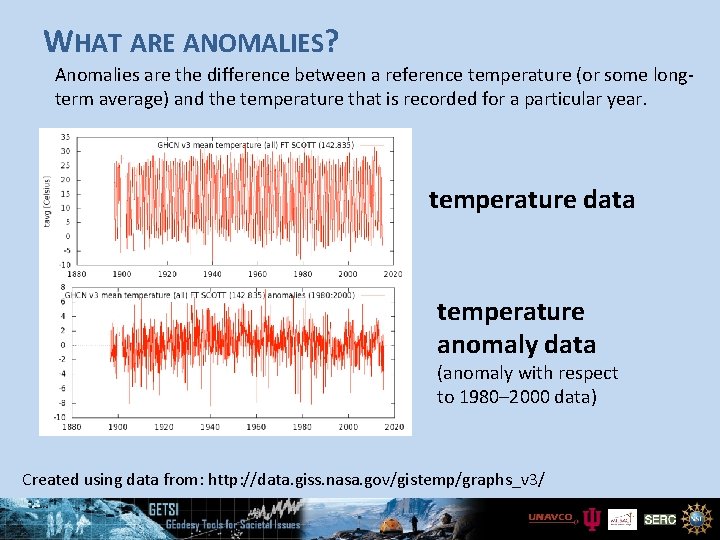
WHAT ARE ANOMALIES? Anomalies are the difference between a reference temperature (or some longterm average) and the temperature that is recorded for a particular year. temperature data temperature anomaly data (anomaly with respect to 1980– 2000 data) Created using data from: http: //data. giss. nasa. gov/gistemp/graphs_v 3/
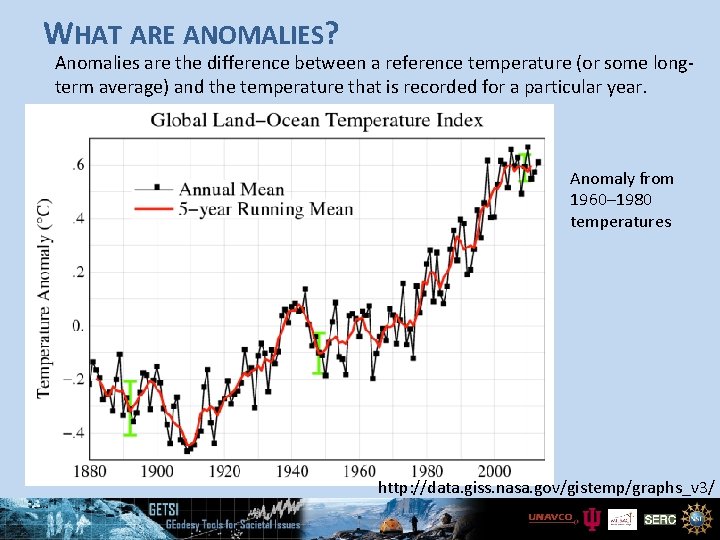
WHAT ARE ANOMALIES? Anomalies are the difference between a reference temperature (or some longterm average) and the temperature that is recorded for a particular year. Anomaly from 1960– 1980 temperatures http: //data. giss. nasa. gov/gistemp/graphs_v 3/