
The math skills needed in the food service

- Slides: 34
The math skills needed in the food service industry are applications of basic math… addition, Cost control is necessary in every aspect of the subtraction, multiplication, foodservice division, ratios, and percentages. establishment, including ‘purchasing’, ‘receiving’, ‘storage’ (inventory), ‘issuing’ (distributing food items from storage), ‘preparation and production’, and ‘sales’. To control costs, it is important to understand these various aspects of the operation, and apply math skills appropriately to each aspect.
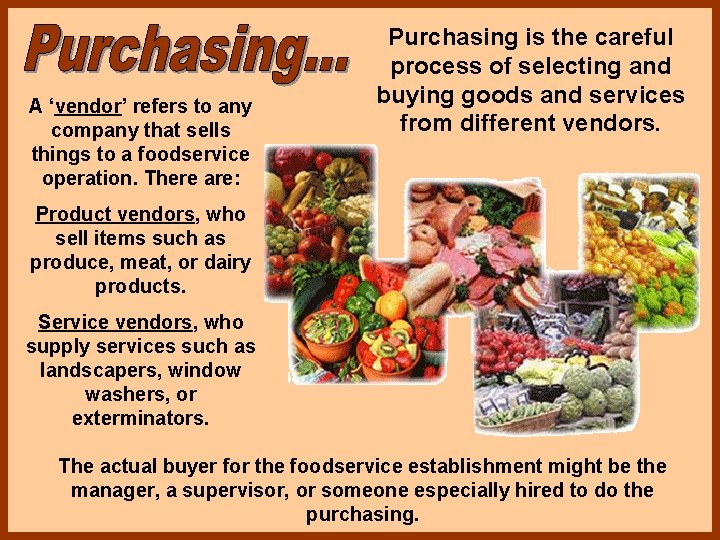
A ‘vendor’ refers to any company that sells things to a foodservice operation. There are: Purchasing is the careful process of selecting and buying goods and services from different vendors. Product vendors, who sell items such as produce, meat, or dairy products. Service vendors, who supply services such as landscapers, window washers, or exterminators. The actual buyer for the foodservice establishment might be the manager, a supervisor, or someone especially hired to do the purchasing.
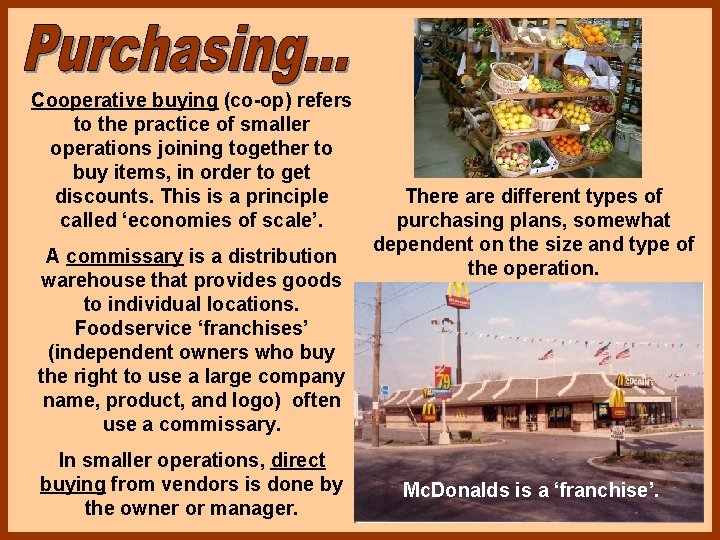
Cooperative buying (co-op) refers to the practice of smaller operations joining together to buy items, in order to get discounts. This is a principle called ‘economies of scale’. A commissary is a distribution warehouse that provides goods to individual locations. Foodservice ‘franchises’ (independent owners who buy the right to use a large company name, product, and logo) often use a commissary. In smaller operations, direct buying from vendors is done by the owner or manager. There are different types of purchasing plans, somewhat dependent on the size and type of the operation. Mc. Donalds is a ‘franchise’.
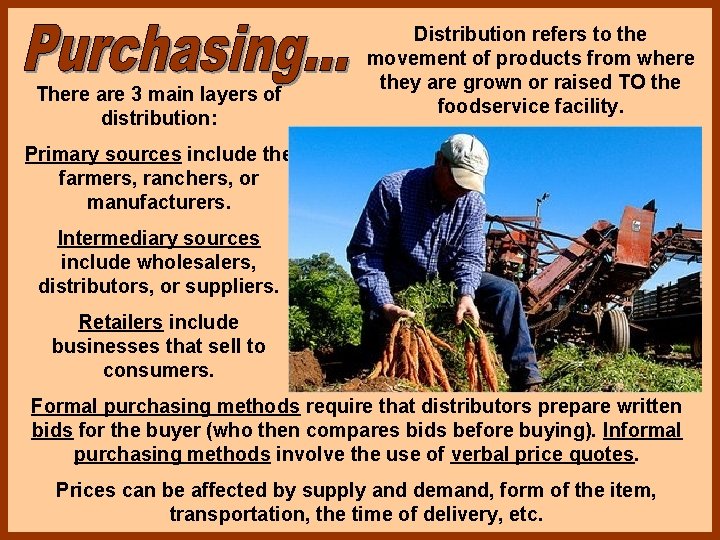
There are 3 main layers of distribution: Distribution refers to the movement of products from where they are grown or raised TO the foodservice facility. Primary sources include the farmers, ranchers, or manufacturers. Intermediary sources include wholesalers, distributors, or suppliers. Retailers include businesses that sell to consumers. Formal purchasing methods require that distributors prepare written bids for the buyer (who then compares bids before buying). Informal purchasing methods involve the use of verbal price quotes. Prices can be affected by supply and demand, form of the item, transportation, the time of delivery, etc.
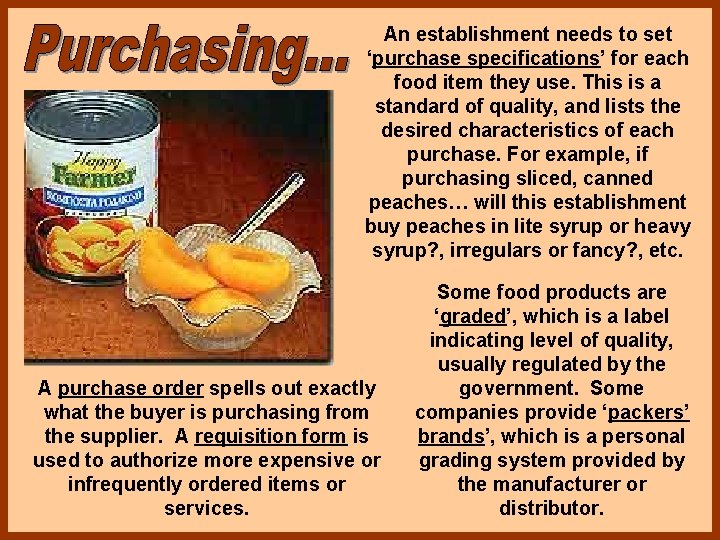
An establishment needs to set ‘purchase specifications’ for each food item they use. This is a standard of quality, and lists the desired characteristics of each purchase. For example, if purchasing sliced, canned peaches… will this establishment buy peaches in lite syrup or heavy syrup? , irregulars or fancy? , etc. A purchase order spells out exactly what the buyer is purchasing from the supplier. A requisition form is used to authorize more expensive or infrequently ordered items or services. Some food products are ‘graded’, which is a label indicating level of quality, usually regulated by the government. Some companies provide ‘packers’ brands’, which is a personal grading system provided by the manufacturer or distributor.
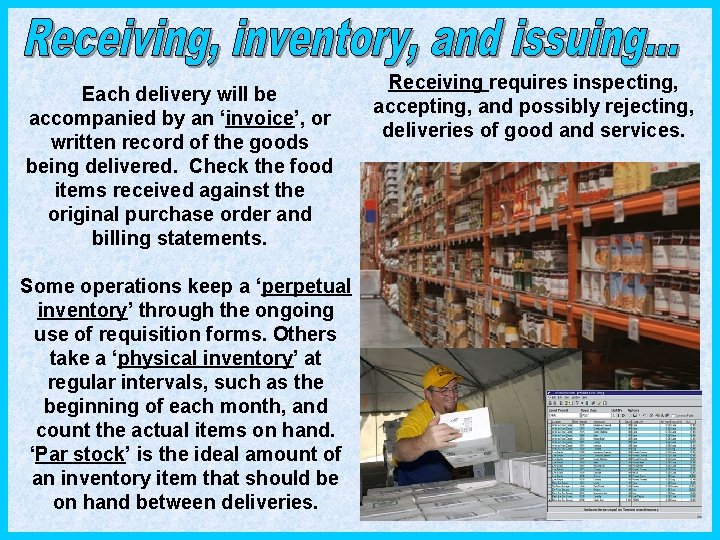
Each delivery will be accompanied by an ‘invoice’, or written record of the goods being delivered. Check the food items received against the original purchase order and billing statements. Some operations keep a ‘perpetual inventory’ through the ongoing use of requisition forms. Others take a ‘physical inventory’ at regular intervals, such as the beginning of each month, and count the actual items on hand. ‘Par stock’ is the ideal amount of an inventory item that should be on hand between deliveries. Receiving requires inspecting, accepting, and possibly rejecting, deliveries of good and services.
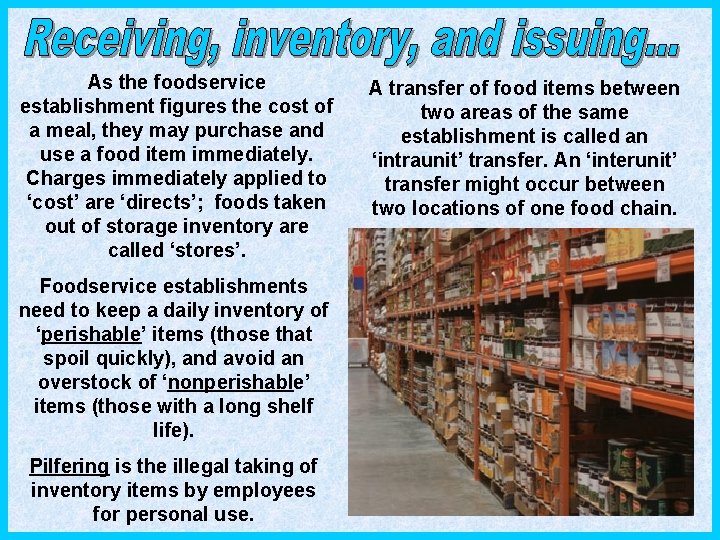
As the foodservice establishment figures the cost of a meal, they may purchase and use a food item immediately. Charges immediately applied to ‘cost’ are ‘directs’; foods taken out of storage inventory are called ‘stores’. Foodservice establishments need to keep a daily inventory of ‘perishable’ items (those that spoil quickly), and avoid an overstock of ‘nonperishable’ items (those with a long shelf life). Pilfering is the illegal taking of inventory items by employees for personal use. A transfer of food items between two areas of the same establishment is called an ‘intraunit’ transfer. An ‘interunit’ transfer might occur between two locations of one food chain.
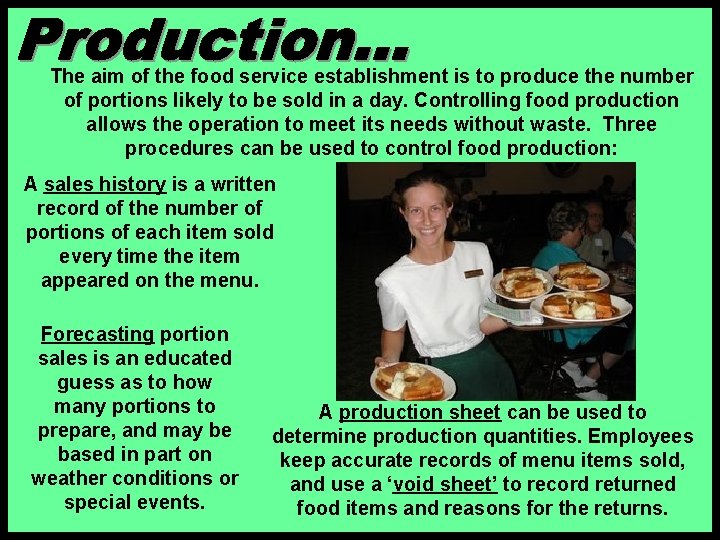
The aim of the food service establishment is to produce the number of portions likely to be sold in a day. Controlling food production allows the operation to meet its needs without waste. Three procedures can be used to control food production: A sales history is a written record of the number of portions of each item sold every time the item appeared on the menu. Forecasting portion sales is an educated guess as to how many portions to prepare, and may be based in part on weather conditions or special events. A production sheet can be used to determine production quantities. Employees keep accurate records of menu items sold, and use a ‘void sheet’ to record returned food items and reasons for the returns.
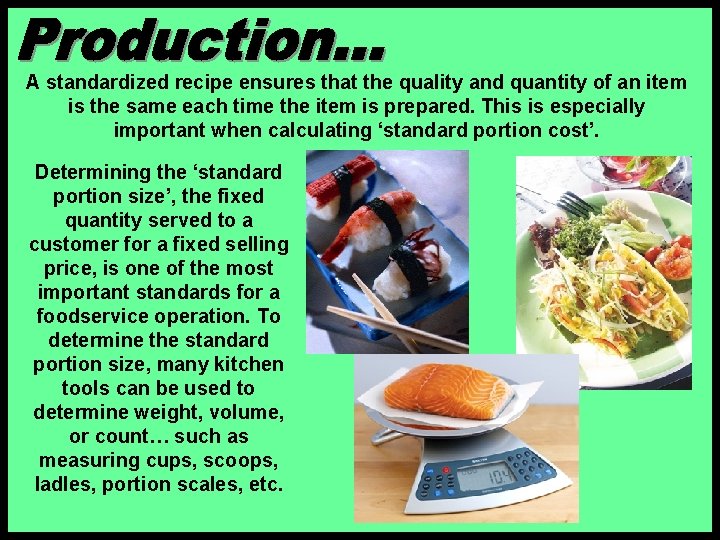
A standardized recipe ensures that the quality and quantity of an item is the same each time the item is prepared. This is especially important when calculating ‘standard portion cost’. Determining the ‘standard portion size’, the fixed quantity served to a customer for a fixed selling price, is one of the most important standards for a foodservice operation. To determine the standard portion size, many kitchen tools can be used to determine weight, volume, or count… such as measuring cups, scoops, ladles, portion scales, etc.
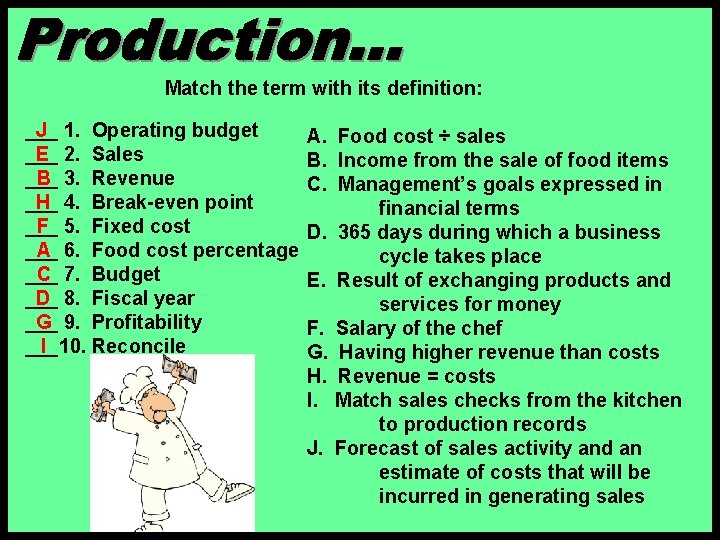
Match the term with its definition: ___ 1. Operating budget J A. Food cost ÷ sales ___ 2. Sales E B. Income from the sale of food items ___ 3. Revenue B C. Management’s goals expressed in ___ 4. Break-even point H financial terms ___ 5. Fixed cost F D. 365 days during which a business ___ 6. Food cost percentage A cycle takes place ___ 7. Budget C E. Result of exchanging products and ___ 8. Fiscal year D services for money ___ 9. Profitability G F. Salary of the chef ___10. Reconcile I G. Having higher revenue than costs H. Revenue = costs I. Match sales checks from the kitchen to production records J. Forecast of sales activity and an estimate of costs that will be incurred in generating sales
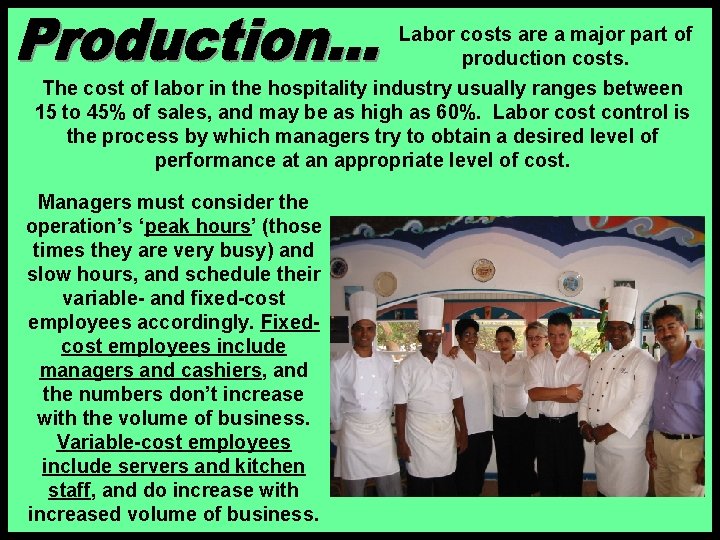
Labor costs are a major part of production costs. The cost of labor in the hospitality industry usually ranges between 15 to 45% of sales, and may be as high as 60%. Labor cost control is the process by which managers try to obtain a desired level of performance at an appropriate level of cost. Managers must consider the operation’s ‘peak hours’ (those times they are very busy) and slow hours, and schedule their variable- and fixed-cost employees accordingly. Fixedcost employees include managers and cashiers, and the numbers don’t increase with the volume of business. Variable-cost employees include servers and kitchen staff, and do increase with increased volume of business.
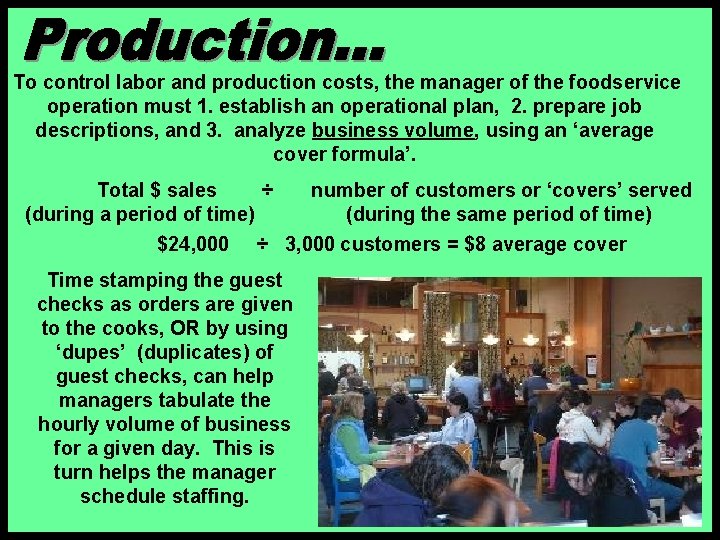
To control labor and production costs, the manager of the foodservice operation must 1. establish an operational plan, 2. prepare job descriptions, and 3. analyze business volume, using an ‘average cover formula’. Total $ sales ÷ number of customers or ‘covers’ served (during a period of time) (during the same period of time) $24, 000 ÷ 3, 000 customers = $8 average cover Time stamping the guest checks as orders are given to the cooks, OR by using ‘dupes’ (duplicates) of guest checks, can help managers tabulate the hourly volume of business for a given day. This is turn helps the manager schedule staffing.
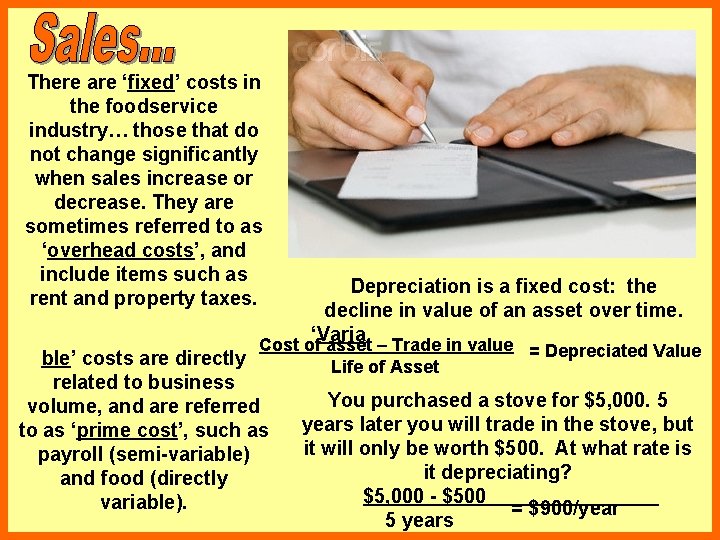
There are ‘fixed’ costs in the foodservice industry… those that do not change significantly when sales increase or decrease. They are sometimes referred to as ‘overhead costs’, and include items such as rent and property taxes. Depreciation is a fixed cost: the decline in value of an asset over time. ‘Varia Cost of asset – Trade in value = Depreciated Value ble’ costs are directly Life of Asset related to business You purchased a stove for $5, 000. 5 volume, and are referred to as ‘prime cost’, such as years later you will trade in the stove, but it will only be worth $500. At what rate is payroll (semi-variable) it depreciating? and food (directly $5, 000 - $500 variable). = $900/year 5 years
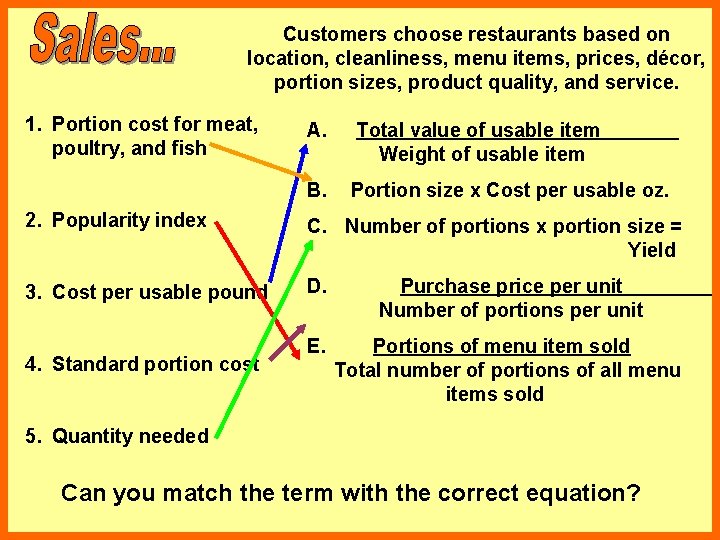
Customers choose restaurants based on location, cleanliness, menu items, prices, décor, portion sizes, product quality, and service. 1. Portion cost for meat, poultry, and fish A. Total value of usable item Weight of usable item B. Portion size x Cost per usable oz. 2. Popularity index C. Number of portions x portion size = Yield 3. Cost per usable pound D. Purchase price per unit Number of portions per unit 4. Standard portion cost E. Portions of menu item sold Total number of portions of all menu items sold 5. Quantity needed Can you match the term with the correct equation?
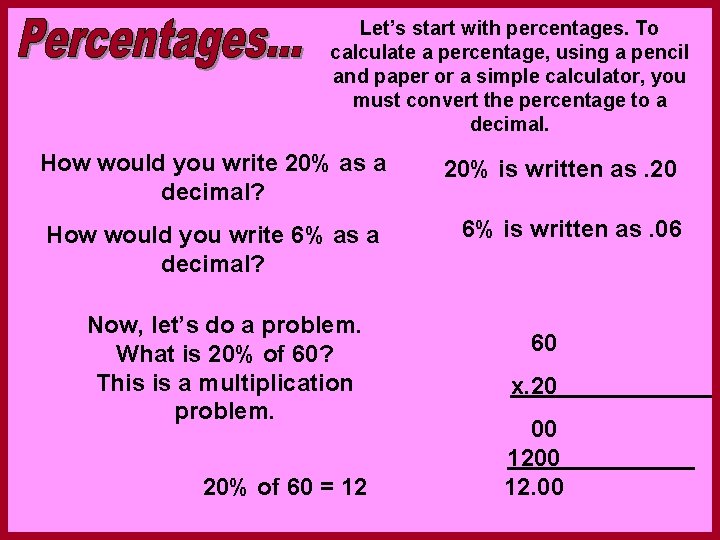
Let’s start with percentages. To calculate a percentage, using a pencil and paper or a simple calculator, you must convert the percentage to a decimal. How would you write 20% as a 20% is written as. 20 decimal? How would you write 6% as a decimal? Now, let’s do a problem. What is 20% of 60? This is a multiplication problem. 20% of 60 = 12 6% is written as. 06 60 x. 20 00 12. 00
A food service manager budgets 4% of her total $856, 000 budget for marketing. What is her annual marketing budget? $856, 000 x. 04 = $34, 240 So, how much will she spend per month? $34, 240 ÷ 12 = $2, 853. 3333333 which would correctly be rounded to the closest hundredth… $2, 853. 33
Of the 4, 500 customers the restaurant served last month, 710 ordered items from the ‘light menu’ selections. What percentage is this? 710 ÷ 4, 500 = 15. 7% This could be rounded up to 16%. . . since the 7 is greater than 5.
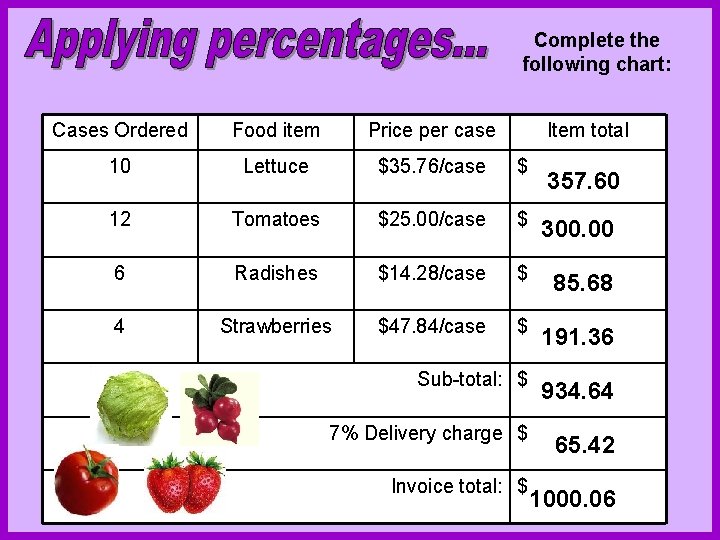
Complete the following chart: Cases Ordered Food item Price per case Item total 10 Lettuce $35. 76/case $ 12 Tomatoes $25. 00/case $ 300. 00 6 Radishes $14. 28/case $ 85. 68 4 Strawberries $47. 84/case $ 191. 36 Sub-total: $ 934. 64 7% Delivery charge $ 65. 42 Invoice total: $ 357. 60 1000. 06
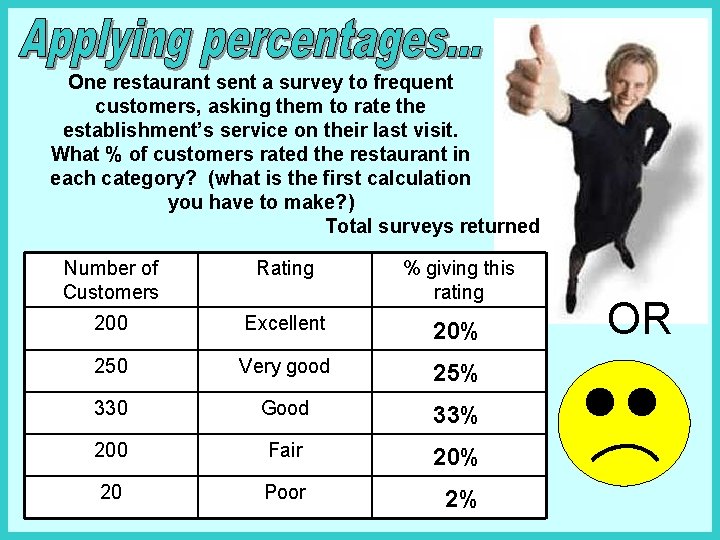
One restaurant sent a survey to frequent customers, asking them to rate the establishment’s service on their last visit. What % of customers rated the restaurant in each category? (what is the first calculation you have to make? ) Total surveys returned Number of Customers Rating % giving this rating 200 Excellent 20% 250 Very good 25% 330 Good 33% 200 Fair 20% 20 Poor 2% OR
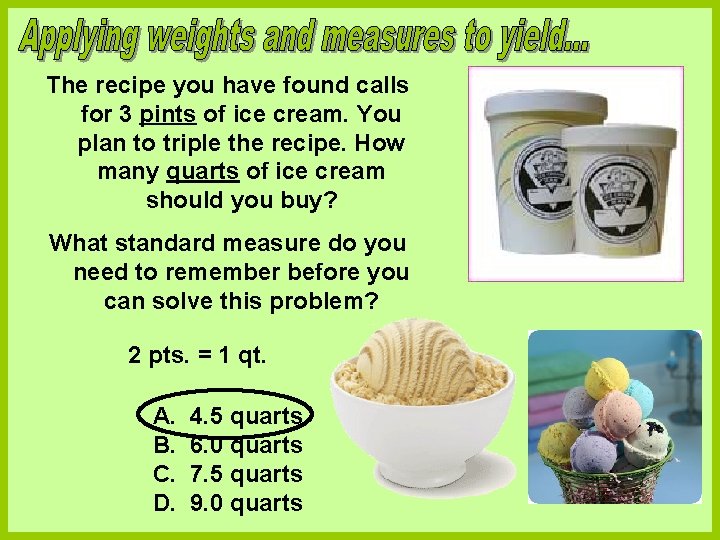
The recipe you have found calls for 3 pints of ice cream. You plan to triple the recipe. How many quarts of ice cream should you buy? What standard measure do you need to remember before you can solve this problem? 2 pts. = 1 qt. A. 4. 5 quarts B. 6. 0 quarts C. 7. 5 quarts D. 9. 0 quarts
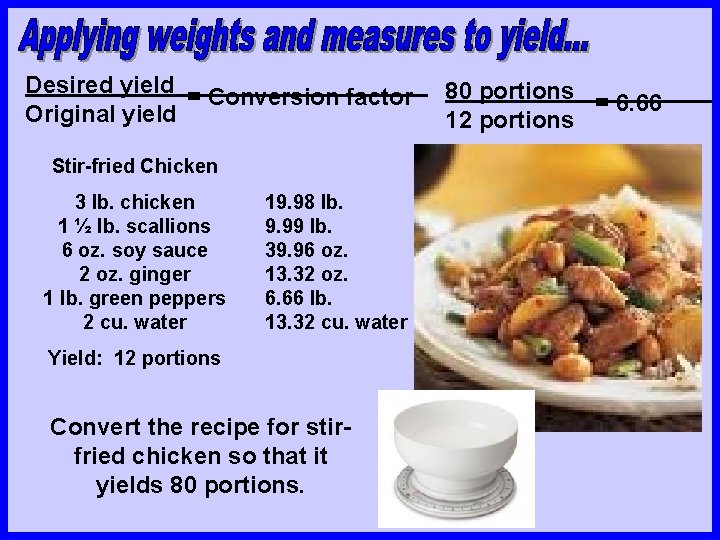
Desired yield = Conversion factor 80 portions = 6. 66 Original yield 12 portions Stir-fried Chicken 3 lb. chicken 19. 98 lb. 9. 99 lb. 1 ½ lb. scallions 6 oz. soy sauce 39. 96 oz. 2 oz. ginger 13. 32 oz. 1 lb. green peppers 6. 66 lb. 2 cu. water 13. 32 cu. water Yield: 12 portions Convert the recipe for stirfried chicken so that it yields 80 portions.
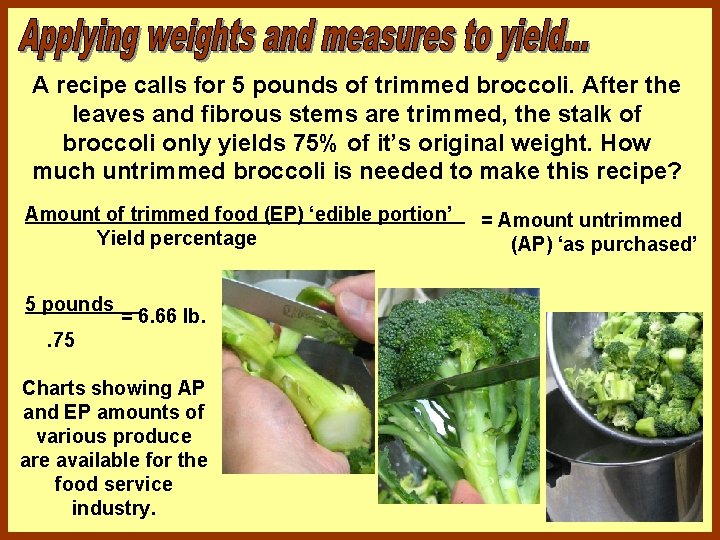
A recipe calls for 5 pounds of trimmed broccoli. After the leaves and fibrous stems are trimmed, the stalk of broccoli only yields 75% of it’s original weight. How much untrimmed broccoli is needed to make this recipe? Amount of trimmed food (EP) ‘edible portion’ = Amount untrimmed Yield percentage (AP) ‘as purchased’ 5 pounds = 6. 66 lb. . 75 Charts showing AP and EP amounts of various produce are available for the food service industry.
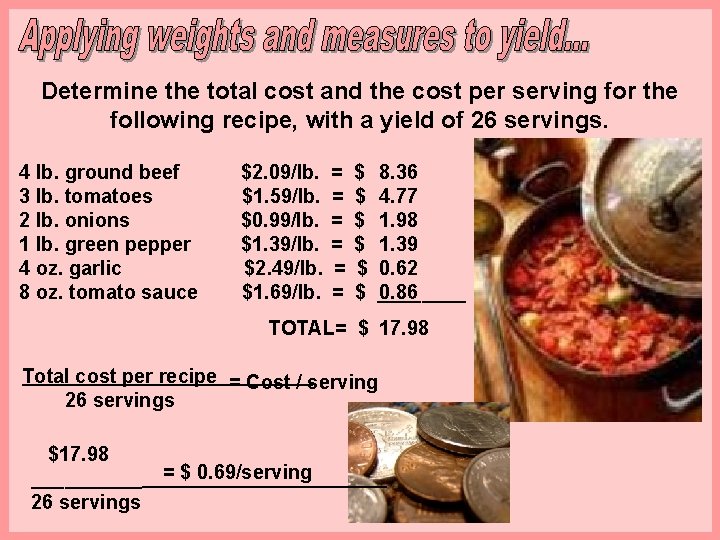
Determine the total cost and the cost per serving for the following recipe, with a yield of 26 servings. 4 lb. ground beef $2. 09/lb. = $ 8. 36 3 lb. tomatoes $1. 59/lb. = $ 4. 77 2 lb. onions $0. 99/lb. = $ 1. 98 1 lb. green pepper $1. 39/lb. = $ 1. 39 4 oz. garlic $2. 49/lb. = $ 0. 62 8 oz. tomato sauce $1. 69/lb. = $ ____ 0. 86 TOTAL= $ 17. 98 Total cost per recipe = Cost / serving 26 servings $17. 98 = $ 0. 69/serving _____ 26 servings
High employee turnover, a high ratio of employees who leave compared to the number of total employees, accounts for high labor costs. There is added cost in finding, hiring, and training new employees. When employees are well trained, they perform more effectively, experience greater job satisfaction, and turnover is reduced. If a restaurant employs 75 people, and 21 have left in the past year, what is this establishment’s employee turnover rate? 21÷ 75 = 28% turnover
If a restaurant’s average daily food cost is $1, 422. 00 and its average daily sales total is $2, 665. 00, what is the operation’s average daily food cost percentage? Cost ÷ Sales = Food cost percentage $1, 422 ÷ $2, 665 = 53% A restaurant has 98 seats and will be open for 340 days. It expects next year’s customer turnover to be 2 and projects a check average of $11. 25. What is the establishment’s projected revenue for the year? When projecting foodservice revenue, a variety of factors come into play: number of seats, estimated A. $187, 400 customer turnover (the number of customers that will be B. $468, 500 seated in each seat per day), estimated average check, C. $749, 700 and number of days the operation will be serving D. $934, 800 (#of seats x customer turnover per day) x # of days food is served x $ per average check = projected revenue (98 x 2) x 340 x $11. 25 =
A foodservice operation projects next year’s fixed costs to be $376, 800 and variable costs to be 24% of sales. At what level of revenue will the operation break even? To solve these problems, you can use a cost/volume/profit formula At what level of revenue will the operation earn a profit of $75, 000? $376, 800 + 0 = $376, 800 ÷. 76 = $495, 789. 47 break even point 100%-24% $376, 800 + 75, 000 = $451, 800 ÷. 76 = $594, 473. 68 revenue needed 100% - 24% to earn a profit of $75, 000 Try another: A restaurant projects next year’s fixed costs to be $860, 540 and variable costs to be 15% of sales. At what level will the restaurant break even? $860, 540 ÷. 85 = $1, 012, 400. 00 At what level will they earn a $100, 000 profit? $960, 540 ÷. 85 = $1, 130, 047
If a restaurant had total sales last month of $64, 578, and served a total of 2, 966 customers, what was the operation’s average sale per customer? $21. 77 One guest check includes soup @ $3. 95; salad @ $3. 45; bacon burger @ $6. 95; chicken teriyaki @ $8. 95; 2 coffees @ 1. 05 each; and Key Lime pie @ $2. 95. Calculate the total check, adding 8% tax. $28. 35+ 2. 27 tax= $30. 62
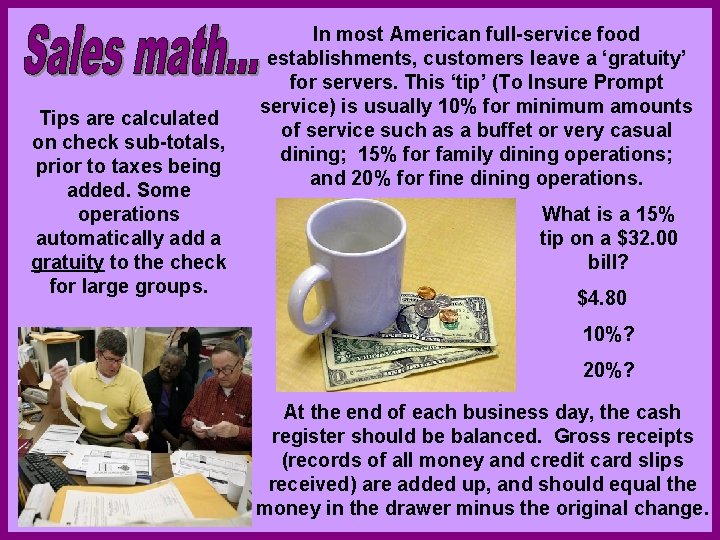
Tips are calculated on check sub-totals, prior to taxes being added. Some operations automatically add a gratuity to the check for large groups. In most American full-service food establishments, customers leave a ‘gratuity’ for servers. This ‘tip’ (To Insure Prompt service) is usually 10% for minimum amounts of service such as a buffet or very casual dining; 15% for family dining operations; and 20% for fine dining operations. What is a 15% tip on a $32. 00 bill? $4. 80 10%? 20%? At the end of each business day, the cash register should be balanced. Gross receipts (records of all money and credit card slips received) are added up, and should equal the money in the drawer minus the original change.
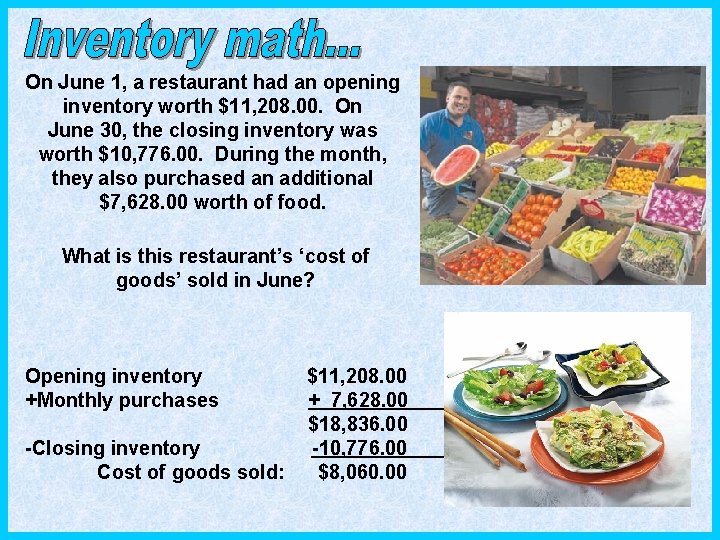
On June 1, a restaurant had an opening inventory worth $11, 208. 00. On June 30, the closing inventory was worth $10, 776. 00. During the month, they also purchased an additional $7, 628. 00 worth of food. What is this restaurant’s ‘cost of goods’ sold in June? Opening inventory $11, 208. 00 +Monthly purchases + 7, 628. 00 $18, 836. 00 -Closing inventory -10, 776. 00 Cost of goods sold: $8, 060. 00
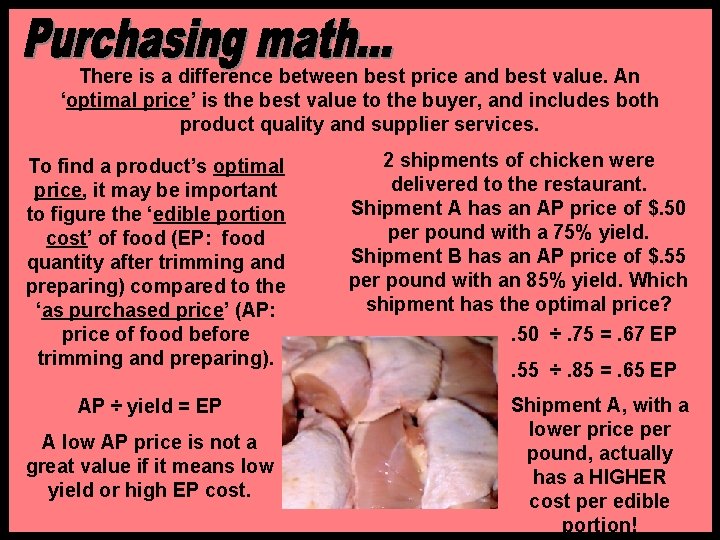
There is a difference between best price and best value. An ‘optimal price’ is the best value to the buyer, and includes both product quality and supplier services. 2 shipments of chicken were To find a product’s optimal delivered to the restaurant. price, it may be important Shipment A has an AP price of $. 50 to figure the ‘edible portion per pound with a 75% yield. cost’ of food (EP: food Shipment B has an AP price of $. 55 quantity after trimming and per pound with an 85% yield. Which preparing) compared to the shipment has the optimal price? ‘as purchased price’ (AP: . 50 ÷. 75 =. 67 EP price of food before trimming and preparing). . 55 ÷. 85 =. 65 EP AP ÷ yield = EP A low AP price is not a great value if it means low yield or high EP cost. Shipment A, with a lower price per pound, actually has a HIGHER cost per edible portion!
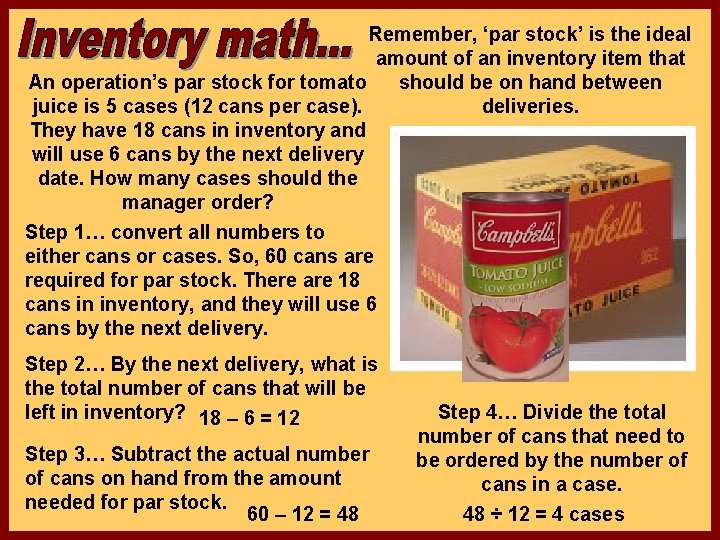
Remember, ‘par stock’ is the ideal amount of an inventory item that An operation’s par stock for tomato should be on hand between juice is 5 cases (12 cans per case). deliveries. They have 18 cans in inventory and will use 6 cans by the next delivery date. How many cases should the manager order? Step 1… convert all numbers to either cans or cases. So, 60 cans are required for par stock. There are 18 cans in inventory, and they will use 6 cans by the next delivery. Step 2… By the next delivery, what is the total number of cans that will be left in inventory? 18 – 6 = 12 Step 3… Subtract the actual number of cans on hand from the amount needed for par stock. 60 – 12 = 48 Step 4… Divide the total number of cans that need to be ordered by the number of cans in a case. 48 ÷ 12 = 4 cases