
The Mars Climate Database MCD version 5 2
The Mars Climate Database (MCD version 5. 2) PM #1 09/07/2015 Torino
What is the Mars Climate Database ? • The Mars Climate Database (MCD) is a database derived from Global Climate Model (GCM) simulations, using the LMD-GCM. • The MCD is intended to be useful for engineering applications (e. g. Entry Descent & Landing studies) and scientific work which require accurate knowledge of the Martian atmosphere (e. g. Analysis of observations). • The MCD is freely available, either via light online access (http: //www-mars. lmd. jussieu. fr) for moderate needs, or a full version which includes advanced post-processing software (Fortran subroutine call_mcd; examples of C, C++, IDL, MATLAB, SCILAB, python interfaces are provided). • MCD v 4. x and v 5. x (v 5. 0 released in 2012, v 5. 1 in 2014 and v 5. 2 in March 2015) have been distributed to more than 250 teams around the world.
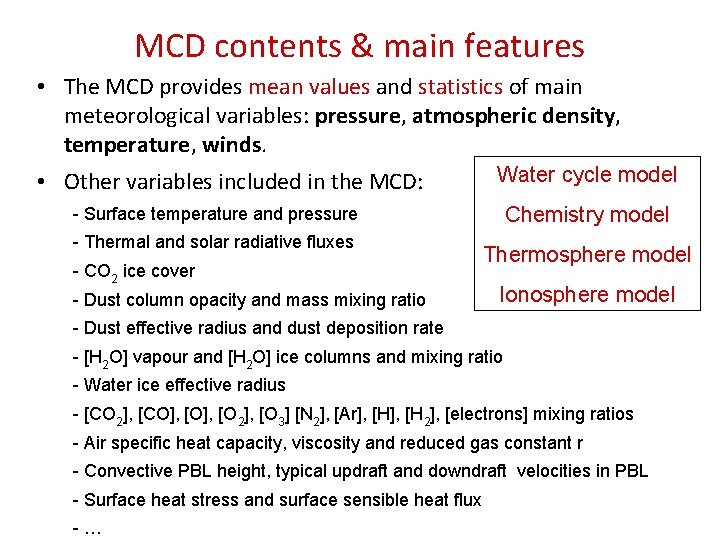
MCD contents & main features • The MCD provides mean values and statistics of main meteorological variables: pressure, atmospheric density, temperature, winds. • Other variables included in the MCD: Water cycle model Chemistry model - Surface temperature and pressure - Thermal and solar radiative fluxes - CO 2 ice cover - Dust column opacity and mass mixing ratio Thermosphere model Ionosphere model - Dust effective radius and dust deposition rate - [H 2 O] vapour and [H 2 O] ice columns and mixing ratio - Water ice effective radius - [CO 2], [CO], [O 2], [O 3] [N 2], [Ar], [H 2], [electrons] mixing ratios - Air specific heat capacity, viscosity and reduced gas constant r - Convective PBL height, typical updraft and downdraft velocities in PBL - Surface heat stress and surface sensible heat flux -…
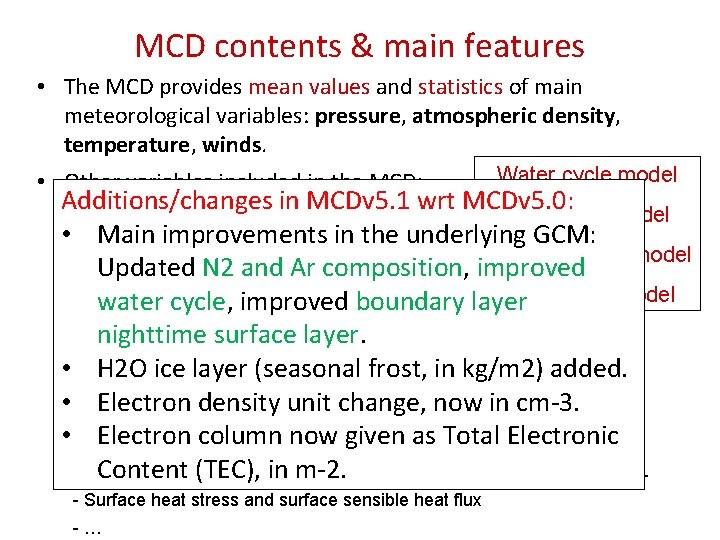
MCD contents & main features • The MCD provides mean values and statistics of main meteorological variables: pressure, atmospheric density, temperature, winds. • Other variables included in the MCD: Water cycle model Additions/changes in MCDv 5. 1 wrt MCDv 5. 0: - Surface temperature and pressure Chemistry model • - Thermal Main improvements in the underlying GCM: and solar radiative fluxes Thermosphere model Updated N 2 and Ar composition, improved - CO ice cover 2 Ionosphere model - Dust column opacity and mass mixing ratio water cycle, improved boundary layer - Dust effective radius and dust deposition rate nighttime surface layer. - [H 2 O] vapour and [H 2 O] ice columns and mixing ratio • - Water H 2 O ice layer (seasonal frost, in kg/m 2) added. ice effective radius • - [CO Electron density unit change, now in cm-3. ], [CO], [O 2], [O 3] [N 2], [Ar], [H 2], [electrons] mixing ratios 2 • - Air. Electron column now given as Total Electronic specific heat capacity, viscosity and reduced gas constant r - Convective PBL height, typical updraft and downdraft velocities in PBL Content (TEC), in m-2. - Surface heat stress and surface sensible heat flux -…
MCD contents & main features • The MCD provides mean values and statistics of main meteorological variables: pressure, atmospheric density, temperature, winds. • Other variables included in the MCD: Water cycle model Additions/changes in MCDv 5. 1 wrt MCDv 5. 0: - Surface temperature and pressure Chemistry model • - Thermal Main improvements in the underlying GCM: and solar radiative fluxes Additions/changes in MCDv 5. 2 wrt MCDv 5. 1: Thermosphere model Updated N 2 and Ar composition, improved - CO cover • 2 ice. Corrected vertical winds (bugged in MCDv 5. 0). Ionosphere model - Dust column opacity and mass mixing ratio water cycle, improved boundary layer • Improved interpolation scheme for the near- Dust effective radius and dust deposition rate nighttime surface layer. - [H 2 O] vapour and [H 2 O] ice columns and mixing ratio • - Water H 2 O ice layer (seasonal frost, in kg/m 2) added. • ice More control on combined small and large scale effective radius • - [CO Electron density unit change, now in cm-3. ], [CO], [O 2], [O 3] [N 2], [Ar], [H 2], [electrons] mixing ratios perturbations to avoid (extremely rare cases of) 2 • - Air. Electron column now given as Total Electronic specific heat capacity, viscosity and reduced gas constant r unphysical negative density. - Convective PBL height, typical updraft and downdraft velocities in PBL Content (TEC), in m-2. • Added outputs: Local Mean Solar Time, Sun-Mars - Surface heat stress and surface sensible heat flux -… distance, solar zenith angle
MCD contents & main features • The MCD enables to reconstruct realistic conditions using: - day-to-day variability of main variables - adding random small scale perturbations as vertical gravity waves (of user specified wavelength) - adding random large scale perturbations (extracted from EOFs of individual GCM runs) • The MCD provides a high resolution mode based on 32 pix. /deg. MOLA topography (where GCM resolution is 5. 625° x 3. 75°) combined to Viking Lander 1 pressure records, which yields: - high resolution surface pressure - reconstructed high resolution atmospheric temperature, using an empirical scheme validated using high resolution GCM runs.

MCD contents & main features • The dust load of the Martian atmosphere is highly variable; the MCD includes 4 dust scenarios to bracket reality, topped by 3 EUV scenarios to account for the Sun’s 11 year cycle. • New in MCDv 5. 2: Mars Years 24 to 31 cases Opportunity entry profile • Climatology: “Best guess” scenario for a typical Mars year • Cold: very clear sky • Warm: dusty atmosphere • Dust Storm: severe global dust storm • Opportunity landed during a local dust storm in MY 26 (retrieved by P. Withers)
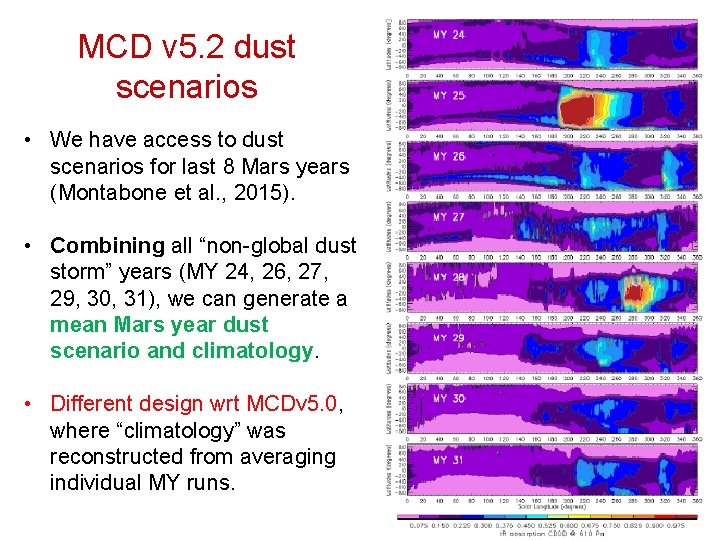
MCD v 5. 2 dust scenarios • We have access to dust scenarios for last 8 Mars years (Montabone et al. , 2015). • Combining all “non-global dust storm” years (MY 24, 26, 27, 29, 30, 31), we can generate a mean Mars year dust scenario and climatology. • Different design wrt MCDv 5. 0, where “climatology” was reconstructed from averaging individual MY runs.
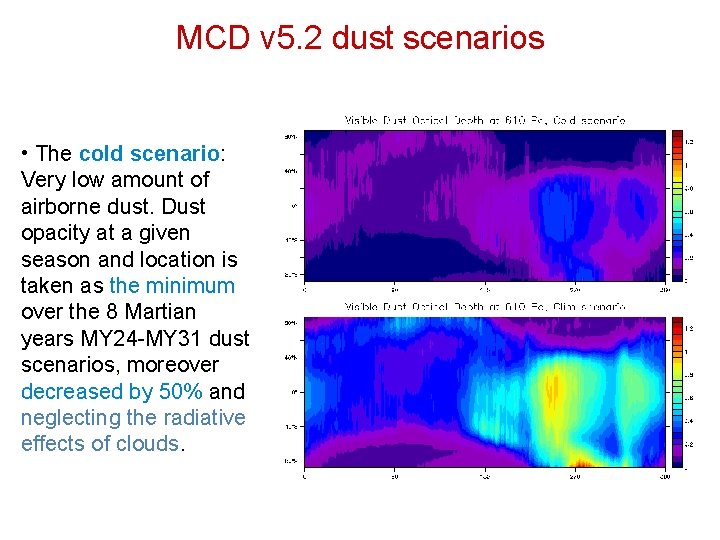
MCD v 5. 2 dust scenarios • The cold scenario: Very low amount of airborne dust. Dust opacity at a given season and location is taken as the minimum over the 8 Martian years MY 24 -MY 31 dust scenarios, moreover decreased by 50% and neglecting the radiative effects of clouds.
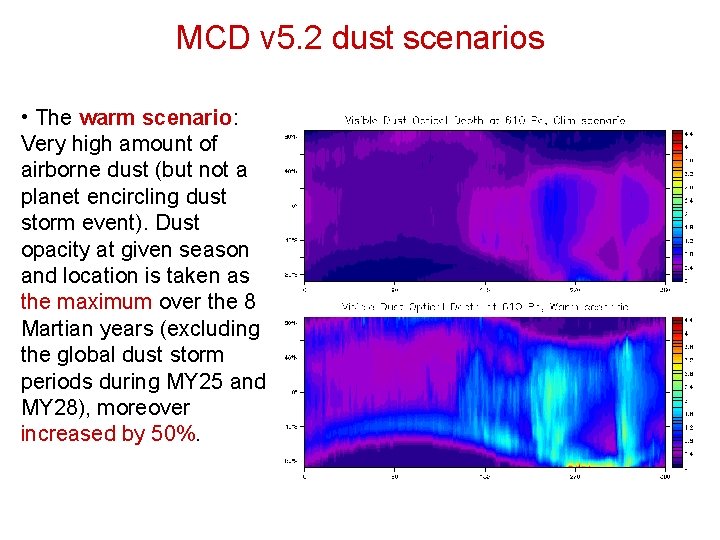
MCD v 5. 2 dust scenarios • The warm scenario: Very high amount of airborne dust (but not a planet encircling dust storm event). Dust opacity at given season and location is taken as the maximum over the 8 Martian years (excluding the global dust storm periods during MY 25 and MY 28), moreover increased by 50%.
MCD v 5. 2 dust scenarios • The dust storm scenario: An extreme case of fixed high opacity (tau=5) combined with “darker dust” properties (ie: using Ockert-Bell dust properties instead of Wolff et al. properties). Only generated for the second half (Ls=180° to 360°) of the year. • Moreover (change in design wrt to earlier MCDv 5. 0), the dust storm conditions are ran starting from “climatology” initial conditions every Martian month (30° of Ls). This enforces realistic CO 2 (and associated surface pressure) and H 2 O cycles while capturing the effect of the onset of an intense planet encircling dust storm => Recall that MCD data is stored at 12 times of day for 12 distinct months, from which is reconstructed, by interpolation, the state of the system at a given date and time of day.
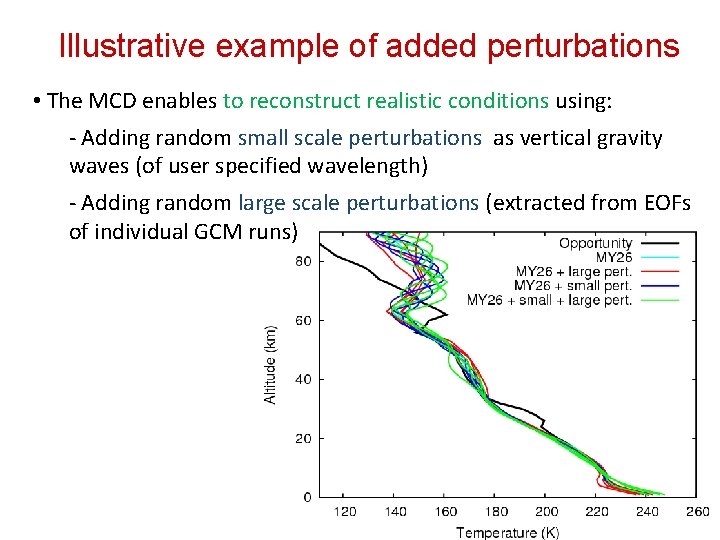
Illustrative example of added perturbations • The MCD enables to reconstruct realistic conditions using: - Adding random small scale perturbations as vertical gravity waves (of user specified wavelength) - Adding random large scale perturbations (extracted from EOFs of individual GCM runs)
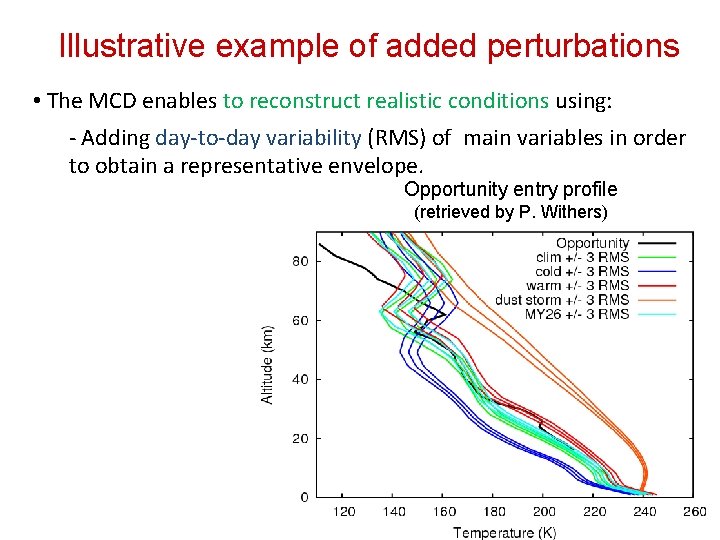
Illustrative example of added perturbations • The MCD enables to reconstruct realistic conditions using: - Adding day-to-day variability (RMS) of main variables in order to obtain a representative envelope. Opportunity entry profile (retrieved by P. Withers)
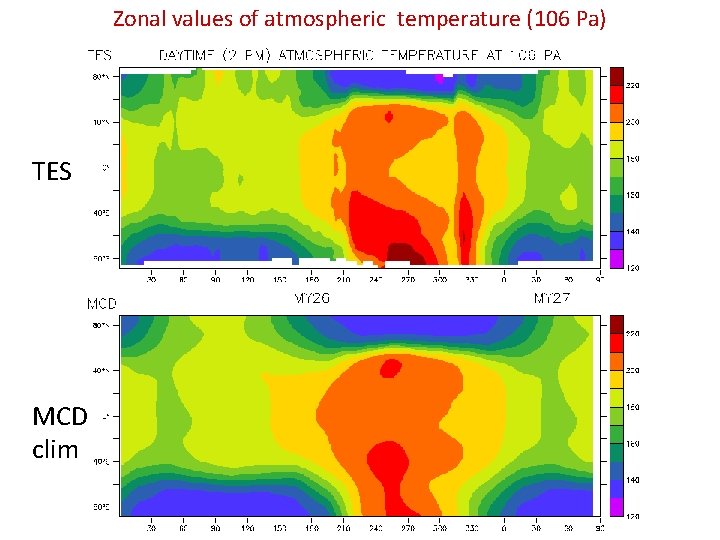
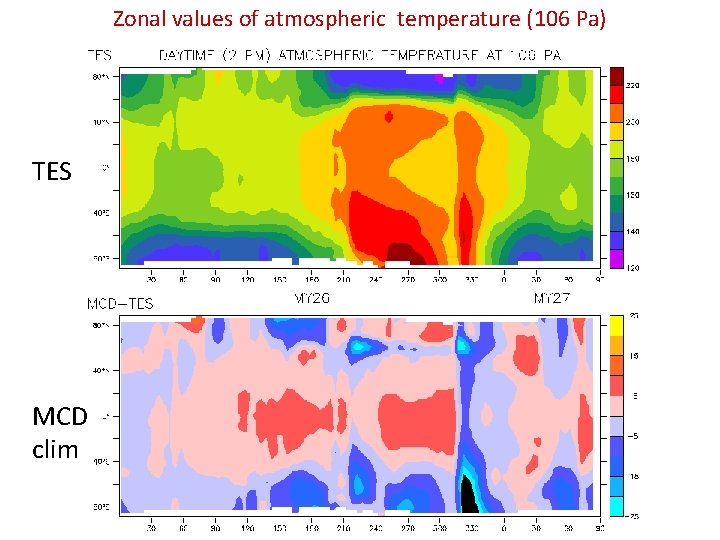
Validation of the MCD climatology • Ongoing work (concerning v 5. 2) • Available measurements are the best way to evaluate and validate the MCD, e. g. : - Surface temperatures, atmospheric temperatures and water vapour can be compared to TES values. - Atmospheric temperatures and water ice can be compared to MCS values. - Atmospheric temperatures can be compared to MGS and Mars Express Radio Occultations. - Surface pressures can be compared to Viking Lander, Pathfinder, Phoenix and MSL measurements. - …
Surface Pressure Viking Landers Mars Years 12 -13
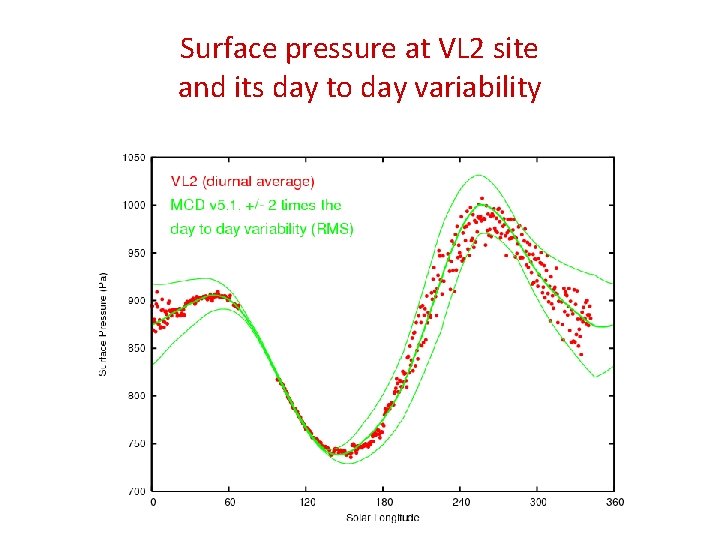
Surface pressure at VL 2 site and its day to day variability
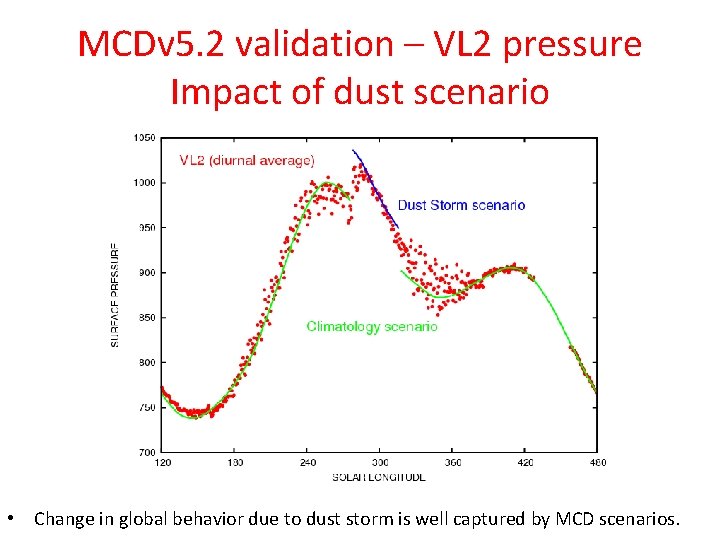
MCDv 5. 2 validation – VL 2 pressure Impact of dust scenario • Change in global behavior due to dust storm is well captured by MCD scenarios.
Surface Pressure REMS onboard Curiosity Mars Year 31
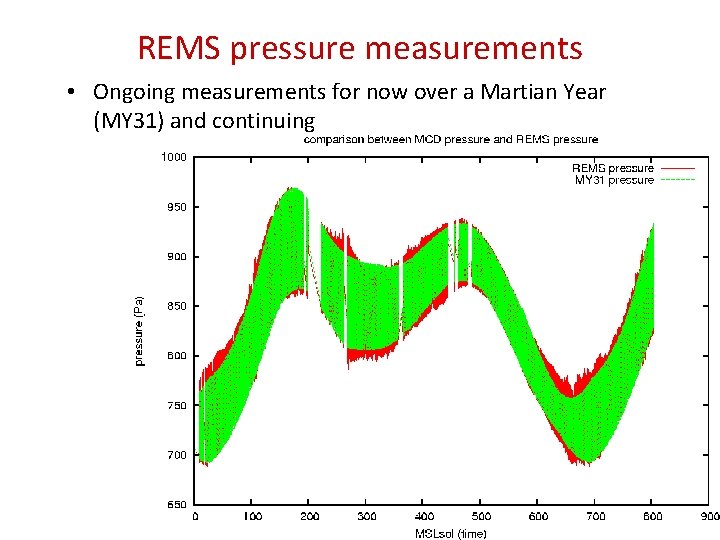
REMS pressure measurements • Ongoing measurements for now over a Martian Year (MY 31) and continuing
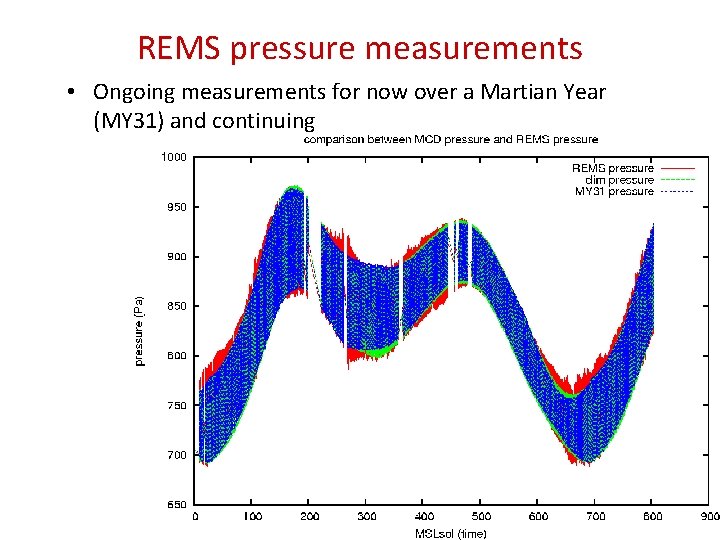
REMS pressure measurements • Ongoing measurements for now over a Martian Year (MY 31) and continuing
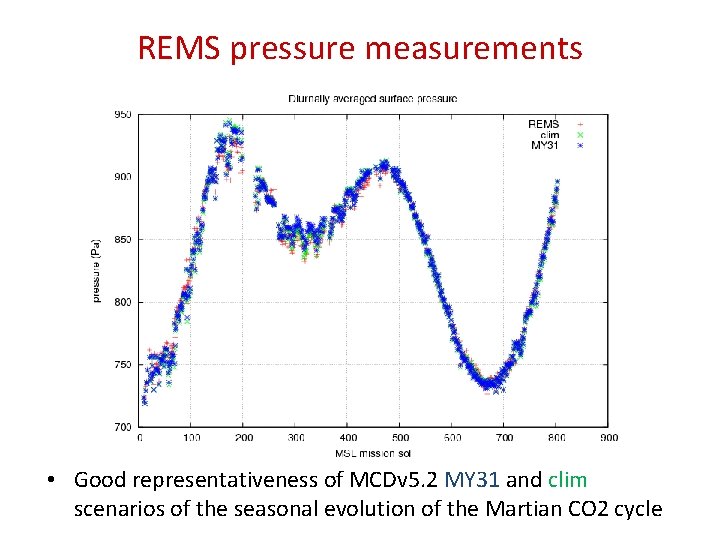
REMS pressure measurements • Good representativeness of MCDv 5. 2 MY 31 and clim scenarios of the seasonal evolution of the Martian CO 2 cycle
Atmospheric Temperature TES onboard MGS Mars Years 24 -27 (2 am-2 pm measurements)
Zonal values of atmospheric temperature (106 Pa) TES MCD clim
Zonal values of atmospheric temperature (106 Pa) TES MCD clim
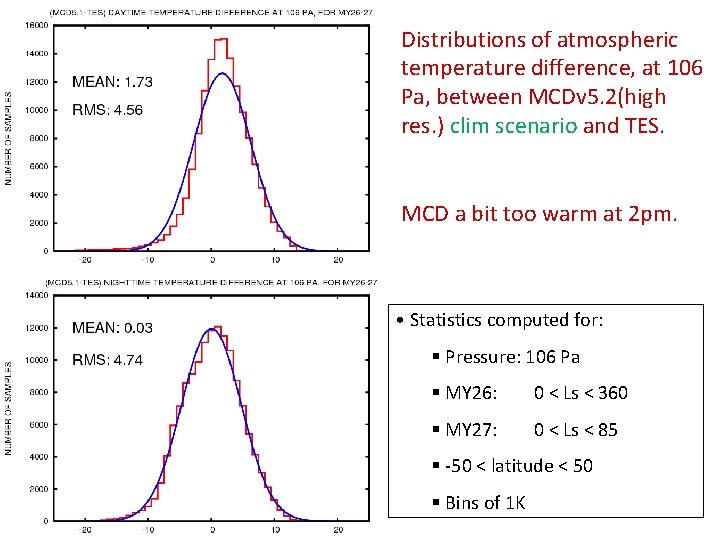
Distributions of atmospheric temperature difference, at 106 Pa, between MCDv 5. 2(high res. ) clim scenario and TES. MCD a bit too warm at 2 pm. • Statistics computed for: Pressure: 106 Pa MY 26: 0 < Ls < 360 MY 27: 0 < Ls < 85 -50 < latitude < 50 Bins of 1 K
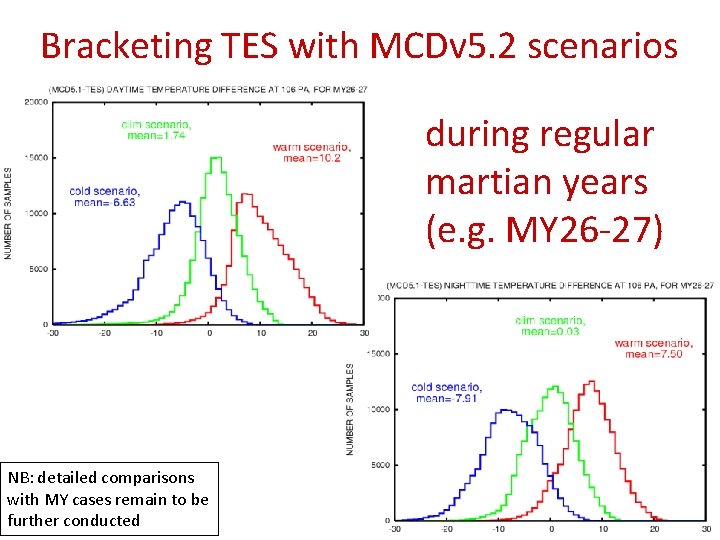
Bracketing TES with MCDv 5. 2 scenarios during regular martian years (e. g. MY 26 -27) NB: detailed comparisons with MY cases remain to be further conducted
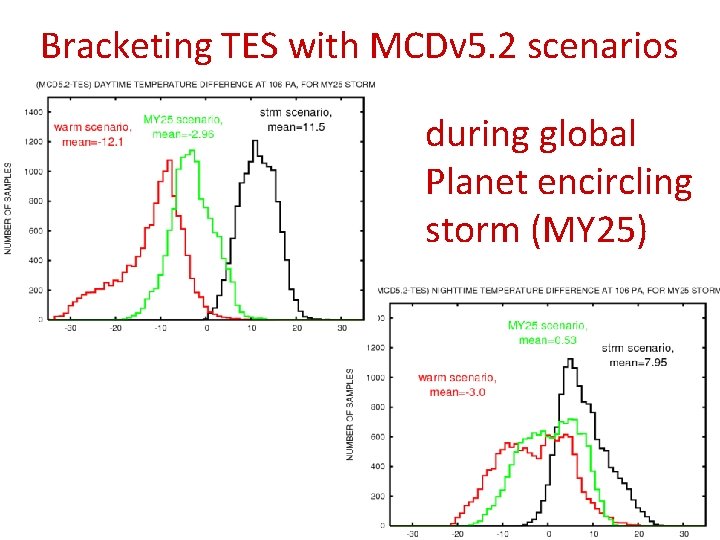
Bracketing TES with MCDv 5. 2 scenarios during global Planet encircling storm (MY 25)
Atmospheric Temperature MCS onboard MRO Mars Years 28 -31 (3 am-3 pm measurements)
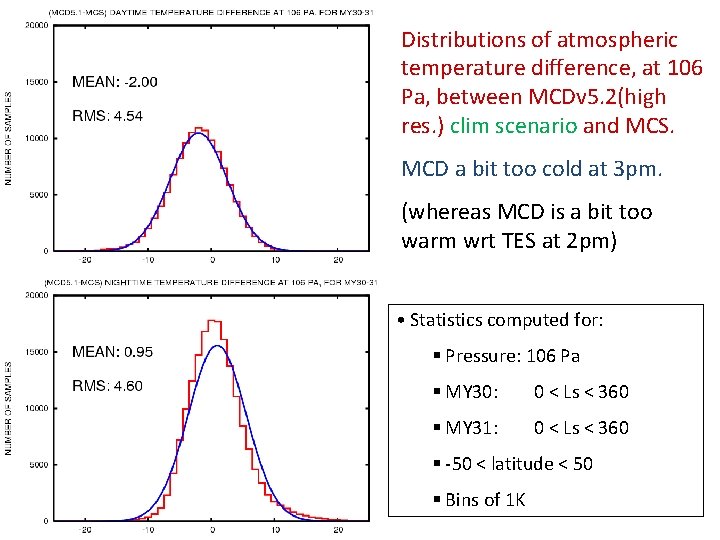
Distributions of atmospheric temperature difference, at 106 Pa, between MCDv 5. 2(high res. ) clim scenario and MCS. MCD a bit too cold at 3 pm. (whereas MCD is a bit too warm wrt TES at 2 pm) • Statistics computed for: Pressure: 106 Pa MY 30: 0 < Ls < 360 MY 31: 0 < Ls < 360 -50 < latitude < 50 Bins of 1 K
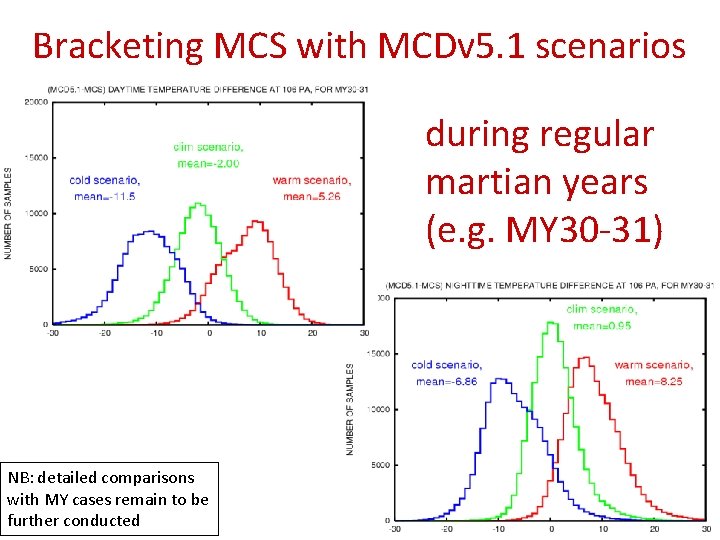
Bracketing MCS with MCDv 5. 1 scenarios during regular martian years (e. g. MY 30 -31) NB: detailed comparisons with MY cases remain to be further conducted
Validation of the MCDv 5. 2 climatology • Ongoing work => Goal: Make a validation document • Using all available measurements: - Surface temperatures, atmospheric temperatures and water vapour can be compared to TES values. - Atmospheric temperatures and water ice can be compared to MCS values. - Atmospheric temperatures can be compared to MGS and Mars Express Radio Occultations. - Surface pressures can be compared to Viking Lander, Pathfinder, Phoenix and MSL measurements. - …
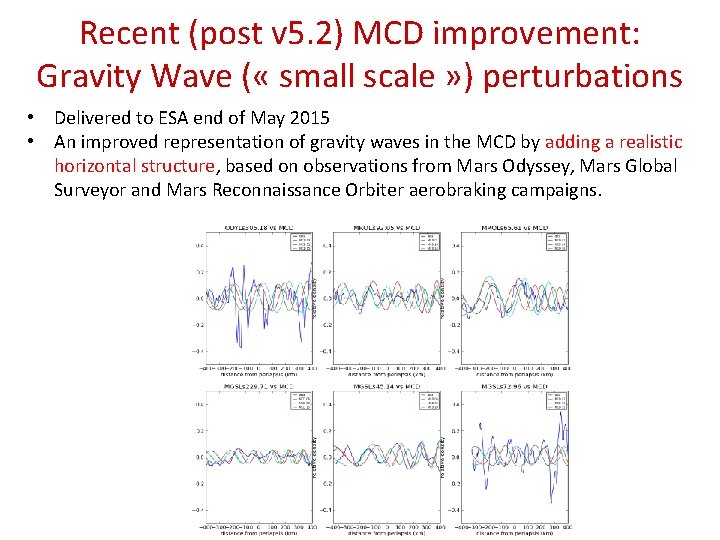
Recent (post v 5. 2) MCD improvement: Gravity Wave ( « small scale » ) perturbations • Delivered to ESA end of May 2015 • An improved representation of gravity waves in the MCD by adding a realistic horizontal structure, based on observations from Mars Odyssey, Mars Global Surveyor and Mars Reconnaissance Orbiter aerobraking campaigns.
- Slides: 32