
THE MARKET SYSTEM Public Sector and Government Functions
THE MARKET SYSTEM Public Sector and Government Functions AP ECONOMICS CHAPTER 4 Mc. Connell Brue
MARKET SYSTEM CHARACTERISTICS n PUBLIC SECTOR – includes all levels of government (national, state & local) ¨ Performs functions not possible by private sector ¨ Provide public goods and services ¨ Receive tax revenue to pay for government spending (or borrow!)
Economic Functions of Government 1. LEGAL & SOCIAL FRAMEWORK – Laws promote order which inspires confidence in the market system ¨ Ensures property rights (deeds, titles, etc) ¨ Protects ownership through “rule of law” ¨ Courts exist to mediate disputes and provide fair and efficient solutions ¨
Economic Functions of Government 2. PROVIDE PUBLIC GOODS AND SERVICES Would not be provided by the private sector due to “free rider” problem & low incentives ¨ Can be offered to many at low additional cost ¨ Difficult to “exclude” others from using ¨ Examples: military, , police, fire protection, streets & highways, public schools, libraries, parks, monetary system, etc. ¨
Economic Functions of Government 3. MAINTAIN COMPETITION – rules for fair competition to protect businesses & consumers ¨ Monopolies are illegal (Sherman Antitrust Act) ¨ “Natural or Legal” Monopolies are allowed, but regulated ¨ Examples of legal monopoly: cable service, utility price regulation, mass transit, AMTRAK
Economic Functions of Government 4. REDISTRIBUTION OF INCOME – Market system allows unequal distribution of income. Society chooses to collectively provide help for some social problems. ¨ Progressive taxes - larger proportion of wealth of the rich is taxed ¨ Transfer payments – provide for the poor, disabled, unemployed, elderly, etc. ¨ Examples: Social Security, Medicare, Medicaid, Food Stamps, other welfare programs
Economic Functions of Government 4. REDISTRIBUTION OF INCOME (con’t) ¨Market Interventions – government regulates prices for fairness ¨ Examples: farm subsidies - payments to farmers so low price will not hurt them Minimum wage laws – require employers to pay a fair wage so less skilled workers can support themselves
Economic Functions of Government 5. CORRECTING FOR MARKET FAILURES (Externalities; Spillover Costs & Benefits) – when mkt produces wrong amount of a good or service or fails to produce at all ¨ Cost or benefits goes to neutral 3 rd party ¨ Producer does not pay full costs of production Example: secondhand smoke, pollution, drunk drivers, property improvements in neighborhood, good schools improve community, immunizations
Economic Functions of Government n CORRECTING FOR MARKET FAILURES Negative Externality can be corrected by: Laws & regulations – costs must be paid upfront or actions are outlawed; fines, etc. n Taxes – cover the cost of government cleanup or later treatment, solutions etc. n Positive Externality can be encouraged by: Subsidies to producers to increase supply Tax incentives (tax breaks, etc) Government provides goods or services
Economic Functions of Government 6. STABILIZING THE ECONOMY – to correct economic problems (mainly recession/unemployment or inflation) ¨Output depends on spending to encourage production n Too little spending = recession & unemployment n Too much spending = inflation & instability
Economic Functions of Government n STABILIZING n THE ECONOMY (con’t) Gov can correct through taxing and spending ¨Too little spending – can reduce taxes &/or increase gov spending ¨Too much spending - can increase taxes &/or decrease gov spending
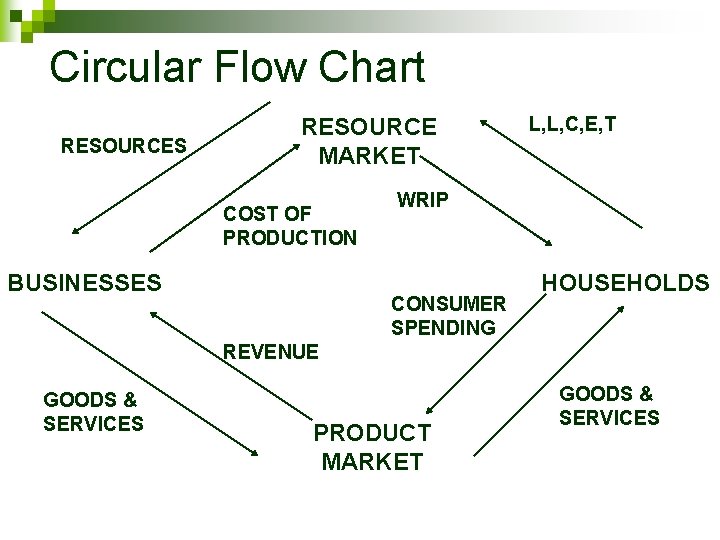
Circular Flow Chart RESOURCES RESOURCE MARKET COST OF PRODUCTION BUSINESSES L, L, C, E, T WRIP CONSUMER SPENDING HOUSEHOLDS REVENUE GOODS & SERVICES PRODUCT MARKET GOODS & SERVICES
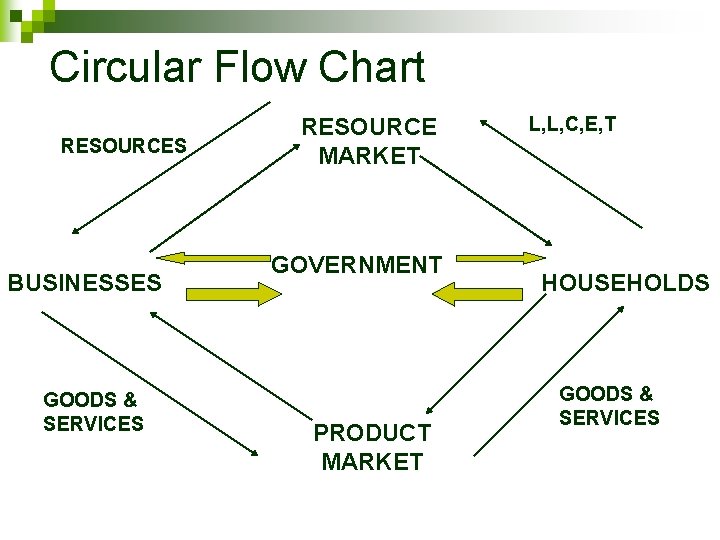
Circular Flow Chart RESOURCES BUSINESSES GOODS & SERVICES RESOURCE MARKET GOVERNMENT PRODUCT MARKET L, L, C, E, T HOUSEHOLDS GOODS & SERVICES
- Slides: 13