
THE MARKET SYSTEM and the Circular Flow Model

- Slides: 26
THE MARKET SYSTEM and the Circular Flow Model An economic system is an organized way a society provides for the wants and needs of its people, or how a society answers the three basic economic questions.
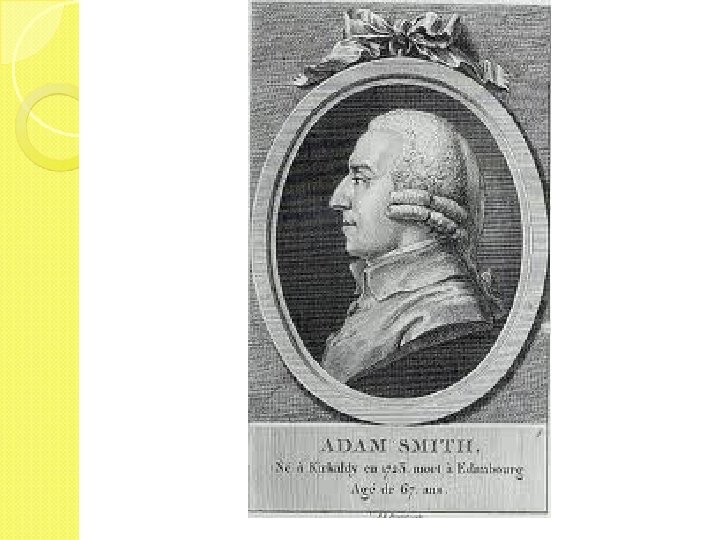
Capitalism is based on theories of Adam Smith, who wrote The Wealth of Nations in 1776. Capitalism is based on the idea of laissez-faire economics and focuses on efficiency, incentives and freedom. Adam Smith is known as the “father” of capitalism and The Invisible Hand Theory.
Important beliefs in capitalism and a market economy include: Free enterprise (economic freedom) Freedom of choice Private property Profit motive Competition Self-interest Markets and prices Active, but limited government
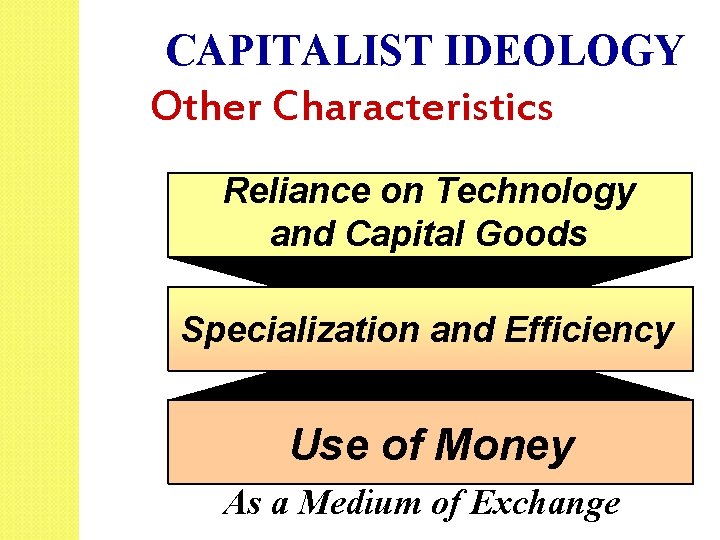
CAPITALIST IDEOLOGY Other Characteristics Reliance on Technology and Capital Goods Specialization and Efficiency Use of Money As a Medium of Exchange
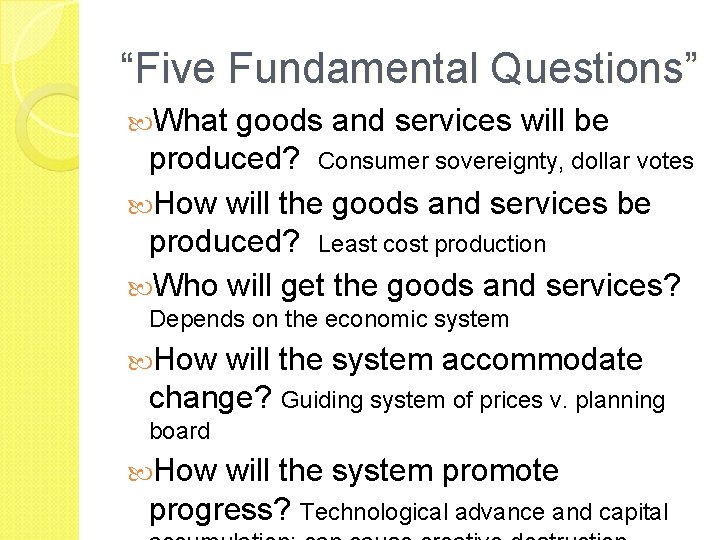
“Five Fundamental Questions” What goods and services will be produced? Consumer sovereignty, dollar votes How will the goods and services be produced? Least cost production Who will get the goods and services? Depends on the economic system How will the system accommodate change? Guiding system of prices v. planning board How will the system promote progress? Technological advance and capital
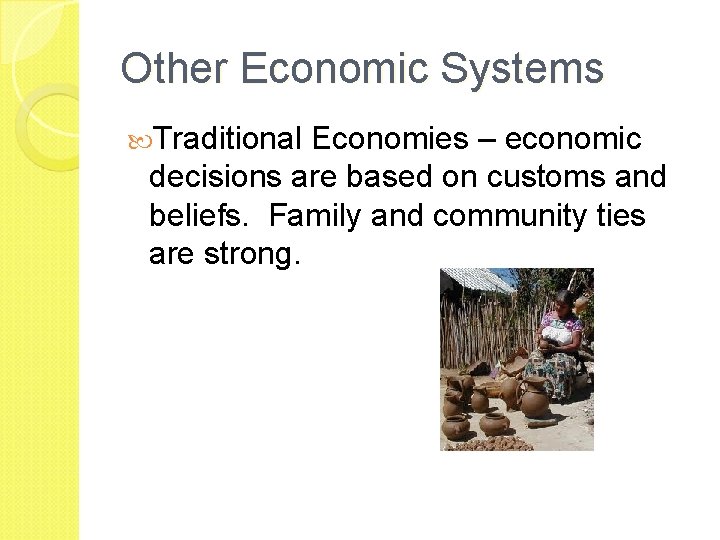
Other Economic Systems Traditional Economies – economic decisions are based on customs and beliefs. Family and community ties are strong.
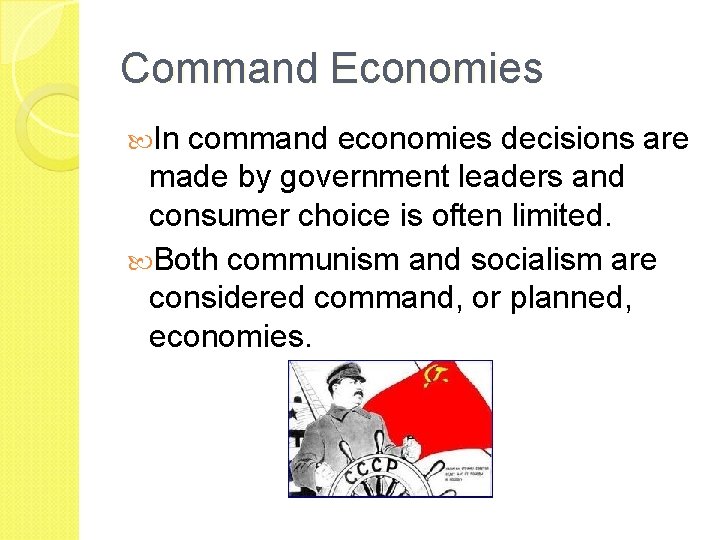
Command Economies In command economies decisions are made by government leaders and consumer choice is often limited. Both communism and socialism are considered command, or planned, economies.
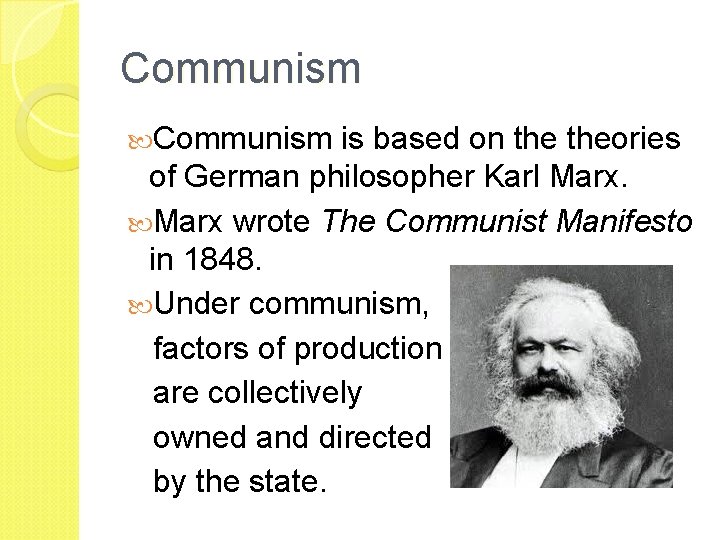
Communism is based on theories of German philosopher Karl Marx wrote The Communist Manifesto in 1848. Under communism, factors of production are collectively owned and directed by the state.
Socialism A system in which the government owns some factors of production and has a role in determining what and how goods are produced. Private property ownership is allowed to some degree. Socialism is considered less efficient than capitalism. The demise of the command economies is caused mostly by the coordination and incentive problems.
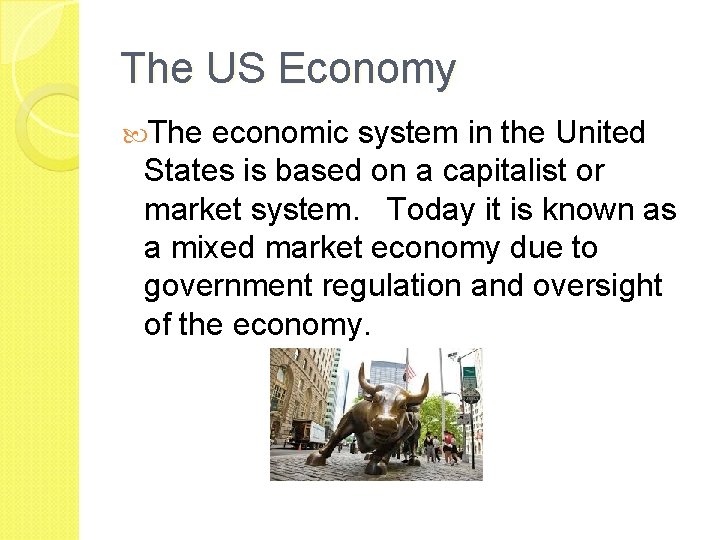
The US Economy The economic system in the United States is based on a capitalist or market system. Today it is known as a mixed market economy due to government regulation and oversight of the economy.
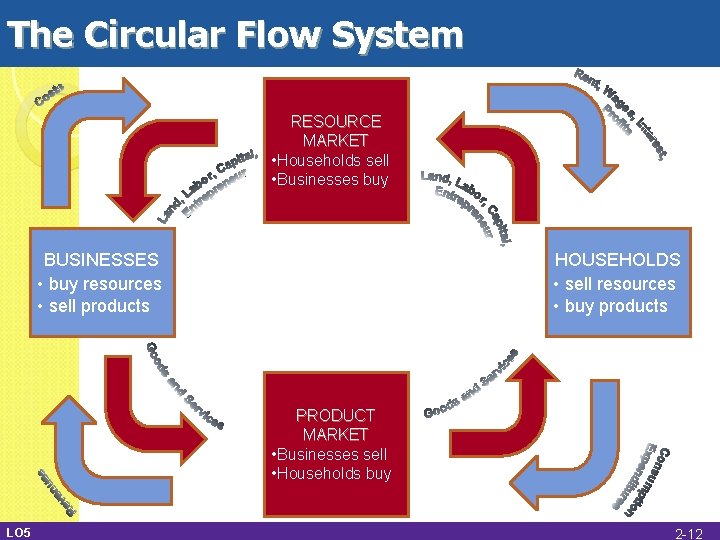
The Circular Flow System RESOURCE MARKET • Households sell • Businesses buy BUSINESSES • buy resources • sell products HOUSEHOLDS • sell resources • buy products PRODUCT MARKET • Businesses sell • Households buy LO 5 2 -12
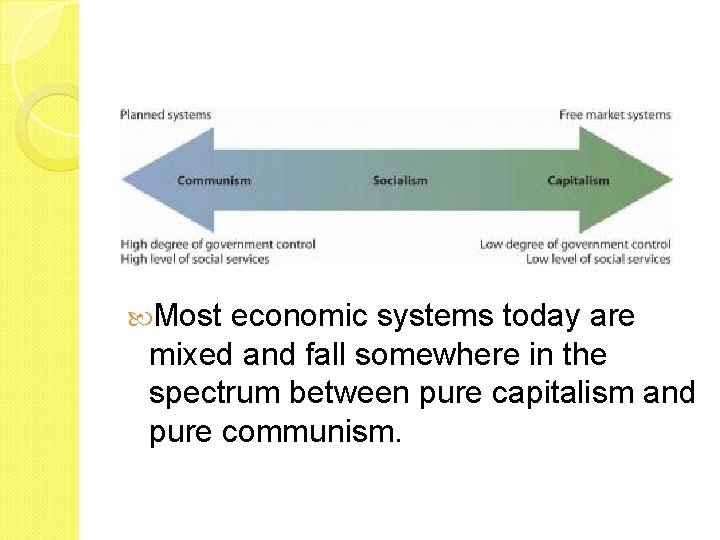
Most economic systems today are mixed and fall somewhere in the spectrum between pure capitalism and pure communism.
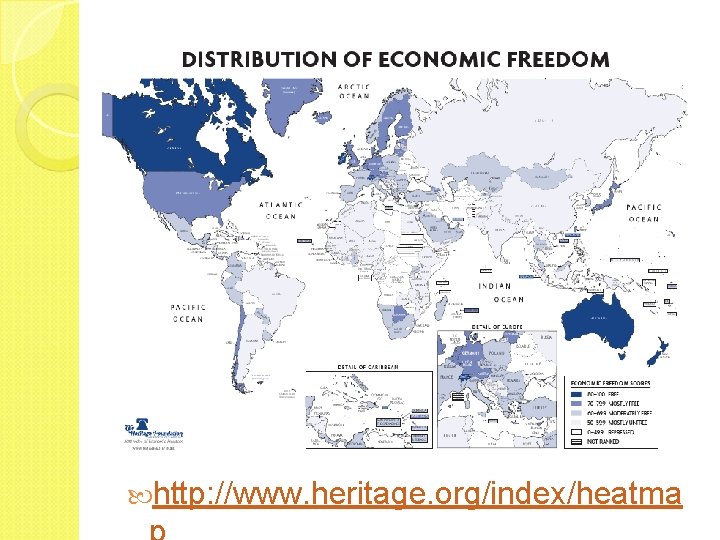
http: //www. heritage. org/index/heatma
Forms of Business Organization in the United States There are three main forms of business organization in the United States – the sole proprietorship, the partnership and the corporation
Sole Proprietorship A sole proprietorship is a business owned by one person. Advantages include ease of starting up and management, owner receives all the profits, tax advantages and pride of ownership. Disadvantages include unlimited liability, difficulty in raising financial capital and limited life.
Partnerships A partnership is a business jointly owned by two or more persons. Advantages include ease of management and establishment, additional financial capital and tax advantages. Disadvantages include unlimited liability, limited life and potential conflicts between partners.
Corporations A corporation is a form of business organization recognized by law as a separate legal entity having all the rights of an individual. Advantages include ease of raising financial capital (stocks and bonds), professional managers hired by the Board of Directors, limited liability, unlimited life. Disadvantages include the difficulty and expense of incorporating, double taxation, government regulation, separation of ownership and control and some unscrupulous practices.
Growth through Mergers There are three different types of mergers - horizontal, vertical and conglomerate.
Horizontal Merger A horizontal merger takes place when two or more firms that produce the same kind of product join forces.
Vertical Merger A vertical merger takes place when firms involved in different steps of manufacturing or marketing join together.
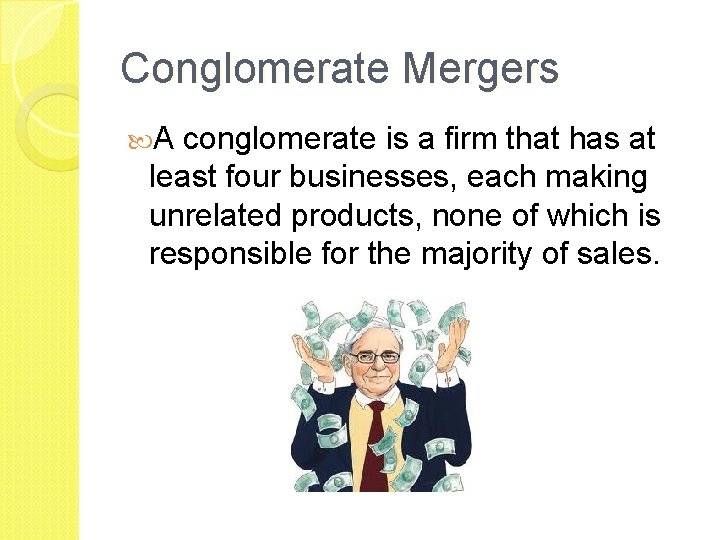
Conglomerate Mergers A conglomerate is a firm that has at least four businesses, each making unrelated products, none of which is responsible for the majority of sales.
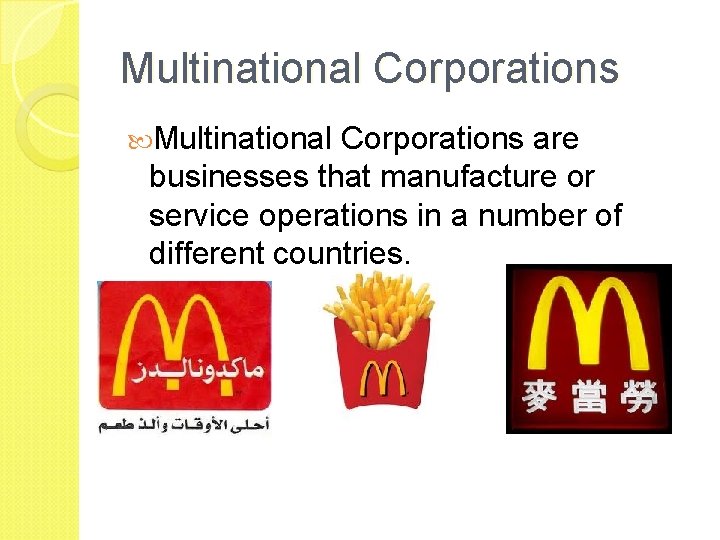
Multinational Corporations are businesses that manufacture or service operations in a number of different countries.
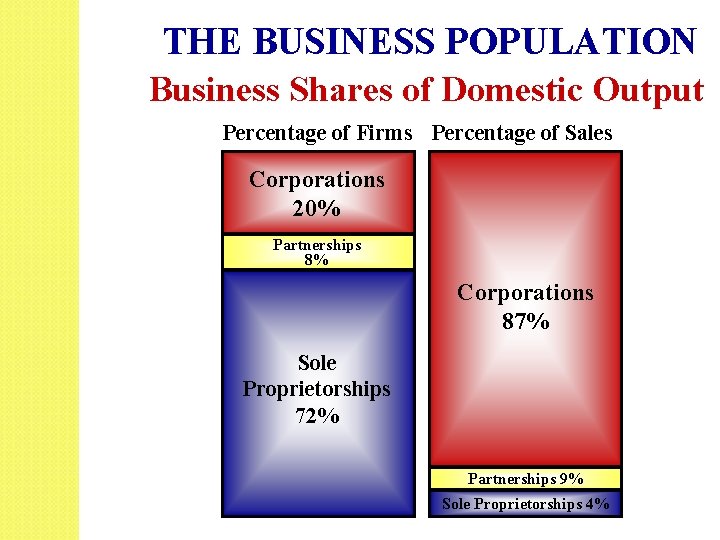
THE BUSINESS POPULATION Business Shares of Domestic Output Percentage of Firms Percentage of Sales Corporations 20% Partnerships 8% Corporations 87% Sole Proprietorships 72% Partnerships 9% Sole Proprietorships 4%
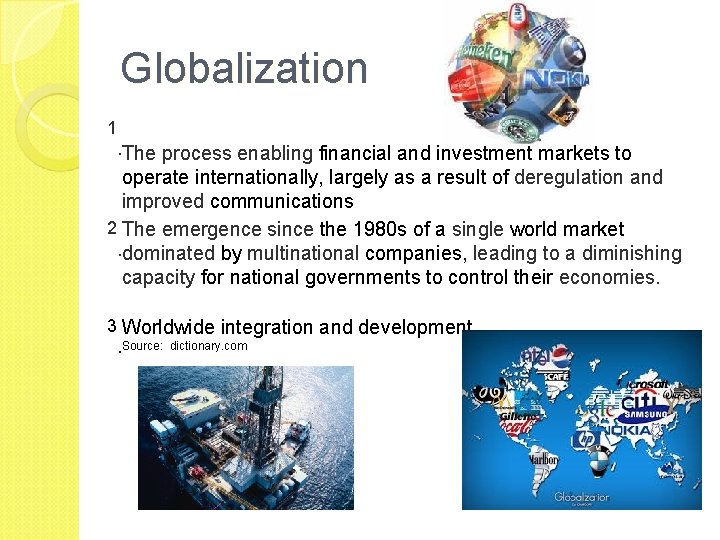
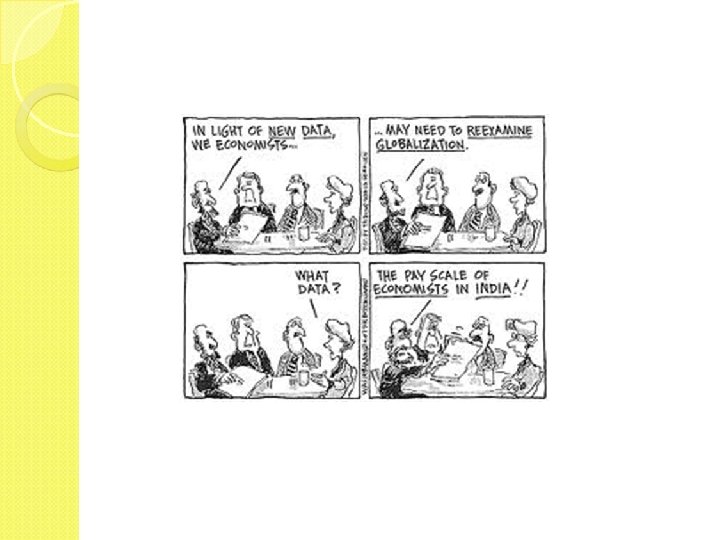
Globalization 1. The process enabling financial and investment markets to operate internationally, largely as a result of deregulation and improved communications 2 The emergence since the 1980 s of a single world market. dominated by multinational companies, leading to a diminishing capacity for national governments to control their economies. 3 Worldwide integration and development. . Source: dictionary. com