
The Market Revolution 1800 1840 Industrial Revolution Great
- Slides: 13
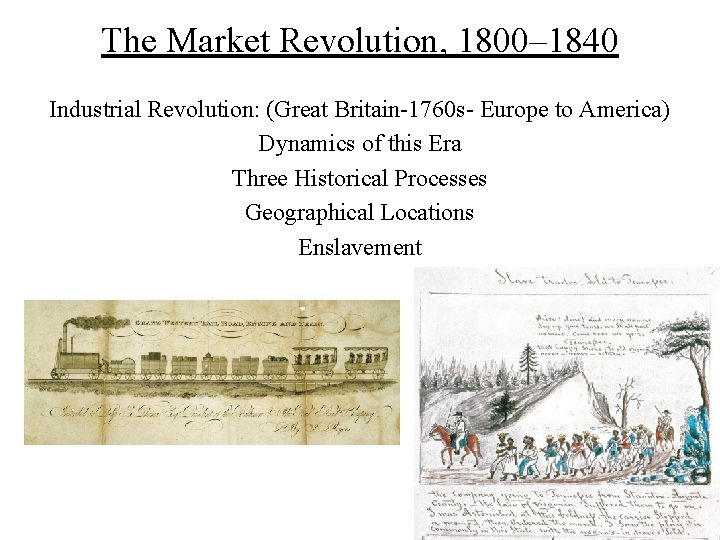
The Market Revolution, 1800– 1840 Industrial Revolution: (Great Britain-1760 s- Europe to America) Dynamics of this Era Three Historical Processes Geographical Locations Enslavement
A New Economy in the Nation • Economic changes – Colonial era – Innovations: transportation and communication • Roads and Steamboats – Toll roads (Turnpikes) – Improvement of water technology – Steamboat: Robert Fulton • The Erie Canal – 1825 upstate New York – Problems with canals • The Daguerreotype – Early form of photography: Recording of events, people, life. – Robert Cornelius’ Self-Portrait: The First Ever “Selfie” (1839)
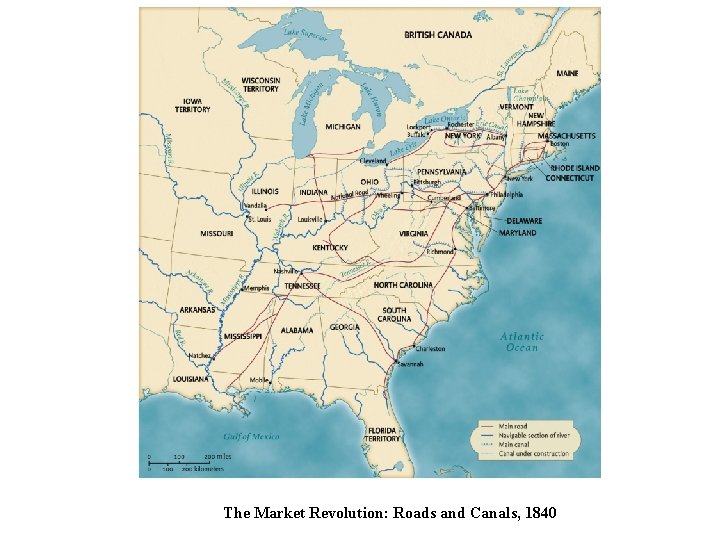
The Market Revolution: Roads and Canals, 1840
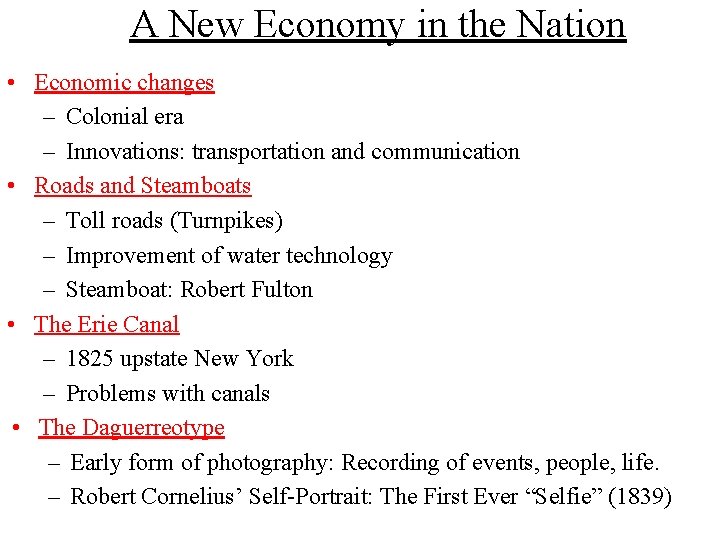
Communication: Railroads and the Telegraph • Railroads – – – Opening of new areas Stimulated coal mining Iron manufacturing 1828: Baltimore and Ohio- work on first railroad 1860: 30, 000 miles long • What Railroads Represent – – Time and Space Settlement of Railroads “Bells and Whistles” Carving out indigenous lands • Telegraph – Samuel F. B. Morse (1830 s)
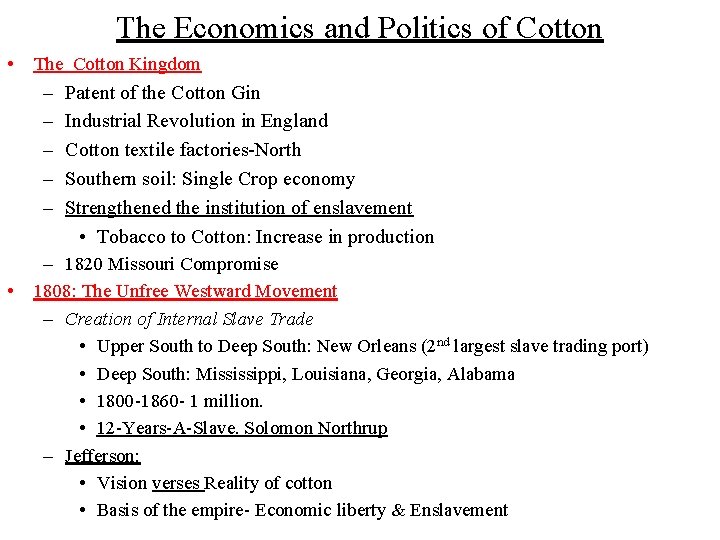
The Economics and Politics of Cotton • The Cotton Kingdom – – – • Patent of the Cotton Gin Industrial Revolution in England Cotton textile factories-North Southern soil: Single Crop economy Strengthened the institution of enslavement • Tobacco to Cotton: Increase in production – 1820 Missouri Compromise 1808: The Unfree Westward Movement – Creation of Internal Slave Trade • Upper South to Deep South: New Orleans (2 nd largest slave trading port) • Deep South: Mississippi, Louisiana, Georgia, Alabama • 1800 -1860 - 1 million. • 12 -Years-A-Slave. Solomon Northrup – Jefferson: • Vision verses Reality of cotton • Basis of the empire- Economic liberty & Enslavement
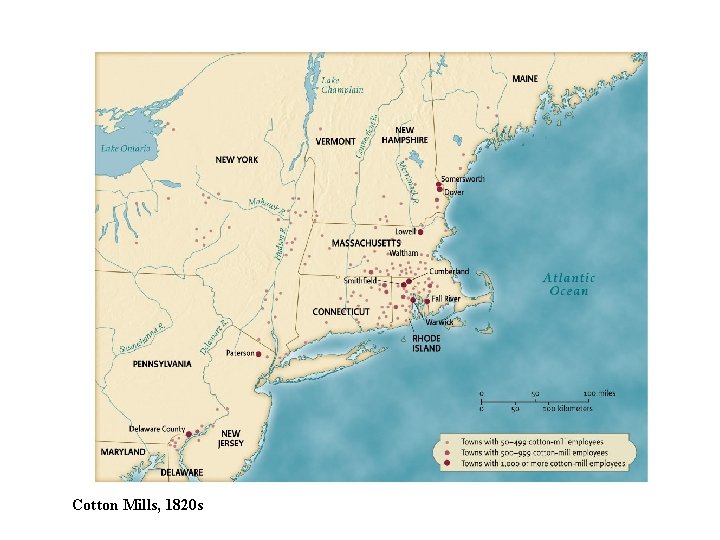
Cotton Mills, 1820 s
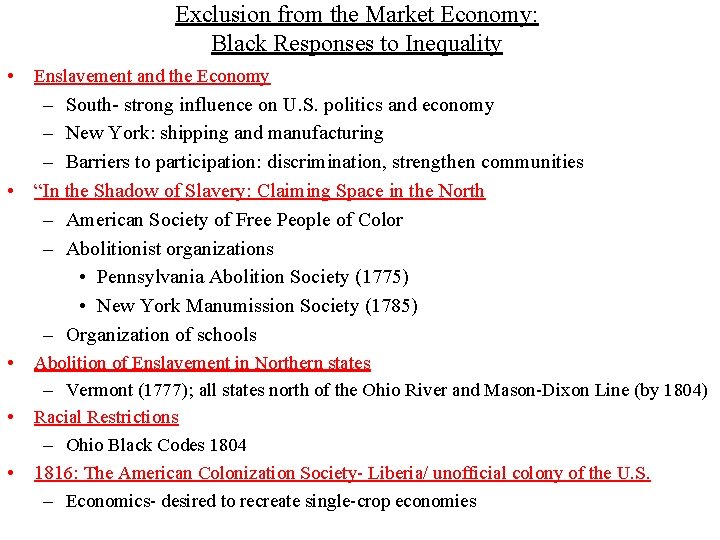
Exclusion from the Market Economy: Black Responses to Inequality • Enslavement and the Economy – South- strong influence on U. S. politics and economy – New York: shipping and manufacturing – Barriers to participation: discrimination, strengthen communities • “In the Shadow of Slavery: Claiming Space in the North – American Society of Free People of Color – Abolitionist organizations • Pennsylvania Abolition Society (1775) • New York Manumission Society (1785) – Organization of schools • Abolition of Enslavement in Northern states – Vermont (1777); all states north of the Ohio River and Mason-Dixon Line (by 1804) • Racial Restrictions – Ohio Black Codes 1804 • 1816: The American Colonization Society- Liberia/ unofficial colony of the U. S. – Economics- desired to recreate single-crop economies
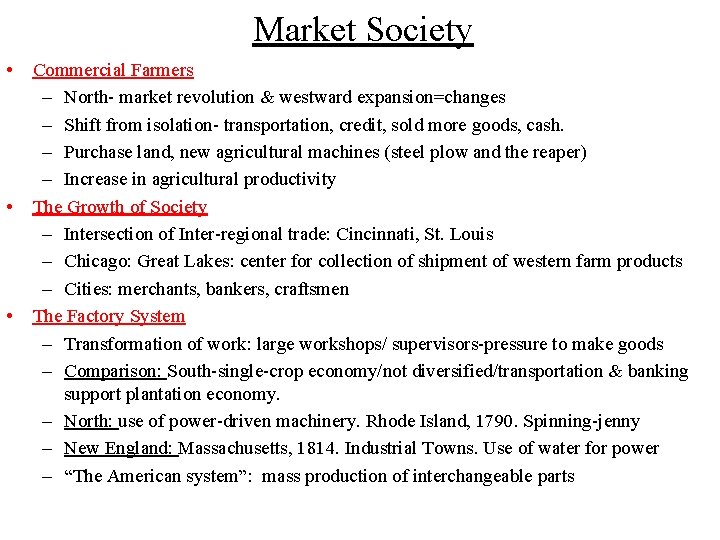
Market Society • • • Commercial Farmers – North- market revolution & westward expansion=changes – Shift from isolation- transportation, credit, sold more goods, cash. – Purchase land, new agricultural machines (steel plow and the reaper) – Increase in agricultural productivity The Growth of Society – Intersection of Inter-regional trade: Cincinnati, St. Louis – Chicago: Great Lakes: center for collection of shipment of western farm products – Cities: merchants, bankers, craftsmen The Factory System – Transformation of work: large workshops/ supervisors-pressure to make goods – Comparison: South-single-crop economy/not diversified/transportation & banking support plantation economy. – North: use of power-driven machinery. Rhode Island, 1790. Spinning-jenny – New England: Massachusetts, 1814. Industrial Towns. Use of water for power – “The American system”: mass production of interchangeable parts
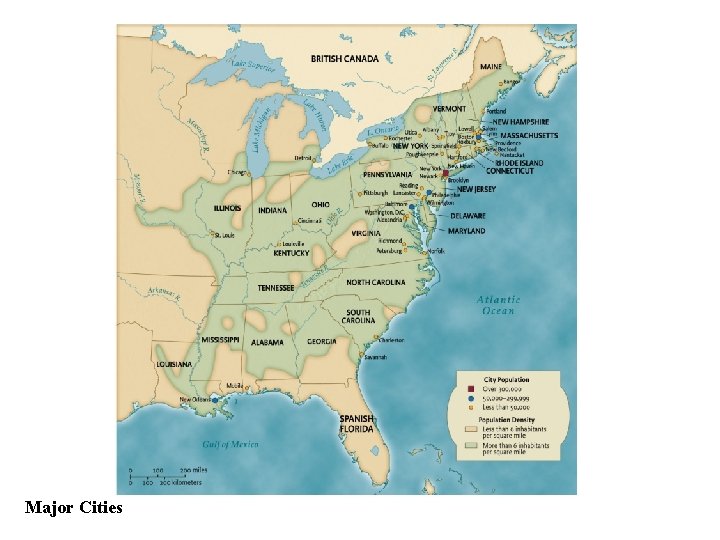
Major Cities
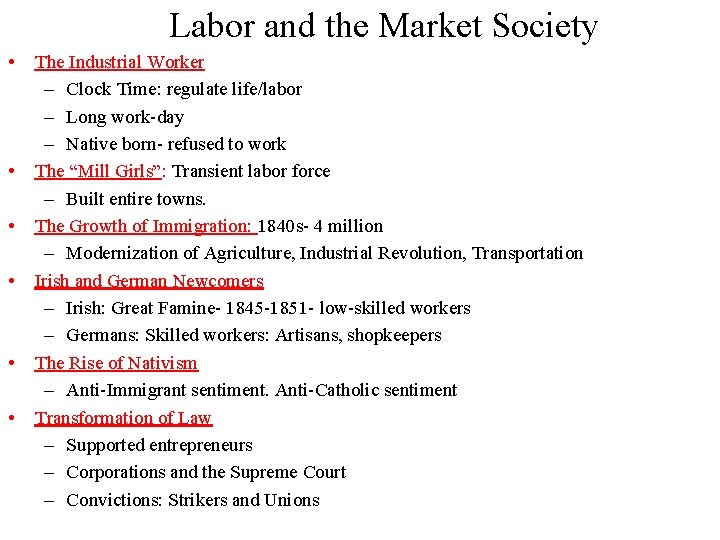
Labor and the Market Society • • • The Industrial Worker – Clock Time: regulate life/labor – Long work-day – Native born- refused to work The “Mill Girls”: Transient labor force – Built entire towns. The Growth of Immigration: 1840 s- 4 million – Modernization of Agriculture, Industrial Revolution, Transportation Irish and German Newcomers – Irish: Great Famine- 1845 -1851 - low-skilled workers – Germans: Skilled workers: Artisans, shopkeepers The Rise of Nativism – Anti-Immigrant sentiment. Anti-Catholic sentiment Transformation of Law – Supported entrepreneurs – Corporations and the Supreme Court – Convictions: Strikers and Unions
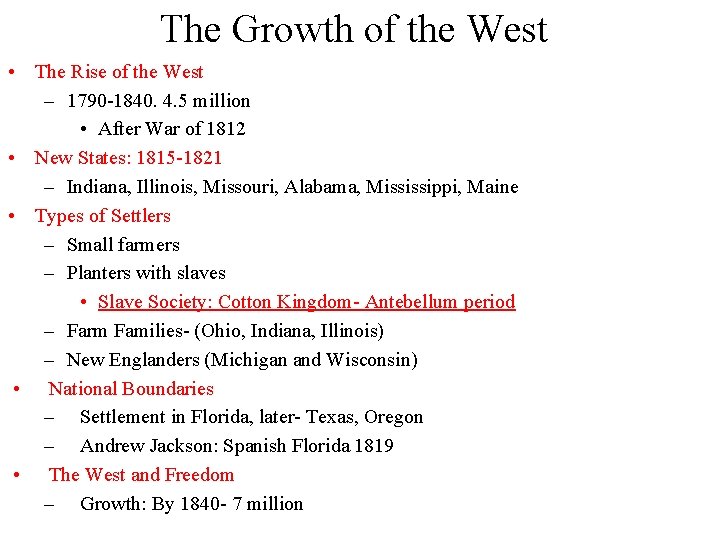
The Growth of the West • The Rise of the West – 1790 -1840. 4. 5 million • After War of 1812 • New States: 1815 -1821 – Indiana, Illinois, Missouri, Alabama, Mississippi, Maine • Types of Settlers – Small farmers – Planters with slaves • Slave Society: Cotton Kingdom- Antebellum period – Farm Families- (Ohio, Indiana, Illinois) – New Englanders (Michigan and Wisconsin) • National Boundaries – Settlement in Florida, later- Texas, Oregon – Andrew Jackson: Spanish Florida 1819 • The West and Freedom – Growth: By 1840 - 7 million
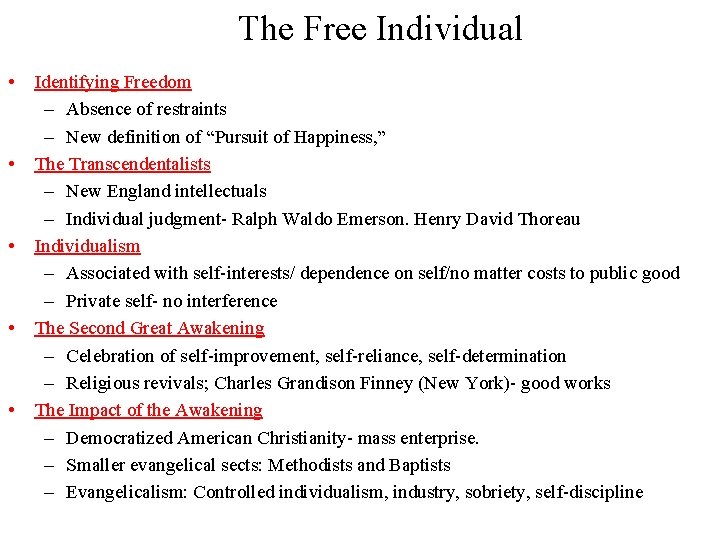
The Free Individual • • • Identifying Freedom – Absence of restraints – New definition of “Pursuit of Happiness, ” The Transcendentalists – New England intellectuals – Individual judgment- Ralph Waldo Emerson. Henry David Thoreau Individualism – Associated with self-interests/ dependence on self/no matter costs to public good – Private self- no interference The Second Great Awakening – Celebration of self-improvement, self-reliance, self-determination – Religious revivals; Charles Grandison Finney (New York)- good works The Impact of the Awakening – Democratized American Christianity- mass enterprise. – Smaller evangelical sects: Methodists and Baptists – Evangelicalism: Controlled individualism, industry, sobriety, self-discipline
The Limits of Prosperity • Liberty and Prosperity – Right to compete for economic advancement – Success stories: Opportunities- Idea of “Self-made man” – Creation of a new middle class: clerks, teachers, lawyers*, doctors* • The Cult of Domesticity – No opportunities – Private sphere: no competition from market economy – Virtue: Frail, dependent on men, minimized participation in public life • The Southern mistress • The Middle Class • Loss of Freedom: Recession (1819), Depression (1837) - unemployment • The Early Labor Movement – Workingmen’s Parties. – 1830 Union & Strikes – Concept of “wage-slavery”: Problematic comparison to enslavement