
The Market Economy in the Northern States 1790
- Slides: 14
The Market Economy in the Northern States, 1790 -1860: Economic, Social, Cultural, and Political Changes The Market Revolution affected all of the U. S. ; indeed, in some ways southern agriculture was more highly commercialized more quickly than northern agriculture. However, economic and social change produced different cultures in the different regions—largely because of two different labor systems (but also due to other factors). I. The Market Economy in the U. S. , 1790 -1860 II. The Influence of the Market Economy on the North A. Agriculture B. Industry C. “Free Labor” 1. In the Workplace 2. In American Debates over the Nature of Labor III. Expanding Roles for Women in the Antebellum North A. As Workers (Lowell, Massachusetts) B. As Reformers
Defining the Market Economy Between 1790 and 1860, the United States became more and more shaped by the market economy. In general, this meant leaving behind subsistenceoriented and household-oriented systems of production, and embracing less personal, more commercial, and more profit-oriented economic activities. ** Less bartering, more cash transactions, more wage labor; ** Greater specialization and division of labor; ** Increased emphasis of producing farm surplus for market, while reducing emphasis on subsistence agriculture; ** Development of transportation networks that facilitated shipment of products over longer distances; this required more trust in doing business with strangers or at a distance; ** Work became something undertaken in more impersonal settings; rather than working on family farms and in household production, people went to work for strangers; the system of apprenticeship (long-term training under a mentor) diminished, with many new jobs requiring fewer skills; ** Land was increasingly seen as a commodity, rather than as a “mere” home; more people engaged in land speculation; ** Rise of industry, especially in the northern states; ** Americans embraced new technologies to heighten production and accelerate transportation and commerce; good examples include the cotton gin, the steamboat, and the railroad
Key Developments in Rise of Market Economy, 1790 -1830 International Tensions Leading up to and including the War of 1812— Cut off from Britain, the U. S. was forced to grow domestic textile production Governments adopted policies to stimulate economic expansion National Bank chartered in 1816 to stabilize currency, strengthen interregional ties. Protective tariff of 1816 placed a 20% duty on selected imports in order to make U. S. produced goods more affordable, thus stimulating domestic manufacture. Tariff applied to textiles, iron, sugar, and other products. Supreme Court decisions supported enforcement of contracts and government interventions to stabilize economy State governments invested millions in a network of canals to lower the cost of transporting goods by land--3300 miles of canal by 1840. States also transformed the legal meaning of corporations in order to make them into devices for raising capital, reducing liability, and perpetuating businesses beyond the lives of owners
Substantial Growth Characterized the U. S. , 1790 -1860 Population: Doubled in size every 22 years (twice the rate of natural increase in Great Britain). Immigration was not yet large. 1790: 4 million; 1820: 9+ million; 1850: 23 million Territorial: In 1790 the U. S. was confined to lands east of the Mississippi River. By 1848 it had extended its territory all the way to the Pacific Coast—by conquering Native Americans and winning a war against Mexico. The added land minerals and timber etc. meant substantially more resources and wealth for the U. S. Economic: The U. S. economy expanded annually at a rate ranging from 0. 9% to 2. 2%. Between 1800 and 1840, real per capita income increased by 55%. Actual economic conditions were cyclical, with steep downturns in 1819 and 1837.
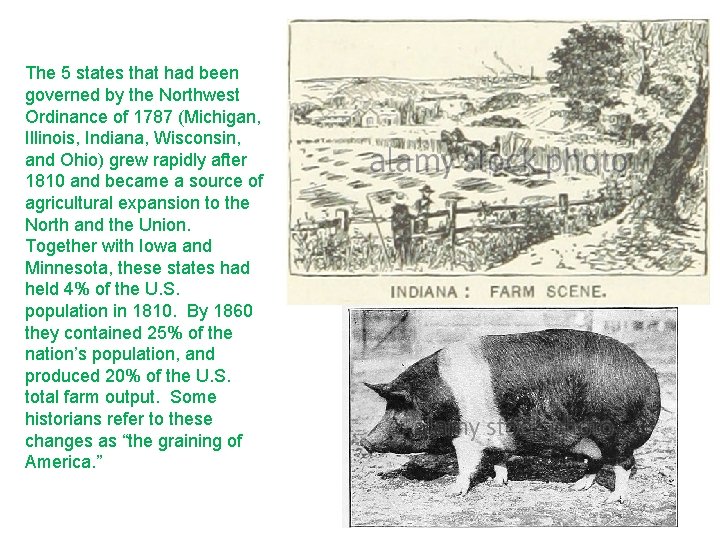
The 5 states that had been governed by the Northwest Ordinance of 1787 (Michigan, Illinois, Indiana, Wisconsin, and Ohio) grew rapidly after 1810 and became a source of agricultural expansion to the North and the Union. Together with Iowa and Minnesota, these states had held 4% of the U. S. population in 1810. By 1860 they contained 25% of the nation’s population, and produced 20% of the U. S. total farm output. Some historians refer to these changes as “the graining of America. ”
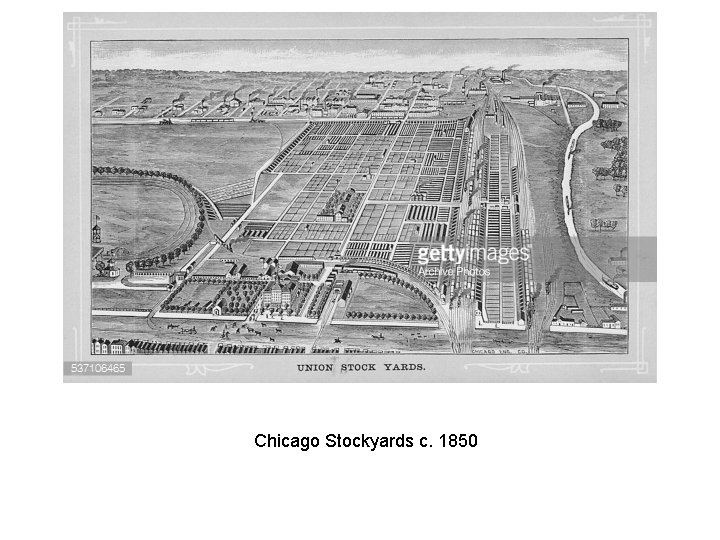
Chicago Stockyards c. 1850
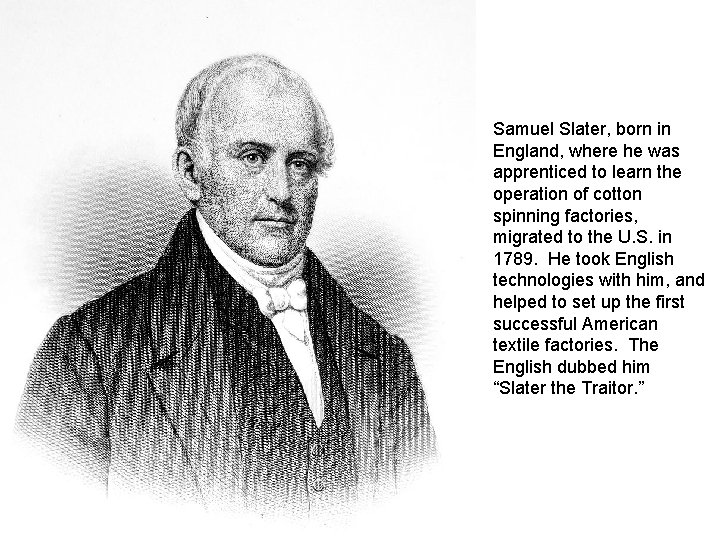
Samuel Slater, born in England, where he was apprenticed to learn the operation of cotton spinning factories, migrated to the U. S. in 1789. He took English technologies with him, and helped to set up the first successful American textile factories. The English dubbed him “Slater the Traitor. ”
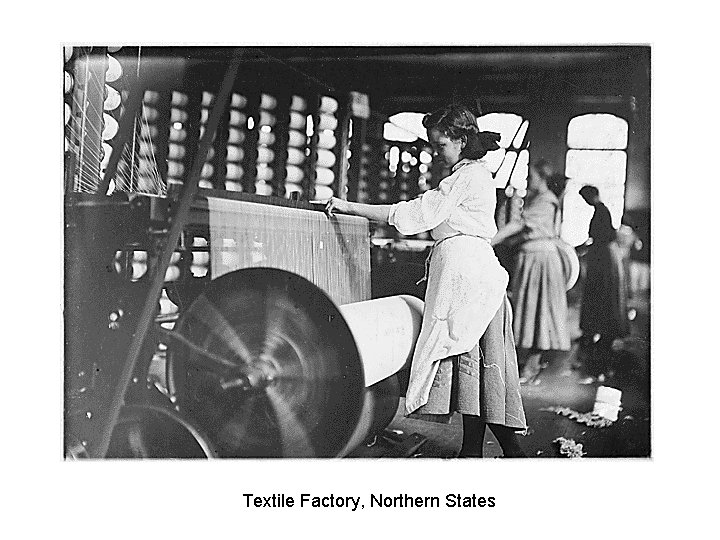
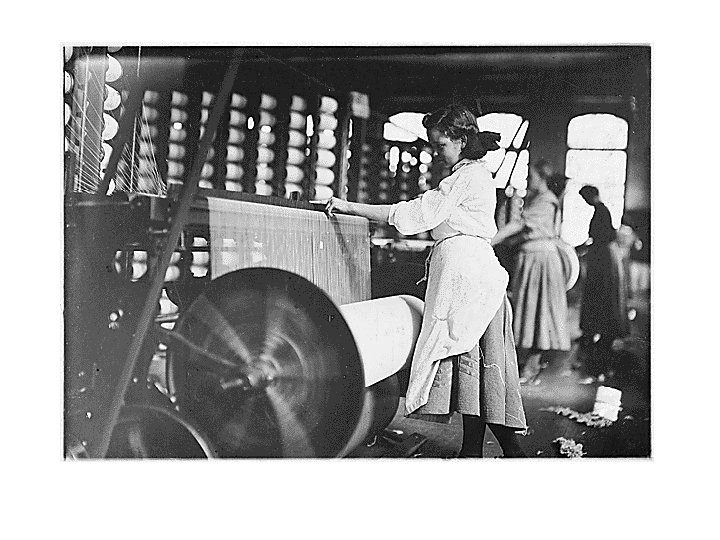
The Increase in Wage Work in the Northern States Percentage of Wage Laborers in the U. S. Economy: 1800: 12% 1860: 40% By 1850, the work forces in Boston and New York consisted of more than two-thirds wage workers. By 1850 the number of wage laborers in the U. S. exceeded the number of African American slaves. Most wage laborers lived in the North. By 1860, almost half were women.
Textile Factory, Northern States
North and South Debated the Idea of “Free Labor” Some Southerners attacked the North’s “free labor” system, arguing that their slave labor system provided better protections for unfree labor by taking care of them from cradle to grave. Some critics of the free labor system referred to it as “wage slavery. ” Many Northerners forcefully justified the system of free labor. They argued that the system offered opportunities for upward mobility; laborers did not need to expect to remain laborers all their lives. They argued that wageworkers owned their bodies and their labor, and were free to sell or not sell their labor to whomever they wished. And increasingly, as states eliminated property requirements for voting, wageworkers participated in elections. Northern advocates of free labor criticized Southern slave owners as idle and unproductive, because of their reliance on slaves. By owning and using slaves, they tried to avoid labor and thus were unproductive members of society. “Free Labor” became an important aspect of mid-19 th-century Northern ideology, and part of the definition of what an American citizen should be.
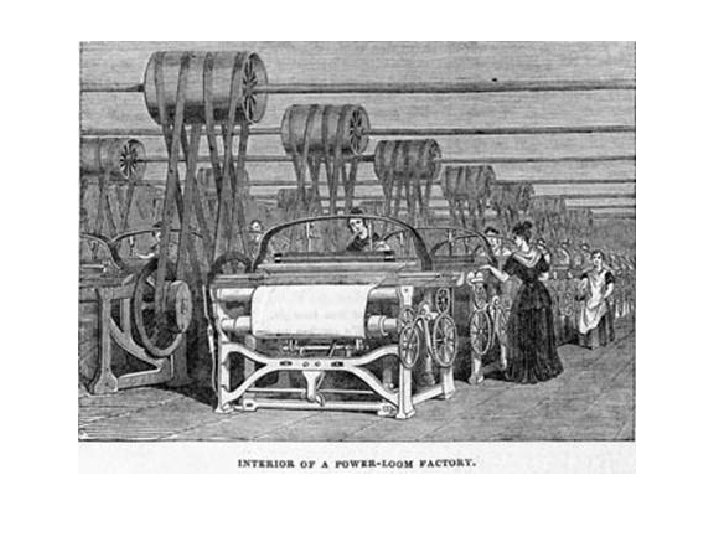
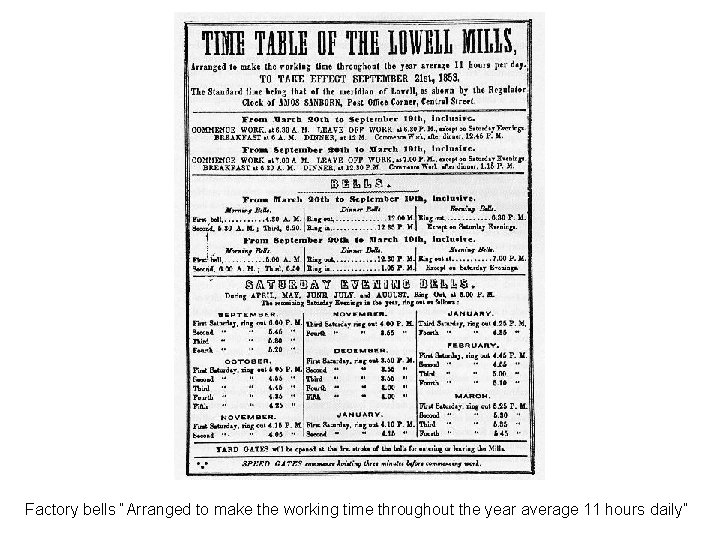
Factory bells “Arranged to make the working time throughout the year average 11 hours daily”