
The MAQC Microarray Quality Control Project Calibrated RNA
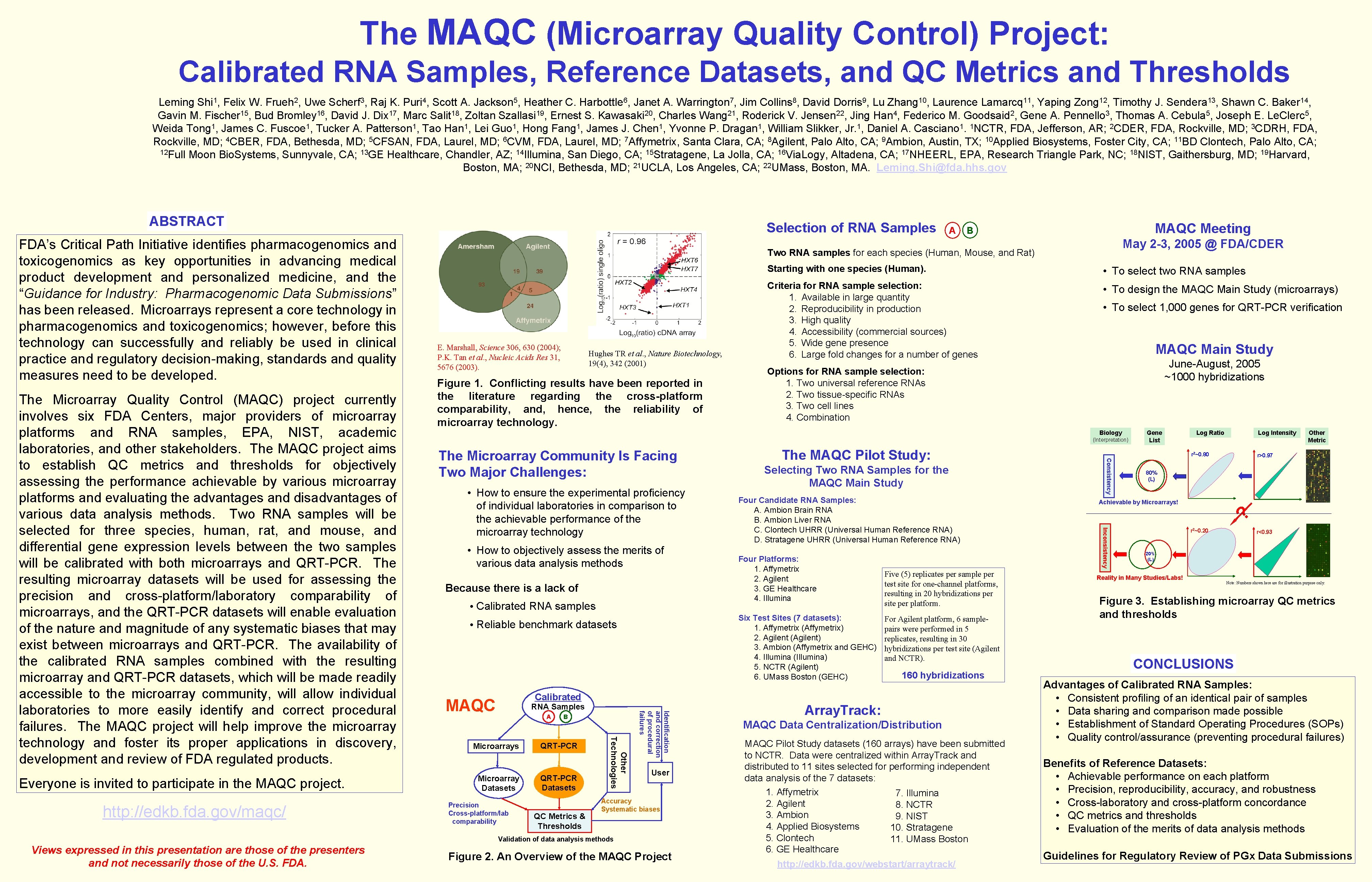
The MAQC (Microarray Quality Control) Project: Calibrated RNA Samples, Reference Datasets, and QC Metrics and Thresholds Leming Shi 1, Felix W. Frueh 2, Uwe Scherf 3, Raj K. Puri 4, Scott A. Jackson 5, Heather C. Harbottle 6, Janet A. Warrington 7, Jim Collins 8, David Dorris 9, Lu Zhang 10, Laurence Lamarcq 11, Yaping Zong 12, Timothy J. Sendera 13, Shawn C. Baker 14, Gavin M. Fischer 15, Bud Bromley 16, David J. Dix 17, Marc Salit 18, Zoltan Szallasi 19, Ernest S. Kawasaki 20, Charles Wang 21, Roderick V. Jensen 22, Jing Han 4, Federico M. Goodsaid 2, Gene A. Pennello 3, Thomas A. Cebula 5, Joseph E. Le. Clerc 5, Weida Tong 1, James C. Fuscoe 1, Tucker A. Patterson 1, Tao Han 1, Lei Guo 1, Hong Fang 1, James J. Chen 1, Yvonne P. Dragan 1, William Slikker, Jr. 1, Daniel A. Casciano 1. 1 NCTR, FDA, Jefferson, AR; 2 CDER, FDA, Rockville, MD; 3 CDRH, FDA, Rockville, MD; 4 CBER, FDA, Bethesda, MD; 5 CFSAN, FDA, Laurel, MD; 6 CVM, FDA, Laurel, MD; 7 Affymetrix, Santa Clara, CA; 8 Agilent, Palo Alto, CA; 9 Ambion, Austin, TX; 10 Applied Biosystems, Foster City, CA; 11 BD Clontech, Palo Alto, CA; 12 Full Moon Bio. Systems, Sunnyvale, CA; 13 GE Healthcare, Chandler, AZ; 14 Illumina, San Diego, CA; 15 Stratagene, La Jolla, CA; 16 Via. Logy, Altadena, CA; 17 NHEERL, EPA, Research Triangle Park, NC; 18 NIST, Gaithersburg, MD; 19 Harvard, Boston, MA; 20 NCI, Bethesda, MD; 21 UCLA, Los Angeles, CA; 22 UMass, Boston, MA. Leming. Shi@fda. hhs. gov ABSTRACT Hughes TR et al. , Nature Biotechnology, 19(4), 342 (2001) Figure 1. Conflicting results have been reported in the literature regarding the cross-platform comparability, and, hence, the reliability of microarray technology. Starting with one species (Human). • To select two RNA samples Criteria for RNA sample selection: 1. Available in large quantity 2. Reproducibility in production 3. High quality 4. Accessibility (commercial sources) 5. Wide gene presence 6. Large fold changes for a number of genes • To design the MAQC Main Study (microarrays) • To select 1, 000 genes for QRT-PCR verification MAQC Main Study June-August, 2005 ~1000 hybridizations Options for RNA sample selection: 1. Two universal reference RNAs 2. Two tissue-specific RNAs 3. Two cell lines 4. Combination Biology (Interpretation) The Microarray Community Is Facing Two Major Challenges: • How to objectively assess the merits of various data analysis methods Because there is a lack of • Calibrated RNA samples The MAQC Pilot Study: Selecting Two RNA Samples for the MAQC Main Study Four Candidate RNA Samples: A. Ambion Brain RNA B. Ambion Liver RNA C. Clontech UHRR (Universal Human Reference RNA) D. Stratagene UHRR (Universal Human Reference RNA) Four Platforms: 1. Affymetrix 2. Agilent 3. GE Healthcare 4. Illumina Six Test Sites (7 datasets): 1. Affymetrix (Affymetrix) 2. Agilent (Agilent) 3. Ambion (Affymetrix and GEHC) 4. Illumina (Illumina) 5. NCTR (Agilent) 6. UMass Boston (GEHC) • Reliable benchmark datasets Five (5) replicates per sample per test site for one-channel platforms, resulting in 20 hybridizations per site per platform. For Agilent platform, 6 samplepairs were performed in 5 replicates, resulting in 30 hybridizations per test site (Agilent and NCTR). 160 hybridizations Calibrated MAQC RNA Samples A Microarrays Microarray Datasets Precision Cross-platform/lab comparability B QRT-PCR Datasets QC Metrics & Thresholds User Accuracy Systematic biases Figure 2. An Overview of the MAQC Project Array. Track: MAQC Data Centralization/Distribution MAQC Pilot Study datasets (160 arrays) have been submitted to NCTR. Data were centralized within Array. Track and distributed to 11 sites selected for performing independent data analysis of the 7 datasets: 1. Affymetrix 7. Illumina 2. Agilent 8. NCTR 3. Ambion 9. NIST 4. Applied Biosystems 10. Stratagene 5. Clontech 11. UMass Boston 6. GE Healthcare http: //edkb. fda. gov/webstart/arraytrack/ Gene List Log Ratio Log Intensity r 2~0. 80 Other Metric r>0. 97 80% (L) … Achievable by Microarrays! Inconsistency • How to ensure the experimental proficiency of individual laboratories in comparison to the achievable performance of the microarray technology Validation of data analysis methods Views expressed in this presentation are those of the presenters and not necessarily those of the U. S. FDA. May 2 -3, 2005 @ FDA/CDER Consistency http: //edkb. fda. gov/maqc/ E. Marshall, Science 306, 630 (2004); P. K. Tan et al. , Nucleic Acids Res 31, 5676 (2003). Identification and correction of procedural failures Everyone is invited to participate in the MAQC project. MAQC Meeting B Two RNA samples for each species (Human, Mouse, and Rat) Other Technologies The Microarray Quality Control (MAQC) project currently involves six FDA Centers, major providers of microarray platforms and RNA samples, EPA, NIST, academic laboratories, and other stakeholders. The MAQC project aims to establish QC metrics and thresholds for objectively assessing the performance achievable by various microarray platforms and evaluating the advantages and disadvantages of various data analysis methods. Two RNA samples will be selected for three species, human, rat, and mouse, and differential gene expression levels between the two samples will be calibrated with both microarrays and QRT-PCR. The resulting microarray datasets will be used for assessing the precision and cross-platform/laboratory comparability of microarrays, and the QRT-PCR datasets will enable evaluation of the nature and magnitude of any systematic biases that may exist between microarrays and QRT-PCR. The availability of the calibrated RNA samples combined with the resulting microarray and QRT-PCR datasets, which will be made readily accessible to the microarray community, will allow individual laboratories to more easily identify and correct procedural failures. The MAQC project will help improve the microarray technology and foster its proper applications in discovery, development and review of FDA regulated products. A ? FDA’s Critical Path Initiative identifies pharmacogenomics and toxicogenomics as key opportunities in advancing medical product development and personalized medicine, and the “Guidance for Industry: Pharmacogenomic Data Submissions” has been released. Microarrays represent a core technology in pharmacogenomics and toxicogenomics; however, before this technology can successfully and reliably be used in clinical practice and regulatory decision-making, standards and quality measures need to be developed. Selection of RNA Samples r 2~0. 20 r<0. 93 … 20% (L) Reality in Many Studies/Labs! Note: Numbers shown here are for illustration purpose only. Figure 3. Establishing microarray QC metrics and thresholds CONCLUSIONS Advantages of Calibrated RNA Samples: • Consistent profiling of an identical pair of samples • Data sharing and comparison made possible • Establishment of Standard Operating Procedures (SOPs) • Quality control/assurance (preventing procedural failures) Benefits of Reference Datasets: • Achievable performance on each platform • Precision, reproducibility, accuracy, and robustness • Cross-laboratory and cross-platform concordance • QC metrics and thresholds • Evaluation of the merits of data analysis methods Guidelines for Regulatory Review of PGx Data Submissions
- Slides: 1