
The many problems for the Rutherford atomic model
The many problems for the Rutherford atomic model re-summarized: • Electrons seem to act like waves and refuse to sit still and be measured. • Rutherford’s atom can’t explain: 1. Why the electrons and protons don’t collapse into each other in the atom. 2. Why the sun only gives us a few colors and not all of them.

The way out of this mess arises from two main sources: 1) The photoelectric effect (and Einstein’s explanation for it) see page 62 2) De. Broglie’s hypothesis see page 63 -4 Both deal with aspects of waves.
A brief review of the classical theory of light: • Light is a wave …because light diffracts • Light has no mass (=>no momentum) …because there is no limit to the intensity and tightness of focus. * *we can pack any amount of light into arbitrarily small space
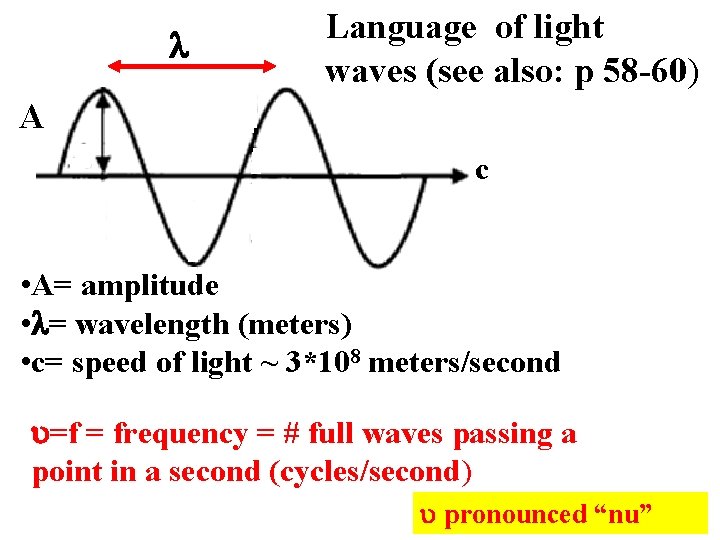
Language of light waves (see also: p 58 -60) A c • A= amplitude • = wavelength (meters) • c= speed of light ~ 3*108 meters/second =f = frequency = # full waves passing a point in a second (cycles/second) pronounced “nu”

A Equations of classical light theory (see also: p 58 -60) C f* =c Wave Energy, E ~ A 2 =f = frequency = # full waves passing a point in a second
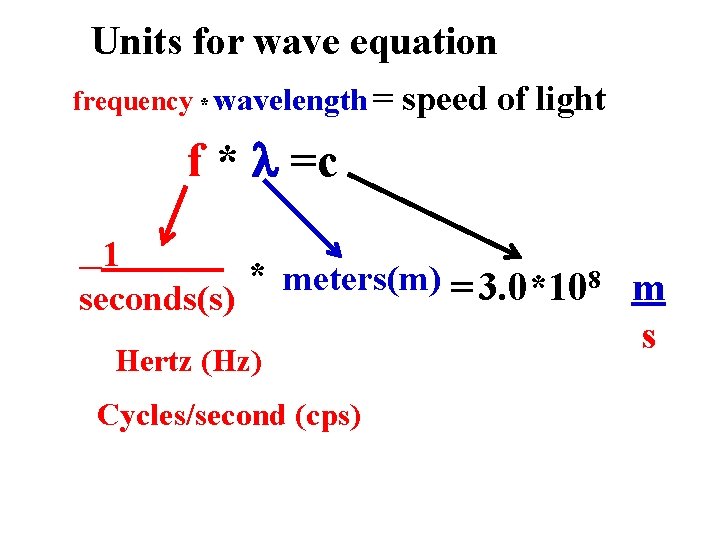
Units for wave equation frequency * wavelength = speed of light f * =c 1 * meters(m) = 3. 0*108 m seconds(s) Hertz (Hz) Cycles/second (cps) s
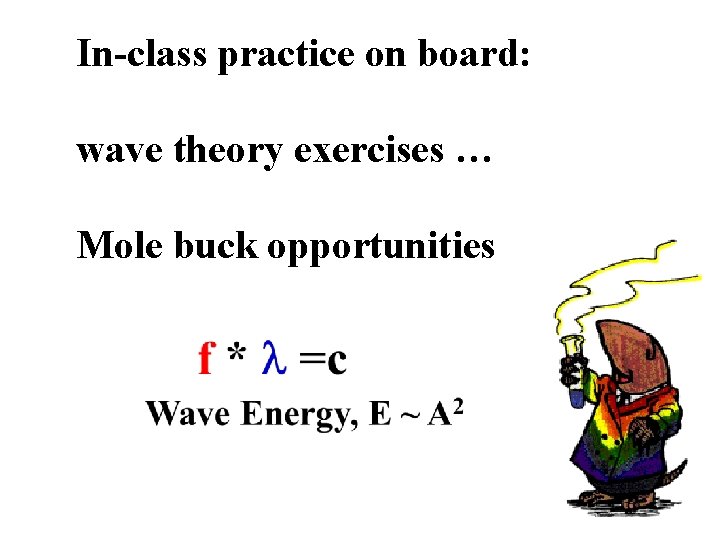
In-class practice on board: wave theory exercises … Mole buck opportunities
- Slides: 7