
The Many Pathways to Recovery from Substance Use
The Many Pathways to Recovery from Substance Use Disorders: Contributions from Public Health, Psychology, and Behavioral Economics Jalie A. Tucker, Ph. D. , M. P. H. Department of Health Education & Behavior Center for Behavioral Economic Health Research University of Florida – Gainesville
Today’s talk Contributions from public health: Epidemiology of helpseeking vs. recovery from substance-related problems Contributions from psychology and behavioral economics with emphasis on alcohol use disorders: Research on natural recovery ~ understanding successful behavior change apart from treatment New directions for promoting change by applying choice architecture principles and findings
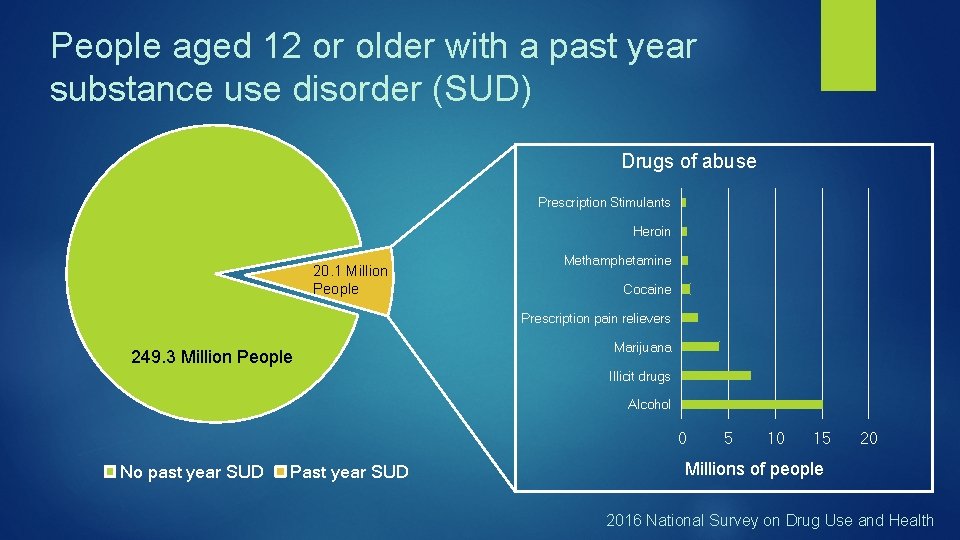
People aged 12 or older with a past year substance use disorder (SUD) Drugs of abuse Prescription Stimulants Heroin 20. 1 Million People Methamphetamine Cocaine Prescription pain relievers 249. 3 Million People Marijuana Illicit drugs Alcohol 0 No past year SUD Past year SUD 5 10 15 20 Millions of people 2016 National Survey on Drug Use and Health
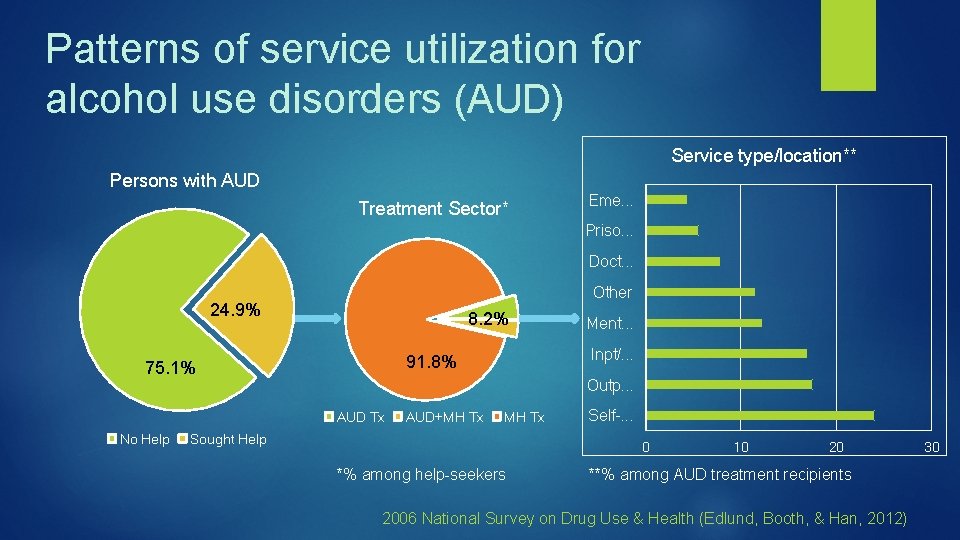
Patterns of service utilization for alcohol use disorders (AUD) Service type/location** Persons with AUD Treatment Sector* Eme. . . Priso. . . Doct. . . Other 24. 9% 8. 2% Outp. . . AUD Tx No Help Inpt/. . . 91. 8% 75. 1% Ment. . . AUD+MH Tx Sought Help Self-. . . 0 *% among help-seekers 10 20 **% among AUD treatment recipients 2006 National Survey on Drug Use & Health (Edlund, Booth, & Han, 2012) 30

Outcomes of recovery attempts by persons with AUD as a function of treatment status Canadian National Survey (1989) Moderation (32%) Abstinence (68%) Treatment No treatment > 75% recovered without treatment (n = 446 of 10, 796) Treatment No treatment

Population perspective on substance use, problems, and interventions none Substance Use moderate heavy abuse dependence Prevention Digital Outpatient Inpatient health Tx Tx & brief interventions substantial none mild severe moderate Problems Adapted from Institute of Medicine, 1990
Utility of natural recovery research to inform change processes and outcomes 66 -75% of resolutions occur outside of treatment Understanding natural circumstances and processes that support recovery can inform intervention development across the problem severity spectrum, thereby helping close the population need-service utilization gap Opportunity to study low-risk drinking—more common among untreated than treated persons Consistent with positive psychology; departs from longstanding focus on relapse determinants using clinical samples
Natural recovery from alcohol-related problems Documented in early population surveys but less research on processes, contexts, and outcomes Focus of our research starting in the late 1980 s, including both retrospective case-control studies and prospective studies of persons who recently quit alcohol misuse Guided by Behavioral Economics
Behavioral Economics Merger of consumer demand theory in micro-economics with methods of behavior analysis/operant psychology Focuses on how behavior and resources (e. g. , time, money, effort to obtain) are distributed to available activities and commodities in the context of choice Preference is context dependent, inferred from resource allocation patterns, and evaluated at a molar level Well suited to studying substance misuse because the primary problem is excessive demand for substances over time Well established that substance use varies inversely with constraints on drug access and directly with constraints on other valued activities
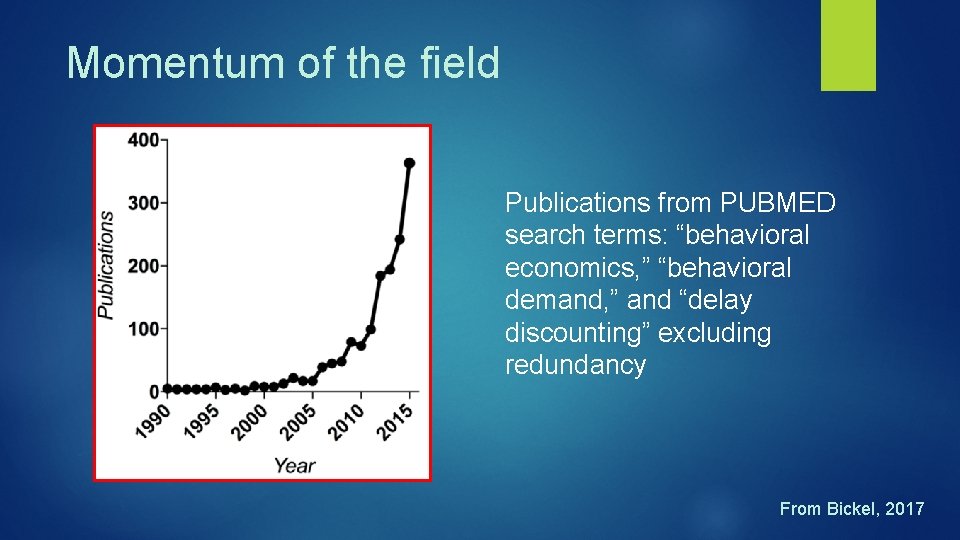
Momentum of the field Publications from PUBMED search terms: “behavioral economics, ” “behavioral demand, ” and “delay discounting” excluding redundancy From Bickel, 2017
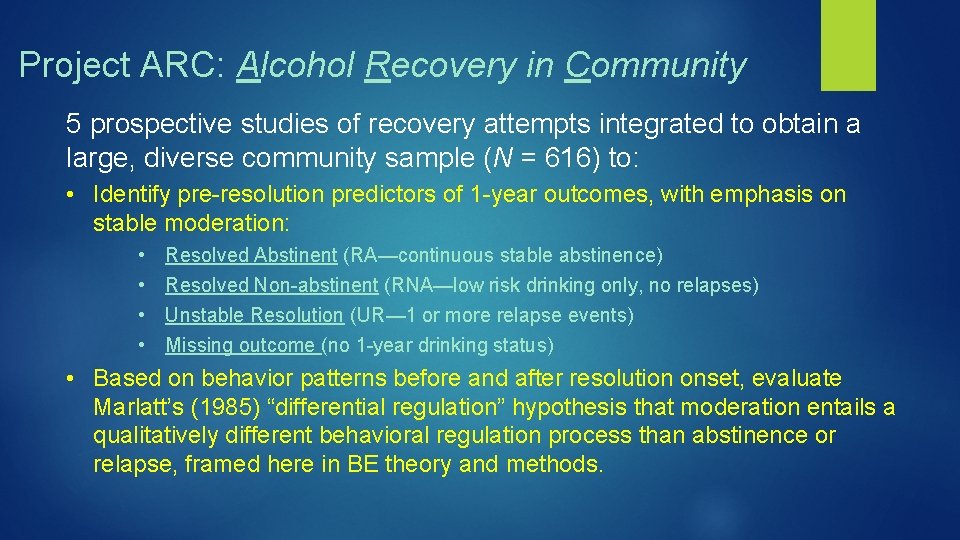
Project ARC: Alcohol Recovery in Community 5 prospective studies of recovery attempts integrated to obtain a large, diverse community sample (N = 616) to: • Identify pre-resolution predictors of 1 -year outcomes, with emphasis on stable moderation: • • Resolved Abstinent (RA—continuous stable abstinence) Resolved Non-abstinent (RNA—low risk drinking only, no relapses) Unstable Resolution (UR— 1 or more relapse events) Missing outcome (no 1 -year drinking status) • Based on behavior patterns before and after resolution onset, evaluate Marlatt’s (1985) “differential regulation” hypothesis that moderation entails a qualitatively different behavioral regulation process than abstinence or relapse, framed here in BE theory and methods.
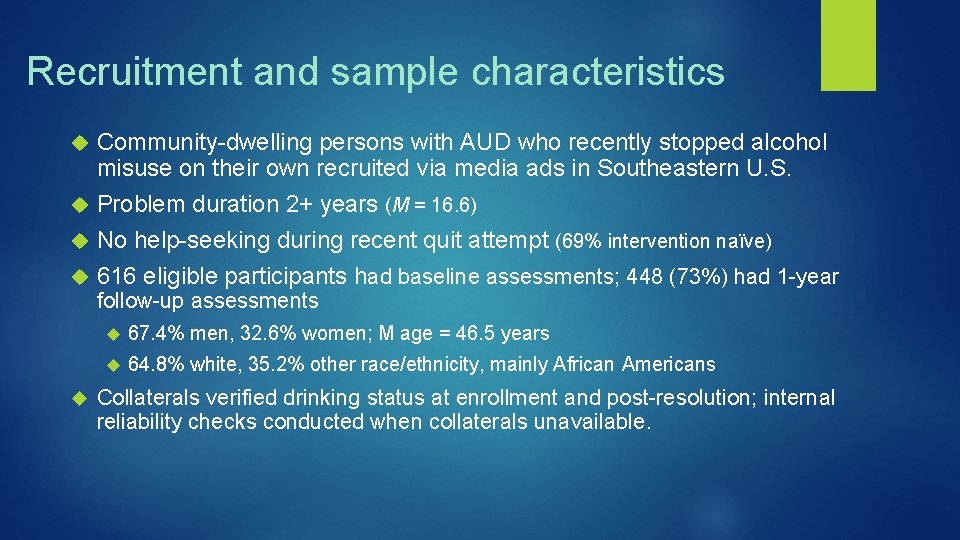
Recruitment and sample characteristics Community-dwelling persons with AUD who recently stopped alcohol misuse on their own recruited via media ads in Southeastern U. S. Problem duration 2+ years (M = 16. 6) No help-seeking during recent quit attempt (69% intervention naïve) 616 eligible participants had baseline assessments; 448 (73%) had 1 -year follow-up assessments 67. 4% men, 32. 6% women; M age = 46. 5 years 64. 8% white, 35. 2% other race/ethnicity, mainly African Americans Collaterals verified drinking status at enrollment and post-resolution; internal reliability checks conducted when collaterals unavailable.
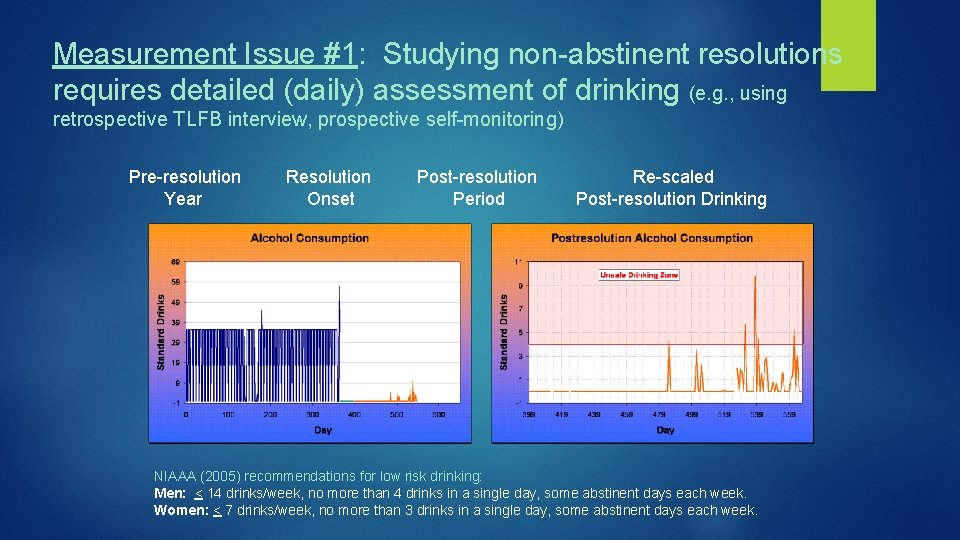
Measurement Issue #1: Studying non-abstinent resolutions requires detailed (daily) assessment of drinking (e. g. , using retrospective TLFB interview, prospective self-monitoring) Pre-resolution Year Resolution Onset Post-resolution Period Re-scaled Post-resolution Drinking NIAAA (2005) recommendations for low risk drinking: Men: < 14 drinks/week, no more than 4 drinks in a single day, some abstinent days each week. Women: < 7 drinks/week, no more than 3 drinks in a single day, some abstinent days each week.
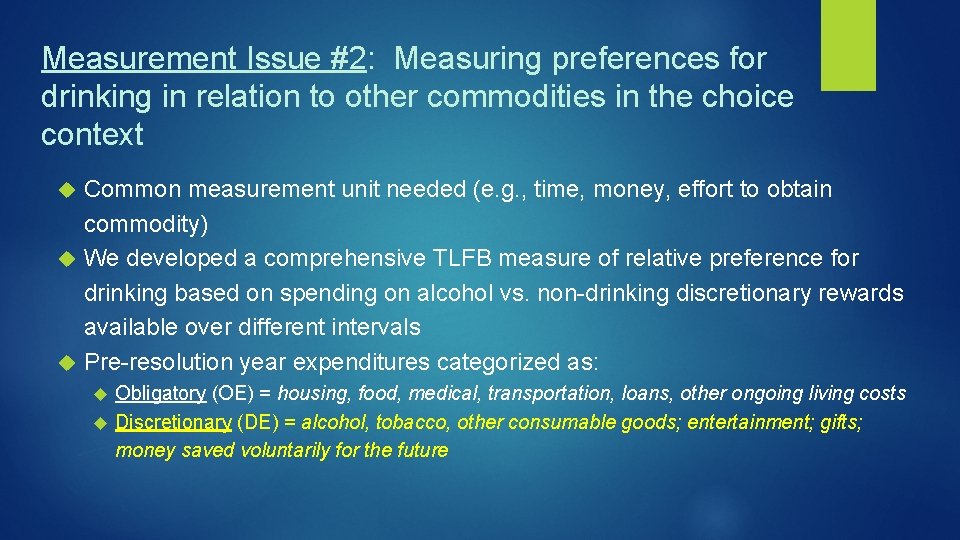
Measurement Issue #2: Measuring preferences for drinking in relation to other commodities in the choice context Common measurement unit needed (e. g. , time, money, effort to obtain commodity) We developed a comprehensive TLFB measure of relative preference for drinking based on spending on alcohol vs. non-drinking discretionary rewards available over different intervals Pre-resolution year expenditures categorized as: Obligatory (OE) = housing, food, medical, transportation, loans, other ongoing living costs Discretionary (DE) = alcohol, tobacco, other consumable goods; entertainment; gifts; money saved voluntarily for the future
Measuring preferences for drinking in relation to other commodities in the choice context Current preferences better expressed in discretionary expenditures Alcohol-Savings Discretionary Expenditure (ASDE) index = [ $ alcohol/pooled DE – $ saved/pooled DE ] Pre-resolution BE Hypothesis: Problem drinkers with relatively better selfregulation as reflected in greater allocation to voluntary savings than drinking (i. e. , lower ASDE values), even when drinking abusively, should be more likely to achieve stable resolution, especially moderation.
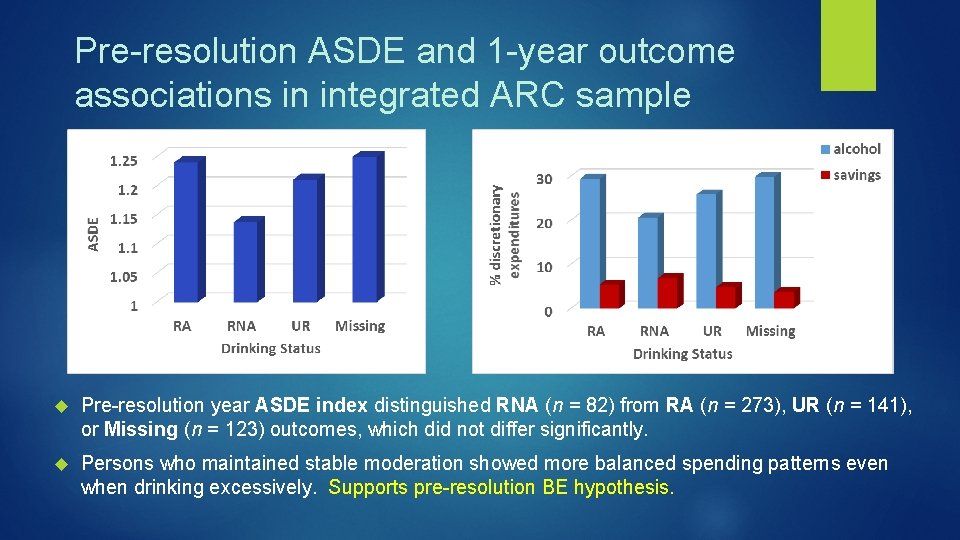
Pre-resolution ASDE and 1 -year outcome associations in integrated ARC sample Pre-resolution year ASDE index distinguished RNA (n = 82) from RA (n = 273), UR (n = 141), or Missing (n = 123) outcomes, which did not differ significantly. Persons who maintained stable moderation showed more balanced spending patterns even when drinking excessively. Supports pre-resolution BE hypothesis.
Profiles of pre-resolution problem severity indicators associated with stable moderation Recent studies suggest importance of characterizing drinking problem severity using multiple indicators not limited to drinking practices, the longstanding approach in the field Using latent profile analysis (LPA), we identified distinctive profiles of severity indicators assessed in Project ARC: Alcohol dependence (Alcohol Dependence Scale, ADS) Alcohol-related problems (Drinking Problems Scale, DPS) Pre-resolution year ASDE index Pre-resolution year heavy drinking days (4+ drinks for women, 5+drinks for men) Evaluated outcomes the utility of the latent profiles to predict 1 -year drinking
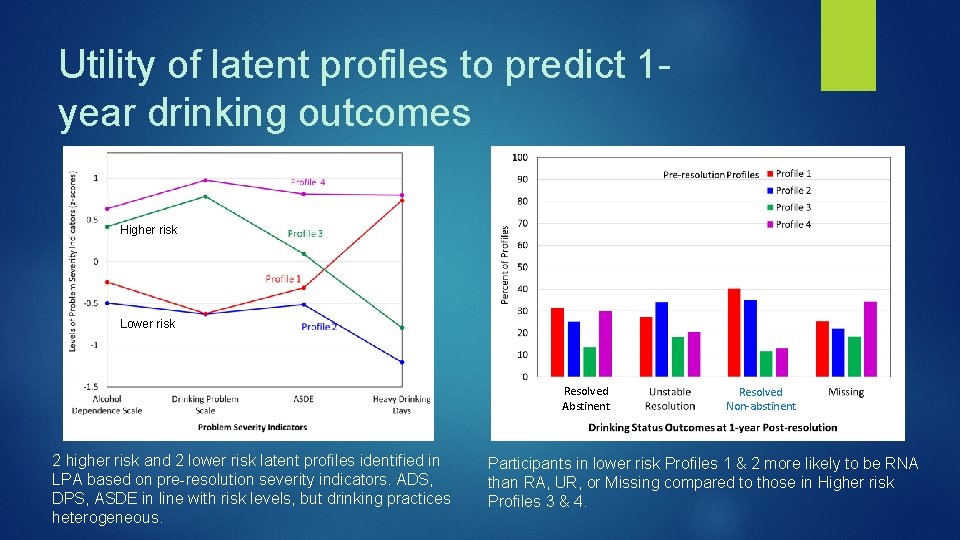
Utility of latent profiles to predict 1 year drinking outcomes Higher risk Lower risk Resolved Abstinent 2 higher risk and 2 lower risk latent profiles identified in LPA based on pre-resolution severity indicators. ADS, DPS, ASDE in line with risk levels, but drinking practices heterogeneous. Resolved Non-abstinent Participants in lower risk Profiles 1 & 2 more likely to be RNA than RA, UR, or Missing compared to those in Higher risk Profiles 3 & 4.
Pre-resolution drinking re-visited as a predictor of 1 -year drinking outcomes Given the heterogeneity in drinking practices and lack of predictive utility, we evaluated 4 specific dimensions of pre-resolution drinking as outcome predictors in multinominal logistic regressions: Mean quantity of alcohol consumed per drinking day Variability of quantities consumed per drinking day Frequency of heavy drinking days (4+ drinks for women and 5+ drinks for men) Variability in # of days between heavy drinking fluctuation in intervals between heavy drinking days) days (reflects degree of
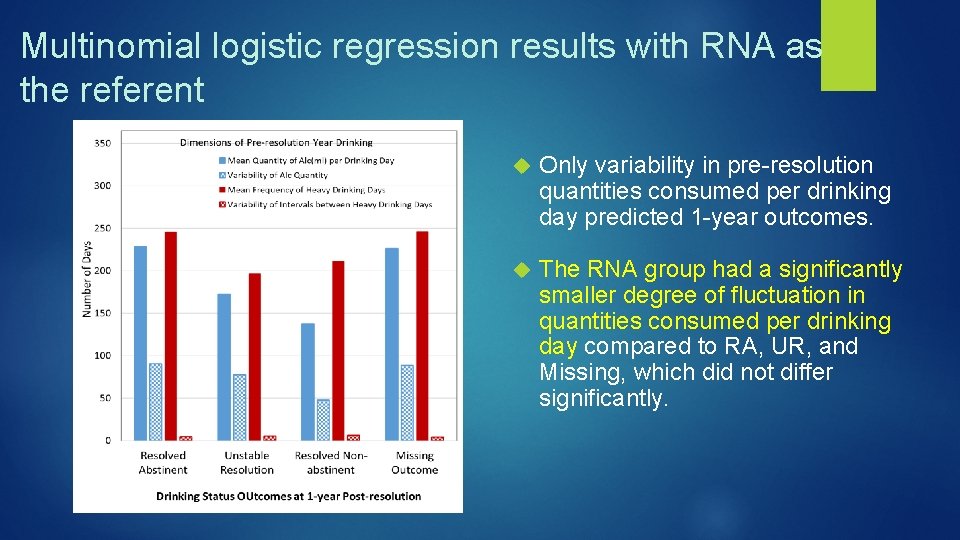
Multinomial logistic regression results with RNA as the referent Only variability in pre-resolution quantities consumed per drinking day predicted 1 -year outcomes. The RNA group had a significantly smaller degree of fluctuation in quantities consumed per drinking day compared to RA, UR, and Missing, which did not differ significantly.
Summary of pre-resolution findings Identified four pre-resolution moderation predictors useful for drinking goal setting: lower alcohol dependence fewer alcohol-related problems more balanced spending on alcohol vs. savings less variability in quantities consumed on drinking days Pre-resolution BE hypothesis supported: Even when drinking heavily, RNA group exercised relatively more self-regulation of spending and drinking compared to other outcome groups. So what happens post-resolution. . . ?
Post-resolution year spending patterns Post-resolution BE hypothesis: Recovery entails shifts in resource allocation away from drinking towards valuable delayed non-drinking rewards, which reinforce and stabilize the shifted recovery behavior patterns ASDE index not as useful post-resolution because alcohol spending tends to be greatly reduced even among the unresolved group Therefore, we compared outcome groups on post-resolution spending on other commodity classes using data from our most recent “Time Horizons” study (n = 175)
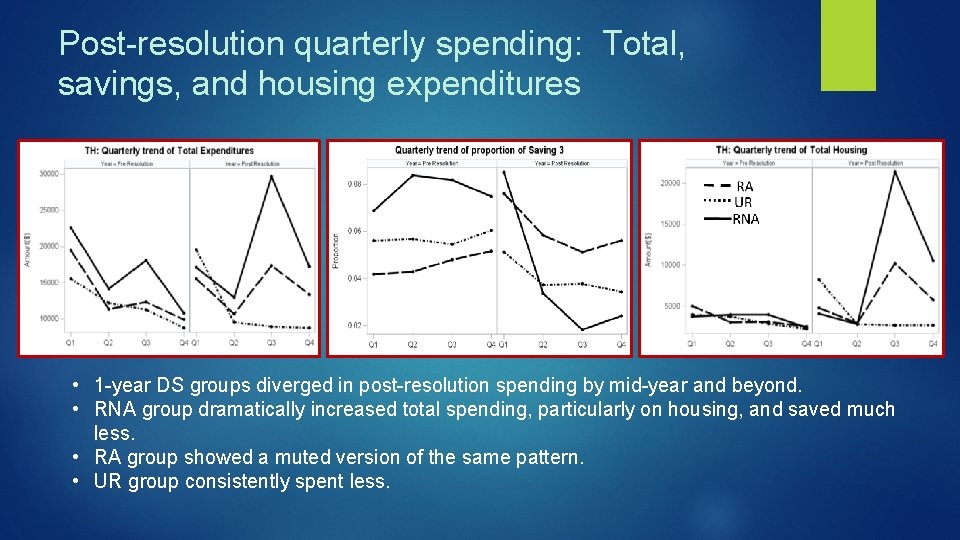
Post-resolution quarterly spending: Total, savings, and housing expenditures • 1 -year DS groups diverged in post-resolution spending by mid-year and beyond. • RNA group dramatically increased total spending, particularly on housing, and saved much less. • RA group showed a muted version of the same pattern. • UR group consistently spent less.
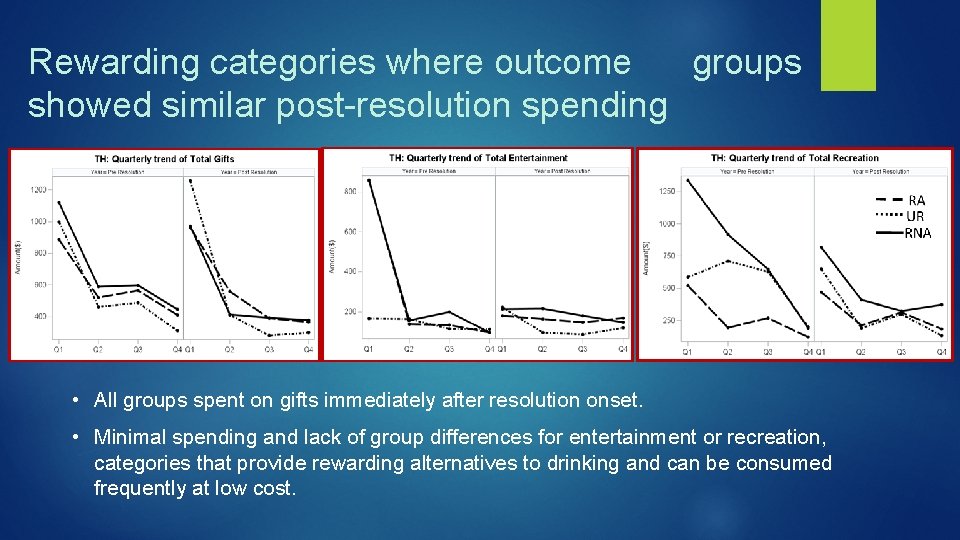
Rewarding categories where outcome groups showed similar post-resolution spending • All groups spent on gifts immediately after resolution onset. • Minimal spending and lack of group differences for entertainment or recreation, categories that provide rewarding alternatives to drinking and can be consumed frequently at low cost.
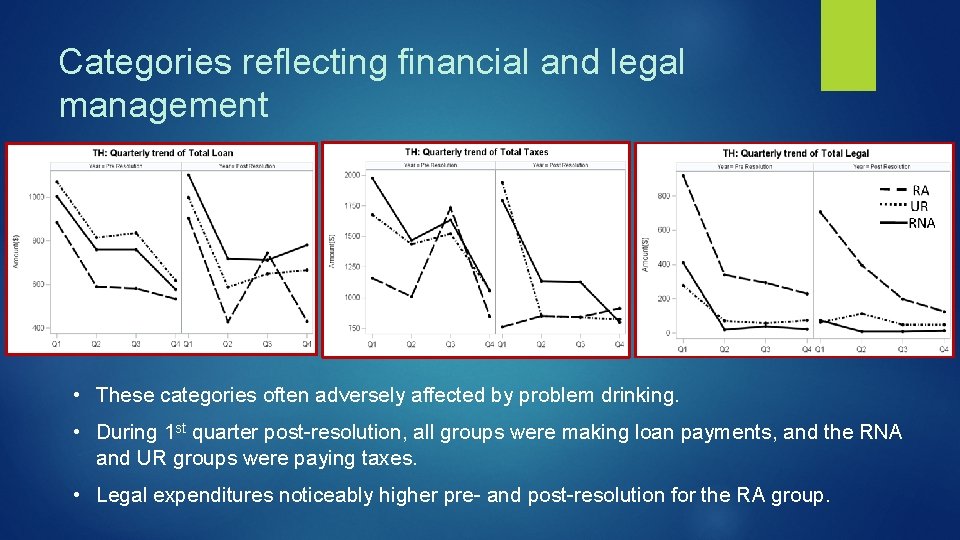
Categories reflecting financial and legal management • These categories often adversely affected by problem drinking. • During 1 st quarter post-resolution, all groups were making loan payments, and the RNA and UR groups were paying taxes. • Legal expenditures noticeably higher pre- and post-resolution for the RA group.
Summary of post-resolution findings Ø Some shifts in spending common to all outcome groups, others distinctively different for the RNA group. Ø RNA participants showed greater longitudinal variability in spending patterns compared to other outcome groups: Ø Ø They saved proportionately more while drinking heavily, but post-resolution they reduced savings and increased spending. RA and especially UR groups spent less post-resolution. Ø Spending was on big ticket items (e. g. , housing). Contrary to behavioral self-control programming, small rewards consumed frequently appeared unrelated to resolution type or stability. Does engaging in stable low-risk drinking for 6 months provide a behavioral context for releasing pent-up demand for expensive goods like housing? In turn, does this consumption reinforce continued moderation?
Overall Conclusions Replicates clinical research using a large predominately natural recovery sample showing that stable moderation is associated with lower problem severity and added support for: BE index of reward value of drinking vs. saving for the future Utility of variability in drinking day quantity Supports Marlatt’s differential regulation hypothesis that the behavioral pathway to stable moderation is qualitatively different from the pathway to stable abstinence or relapse. Generally highlights usefulness of BE focus on behavioral patterning and context dependence of choice over lengthy intervals.
Looking ahead: Applying BE choice architecture to change addictive behavior Key Finding: Biased choice is normative. Real people do not choose “rationally” in line with what classic economic models predict. Their “irrational” deviations show reliable regularities, e. g. : Delay discounting—shorter term outcomes are weighed more heavily than delayed outcomes, even when the latter have higher overall value. Steeper discounting associated with lower income and education, younger age, and active addiction. Magnitude effect—smaller rewards are discounted more than larger rewards. Sign effect—positive outcomes are discounted more than negative outcomes. Loss aversion—tendency to prefer avoiding losses to acquiring equivalent gains. Sequence effect—sequences of outcomes that end in gains are preferred to those that end in losses, even when the overall utilities of the sequences are the same. Tucker, J. A. , Chandler, S. D. , & Cheong, J. (2017). Role of choice biases and choice architecture in behavioral economic strategies to reduce addictive behaviors. In N. Heather & G. Segal (Eds. ), Addiction and Choice. Oxford, U. K. : Oxford University Press. (pp. 346 -364)
Applying BE choice architecture to change health behaviors Two general approaches that take choice biases in account: Remediate approach. choice biases and limit their negative effects. More familiar Episodic Future Thinking intervention to reduce delay discounting and addictive behaviors (Bickel, Stein, & colleagues) Substance-Free Activity Session to support enriching the environment with alternative rewards (Murphy & colleagues) Use choice biases to promote healthy decisions and outcomes. Accept that biased choices are normative and focus on structuring health messages, choices, interventions, and contexts in ways that use the biases to promote good choices and outcomes.
Use choice biases to promote healthy decisions and outcomes Basis of nudges to alter “. . . people’s behavior in predictable ways without restricting any options or significantly changing their economic incentives such as time or money. ” (Thaler & Sunstein, 2008) Special case of asymmetric paternalism (Lowenstein, 2007): Arrange choices so that persons with greater biases make beneficial choices without constraining freedom of choice for less biased decision-makers. Change default options without constraining overall availability of options (e. g. , opt out vs. opt in HIV testing guidelines). Positional Offer manipulations (e. g. , put desserts at end not start of cafeteria lines) treatment on demand to capitalize on shifting motivations in favor of pro-health behavior (exploits delay discounting). Successful in HIV/AIDS and SUD treatment; supports “through any door” approach to treatment engagement.
Key issues and future directions Scalability of choice architecture interventions critical for population health impact, but government involvement raises ethical/privacy issues (e. g. , “nanny state”). Unlikely a single approach is enough; what mix of tactics may maximize benefits remains to be determined. Continue investigating multiple pathways to positive change from harm reduction to moderation and abstinence and how to promote them.
Acknowledgements This research was supported in part by NIH/NIAAA grants R 01 AA 08972, R 01 AA 017880, and 5 R 01 AA 023657 -03. The following people made substantive contributions to portions of the ARC data set and analyses: Elizabeth Blum, Ph. D Jee. Won Cheong, Ph. D* Rusty Foushee, Ph. D Paula Rippens, Ph. D David Roth, Ph. D Kerstin Schroder, Ph. D Cathy Simpson, Ph. D Rudy Vuchinich, Ph. D Susan Chandler, MPH* *Current collaborators Beth Black, BS Scott Crawford, MPH Soyeon Jung, MS* Jin Huang, MD, MS Brice Lambert, MS Katie Lindstrom* Jessica Stringer, MS Mary Vignolo, BS Tyler G. James, BS* Andrew Westfall, MS
- Slides: 32