
The Manhattan Transcript Bernard Tschumi a h s
The Manhattan Transcript Bernard Tschumi a h s e n e m s ı r m a | b e s t e n u r ö z t ü r k | ı ş ı k ö y k ü m ö z t ü r k
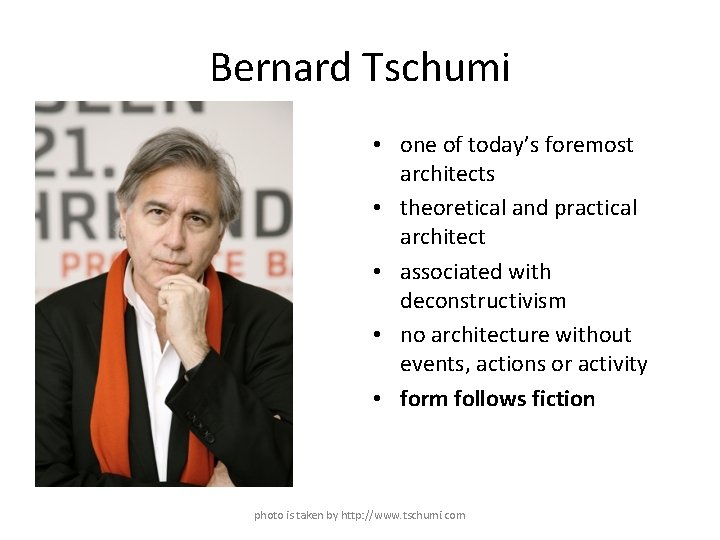
Bernard Tschumi • one of today’s foremost architects • theoretical and practical architect • associated with deconstructivism • no architecture without events, actions or activity • form follows fiction photo is taken by http: //www. tschumi. com
The Manhattan Transcript • neither real projects nor mere fantasies • complex relationship – – between space and their use between the set and the script between type and program between object and events • disjunctions among use, form and social values – hence, the drawings make use of the tripartite mode of notion developed earlier in order to introduce time and experience into the reading of architecture of the city.
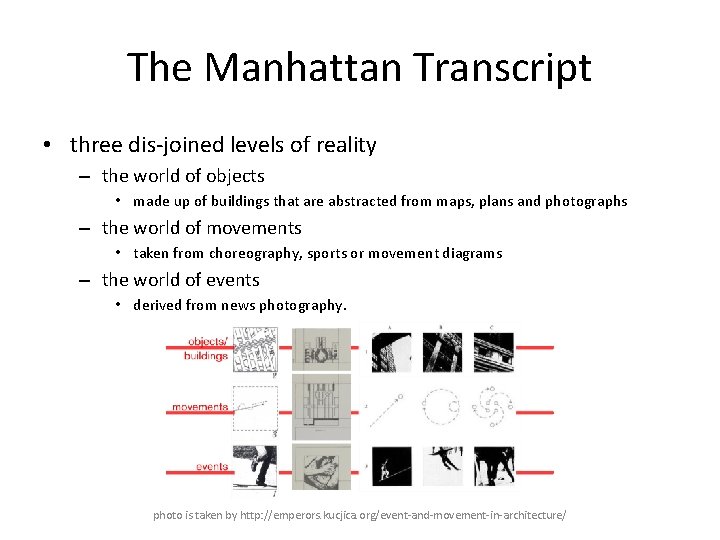
The Manhattan Transcript • three dis-joined levels of reality – the world of objects • made up of buildings that are abstracted from maps, plans and photographs – the world of movements • taken from choreography, sports or movement diagrams – the world of events • derived from news photography. photo is taken by http: //emperors. kucjica. org/event-and-movement-in-architecture/
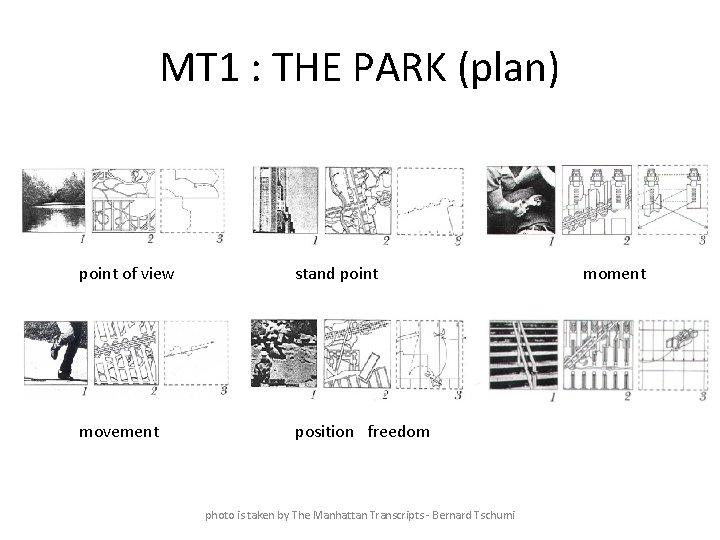
MT 1 : THE PARK (plan) point of view stand point movement position freedom photo is taken by The Manhattan Transcripts - Bernard Tschumi moment
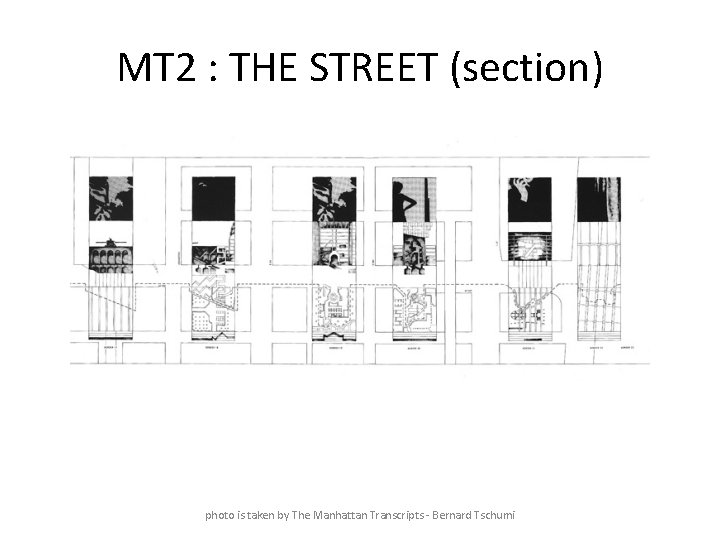
MT 2 : THE STREET (section) photo is taken by The Manhattan Transcripts - Bernard Tschumi
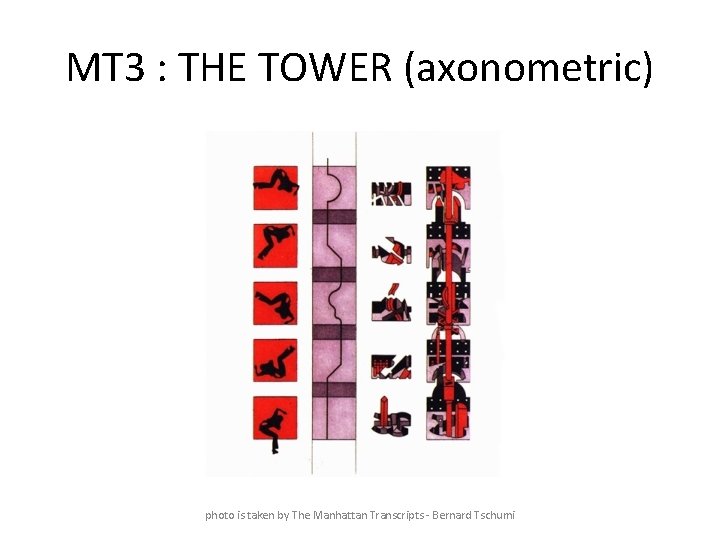
MT 3 : THE TOWER (axonometric) photo is taken by The Manhattan Transcripts - Bernard Tschumi
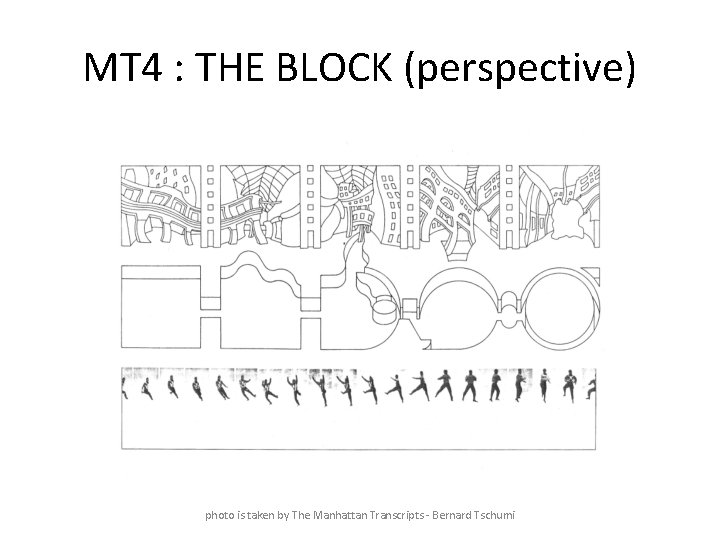
MT 4 : THE BLOCK (perspective) photo is taken by The Manhattan Transcripts - Bernard Tschumi
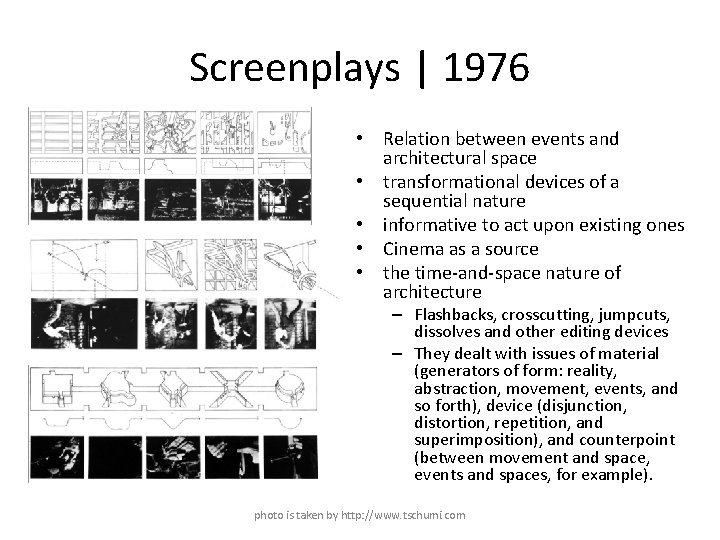
Screenplays | 1976 • Relation between events and architectural space • transformational devices of a sequential nature • informative to act upon existing ones • Cinema as a source • the time-and-space nature of architecture – Flashbacks, crosscutting, jumpcuts, dissolves and other editing devices – They dealt with issues of material (generators of form: reality, abstraction, movement, events, and so forth), device (disjunction, distortion, repetition, and superimposition), and counterpoint (between movement and space, events and spaces, for example). photo is taken by http: //www. tschumi. com
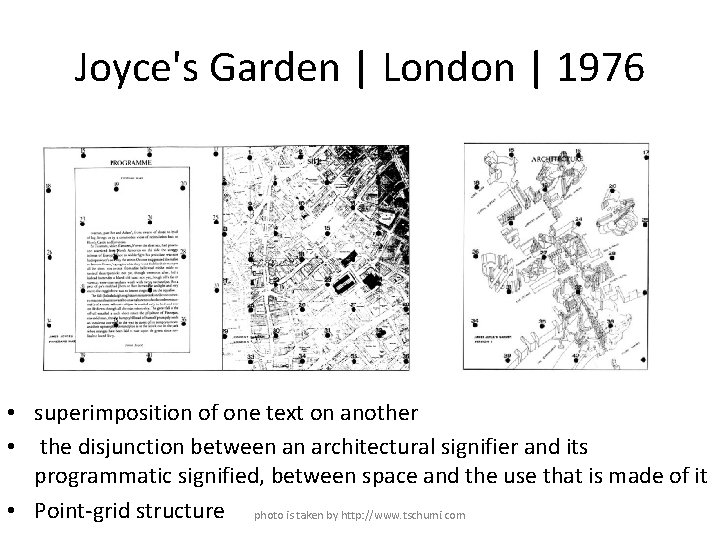
Joyce's Garden | London | 1976 • superimposition of one text on another • the disjunction between an architectural signifier and its programmatic signified, between space and the use that is made of it • Point-grid structure photo is taken by http: //www. tschumi. com
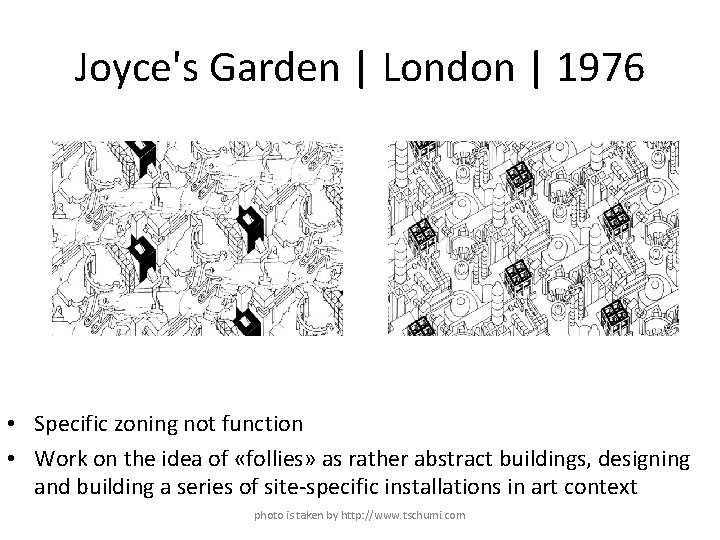
Joyce's Garden | London | 1976 • Specific zoning not function • Work on the idea of «follies» as rather abstract buildings, designing and building a series of site-specific installations in art context photo is taken by http: //www. tschumi. com
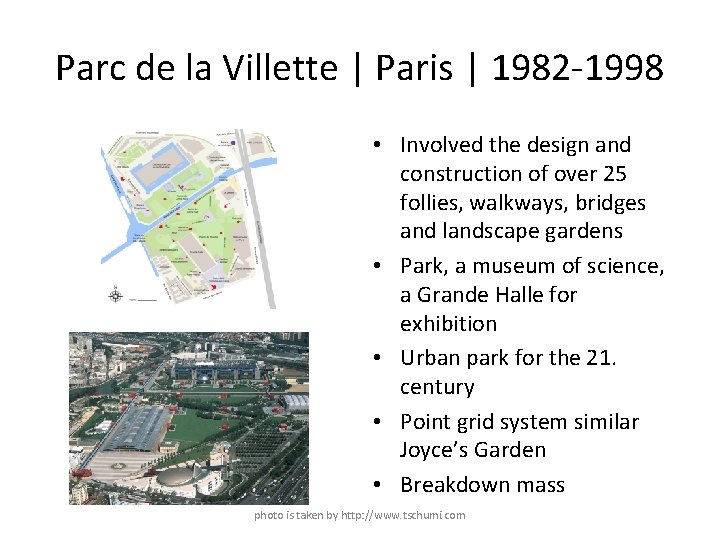
Parc de la Villette | Paris | 1982 -1998 • Involved the design and construction of over 25 follies, walkways, bridges and landscape gardens • Park, a museum of science, a Grande Halle for exhibition • Urban park for the 21. century • Point grid system similar Joyce’s Garden • Breakdown mass photo is taken by http: //www. tschumi. com
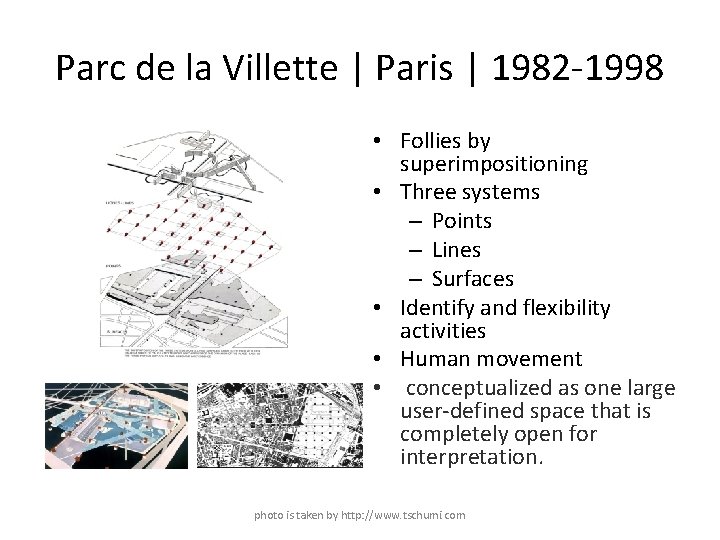
Parc de la Villette | Paris | 1982 -1998 • Follies by superimpositioning • Three systems – Points – Lines – Surfaces • Identify and flexibility activities • Human movement • conceptualized as one large user-defined space that is completely open for interpretation. photo is taken by http: //www. tschumi. com
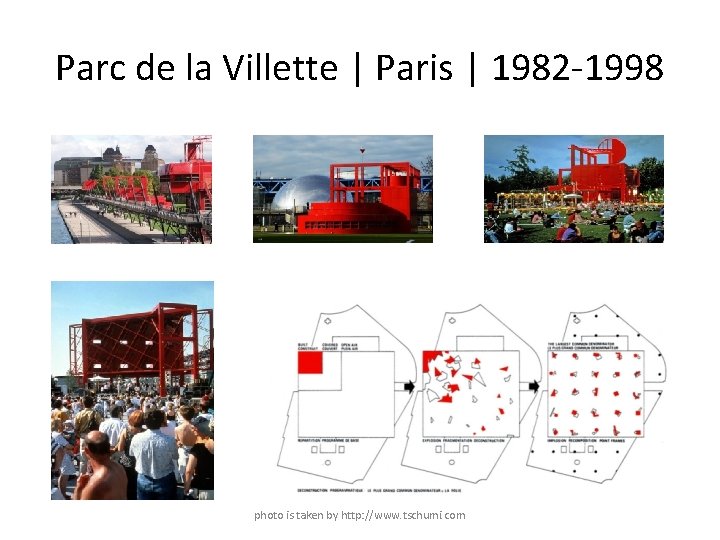
Parc de la Villette | Paris | 1982 -1998 photo is taken by http: //www. tschumi. com
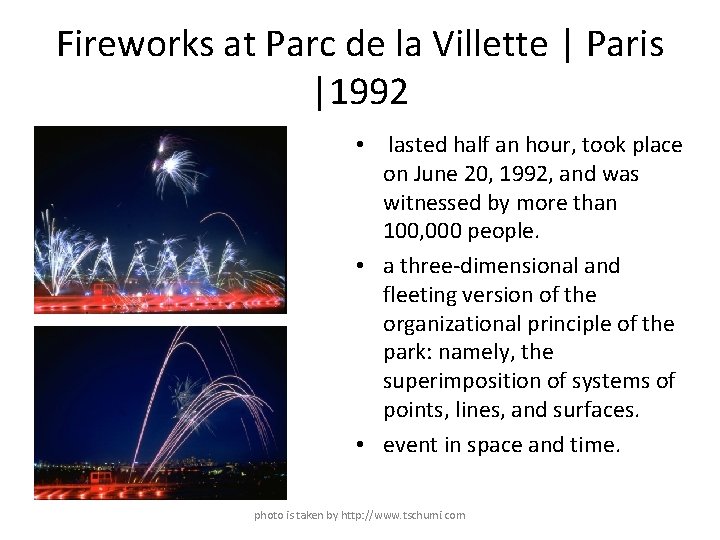
Fireworks at Parc de la Villette | Paris |1992 • lasted half an hour, took place on June 20, 1992, and was witnessed by more than 100, 000 people. • a three-dimensional and fleeting version of the organizational principle of the park: namely, the superimposition of systems of points, lines, and surfaces. • event in space and time. photo is taken by http: //www. tschumi. com
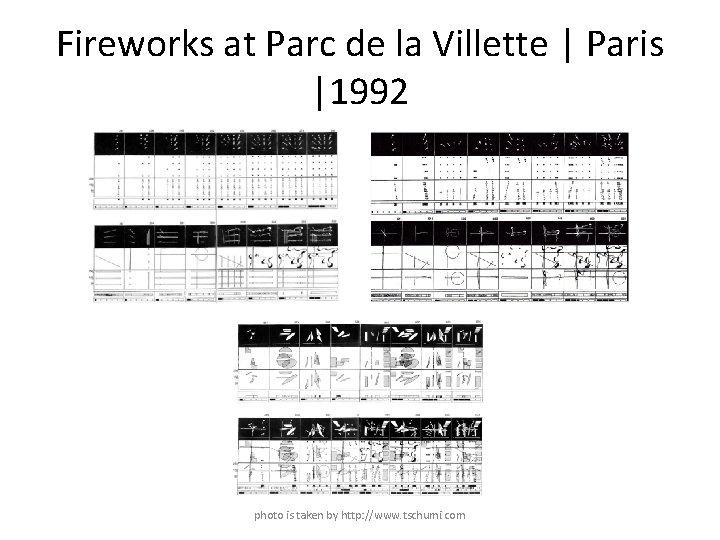
Fireworks at Parc de la Villette | Paris |1992 photo is taken by http: //www. tschumi. com
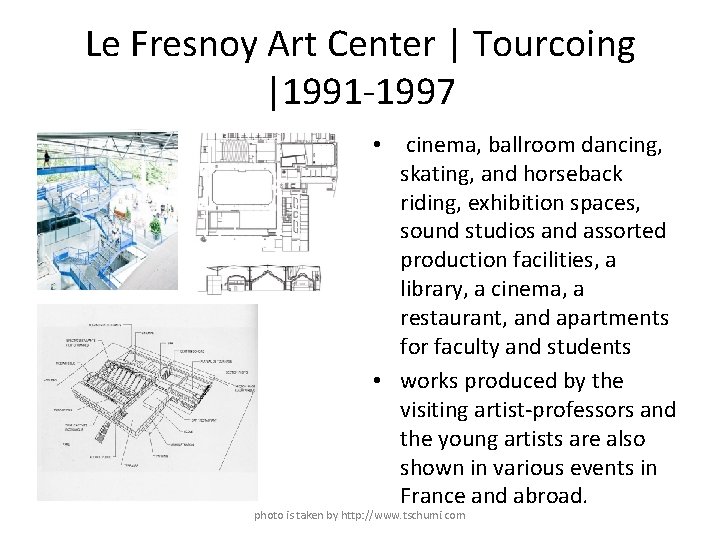
Le Fresnoy Art Center | Tourcoing |1991 -1997 • cinema, ballroom dancing, skating, and horseback riding, exhibition spaces, sound studios and assorted production facilities, a library, a cinema, a restaurant, and apartments for faculty and students • works produced by the visiting artist-professors and the young artists are also shown in various events in France and abroad. photo is taken by http: //www. tschumi. com
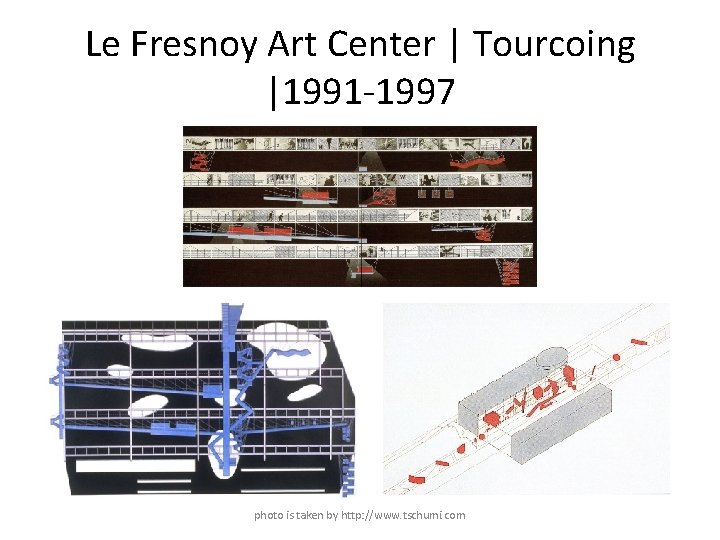
Le Fresnoy Art Center | Tourcoing |1991 -1997 photo is taken by http: //www. tschumi. com
References • Bernard Tschumi Architects. (n. d. ). Retrieved March 21, 2017, from http: //www. tschumi. com/ • Tschumi, B. (1995). Manhattan Transcripts. London: Academy Editions. • Tschumi, B. (2001). Architecture and Disjunction. Cambridge, MA: MIT Press. • Tschumi, B. (2012). Bernard Tschumi: Architecture Concepts: Red is Not a Color. New York: Rizzoli International Publications.
- Slides: 19