
The Man They Called Pythagoras 572 B C
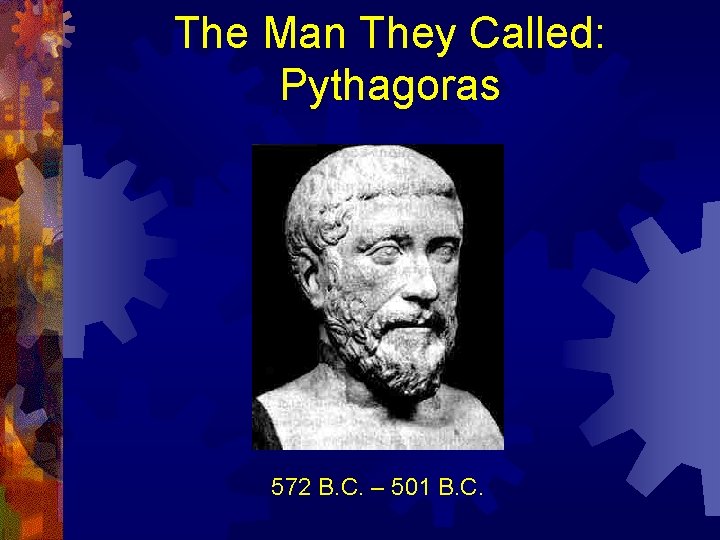
The Man They Called: Pythagoras 572 B. C. – 501 B. C.
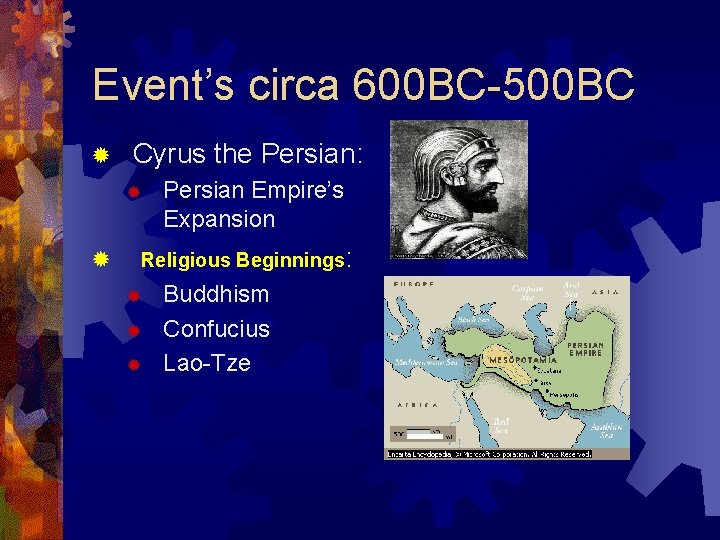
Event’s circa 600 BC-500 BC ® Cyrus the Persian: ® ® Persian Empire’s Expansion Religious Beginnings: ® ® ® Buddhism Confucius Lao-Tze
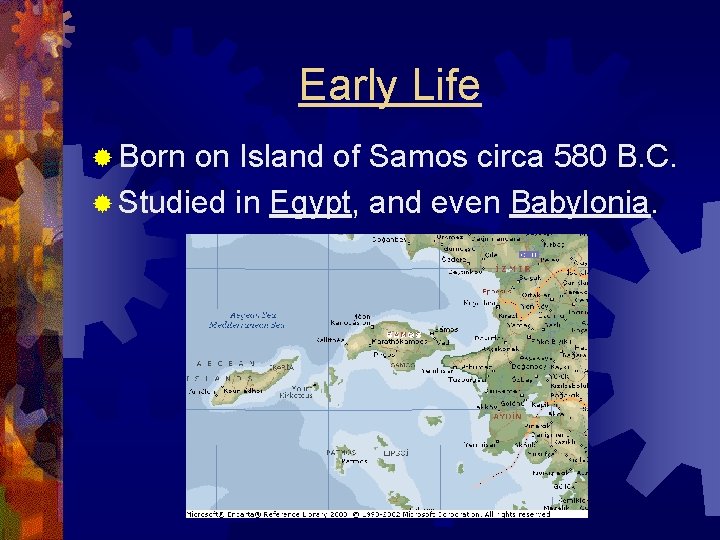
Early Life ® Born on Island of Samos circa 580 B. C. ® Studied in Egypt, and even Babylonia.
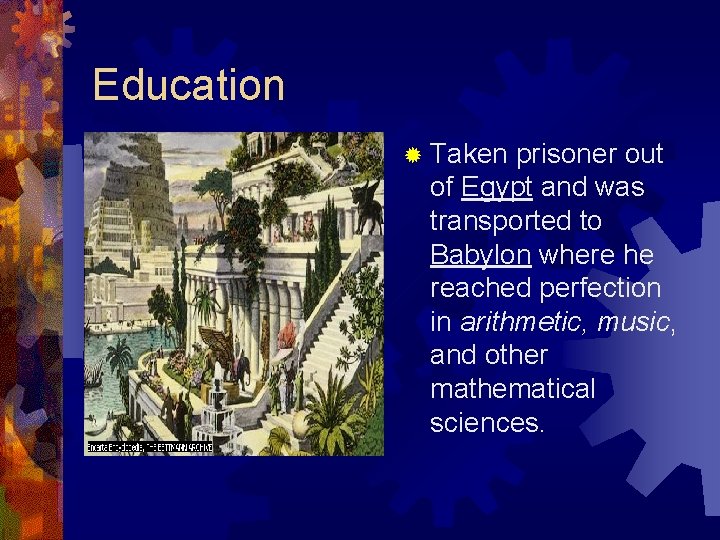
Education ® Taken prisoner out of Egypt and was transported to Babylon where he reached perfection in arithmetic, music, and other mathematical sciences.
Establishing a School ® After years of traveling and studying, he settled in Croton where he established a school. ® Main Mathemata (subjects) of study were: ® ® Arithmetic Music Geometry Astronomy ® (Logic, grammar, rhetoric would later be added)
The Effects of School ®A sacred brotherhood was created at the school by the followers of Pythagoras and called themselves Pythagoreans. ® Believed the key in explaining the universe was in Numbers ® Thesis: “Everything is Number”
Contributions to Mathematics ® First to study the Theory of Numbers, and their relations to each other. ® Astronomy: “Harmony of Spheres” ® Pythagorean’s Theorem: ®: a 2+b 2=c 2 for right triangles ® History of Pythagorean theorem and proofs ® http: //students. bath. ac. uk/ma 1 ajn/history. htm
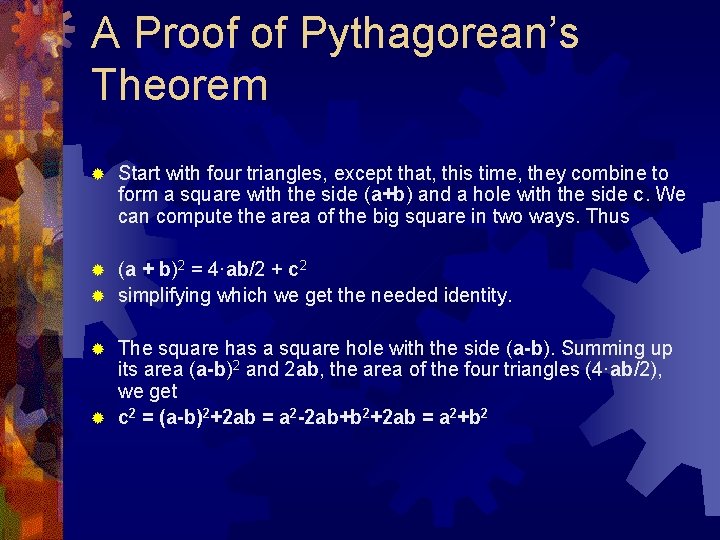
A Proof of Pythagorean’s Theorem ® Start with four triangles, except that, this time, they combine to form a square with the side (a+b) and a hole with the side c. We can compute the area of the big square in two ways. Thus (a + b)2 = 4·ab/2 + c 2 ® simplifying which we get the needed identity. ® The square has a square hole with the side (a-b). Summing up its area (a-b)2 and 2 ab, the area of the four triangles (4·ab/2), we get ® c 2 = (a-b)2+2 ab = a 2 -2 ab+b 2+2 ab = a 2+b 2 ®
Contributions to Number Theory ® Was first to study the properties of Numbers: ® Odd or even properties ® Triangular Numbers: {1, 3, 6, 10…n(n+1)/2} ® Perfect Numbers: {6, 28…} ® Gave Number’s Personalities: ® Number was Everything ® [2=woman, 3=man, 10=universe]
The Ending ®A Revolution around 500 BC occurred in the city of Croton ® During this revolution many Pythagoreans were murdered ® Pythagoras is believed to have been murdered at this time. (500 BC) ® The brotherhood lasted for 2 more centuries after Pythagoras’s death.
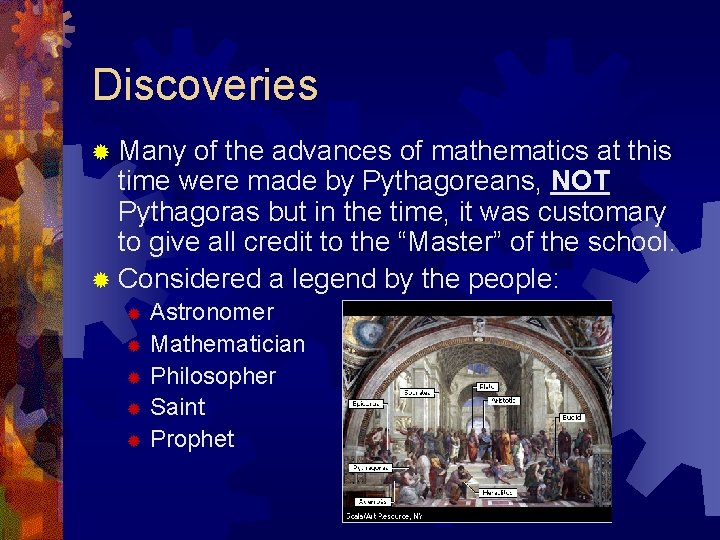
Discoveries ® Many of the advances of mathematics at this time were made by Pythagoreans, NOT Pythagoras but in the time, it was customary to give all credit to the “Master” of the school. ® Considered a legend by the people: Astronomer ® Mathematician ® Philosopher ® Saint ® Prophet ®
Sources/ References ® ® Pythagorean Theorem: ® http: //www. cut-the-knot. org/pythagoras/index. shtml Pythagoras of Samos ® ® http: //www-groups. dcs. st-andrews. ac. uk/~history/Mathematicians/Pythagoras. html History of Pythagoras ® http: //students. bath. ac. uk/ma 1 ajn/history. htm ® Burton, David. Elementary Number Theory, Forth Edition. Mc. Graw-Hill Companies, San Francisco, 1998. (pg. 12 -15) ® Boyer, Carl B. A History of Mathematics. Second Edition. John Wiley & Sons, New York, 1991. Pg. 43 -61
- Slides: 12