
The Malware Menagerie Roger Clarke Xamax Consultancy Canberra
The Malware Menagerie Roger Clarke, Xamax Consultancy, Canberra Visiting Professor in Cyberspace Law & Policy at U. N. S. W. , e. Commerce at Uni of Hong Kong, Computer Science at A. N. U. http: //www. anu. edu. au/people/Roger. Clarke/. . . / EC/Secy. Mq-Malware. ppt LAW 868 – Electronic Commerce and the Law Macquarie University – 14 September 2006 Copyright, 1995 -2006 1
The Malware Menagerie Agenda • • • Copyright, 1995 -2006 Virus Worm Trojan Horse Spyware Bots / Robots / Agents • • • Backdoor / Trapdoor Zombie Exploit Bug Phishing http: //www. wikipedia. org/<term> 2
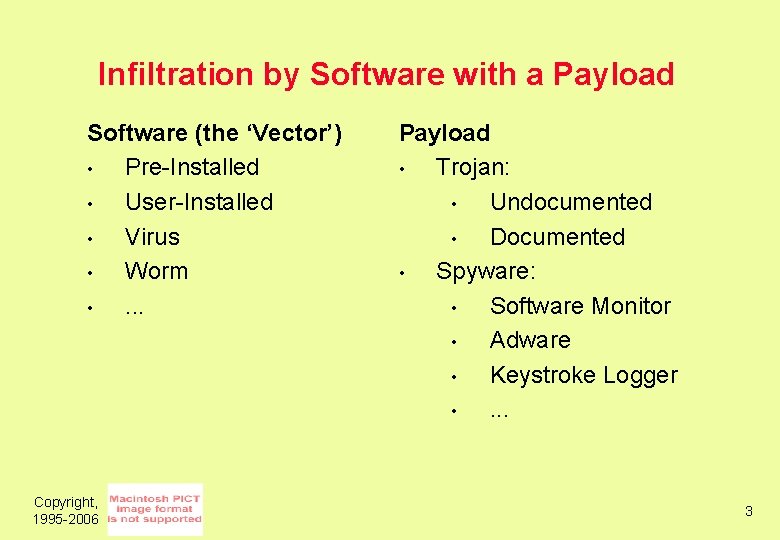
Infiltration by Software with a Payload Software (the ‘Vector’) • Pre-Installed • User-Installed • Virus • Worm • . . . Copyright, 1995 -2006 Payload • Trojan: • Undocumented • Documented • Spyware: • Software Monitor • Adware • Keystroke Logger • . . . 3
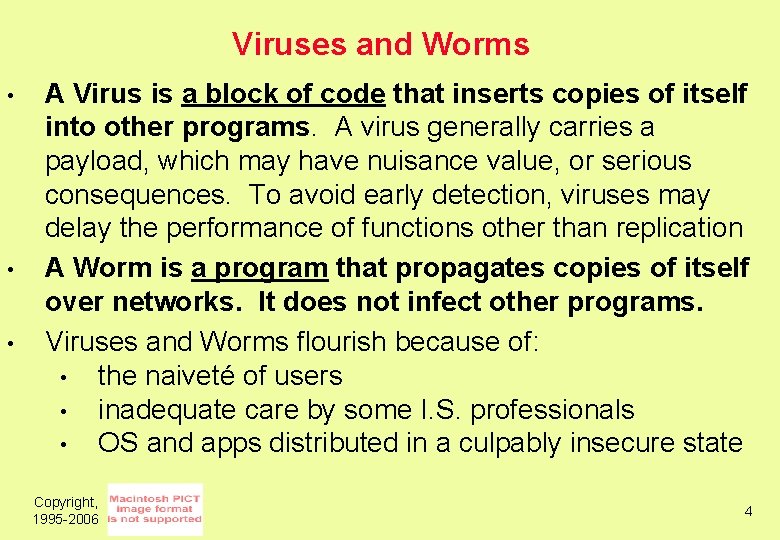
Viruses and Worms • • • A Virus is a block of code that inserts copies of itself into other programs. A virus generally carries a payload, which may have nuisance value, or serious consequences. To avoid early detection, viruses may delay the performance of functions other than replication A Worm is a program that propagates copies of itself over networks. It does not infect other programs. Viruses and Worms flourish because of: • the naiveté of users • inadequate care by some I. S. professionals • OS and apps distributed in a culpably insecure state Copyright, 1995 -2006 4
Trojan Horses A program that purports to perform a useful function (and may do so) but certainly performs malicious functions e. g. keystroke recorders embedded in utilities Copyright, 1995 -2006 5
Spyware • • Copyright, 1995 -2006 Software that surreptitiously: • gathers data within a device e. g. about its user, or the uses made of it • makes it available to some other party Key applications: • keystroke loggers (esp. for passwords) • monitoring of user behaviour for consumer marketing purposes (‘adware’) • monitoring of uses of copyright works (software, audio, video) 6
Bots / Robots / Agents • Copyright, 1995 -2006 Software that interacts with other software or human users as though it were a human • Web crawlers or spiders • Re enquiries / requests / incident reports • Auto-acknowledgement • Auto-response • Automated Trading • Online Games 7
Backdoors / Trapdoors Any planned means whereby a user can surreptitiously gain unauthorised access to an Internet node e. g. a feature of a package intended to enable maintenance programmers to gain access, or a feature added into a program by a virus Copyright, 1995 -2006 8
‘Zombies’ • • Copyright, 1995 -2006 A common use of Trojan Horses Establishes a large number of processors, scattered around the Internet, that are under central or timed control (hence ‘zombies’) These are referred to as a Botnet They can be used to: • perform DDo. S attacks • send Spam 9
Exploits • • An Exploit is an established way of performing an attack on a vulnerability Standard techniques are supported by established guidelines and programming code, which circulate on the Internet Code that enables easy performance of an exploit is expressed in a script ‘Script Kiddies’ is a derogatory term for relatively unskilled crackers who rely on techniques and program code developed by others Copyright, 1995 -2006 10
Bugs • • Errors in software (systems software esp. MS Windows) or applications (esp. MSIE) They may create vulnerabilities The vulnerabilities may be attacked by crackers This gives rise to the need for urgent patches http: //www. microsoft. com/technet/security/current. aspx Aus. CERT Security Alerts http: //national. auscert. org. au/render. html? cid=2998 Commercial Services, e. g. http: //secunia. com/advisories/ Copyright, 1995 -2006 11
Phishing • • Copyright, 1995 -2006 Sending people e-mail messages in order to lure them into divulging sensitive data The data sought is commonly passwords and credit-card details The sender commonly assumes a relatively highly trusted identity e. g. a fin’l institution The data is commonly keyed into a web-form on a site that purports to be operated by the trusted identity 12
- Slides: 12