
The Malthusian Model Lectures in Macroeconomics Charles W


- Slides: 19
The Malthusian Model Lectures in Macroeconomics- Charles W. Upton
The Malthusian Model • Developed by Thomas Robert Malthus in On Population, 1798. The Malthusian Model
The Malthusian Model • Developed by Thomas Robert Malthus in On Population, 1798. • A Simplistic Model, but a guide to how economists use models. The Malthusian Model
The Malthusian Model • Developed by Thomas Robert Malthus in On Population, 1798. • A Simplistic Model, but a guide to how economists use models. • Indeed, the model is still used in many public policy discussions. The Malthusian Model
Key Assumptions • Resources, if they grow at all, tend to grow at an arithmetic rate. The Malthusian Model
Key Assumptions • Resources, if they grow at all, tend to grow at an arithmetic rate. • Population, unchecked by famine, will grow at a geometric rate. The Malthusian Model
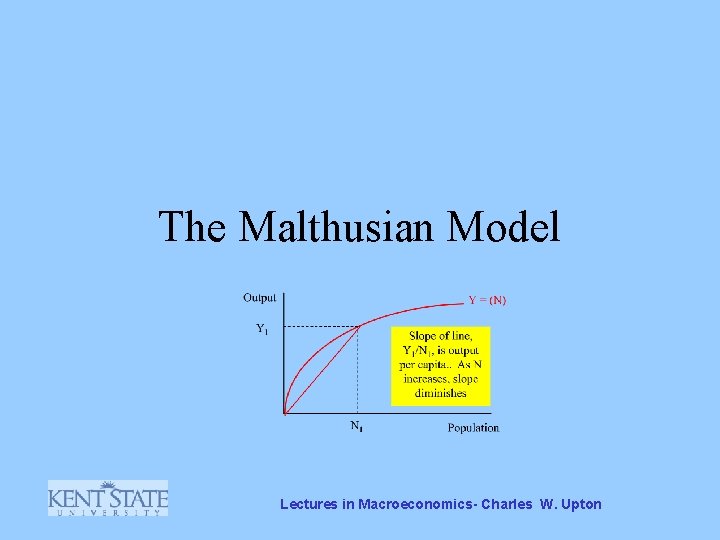
A Graphical Interpretation • Diminishing returns to proportion – Double the number of workers, you get more output, but not twice as much The Malthusian Model
A Graphical Interpretation • Diminishing returns to proportion • Population unchecked by famine grows at a geometric rate. – We will not attempt to measure this rate. The Malthusian Model
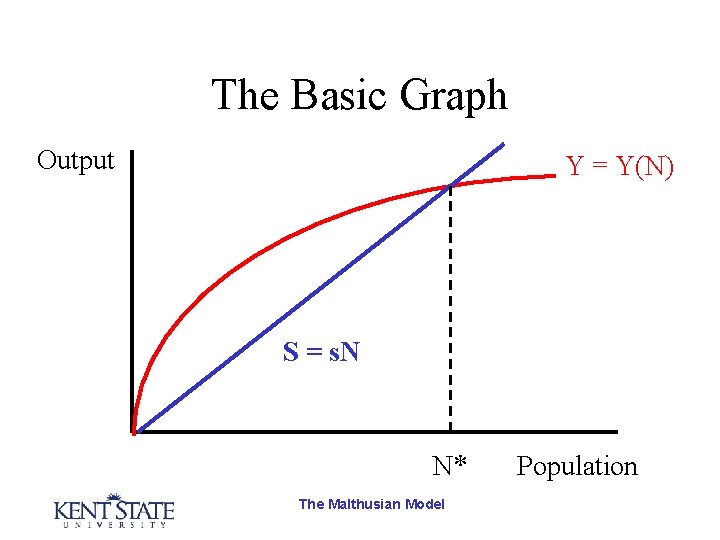
A Graphical Interpretation • Diminishing returns to proportion • Population unchecked by famine grows at a geometric rate. • There is a minimum subsistence budget s. – Again, we will not attempt to quantify this budget. The Malthusian Model
The Basic Graph Output Y = (N) Population The Malthusian Model
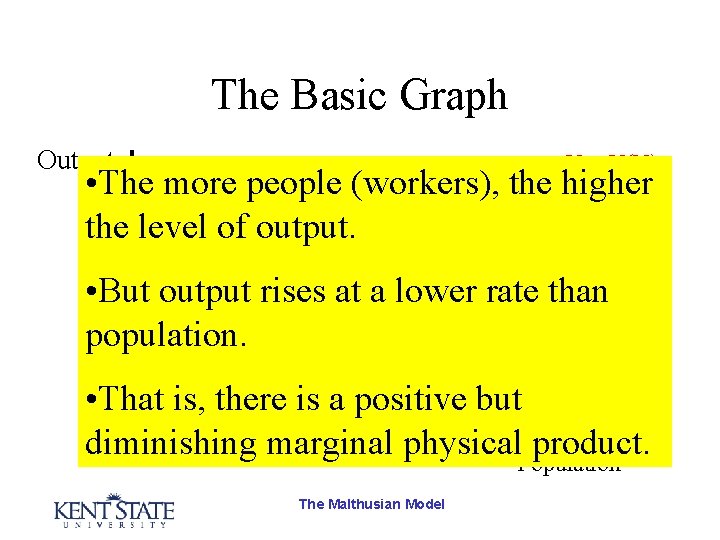
The Basic Graph Output Y = Y(N) • The more people (workers), the higher the level of output. • But output rises at a lower rate than population. • That is, there is a positive but diminishing marginal physical. Population product. The Malthusian Model
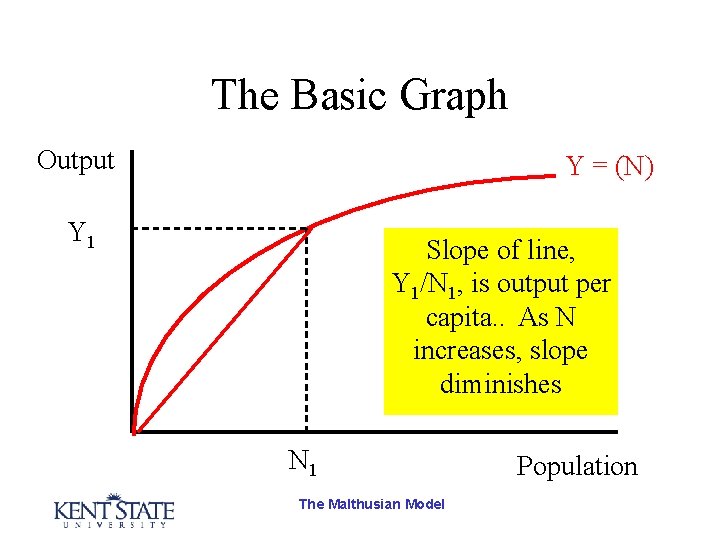
The Basic Graph Output Y = (N) Y 1 Slope of line, Y 1/N 1, is output per capita. . As N increases, slope diminishes N 1 The Malthusian Model Population
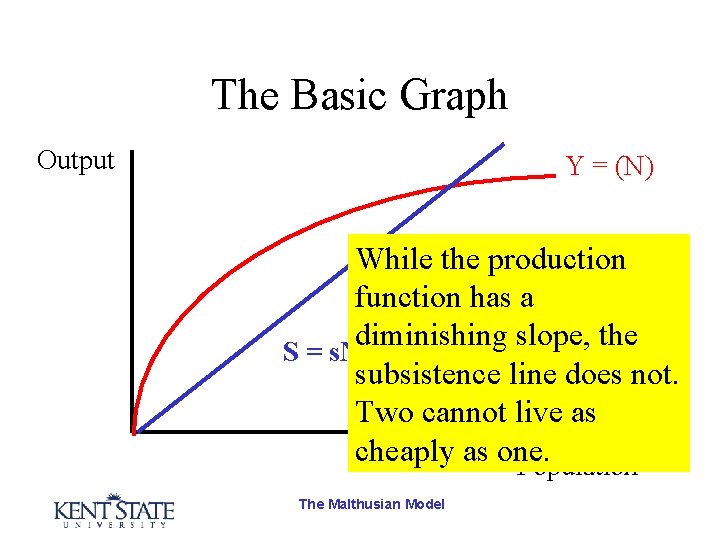
The Basic Graph Output Y = (N) S = s. N Population The Malthusian Model
The Basic Graph Output Y = (N) While the production function has a diminishing slope, the S = s. N subsistence line does not. Two cannot live as cheaply as one. Population The Malthusian Model
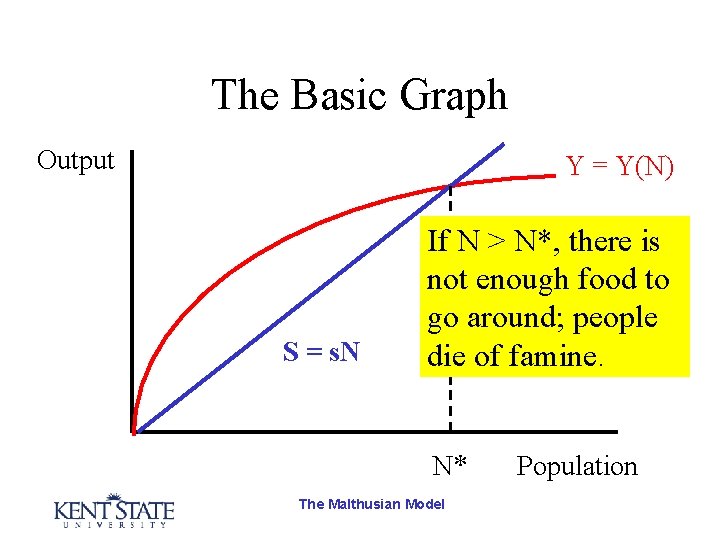
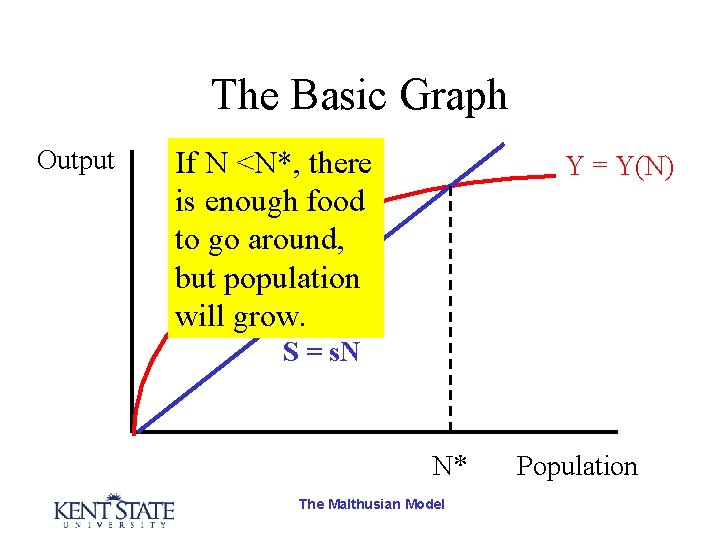
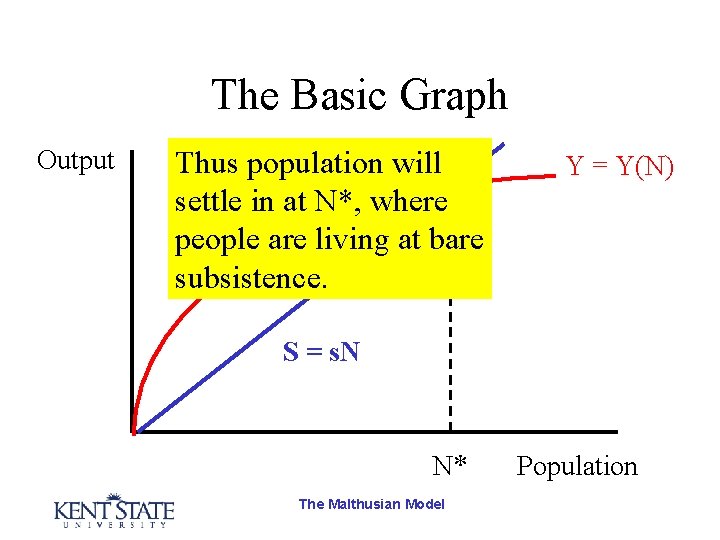
The Basic Graph Output Y = Y(N) S = s. N N* The Malthusian Model Population
The Basic Graph Output Y = Y(N) S = s. N If N > N*, there is not enough food to go around; people die of famine. N* The Malthusian Model Population
The Basic Graph Output If N <N*, there is enough food to go around, but population will grow. Y = Y(N) S = s. N N* The Malthusian Model Population
The Basic Graph Output Thus population will settle in at N*, where people are living at bare subsistence. Y = Y(N) S = s. N N* The Malthusian Model Population
End © 2003 Charles W. Upton. All rights reserved The Malthusian Model