
The Magnetosphere of Planet Mercury The planet Shape











- Slides: 34
The Magnetosphere of Planet Mercury The planet Shape and structure of the magnetosphere Current systems Dynamics Energy sources Eigen oscillations
Planet und Magnetfeld Planetenradius: Kernradius: Mittl. Dichte: Rotationsrate: Dipolmoment: Ober. Temp. : Atmosphäre: Exosphäre: Plasmasphäre: Magnetosphäre: 2439 km ~1829 km 5. 42 g/cm 3 58. 64 Tage 5· 1019 Am 2 -173° - 429° Nein Ja
Das Magnetfeld des Planeten Merkur Ness et al. , 1978
Planetary Magnetic Fields
Magnetospheric Plasma Sources Mercury: solar wind and sputtering of surface material, e. g. sodium Earth: solar wind and ionosphere Jupiter: solar wind and volcanic activity of the moon Io Saturn: solar wind, atmosphere of moon Titan, sputtering at surfaces of icy moons and rings Uranus: polar ionosphere, minor solar wind contribution Neptun: ionosphere, moon Triton
The Magnetosphere of Mercury No atmosphere thus no ionosphere but exosphere No plasmasphere Weak magnetic field Multi-ion plasma Small magnetosphere
Solar Wind: The Embedding Medium Magnetic field and plasma density Mercury: 46 - 21 n. T 73 - 33 cm-1 Earth: 8 n. T 5 cm-1 Jupiter: 1 n. T 0. 2 cm-1 Saturn: 0. 6 n. T 0. 06 cm-1 Uranus: 0. 3 n. T 0. 01 cm-1 Neptun: 0. 005 n. T 0. 005 cm-1 The velocity is almost constant in the inner part of the heliosphere
Magnetopause Formation The magnetopause is a surface where the dynamic pressure of the solar wind and the magnetic pressure of the magnetospheric plasma are in equilibrium: The dynamic pressure of solar wind particles is transferred to the magnetospheric plasma by specular reflection of the particles at the boundary.
Magnetoapause Position The magnetopause stand-off distance along the Sun-Earth line is given by where k = 0. 88 is a correction factor resulting from gasdynamic approximations to the magnetosheath flow: At Mercury RMP = 1. 5 RP
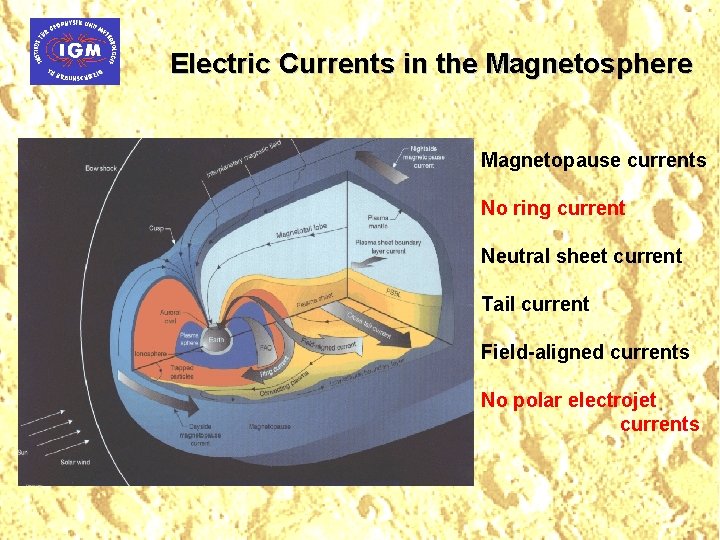
Electric Currents in the Magnetosphere Magnetopause currents No ring current Neutral sheet current Tail current Field-aligned currents No polar electrojet currents
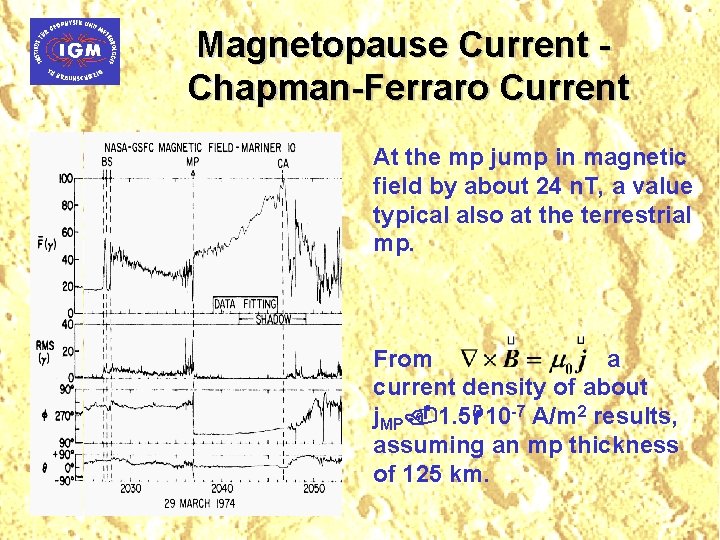
Magnetopause Current Chapman-Ferraro Current At the mp jump in magnetic field by about 24 n. T, a value typical also at the terrestrial mp. From a current density of about j. MP 1. 5 10 -7 A/m 2 results, assuming an mp thickness of 125 km.
Magnetopause Current – Ground Magnetic Effect Chapman-Ferraro currents produce ground-magnetic effects, which at Earth are of the order of 10 n. T added to a 30, 000 n. T background field and at Mercury are of the order of 70 n. T added to a 340 n. T background field The external field matters at the surface !!!!
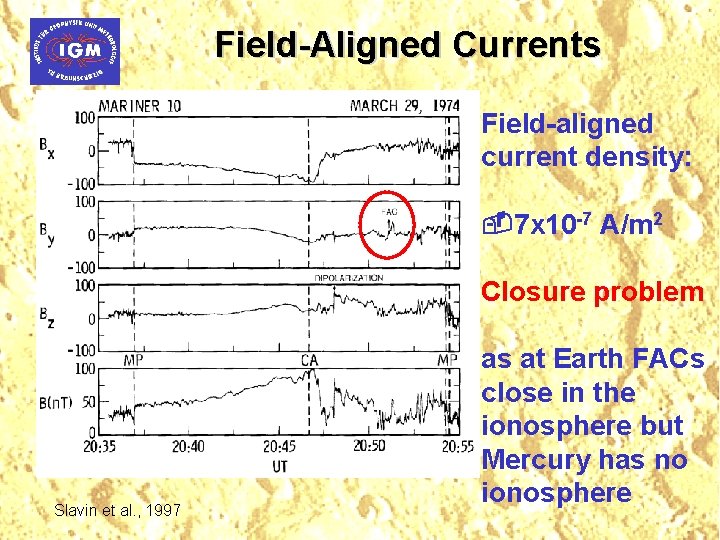
Field-Aligned Currents Field-aligned current density: 7 x 10 -7 A/m 2 Closure problem Slavin et al. , 1997 as at Earth FACs close in the ionosphere but Mercury has no ionosphere
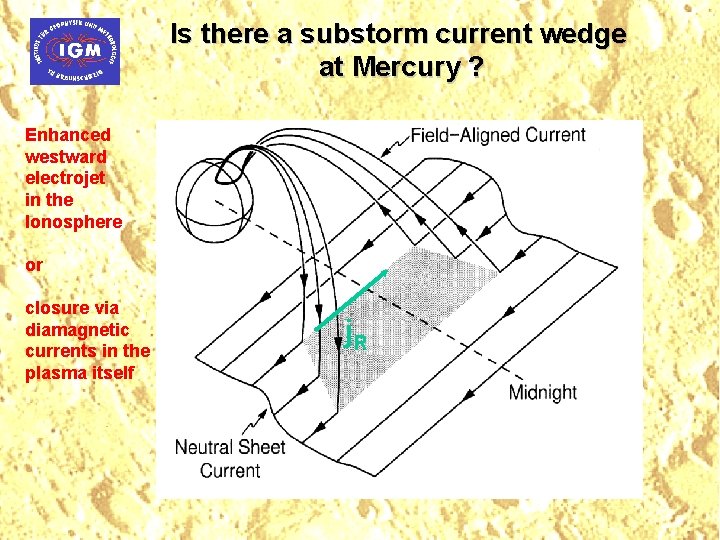
Is there a substorm current wedge at Mercury ? Enhanced westward electrojet in the Ionosphere or closure via diamagnetic currents in the plasma itself j. R
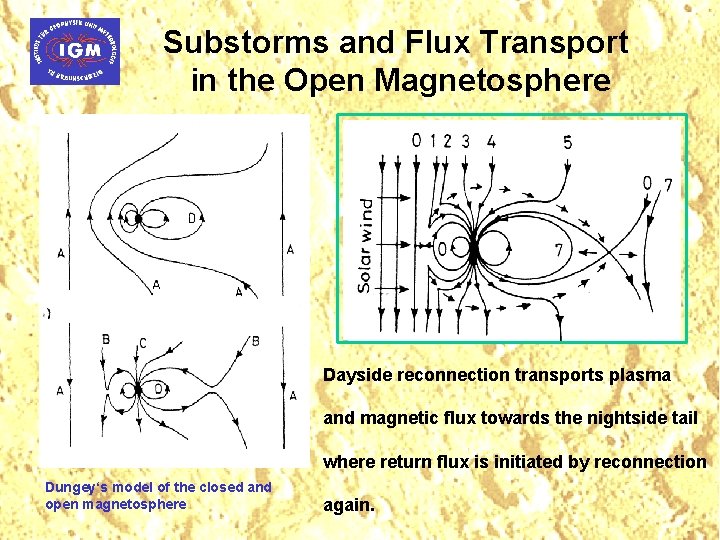
Substorms and Flux Transport in the Open Magnetosphere Dayside reconnection transports plasma and magnetic flux towards the nightside tail where return flux is initiated by reconnection Dungey‘s model of the closed and open magnetosphere again.
Corotation, Reconnection Induced Convection, and the Plasmapause Does Mercury have a plasmasphere ?
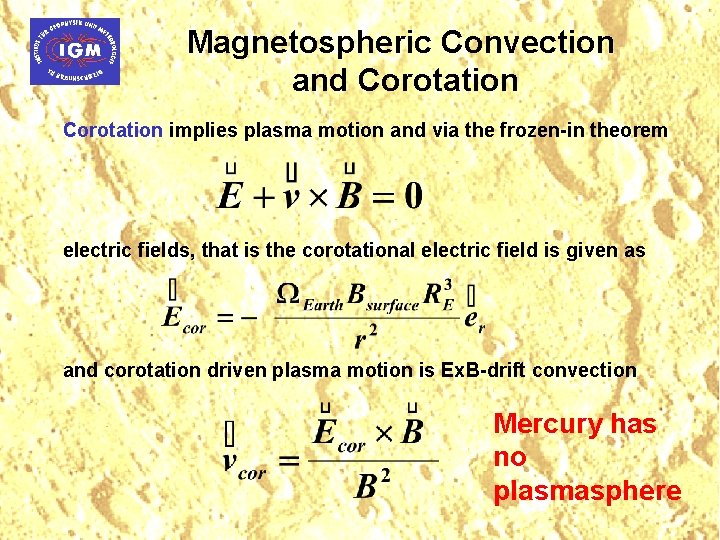
Magnetospheric Convection and Corotation implies plasma motion and via the frozen-in theorem electric fields, that is the corotational electric field is given as and corotation driven plasma motion is Ex. B-drift convection Mercury has no plasmasphere
External Forcing – Internal Reactions ? Siscoe and Christopher, 1975
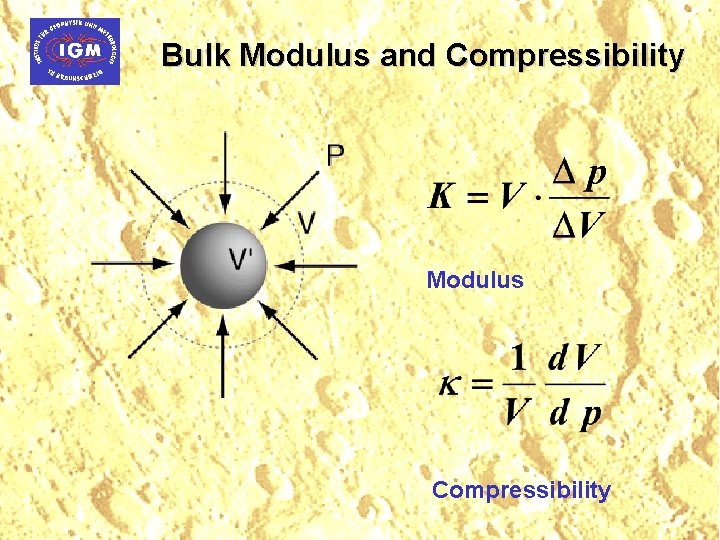
Bulk Modulus and Compressibility Modulus Compressibility
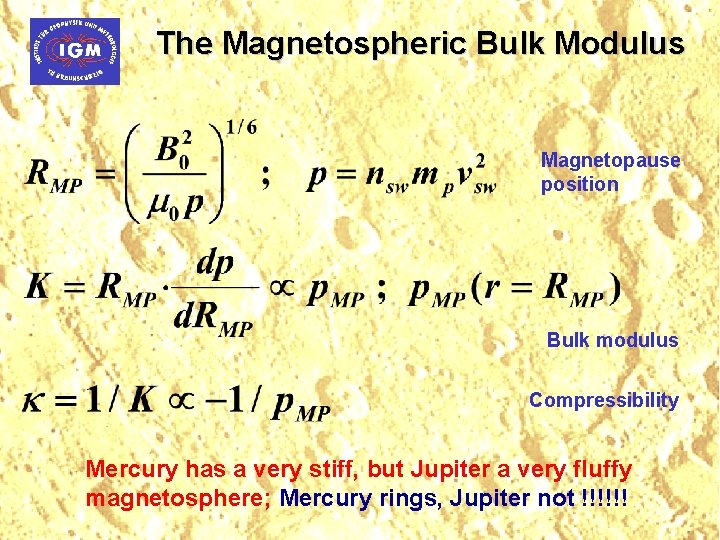
The Magnetospheric Bulk Modulus Magnetopause position Bulk modulus Compressibility Mercury has a very stiff, but Jupiter a very fluffy magnetosphere; Mercury rings, Jupiter not !!!!!!
Ringing the Magnetospheric Bell Magnetospheric eigenoscillations are MHD waves in the terretrial magnetosphere. Their periods are much longer than proton gyroperiods !!! Units: 1 n. T; 0. 1 m. V/m
ULF Waves at Mercury This is the only published evidence for ULF waves in the Hermean magnetosphere. Amplitude: 2 n. T Period: 2 s, e. g. about twice TG, Proton this wave is not an (from Russell, 1989) MHD wave !!!!
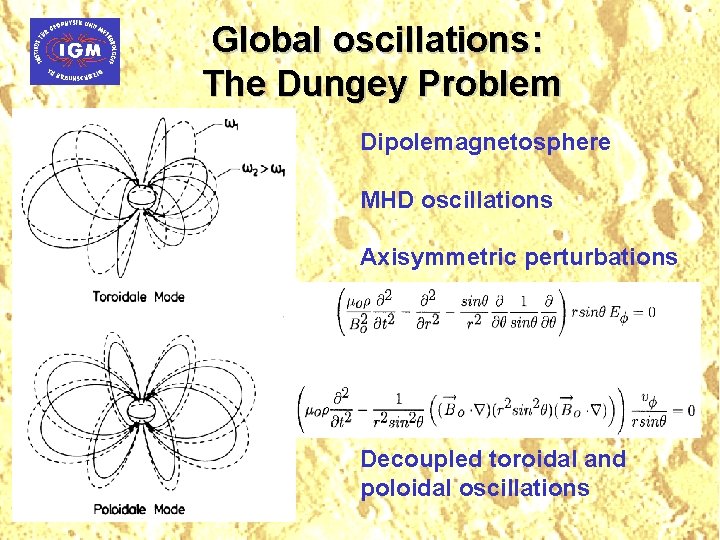
Global oscillations: The Dungey Problem Dipolemagnetosphere MHD oscillations Axisymmetric perturbations Decoupled toroidal and poloidal oscillations
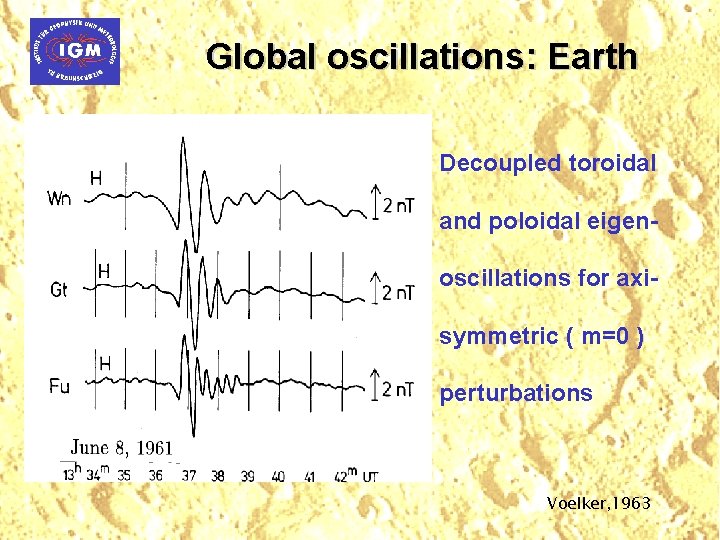
Global oscillations: Earth Decoupled toroidal and poloidal eigenoscillations for axisymmetric ( m=0 ) perturbations Voelker, 1963
Global oscillations: Mercury To treat this question we need Dungey‘s equations for a non-MHD model of the Hermean magnetosphere as the anticipated eigenfrequencies are less, but comparable to the gyrofrequency
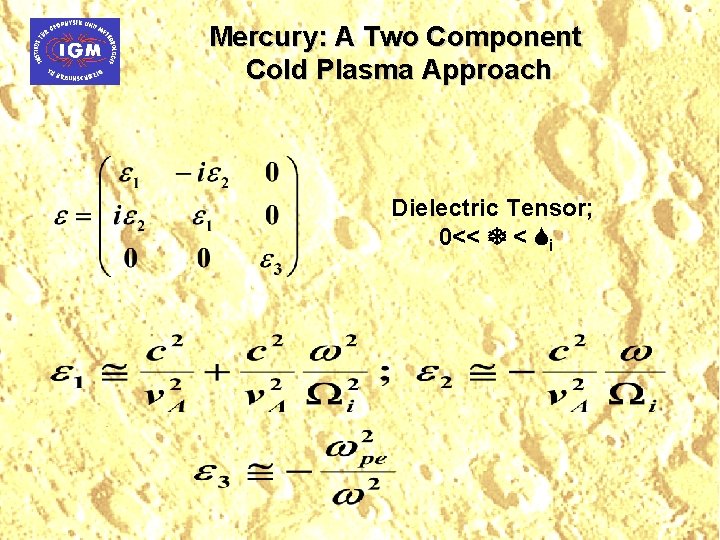
Mercury: A Two Component Cold Plasma Approach Dielectric Tensor; 0<< < i
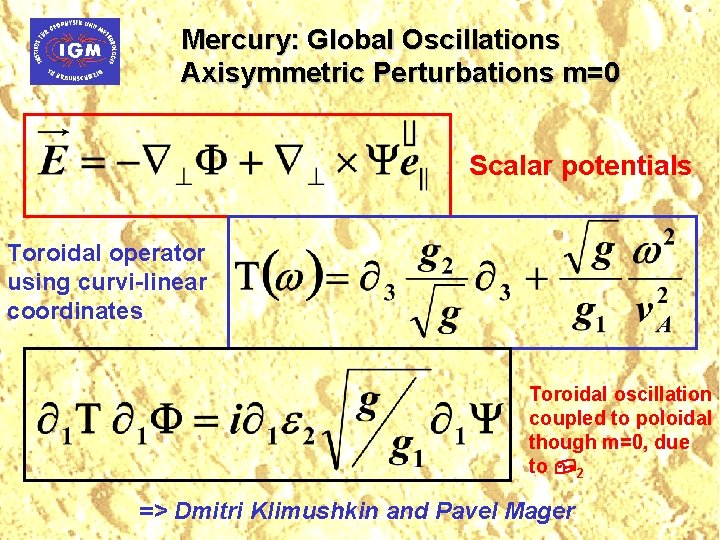
Mercury: Global Oscillations Axisymmetric Perturbations m=0 Scalar potentials Toroidal operator using curvi-linear coordinates Toroidal oscillation coupled to poloidal though m=0, due to 2 => Dmitri Klimushkin and Pavel Mager
Kinetic Alfvén Waves in the Hermean Magnetosphere a) Solar wind buffeting causes ringing of the magnetosphere b) The scale of the magnetosphere is about 10 x the ion gyroradius c) Waves generated by buffeting are kinetic Alfvén waves with E|| 0. 2 m. V/m (Glassmeier, 2000) d) Buffeting causes particle heating via kinetic Alfvén waves
Electromagnetic Induction at Mercury We have a small magnetosphere Magnetopause currents are close to the planet Temporal variations of magnetopause currents may cause strong induction effects As the planet consists mainly out of a highly conducting core How large are these induced fields ?
Isototalen an der Merkuroberfläche Quadrupolanteile Breite Nordpol Länge Südpol Nordpol
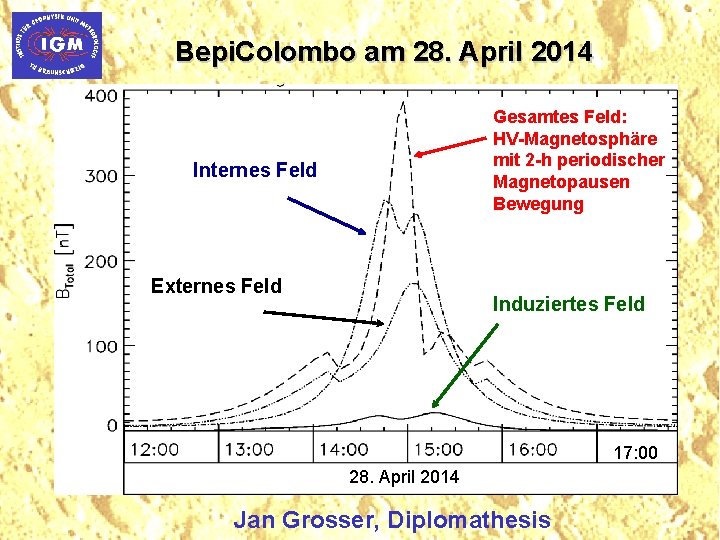
Bepi. Colombo am 28. April 2014 Gesamtes Feld: HV-Magnetosphäre mit 2 -h periodischer Magnetopausen Bewegung Internes Feld Externes Feld Induziertes Feld 17: 00 28. April 2014 Jan Grosser, Diplomathesis
Das Humboldt Observatorium, Merkuräquator, 28. April 2014, 18: 00 Lokalzeit Gesamtes Feld Interner Anteil Externer Anteil Induzierter Anteil 17: 00 28. April 2014
Summary Mercury is a new point in the magnetospheric phase space !!!!!!
Ein Dankeschön an. . . Jan Grosser Diplomand am IGM, TUBS Anja Stadelmann Doktorandin am IGM, TUBS Dr. Ulrich Auster IGM, TU Braunschweig Prof. Dr. D. Klimushkin, Irkutsk, Russia Dr. P. Mager, Irkutsk, Russia Prof. Dr. J. Vogt IUB, Bremen Prof. Dr. G. -H. Voigt FH Aachen