
The Lymphatic System and Immunity Muse Bio 2440
The Lymphatic System and Immunity Muse Bio 2440 lecture #5 2/8/12 Copyright © 2009 Pearson Education, Inc. , publishing as Pearson Benjamin Cummings
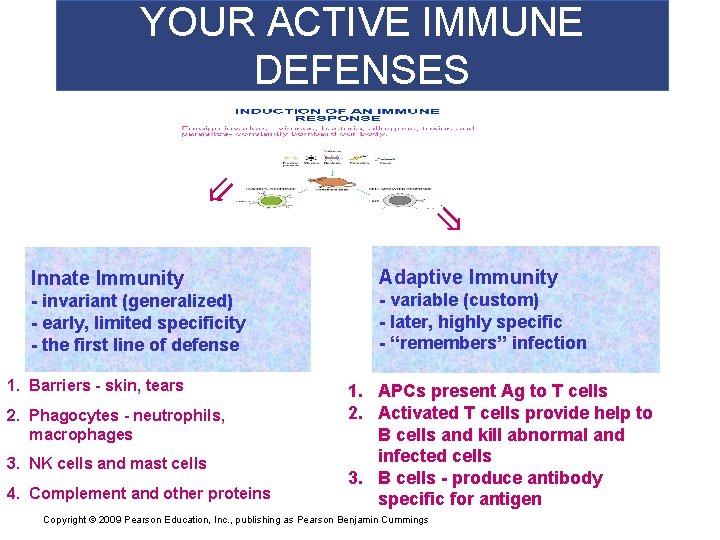
YOUR ACTIVE IMMUNE DEFENSES Innate Immunity Adaptive Immunity - invariant (generalized) - early, limited specificity - the first line of defense - variable (custom) - later, highly specific - ‘‘remembers’’ infection 1. Barriers - skin, tears 2. Phagocytes - neutrophils, macrophages 3. NK cells and mast cells 4. Complement and other proteins 1. APCs present Ag to T cells 2. Activated T cells provide help to B cells and kill abnormal and infected cells 3. B cells - produce antibody specific for antigen Copyright © 2009 Pearson Education, Inc. , publishing as Pearson Benjamin Cummings

Immunity or Resistance § Ability to ward off damage or disease through our defenses § 2 types of immunity § Innate or nonspecific immunity – present at birth § No specific recognition of invaders, no memory component § 1 st and 2 nd line of defenses § Adaptive or specific immunity § Specific recognition of invaders with a memory component Copyright © 2009 Pearson Education, Inc. , publishing as Pearson Benjamin Cummings
Overview of the Lymphoid System § The Lymphoid System § Protects us against disease § Lymphoid system cells respond to § Environmental pathogens § Toxins § Abnormal body cells, such as cancers Copyright © 2009 Pearson Education, Inc. , publishing as Pearson Benjamin Cummings
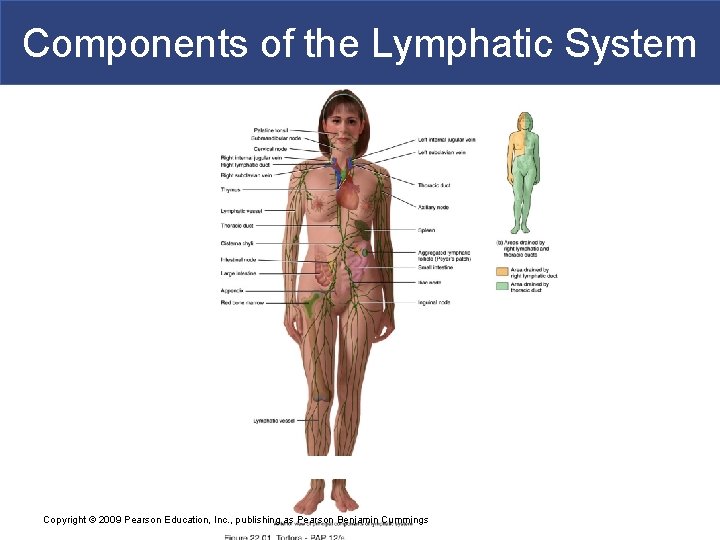
Components of the Lymphatic System Copyright © 2009 Pearson Education, Inc. , publishing as Pearson Benjamin Cummings
Immunity § Resistance to disease § Immune system has two intrinsic systems § Innate (nonspecific) defense system § Adaptive (specific) defense system Copyright © 2009 Pearson Education, Inc. , publishing as Pearson Benjamin Cummings
Immunity § Innate defense system has two lines of defense § First line of defense is external body membranes (skin and mucosae) § Second line of defense is antimicrobial proteins, phagocytes, and other cells § Inhibit spread of invaders § Inflammation is its most important mechanism Copyright © 2009 Pearson Education, Inc. , publishing as Pearson Benjamin Cummings

Immunity § Adaptive defense system § Third line of defense attacks particular foreign substances § Takes longer to react than the innate system § Innate and adaptive defenses are deeply intertwined Copyright © 2009 Pearson Education, Inc. , publishing as Pearson Benjamin Cummings
Overview of the Lymphoid System § Specific Defenses § Lymphocytes § Part of the immune response § Identify, attack, and develop immunity: – to a specific pathogen Copyright © 2009 Pearson Education, Inc. , publishing as Pearson Benjamin Cummings
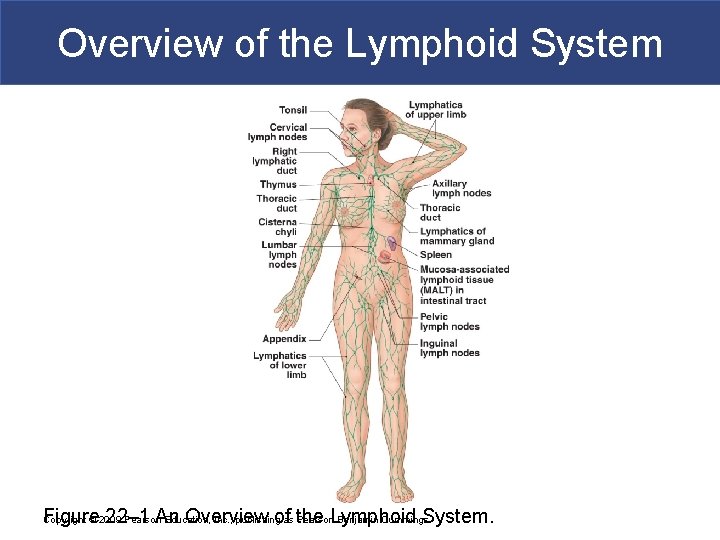
Overview of the Lymphoid System Figure 22– 1 An Overview of the Lymphoid System. Copyright © 2009 Pearson Education, Inc. , publishing as Pearson Benjamin Cummings
Structures of Body Defenses § Lymphocyte Circulation § From blood to interstitial fluid through capillaries § Returns to venous blood through lymphatic vessels § Lymph = interstitial fluid that has entered a lymphatic § The Circulation of Fluids § From blood plasma to lymph and back to the venous system § Transports hormones, nutrients, and waste products Copyright © 2009 Pearson Education, Inc. , publishing as Pearson Benjamin Cummings

Structures of Body Defenses § Lymphedema § Blockage of lymph drainage from a limb § Causes severe swelling § Interferes with immune system function § Lymphocytes § Make up 20– 30% of circulating leukocytes § Most are stored, not circulating Copyright © 2009 Pearson Education, Inc. , publishing as Pearson Benjamin Cummings
Structures of Body Defenses § Three Classes of Circulating Lymphocytes § T cells § Thymus-dependent § B cells § Bone marrow-derived § NK cells § Natural killer cells Copyright © 2009 Pearson Education, Inc. , publishing as Pearson Benjamin Cummings
Structures of Body Defenses § T Cells § § Make up 80% of circulating lymphocytes Three Main Types of T Cells § Cytotoxic T cells § Helper T cells § Suppressor T cells Copyright © 2009 Pearson Education, Inc. , publishing as Pearson Benjamin Cummings
Structures of Body Defenses § Cytotoxic T Cells § Attack cells infected by viruses § Produce cell-mediated immunity § Helper T Cells § Stimulate function of T cells and B cells Copyright © 2009 Pearson Education, Inc. , publishing as Pearson Benjamin Cummings
Structures of Body Defenses § Suppressor T Cells § Inhibit function of T cells and B cells § Regulatory T Cells § Are helper and suppressor T cells § Control sensitivity of immune response Copyright © 2009 Pearson Education, Inc. , publishing as Pearson Benjamin Cummings
Structures of Body Defenses § Other T Cells § Inflammatory T cells § Suppressor/inducer T cells § B Cells § Make up 10– 15% of circulating lymphocytes § Differentiate (change) into plasma cells § Produce and secrete antibodies (immunoglobulin proteins) Copyright © 2009 Pearson Education, Inc. , publishing as Pearson Benjamin Cummings
Structures of Body Defenses § Antigens § Targets that identify any pathogen or foreign compound § Immunoglobulin Proteins (Antibodies) § The binding of a specific antibody to its specific target antigen initiates antibody-mediated immunity Copyright © 2009 Pearson Education, Inc. , publishing as Pearson Benjamin Cummings
Structures of Body Defenses § Antibody-Mediated Immunity § A chain of events that destroys the target compound or organism § Natural Killer (NK) Cells § Also called large granular lymphocytes § Make up 5– 10% of circulating lymphocytes § Responsible for immunological surveillance § Attack foreign cells, virus-infected cells, and cancer cells Copyright © 2009 Pearson Education, Inc. , publishing as Pearson Benjamin Cummings
Structures of Body Defenses § Lymphocyte Distribution § Tissues maintain different T cell and B cell populations § Lymphocytes wander through tissues § Enter blood vessels or lymphatics for transport § Can survive many years Copyright © 2009 Pearson Education, Inc. , publishing as Pearson Benjamin Cummings
Structures of Body Defenses § Lymphocyte production (lymphopoiesis) involves § Bone marrow § Thymus § Peripheral lymphoid tissues § Hemocytoblasts § In bone marrow, divide into two types of lymphoid stem cells Copyright © 2009 Pearson Education, Inc. , publishing as Pearson Benjamin Cummings
Structures of Body Defenses § Lymphoid Stem Cells § Group 1 § Remains in bone marrow § Produces B cells and natural killer cells § Group 2 § Migrates to thymus § Produces T cells in environment isolated by bloodthymus barrier Copyright © 2009 Pearson Education, Inc. , publishing as Pearson Benjamin Cummings
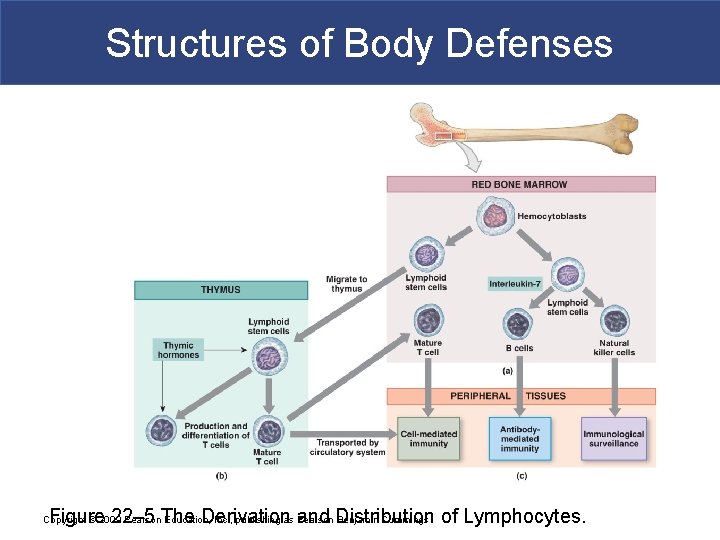
Structures of Body Defenses Figure 22– 5 The Derivation and Distribution of Lymphocytes. Copyright © 2009 Pearson Education, Inc. , publishing as Pearson Benjamin Cummings
Structures of Body Defenses § T Cells and B Cells § Migrate throughout the body § To defend peripheral tissues § Retain their ability to divide § Is essential to immune system function Copyright © 2009 Pearson Education, Inc. , publishing as Pearson Benjamin Cummings
Structures of Body Defenses § Differentiation § B cells differentiate § With exposure to hormone called cytokine (interleukin-7) § T cells differentiate § With exposure to several thymic hormones Copyright © 2009 Pearson Education, Inc. , publishing as Pearson Benjamin Cummings
Structures of Body Defenses § Distribution of Lymphoid Nodules § Lymph nodes § Spleen § Respiratory tract (tonsils) § Along digestive and urinary tracts Copyright © 2009 Pearson Education, Inc. , publishing as Pearson Benjamin Cummings
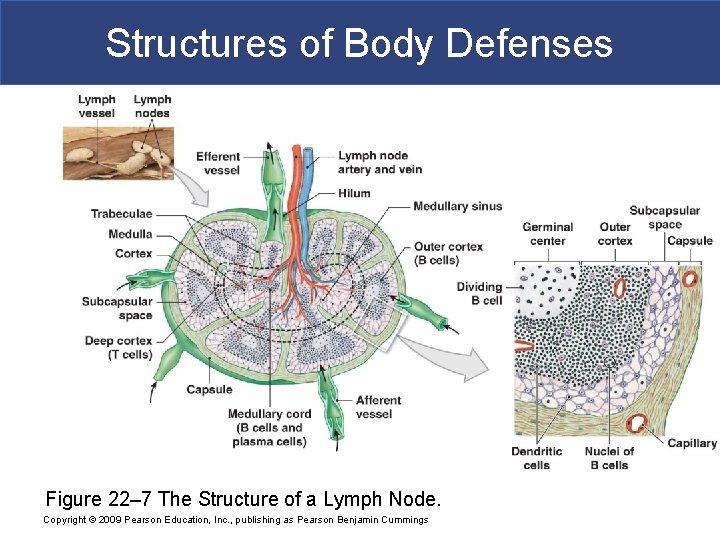
Structures of Body Defenses Figure 22– 7 The Structure of a Lymph Node. Copyright © 2009 Pearson Education, Inc. , publishing as Pearson Benjamin Cummings
Structures of Body Defenses § Antigen Presentation § First step in immune response § Extracted antigens are “presented” to lymphocytes § Or attached to dendritic cells to stimulate lymphocytes Copyright © 2009 Pearson Education, Inc. , publishing as Pearson Benjamin Cummings
Structures of Body Defenses § The Thymus § Located in mediastinum § Atrophies after puberty § Diminishing effectiveness of immune system § Divisions of the Thymus § Thymus is divided into two thymic lobes § Septa divide lobes into smaller lobules Copyright © 2009 Pearson Education, Inc. , publishing as Pearson Benjamin Cummings
Structures of Body Defenses § Reticular Epithelial Cells in the Medulla § Form concentric layers known as thymic (Hassall) corpuscles § The medulla has no blood–thymus barrier § T cells can enter or leave bloodstream § Thymus Hormones § Thymosin, an extract from the thymus that promotes development of lymphocytes Copyright © 2009 Pearson Education, Inc. , publishing as Pearson Benjamin Cummings
Structures of Body Defenses § Three Functions of the Spleen § Removal of abnormal blood cells and other blood components by phagocytosis § Storage of iron recycled from red blood cells § Initiation of immune responses by B cells and T cells § In response to antigens in circulating blood Copyright © 2009 Pearson Education, Inc. , publishing as Pearson Benjamin Cummings
Structures of Body Defenses § Structure of the Spleen § Inside fibrous capsule § Red pulp: contains many red blood cells § White pulp: resembles lymphoid nodules Copyright © 2009 Pearson Education, Inc. , publishing as Pearson Benjamin Cummings
Nonspecific Defenses § Seven major categories of nonspecific defenses § Physical barriers § Phagocytes § Immunological surveillance § Interferons § Complement § Inflammatory response § Fever Copyright © 2009 Pearson Education, Inc. , publishing as Pearson Benjamin Cummings
Nonspecific Defenses § Interferons § Chemical messengers that trigger production of antiviral proteins in normal cells § Antiviral proteins § Do not kill viruses § Block replication in cell § Complement (C) Proteins § Form the complement system § Complement action of antibodies Copyright © 2009 Pearson Education, Inc. , publishing as Pearson Benjamin Cummings
Nonspecific Defenses § Inflammation § Triggers a complex inflammatory response § Fever § A high body temperature § Increases body metabolism § Accelerates defenses § Inhibits some viruses and bacteria Copyright © 2009 Pearson Education, Inc. , publishing as Pearson Benjamin Cummings
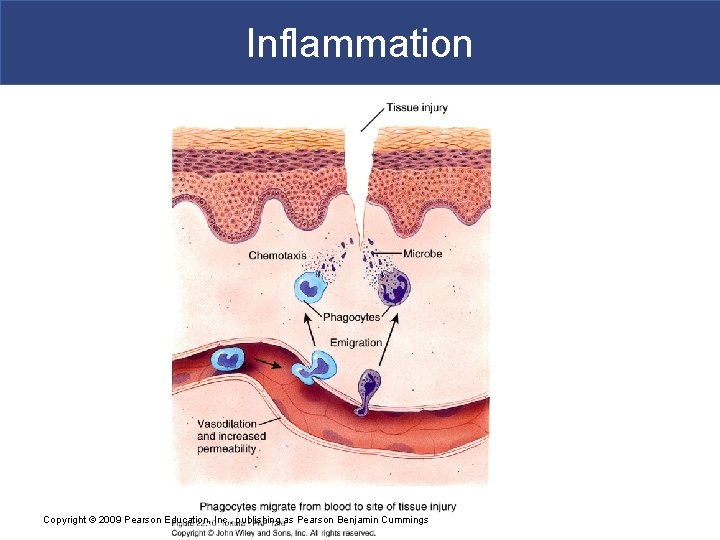
Inflammation Copyright © 2009 Pearson Education, Inc. , publishing as Pearson Benjamin Cummings
Nonspecific Defenses § Two Types of Macrophages § Fixed macrophages § Also called histiocytes § Stay in specific tissues or organs: – e. g. , dermis and bone marrow § Free macrophages § Travel throughout body Copyright © 2009 Pearson Education, Inc. , publishing as Pearson Benjamin Cummings
Nonspecific Defenses § Movement and Phagocytosis § All macrophages § Move through capillary walls (emigration) § Are attracted or repelled by chemicals in surrounding fluids (chemotaxis) § Phagocytosis begins: – when phagocyte attaches to target (adhesion) – and surrounds it with a vesicle Copyright © 2009 Pearson Education, Inc. , publishing as Pearson Benjamin Cummings
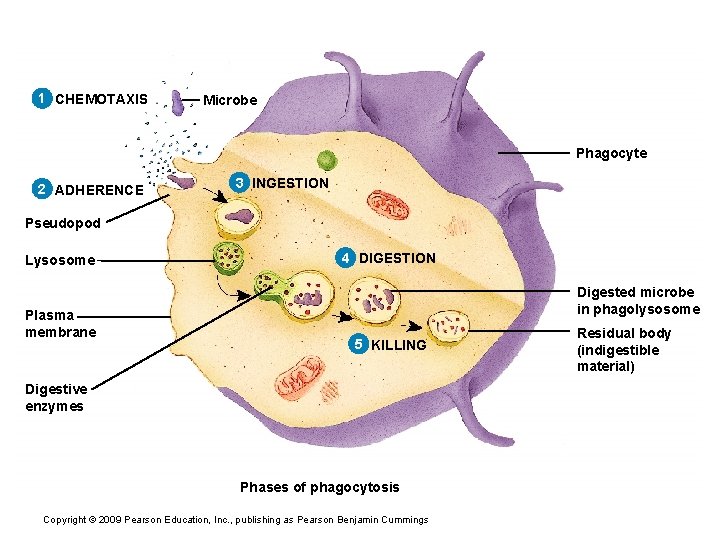
1 CHEMOTAXIS Microbe Phagocyte 2 ADHERENCE 3 INGESTION Pseudopod Lysosome Plasma membrane 4 DIGESTION Digested microbe in phagolysosome 5 KILLING Digestive enzymes Phases of phagocytosis Copyright © 2009 Pearson Education, Inc. , publishing as Pearson Benjamin Cummings Residual body (indigestible material)
Nonspecific Defenses § Immunological surveillance is carried out by natural killer (NK) cells § Identify and attach to abnormal cell (nonselective) § Golgi apparatus in NK cell: forms perforin vesicles § Vesicles release proteins called perforins (exocytosis) § Perforins lyse abnormal plasma membrane § Also attack cancer cells and cells infected with viruses Copyright © 2009 Pearson Education, Inc. , publishing as Pearson Benjamin Cummings
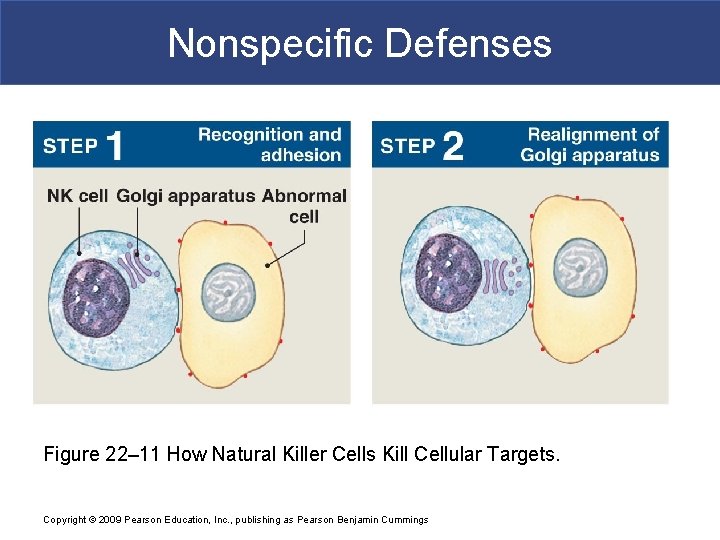
Nonspecific Defenses Figure 22– 11 How Natural Killer Cells Kill Cellular Targets. Copyright © 2009 Pearson Education, Inc. , publishing as Pearson Benjamin Cummings
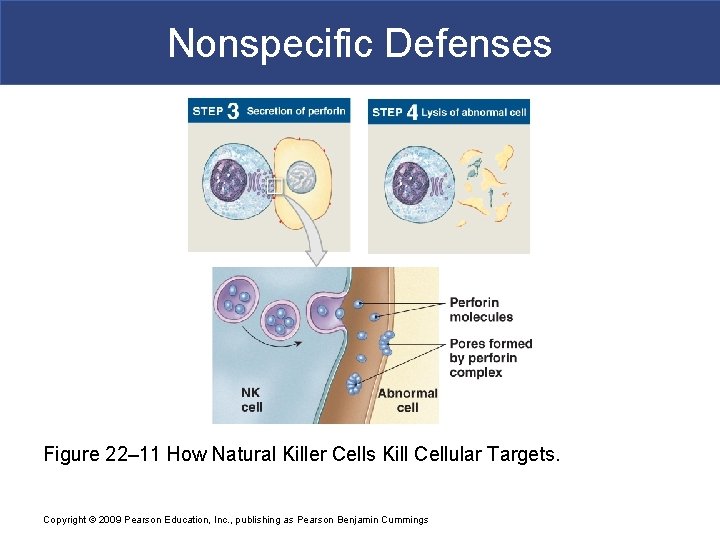
Nonspecific Defenses Figure 22– 11 How Natural Killer Cells Kill Cellular Targets. Copyright © 2009 Pearson Education, Inc. , publishing as Pearson Benjamin Cummings
Nonspecific Defenses § Immunological Surveillance § Cancer cells § With tumor-specific antigens: – are identified as abnormal by NK cells – some cancer cells avoid NK cells (immunological escape) Copyright © 2009 Pearson Education, Inc. , publishing as Pearson Benjamin Cummings
Nonspecific Defenses § Immunological Surveillance § Viral infections § Cells infected with viruses: – present abnormal proteins on plasma membranes – allow NK cells to identify and destroy them Copyright © 2009 Pearson Education, Inc. , publishing as Pearson Benjamin Cummings
Nonspecific Defenses § Interferons § Proteins (cytokines) released by activated lymphocytes and macrophages § Cytokines § Chemical messengers released by tissue cells § To coordinate local activities § To act as hormones to affect whole body Copyright © 2009 Pearson Education, Inc. , publishing as Pearson Benjamin Cummings
Nonspecific Defenses § Three Types of Interferons § Alpha-interferons § Produced by leukocytes § Stimulate NK cells § Beta-interferons § Secreted by fibrocytes § Slow inflammation § Gamma-interferons § Secreted by T cells and NK cells § Stimulate macrophage activity Copyright © 2009 Pearson Education, Inc. , publishing as Pearson Benjamin Cummings
Nonspecific Defenses § Complement § Plasma contains 11 special complement (C) proteins § That complement antibody action § Complement activation § Complements work together in cascades § Two pathways activate the complement system: – classical pathway – alternative pathway Copyright © 2009 Pearson Education, Inc. , publishing as Pearson Benjamin Cummings
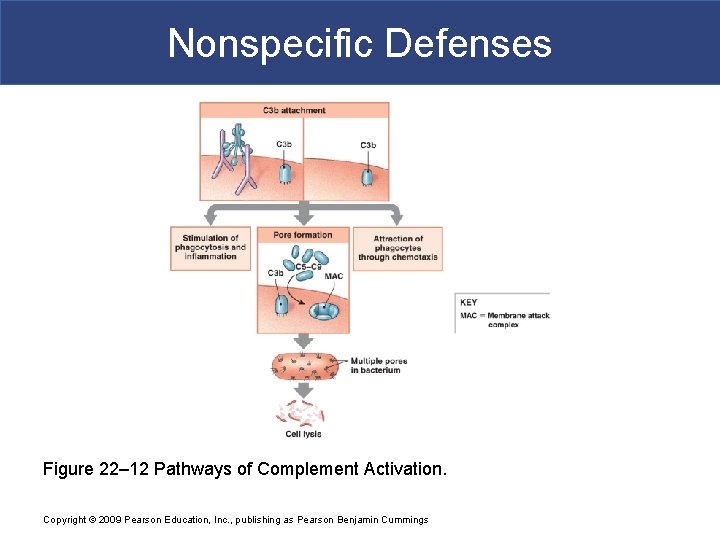
Nonspecific Defenses Figure 22– 12 Pathways of Complement Activation. Copyright © 2009 Pearson Education, Inc. , publishing as Pearson Benjamin Cummings
Nonspecific Defenses § Products of Inflammation § Necrosis § Local tissue destruction in area of injury § Pus § Mixture of debris and necrotic tissue § Abscess § Pus accumulated in an enclosed space Copyright © 2009 Pearson Education, Inc. , publishing as Pearson Benjamin Cummings
Nonspecific Defenses § Fever § A maintained body temperature above 37°C (99°F) § Pyrogens § Any material that causes the hypothalamus to raise body temperature: – circulating pathogens, toxins, or antibody complexes § Endogenous pyrogens = interleukin-1 (IL-1) – pyrogen released by active macrophages – a cytokine Copyright © 2009 Pearson Education, Inc. , publishing as Pearson Benjamin Cummings
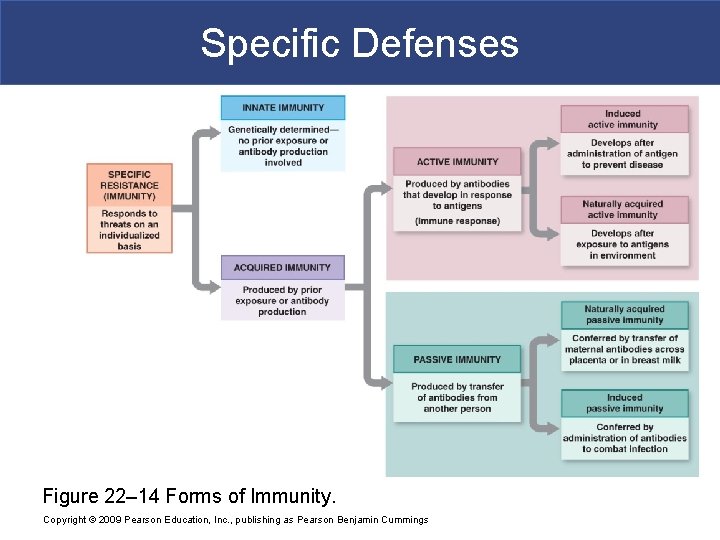
Specific Defenses Figure 22– 14 Forms of Immunity. Copyright © 2009 Pearson Education, Inc. , publishing as Pearson Benjamin Cummings
Specific Defenses § Four Properties of Immunity § Specificity § Each T or B cell responds only to a specific antigen and ignores all others § Versatility § The body produces many types of lymphocytes: – each fights a different type of antigen – active lymphocyte clones itself to fight specific antigen Copyright © 2009 Pearson Education, Inc. , publishing as Pearson Benjamin Cummings
Specific Defenses § Four Properties of Immunity § Memory § Some active lymphocytes (memory cells): – stay in circulation – provide immunity against new exposure § Tolerance § Immune system ignores “normal” (self) antigens Copyright © 2009 Pearson Education, Inc. , publishing as Pearson Benjamin Cummings
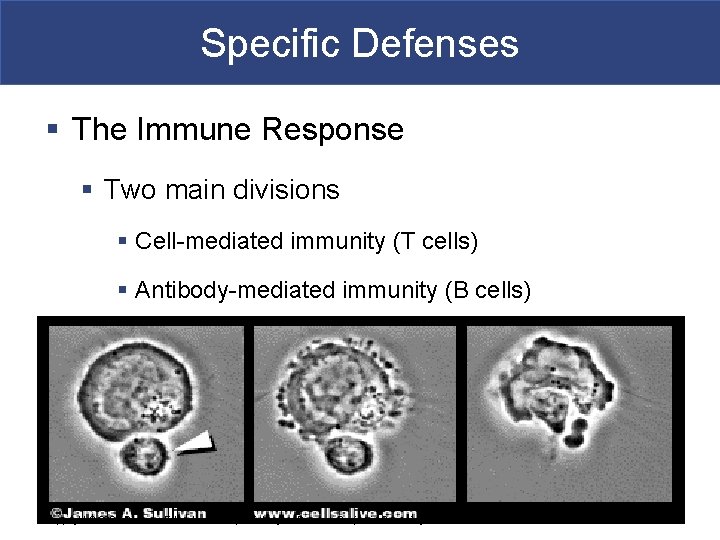
Specific Defenses § The Immune Response § Two main divisions § Cell-mediated immunity (T cells) § Antibody-mediated immunity (B cells) Copyright © 2009 Pearson Education, Inc. , publishing as Pearson Benjamin Cummings
T Cells and Immunity § Cell-mediated immunity (T cells) § Cytotoxic T cells (also called TC cells) § Attack cells infected by viruses § Responsible for cell-mediated immunity § Helper T cells (also called TH cells) § Stimulate function of T cells and B cells § Suppressor T cells (also called TS cells) § Inhibit function of T cells and B cells Copyright © 2009 Pearson Education, Inc. , publishing as Pearson Benjamin Cummings
T Cells and Immunity § Antigen Recognition § T cells only recognize antigens that are bound to glycoproteins in plasma membranes Copyright © 2009 Pearson Education, Inc. , publishing as Pearson Benjamin Cummings
T Cells and Immunity § MHC Proteins § The membrane glycoproteins that bind to antigens § Genetically coded in chromosome 6 § The major histocompatibility complex (MHC) § Differs among individuals Copyright © 2009 Pearson Education, Inc. , publishing as Pearson Benjamin Cummings
T Cells and Immunity § Class I MHC Proteins § Pick up small peptides in cell and carry them to the surface § T cells ignore normal peptides § Abnormal peptides or viral proteins activate T cells to destroy cell Copyright © 2009 Pearson Education, Inc. , publishing as Pearson Benjamin Cummings
T Cells and Immunity § Class II MHC Proteins § Antigenic fragments § From antigenic processing of pathogens § Bind to Class II proteins § Inserted in plasma membrane to stimulate T cells Copyright © 2009 Pearson Education, Inc. , publishing as Pearson Benjamin Cummings
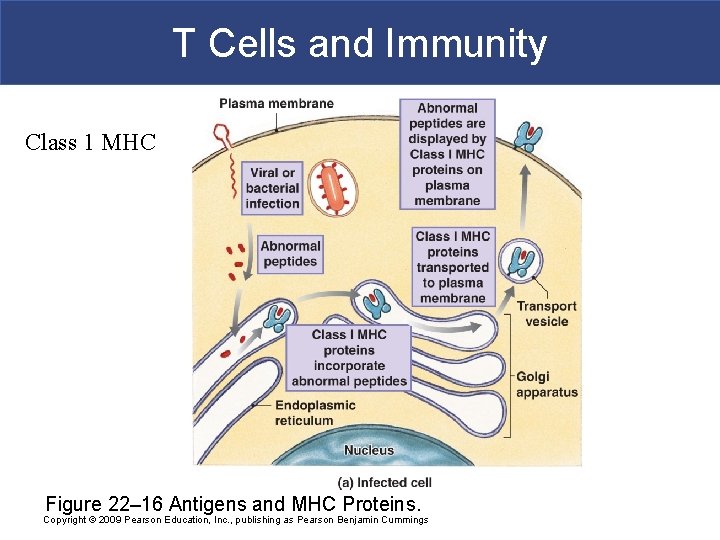
T Cells and Immunity Class 1 MHC Figure 22– 16 Antigens and MHC Proteins. Copyright © 2009 Pearson Education, Inc. , publishing as Pearson Benjamin Cummings
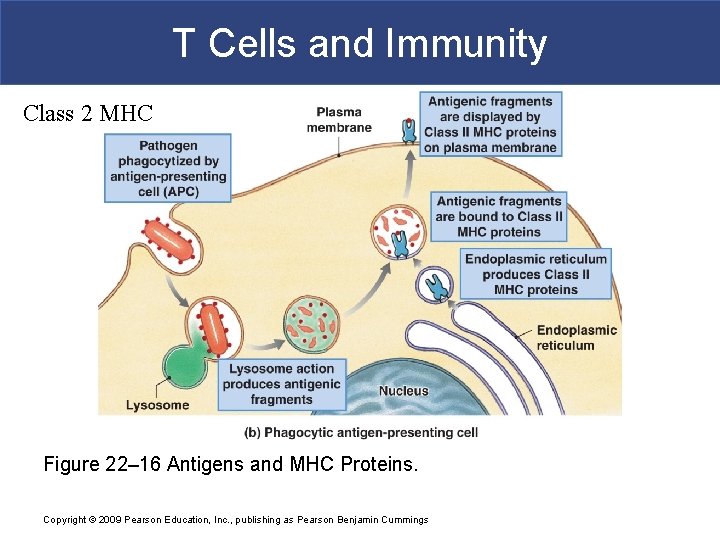
T Cells and Immunity Class 2 MHC Figure 22– 16 Antigens and MHC Proteins. Copyright © 2009 Pearson Education, Inc. , publishing as Pearson Benjamin Cummings
T Cells and Immunity § Antigen-Presenting Cells (APCs) § Responsible for activating T cells against foreign cells and proteins Copyright © 2009 Pearson Education, Inc. , publishing as Pearson Benjamin Cummings
T Cells and Immunity § Phagocytic APCs § Free and fixed macrophages § In connective tissues § Kupffer cells § Of the liver § Microglia § In the CNS Copyright © 2009 Pearson Education, Inc. , publishing as Pearson Benjamin Cummings
T Cells and Immunity § Non-phagocytic (pinocytic) APCs § Langerhans cells § In the skin § Dendritic cells § In lymph nodes and spleen Copyright © 2009 Pearson Education, Inc. , publishing as Pearson Benjamin Cummings
T Cells and Immunity § Antigen Recognition § Inactive T cell receptors § Recognize Class I or Class II MHC proteins § Recognize a specific antigen § Binding occurs when MHC protein matches antigen Copyright © 2009 Pearson Education, Inc. , publishing as Pearson Benjamin Cummings
T Cells and Immunity § CD Markers § Also called cluster of differentiation markers § In T cell membranes § Molecular mechanism of antigen recognition § More than 70 types: – designated by an identifying number § CD 3 Receptor Complex § Found in all T cells Copyright © 2009 Pearson Education, Inc. , publishing as Pearson Benjamin Cummings
T Cells and Immunity § CD 4 Markers (target for HIV virus) § Found on helper T cells § Respond to antigens on Class II MHC proteins § CD 8 Markers § Found on cytotoxic T cells and suppressor T cells § Respond to antigens on Class I MHC proteins Copyright © 2009 Pearson Education, Inc. , publishing as Pearson Benjamin Cummings
T Cells and Immunity § CD 8 or CD 4 Markers § Bind to CD 3 receptor complex § Prepare cell for activation Copyright © 2009 Pearson Education, Inc. , publishing as Pearson Benjamin Cummings
T Cells and Immunity § Costimulation § For T cell to be activated, it must be costimulated § By binding to stimulating cell at second site § Which confirms the first signal Copyright © 2009 Pearson Education, Inc. , publishing as Pearson Benjamin Cummings
T Cells and Immunity § Two Classes of CD 8 T Cells § Activated by exposure to antigens on MHC proteins § One responds quickly: – producing cytotoxic T cells and memory T cells § The other responds slowly: – producing suppressor T cells Copyright © 2009 Pearson Education, Inc. , publishing as Pearson Benjamin Cummings
T Cells and Immunity § Cytotoxic T Cells § Also called killer T cells § Seek out and immediately destroy target cells Copyright © 2009 Pearson Education, Inc. , publishing as Pearson Benjamin Cummings
T Cells and Immunity Actions of Cytotoxic T Cells 1. Release perforin: § To destroy antigenic plasma membrane 2. Secrete poisonous lymphotoxin: § To destroy target cell 3. Activate genes in target cell: “apoptosis” § That cause cell to die Copyright © 2009 Pearson Education, Inc. , publishing as Pearson Benjamin Cummings
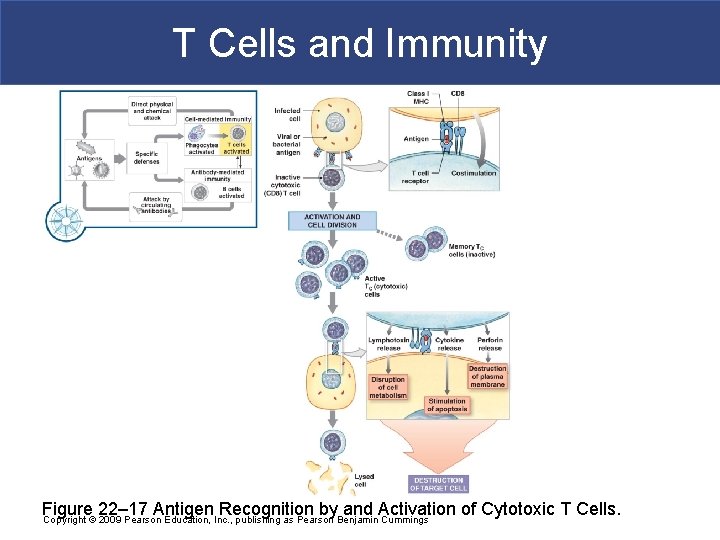
T Cells and Immunity Figure 22– 17 Antigen Recognition by and Activation of Cytotoxic T Cells. Copyright © 2009 Pearson Education, Inc. , publishing as Pearson Benjamin Cummings
T Cells and Immunity § Slow Response § Can take up to 2 days from time of first exposure to an antigen for cytotoxic T cells to reach effective levels Copyright © 2009 Pearson Education, Inc. , publishing as Pearson Benjamin Cummings
T Cells and Immunity § Memory TC Cells § Produced with cytotoxic T cells § Stay in circulation § Immediately form cytotoxic T cells if same antigen appears again Copyright © 2009 Pearson Education, Inc. , publishing as Pearson Benjamin Cummings
T Cells and Immunity § Suppressor T Cells § Secrete suppression factors § Inhibit responses of T and B cells § Act after initial immune response § Limit immune reaction to single stimulus Copyright © 2009 Pearson Education, Inc. , publishing as Pearson Benjamin Cummings
T Cells and Immunity § Helper T Cells § Activated CD 4 T cells divide into § Active helper T cells (TH cells): – secrete cytokines § Memory TH cells: – remain in reserve Copyright © 2009 Pearson Education, Inc. , publishing as Pearson Benjamin Cummings
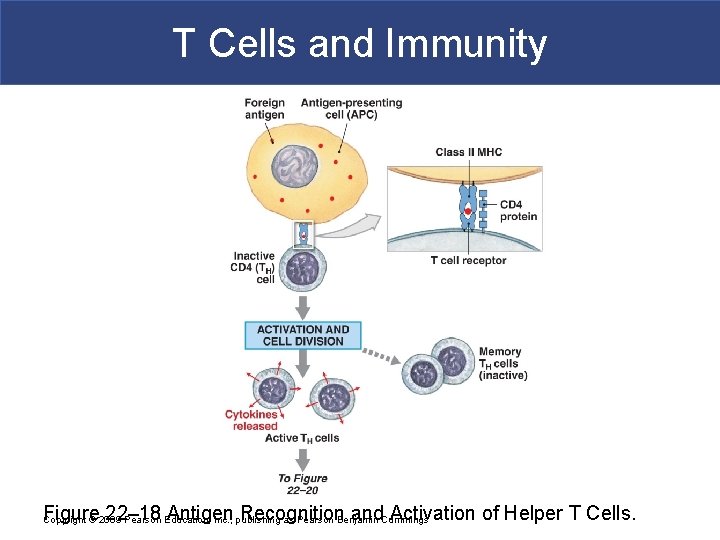
T Cells and Immunity Figure 22– 18 Antigen Recognition and. Cummings Activation of Helper T Cells. Copyright © 2009 Pearson Education, Inc. , publishing as Pearson Benjamin
T Cells and Immunity § Four Functions of Cytokines § Stimulate T cell divisions § Produce memory TH cells § Accelerate cytotoxic T cell maturation § Attract and stimulate macrophages § Attract and stimulate NK cells § Promote activation of B cells Copyright © 2009 Pearson Education, Inc. , publishing as Pearson Benjamin Cummings
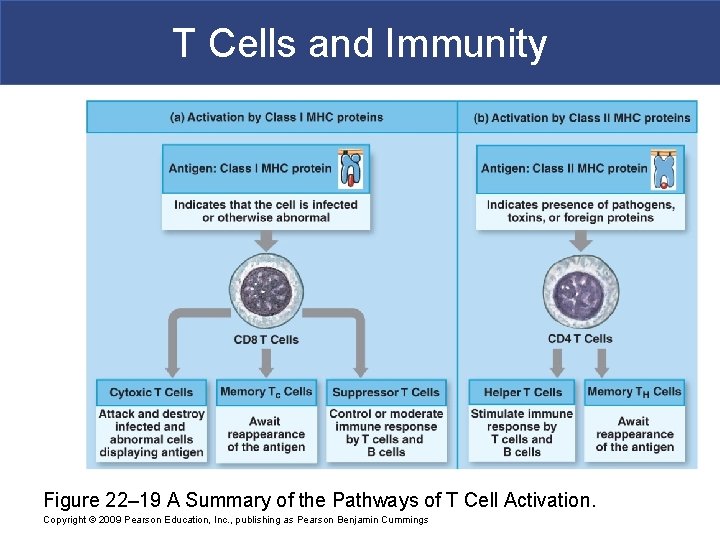
T Cells and Immunity Figure 22– 19 A Summary of the Pathways of T Cell Activation. Copyright © 2009 Pearson Education, Inc. , publishing as Pearson Benjamin Cummings
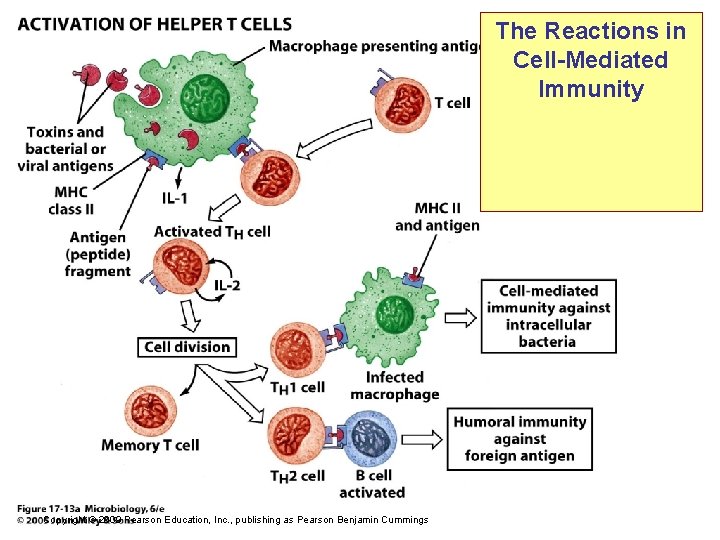
The Reactions in Cell-Mediated Immunity Copyright © 2009 Pearson Education, Inc. , publishing as Pearson Benjamin Cummings
B Cells and Immunity § B Cells § Responsible for antibody-mediated immunity § Attack antigens by producing specific antibodies § Millions of populations, each with different antibody molecules Copyright © 2009 Pearson Education, Inc. , publishing as Pearson Benjamin Cummings
B Cells and Immunity § B Cell Sensitization § Corresponding antigens in interstitial fluids bind to B cell receptors § B cell prepares for activation § Preparation process is sensitization Copyright © 2009 Pearson Education, Inc. , publishing as Pearson Benjamin Cummings
B Cells and Immunity § B Cell Sensitization § During sensitization, antigens are § Taken into the B cell § Processed § Reappear on surface, bound to Class II MHC protein Copyright © 2009 Pearson Education, Inc. , publishing as Pearson Benjamin Cummings
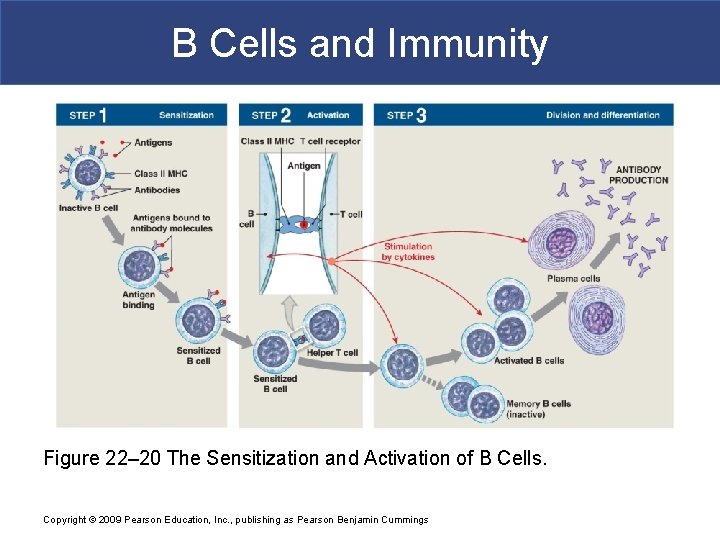
B Cells and Immunity Figure 22– 20 The Sensitization and Activation of B Cells. Copyright © 2009 Pearson Education, Inc. , publishing as Pearson Benjamin Cummings
B Cells and Immunity § Helper T Cells § Sensitized B cell is prepared for activation but needs helper T cell activated by same antigen § B Cell Activation § Helper T cell binds to MHC complex § Secretes cytokines that promote B cell activation and division Copyright © 2009 Pearson Education, Inc. , publishing as Pearson Benjamin Cummings
B Cells and Immunity § B Cell Division § Activated B cell divides into § Plasma cells § Memory B cells Copyright © 2009 Pearson Education, Inc. , publishing as Pearson Benjamin Cummings
B Cells and Immunity § Plasma Cells § Synthesize and secrete antibodies into interstitial fluid § Memory B Cells § Like memory T cells, remain in reserve to respond to next infection Copyright © 2009 Pearson Education, Inc. , publishing as Pearson Benjamin Cummings
B Cells and Immunity § Antibody Structure § Two parallel pairs of polypeptide chains § One pair of heavy chains § One pair of light chains § Each chain contains § Constant segments § Variable segments Copyright © 2009 Pearson Education, Inc. , publishing as Pearson Benjamin Cummings
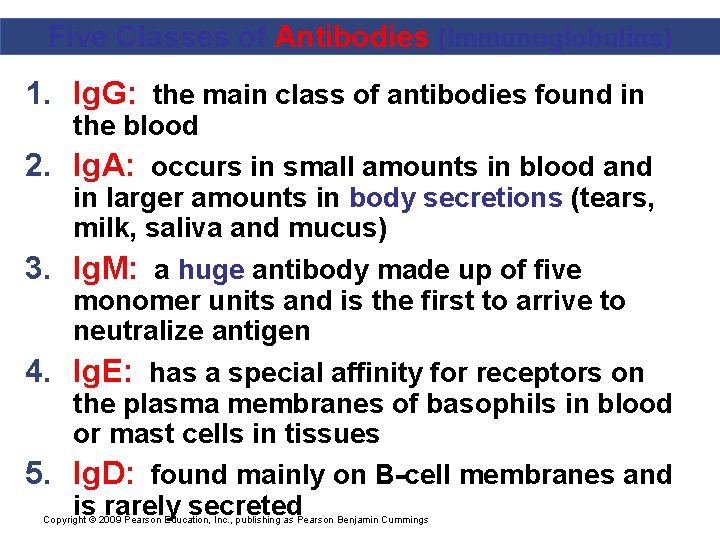
Five Classes of Antibodies (Immunoglobulins) 1. Ig. G: the main class of antibodies found in 2. 3. 4. 5. the blood Ig. A: occurs in small amounts in blood and in larger amounts in body secretions (tears, milk, saliva and mucus) Ig. M: a huge antibody made up of five monomer units and is the first to arrive to neutralize antigen Ig. E: has a special affinity for receptors on the plasma membranes of basophils in blood or mast cells in tissues Ig. D: found mainly on B-cell membranes and is rarely secreted Copyright © 2009 Pearson Education, Inc. , publishing as Pearson Benjamin Cummings
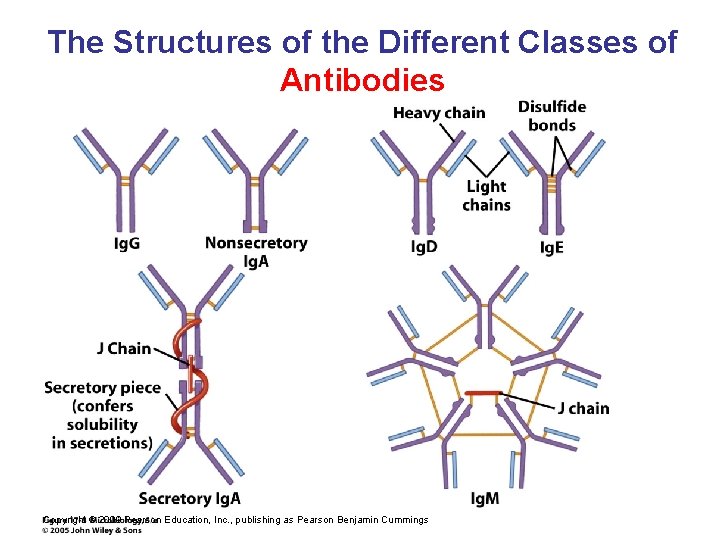
The Structures of the Different Classes of Antibodies Copyright © 2009 Pearson Education, Inc. , publishing as Pearson Benjamin Cummings
B Cells and Immunity § Variable Segments of Light and Heavy Chains § Determine specificity of antibody molecule Copyright © 2009 Pearson Education, Inc. , publishing as Pearson Benjamin Cummings
B Cells and Immunity § Binding Sites § Free tips of two variable segments § Form antigen binding sites of antibody molecule § Which bind to antigenic determinant sites of antigen molecule § Antigen-Antibody Complex § An antibody bound to an antigen Copyright © 2009 Pearson Education, Inc. , publishing as Pearson Benjamin Cummings
B Cells and Immunity § A Complete Antigen § Has two antigenic determinant sites § Binds to both antigen-binding sites of variable segments of antibody § B Cell Sensitization § Exposure to a complete antigen leads to § B cell sensitization § Immune response Copyright © 2009 Pearson Education, Inc. , publishing as Pearson Benjamin Cummings
B Cells and Immunity § Hapten (also called partial antigen) § Must attach to a carrier molecule to act as a complete antigen § Dangers of Haptens § Antibodies produced will attack both hapten and carrier molecule § If carrier is “normal” § Antibody attacks normal cells § For example, penicillin allergy Copyright © 2009 Pearson Education, Inc. , publishing as Pearson Benjamin Cummings
B Cells and Immunity § Five Classes of Antibodies § Also called immunoglobulins (Igs) § Are found in body fluids § Are determined by constant segments § Have no effect on antibody specificity Copyright © 2009 Pearson Education, Inc. , publishing as Pearson Benjamin Cummings
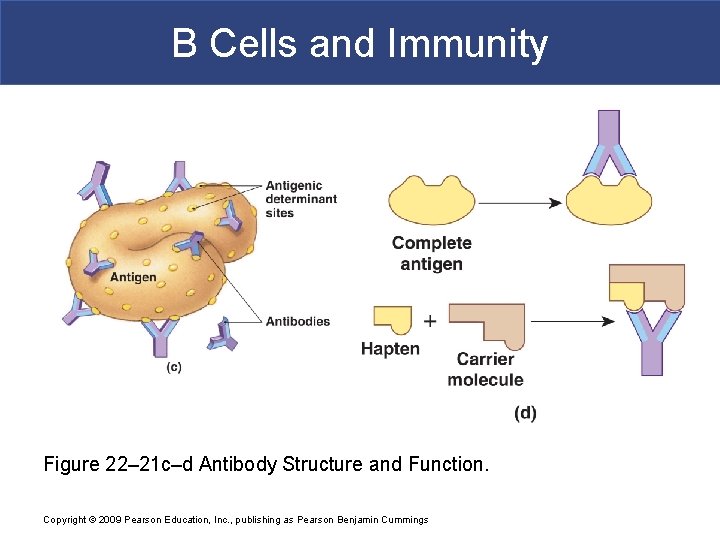
B Cells and Immunity Figure 22– 21 c–d Antibody Structure and Function. Copyright © 2009 Pearson Education, Inc. , publishing as Pearson Benjamin Cummings
B Cells and Immunity § Seven Functions of Antigen-Antibody Complexes § Neutralization of antigen-binding sites § Precipitation and agglutination: formation of immune complex § Activation of complement § Attraction of phagocytes § Opsonization: increasing phagocyte efficiency § Stimulation of inflammation § Prevention of bacterial and viral adhesion Copyright © 2009 Pearson Education, Inc. , publishing as Pearson Benjamin Cummings Figure 22– 22
B Cells and Immunity § Primary and Secondary Responses to Antigen Exposure § Occur in both cell-mediated antibodymediated immunity Copyright © 2009 Pearson Education, Inc. , publishing as Pearson Benjamin Cummings Figure 22– 22
B Cells and Immunity § Primary and Secondary Responses to Antigen Exposure § First exposure § Produces initial primary response § Next exposure § Triggers secondary response § More extensive and prolonged § Memory cells already primed Copyright © 2009 Pearson Education, Inc. , publishing as Pearson Benjamin Cummings
B Cells and Immunity § The Primary Response § Takes time to develop § Antigens activate B cells § Plasma cells differentiate § Antibody titer (level) slowly rises Copyright © 2009 Pearson Education, Inc. , publishing as Pearson Benjamin Cummings
B Cells and Immunity § The Primary Response § Peak response § Can take 2 weeks to develop § Declines rapidly § Ig. M § Is produced faster than Ig. G § Is less effective Copyright © 2009 Pearson Education, Inc. , publishing as Pearson Benjamin Cummings
B Cells and Immunity § The Secondary Response § Activates memory B cells § At lower antigen concentrations than original B cells § Secretes antibodies in massive quantities Copyright © 2009 Pearson Education, Inc. , publishing as Pearson Benjamin Cummings
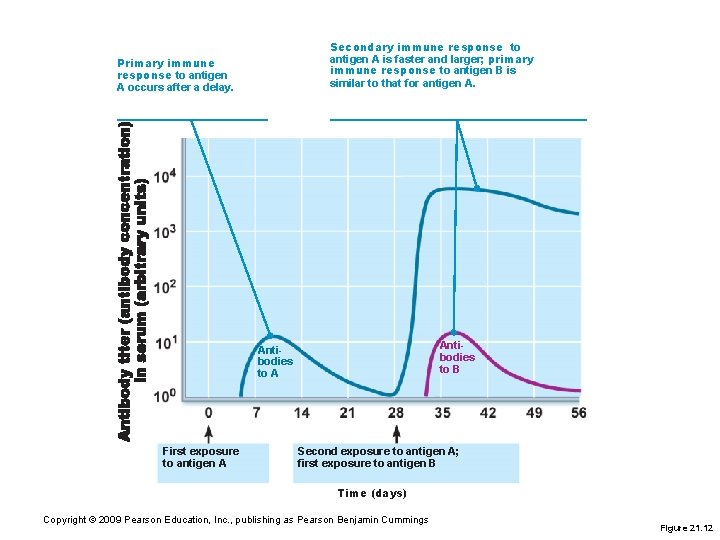
Secondary immune response to antigen A is faster and larger; primary immune response to antigen B is similar to that for antigen A. Primary immune response to antigen A occurs after a delay. Antibodies to B Antibodies to A First exposure to antigen A Second exposure to antigen A; first exposure to antigen B Time (days) Copyright © 2009 Pearson Education, Inc. , publishing as Pearson Benjamin Cummings Figure 21. 12
B Cells and Immunity § Effects of Memory B Cell Activation § Ig. G § Rises very high and very quickly § Can remain elevated for extended time § Ig. M § Production is also quicker § Slightly extended Copyright © 2009 Pearson Education, Inc. , publishing as Pearson Benjamin Cummings
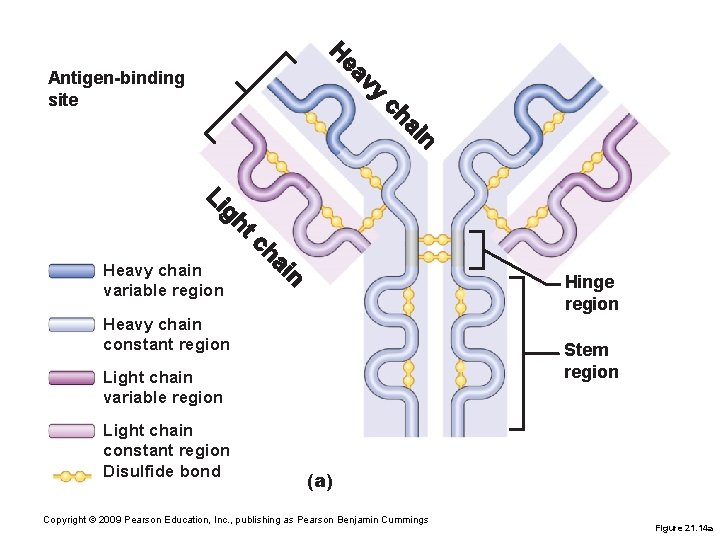
Antigen-binding site Heavy chain variable region Hinge region Heavy chain constant region Stem region Light chain variable region Light chain constant region Disulfide bond (a) Copyright © 2009 Pearson Education, Inc. , publishing as Pearson Benjamin Cummings Figure 21. 14 a
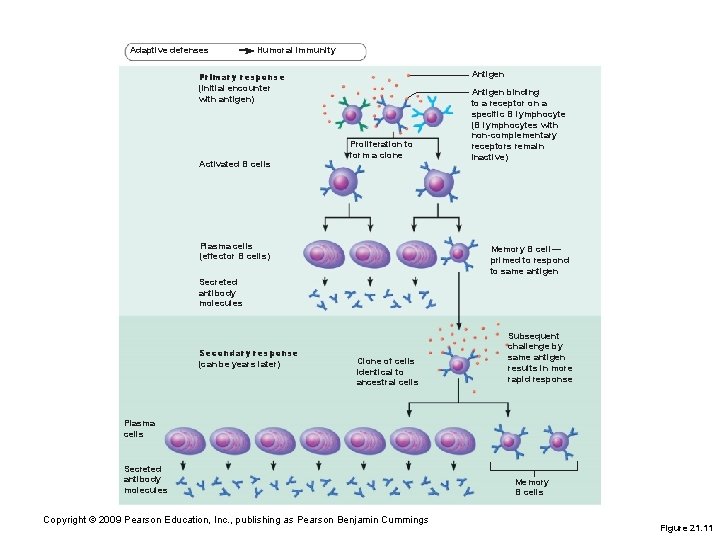
Adaptive defenses Humoral immunity Antigen Primary response (initial encounter with antigen) Activated B cells Proliferation to form a clone Plasma cells (effector B cells) Antigen binding to a receptor on a specific B lymphocyte (B lymphocytes with non-complementary receptors remain inactive) Memory B cell— primed to respond to same antigen Secreted antibody molecules Secondary response (can be years later) Clone of cells identical to ancestral cells Subsequent challenge by same antigen results in more rapid response Plasma cells Secreted antibody molecules Copyright © 2009 Pearson Education, Inc. , publishing as Pearson Benjamin Cummings Memory B cells Figure 21. 11
B Cells and Immunity § Combined Responses to Bacterial Infection § Neutrophils and NK cells begin killing bacteria § Cytokines draw phagocytes to area § Antigen presentation activates § Helper T cells § Cytotoxic T cells § B cells activate and differentiate § Plasma cells increase antibody levels Copyright © 2009 Pearson Education, Inc. , publishing as Pearson Benjamin Cummings
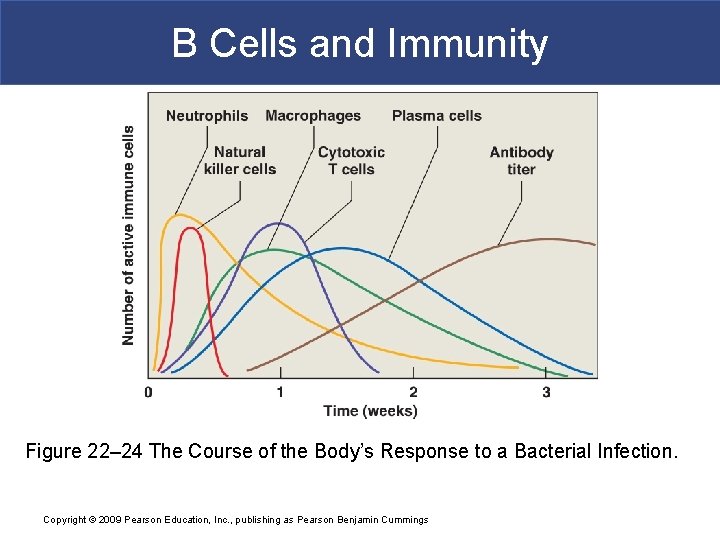
B Cells and Immunity Figure 22– 24 The Course of the Body’s Response to a Bacterial Infection. Copyright © 2009 Pearson Education, Inc. , publishing as Pearson Benjamin Cummings
B Cells and Immunity § Combined Responses to Viral Infection § Similar to bacterial infection § But cytotoxic T cells and NK cells are activated by contact with virus-infected cells Copyright © 2009 Pearson Education, Inc. , publishing as Pearson Benjamin Cummings
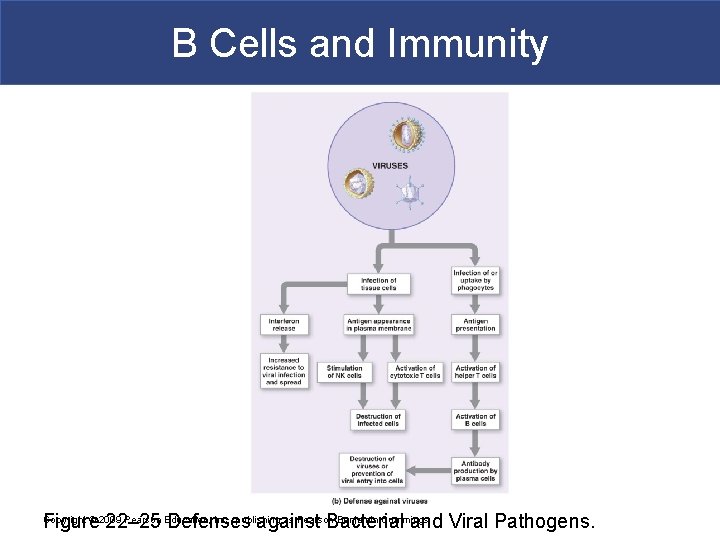
B Cells and Immunity Figure 22– 25 Defenses against Bacterial and Viral Pathogens. Copyright © 2009 Pearson Education, Inc. , publishing as Pearson Benjamin Cummings
Immune System Development § Fetus can produce immune response (has immunological competence) § After exposure to antigen § At about 3– 4 months Copyright © 2009 Pearson Education, Inc. , publishing as Pearson Benjamin Cummings
Immune System Development § Development of Immunological Competence § Fetal thymus cells migrate to tissues that form T cells § Liver and bone marrow produce B cells § 4 -month fetus produces Ig. M antibodies Copyright © 2009 Pearson Education, Inc. , publishing as Pearson Benjamin Cummings
Immune System Development § Before Birth § Maternal Ig. G antibodies § Pass through placenta § Provide passive immunity to fetus § After Birth § Mother’s milk provides Ig. A antibodies § While passive immunity is lost Copyright © 2009 Pearson Education, Inc. , publishing as Pearson Benjamin Cummings
Immune System Development § Normal Resistance § Infant produces Ig. G antibodies through exposure to antigens § Antibody, B cell, and T cell levels slowly rise to adult levels § About age 12 Copyright © 2009 Pearson Education, Inc. , publishing as Pearson Benjamin Cummings
Immune System Development § Six Groups of Hormonal Cytokines § Interleukins § Interferons § Tumor necrosis factors (TNFs) § Chemicals that regulate phagocytic activities § Colony-stimulating factors (CSFs) § Miscellaneous cytokines Copyright © 2009 Pearson Education, Inc. , publishing as Pearson Benjamin Cummings
Immune System Development § Autoimmune Disorders § A malfunction of system that recognizes and ignores “normal” antigens § Activated B cells make autoantibodies against body cells § Thyroiditis § Rheumatoid arthritis § Insulin-dependent diabetes mellitus (IDDM) Copyright © 2009 Pearson Education, Inc. , publishing as Pearson Benjamin Cummings
Immune System Development § Immunodeficiency diseases result from § Problems with embryological development of lymphoid tissues: § Can result in severe combined immunodeficiency disease (SCID) § Viral infections such as HIV § Can result in AIDS § Immunosuppressive drugs or radiation treatments: § Can lead to complete immunological failure Copyright © 2009 Pearson Education, Inc. , publishing as Pearson Benjamin Cummings
Immune System Development § Allergies § Inappropriate or excessive immune responses to antigens § Allergens § Antigens that trigger allergic reactions Copyright © 2009 Pearson Education, Inc. , publishing as Pearson Benjamin Cummings
Immune System Development § Four Categories of Allergic Reactions § Type I § Immediate hypersensitivity § Type II § Cytotoxic reactions § Type III § Immune complex disorders § Type IV § Delayed hypersensitivity Copyright © 2009 Pearson Education, Inc. , publishing as Pearson Benjamin Cummings
Immune System Development § Type I Allergy § Also called immediate hypersensitivity § A rapid and severe response to the presence of an antigen § Most commonly recognized type of allergy § Includes allergic rhinitis (environmental allergies) Copyright © 2009 Pearson Education, Inc. , publishing as Pearson Benjamin Cummings
Immune System Development § Type I Allergy § Sensitization leads to § Production of large quantities of Ig. E antibodies distributed throughout the body § Second exposure leads to § Massive inflammation of affected tissues Copyright © 2009 Pearson Education, Inc. , publishing as Pearson Benjamin Cummings
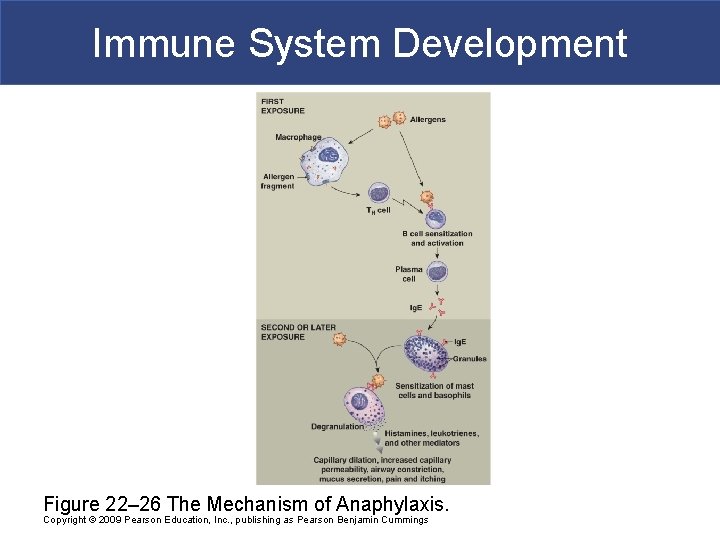
Immune System Development Figure 22– 26 The Mechanism of Anaphylaxis. Copyright © 2009 Pearson Education, Inc. , publishing as Pearson Benjamin Cummings
Immune System Development § Antihistamines § Drugs that block histamine released by mast cells § Can relieve mild symptoms of immediate hypersensitivity Copyright © 2009 Pearson Education, Inc. , publishing as Pearson Benjamin Cummings
Immune System Development § Stress and the Immune Response § Glucocorticoids § Secreted to limit immune response § Long-term secretion (chronic stress): – inhibits immune response – lowers resistance to disease Copyright © 2009 Pearson Education, Inc. , publishing as Pearson Benjamin Cummings
Immune System Development § Functions of Glucocorticoids § Depression of the inflammatory response § Reduction in abundance and activity of phagocytes § Inhibition of interleukin secretion Copyright © 2009 Pearson Education, Inc. , publishing as Pearson Benjamin Cummings
Immune System Development § Four Effects of Aging on the Immune Response § Thymic hormone production is greatly reduced § T cells become less responsive to antigens § Fewer T cells reduces responsiveness of B cells § Immune surveillance against tumor cells declines Basically - T cells just wear down Copyright © 2009 Pearson Education, Inc. , publishing as Pearson Benjamin Cummings
- Slides: 127