
THE LYMPHATIC SYSTEM AND BODY DEFENSES Ms Dunishiya
THE LYMPHATIC SYSTEM AND BODY DEFENSES Ms. Dunishiya de Silva Copyright © 2006 Pearson Education, Inc. , publishing as Benjamin Cummings
Copyright © 2006 Pearson Education, Inc. , publishing as Benjamin Cummings

The Lymphatic System § Lymphatic system functions § Transport excess interstitial fluids (and proteins) back to the blood § Transporting dietary fats. § Play essential roles in body defense and resistance to disease Copyright © 2006 Pearson Education, Inc. , publishing as Benjamin Cummings

Lymphatic Vessels Lymph Capillaries § Walls overlap to form flap-like minivalves § Fluid leaks into lymph capillaries Figure 12. 2 Copyright © 2006 Pearson Education, Inc. , publishing as Benjamin Cummings

Lymphatic Vessels § Lymph Capillaries § Capillaries are anchored to connective tissue by filaments § Higher pressure on the inside closes minivalves Copyright © 2006 Pearson Education, Inc. , publishing as Benjamin Cummings

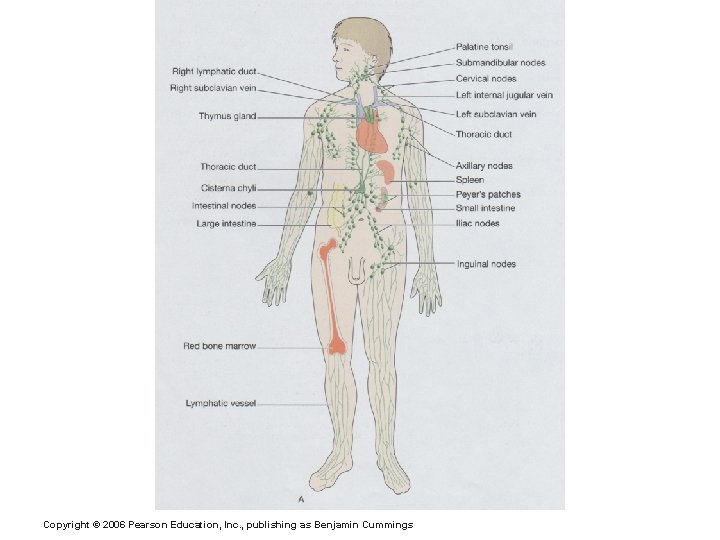
Lymphatic Vessels § Lymphatic collecting vessels § Collects lymph from lymph capillaries § Carries lymph to and away from lymph nodes Figure 12. 1 Copyright © 2006 Pearson Education, Inc. , publishing as Benjamin Cummings

Lymphatic Vessels § Lymphatic collecting vessels (continued) § Returns fluid to circulatory veins near the heart § Right lymphatic duct § Thoracic duct Copyright © 2006 Pearson Education, Inc. , publishing as Benjamin Cummings
Movement of lymph towards the heart § This is aided by: § Valves in the vessel walls § Milking action of skeletal muscle § Pressure changes in the chest during breathing § Rhythmic contraction of smooth muscle in vessel Copyright © 2006 Pearson Education, Inc. , publishing as Benjamin Cummings
Lymph § Materials returned to the blood § Water § Blood cells § Proteins Copyright © 2006 Pearson Education, Inc. , publishing as Benjamin Cummings
Lymph § Harmful materials that enter lymph vessels § Bacteria § Viruses § Cancer cells § Cell debris Copyright © 2006 Pearson Education, Inc. , publishing as Benjamin Cummings
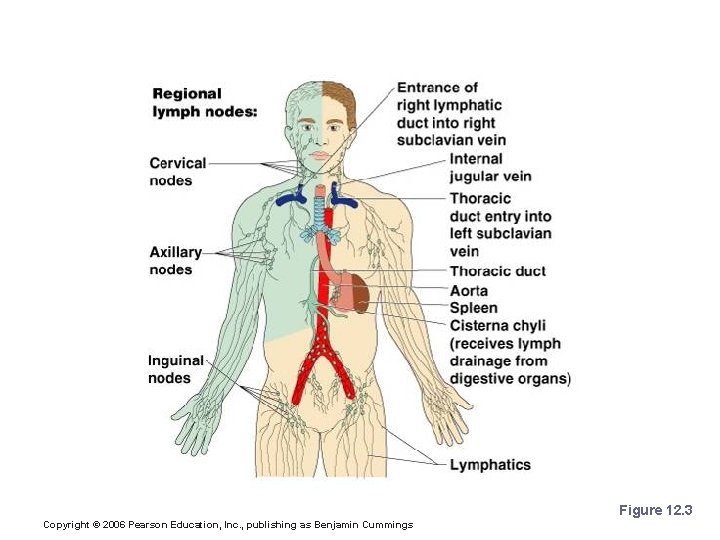
Lymph Nodes Figure 12. 3 Copyright © 2006 Pearson Education, Inc. , publishing as Benjamin Cummings
Lymph Node Structure § Most are kidney-shaped, less than 1 inch long § Cortex § Outer part § Contains follicles – collections of lymphocytes § Medulla § Inner part § Contains phagocytic macrophages Copyright © 2006 Pearson Education, Inc. , publishing as Benjamin Cummings
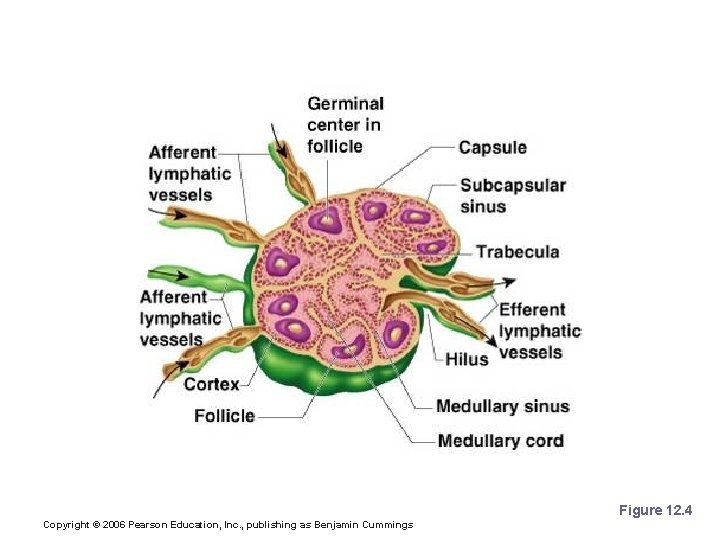
Lymph Node Structure Figure 12. 4 Copyright © 2006 Pearson Education, Inc. , publishing as Benjamin Cummings
Flow of Lymph Through Nodes § Lymph enters the convex side through afferent lymphatic vessels § Lymph flows through a number of sinuses inside the node § Lymph exits through efferent lymphatic vessels § Fewer efferent than afferent vessels causes flow to be slowed Copyright © 2006 Pearson Education, Inc. , publishing as Benjamin Cummings
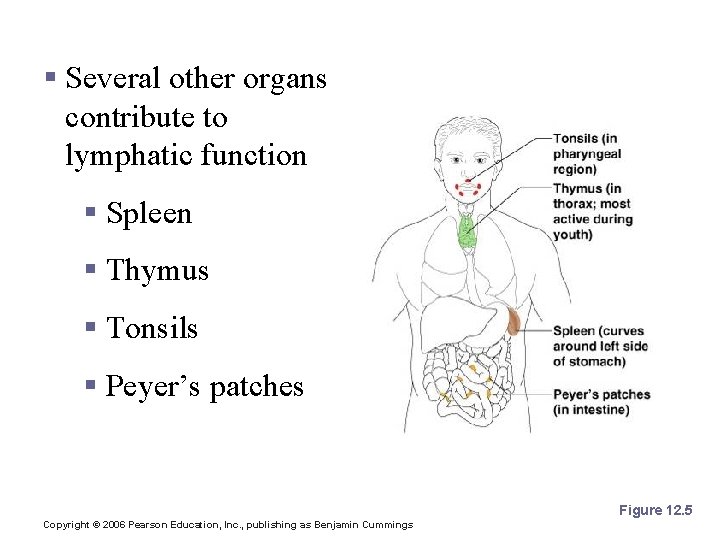
Other Lymphoid Organs § Several other organs contribute to lymphatic function § Spleen § Thymus § Tonsils § Peyer’s patches Figure 12. 5 Copyright © 2006 Pearson Education, Inc. , publishing as Benjamin Cummings
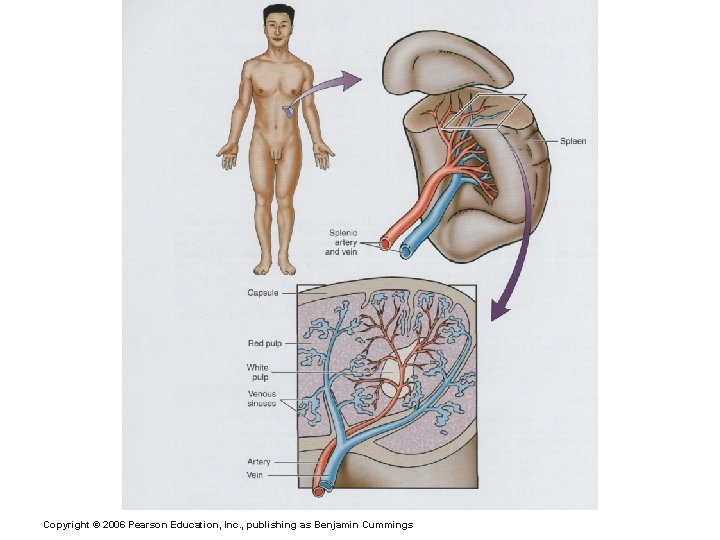
The Spleen § Located on the left side of the abdomen § Filters blood § Destroys worn out blood cells § Forms blood cells in the fetus § Acts as a blood reservoir Copyright © 2006 Pearson Education, Inc. , publishing as Benjamin Cummings
Copyright © 2006 Pearson Education, Inc. , publishing as Benjamin Cummings
The Thymus § Located in the upper thorax behind the sternum and below the thyroid gland § Functions at peak levels only during childhood § Produces hormones (like thymosin) to program lymphocytes Copyright © 2006 Pearson Education, Inc. , publishing as Benjamin Cummings
Tonsils § Small masses of lymphoid tissue around the pharynx § Trap and remove bacteria and other foreign materials § Tonsillitis is caused by congestion with bacteria Copyright © 2006 Pearson Education, Inc. , publishing as Benjamin Cummings
Peyer’s Patches § Found in the wall of the small intestine § Resemble tonsils in structure § Capture and destroy bacteria in the intestine Copyright © 2006 Pearson Education, Inc. , publishing as Benjamin Cummings
Mucosa-Associated Lymphatic Tissue (MALT) § Includes: § Peyer’s patches § Tonsils § Other small accumulations of lymphoid tissue § Acts as a sentinal to protect respiratory and digestive tracts Copyright © 2006 Pearson Education, Inc. , publishing as Benjamin Cummings
Antigens (Nonself) § Any substance capable of exciting the immune system and provoking an immune response § Examples of common antigens § Foreign proteins § Nucleic acids § Large carbohydrates § Some lipids § Pollen grains § Microorganisms Copyright © 2006 Pearson Education, Inc. , publishing as Benjamin Cummings
Self-Antigens § Human cells have many surface proteins § Our immune cells do not attack our own proteins § Our cells in another person’s body can trigger an immune response because they are foreign § Restricts donors for transplants Copyright © 2006 Pearson Education, Inc. , publishing as Benjamin Cummings
§ Antibody - A blood protein produced in lymphoid tissue that can provide immunity against a specific antigen § Pathogen – a disease causing microorganism (e. g. some bacteria, fungi, viruses, etc) Copyright © 2006 Pearson Education, Inc. , publishing as Benjamin Cummings
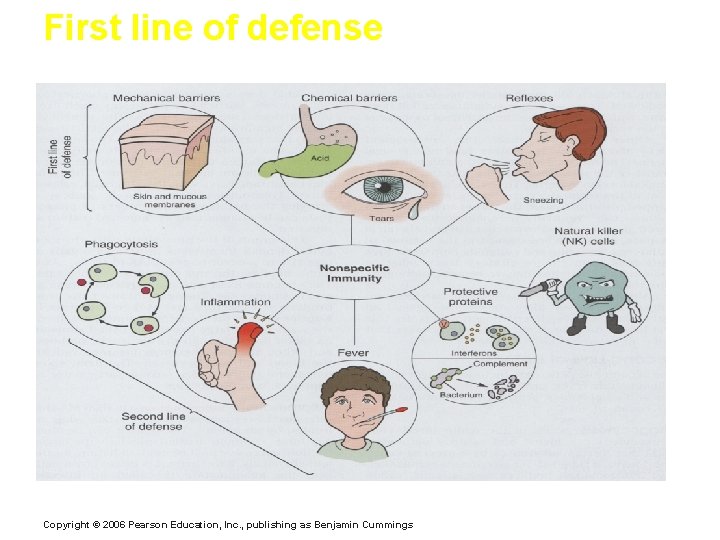
First line of defense Copyright © 2006 Pearson Education, Inc. , publishing as Benjamin Cummings
Surface Membrane Barriers – First Line of Defense § The skin § Physical barrier to foreign materials § p. H of the skin is acidic to inhibit bacterial growth § Sebum is toxic to bacteria § Vaginal secretions are very acidic Copyright © 2006 Pearson Education, Inc. , publishing as Benjamin Cummings
Surface Membrane Barriers – First Line of Defense § Stomach mucosa § Secretes hydrochloric acid § Has protein-digesting enzymes § Saliva, perspiration and lacrimal fluid contain lysozyme § Mucus traps microogranisms in digestive and respiratory pathways Copyright © 2006 Pearson Education, Inc. , publishing as Benjamin Cummings
Surface Membrane Barriers – First Line of Defense § Cilia sweep dust and bacterial laden mucus towards the mouth § Flow of urine cleanses the urethra § Reflexes assist in the removal of pathogens: § Coughing and sneezing (the respiratory tract) § Vomiting and diarrhea (the gastrointestinal tract) Copyright © 2006 Pearson Education, Inc. , publishing as Benjamin Cummings
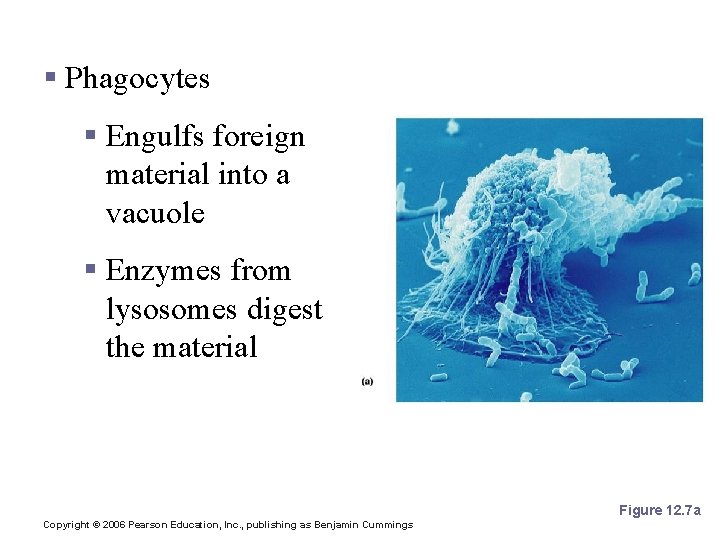
Defensive Cells § Phagocytes § Engulfs foreign material into a vacuole § Enzymes from lysosomes digest the material Figure 12. 7 a Copyright © 2006 Pearson Education, Inc. , publishing as Benjamin Cummings
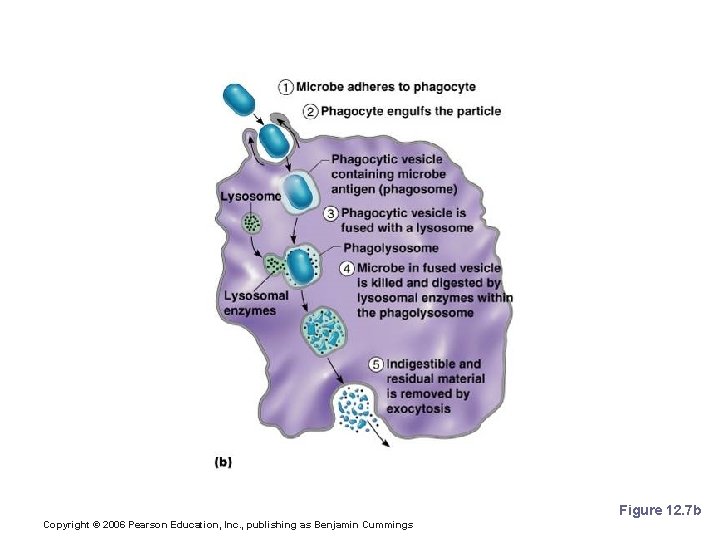
Events of Phagocytosis Figure 12. 7 b Copyright © 2006 Pearson Education, Inc. , publishing as Benjamin Cummings
Inflammatory Response - Second Line of Defense § Triggered when body tissues are injured § Produces four cardinal signs § Redness § Heat § Swelling § Pain § Results in a chain of events leading to protection and healing Copyright © 2006 Pearson Education, Inc. , publishing as Benjamin Cummings
Functions of the Inflammatory Response § Prevents spread of damaging agents § Disposes of cell debris and pathogens § Sets the stage for repair Copyright © 2006 Pearson Education, Inc. , publishing as Benjamin Cummings
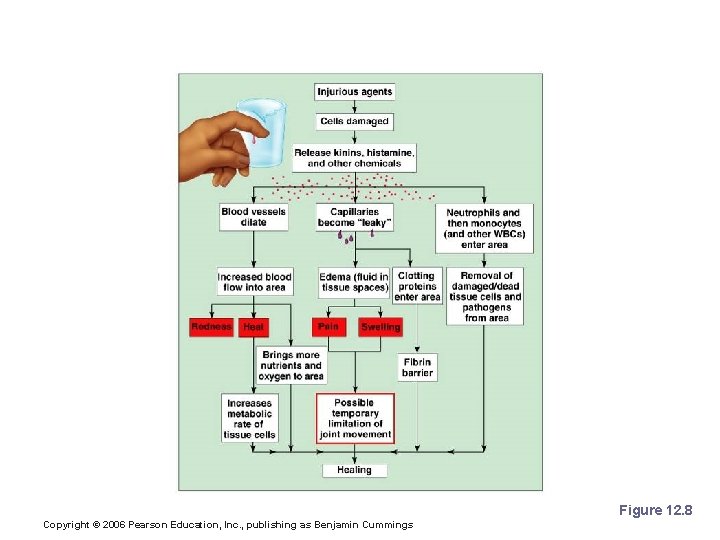
Steps in the Inflammatory Response Figure 12. 8 Copyright © 2006 Pearson Education, Inc. , publishing as Benjamin Cummings
Defensive Cells § Natural killer cells § Can lyse and kill cancer cells § Can destroy virus- infected cells Copyright © 2006 Pearson Education, Inc. , publishing as Benjamin Cummings
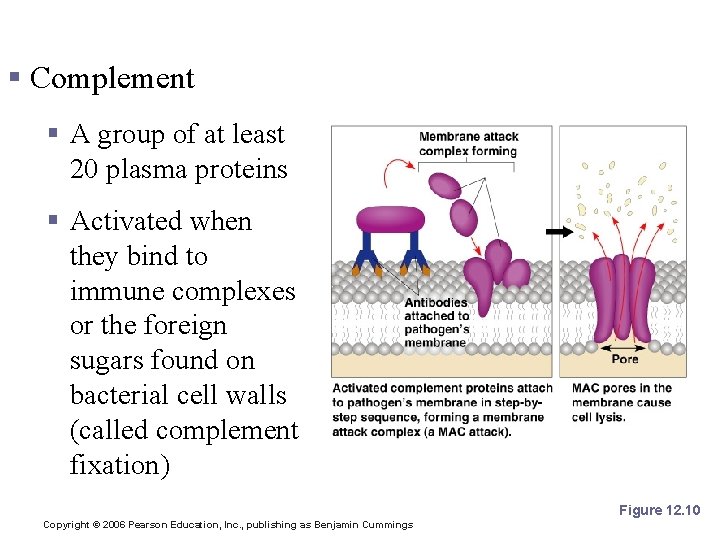
Antimicrobial Chemicals § Complement § A group of at least 20 plasma proteins § Activated when they bind to immune complexes or the foreign sugars found on bacterial cell walls (called complement fixation) Figure 12. 10 Copyright © 2006 Pearson Education, Inc. , publishing as Benjamin Cummings
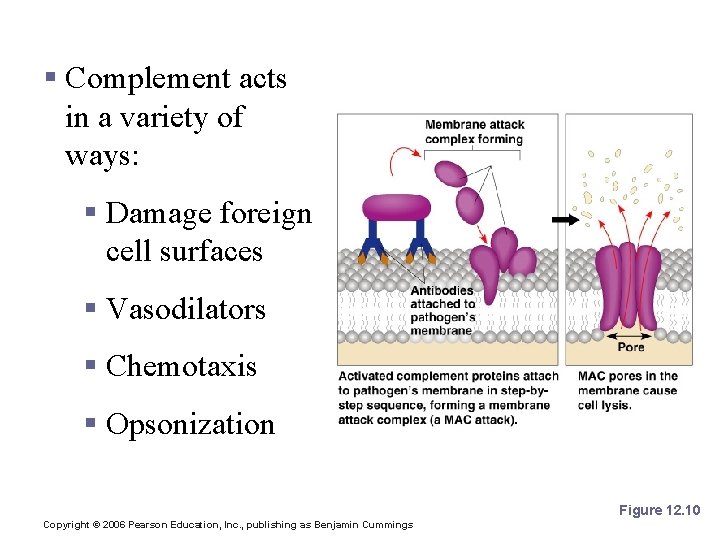
Antimicrobial Chemicals § Complement acts in a variety of ways: § Damage foreign cell surfaces § Vasodilators § Chemotaxis § Opsonization Figure 12. 10 Copyright © 2006 Pearson Education, Inc. , publishing as Benjamin Cummings
Antimicrobial Chemicals § Interferon § Secreted proteins of virus-infected cells § Bind to healthy cell surfaces to inhibit viruses binding § Transferrins § Inhibit bacterial growth by reducing the amount of available iron Copyright © 2006 Pearson Education, Inc. , publishing as Benjamin Cummings
Fever § Abnormally high body temperature § Hypothalmus heat regulation can be reset by pyrogens (secreted by white blood cells) § High temperatures inhibit the release of iron and zinc from liver and spleen needed by bacteria § Fever also increases the speed of tissue repair Copyright © 2006 Pearson Education, Inc. , publishing as Benjamin Cummings
Specific Defense: The Immune System – Third Line of Defense § Antigen specific – recognizes and acts against particular foreign substances § Systemic – not restricted to the initial infection site § Has memory – recognizes and mounts a stronger attack on previously encountered pathogens Copyright © 2006 Pearson Education, Inc. , publishing as Benjamin Cummings
Cells of the Immune System § Lymphocytes § Originate from hemocytoblasts in the red bone marrow § B lymphocytes become immunocompetent in the bone marrow § T lymphocytes become immunocompetent in the thymus § Macrophages § Arise from monocytes § Become widely distributed in lymphoid organs Copyright © 2006 Pearson Education, Inc. , publishing as Benjamin Cummings
Humoral (Antibody-Mediated) Immune Response § B cells with the proper receptors recognize and bind antigen particles (without having to be presented with them by an antigenpresenting cell) § The B cell is activated (and along with the stimulus from helper T cells) begins to form a clone § A large number of clones are produced (primary humoral response) Copyright © 2006 Pearson Education, Inc. , publishing as Benjamin Cummings
Humoral (Antibody Mediated) Immune Response § Most B cells become plasma cells § Produce antibodies to destroy antigens § Activity lasts for four or five days § Some B cells become long-lived memory cells (secondary humoral response) Copyright © 2006 Pearson Education, Inc. , publishing as Benjamin Cummings
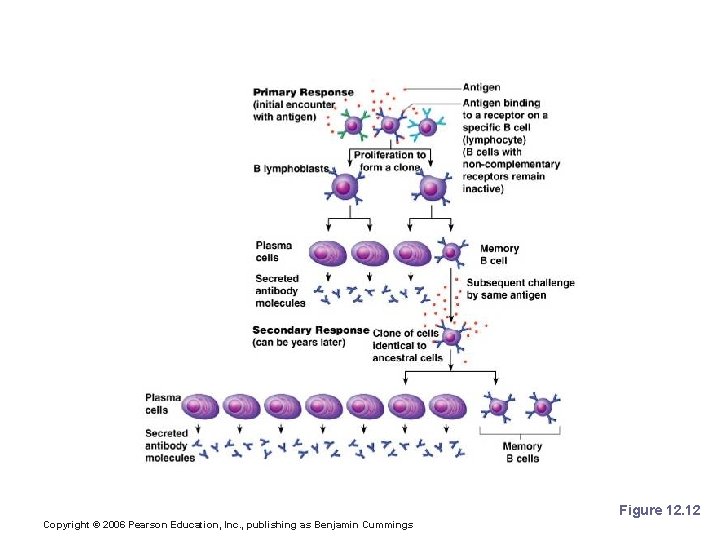
Humoral Immune Response Figure 12. 12 Copyright © 2006 Pearson Education, Inc. , publishing as Benjamin Cummings
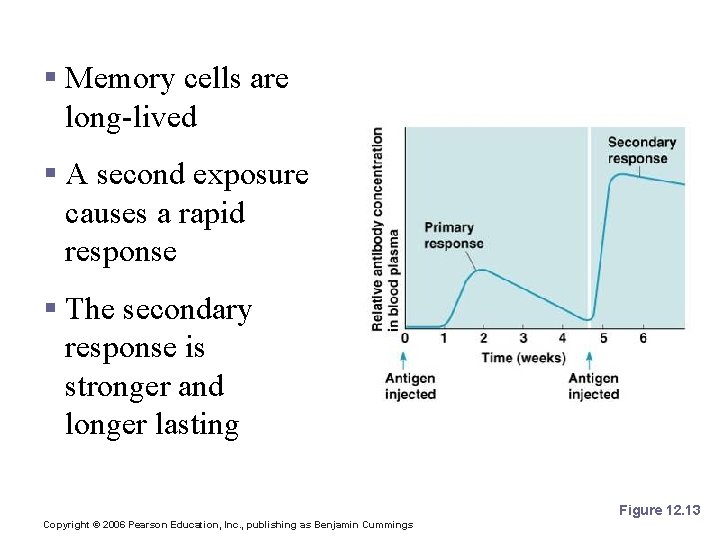
Secondary Response § Memory cells are long-lived § A second exposure causes a rapid response § The secondary response is stronger and longer lasting Figure 12. 13 Copyright © 2006 Pearson Education, Inc. , publishing as Benjamin Cummings
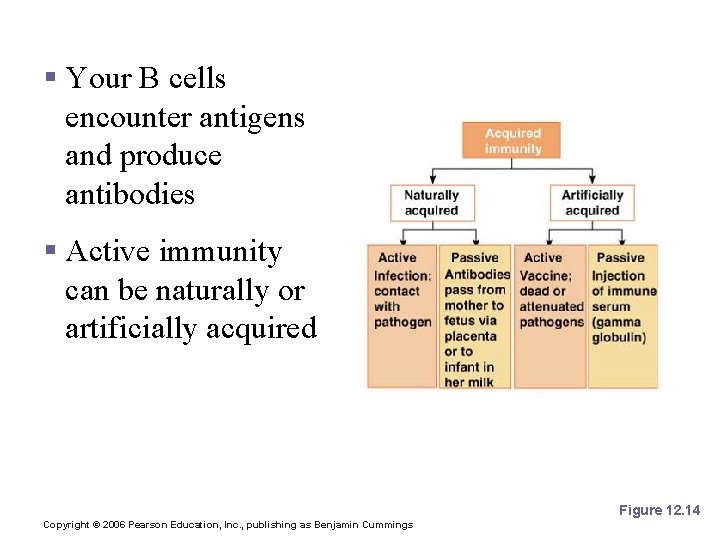
Active Immunity § Your B cells encounter antigens and produce antibodies § Active immunity can be naturally or artificially acquired Figure 12. 14 Copyright © 2006 Pearson Education, Inc. , publishing as Benjamin Cummings
Passive Immunity § Antibodies are obtained from someone else § Conferred naturally from a mother to her fetus § Conferred artificially from immune serum or gamma globulin § Immunological memory does not occur § Protection provided by “borrowed antibodies” Copyright © 2006 Pearson Education, Inc. , publishing as Benjamin Cummings
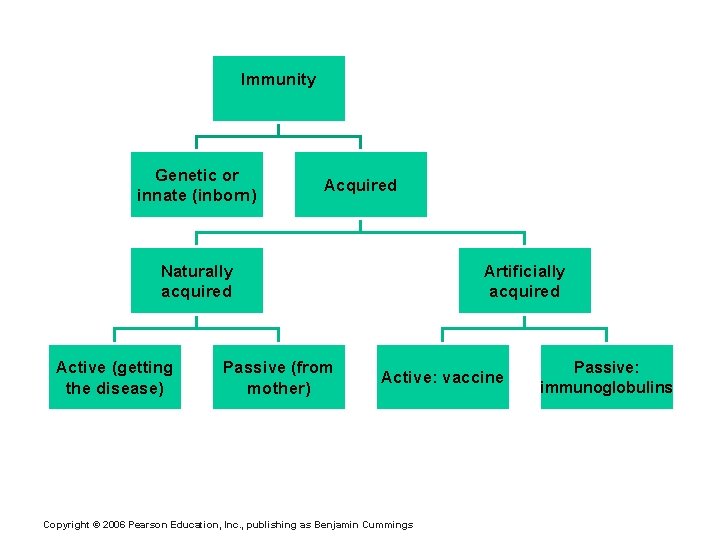
Immunity Genetic or innate (inborn) Acquired Naturally acquired Active (getting the disease) Passive (from mother) Artificially acquired Active: vaccine Copyright © 2006 Pearson Education, Inc. , publishing as Benjamin Cummings Passive: immunoglobulins
Antibody Function § Antibodies are Y or T shaped soluble proteins. Each has two antigen binding sites particular to specific antigens. The remaining end is similar in all antibodies. § Antibodies inactivate antigens in a number of ways § Complement fixation § Neutralization § Agglutination § Precipitation Copyright © 2006 Pearson Education, Inc. , publishing as Benjamin Cummings
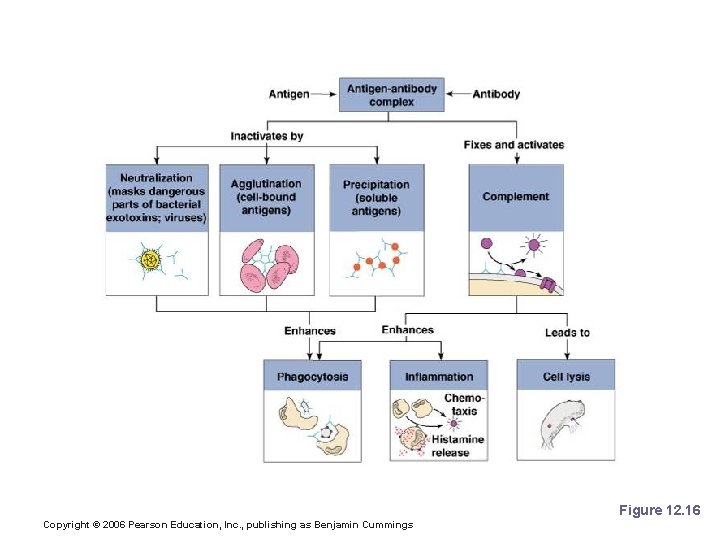
Antibody Function Figure 12. 16 Copyright © 2006 Pearson Education, Inc. , publishing as Benjamin Cummings
Cellular (Cell-Mediated) Immune Response § a macrophage engulfs and digests a pathogen § the macrophage then pushes to its membrane surface the antigen from the digested pathogen (called antigen presentation) § a T cell that has receptor sites for that particular antigen then binds to the antigen on the macrophage’s surface and becomes activated (called T cell activation) § The activated T cell then clones resulting in a large number of T cells. Copyright © 2006 Pearson Education, Inc. , publishing as Benjamin Cummings
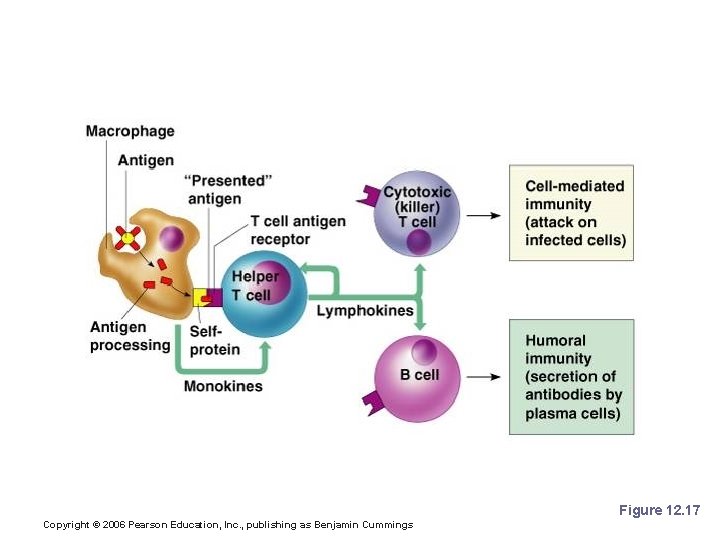
Cellular (Cell-Mediated) Immune Response Figure 12. 17 Copyright © 2006 Pearson Education, Inc. , publishing as Benjamin Cummings
T Cell Clones § Cytotoxic T cells § Specialize in killing infected cells § Insert a toxic chemical (perforin) § Helper T cells § Recruit other cells to fight the invaders § Interact directly with B cells Copyright © 2006 Pearson Education, Inc. , publishing as Benjamin Cummings
T Cell Clones § Regulatory T cells § Release chemicals to suppress the activity of T and B cells § Stop the immune response to prevent uncontrolled activity § A few members of each clone are Memory T cells Copyright © 2006 Pearson Education, Inc. , publishing as Benjamin Cummings
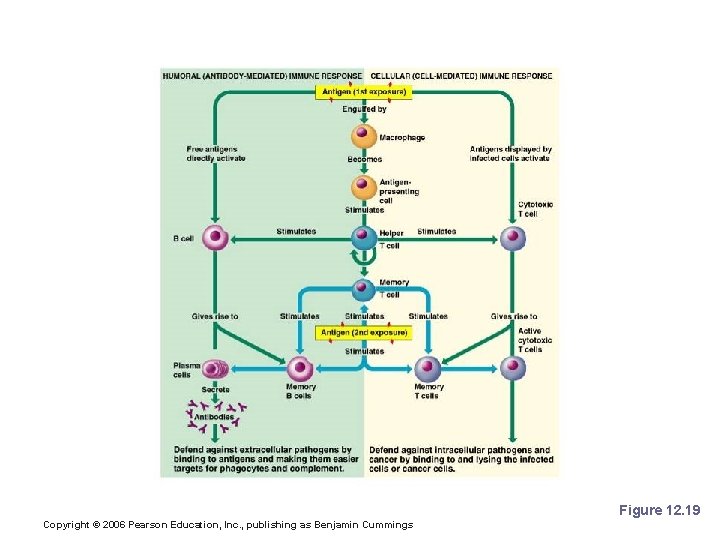
Summary of the Immune Response Figure 12. 19 Copyright © 2006 Pearson Education, Inc. , publishing as Benjamin Cummings
- Slides: 54