
The Loyalists Mass Migration In the 13 Colonies


- Slides: 13
The Loyalists Mass Migration
In the 13 Colonies, those who remained loyal to Britain were called the United Empire Loyalist. Many Loyalists had been persecuted by rebel forces during the American Revolution. Most Loyalist were forced to flee their land, homes, and possessions.
When did Loyalists leave? Some came to BNA soon after the American Revolution began. Most were evacuated by ship from New York in 1783 & 1784 when the war was over. Some Loyalists went back to Britain, Jamaica, or to other British colonies.
WHY? The Loyalist migrated for many reasons: 1. Some had roots in Britain and wanted to live under British rule. 2. Life was intolerable for some in the 13 Colonies (harassment) 3. Many women & children had to migrate because fathers or husbands decided to move. 4. Some Loyalist were conscientious objectors – who for religious reasons would not fight. 5. Other were “Land Loyalists” who wanted to take advantage of the free land in BNA.
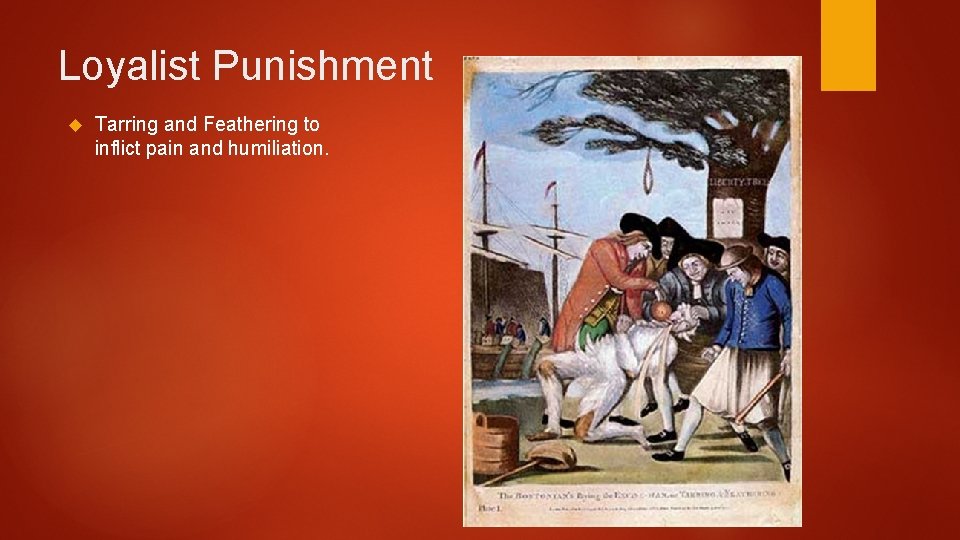
Loyalist Punishment Tarring and Feathering to inflict pain and humiliation.
WHO were the Loyalists? Wealthy & poor Young & old Male & female European African Canadian First Nations
First Nations Loyalists The Iroquois Six Nations Confederacy were also Loyalist refugees The Six Nations were divided: 2 Nations sided with the rebels (Tuscarora & Oneida) 4 Nations sided with the British (Mohawk, Onondaga, Cayuga, & Seneca) The First Nations Loyalists were fighting for their communities’ survival. Battles took place on their homeland, and the causalities were often their families Despite their loyalty, First Nations peoples were ignored in the Treaty of Paris in 1783
African American/Canadian Loyalist Near the end of the American Revolution, Great Britain issued a proclamation promising freedom and safety to any slave who deserted their American masters. Approximately 3, 000 free Black Loyalists – as well as hundreds of salves migrated to Canada. (BNA at the time). Sadly when they arrived they were marginalized, attacked and harassed. In 1792, 1200 Black Loyalists left Nova Scotia for Africa.
The Loyalists Immigration to BNA Between 1782 – 1784 around 35, 000 Loyalist families settled in Nova Scotia. 10, 000 Loyalists families settled in Quebec. In total, close to 100, 000 Loyalist migrated to BNA during these years.
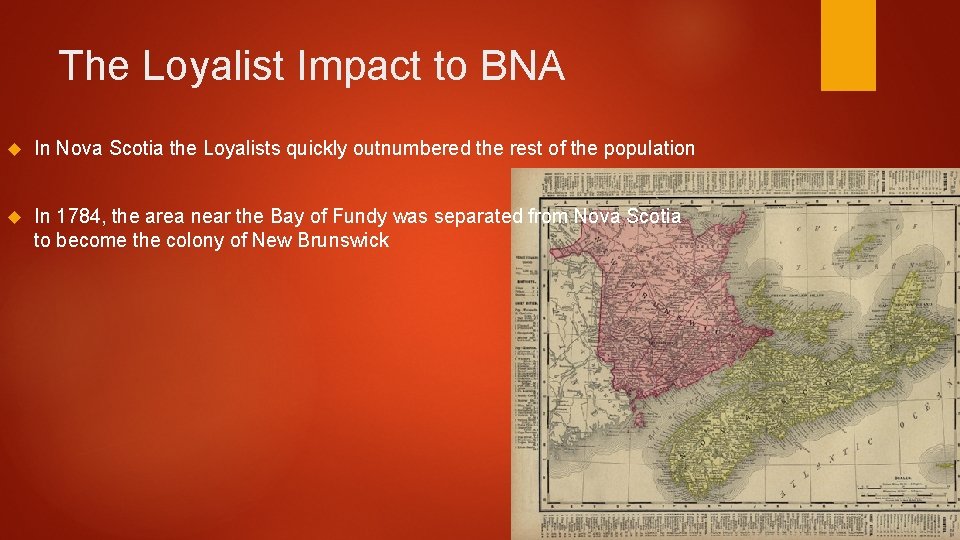
The Loyalist Impact to BNA In Nova Scotia the Loyalists quickly outnumbered the rest of the population In 1784, the area near the Bay of Fundy was separated from Nova Scotia to become the colony of New Brunswick
The Constitutional Act 1791 The arrival of the Loyalists changed BNA’s demographics: 1. Increased English – speaking population 2. Increased demand for agricultural land Sir Guy Carleton decided to revamp the Quebec Act. In it’s place: Constitutional Act 1791
The Constitutional Act Con’t. The Constitutional Act recognized that there were two dominant groups in the colony: English and French. Each group had their own religious, legal and political outlooks, as well as traditions. Gees I wonder who was left out Therefore Quebec was divided into 2 Colonies: v Upper Canada (now ONT) v Lower Canada (now QUE) v (named after the direction of the St. Lawrence. ) of this deal? ?
The Constitutional Act Con’t. Each of the Canada's could maintain its own language regulations, laws, landowning system, and religious beliefs: 1. Each area had a separate Appointed Governor and Council 2. Each had an Elected Assembly 3. It provided a British legal and land holding system for Upper Canada 4. Preserved French Catholic rights in lower Canada 5. Each of the Canadas had a capital city: Lower Canada=Quebec City, & Upper Canada=Newark