
The low temperature thermal expansion of materials used



- Slides: 21
The low temperature thermal expansion of materials used for superconducting magnets K. J. Radcliff, R. P. Walsh, and R. P. Reed kradcliff@magnet. fsu. edu 1
Outline • • Introduction Definitions Dilatometer setup Specimen geometry Test procedure Calibration Materials tested Summary kradcliff@magnet. fsu. edu 2
Introduction • Magnet materials experience large temperature ranges and extreme low temperatures, resulting in large thermal stresses. • Thermal stresses occur due to differential thermal expansion between various materials. • Proper designs should consider thermal mismatches to prevent premature failures in magnets. kradcliff@magnet. fsu. edu 3
Definitions • The coefficient of thermal expansion (CTE) is defined to be the linear slope of thermal expansion vs temperature curve. • Units of mm/mm/K (in/in/F) • Ex: A US manufacture uses CTE number in their strain gages for a particular material the strain gage will be bonded to. • SK-06 -350 -CY vs SK-09 -350 -CY • • Steel has a RT CTE of 6 e-6 in/in/F Stainless steel ha a RT CTE of 9 e-6 in/in/F • Rule of thumb: alphabetical expansions from high TE to low TE. • • A B C S T Aluminum, brass, copper, steel, and Ti. kradcliff@magnet. fsu. edu 4
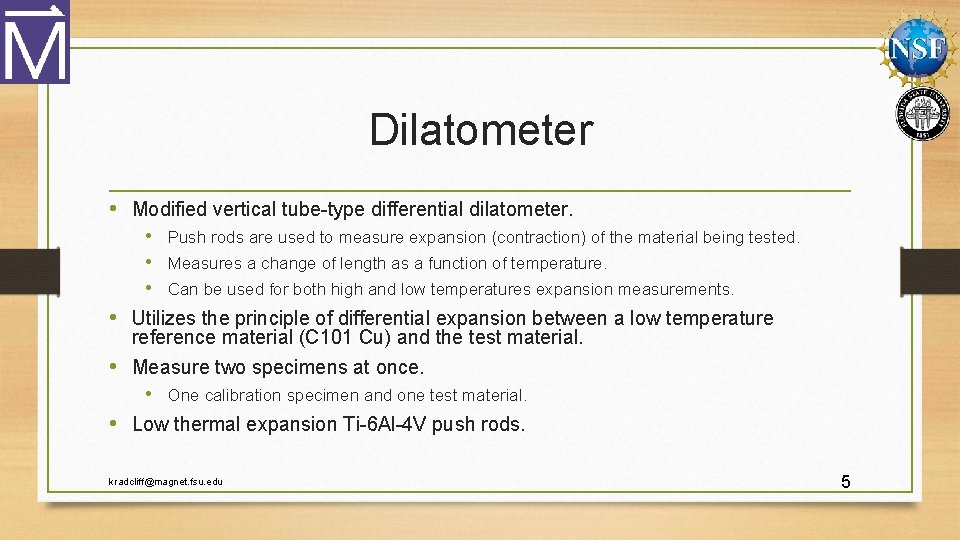
Dilatometer • Modified vertical tube-type differential dilatometer. • Push rods are used to measure expansion (contraction) of the material being tested. • Measures a change of length as a function of temperature. • Can be used for both high and low temperatures expansion measurements. • Utilizes the principle of differential expansion between a low temperature reference material (C 101 Cu) and the test material. • Measure two specimens at once. • One calibration specimen and one test material. • Low thermal expansion Ti-6 Al-4 V push rods. kradcliff@magnet. fsu. edu 5
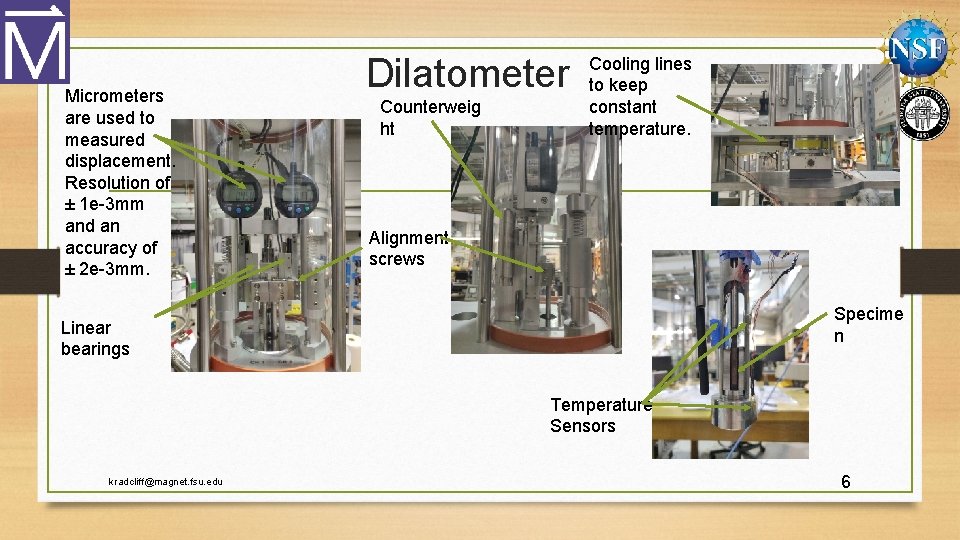
Micrometers are used to measured displacement. Resolution of ± 1 e-3 mm and an accuracy of ± 2 e-3 mm. Dilatometer Counterweig ht Cooling lines to keep constant temperature. Alignment screws Specime n Linear bearings Temperature Sensors kradcliff@magnet. fsu. edu 6
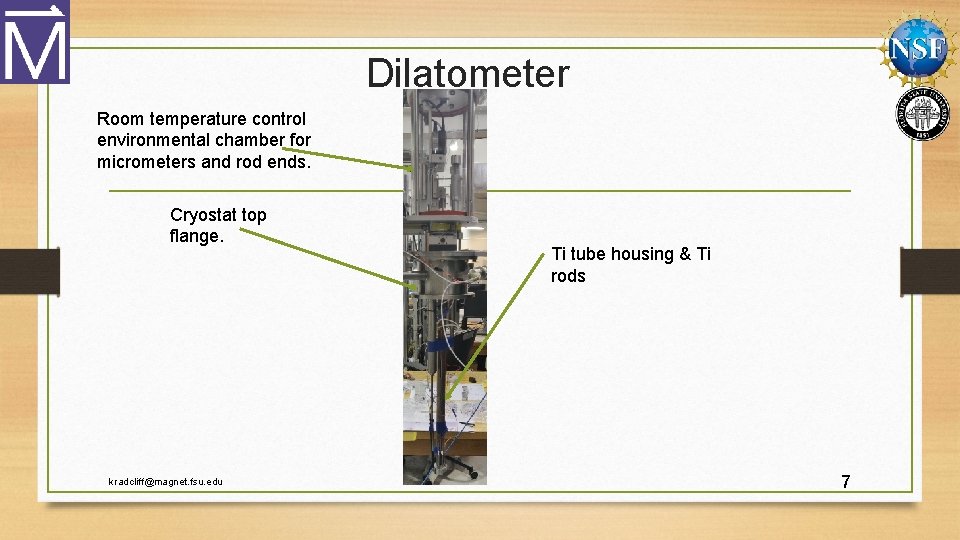
Dilatometer Room temperature control environmental chamber for micrometers and rod ends. Cryostat top flange. kradcliff@magnet. fsu. edu Ti tube housing & Ti rods 7
Specimen Geometry kradcliff@magnet. fsu. edu 8
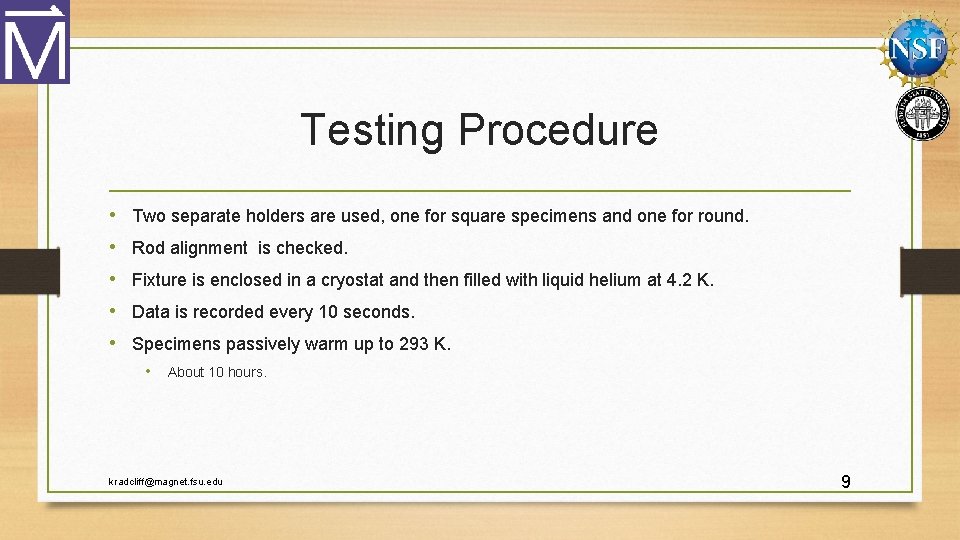
Testing Procedure • Two separate holders are used, one for square specimens and one for round. • Rod alignment is checked. • Fixture is enclosed in a cryostat and then filled with liquid helium at 4. 2 K. • Data is recorded every 10 seconds. • Specimens passively warm up to 293 K. • About 10 hours. kradcliff@magnet. fsu. edu 9
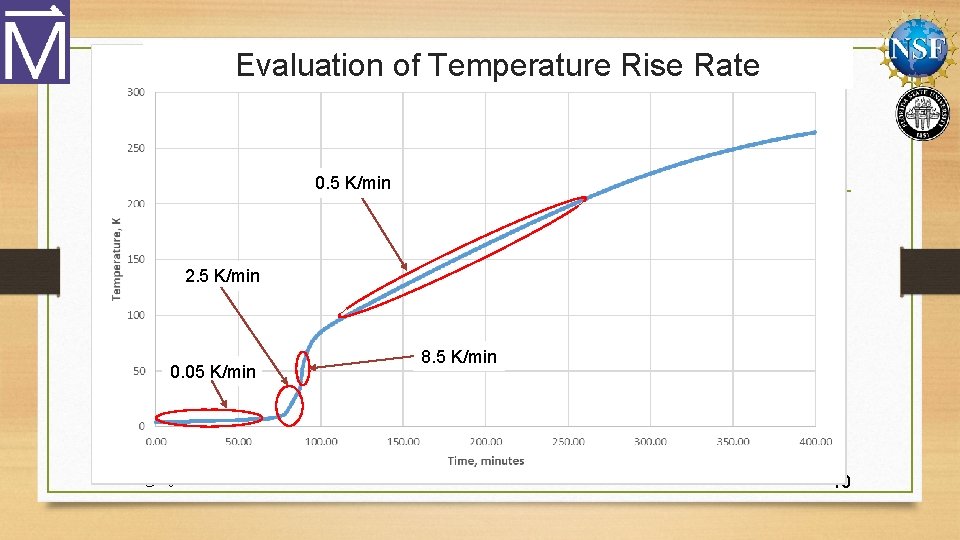
Evaluation of Temperature Rise Rate 0. 5 K/min 2. 5 K/min 0. 05 K/min kradcliff@magnet. fsu. edu 8. 5 K/min 10
Calibration • C 101 copper is used to calibrate the fixture. • Raw data is zeroed at 293 K. • Using NIST reference data of thermal expansion for copper is used to determine correction curve for fixture. • A total of 10 calibrations runs were performed. • A Polynomial curve fit is then made for thermal expansion of fixture and used to correct for unknown materials. kradcliff@magnet. fsu. edu 11
Calibration Process Cu + Fixture • Raw data is subtracted from NIST Cu Ref. Correction NIST Ref • This correction is done for each copper calibration run to get an average polynomial fit. kradcliff@magnet. fsu. edu 12
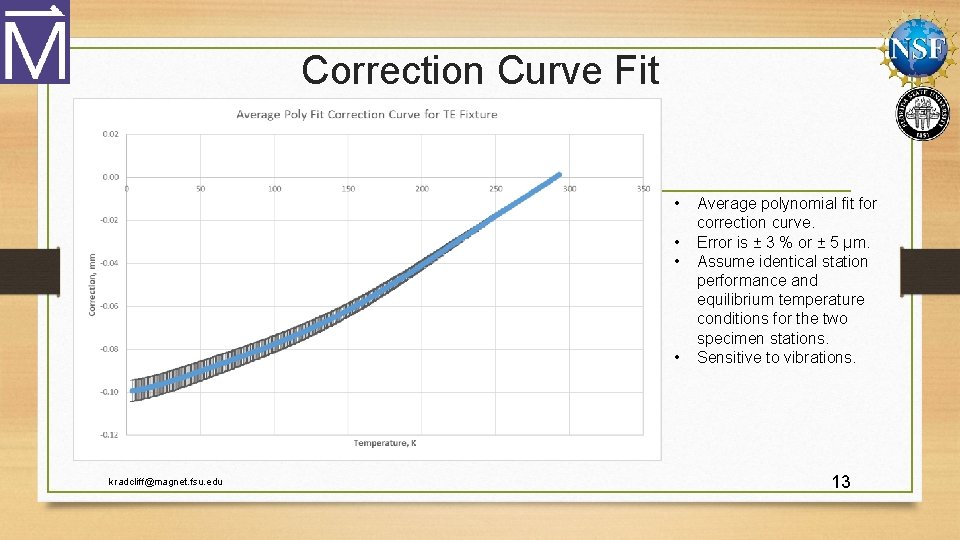
Correction Curve Fit • • kradcliff@magnet. fsu. edu Average polynomial fit for correction curve. Error is ± 3 % or ± 5 μm. Assume identical station performance and equilibrium temperature conditions for the two specimen stations. Sensitive to vibrations. 13
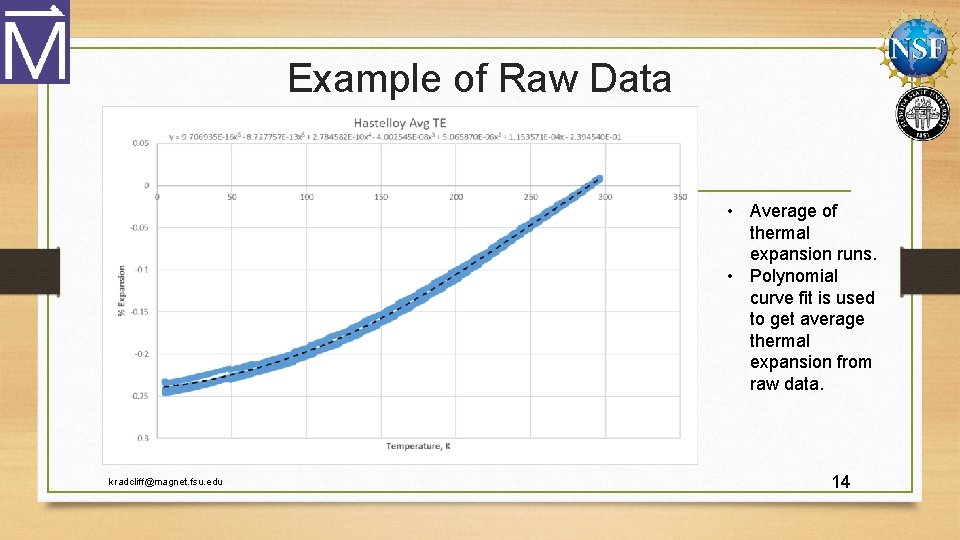
Example of Raw Data • Average of thermal expansion runs. • Polynomial curve fit is used to get average thermal expansion from raw data. kradcliff@magnet. fsu. edu 14
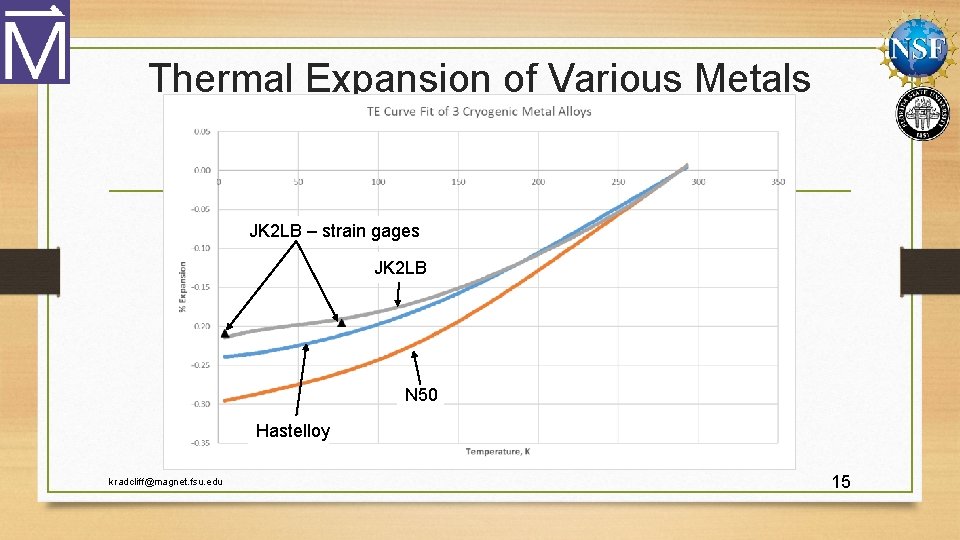
Thermal Expansion of Various Metals JK 2 LB – strain gages JK 2 LB N 50 Hastelloy kradcliff@magnet. fsu. edu 15
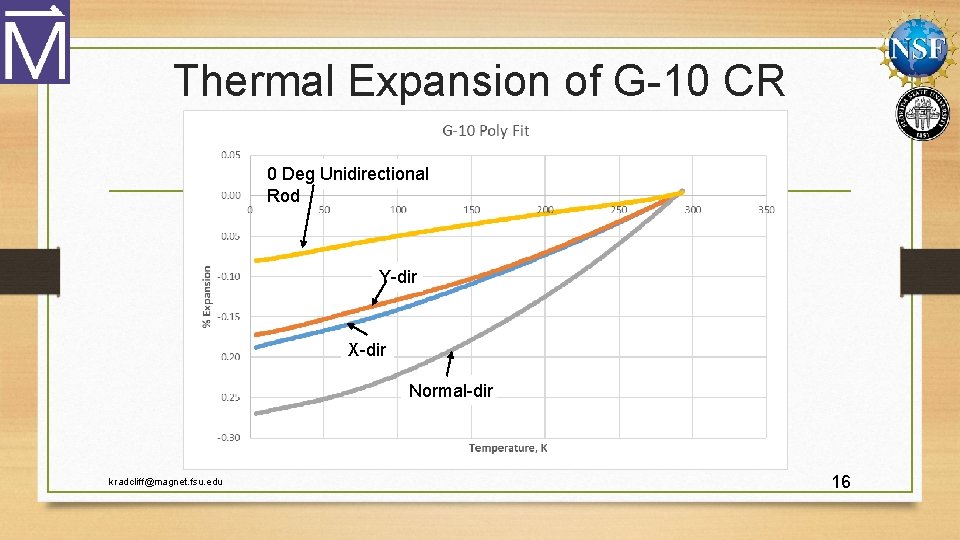
Thermal Expansion of G-10 CR 0 Deg Unidirectional Rod Y-dir X-dir Normal-dir kradcliff@magnet. fsu. edu 16
Thermal Expansion of Impregnation Epoxies CS Epoxy Stycast L 28 NHMFL 61 kradcliff@magnet. fsu. edu 17
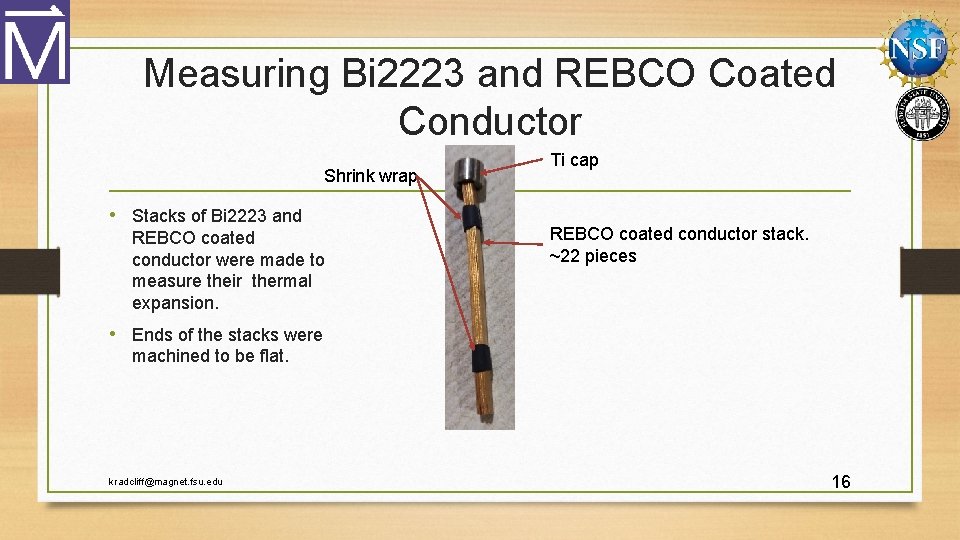
Measuring Bi 2223 and REBCO Coated Conductor Shrink wrap • Stacks of Bi 2223 and REBCO coated conductor were made to measure their thermal expansion. Ti cap REBCO coated conductor stack. ~22 pieces • Ends of the stacks were machined to be flat. kradcliff@magnet. fsu. edu 16
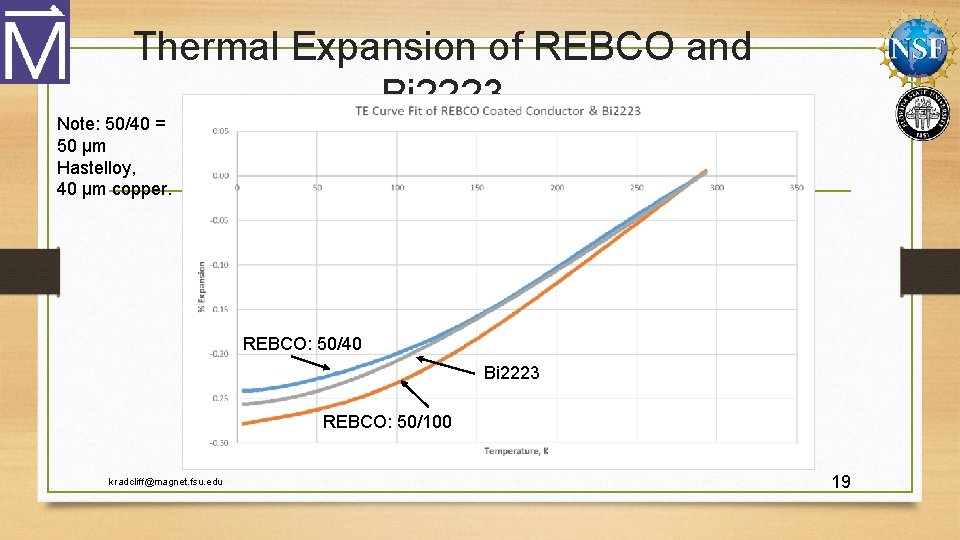
Thermal Expansion of REBCO and Bi 2223 Note: 50/40 = 50 μm Hastelloy, 40 μm copper. REBCO: 50/40 Bi 2223 REBCO: 50/100 kradcliff@magnet. fsu. edu 19
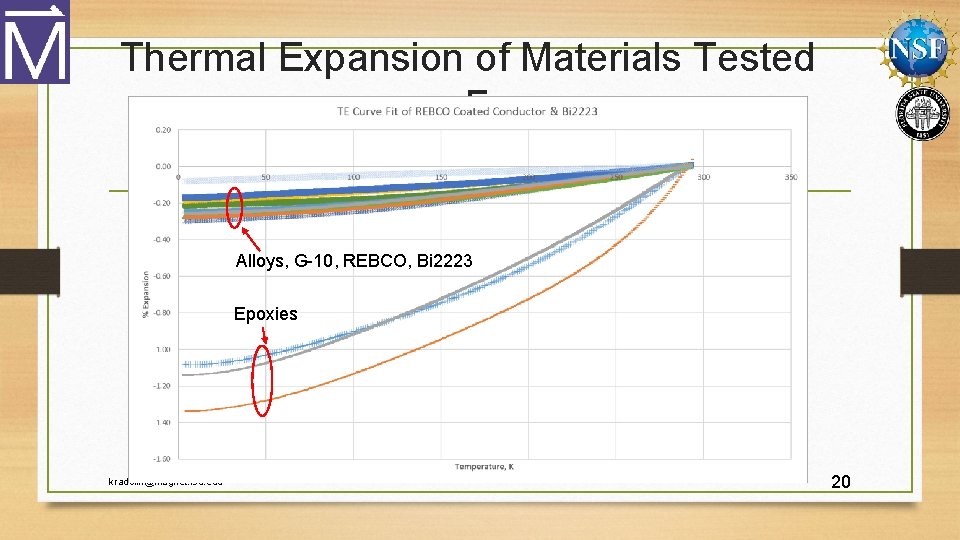
Thermal Expansion of Materials Tested so Far Alloys, G-10, REBCO, Bi 2223 Epoxies kradcliff@magnet. fsu. edu 20
Summary • Relatively simply way to measure thermal expansion of unknown materials. • A thermal expansion database is being made for magnet designers and other applications. • Increase accuracy of measurements. • Improve temperature rise rate. kradcliff@magnet. fsu. edu 21