
The Looming Software Crisis due to the Multicore
- Slides: 52
The Looming Software Crisis due to the Multicore Menace Saman Amarasinghe Computer Science and Artificial Intelligence Laboratory Massachusetts Institute of Technology
The “Software Crisis” “To put it quite bluntly: as long as there were no machines, programming was no problem at all; when we had a few weak computers, programming became a mild problem, and now we have gigantic computers, programming has become an equally gigantic problem. " -- E. Dijkstra, 1972 Turing Award Lecture 2
The First Software Crisis • Time Frame: ’ 60 s and ’ 70 s • Problem: Assembly Language Programming – Computers could handle larger more complex programs • Needed to get Abstraction and Portability without losing Performance 3
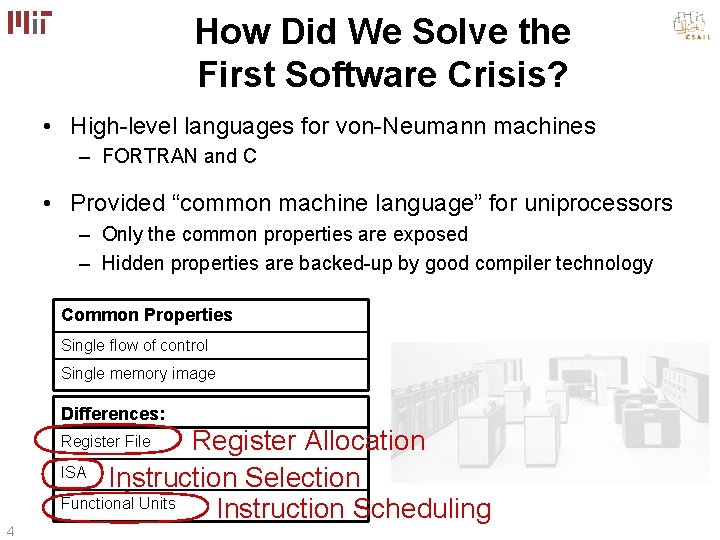
How Did We Solve the First Software Crisis? • High-level languages for von-Neumann machines – FORTRAN and C • Provided “common machine language” for uniprocessors – Only the common properties are exposed – Hidden properties are backed-up by good compiler technology Common Properties Single flow of control Single memory image Differences: Register Allocation ISA Instruction Selection Functional Units Instruction Scheduling Register File 4
The Second Software Crisis • Time Frame: ’ 80 s and ’ 90 s • Problem: Inability to build and maintain complex and robust applications requiring multi-million lines of code developed by hundreds of programmers – Computers could handle larger more complex programs • Needed to get Composability, Malleability and Maintainability – High-performance was not an issue left to Moore’s Law 5
How Did We Solve the Second Software Crisis? • Object Oriented Programming – C++ – Now C# and Java • Better tools – Component libraries, Purify • Better software engineering methodology – Design patterns, specification, testing, code reviews 6
Today: Programmers are Oblivious about the Processors • Solid boundary between Hardware and Software • Programmers don’t have to know anything about the processor – High level languages abstract away the processors – Ex: Java bytecode is machine independent – Moore’s law does not require the programmers to know anything about the processors to get good speedups • Programs are oblivious to the processor works on all processors – A program written in ’ 70 using C still works and is much faster today • This abstraction provides a lot of freedom for the programmers 7
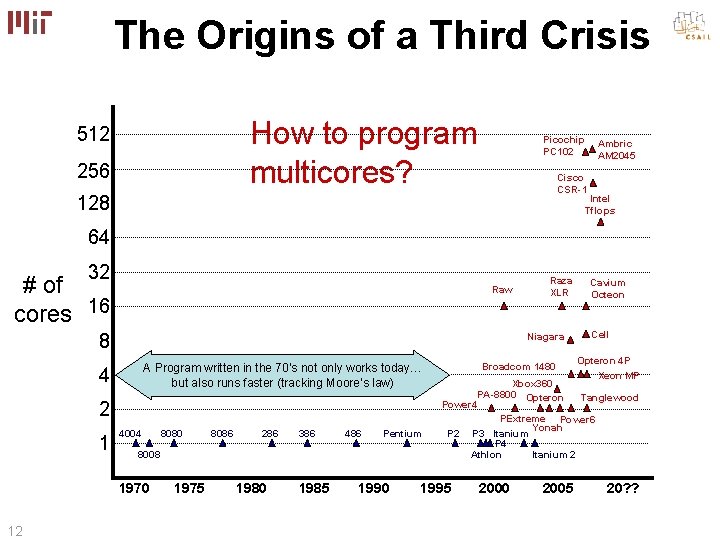
The Origins of a Third Crisis • Time Frame: 2010 to ? ? • Problem: Sequential performance is left behind by Moore’s law – All software developers have abstracted away the processor assuming that Moore’s law will always provide performance gains! 8
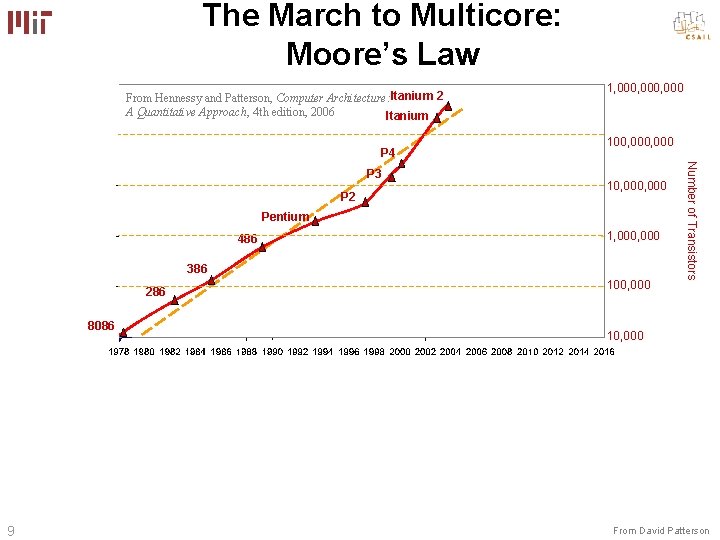
The March to Multicore: Moore’s Law From Hennessy and Patterson, Computer Architecture: Itanium 2 A Quantitative Approach, 4 th edition, 2006 Itanium P 4 P 2 100, 000 10, 000 Pentium 486 1, 000 386 286 8086 9 100, 000 Number of Transistors P 3 1, 000, 000 10, 000 From David Patterson
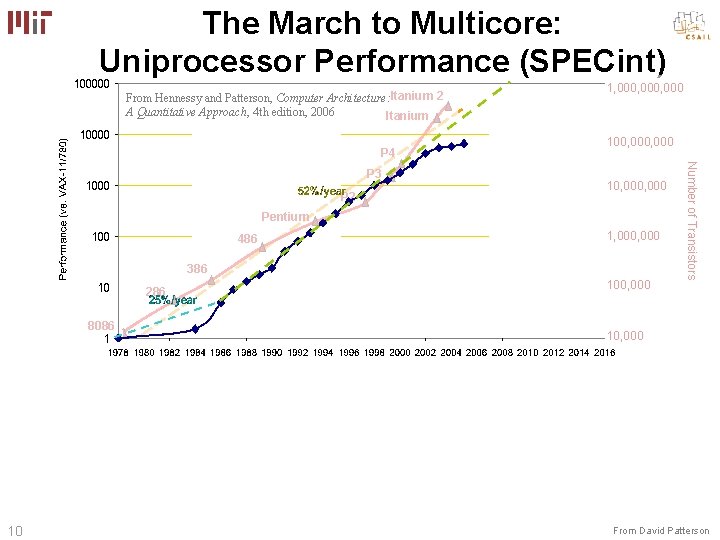
The March to Multicore: Uniprocessor Performance (SPECint) From Hennessy and Patterson, Computer Architecture: Itanium 2 A Quantitative Approach, 4 th edition, 2006 Itanium P 4 P 2 100, 000 10, 000 Pentium 486 1, 000 386 286 8086 10 100, 000 Number of Transistors P 3 1, 000, 000 10, 000 From David Patterson
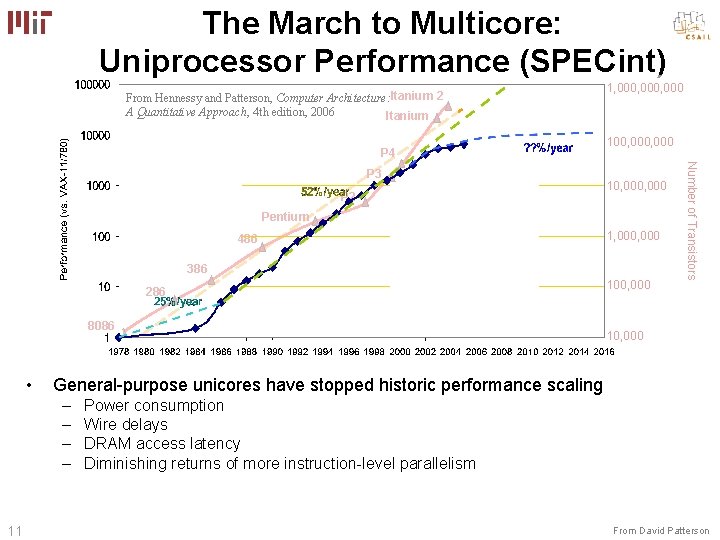
The March to Multicore: Uniprocessor Performance (SPECint) From Hennessy and Patterson, Computer Architecture: Itanium 2 A Quantitative Approach, 4 th edition, 2006 Itanium P 4 P 2 100, 000 10, 000 Pentium 486 1, 000 386 286 8086 • 10, 000 General-purpose unicores have stopped historic performance scaling – – 11 100, 000 Number of Transistors P 3 1, 000, 000 Power consumption Wire delays DRAM access latency Diminishing returns of more instruction-level parallelism From David Patterson
The Origins of a Third Crisis How to program multicores? 512 256 Picochip PC 102 Ambric AM 2045 Cisco CSR-1 128 Intel Tflops 64 32 # of cores 16 Raw 8 Niagara A Program written in the 70’s not only works today… but also runs faster (tracking Moore’s law) 4 2 1 4004 8080 8086 286 386 486 Pentium 8008 1970 12 Raza XLR 1975 1980 1985 1990 Broadcom 1480 Cavium Octeon Cell Opteron 4 P Xeon MP Xbox 360 PA-8800 Opteron Tanglewood Power 4 PExtreme Power 6 Yonah P 2 P 3 Itanium P 4 Athlon Itanium 2 1995 2000 2005 20? ?
The Origins of a Third Crisis • Time Frame: 2010 to ? ? • Problem: Sequential performance is left behind by Moore’s law • Needed continuous and reasonable performance improvements – to support new features – to support larger datasets • While sustaining portability, malleability and maintainability without unduly increasing complexity faced by the programmer critical to keep-up with the current rate of evolution in software 13
Why Parallelism is Hard • A huge increase in complexity and work for the programmer – Programmer has to think about performance! – Parallelism has to be designed in at every level • Humans are sequential beings – Deconstructing problems into parallel tasks is hard for many of us • Parallelism is not easy to implement – Parallelism cannot be abstracted or layered away – Code and data has to be restructured in very different (non-intuitive) ways • Parallel programs are very hard to debug – Combinatorial explosion of possible execution orderings – Race condition and deadlock bugs are non-deterministic and illusive – Non-deterministic bugs go away in lab environment and with instrumentation 14
Outline: Ideas on Solving the Third Software Crisis 1. Advances in Computer Architecture 2. Novel Programming Models and Languages 3. Aggressive Compilers 4. Tools to support parallelization, debugging and migration 15
Computer Architecture • Current generation of multicores – How can we cobble together something with existing parts/investments? – Impact of multicores haven’t hit us yet • The move to multicore will be a disruptive shift – An inversion of the cost model – A forced shift in the programming model • A chance to redesign the microprocessor from scratch. • What are the innovations that will reduce/eliminate the extra burden placed on the programmer? 16
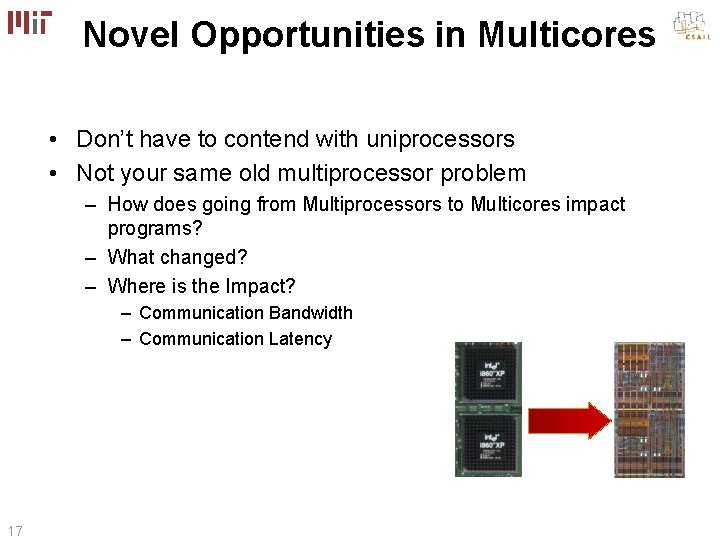
Novel Opportunities in Multicores • Don’t have to contend with uniprocessors • Not your same old multiprocessor problem – How does going from Multiprocessors to Multicores impact programs? – What changed? – Where is the Impact? – Communication Bandwidth – Communication Latency 17
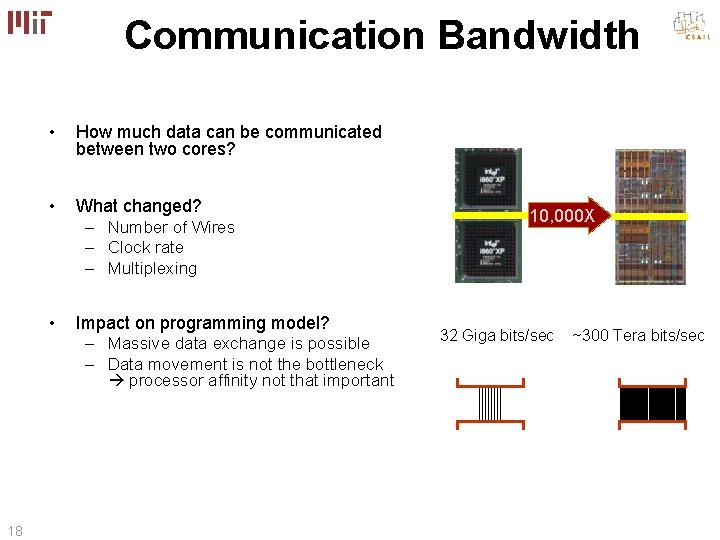
Communication Bandwidth • How much data can be communicated between two cores? • What changed? – Number of Wires – Clock rate – Multiplexing • Impact on programming model? – Massive data exchange is possible – Data movement is not the bottleneck processor affinity not that important 18 10, 000 X 32 Giga bits/sec ~300 Tera bits/sec
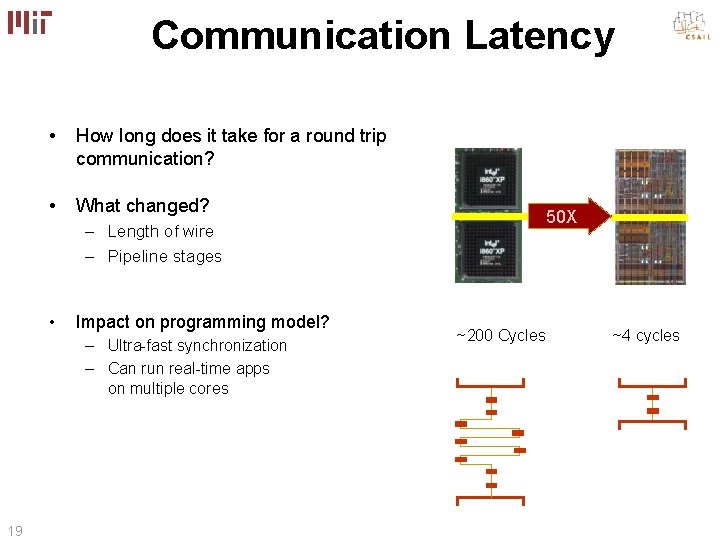
Communication Latency • How long does it take for a round trip communication? • What changed? 50 X – Length of wire – Pipeline stages • Impact on programming model? – Ultra-fast synchronization – Can run real-time apps on multiple cores 19 ~200 Cycles ~4 cycles
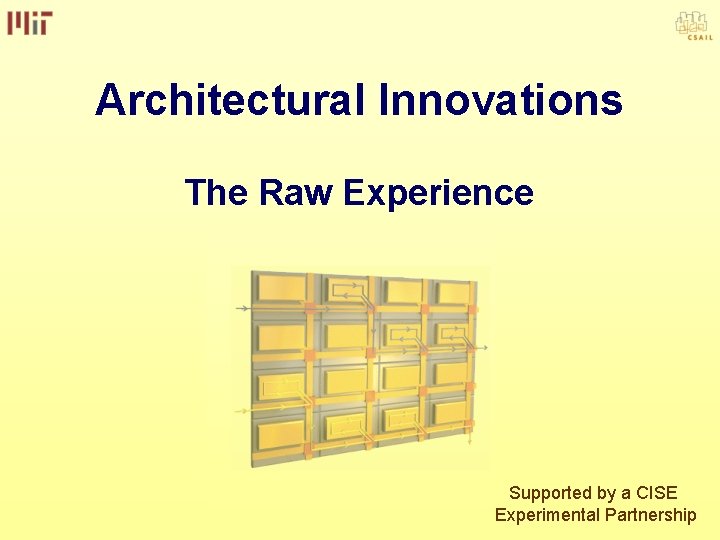
Architectural Innovations The Raw Experience Supported by a CISE Experimental Partnership
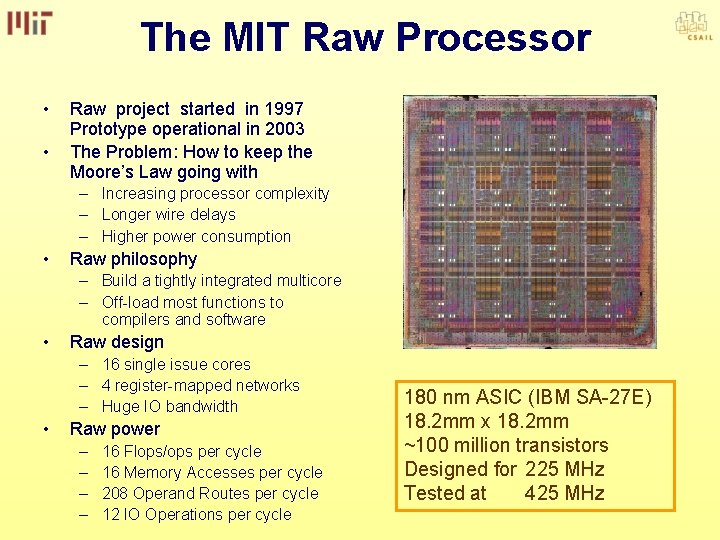
The MIT Raw Processor • • Raw project started in 1997 Prototype operational in 2003 The Problem: How to keep the Moore’s Law going with – Increasing processor complexity – Longer wire delays – Higher power consumption • Raw philosophy – Build a tightly integrated multicore – Off-load most functions to compilers and software • Raw design – 16 single issue cores – 4 register-mapped networks – Huge IO bandwidth • Raw power – – 16 Flops/ops per cycle 16 Memory Accesses per cycle 208 Operand Routes per cycle 12 IO Operations per cycle 180 nm ASIC (IBM SA-27 E) 18. 2 mm x 18. 2 mm ~100 million transistors Designed for 225 MHz Tested at 425 MHz
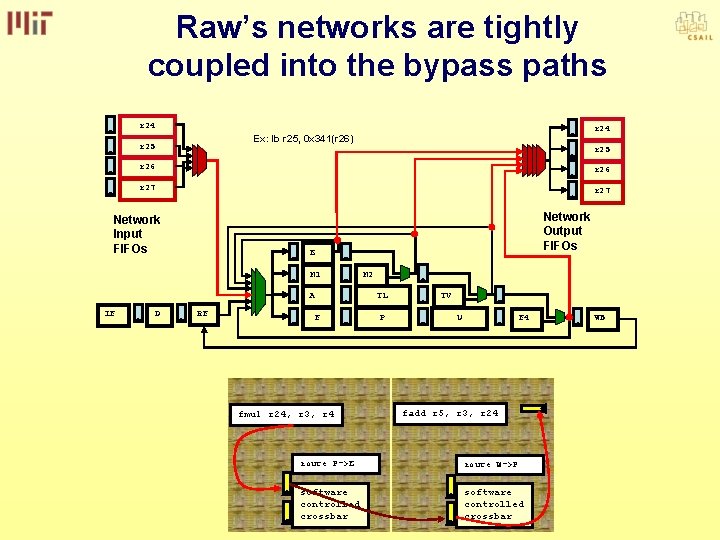
Raw’s networks are tightly coupled into the bypass paths r 24 r 25 r 26 r 27 Network Input FIFOs A D Network Output FIFOs E M 1 IF r 24 Ex: lb r 25, 0 x 341(r 26) RF F fmul r 24, r 3, r 4 M 2 TL P TV U F 4 fadd r 5, r 3, r 24 route P->E route W->P software controlled crossbar WB
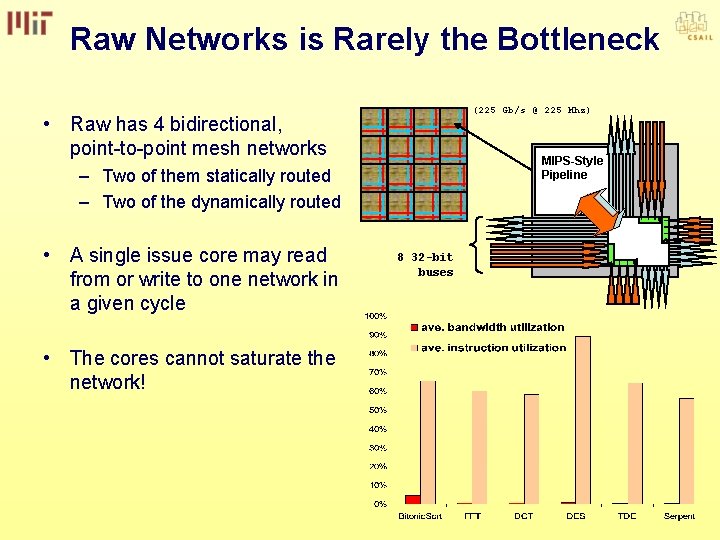
Raw Networks is Rarely the Bottleneck (225 Gb/s @ 225 Mhz) • Raw has 4 bidirectional, point-to-point mesh networks MIPS-Style Pipeline – Two of them statically routed – Two of the dynamically routed • A single issue core may read from or write to one network in a given cycle • The cores cannot saturate the network! 8 32 -bit buses
Outline: Ideas on Solving the Third Software Crisis 1. Advances in Computer Architecture 2. Novel Programming Models and Languages 3. Aggressive Compilers 4. Tools to support parallelization, debugging and migration 24
Programming Models and Languages • Critical to solving the third software crisis • Novel languages were the central solution in the last two crises 25
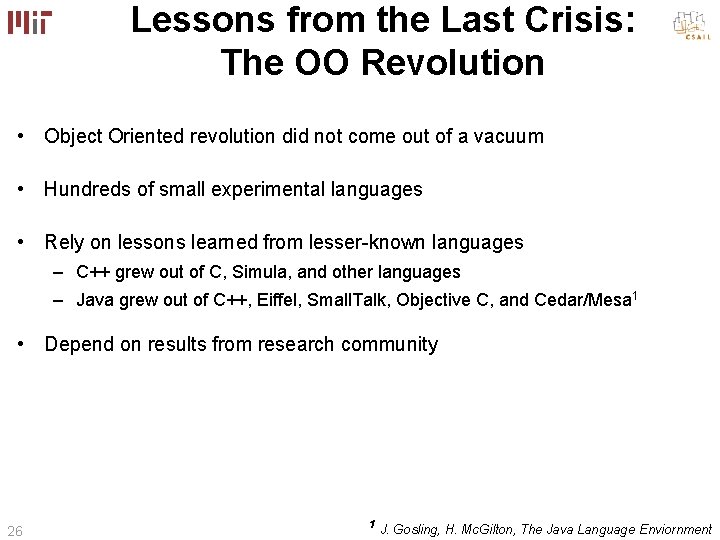
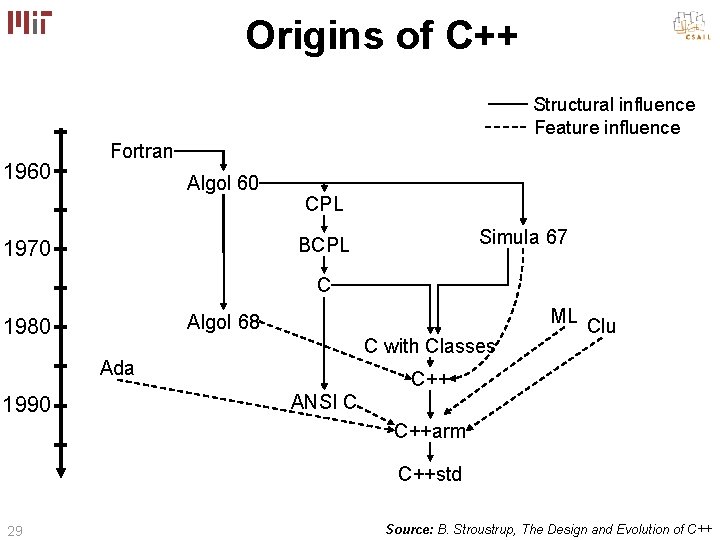
Lessons from the Last Crisis: The OO Revolution • Object Oriented revolution did not come out of a vacuum • Hundreds of small experimental languages • Rely on lessons learned from lesser-known languages – C++ grew out of C, Simula, and other languages – Java grew out of C++, Eiffel, Small. Talk, Objective C, and Cedar/Mesa 1 • Depend on results from research community 26 1 J. Gosling, H. Mc. Gilton, The Java Language Enviornment
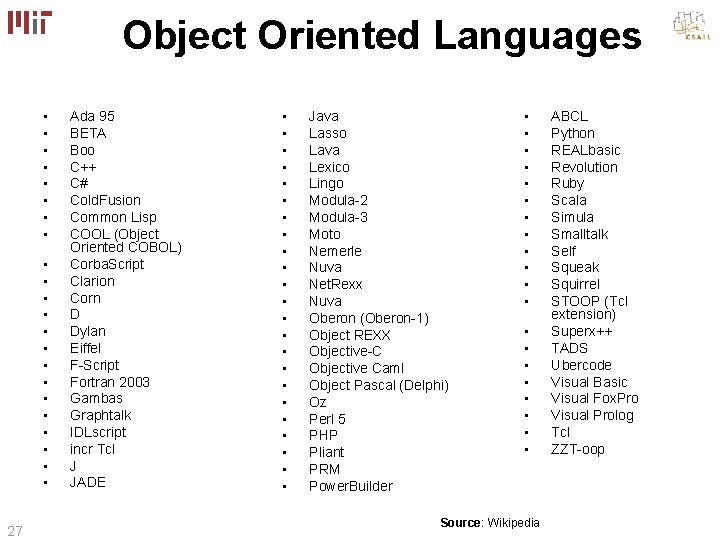
Object Oriented Languages • • • • • • 27 Ada 95 BETA Boo C++ C# Cold. Fusion Common Lisp COOL (Object Oriented COBOL) Corba. Script Clarion Corn D Dylan Eiffel F-Script Fortran 2003 Gambas Graphtalk IDLscript incr Tcl J JADE • • • • • • Java Lasso Lava Lexico Lingo Modula-2 Modula-3 Moto Nemerle Nuva Net. Rexx Nuva Oberon (Oberon-1) Object REXX Objective-C Objective Caml Object Pascal (Delphi) Oz Perl 5 PHP Pliant PRM Power. Builder • • • • • Source: Wikipedia ABCL Python REALbasic Revolution Ruby Scala Simula Smalltalk Self Squeak Squirrel STOOP (Tcl extension) Superx++ TADS Ubercode Visual Basic Visual Fox. Pro Visual Prolog Tcl ZZT-oop
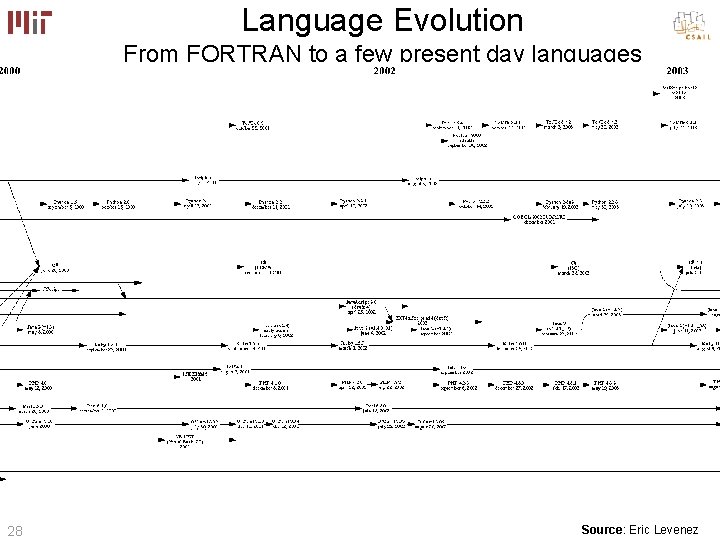
Language Evolution From FORTRAN to a few present day languages 28 Source: Eric Levenez
Origins of C++ Structural influence Feature influence 1960 Fortran Algol 60 CPL Simula 67 BCPL 1970 C ML Algol 68 1980 C with Classes Ada 1990 Clu C++ ANSI C C++arm C++std 29 Source: B. Stroustrup, The Design and Evolution of C++
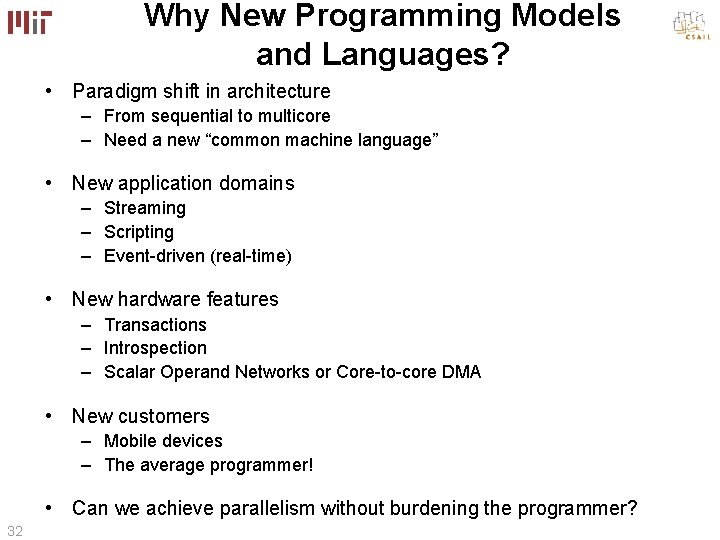
Why New Programming Models and Languages? • Paradigm shift in architecture – From sequential to multicore – Need a new “common machine language” • New application domains – Streaming – Scripting – Event-driven (real-time) • New hardware features – Transactions – Introspection – Scalar Operand Networks or Core-to-core DMA • New customers – Mobile devices – The average programmer! • Can we achieve parallelism without burdening the programmer? 32
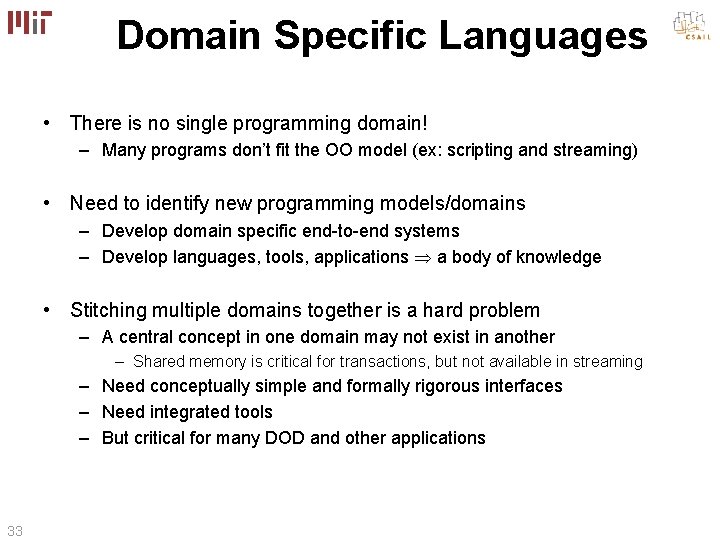
Domain Specific Languages • There is no single programming domain! – Many programs don’t fit the OO model (ex: scripting and streaming) • Need to identify new programming models/domains – Develop domain specific end-to-end systems – Develop languages, tools, applications a body of knowledge • Stitching multiple domains together is a hard problem – A central concept in one domain may not exist in another – Shared memory is critical for transactions, but not available in streaming – Need conceptually simple and formally rigorous interfaces – Need integrated tools – But critical for many DOD and other applications 33
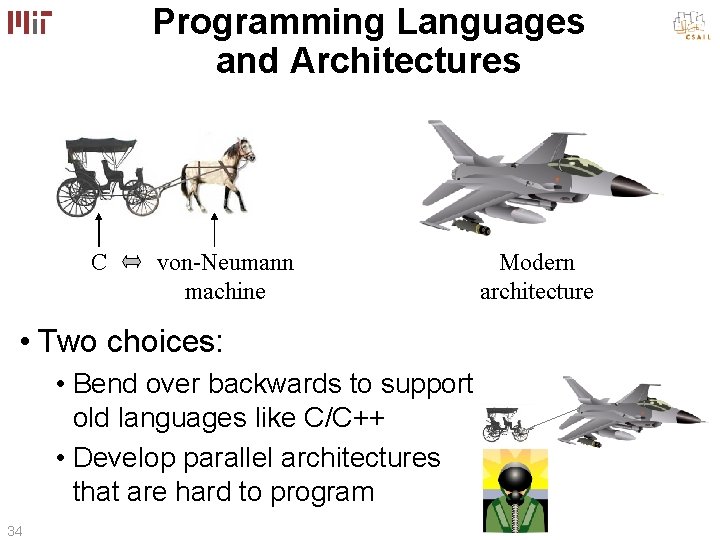
Programming Languages and Architectures C von-Neumann machine • Two choices: • Bend over backwards to support old languages like C/C++ • Develop parallel architectures that are hard to program 34 Modern architecture
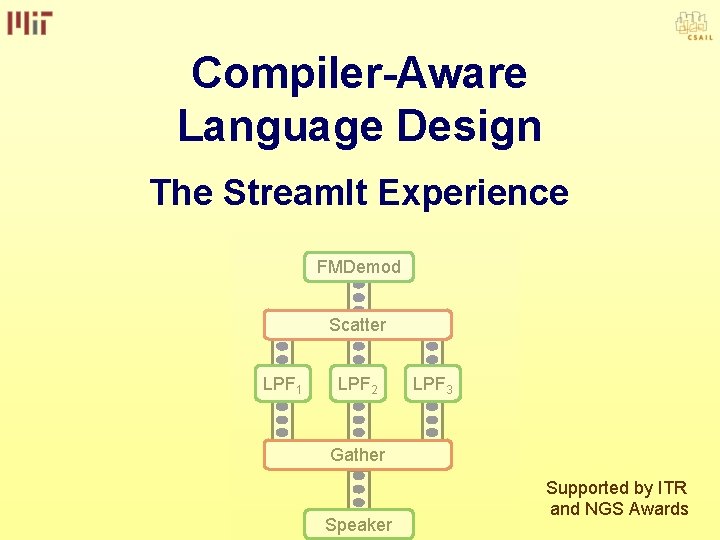
Compiler-Aware Language Design The Stream. It Experience FMDemod Scatter LPF 1 LPF 2 LPF 3 Gather Speaker Supported by ITR and NGS Awards
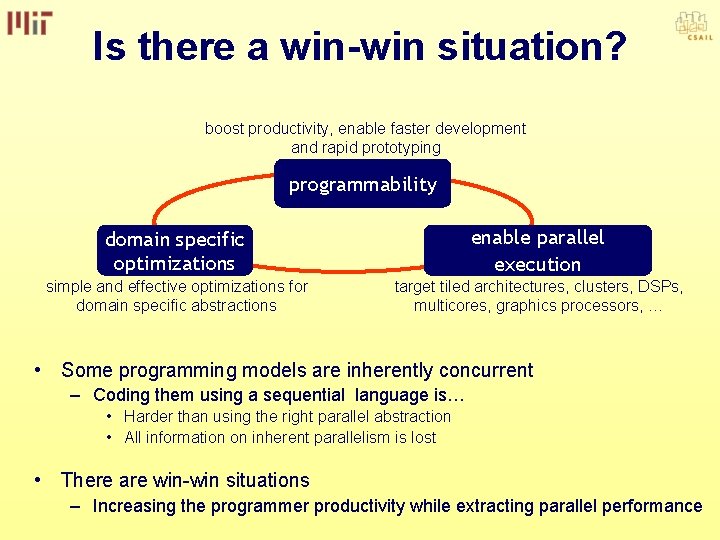
Is there a win-win situation? boost productivity, enable faster development and rapid prototyping programmability domain specific optimizations enable parallel execution simple and effective optimizations for domain specific abstractions target tiled architectures, clusters, DSPs, multicores, graphics processors, … • Some programming models are inherently concurrent – Coding them using a sequential language is… • Harder than using the right parallel abstraction • All information on inherent parallelism is lost • There are win-win situations – Increasing the programmer productivity while extracting parallel performance
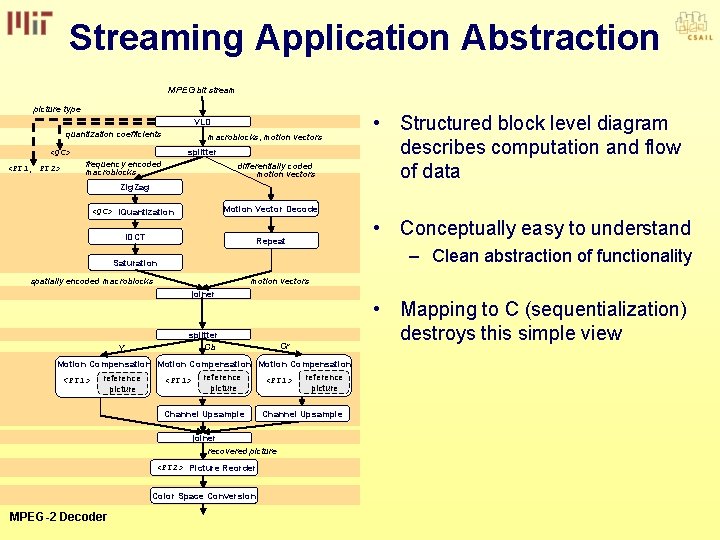
Streaming Application Abstraction MPEG bit stream picture type VLD quantization coefficients macroblocks, motion vectors splitter <QC> <PT 1, PT 2> frequency encoded macroblocks differentially coded motion vectors Zig. Zag <QC> IQuantization Motion Vector Decode IDCT Repeat VLD(QC, PT 1, PT 2); • add Structured block level diagram add splitjoin { split roundrobin(N B, V); describes computation and flow ofadddata pipeline { add add Zig. Zag(B); IQuantization(B) to QC; IDCT(B); Saturation(B); } • Conceptually easy to understand add pipeline { add Motion. Vector. Decode(); – Clean abstraction of functionality add Repeat(V, N); Saturation } spatially encoded macroblocks motion vectors joiner join roundrobin(B, V); • add. Mapping to C (sequentialization) splitjoin { split roundrobin(4 (B+V), B+V); destroys this simple view } Y splitter Cb Cr add Motion. Compensation(4 (B+V)) to PT 1; for (int i = 0; i < 2; i++) { add pipeline { add Motion. Compensation(B+V) to PT 1; add Channel. Upsample(B); } } Motion Compensation <PT 1> reference picture Channel Upsample joiner recovered picture <PT 2> Picture Reorder Color Space Conversion MPEG-2 Decoder join roundrobin(1, 1, 1); } add Picture. Reorder(3 W H) to PT 2; add Color. Space. Conversion(3 W H);
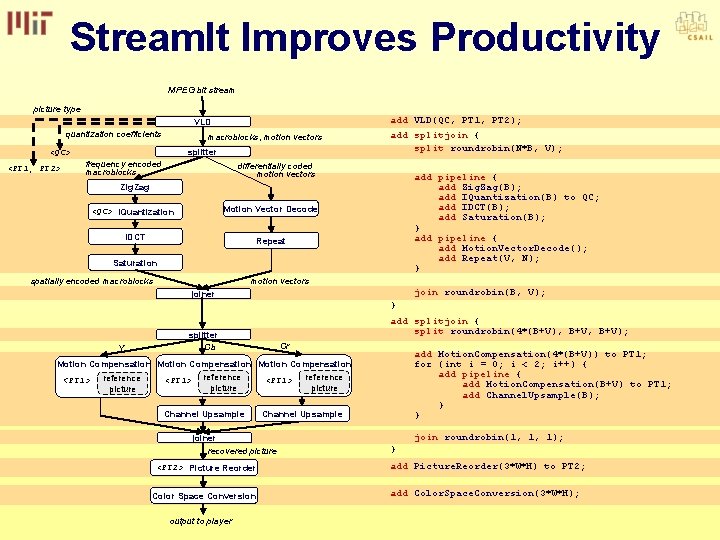
Stream. It Improves Productivity MPEG bit stream picture type VLD quantization coefficients macroblocks, motion vectors splitter <QC> <PT 1, PT 2> frequency encoded macroblocks add VLD(QC, PT 1, PT 2); add splitjoin { split roundrobin(N B, V); differentially coded motion vectors add pipeline { add Zig. Zag(B); add IQuantization(B) to QC; add IDCT(B); add Saturation(B); } add pipeline { add Motion. Vector. Decode(); add Repeat(V, N); } Zig. Zag <QC> IQuantization Motion Vector Decode IDCT Repeat Saturation spatially encoded macroblocks motion vectors join roundrobin(B, V); joiner } Y add splitjoin { split roundrobin(4 (B+V), B+V); splitter Cb Cr add Motion. Compensation(4 (B+V)) to PT 1; for (int i = 0; i < 2; i++) { add pipeline { add Motion. Compensation(B+V) to PT 1; add Channel. Upsample(B); } } Motion Compensation <PT 1> reference picture Channel Upsample joiner recovered picture <PT 2> Picture Reorder Color Space Conversion output to player join roundrobin(1, 1, 1); } add Picture. Reorder(3 W H) to PT 2; add Color. Space. Conversion(3 W H);
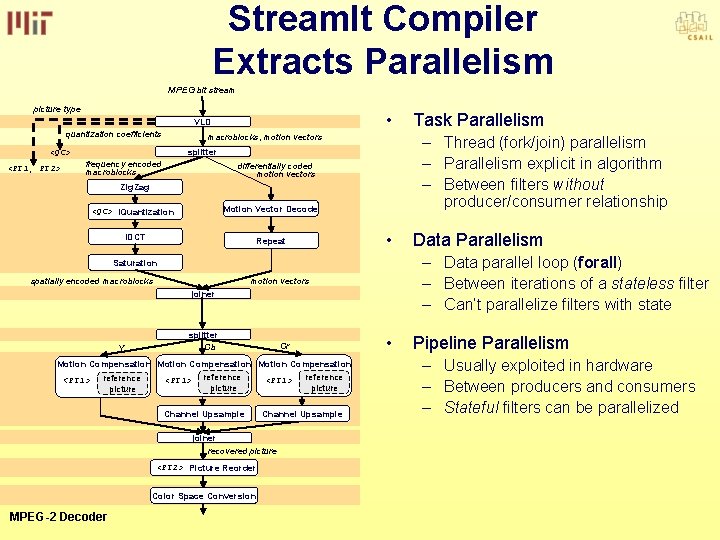
Stream. It Compiler Extracts Parallelism MPEG bit stream picture type PT 2); • add VLD(QC, Task PT 1, Parallelism VLD quantization coefficients macroblocks, motion vectors – Thread (fork/join) parallelism – Parallelism explicit in algorithm add pipeline { – add. Between Zig. Zag(B); filters without add IQuantization(B) to QC; producer/consumer relationship add IDCT(B); split roundrobin(N B, V); splitter <QC> <PT 1, PT 2> add splitjoin { frequency encoded macroblocks differentially coded motion vectors Zig. Zag <QC> IQuantization Motion Vector Decode IDCT Repeat • Saturation spatially encoded macroblocks motion vectors joiner } Y Cr • Channel Upsample joiner recovered picture Color Space Conversion MPEG-2 Decoder – Data parallel loop (forall) – Between iterations of a stateless filter join roundrobin(B, V); – Can’t parallelize filters with state Pipeline Parallelism add Motion. Compensation(4 (B+V)) to PT 1; for (int i = 0; i < 2; i++) { add pipeline { add Motion. Compensation(B+V) to PT 1; add Channel. Upsample(B); } } – Usually exploited in hardware – Between producers and consumers – Stateful filters can be parallelized Motion Compensation <PT 1> reference picture <PT 2> Picture Reorder Data Parallelism add splitjoin { split roundrobin(4 (B+V), B+V); splitter Cb Channel Upsample add Saturation(B); } add pipeline { add Motion. Vector. Decode(); add Repeat(V, N); } join roundrobin(1, 1, 1); } add Picture. Reorder(3 W H) to PT 2; add Color. Space. Conversion(3 W H);
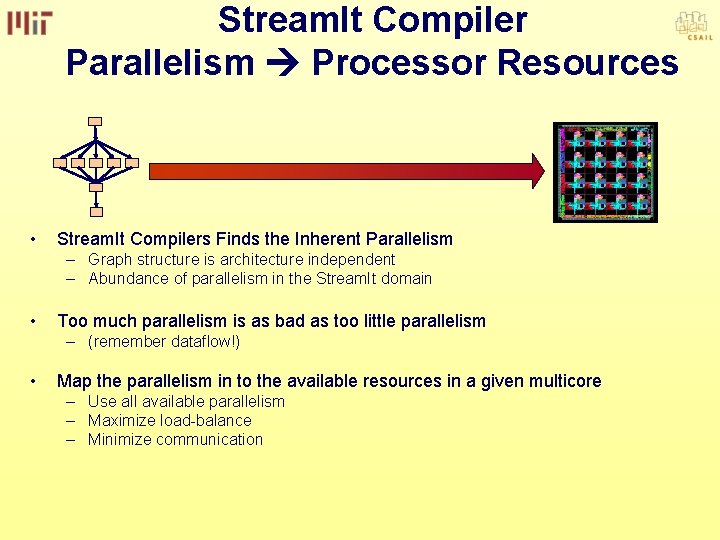
Stream. It Compiler Parallelism Processor Resources • Stream. It Compilers Finds the Inherent Parallelism – Graph structure is architecture independent – Abundance of parallelism in the Stream. It domain • Too much parallelism is as bad as too little parallelism – (remember dataflow!) • Map the parallelism in to the available resources in a given multicore – Use all available parallelism – Maximize load-balance – Minimize communication
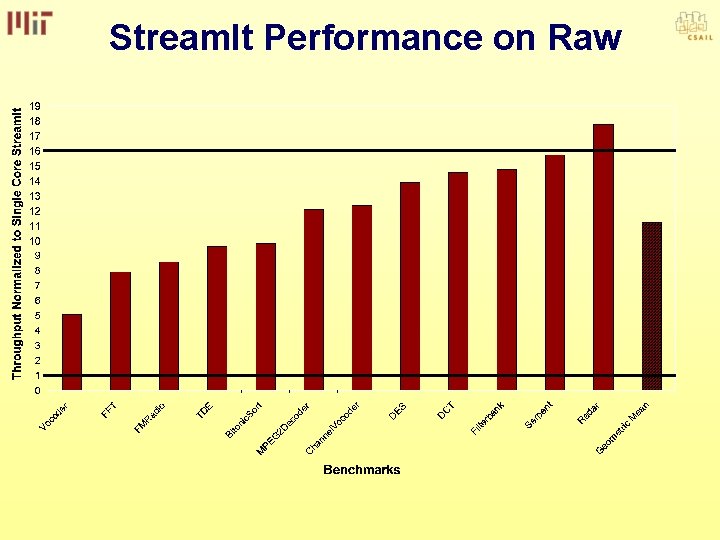
Stream. It Performance on Raw
Outline: Ideas on Solving the Third Software Crisis 1. Advances in Computer Architecture 2. Novel Programming Models and Languages 3. Aggressive Compilers 4. Tools to support parallelization, debugging and migration 43
Compilers • Compilers are critical in reducing the burden on programmers – Identification of data parallel loops can be easily automated, but many current systems (Brook, Peak. Stream) require the programmer to do it. • Need to revive the push for automatic parallelization – Best case: totally automated parallelization hidden from the user – Worst case: simplify the task of the programmer 44
Parallelizing Compilers The SUIF Experience
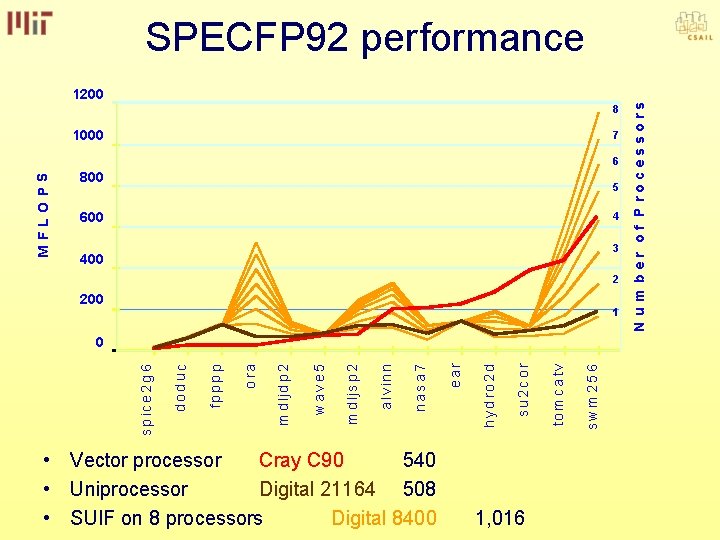
The SUIF Parallelizing Compiler • The SUIF Project at Stanford in the ’ 90 – – Mainly FORTRAN Aggressive transformations to undo “human optimizations” Interprocedural analysis framework Scalar and array data-flow, reduction recognition and a host of other analyses and transformations • SUIF compiler had the Best SPEC results by automatic parallelization
• Vector processor Cray C 90 540 • Uniprocessor Digital 21164 508 • SUIF on 8 processors Digital 8400 1, 016 sw m 256 to m c a tv su 2 cor h y d ro 2 d ear nasa 7 a l v in n m d ljs p 2 w ave 5 m d ljd p 2 o ra fp p doduc s p ic e 2 g 6 M FLO PS 8 1000 7 6 800 5 600 4 400 3 2 200 1 0 N u m b e r o f P ro c e s s o rs SPECFP 92 performance 1200
Automatic Parallelization “Almost” Worked • Why did not this reach mainstream? – – – The compilers were not robust Clients were impossible (performance at any cost) Multiprocessor communication was expensive Had to compete with improvements in sequential performance The Dogfooding problem • Today: Programs are even harder to analyze – – Complex data structures Complex control flow Complex build process Aliasing problem (type unsafe languages)
Outline: Ideas on Solving the Third Software Crisis 1. Advances in Computer Architecture 2. Novel Programming Models and Languages 3. Aggressive Compilers 4. Tools to support parallelization, debugging and migration 49
Tools • A lot of progress in tools to improve programmer productivity • Need tools to – – Identify parallelism Debug parallel code Update and maintain parallel code Stitch multiple domains together • Need an “Eclipse platform for multicores” 50
Migrating the Dusty Deck • Impossible to bring them to the new era automatically – Badly mangled, hand-optimized, impossible to analyze code – Automatic compilation, even with a heroic effort, cannot do anything • Help rewrite the huge stack of dusty deck – Application in use – Source code available – Programmer long gone • Getting the new program to have the same behavior is hard – “Word pagination problem” • Can take advantage of many recent advances – Creating test cases – Extracting invariants – Failure oblivious computing 51
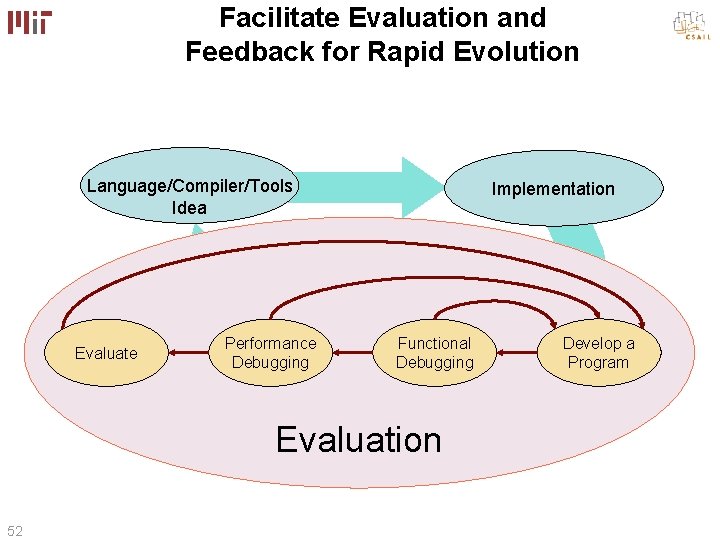
Facilitate Evaluation and Feedback for Rapid Evolution Language/Compiler/Tools Idea Evaluate Performance Debugging Implementation Evaluation Functional Debugging Evaluation 52 Develop a Program
Rapid Evaluation • Extremely hard to get – Real users have no interest in flaky tools – Hard to quantify – Superficial users vs. Deep users will give different feedback – Fatal flaws as well as amazing uses may not come out immediately • Need a huge, sophisticated (and expensive) infrastructure – – – How to get a lot of application experts to use the system? How do you get them to become an expert? How do you get them to use it for a long time? How do you scientifically evaluate? How go you get actionable feedback? • A “Center for Evaluating Multicore Programming Environments”? ? 53
Build and Mobilize the Community • Bring the High Performance Languages/Compilers/Tools folks out of the woodwork! – Then: A few customers with the goal of performance at any cost. – Then: Had to compete with Moore’s law – Now: Reasonable performance improvements for the masses • Bring the folks who won the second crisis – Then: the focus is improving programmer productivity – Now: how to maintain performance in a multicore world – Now: If not solved, all the productivity gains will be lost! • Get architects to listen to language/compiler people – – 54 Then: We don’t need you, we can do everything in hardware Then: Or here is a cool hardware feature, you figure out how to use it. Now: Superscalars crashed and burned; cannot keep the status quo! Now: Need to create a useable programming model
Conclusions • Programming language research is a critical long-term investment – In the 1950 s, the early background for the Simula language was funded by the Norwegian Defense Research Establishment – In 2002, the designers received the ACM Turing Award “for ideas fundamental to the emergence of object oriented programming. ” • Compilers and Tools are also essential components • Computer Architecture is at a cross roads – Once in a lifetime opportunity to redesign from scratch – How to use the Moore’s law gains to improve the programmability? • Switching to multicores without losing the gains in programmer productivity may be the Grandest of the Grand Challenges – Half a century of work still no winning solution – Will affect everyone! • Need a Grand Partnership between the Government, Industry and Academia to solve this crisis! 55