
The London Pathways Unit Dr Alison Bromley Aims
The London Pathways Unit Dr Alison Bromley
Aims of Workshop Introduction to the LPU The OPD Pathway Desistence The Good Lives Model Key Work Sessions Challenges Activity Audio – the men discuss their experiences
The London Pathways Unit (LPU) The unit opened in April 2013 in HMP Belmarsh. It forms part of the national OPD strategy, under which a network of services is being developed in prisons, secure hospitals and the community. For offenders who are assessed as presenting a high risk of violent reoffending and who are likely to have personality difficulties that are clinically linked to their offending. The services aim to facilitate these individuals’ progress through custody to the community, and the unit’s effective operation as a progressive stage in the pathway towards release is central to its primary task and ethos.
The development of the OPD Pathway Born out of learning and development in the understanding of personality disorder. Change driven by both the health and criminal justice systems. Growing understanding of the need for mental health provision within prisons. R&R model, Offending Behaviour Programmes, and Peer Support. Evaluation of programmes indicated poorer engagement and outcome for those with PD. Lack of success of DSPD services.
What was learned? Reasonably long-term, collaborative and consistent relationship between one or more professionals and the client, as a medium of change. A team-based approach, to ‘distribute’ the client’s attachments to and demands on staff. A psychologically-informed approach, underpinned by staff training and support, to avoid repetitions of past patterns of relationship stress, rupture and disengagement.
What was learned? Staff supervision and support to manage the emotional demands of the work. Collaborative approach to the individual’s difficulties, risk factors, needs and strengths. Recognition of the role played by the social environment.
The OPD Pathway Focus on partnership working between health, prison and probation; the OPD is jointly commissioned (by NOMS and NHS), jointly planned and jointly delivered. It's a pathway model, the focus is on progression through services from 'community to community'.
The OPD Pathway A relational model runs throughout the programme, relationships are seen as the primary medium of change. The overarching aims are; reducing reoffending, improving offenders' psychological health, wellbeing, behaviour and relationships.
Desistence The process of change and development in identity, skills and social role. Difficult for those who have experienced significant trauma from a young age, disrupted education, and exclusion. Involves building a personal narrative about how past events, experiences and choices have led to the person’s current situation and past offending, developing new relationships that support non-offending choices and lifestyles, having a social role that creates a sense of accomplishment, contribution, and belonging to the wider community.
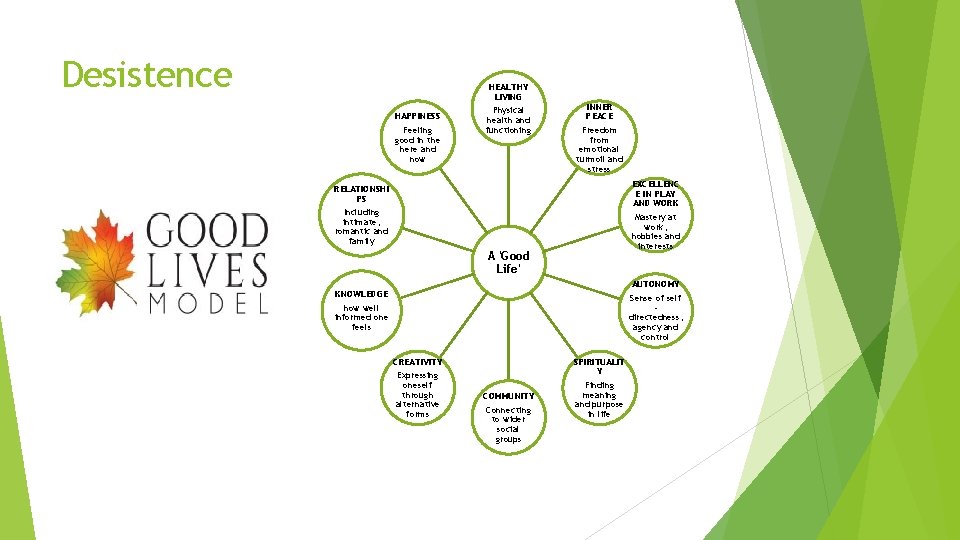
Desistence HAPPINESS Feeling good in the here and now HEALTHY LIVING Physical health and functioning INNER PEACE Freedom from emotional turmoil and stress EXCELLENC E IN PLAY AND WORK Mastery at work, hobbies and interests RELATIONSHI PS Including intimate, romantic and family A 'Good Life' AUTONOMY KNOWLEDGE Sense of self directedness, agency and control how well informed one feels CREATIVITY Expressing oneself through alternative forms COMMUNITY Connecting to wider social groups SPIRITUALIT Y Finding meaning and purpose in life
The LPU: A closer look Four Phases (Livesly, 2003): 1) Introductory (‘safety and containment’) phase, including induction and orientation to the unit; ‘buddying’ from other prisoners; developing relationships with staff, peers and other professionals. 2) Skills development (‘regulation and control’) phase. This might include unit courses for emotional and relationship management skills; review of skills usage in key work; and facilitated family sessions. 3) A consolidation and development phase (‘exploration and change’) of practising skills learned, consolidating work done so far, and deepening self-awareness. This may include taking on responsibilities such as peer support and mentoring. A ‘moving on’ (‘integration and synthesis’) phase. A formulation of the individual’s personality, strengths and risk is finalised with him and shared with the community offender manager; the progression/desistance plan is reviewed and finalised; and steps are taken to implement future plans.

The LPU: A closer look Connected to the wider prison – access to work, training, and education. Key work sessions central to the unit. Courses are voluntary, no strict treatment plan.
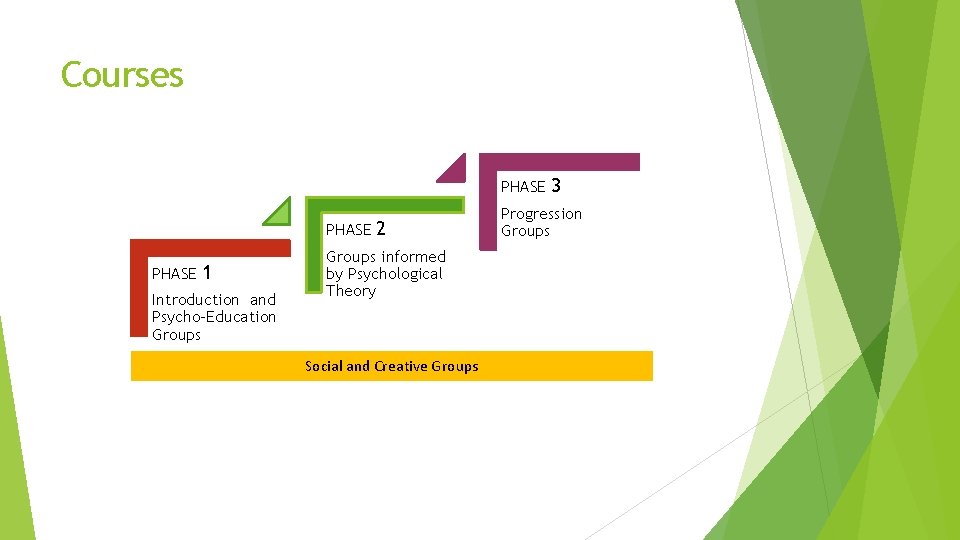
Courses PHASE 1 Introduction and Psycho-Education Groups 2 Groups informed by Psychological Theory Social and Creative Groups 3 Progression Groups
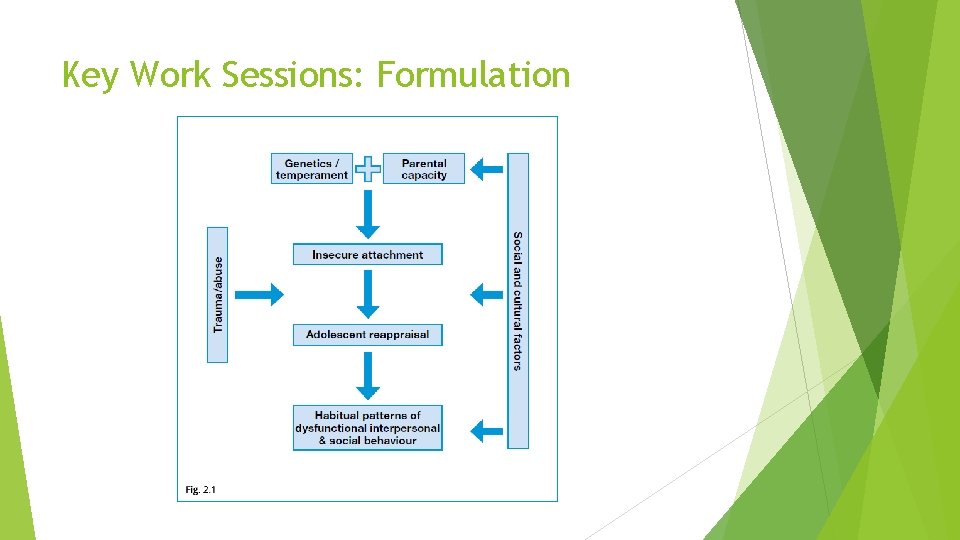
Key Work Sessions: Formulation
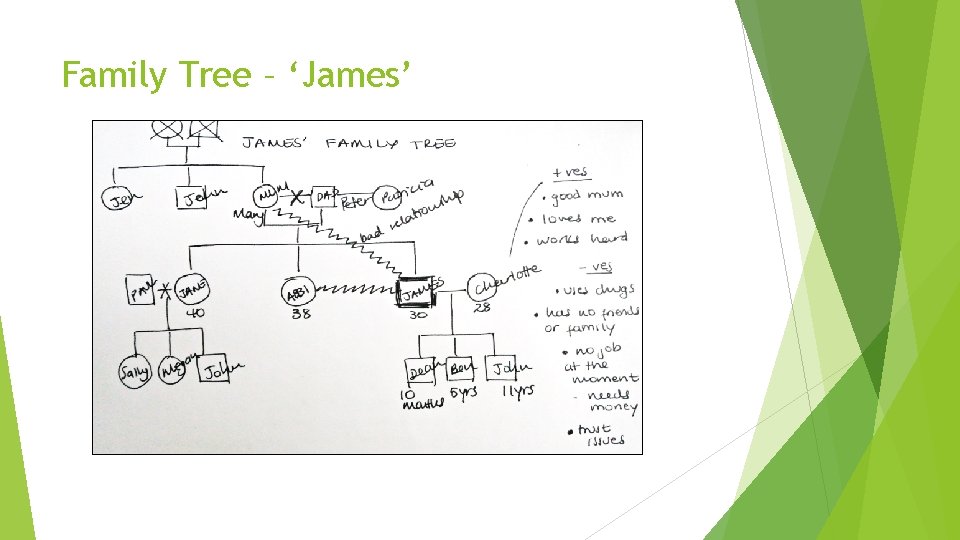
Family Tree – ‘James’
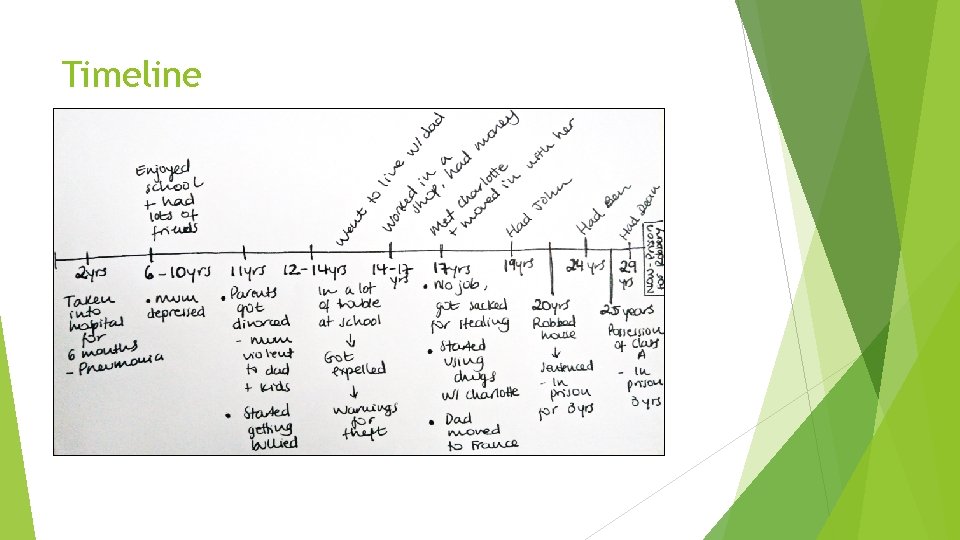
Timeline
Narrative The aim of this formulation is to describe how James’ early experiences impacted on his difficulties later in life. It also aims to highlight James’ main areas of vulnerability and his strengths. There a number of factors in James’ early childhood which made him vulnerable to offend later on. James was 6 months in hospital due to pneumonia when he was 2 years old. This meant that his attachment to his parents was disrupted. Between the ages of 6 and 10 James’ mum struggled with depression, and couldn’t give him the care he needed. A secure attachment to parents is how children ordinarily learn how to manage their emotions. This is also how they learn about other people, the world, and themselves. For James, his early experiences meant that he came to believe the world is not safe and that he only had himself to rely on, because other people are unpredictable or abusive. This was later reinforced by James’ mother being violent in the house and his parents’ separation. The belief that others are abusive was worsened when he started school and other kids bullied him. James felt different from the other kids and could not engage in classes. When he was eventually expelled he felt let down by people who should be helping him, and was pushed towards other kids who got into trouble. These experiences led to James struggling to trust authority figures and developing an early sense of self-reliance.
Narrative Continued… James’ father realised he was struggling and he went to live with him. For a while things were good and James got a job. However, when his father met Patricia, he decided to move to France, leaving James on his own again. Around this time, James met Charlotte and moved in with her. Their relationship was positive but Charlotte used drugs heavily and James started using as well, as a way to cope. His drug use led to him losing his job and having difficulties with money. After his first son was born, James felt under pressure to provide for his family and did not trust the system enough to ask for help. This led to him turning to crime. James is now in prison for robbery and has struggled to stop using drugs for a while. James struggles to trust authority figures. He also struggles to ask for help from others and finds it intrusive when people ask him personal questions. These are the first areas James will be working on, by developing rapport with his key work team. On a positive note, James has engaged in key work sessions fully, has expressed his anxieties in an honest manner and is motivated to engage with the LPU model. He is also motivated to work towards an offence-free life and wants to work on his vocational skills in order to obtain legitimate employment when released.

Collaborative Working Across NHS Trusts Probation Officers and Clinicians
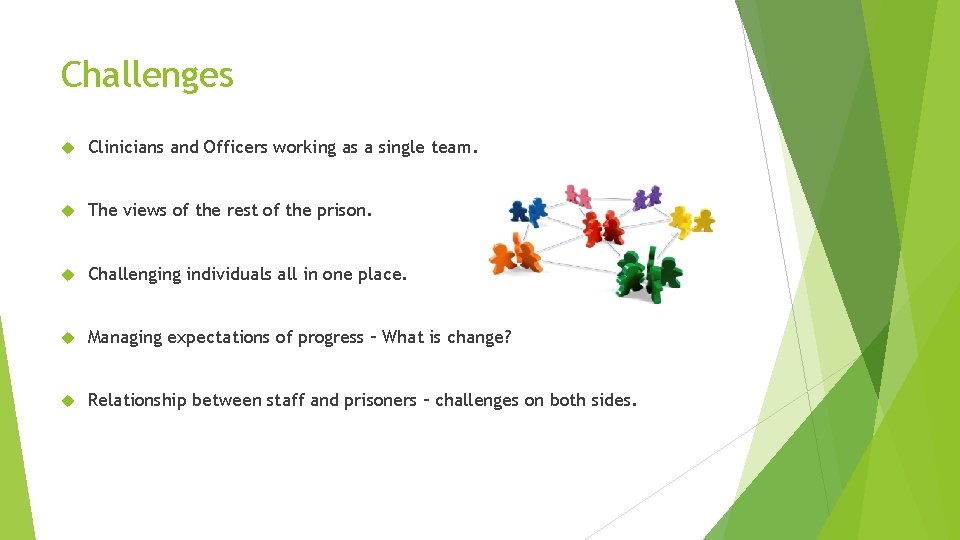
Challenges Clinicians and Officers working as a single team. The views of the rest of the prison. Challenging individuals all in one place. Managing expectations of progress – What is change? Relationship between staff and prisoners – challenges on both sides.
Challenges continued… Funding in prisons. Task to work with those who have deep-routed distrust in authority figures. Defences of the prison service: regime, uniform, shift patterns. Helps to manage the emotional demands of the work. How does this fit with a therapeutic model of working? ‘Them and Us’ dynamic of prisons. Hierarchy in prisons and the introduction of ‘civilian’ staff. Developing relationships while maintaining boundaries and discipline. Working with anti-social behaviour.
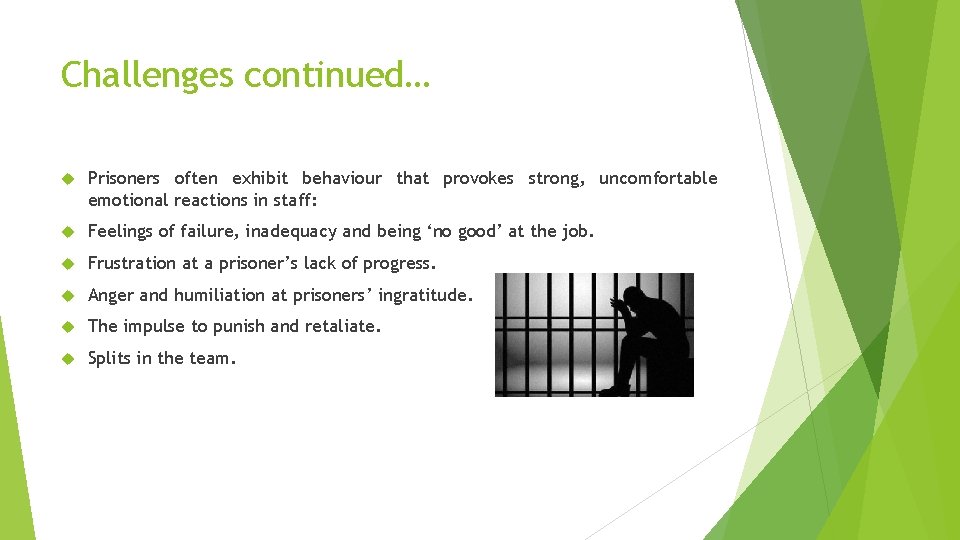
Challenges continued… Prisoners often exhibit behaviour that provokes strong, uncomfortable emotional reactions in staff: Feelings of failure, inadequacy and being ‘no good’ at the job. Frustration at a prisoner’s lack of progress. Anger and humiliation at prisoners’ ingratitude. The impulse to punish and retaliate. Splits in the team.
Activity: The Case of ‘Sam’ Sam is a 30 year old male, the youngest of 8 children. His parents separated when he was young due to his father’s infidelity. His father was extremely strict and punishing, and sometimes violent, and Sam was afraid of him. His mother was loving and caring, and over compensated for his father’s behaviour. She allowed Sam to do as he pleased and favoured him to his older siblings. Sam’s behaviour at school was challenging. After his father left, he struggled with feelings of abandonment and was prone to emotional outbursts and displays of anger. He was expelled from school due to fighting with his peers. Sam starting using cannabis at age 11, before starting to use crack cocaine and ecstasy in his early adolescence. Sam was moved back and forth between his parents homes as his mother could not cope with his behaviour. At age 15 Sam lost his 3 day old daughter. He was involved in numerous volatile relationships with women throughout his teens and early adulthood. At age 19, Sam’s mother died of cancer. Sam was shocked by his loss, finding it traumatising. Within the same year, Sam lost a baby son.
Activity: The Case of ‘Sam’ Sam’s immersed himself in drugs and a ‘party’ lifestyle in order to cope with his losses. Sam was from a high crime area, and most of his friends were involved with offending and drugs. His offending started early, and he became involved with the criminal justice system for numerous acquisitive offences and violence. His Index Offences are of GBH; he attacked someone in a nightclub with a bottle, and manslaughter; he punched someone in a nightclub causing them to fall and hit their head, resulting in their death. Sam received an IPP sentence. When he came to the LPU he was 4 years over tariff. In custody he received numerous adjudications for disobeying lawful orders, and for fighting with other prisoners and staff. He had not been physically violent for several years.
Activity: The Case of ‘Sam’ Presentation Behaviour Bullying of other prisoners Angry outbursts, followed by crying and apologies. Angry outbursts toward others, and verbal abuse (sometimes extreme) Attempts to ‘manipulate’ Loud and dramatic. Smoking ‘spice’ Provoking Dealing tobacco Idealisation and denigration of others Trading goods Climbing the railings/protesting Emotionally volatile with intense emotional outbursts. Distrusting and suspicious of authority.
Concerns Sam’s behaviour seemed un-manageable. He was not progressing with his key-work tasks as the team were stuck in a cycle of trying to manage each emerging crisis. There were suspicions of trading of tobacco/drugs (implications of debt enforcement etc. ). Sam was frequently verbally abusive to staff, and the team were becoming weary. Sam bullied other prisoners, which derailed their progress.
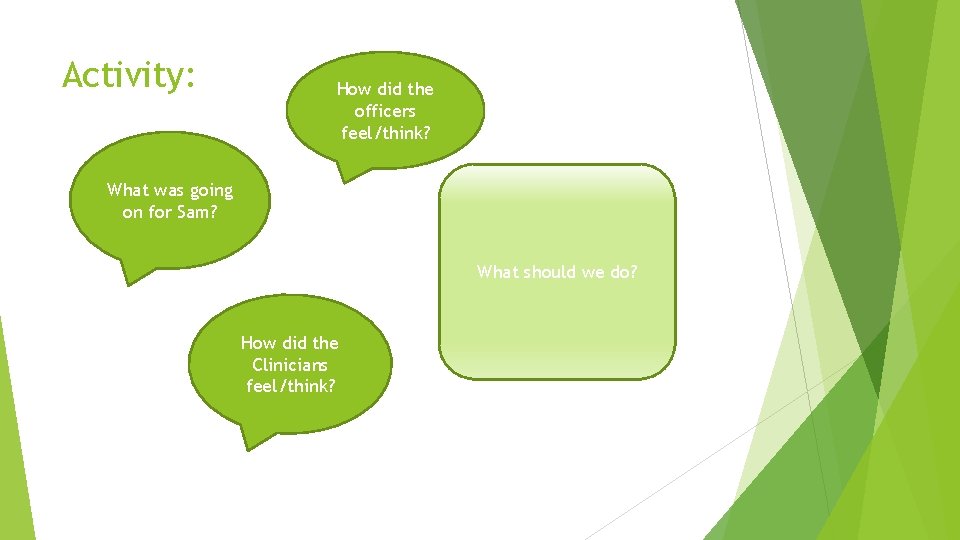
Activity: How did the officers feel/think? What was going on for Sam? What should we do? How did the Clinicians feel/think?

Discussion
Audio: The Men’s Experiences of the LPU

Questions?

References and Further Reading Jones, P (2015) Interventions in Criminal Justice, A handbook for counsellors and therapists working in the criminal justice system, Volume 2. Hove, Pavilion Publishing and Media Ltd. https: //www. justice. gov. uk/downloads/offenders/mentally-disorderedoffenders/working-with-personality-disordered-offenders. pdf http: //www. goodlivesmodel. com/
- Slides: 31