
THE LONDON MOMENT OF A ROTATING SUPERCONDUCTOR SOME
- Slides: 8
THE LONDON MOMENT OF A ROTATING SUPERCONDUCTOR: SOME UNSUSPECTED SUBTLETIES Tony Leggett Department of Physics University of Illinois a t. Urbana-Champaign Many-body/ASC-CENS Workshop in honor of Willi Zwerger Technische Universität München 6 Sept. 2019 Acknowledgement for extended discussions: J. G. Hirsch (very much “work in progress”!)
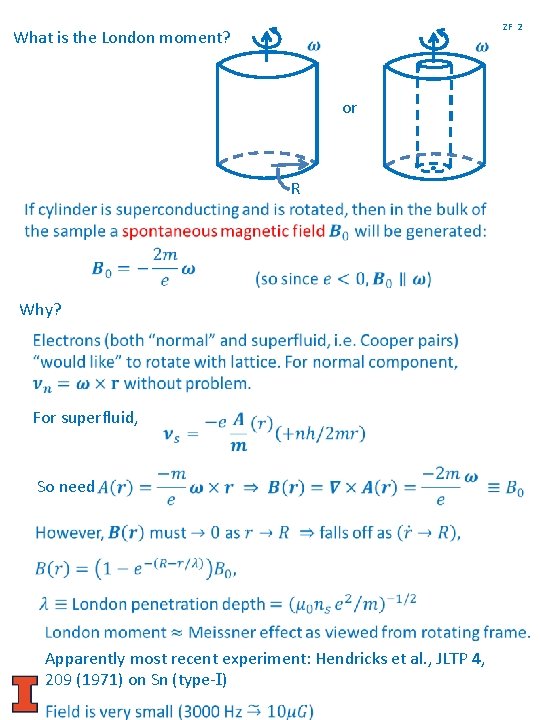
ZF 2 What is the London moment? or R Why? For superfluid, So need Apparently most recent experiment: Hendricks et al. , JLTP 4, 209 (1971) on Sn (type-I)
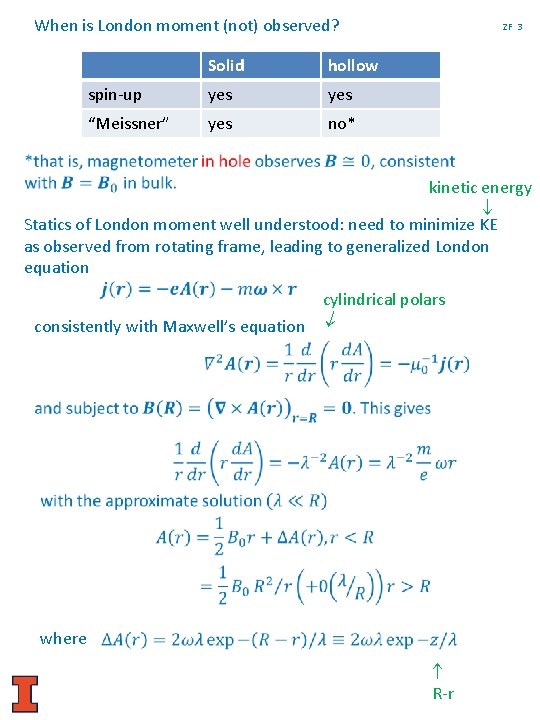
When is London moment (not) observed? Solid hollow spin-up yes “Meissner” yes no* ZF 3 kinetic energy Statics of London moment well understood: need to minimize KE as observed from rotating frame, leading to generalized London equation cylindrical polars consistently with Maxwell’s equation where R-r
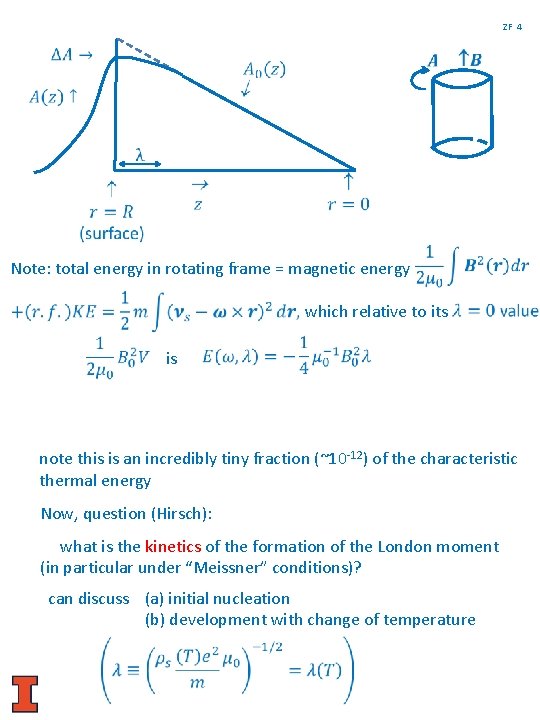
ZF 4 Note: total energy in rotating frame = magnetic energy which relative to its is note this is an incredibly tiny fraction (~10 -12) of the characteristic thermal energy Now, question (Hirsch): what is the kinetics of the formation of the London moment (in particular under “Meissner” conditions)? can discuss (a) initial nucleation (b) development with change of temperature
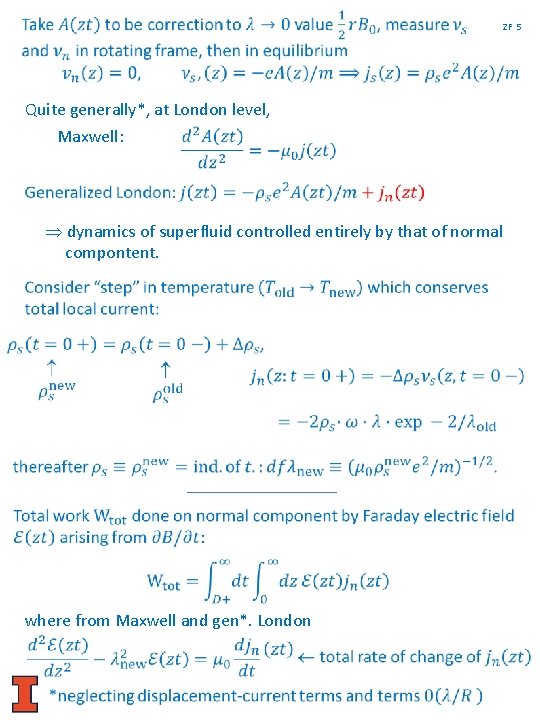
ZF 5 Quite generally*, at London level, Maxwell: dynamics of superfluid controlled entirely by that of normal compontent. where from Maxwell and gen*. London
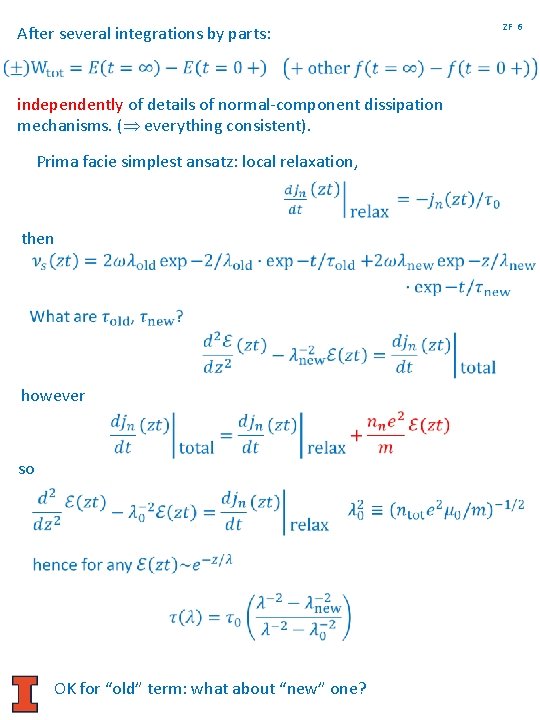
After several integrations by parts: independently of details of normal-component dissipation mechanisms. ( everything consistent). Prima facie simplest ansatz: local relaxation, then however so OK for “old” term: what about “new” one? ZF 6
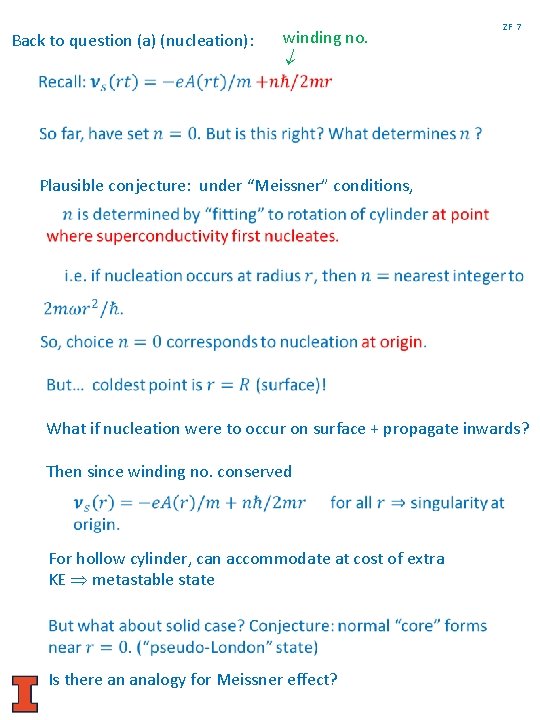
Back to question (a) (nucleation): winding no. ZF 7 Plausible conjecture: under “Meissner” conditions, What if nucleation were to occur on surface + propagate inwards? Then since winding no. conserved For hollow cylinder, can accommodate at cost of extra KE metastable state Is there an analogy for Meissner effect?
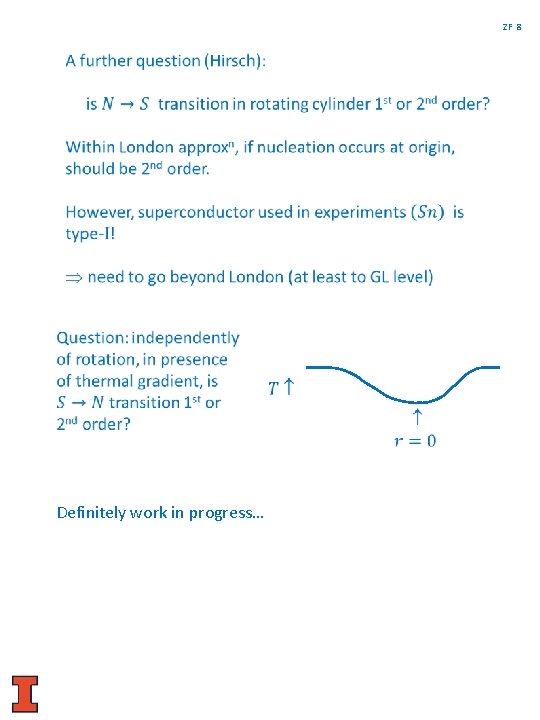
ZF 8 Definitely work in progress…