
THE LOGICAL FRAMEWORK APPROACH LFA Pramod B Shrestha
THE LOGICAL FRAMEWORK APPROACH (LFA) Pramod B. Shrestha 27 June 2016
Akansha’s Feeback
LFA HISTORY n n LFA was developed in the 1960 s The method is in use world wide, by all international development organizations when assessing, monitoring and evaluating projects and programs. The UN-system, EU, multilateral and bilateral development agencies all act to have their counterparts to use result oriented planning, the LFA method, when planning, implementing and evaluating projects and programs.
Why LFA? By using the LFA-method correctly the project/program reaches; § § RELEVANCE FEASIBILITY SUSTAINABILITY COST EFFECIENCY
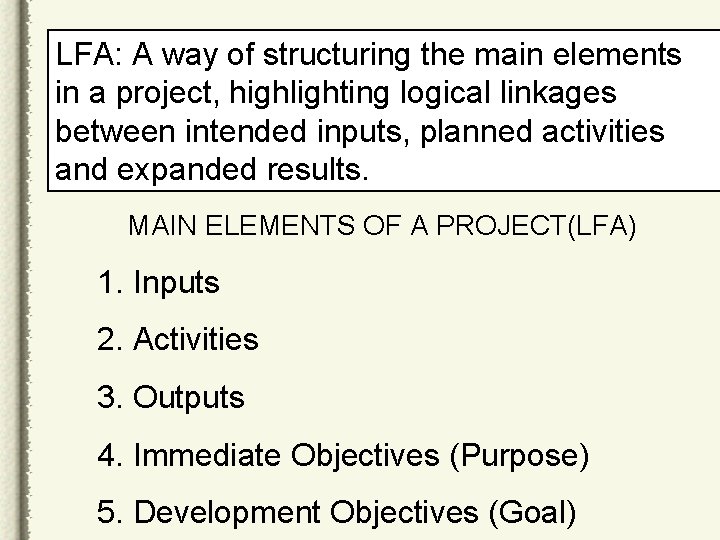
LFA: A way of structuring the main elements in a project, highlighting logical linkages between intended inputs, planned activities and expanded results. MAIN ELEMENTS OF A PROJECT(LFA) 1. Inputs 2. Activities 3. Outputs 4. Immediate Objectives (Purpose) 5. Development Objectives (Goal)
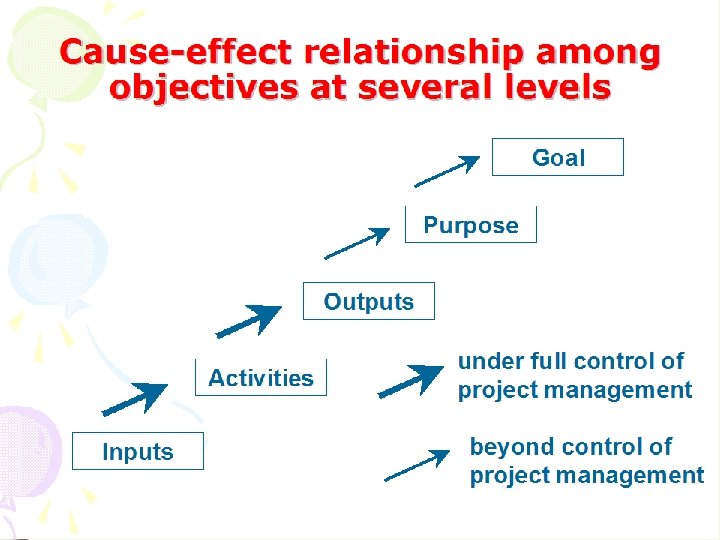
Cause-effect relationship among objectives at several levels Goal Purpose Outputs Activities Inputs under full control of project management beyond control of project management
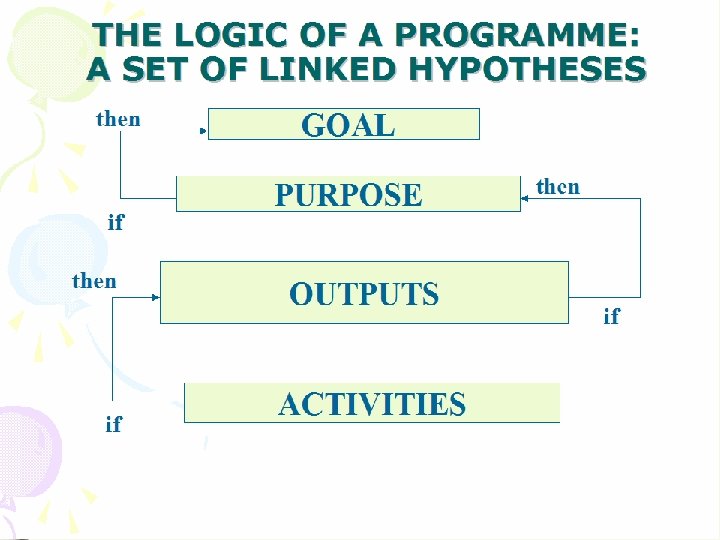
CORE CONCEPT OF LOGFRAME MATRIX: MEANS AND END LOGIC The main concept underlying the Logical Framework is means and end. The better the means and end linkages between each level of aims, the better the programme design. By definition, each programme has a “if-then” or “means-and-end” logic embedded in it. If we produce certain results under certain conditions, then we can expect to achieve certain other outcomes.
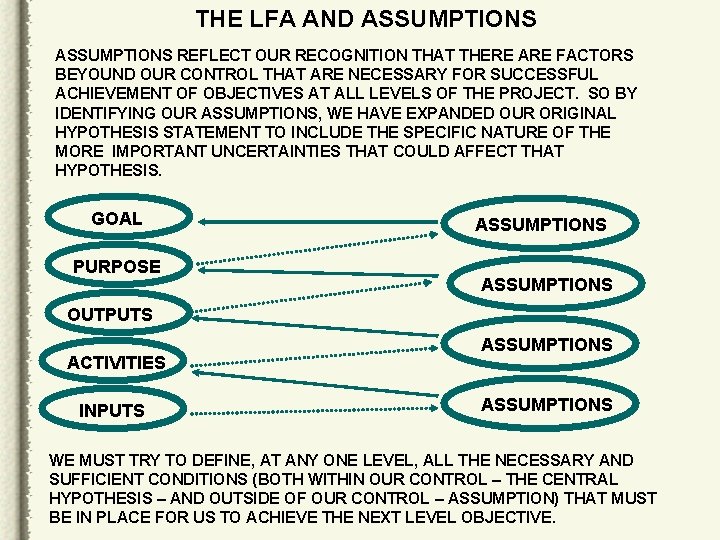
THE LFA AND ASSUMPTIONS REFLECT OUR RECOGNITION THAT THERE ARE FACTORS BEYOUND OUR CONTROL THAT ARE NECESSARY FOR SUCCESSFUL ACHIEVEMENT OF OBJECTIVES AT ALL LEVELS OF THE PROJECT. SO BY IDENTIFYING OUR ASSUMPTIONS, WE HAVE EXPANDED OUR ORIGINAL HYPOTHESIS STATEMENT TO INCLUDE THE SPECIFIC NATURE OF THE MORE IMPORTANT UNCERTAINTIES THAT COULD AFFECT THAT HYPOTHESIS. GOAL PURPOSE ASSUMPTIONS OUTPUTS ACTIVITIES INPUTS ASSUMPTIONS WE MUST TRY TO DEFINE, AT ANY ONE LEVEL, ALL THE NECESSARY AND SUFFICIENT CONDITIONS (BOTH WITHIN OUR CONTROL – THE CENTRAL HYPOTHESIS – AND OUTSIDE OF OUR CONTROL – ASSUMPTION) THAT MUST BE IN PLACE FOR US TO ACHIEVE THE NEXT LEVEL OBJECTIVE.
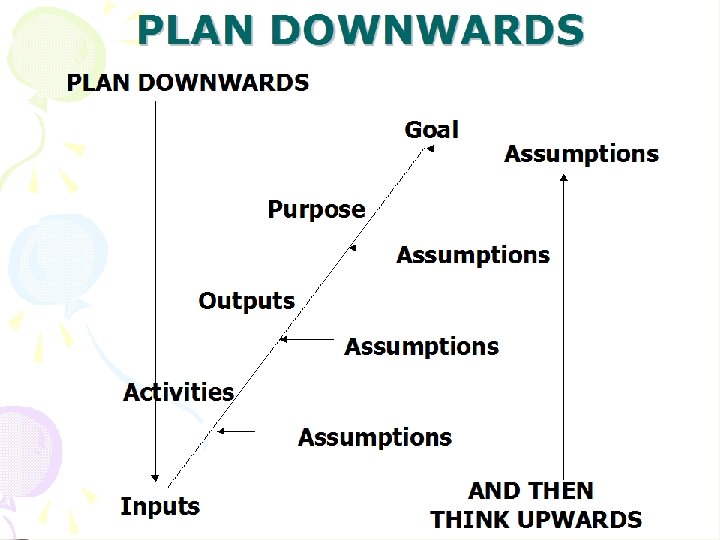
PLAN DOWNWARDS Goal Assumptions Purpose Assumptions Outputs Assumptions Activities Assumptions Inputs AND THEN THINK UPWARDS
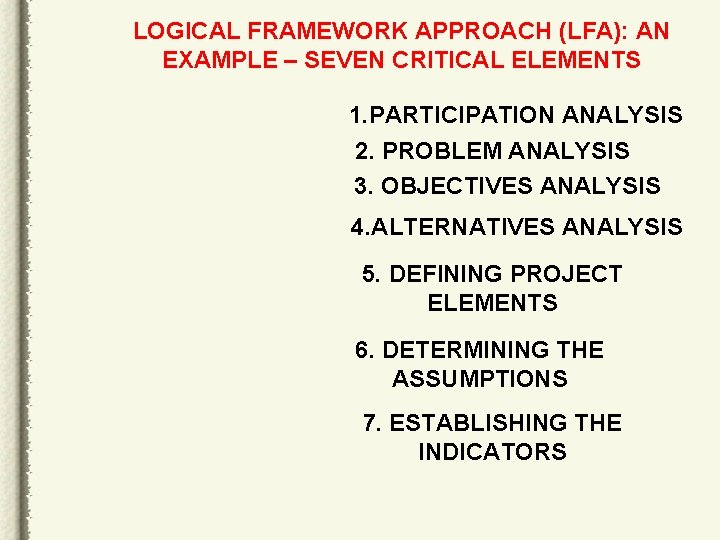
LOGICAL FRAMEWORK APPROACH (LFA): AN EXAMPLE – SEVEN CRITICAL ELEMENTS 1. PARTICIPATION ANALYSIS 2. PROBLEM ANALYSIS 3. OBJECTIVES ANALYSIS 4. ALTERNATIVES ANALYSIS 5. DEFINING PROJECT ELEMENTS 6. DETERMINING THE ASSUMPTIONS 7. ESTABLISHING THE INDICATORS
Context Analysis Background information • Projects are part of a larger context - prior to start, collect relevant background information on the sector and on the relevant organizations to work with. • Which environment will the project be situated in, the country, the region and the sector? • Analysis of Context is made through studies (sector-, country- and /or regional studies etc. )
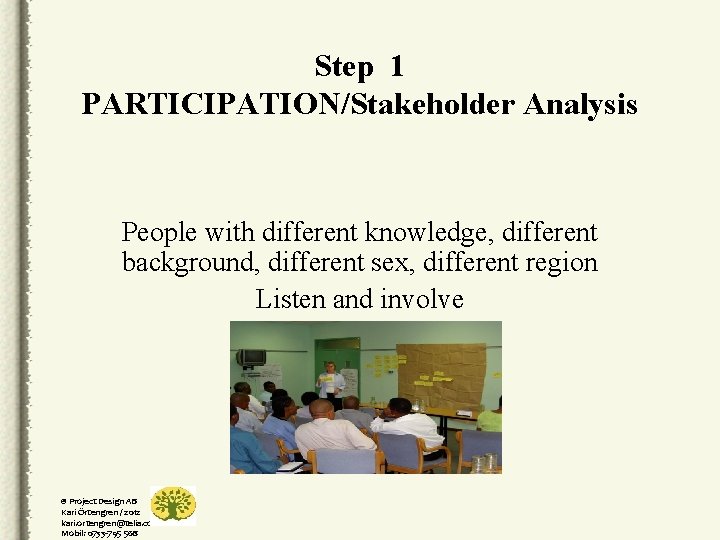
Step 1 PARTICIPATION/Stakeholder Analysis People with different knowledge, different background, different sex, different region Listen and involve © Project Design AB Kari Örtengren / 2012 kari. ortengren@telia. com Mobil: 0733 -795 568
Step 1. PARTICIPATION Analysis • Stakeholders, those who are influenced by and exert an influence on the project entity. Who will be influenced, positively or negatively, by the project. • Stakeholder analysis - mapping of stakeholders and their respective roles, include gender, age, ethnic, regional and aspects of experience! • Which stakeholders should be involved in planning and / or implementing the project – important to include a broad group – people with different knowledge on the sector! © Project Design AB Sweden K. Örtengren 2011
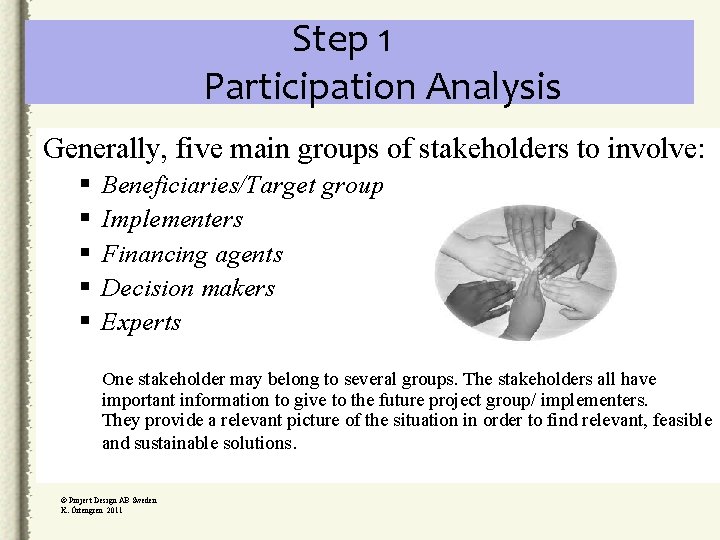
Step 1 Participation Analysis Generally, five main groups of stakeholders to involve: § § § Beneficiaries/Target group Implementers Financing agents Decision makers Experts One stakeholder may belong to several groups. The stakeholders all have important information to give to the future project group/ implementers. They provide a relevant picture of the situation in order to find relevant, feasible and sustainable solutions. © Project Design AB Sweden K. Örtengren 2011
Step 2 Problem Analysis/Situation Analysis Effects Focal Problems Causes How to involve stakeholders and get an understanding of the situation © Project Design AB Kari Örtengren / 2012 kari. ortengren@telia. com Mobil: 0733 -795 568
Step 2. Problem Analysis Situation Analysis • Problem analysis is helping us finding “the roots of the evil” • Three parts in a problem analysis; Ø The main problem to be solved, Our focus Ø The causes, reasons to the focal problem Ø The effects of the focal problem • Discuss who owns the problem? • A problem analysis should always be made by the local stakeholders, the owners of the problem.
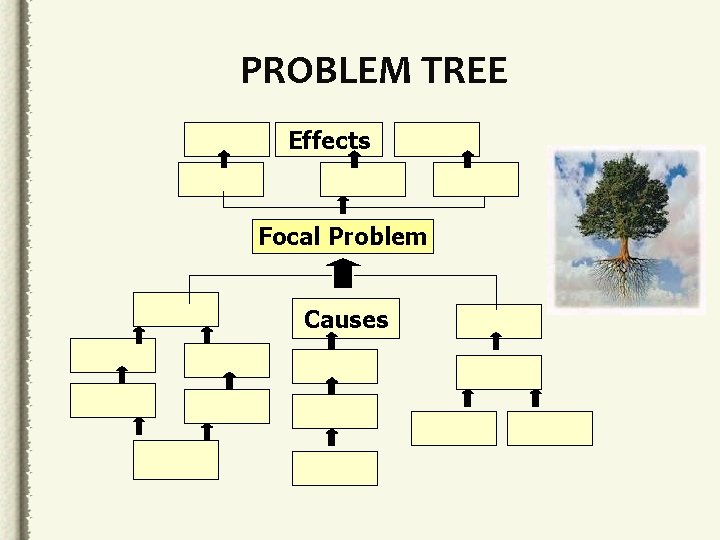
PROBLEM TREE Effekr Effects Focal Problem Causes
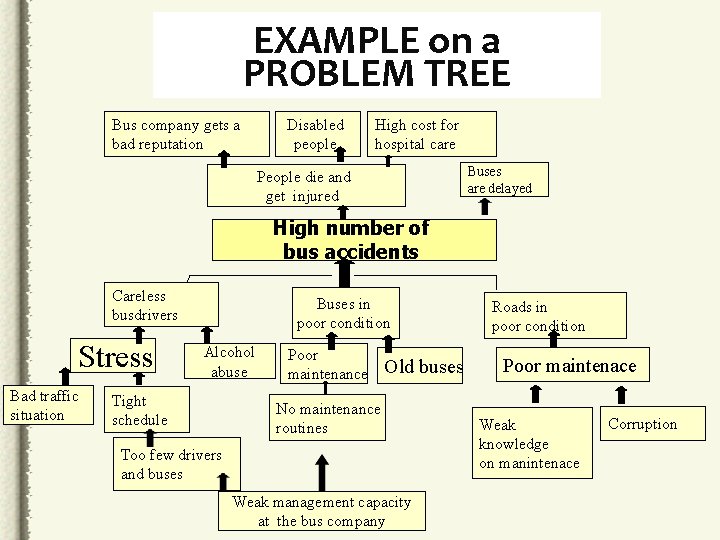
EXAMPLE on a PROBLEM TREE Bus company gets a Effekr bad reputation Disabled people High cost for hospital care Buses are delayed People die and get injured High number of bus accidents Careless busdrivers Stress Bad traffic situation Buses in poor condition Alcohol abuse Tight schedule Poor maintenance Old buses No maintenance routines Too few drivers and buses Weak management capacity at the bus company Roads in poor condition Poor maintenace Weak knowledge on manintenace Corruption
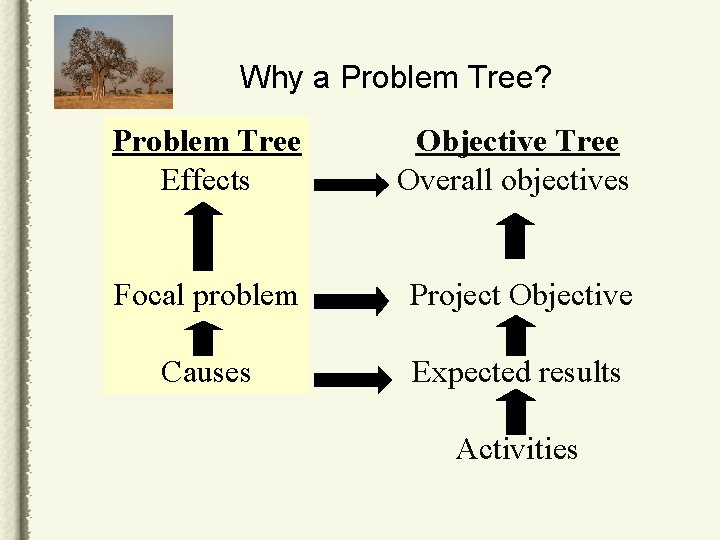
Why a Problem Tree? Problem Tree Effects Objective Tree Overall objectives Focal problem Project Objective Causes Expected results Activities
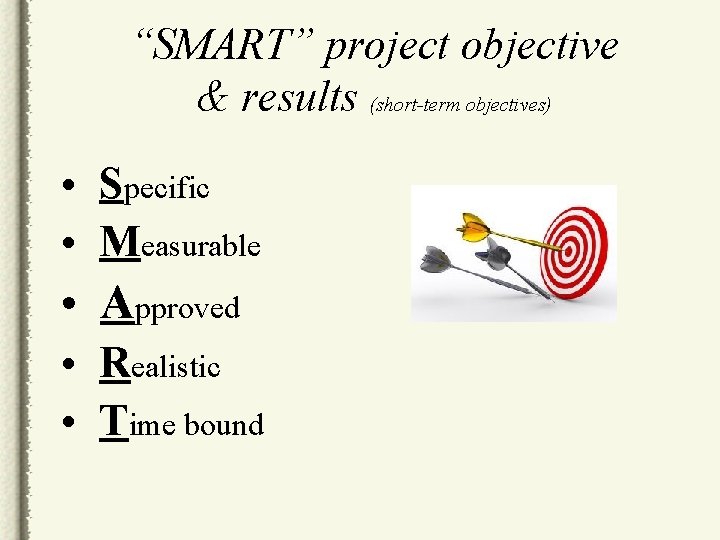
“SMART” project objective & results (short-term objectives) • Specific • Measurable • Approved • Realistic • Time bound
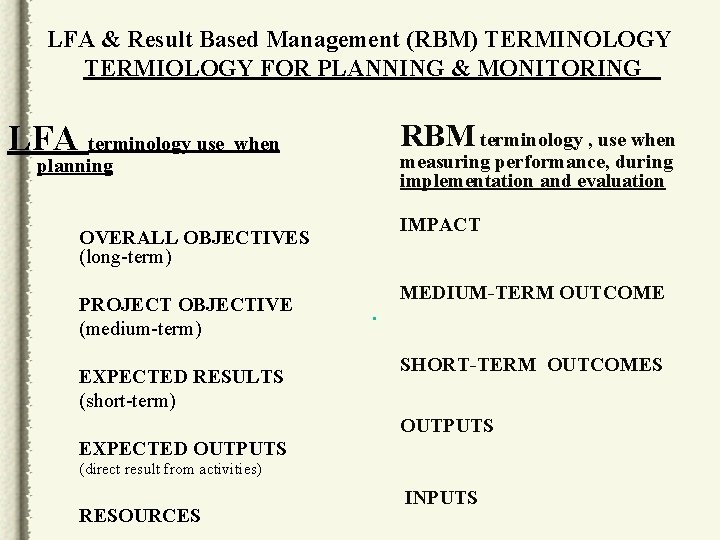
LFA & Result Based Management (RBM) TERMINOLOGY TERMIOLOGY FOR PLANNING & MONITORING LFA terminology use when RBM terminology , use when measuring performance, during implementation and evaluation planning IMPACT OVERALL OBJECTIVES (long-term) PROJECT OBJECTIVE (medium-term) EXPECTED RESULTS (short-term) MEDIUM-TERM OUTCOME • SHORT-TERM OUTCOMES OUTPUTS EXPECTED OUTPUTS (direct result from activities) RESOURCES INPUTS
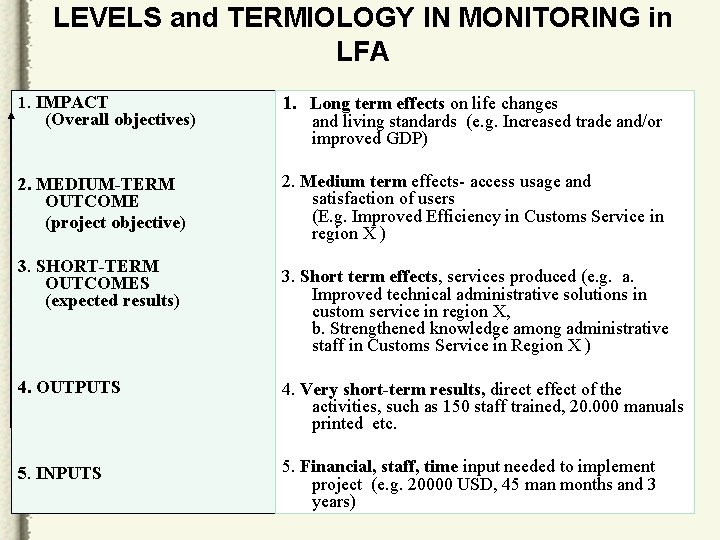
LEVELS and TERMIOLOGY IN MONITORING in LFA 1. IMPACT 1. Long term effects on life changes 2. MEDIUM-TERM OUTCOME (project objective) 2. Medium term effects- access usage and satisfaction of users (E. g. Improved Efficiency in Customs Service in region X ) (Overall objectives) 3. SHORT-TERM OUTCOMES (expected results) and living standards (e. g. Increased trade and/or improved GDP) 3. Short term effects, services produced (e. g. a. Improved technical administrative solutions in custom service in region X, b. Strengthened knowledge among administrative staff in Customs Service in Region X ) 4. OUTPUTS 4. Very short-term results, direct effect of the activities, such as 150 staff trained, 20. 000 manuals printed etc. 5. INPUTS 5. Financial, staff, time input needed to implement project (e. g. 20000 USD, 45 man months and 3 years)
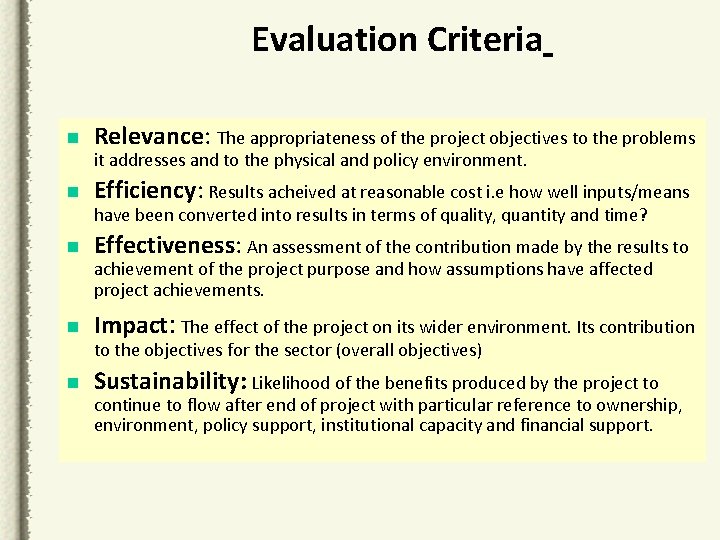
Evaluation Criteria n Relevance: The appropriateness of the project objectives to the problems it addresses and to the physical and policy environment. n Efficiency: Results acheived at reasonable cost i. e how well inputs/means have been converted into results in terms of quality, quantity and time? n Effectiveness: An assessment of the contribution made by the results to achievement of the project purpose and how assumptions have affected project achievements. n Impact: The effect of the project on its wider environment. Its contribution to the objectives for the sector (overall objectives) n Sustainability: Likelihood of the benefits produced by the project to continue to flow after end of project with particular reference to ownership, environment, policy support, institutional capacity and financial support.
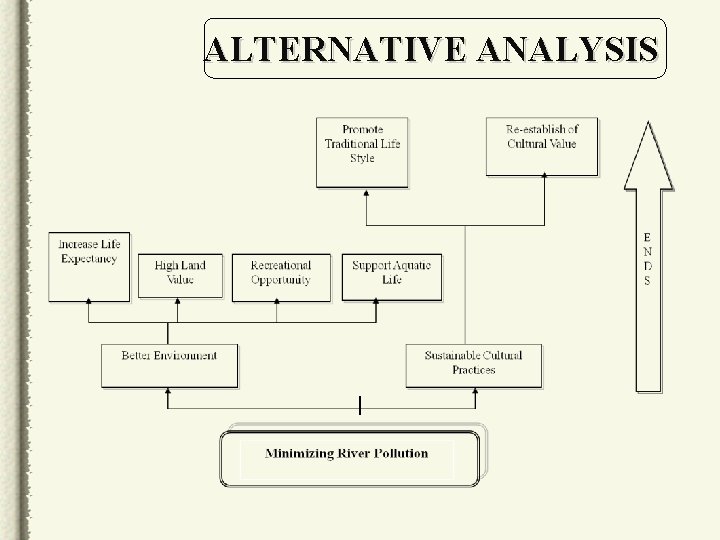
ALTERNATIVE ANALYSIS
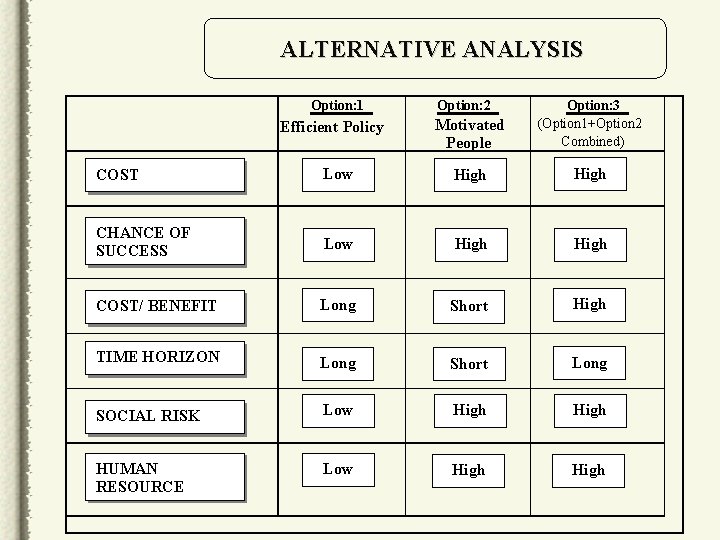
ALTERNATIVE ANALYSIS Option: 1 Efficient Policy Option: 2 Motivated People Option: 3 (Option 1+Option 2 Combined) COST Low High CHANCE OF SUCCESS Low High COST/ BENEFIT Long Short High TIME HORIZON Long Short Long SOCIAL RISK Low High HUMAN RESOURCE Low High
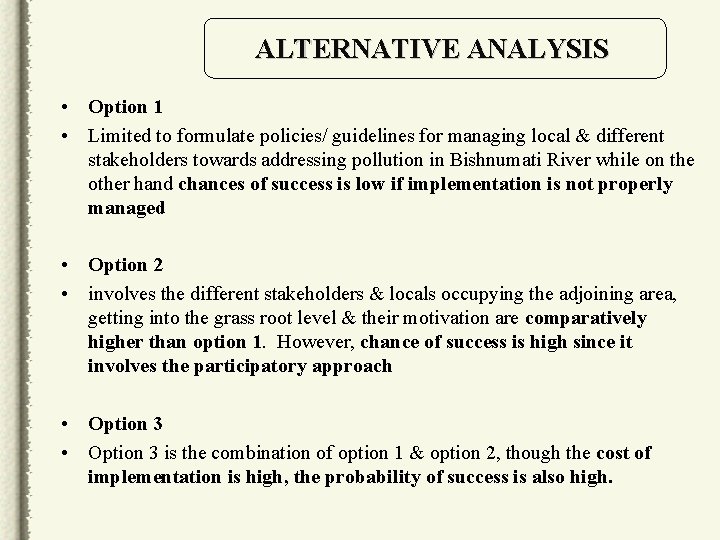
ALTERNATIVE ANALYSIS • Option 1 • Limited to formulate policies/ guidelines for managing local & different stakeholders towards addressing pollution in Bishnumati River while on the other hand chances of success is low if implementation is not properly managed • Option 2 • involves the different stakeholders & locals occupying the adjoining area, getting into the grass root level & their motivation are comparatively higher than option 1. However, chance of success is high since it involves the participatory approach • Option 3 is the combination of option 1 & option 2, though the cost of implementation is high, the probability of success is also high.
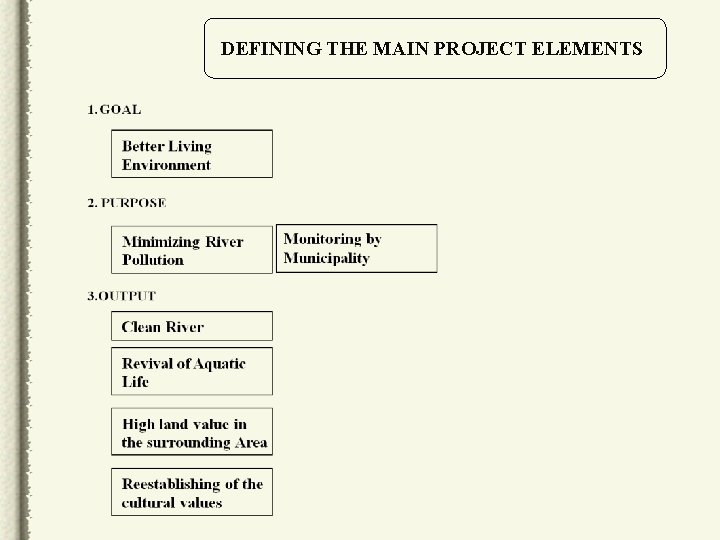
DEFINING THE MAIN PROJECT ELEMENTS
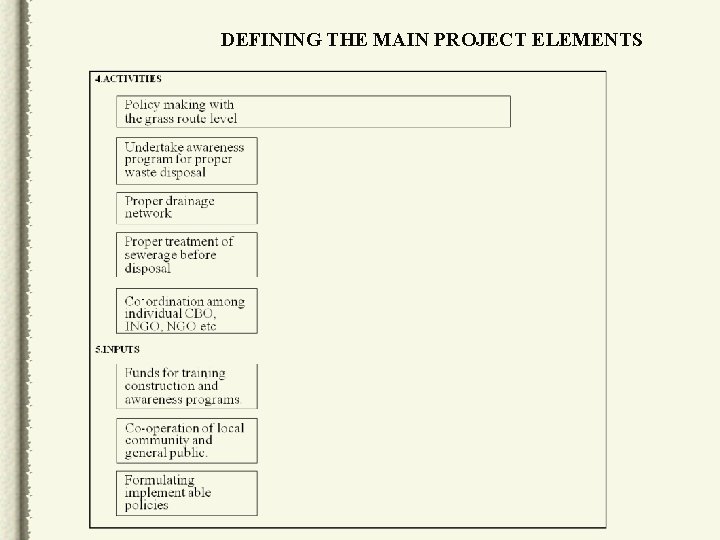
DEFINING THE MAIN PROJECT ELEMENTS
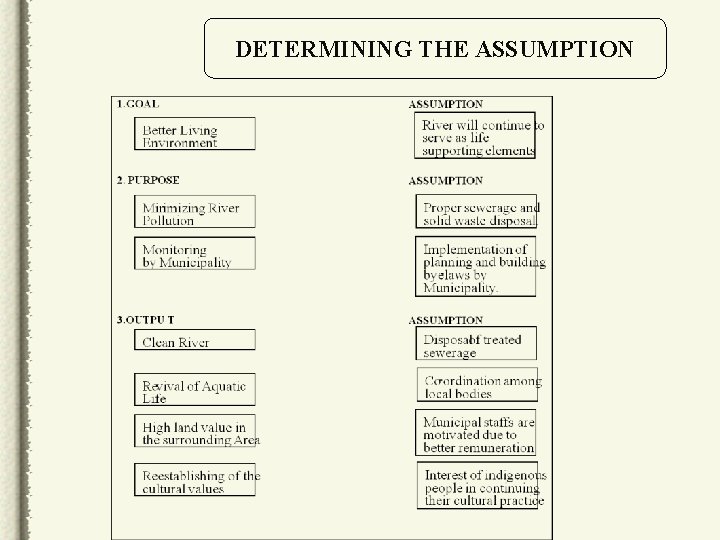
DETERMINING THE ASSUMPTION
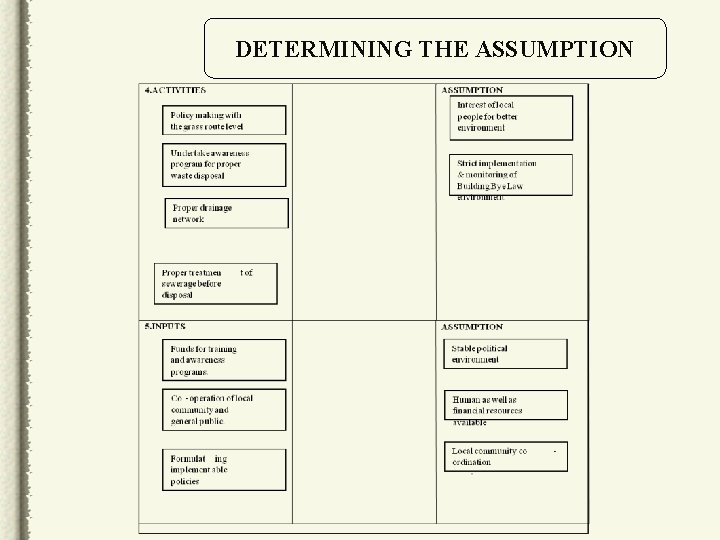
DETERMINING THE ASSUMPTION
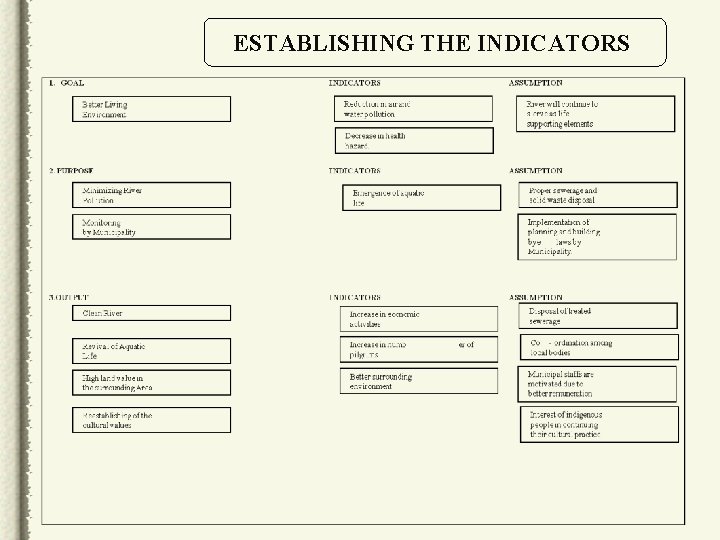
ESTABLISHING THE INDICATORS
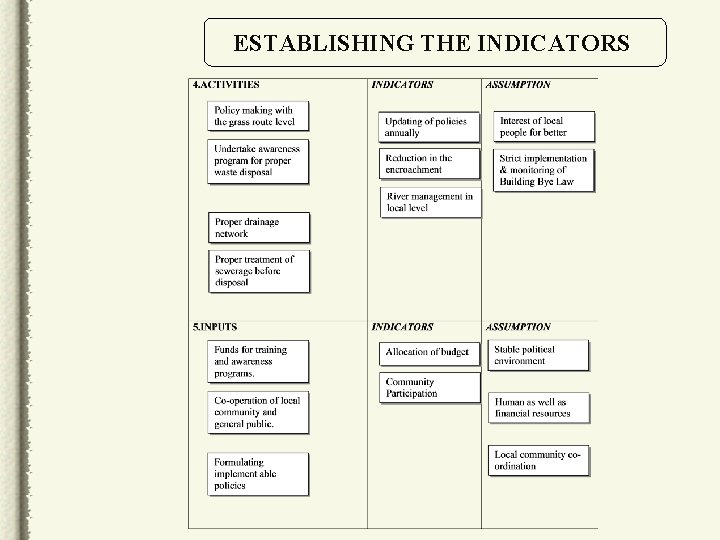
ESTABLISHING THE INDICATORS
Summary o Good planning with an efficient tool such as the LFA o Planning is a process , a participatory approach o Define SMART objectives including monitoring tools such as indicators & source of verifications o Specify activities o Make a risk analysis & risk management plan o Set aside time, resources and skills for planning & monitoring o Responsible monitoring persons o Analysing data & learning from results o Dissemination of results to relevant stakeholders o Good project management skills helps
How strategic planning and monitoring works depends on its users, on us!
- Slides: 35