
The LOCANET task Potluck challenge NIPS 2008 Isabelle
The LOCANET task (Pot-luck challenge, NIPS 2008) Isabelle Guyon, Clopinet Alexander Statnikov, Vanderbilt Univ. Constantin Aliferis, New York University Causality Workbench clopinet. com/causality
Acknowledgements • This work is part of the causality workbench effort of data exchange and benchmark. • André Elisseeff and Jean-Philippe Pellet, IBM Zürich, Gregory F. Cooper, Pittsburg University, and Peter Spirtes, Carnegie Mellon collaborated on the design of the “causation nd prediction challenge” (WCCI 2008) in which the datasets of the LOCANET task were first used. Causality Workbench clopinet. com/causality
Problem description Causality Workbench clopinet. com/causality
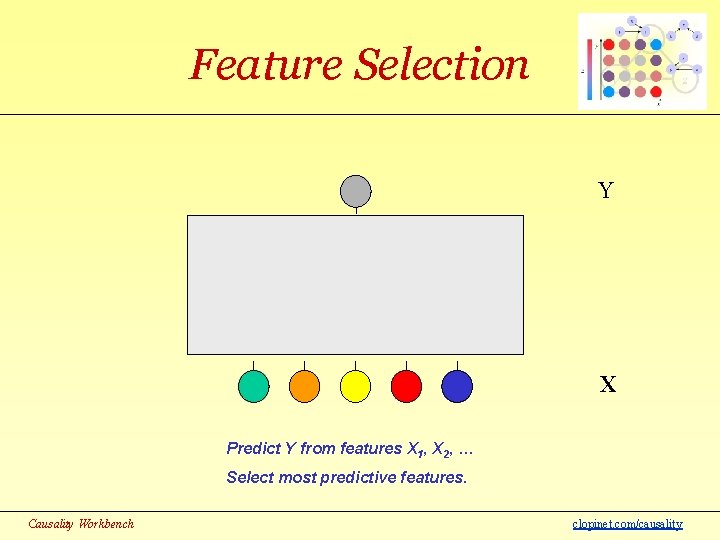
Feature Selection Y X Predict Y from features X 1, X 2, … Select most predictive features. Causality Workbench clopinet. com/causality
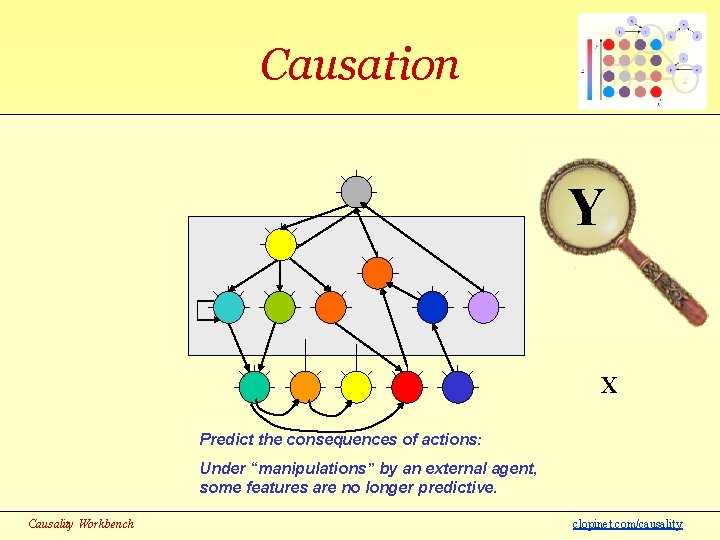
Causation Y Y X Predict the consequences of actions: Under “manipulations” by an external agent, some features are no longer predictive. Causality Workbench clopinet. com/causality
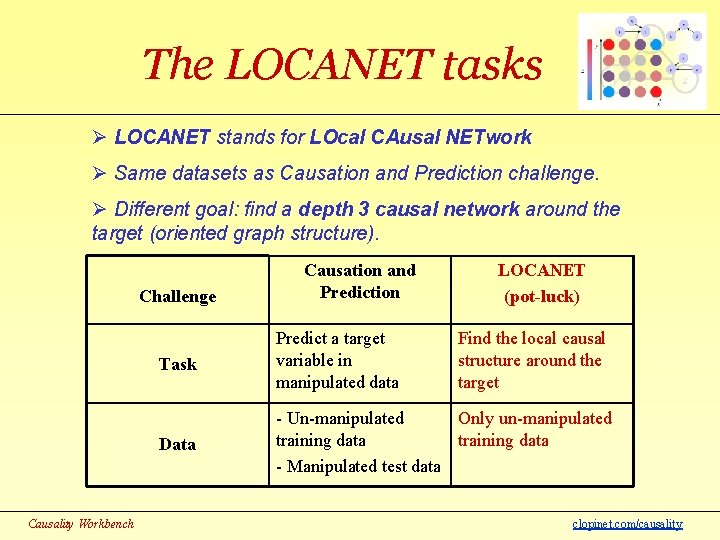
The LOCANET tasks Ø LOCANET stands for LOcal CAusal NETwork Ø Same datasets as Causation and Prediction challenge. Ø Different goal: find a depth 3 causal network around the target (oriented graph structure). Challenge Causality Workbench Causation and Prediction LOCANET (pot-luck) Task Predict a target variable in manipulated data Find the local causal structure around the target Data - Un-manipulated Only un-manipulated training data - Manipulated test data clopinet. com/causality
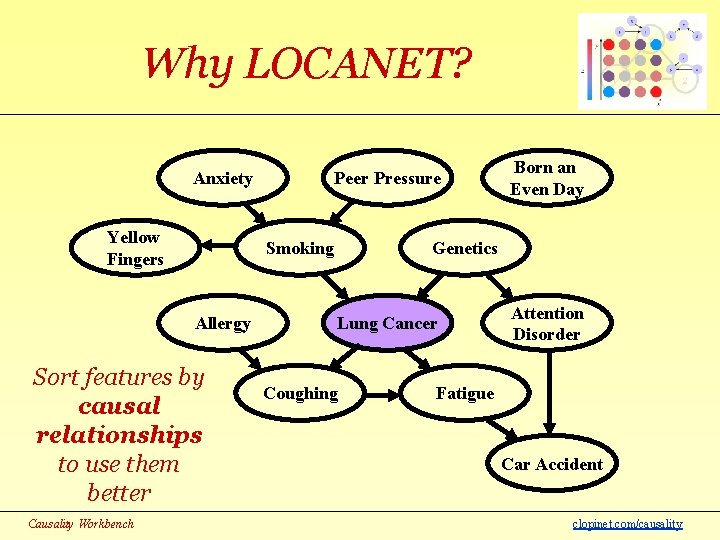
Why LOCANET? Anxiety Yellow Fingers Smoking Allergy Sort features by causal relationships to use them better Causality Workbench Peer Pressure Born an Even Day Genetics Lung Cancer Coughing Attention Disorder Fatigue Car Accident clopinet. com/causality
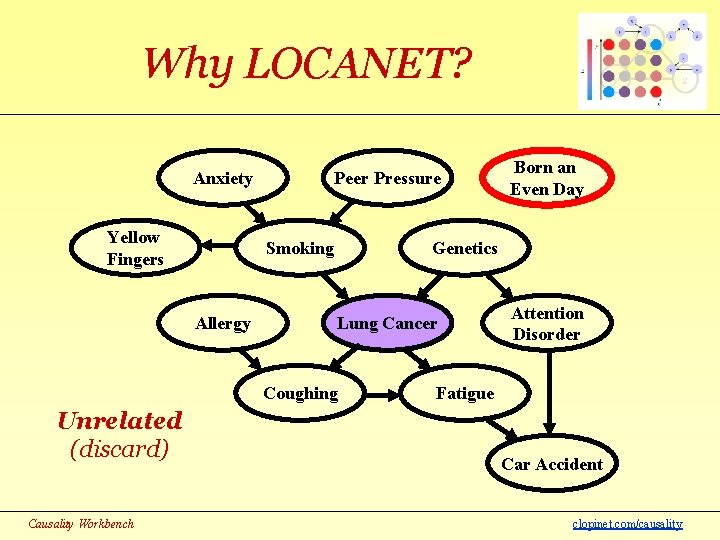
Why LOCANET? Anxiety Yellow Fingers Peer Pressure Smoking Allergy Genetics Lung Cancer Coughing Unrelated (discard) Causality Workbench Born an Even Day Attention Disorder Fatigue Car Accident clopinet. com/causality
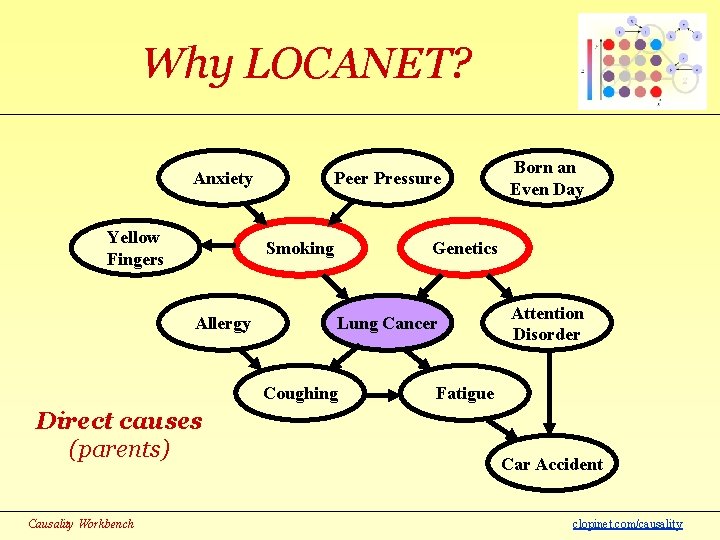
Why LOCANET? Anxiety Yellow Fingers Peer Pressure Smoking Allergy Genetics Lung Cancer Coughing Direct causes (parents) Causality Workbench Born an Even Day Attention Disorder Fatigue Car Accident clopinet. com/causality
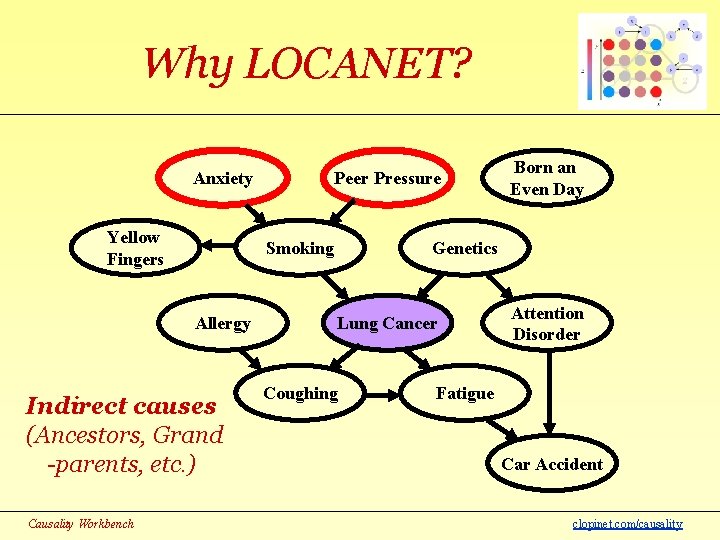
Why LOCANET? Anxiety Yellow Fingers Smoking Allergy Indirect causes (Ancestors, Grand -parents, etc. ) Causality Workbench Peer Pressure Born an Even Day Genetics Lung Cancer Coughing Attention Disorder Fatigue Car Accident clopinet. com/causality
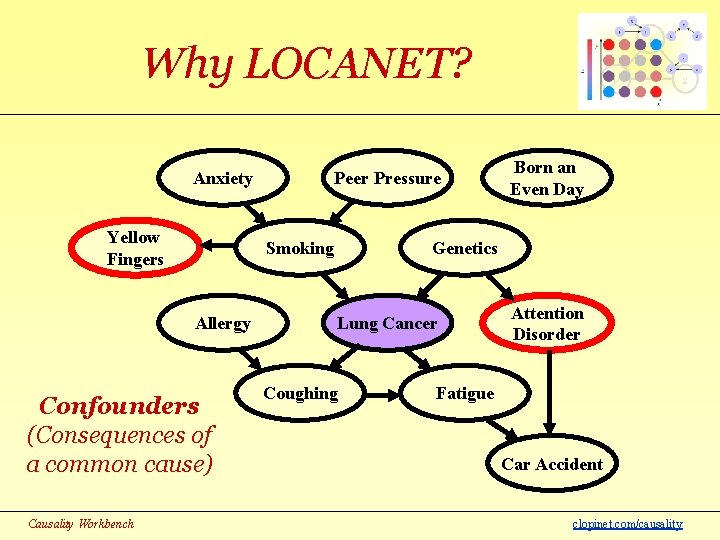
Why LOCANET? Anxiety Yellow Fingers Smoking Allergy Confounders (Consequences of a common cause) Causality Workbench Peer Pressure Born an Even Day Genetics Lung Cancer Coughing Attention Disorder Fatigue Car Accident clopinet. com/causality
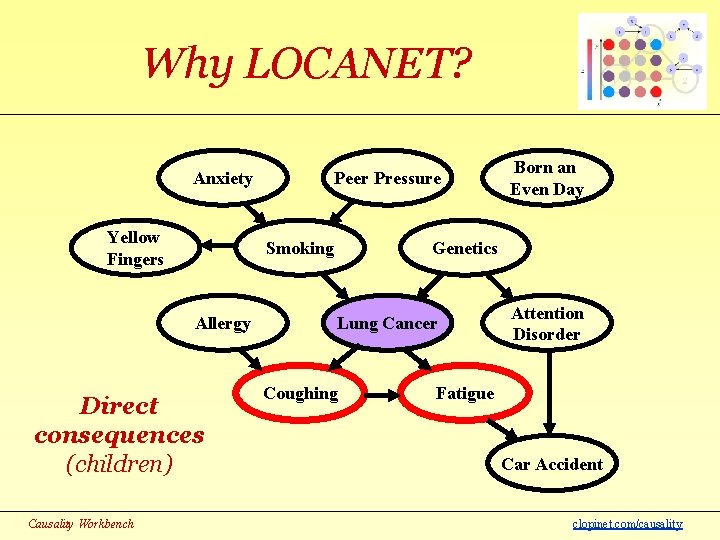
Why LOCANET? Anxiety Yellow Fingers Smoking Allergy Direct consequences (children) Causality Workbench Peer Pressure Born an Even Day Genetics Lung Cancer Coughing Attention Disorder Fatigue Car Accident clopinet. com/causality
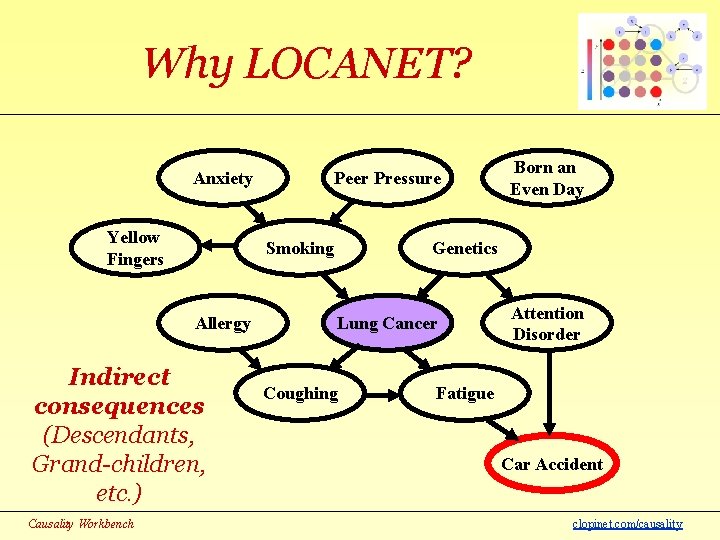
Why LOCANET? Anxiety Yellow Fingers Smoking Allergy Indirect consequences (Descendants, Grand-children, etc. ) Causality Workbench Peer Pressure Born an Even Day Genetics Lung Cancer Coughing Attention Disorder Fatigue Car Accident clopinet. com/causality
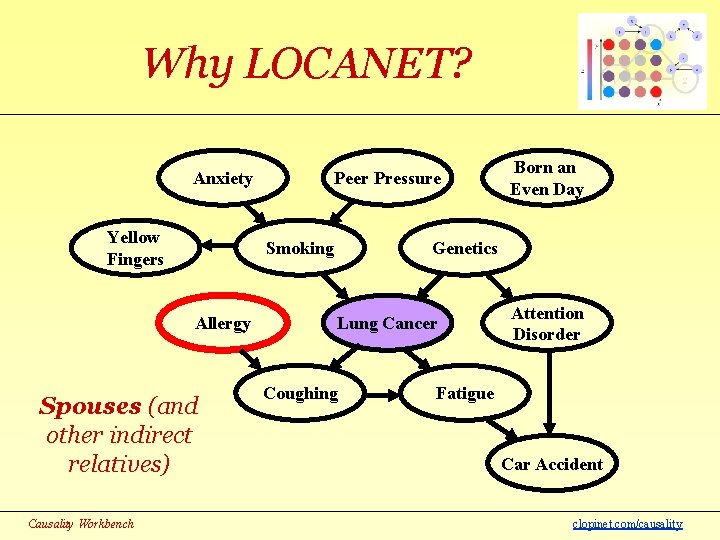
Why LOCANET? Anxiety Yellow Fingers Smoking Allergy Spouses (and other indirect relatives) Causality Workbench Peer Pressure Born an Even Day Genetics Lung Cancer Coughing Attention Disorder Fatigue Car Accident clopinet. com/causality
Datasets Causality Workbench clopinet. com/causality
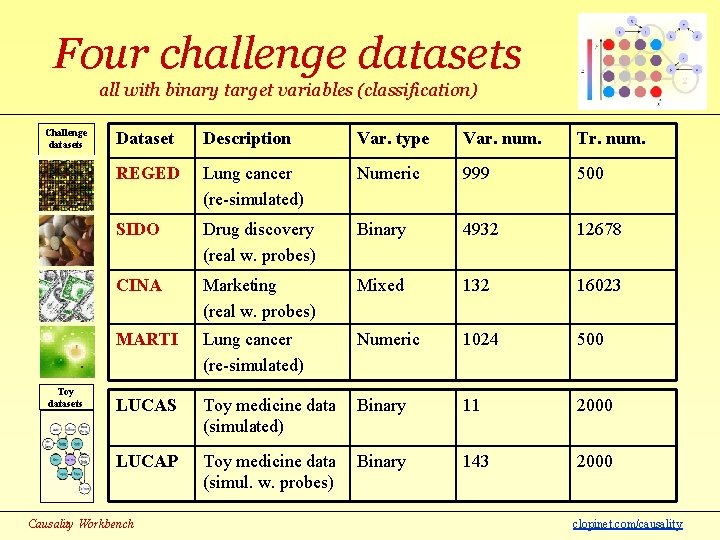
Four challenge datasets all with binary target variables (classification) Challenge datasets Toy datasets Dataset Description Var. type Var. num. Tr. num. REGED Lung cancer (re-simulated) Numeric 999 500 SIDO Drug discovery (real w. probes) Binary 4932 12678 CINA Marketing (real w. probes) Mixed 132 16023 MARTI Lung cancer (re-simulated) Numeric 1024 500 LUCAS Toy medicine data Binary (simulated) 11 2000 LUCAP Toy medicine data Binary (simul. w. probes) 143 2000 Causality Workbench clopinet. com/causality
Difficulties • Violated assumptions: – – – Causal sufficiency Markov equivalence Faithfulness Linearity “Gaussianity” • Overfitting (statistical complexity): – Finite sample size • Algorithm efficiency (computational complexity): – Thousands of variables – Tens of thousands of examples Causality Workbench clopinet. com/causality
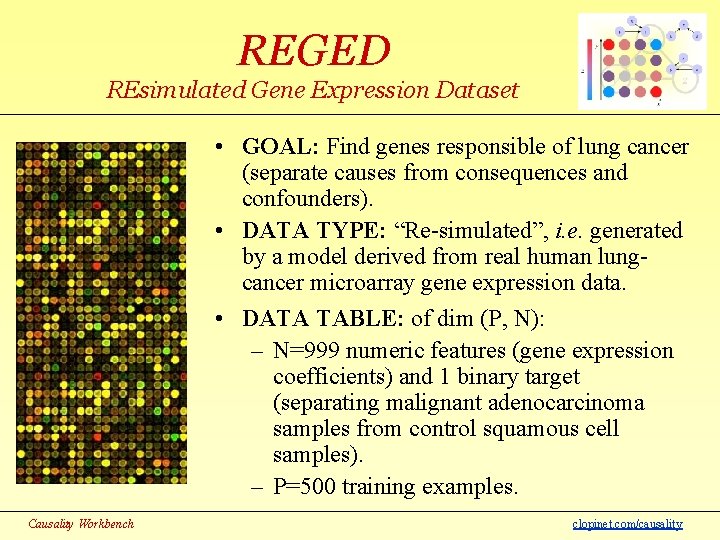
REGED REsimulated Gene Expression Dataset • GOAL: Find genes responsible of lung cancer (separate causes from consequences and confounders). • DATA TYPE: “Re-simulated”, i. e. generated by a model derived from real human lungcancer microarray gene expression data. • DATA TABLE: of dim (P, N): – N=999 numeric features (gene expression coefficients) and 1 binary target (separating malignant adenocarcinoma samples from control squamous cell samples). – P=500 training examples. Causality Workbench clopinet. com/causality
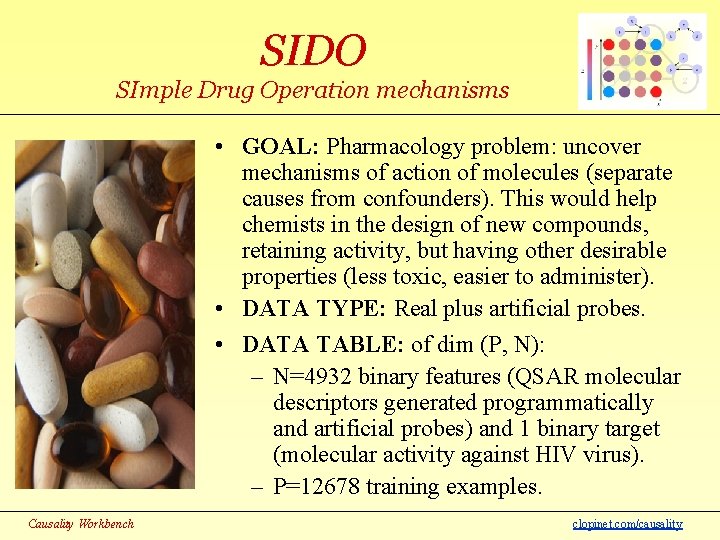
SIDO SImple Drug Operation mechanisms • GOAL: Pharmacology problem: uncover mechanisms of action of molecules (separate causes from confounders). This would help chemists in the design of new compounds, retaining activity, but having other desirable properties (less toxic, easier to administer). • DATA TYPE: Real plus artificial probes. • DATA TABLE: of dim (P, N): – N=4932 binary features (QSAR molecular descriptors generated programmatically and artificial probes) and 1 binary target (molecular activity against HIV virus). – P=12678 training examples. Causality Workbench clopinet. com/causality
CINA Census is Not Adult • GOAL: Uncover the socio-economic factors (age, workclass, education, marital status, occupation, native country, etc. ) affecting high income (separate causes from consequences and confounders). • DATA TYPE: Real plus artificial probes. • DATA TABLE: of dim (P, N): – N=132 mixed categorical coded as binary, binary and numeric features (socioeconomic factors and artificial probes) and 1 binary target whether the income exceeds 50 K USD). – P=16023 training examples. Causality Workbench clopinet. com/causality
MARTI Measurement ARTIfact • GOAL: Find genes responsible of lung cancer (separate causes from consequences and confounders). • DATA TYPE: Same as REGED (Resimulated, generated by a model derived from real human lung-cancer microarray gene expression data) but with on top a noise model (correlated noise). • DATA TABLE: of dim (P, N): – N=1024 numeric features (gene expression coefficients) and 1 binary target (malignant samples vs. control). – P=500 training examples. Causality Workbench clopinet. com/causality
Evaluation method Causality Workbench clopinet. com/causality

Result format • Each feature is numbered according to its position in the data table (the target is 0). • Provide a text file, each line containing a feature followed by a list of parents (up to 3 connections away from the target). • Example: Guyon_LUCAS_feat. localgraph 0: 1 5 1: 3 4 2: 1 6: 5 8: 6 9 9: 0 11 11: 0 10 Causality Workbench clopinet. com/causality
Relationship to target • We consider only local directed acyclic graphs. We encode the relationship as a string of up (u) and down (d) arrows, from the target. – Depth 1 relatives: parents (u) and children (d). – Depth 2 relatives: spouses (du), grand-children (dd), siblings (ud), grand-parents (uu). – Depth 3 relatives: great-grand-parents (uuu), uncles/aunts (uud), nices/nephews (udd), parents of siblings (udu), spouses of children (ddu), parents in law (duu), children of spouses (dud), great-grandchildren (ddd). • If there are 2 paths, we prefer the shortest. • If there are 2 same length paths, both are OK. Causality Workbench clopinet. com/causality
Score: average edit distance • To compare the proposed local network to the true network, a confusion matrix Cij is computed, recording the number of relatives confused for another type of relative, among the 14 types of relatives in depth 3 networks. • A cost matrix Aij, is applied to account for the distance between relatives (computed with an edit distance as the number of substitutions, insertions, or deletions to go from one string to the other). • The score of the solution is then computed as: S = sumij Aij Causality Workbench clopinet. com/causality
Real data with probes Causality Workbench clopinet. com/causality
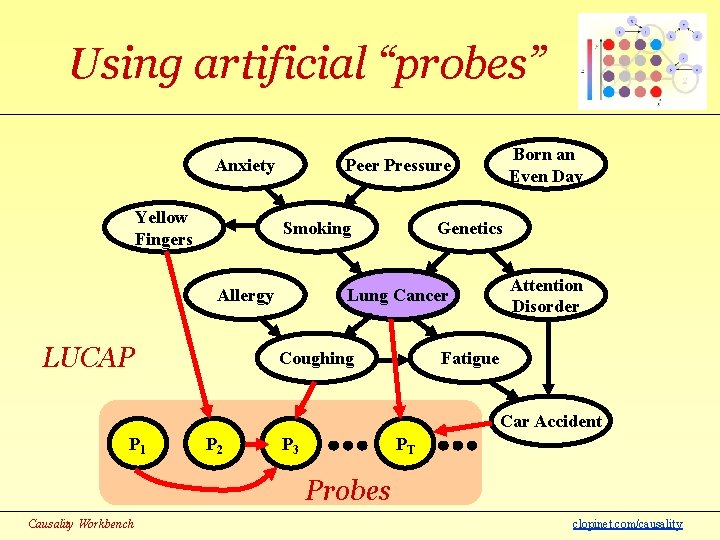
Using artificial “probes” Anxiety Yellow Fingers Smoking Allergy LUCAP Born an Even Day Peer Pressure Genetics Lung Cancer Coughing Attention Disorder Fatigue Car Accident P 1 P 2 P 3 PT Probes Causality Workbench clopinet. com/causality
Evaluation using “probes” • We compute the score: S = sumij Aij Cij by summing only over probes. • We verify manually the plausibility of relationships between real variables. Causality Workbench clopinet. com/causality
Results Causality Workbench clopinet. com/causality
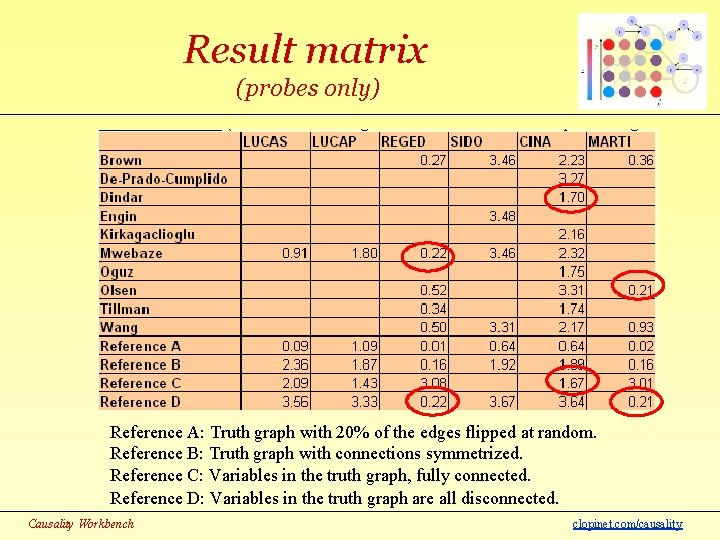
Result matrix (probes only) Reference A: Truth graph with 20% of the edges flipped at random. Reference B: Truth graph with connections symmetrized. Reference C: Variables in the truth graph, fully connected. Reference D: Variables in the truth graph are all disconnected. Causality Workbench clopinet. com/causality
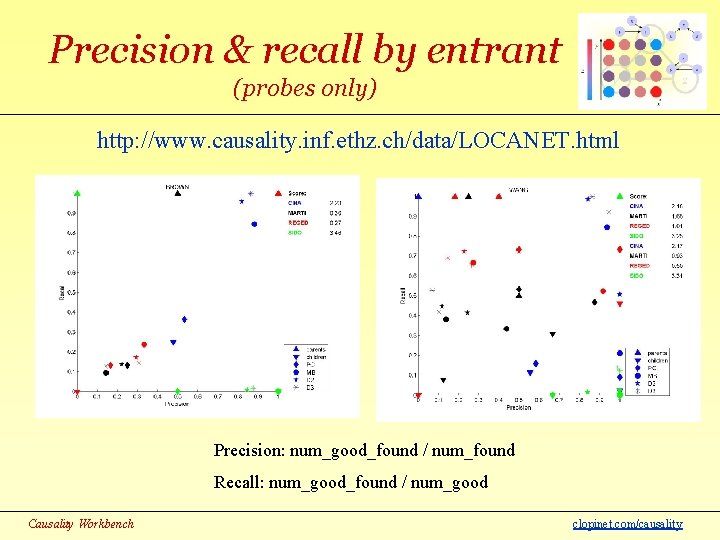
Precision & recall by entrant (probes only) http: //www. causality. inf. ethz. ch/data/LOCANET. html Precision: num_good_found / num_found Recall: num_good_found / num_good Causality Workbench clopinet. com/causality
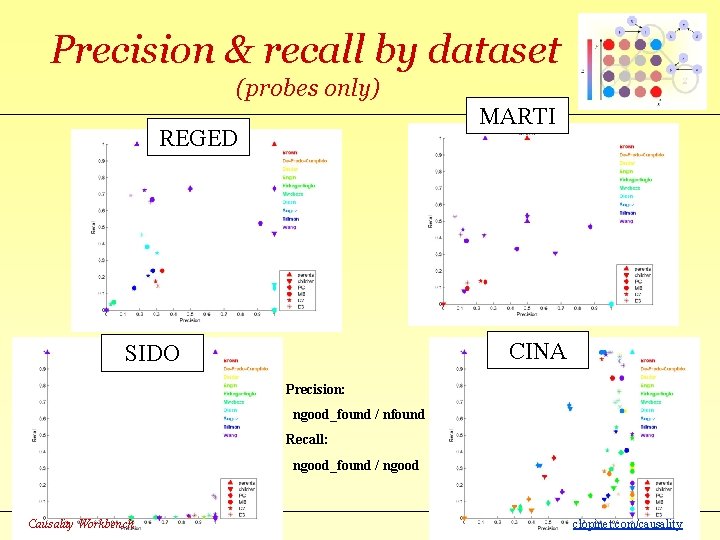
Precision & recall by dataset (probes only) MARTI REGED CINA SIDO Precision: ngood_found / nfound Recall: ngood_found / ngood Causality Workbench clopinet. com/causality
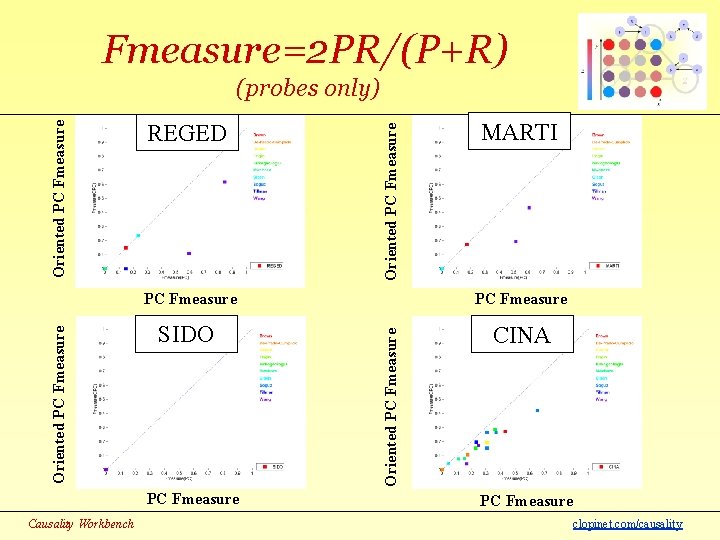
Fmeasure=2 PR/(P+R) MARTI PC Fmeasure SIDO CINA PC Fmeasure Causality Workbench Oriented PC Fmeasure REGED Oriented PC Fmeasure (probes only) PC Fmeasure clopinet. com/causality
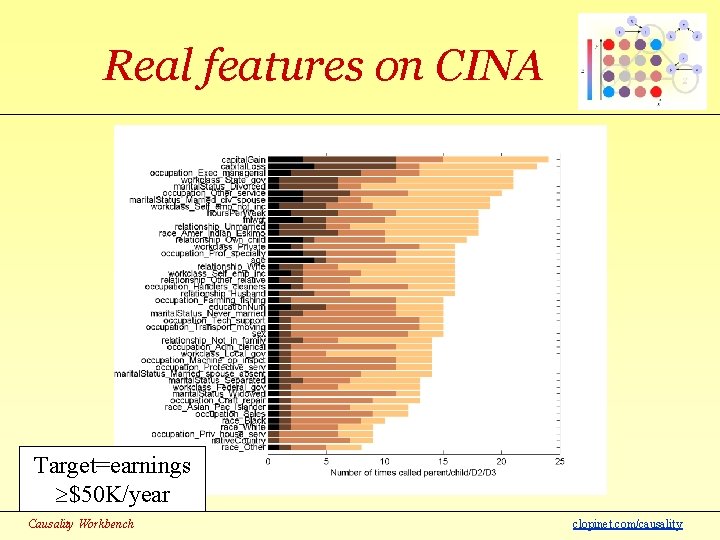
Real features on CINA Target=earnings $50 K/year Causality Workbench clopinet. com/causality
Does this make sense? age C 4 E 1 corr= 0. 24 occupation_Prof_specialty C 3 E 2 corr= 0. 17 fnlwgt C 3 E 2 corr=-0. 01 marital. Status_Married_civ_spouse C 3 E 3 corr= 0. 44 education. Num C 2 E 3 corr= 0. 34 occupation_Other_service C 3 E 4 corr=-0. 16 hours. Per. Week C 2 E 4 corr= 0. 23 relationship_Unmarried C 1 E 4 corr=-0. 14 workclass_Self_emp_not_inc C 1 E 4 corr= 0. 02 capital. Loss C 4 E 7 corr= 0. 14 race_Amer_Indian_Eskimo C 1 E 5 corr=-0. 03 marital. Status_Divorced C 1 E 5 corr=-0. 13 workclass_State_gov C 1 E 5 corr= 0. 01 occupation_Exec_managerial C 2 E 6 corr= 0. 22 <-- ? ? why an effect capital. Gain C 3 E 8 corr= 0. 22 Most variables are cited more often as effects than as causes. Causality Workbench clopinet. com/causality
Most correlated features marital. Status_Married_civ_spouse relationship_Husband education. Num marital. Status_Never_married age hours. Per. Week relationship_Own_child capital. Gain sex occupation_Exec_managerial relationship_Not_in_family occupation_Prof_specialty occupation_Other_service capital. Loss relationship_Unmarried In red: found in the first ½ of the consensus ranking of the challenge. In orange: tie with the feature exactly at the middle. Causality Workbench clopinet. com/causality
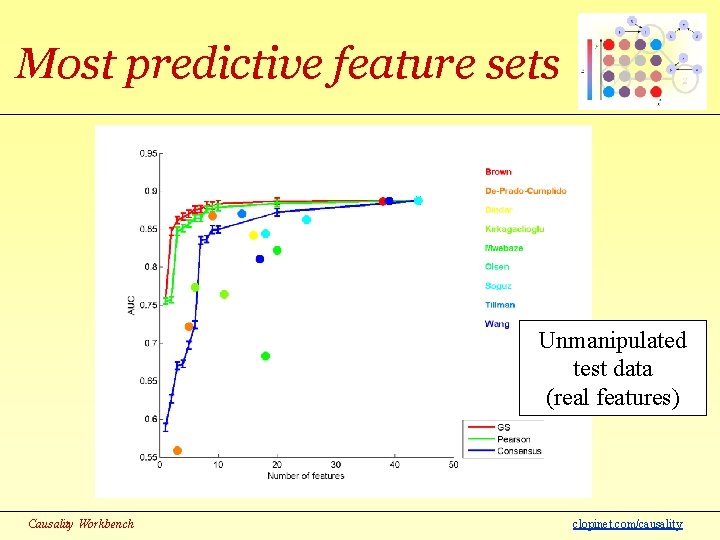
Most predictive feature sets Unmanipulated test data (real features) Causality Workbench clopinet. com/causality
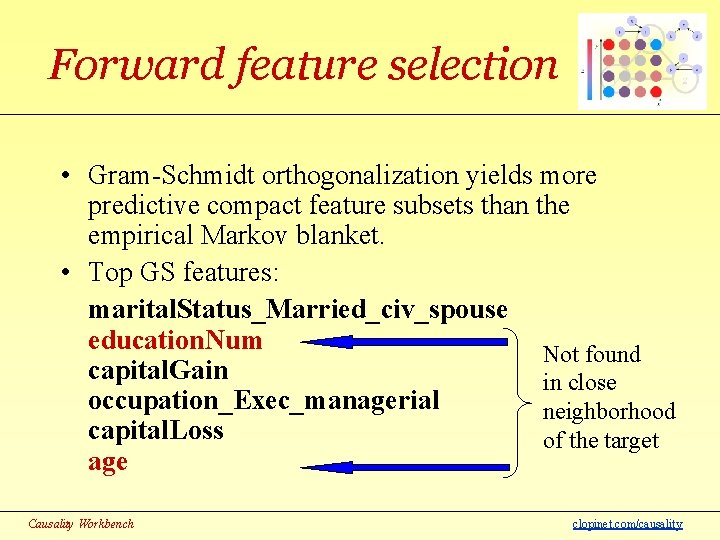
Forward feature selection • Gram-Schmidt orthogonalization yields more predictive compact feature subsets than the empirical Markov blanket. • Top GS features: marital. Status_Married_civ_spouse education. Num Not found capital. Gain in close occupation_Exec_managerial neighborhood capital. Loss of the target age Causality Workbench clopinet. com/causality
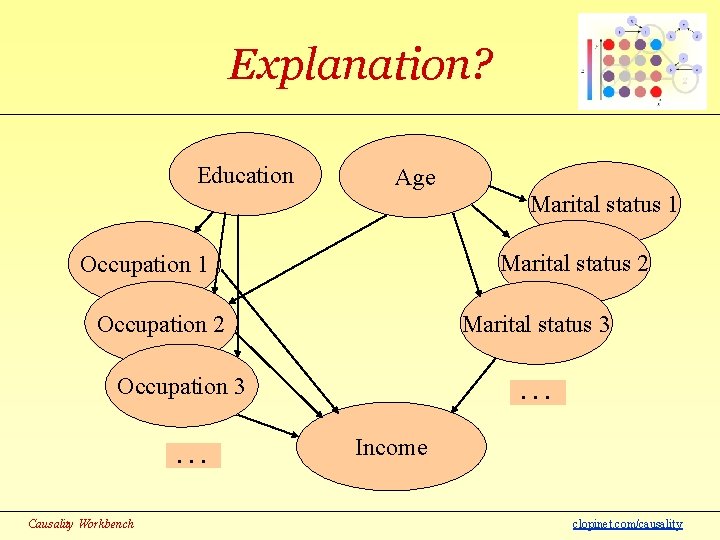
Explanation? Education Age Marital status 1 Marital status 2 Occupation 1 Occupation 2 Marital status 3 … Occupation 3 … Causality Workbench Income clopinet. com/causality
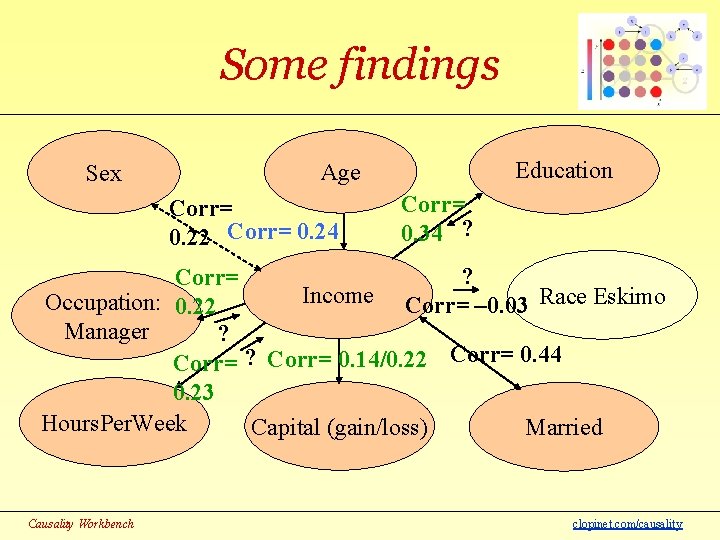
Some findings Sex Education Age Corr= 0. 22 Corr= 0. 24 Corr= 0. 34 ? ? Corr= Income Corr= – 0. 03 Race Eskimo Occupation: 0. 22 Manager ? Corr= 0. 14/0. 22 Corr= 0. 44 0. 23 Hours. Per. Week Capital (gain/loss) Married Causality Workbench clopinet. com/causality
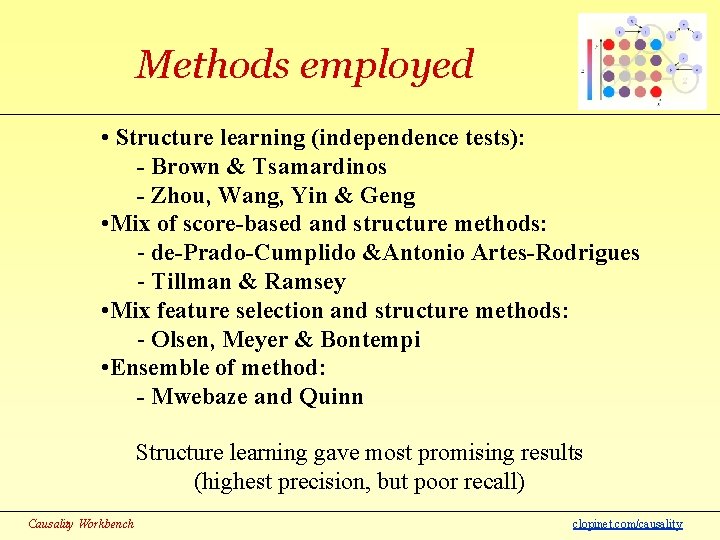
Methods employed • Structure learning (independence tests): - Brown & Tsamardinos - Zhou, Wang, Yin & Geng • Mix of score-based and structure methods: - de-Prado-Cumplido &Antonio Artes-Rodrigues - Tillman & Ramsey • Mix feature selection and structure methods: - Olsen, Meyer & Bontempi • Ensemble of method: - Mwebaze and Quinn Structure learning gave most promising results (highest precision, but poor recall) Causality Workbench clopinet. com/causality
Conclusion • Dimensionality kills causal discovery (SIDO). • Precision generally better than recall. • Orientation inconsistent and not always plausible in real features across entries. • Difficult to define a single good quantitative assessment metric. • CINA offers opportunities to try more algorithms (without probes, without coding). Causality Workbench clopinet. com/causality
- Slides: 42