
The Litter Survey in Sweden Joakim Malmdin Statistics
- Slides: 17
The Litter Survey in Sweden Joakim Malmdin, Statistics Sweden 2010 -08 -12 Nordisk Statistikermøde, København
Background • The littering in Swedish cities has probably increased the last years. The assumption is not confirmed. • In 2007 commission by The Keep Sweden Tidy Foundation to develop a method for measuring the littering. • We are interested in the littering in central city areas. 2010 -08 -12 Nordisk Statistikermøde, København
Keep Sweden Tiny • The Keep Sweden Tidy Foundation started 1983 and is a non-profit organisation. • The foundation creates public opinion and focus on environmental issues and extensive campaigns. • Influence people´s attitudes and behavior. 2010 -08 -12 Nordisk Statistikermøde, København
The task • The task for Statistics Sweden – find at method for measurement of litter in central city areas. • We strive for • an unbiased method of selection, • an effective pre-selection technique, • to measure neither the dirtiest nor the cleanest locations in the central city areas, • working with educated survey teams who count the litter. 2010 -08 -12 Nordisk Statistikermøde, København
Where to measure • Measure the littering on pavements – an area of asphalt, cobbles or concrete located adjacented next to a road. • The pavement is demarcated by the kerb and an obstruction (house wall, flower border etc. ). 2010 -08 -12 Nordisk Statistikermøde, København
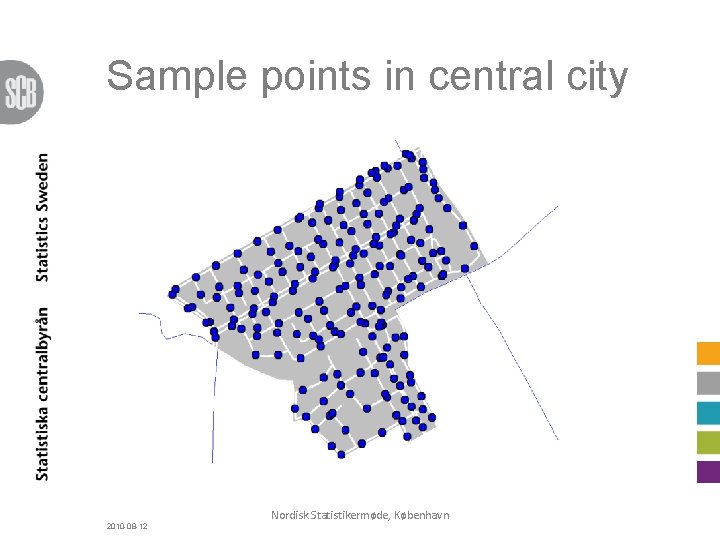
Finding the observation spots • The National Road Database (NVDB) with road/street centre-lines from Swedish Road Administration is used for sampling. • The information from NVDB is combined with the definition of central city core from the municipality. • Centre-line coordinates every fifth meters. • A random selection of 200 potential litter sites is generated. 2010 -08 -12 Nordisk Statistikermøde, København
Sample points in central city 2010 -08 -12 Nordisk Statistikermøde, København
• Target population: Pavements in central city • Frame population: Objects in the frame population (line objects from NVDB) are spots every fifth metre along the line objects. • Sample design: Stratified systematic sample. The stratification is decided by the municipality. Within each strata, central city area, is a systematic sample drawn. 2010 -08 -12 Nordisk Statistikermøde, København
Sampling and data collection • 200 sample points within the central city is taken. • Each sample point is a five metre long section of the pavement of varying width. The surface is measured every half metre. • The coordinates are drawn systematically and then sorted by when they were drawn. • We avoid systematically biased effects of weather and street-cleaning. 2010 -08 -12 Nordisk Statistikermøde, København
Observation period • The recommended length of the observation period is two to four weeks. • This in order to cover variation in weather and other possible conditions. 2010 -08 -12 Nordisk Statistikermøde, København
Rejected sites • Sites were rejected if they were located on • • 2010 -08 -12 major European highways/motorways, a construction area, industrial/private land, within a tunnel or bridge, an outdoor restaurant or café, parked cars or containers, a railway or tramway. Nordisk Statistikermøde, København
Equipment and technique • Measuring tape, paper, pen, map and a GPSreceiver. • Coordinates of where the sample points located accesible on a web page with links to satellite images. • If a spot is located alongside the pavement, the nearest pavement is chosen. 2010 -08 -12 Nordisk Statistikermøde, København
Technique, cont. • The direction of the pavement to be measured is chosen in turn; north, east, south, and west. • If the road has two pavements, both are measured. • The maximum width of a pavement is set to five metres. • All kind of litter is registred and classified according to a list in the field. Results transmitted to the data base via a web page, maintained by Statistics Sweden. 2010 -08 -12 Nordisk Statistikermøde, København
Categories of litter, example • • • Cigarette butts Paper Glass Hard plastic Soft plastic Metal – bottle caps Organic material Candy packaging Other materials 2010 -08 -12 Nordisk Statistikermøde, København
Interpreting the results • It is not straightforward to compare the results between the cities. • The criteria for which areas that are to be chosen are not given in the design plan, but decided upon by the representatives from each city. • The strength lies in the collection of time series and thereby comparable estimates from year to year. 2010 -08 -12 Nordisk Statistikermøde, København
Communicating the results • The results are published by The Keep Sweden Tidy Foundation in cooperation with Statistics Sweden for statistical and methodological advices. • In the information sheet we present the five categories with the most numer of litter items found. • We also provide a table where the litter found is categorised by the days of the week (Monday to Friday). 2010 -08 -12 Nordisk Statistikermøde, København
Thank you for listening! 2010 -08 -12 Nordisk Statistikermøde, København