
The Listening Process Study Material For The students
- Slides: 11
The Listening Process Study Material For The students of B. SC. (Hons. ) Chemistry I Year Section A : By Dr. Shubha Dwivedi Assistant Professor Department of English ARSD College
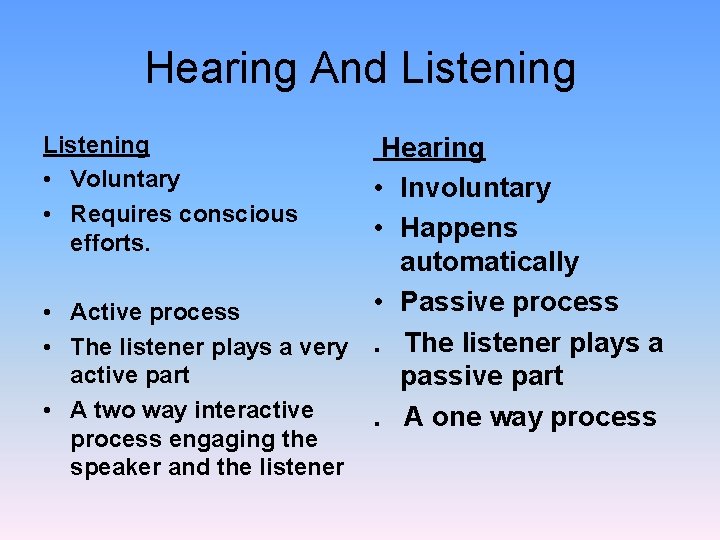
Hearing And Listening • Voluntary • Requires conscious efforts. Hearing • Involuntary • Happens automatically • Passive process • Active process • The listener plays a very. The listener plays a active part passive part • A two way interactive. A one way process engaging the speaker and the listener
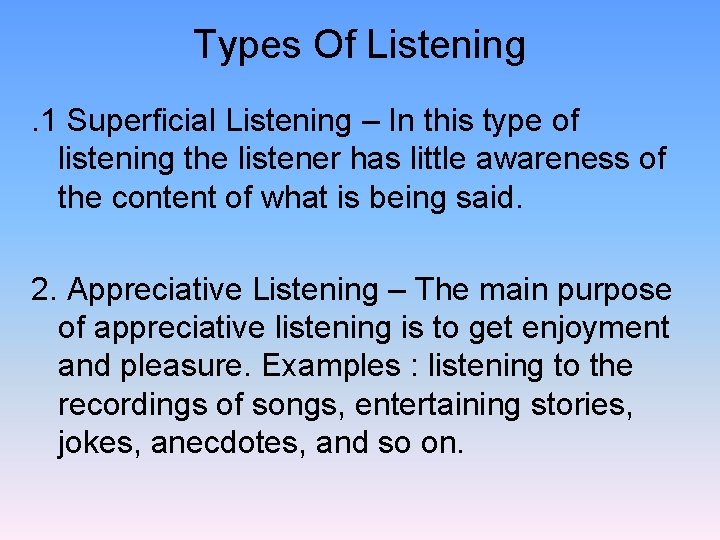
Types Of Listening. 1 Superficial Listening – In this type of listening the listener has little awareness of the content of what is being said. 2. Appreciative Listening – The main purpose of appreciative listening is to get enjoyment and pleasure. Examples : listening to the recordings of songs, entertaining stories, jokes, anecdotes, and so on.
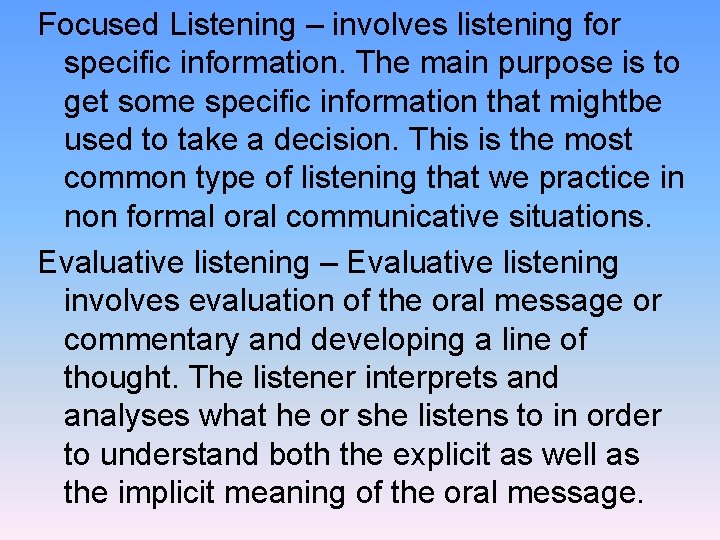
Focused Listening – involves listening for specific information. The main purpose is to get some specific information that mightbe used to take a decision. This is the most common type of listening that we practice in non formal oral communicative situations. Evaluative listening – Evaluative listening involves evaluation of the oral message or commentary and developing a line of thought. The listener interprets and analyses what he or she listens to in order to understand both the explicit as well as the implicit meaning of the oral message.
Attentive Listening – Attentive listening demands the complete attention of the listener. It is basically active and intelligent listening in situations such as group discussions, meetings, job interviews , and so on. Empathetic Listening – is listening not only to what the speaker is saying but also to how he or she is saying, that is , his or her feelings, emotions, and state of mind.
Listening with a purpose - Get an introductory idea of an oral message - Understand the main points of a lecture - Discover the speaker’s ideas during a conversation. - Understand differing viewpoints in order to contribute to a discussion. - Aim a broad understanding of the subject matter of a seminar - Obtain specific information. - Understand new changes and developments in a particular field.
Barriers To Listening – Physical Barriers – Barriers to listening could be noise, physical discomfort, or any other factor that disrupts the listening process. . Psychological barriers – some of the most common barriers to listening result from the listener’s disturbed state of mind, which are psychological in nature. Feelings of anger, frustration, sadness, anxiety or fear influence our reception and receptivity to other’s ideas.
Linguistic barriers – Improper message decoding during listening is the recurrent barrier in the process of oral communication. Since the message is decoded incorrectly by the listener, it may lead to confusion and misunderstanding. Cultural barriers – If the speaker and listener belong to different cultures and share different values, listening could become a difficult process. In oral communication, it is the listener who assigns meaning to the message cues and meanings are assigned in terms of the listener’s frame of references.
The Listening Process • Listening is a process of receiving and interpreting the spoken word. It involves recognizing what is said and comprehending the matter, that is understanding the main and subsidiary points as well as the links between the different parts of speech. This means that effective listening involves not only recognizing unit boundaries phonologically, but also the recognition of false starts, pauses, hesitation, stress, intonation and rhythm patterns.
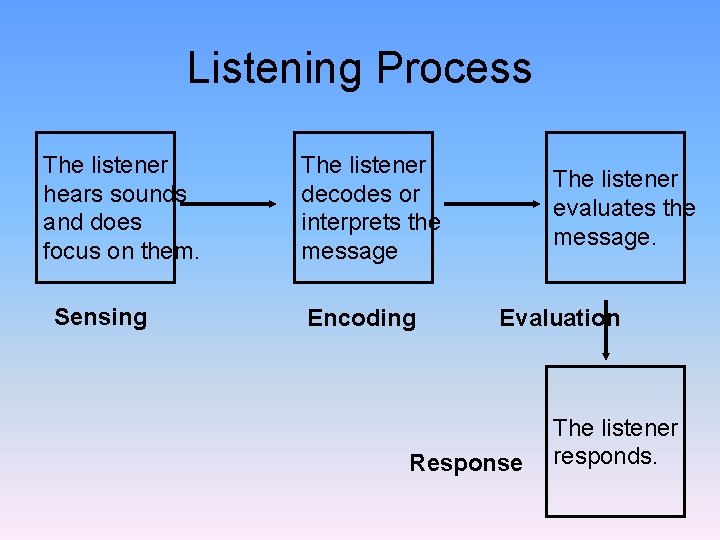
Listening Process The listener hears sounds and does focus on them. Sensing The listener decodes or interprets the message Encoding The listener evaluates the message. Evaluation Response The listener responds.
Questions For Self Assessment • Why is it necessary to ‘stop talking’? • Why is it necessary to go easy on argument and criticism? • Write a paragraph on the importance of silence as a means of communication.