
The Link between Individual Expectations and Savings Do
The Link between Individual Expectations and Savings: Do nursing home expectations matter? Kristin J. Kleinjans, University of Aarhus & RAND Jinkook Lee, Ohio State University Preliminary – comments and suggestions appreciated
Research Questions 1. Are expectations about future nursing home entry linked to actual entry? 2. Is there a relation between these expectations and savings behavior? 2 12/15/2021
Why do we care? In the US : • 40% chance of entering a nursing home for those who reach age 65 • 10% of those stay for at least 5 years • high cost of stay per year (average): US-$60, 000 for semi-private room US-$70, 000 for private room 3 12/15/2021
Why do we care? How are nursing home stays financed? • Medicaid (means tested) (1/3 of individuals when admitted, + 1/3 after savings depleted) • long-term care insurance (3% of total cost) • individual savings 4 12/15/2021
Then… • Do individuals form sensitive expectations about stay in NH? • Do individuals adjust their savings behavior in response to (change in) expectation? 5 12/15/2021
Why use Individual Expectations? • Give additional information otherwise not available • Have been found to have explanatory power (e. g. Hurd/ Mc. Garry 2002, subjective survival prob. ) • Have not yet really been linked to economic behavior (Hurd/ Smith/Zissimopoulus 2004, survival prob. and retirement found only small effects) 6 12/15/2021
Our (preliminary) Results 1. Are expectations about future nursing home entry linked to actual entry? 2. yes 2. Is there a relation between these expectations and savings behavior? positive for singles with (very) low positive wealth 7 12/15/2021
Data HRS 1992 -2002 (6 waves) Age of initial cohort: 51 - 61 + spouses Sample Size: 7, 600 households in 1992 AHEAD 1993 -2002 (5 waves) Age of initial cohort: 70 and older + spouses Working sample: 15, 089 respondents 8 12/15/2021
Survey Question: Probability of Entering Nursing Home "What is the percentage chance that you will move to a nursing home in the next five years? “ Possible answers: 0 to 100 refuse don’t know 9 12/15/2021
Survey Question: Probability of Entering Nursing Home "Nursing homes are institutions primarily for people who need constant nursing supervision or are incapable of living independently. Nursing supervision must be provided on a continuous basis for the institution to qualify as a nursing home. Please don't include stays in adult foster care facilities or other short-term stays in a hospital. “ (HRS respondents, and 1996 onwards) "Of course, nobody wants to go to a nursing home, but sometimes it becomes necessary. “ (AHEAD 1993 and 1995) 10 12/15/2021
What influences the probability of entering a nursing home? (geriatric, medical literature) Age (+), gender (women + ) Health, ADL, IADL Marital status, children (-), living siblings (-) Race (being white +) Education (+) Low income (+), net worth (-) 11 12/15/2021
Self-reported prob. of NH Entry - Low non-response rates: - Refusal: < 1% in all waves ”Dont know”: < 10% in all waves - rounding to the nearest 5% between 15% and 95% - bunching of answers: 0% and 50% - Evidence for rounding: health 12 12/15/2021
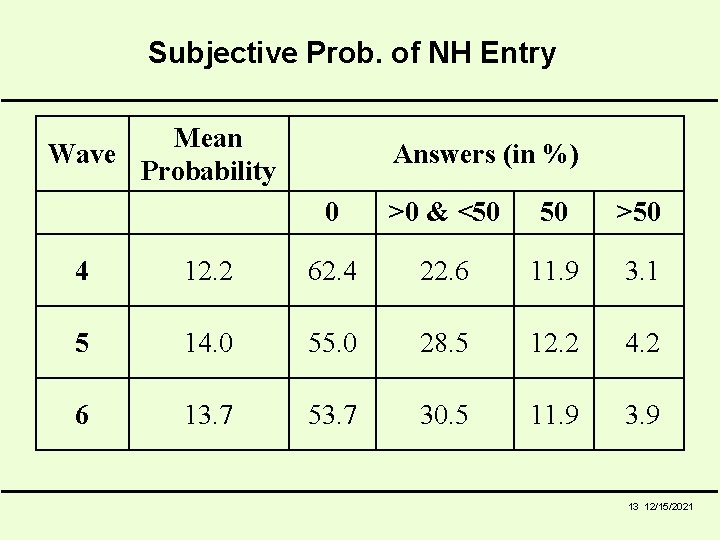
Subjective Prob. of NH Entry Mean Wave Probability Answers (in %) 0 >0 & <50 50 >50 4 12. 2 62. 4 22. 6 11. 9 3. 1 5 14. 0 55. 0 28. 5 12. 2 4. 2 6 13. 7 53. 7 30. 5 11. 9 3. 9 13 12/15/2021
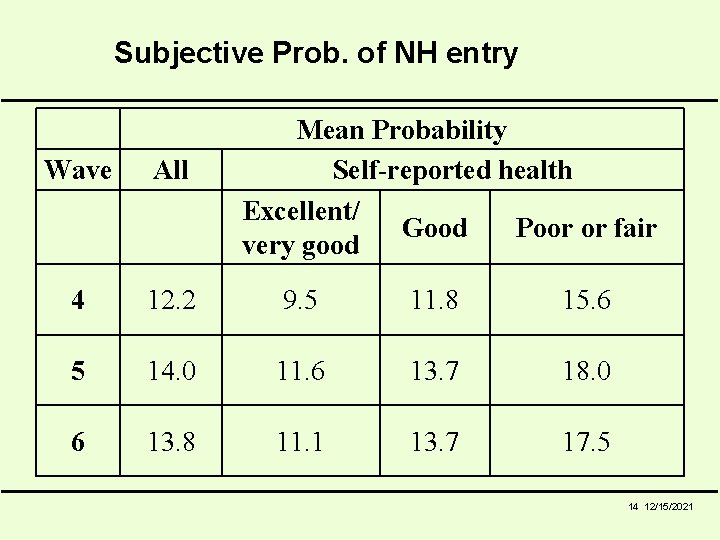
Subjective Prob. of NH entry Mean Probability Self-reported health Excellent/ Good Poor or fair very good Wave All 4 12. 2 9. 5 11. 8 15. 6 5 14. 0 11. 6 13. 7 18. 0 6 13. 8 11. 1 13. 7 17. 5 14 12/15/2021
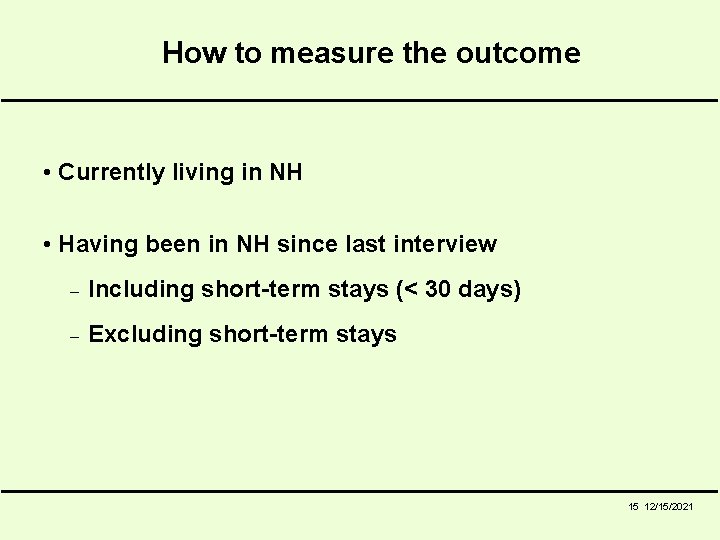
How to measure the outcome • Currently living in NH • Having been in NH since last interview - Including short-term stays (< 30 days) - Excluding short-term stays 15 12/15/2021
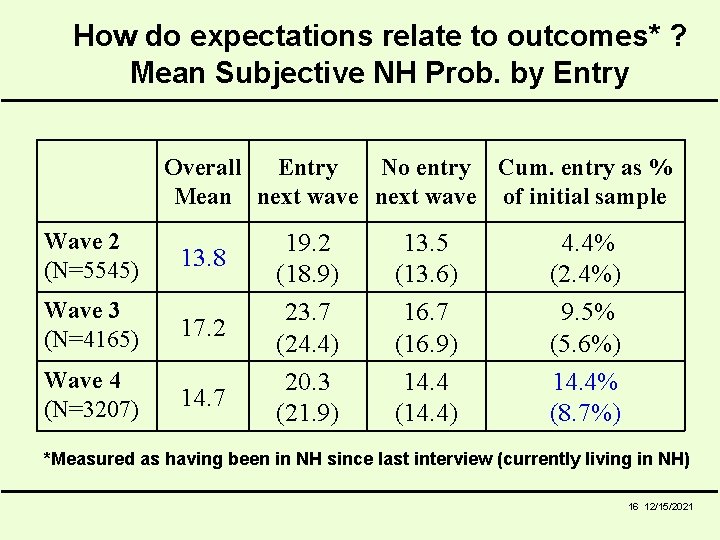
How do expectations relate to outcomes* ? Mean Subjective NH Prob. by Entry Overall Entry No entry Cum. entry as % Mean next wave of initial sample Wave 2 (N=5545) 13. 8 Wave 3 (N=4165) 17. 2 Wave 4 (N=3207) 14. 7 19. 2 (18. 9) 23. 7 (24. 4) 20. 3 (21. 9) 13. 5 (13. 6) 16. 7 (16. 9) 14. 4 (14. 4) 4. 4% (2. 4%) 9. 5% (5. 6%) 14. 4% (8. 7%) *Measured as having been in NH since last interview (currently living in NH) 16 12/15/2021
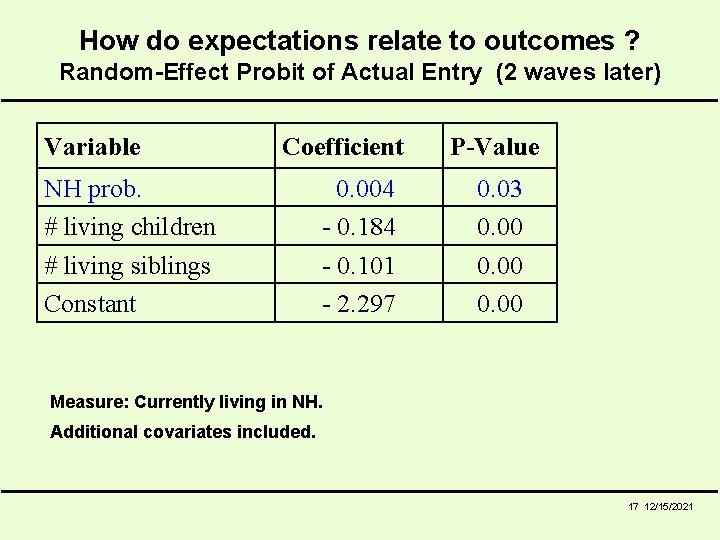
How do expectations relate to outcomes ? Random-Effect Probit of Actual Entry (2 waves later) Variable Coefficient NH prob. # living children # living siblings Constant 0. 004 - 0. 184 - 0. 101 - 2. 297 P-Value 0. 03 0. 00 Measure: Currently living in NH. Additional covariates included. 17 12/15/2021
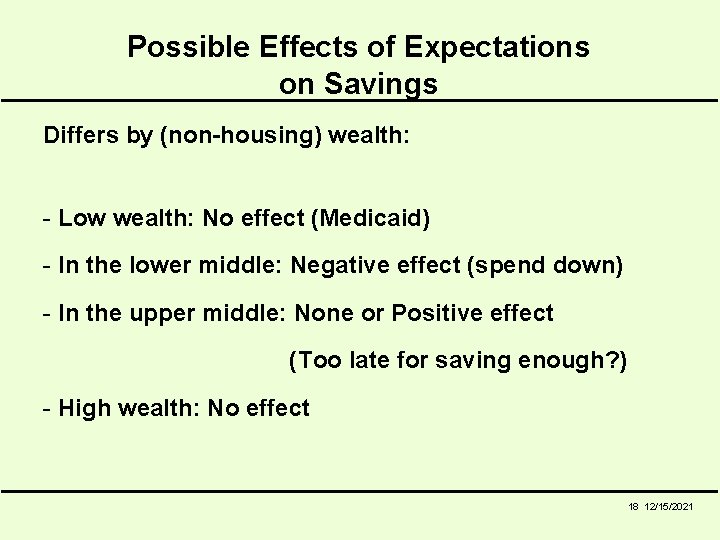
Possible Effects of Expectations on Savings Differs by (non-housing) wealth: - Low wealth: No effect (Medicaid) - In the lower middle: Negative effect (spend down) - In the upper middle: None or Positive effect (Too late for saving enough? ) - High wealth: No effect 18 12/15/2021
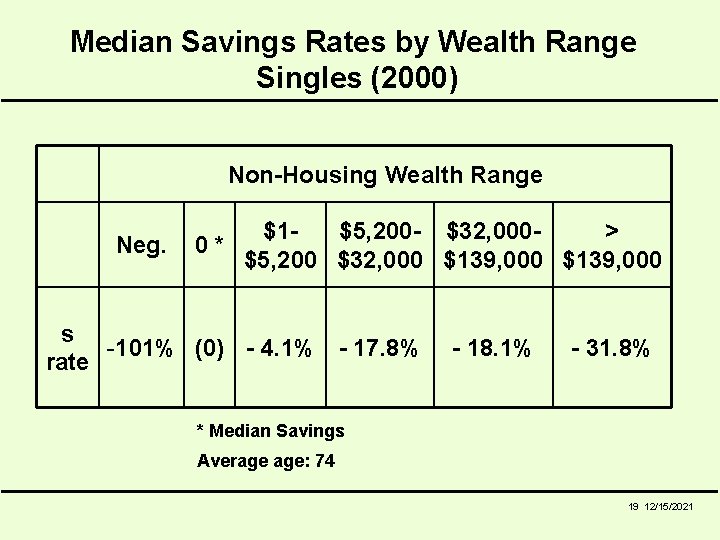
Median Savings Rates by Wealth Range Singles (2000) Non-Housing Wealth Range Neg. $1$5, 200 - $32, 000> 0* $5, 200 $32, 000 $139, 000 s -101% (0) - 4. 1% - 17. 8% rate - 18. 1% - 31. 8% * Median Savings Average age: 74 19 12/15/2021
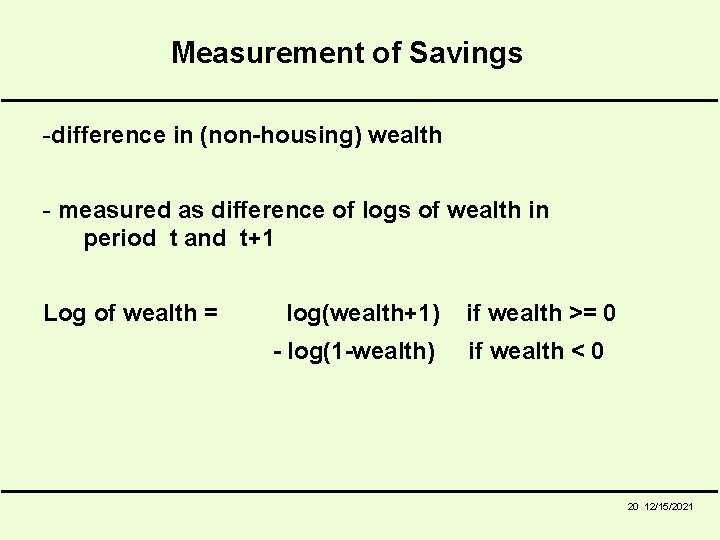
Measurement of Savings -difference in (non-housing) wealth - measured as difference of logs of wealth in period t and t+1 Log of wealth = log(wealth+1) - log(1 -wealth) if wealth >= 0 if wealth < 0 20 12/15/2021
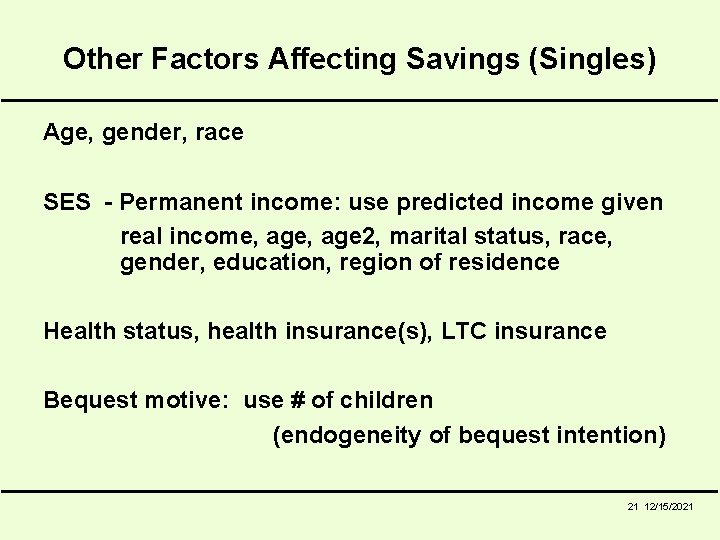
Other Factors Affecting Savings (Singles) Age, gender, race SES - Permanent income: use predicted income given real income, age 2, marital status, race, gender, education, region of residence Health status, health insurance(s), LTC insurance Bequest motive: use # of children (endogeneity of bequest intention) 21 12/15/2021
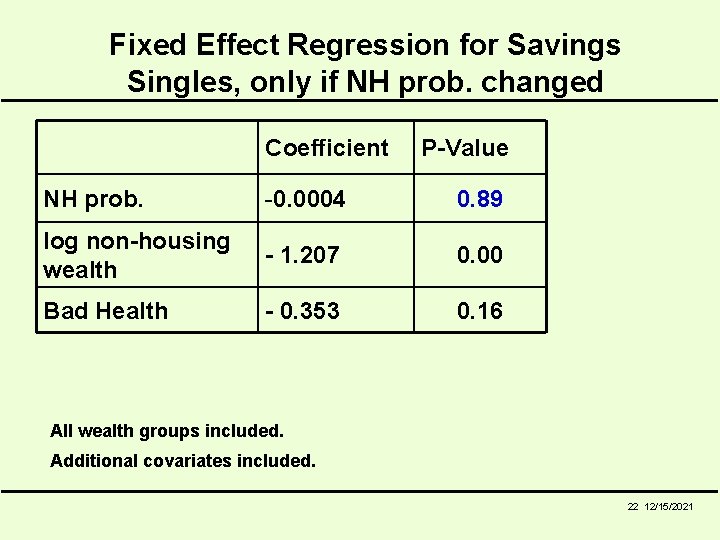
Fixed Effect Regression for Savings Singles, only if NH prob. changed Coefficient P-Value NH prob. -0. 0004 0. 89 log non-housing wealth - 1. 207 0. 00 Bad Health - 0. 353 0. 16 All wealth groups included. Additional covariates included. 22 12/15/2021
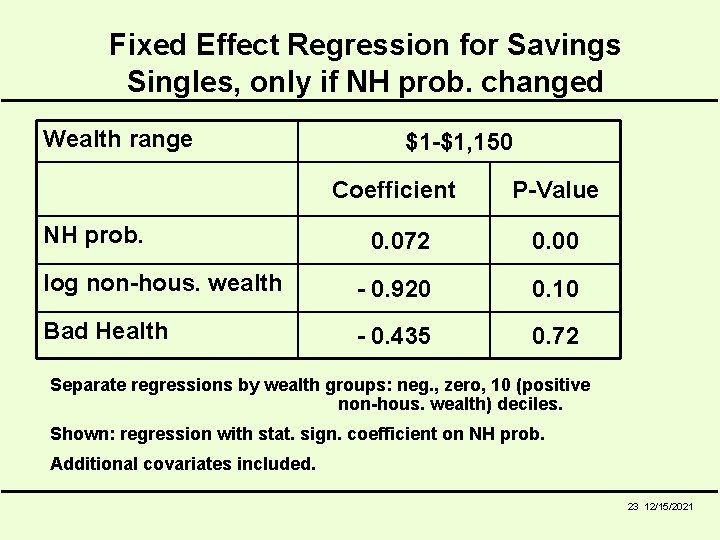
Fixed Effect Regression for Savings Singles, only if NH prob. changed Wealth range $1 -$1, 150 Coefficient P-Value 0. 072 0. 00 log non-hous. wealth - 0. 920 0. 10 Bad Health - 0. 435 0. 72 NH prob. Separate regressions by wealth groups: neg. , zero, 10 (positive non-hous. wealth) deciles. Shown: regression with stat. sign. coefficient on NH prob. Additional covariates included. 23 12/15/2021
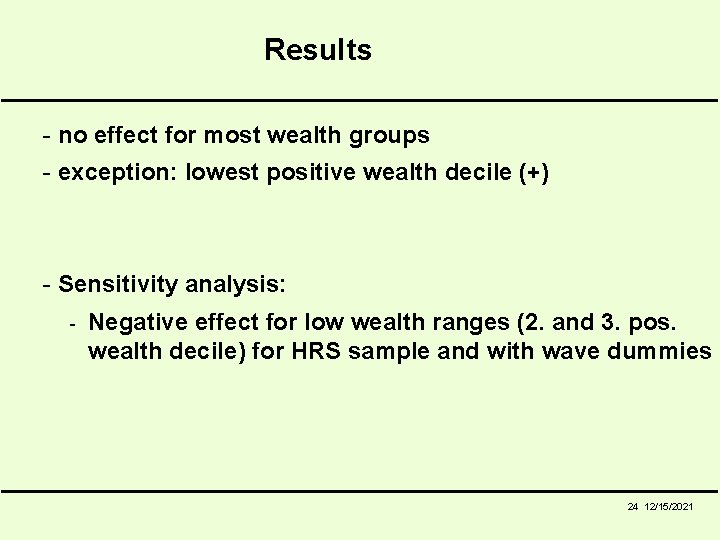
Results - no effect for most wealth groups - exception: lowest positive wealth decile (+) - Sensitivity analysis: - Negative effect for low wealth ranges (2. and 3. pos. wealth decile) for HRS sample and with wave dummies 24 12/15/2021
(Preliminary) Conclusions • Expectations related to risk of nursing home entry and actual entry • Positive effect on savings for those with very low but positive wealth • Some evidence for dissaving for those with slightly higher wealth 25 12/15/2021
Potential Problems • Endogenous non-random sample selection through deaths and NH entry Should bias coefficients downwards (1. decile) • Endogeneity of wealth Should be less of a problem since wealth was accumulated during work life 26 12/15/2021
Next Steps: Address Sample Selection Issues • Include deceased in sample for Part 1 (expectations versus outcomes) • Use IV estimation for Part II (effect on savings) Potential candidate: Number of living children works if death of child affects NH exp but not savings rate 27 12/15/2021
- Slides: 27