
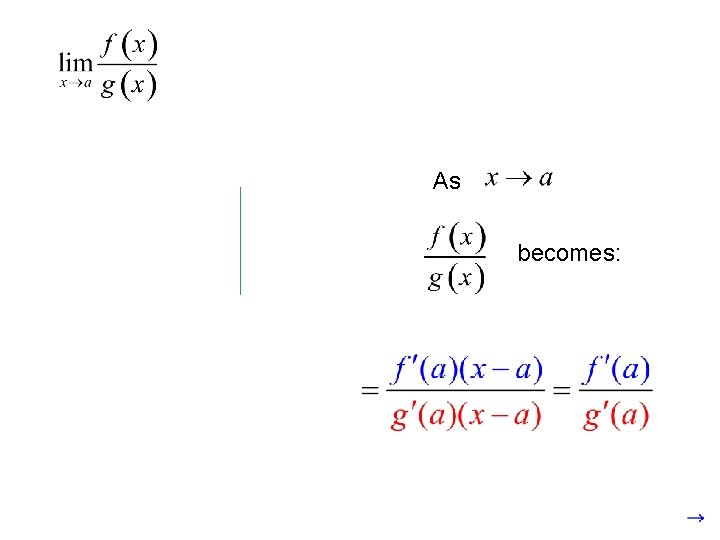
The limit is the ratio of the numerator

- Slides: 18
The limit is the ratio of the numerator over the denominator as x approaches a. If we zoom in far enough, the curves will appear as straight lines.
As becomes:
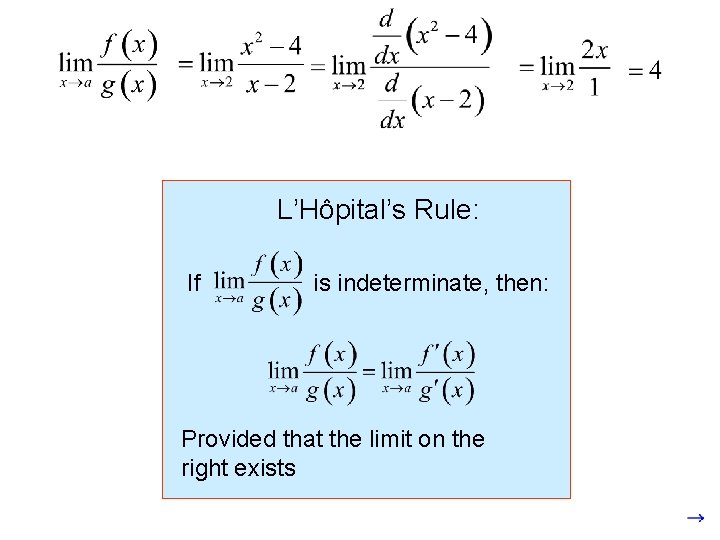
L’Hôpital’s Rule: If is indeterminate, then: Provided that the limit on the right exists
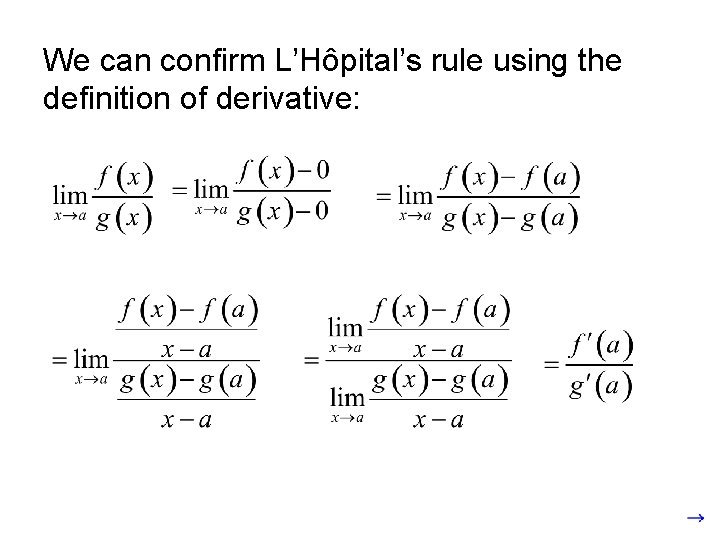
We can confirm L’Hôpital’s rule using the definition of derivative:
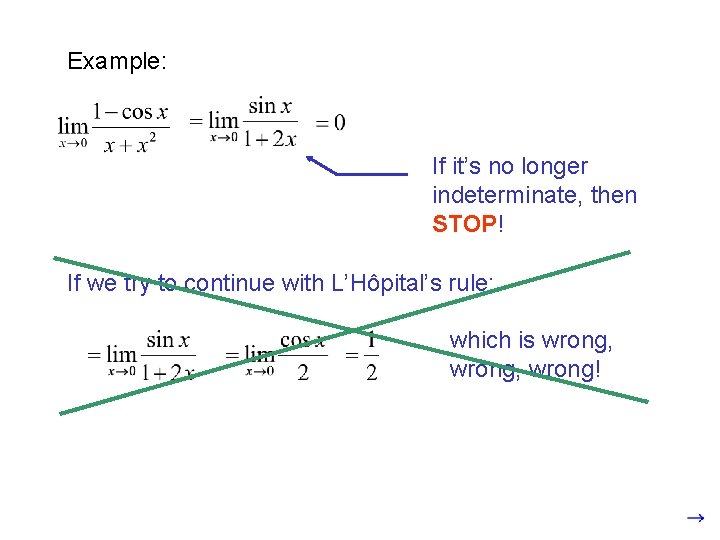
Example: If it’s no longer indeterminate, then STOP! If we try to continue with L’Hôpital’s rule: which is wrong, wrong!
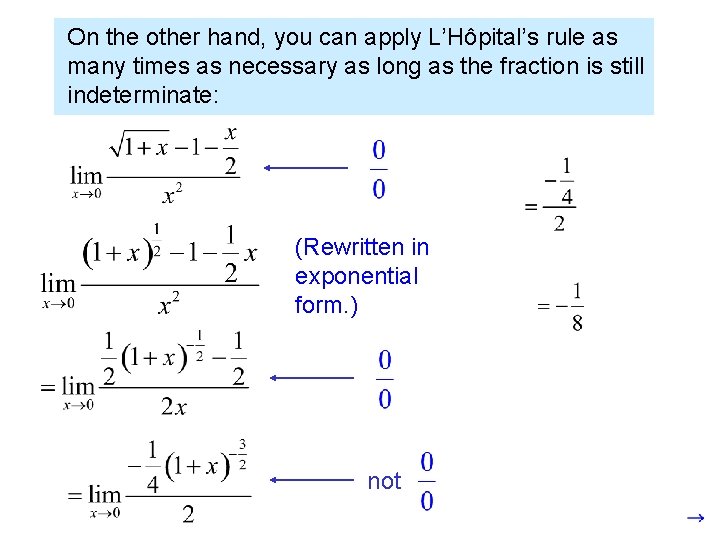
On the other hand, you can apply L’Hôpital’s rule as many times as necessary as long as the fraction is still indeterminate: (Rewritten in exponential form. ) not
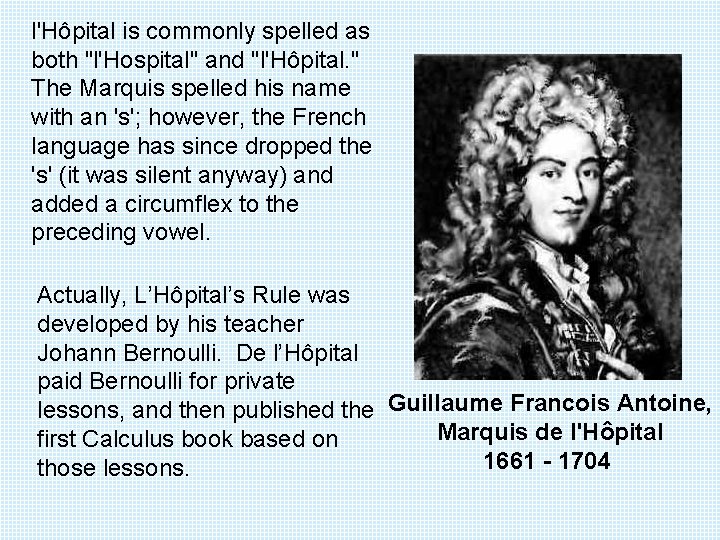
l'Hôpital is commonly spelled as both "l'Hospital" and "l'Hôpital. " The Marquis spelled his name with an 's'; however, the French language has since dropped the 's' (it was silent anyway) and added a circumflex to the preceding vowel. Actually, L’Hôpital’s Rule was developed by his teacher Johann Bernoulli. De l’Hôpital paid Bernoulli for private lessons, and then published the Guillaume Francois Antoine, Marquis de l'Hôpital first Calculus book based on 1661 - 1704 those lessons.
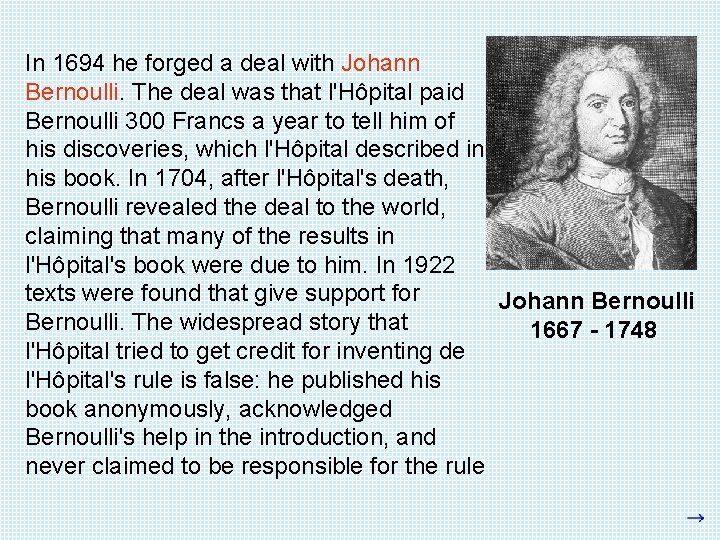
In 1694 he forged a deal with Johann Bernoulli. The deal was that l'Hôpital paid Bernoulli 300 Francs a year to tell him of his discoveries, which l'Hôpital described in his book. In 1704, after l'Hôpital's death, Bernoulli revealed the deal to the world, claiming that many of the results in l'Hôpital's book were due to him. In 1922 texts were found that give support for Johann Bernoulli. The widespread story that 1667 - 1748 l'Hôpital tried to get credit for inventing de l'Hôpital's rule is false: he published his book anonymously, acknowledged Bernoulli's help in the introduction, and never claimed to be responsible for the rule
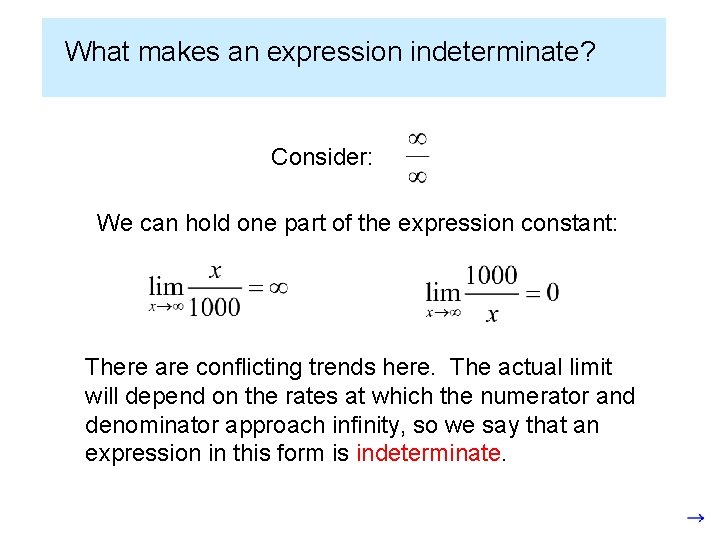
What makes an expression indeterminate? Consider: We can hold one part of the expression constant: There are conflicting trends here. The actual limit will depend on the rates at which the numerator and denominator approach infinity, so we say that an expression in this form is indeterminate.
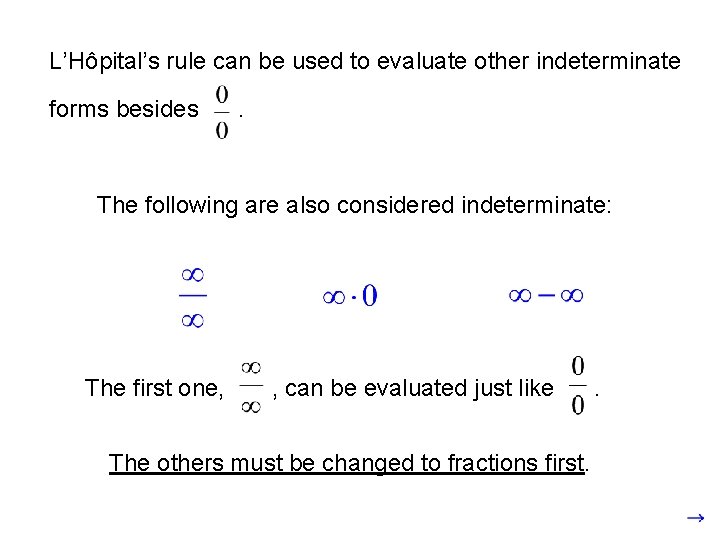
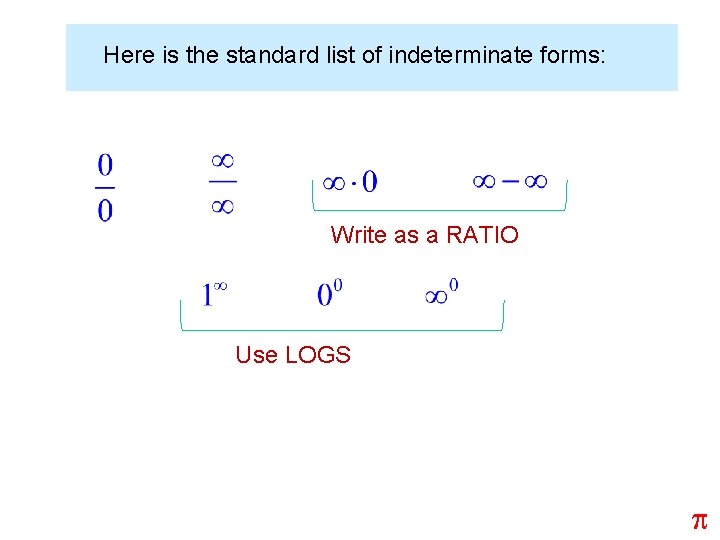
L’Hôpital’s rule can be used to evaluate other indeterminate forms besides . The following are also considered indeterminate: The first one, , can be evaluated just like The others must be changed to fractions first. .
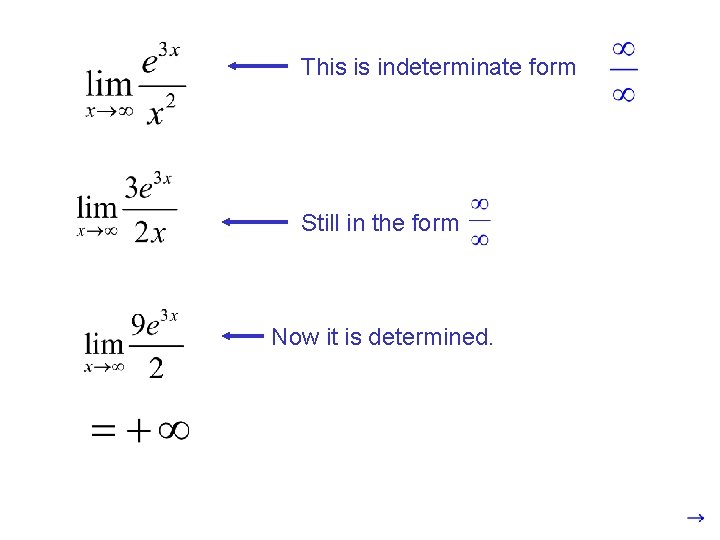
This is indeterminate form Still in the form Now it is determined.
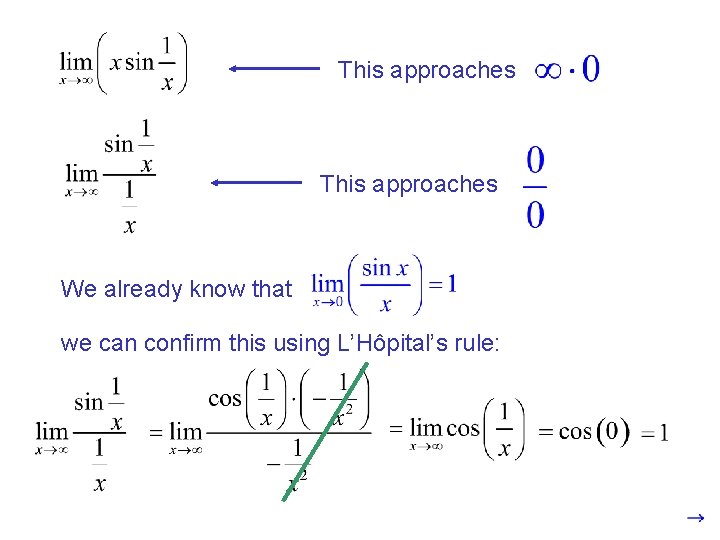
This approaches We already know that we can confirm this using L’Hôpital’s rule:
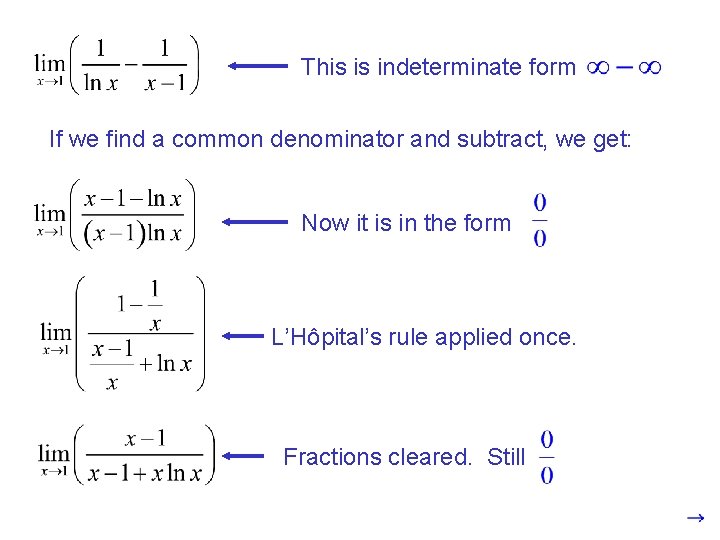
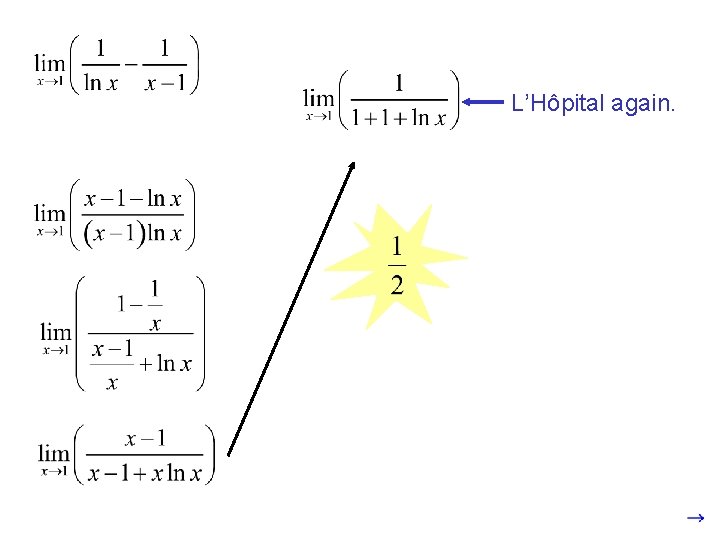
This is indeterminate form If we find a common denominator and subtract, we get: Now it is in the form L’Hôpital’s rule applied once. Fractions cleared. Still
L’Hôpital again.
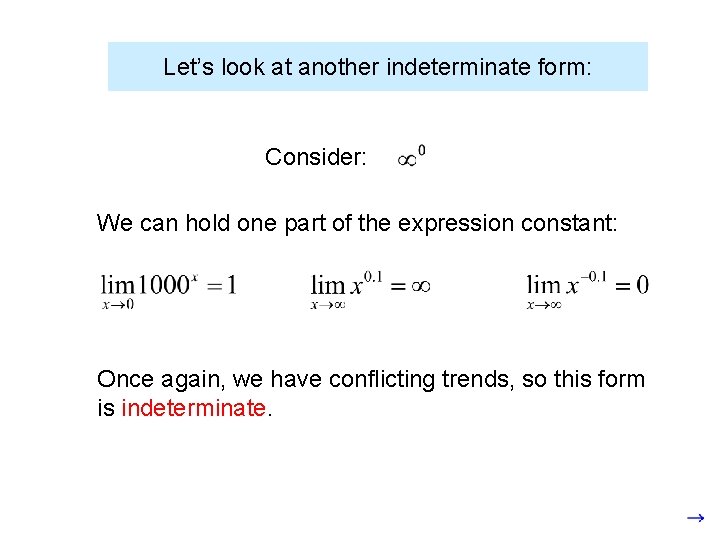
Let’s look at another indeterminate form: Consider: We can hold one part of the expression constant: Once again, we have conflicting trends, so this form is indeterminate.
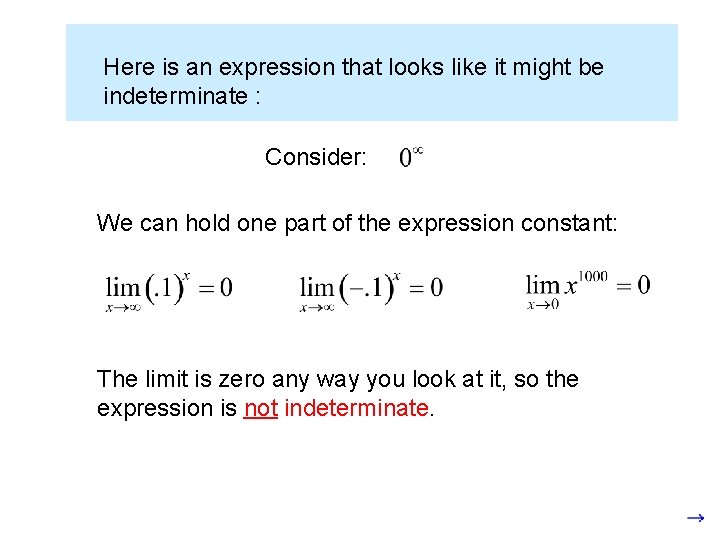
Here is an expression that looks like it might be indeterminate : Consider: We can hold one part of the expression constant: The limit is zero any way you look at it, so the expression is not indeterminate.
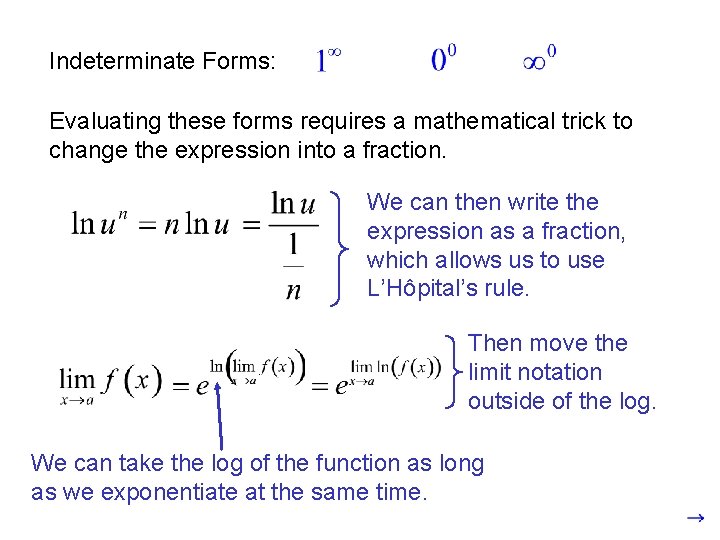
Indeterminate Forms: Evaluating these forms requires a mathematical trick to change the expression into a fraction. We can then write the expression as a fraction, which allows us to use L’Hôpital’s rule. When we take the log of an exponential function, the exponent can be moved out front. Then move the limit notation outside of the log. We can take the log of the function as long as we exponentiate at the same time.
Here is the standard list of indeterminate forms: Write as a RATIO Use LOGS p