
The Light Field Light field radiance function on

- Slides: 43
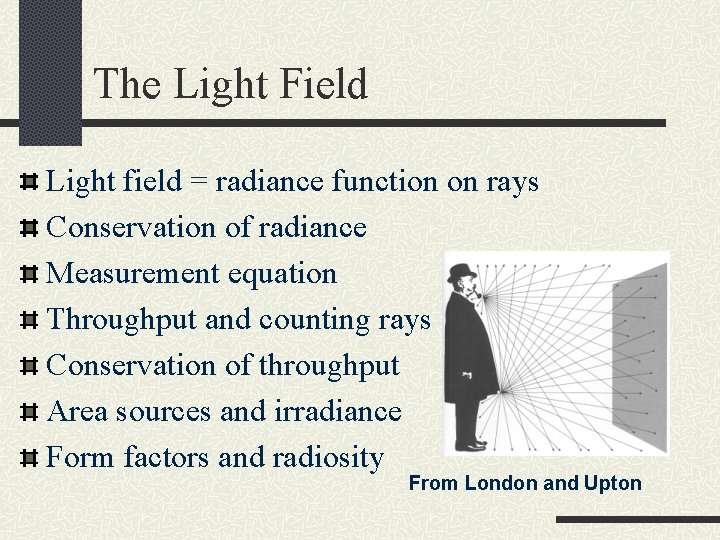
The Light Field Light field = radiance function on rays Conservation of radiance Measurement equation Throughput and counting rays Conservation of throughput Area sources and irradiance Form factors and radiosity From London and Upton
Light Field = Radiance(Ray)
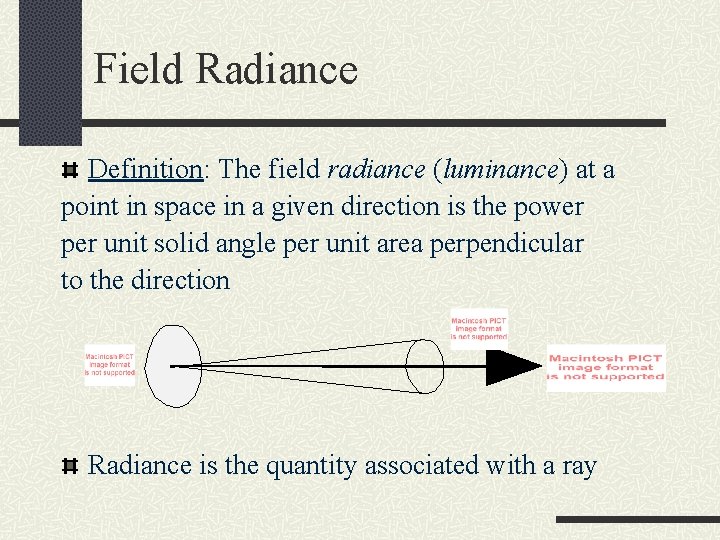
Field Radiance Definition: The field radiance (luminance) at a point in space in a given direction is the power per unit solid angle per unit area perpendicular to the direction Radiance is the quantity associated with a ray
Properties of Radiance
Properties of Radiance Fundamental field quantity that characterizes the distribution of light in an environment. n n Radiance is a function on rays All other field quantities are derived from it Radiance invariant along a ray. n 5 D ray space reduces to 4 D Response of a sensor proportional to radiance.
1 st Law: Conservation of Radiance The radiance in the direction of a light ray remains constant as the ray propagates
1 st Law: Conservation of Radiance The radiance in the direction of a light ray remains constant as the ray propagates
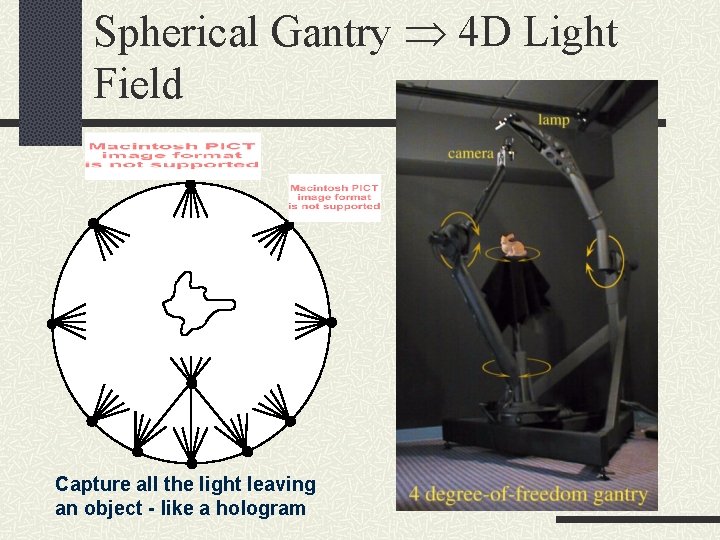
Spherical Gantry 4 D Light Field Capture all the light leaving an object - like a hologram
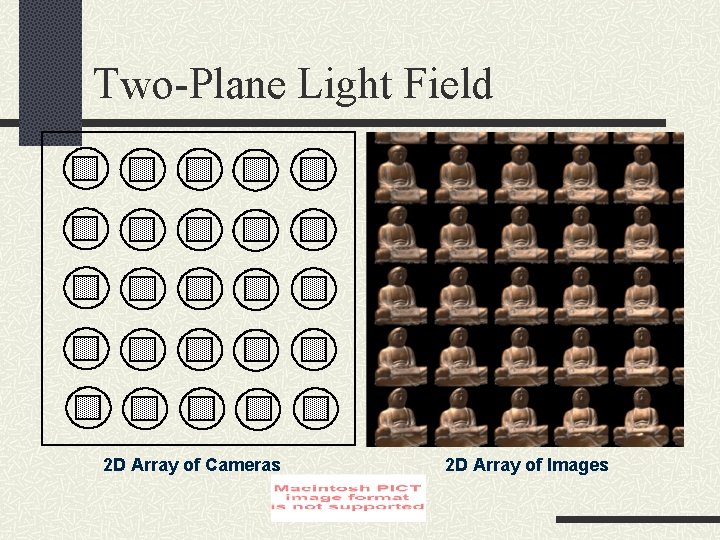
Two-Plane Light Field 2 D Array of Cameras 2 D Array of Images
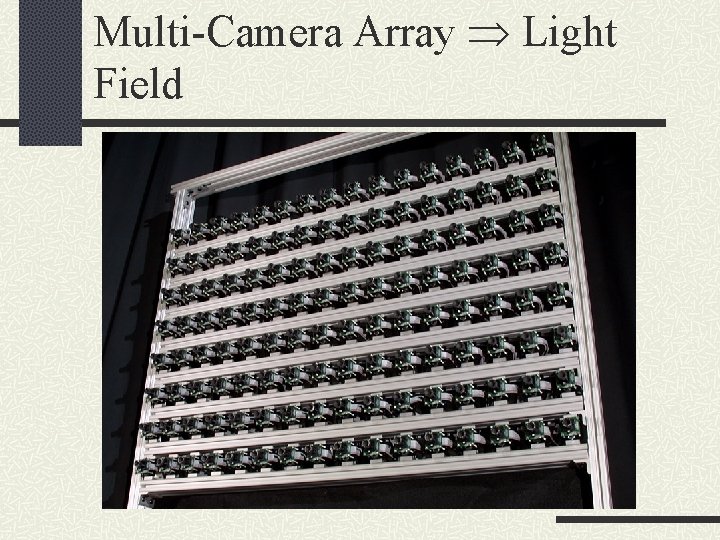
Multi-Camera Array Light Field
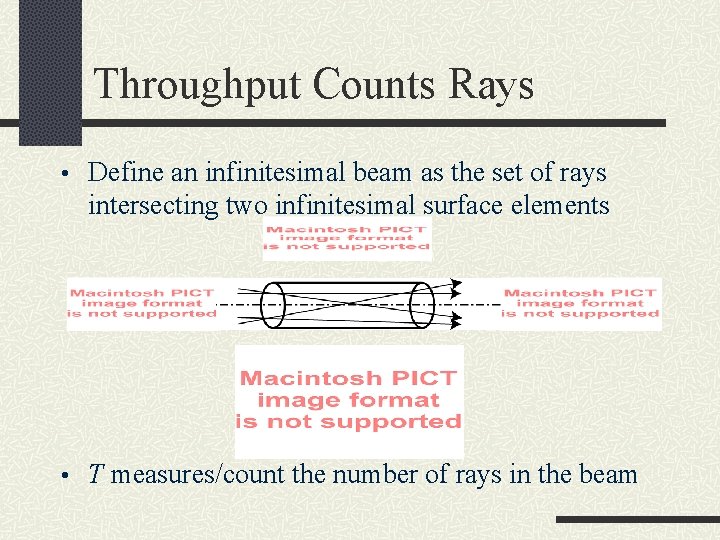
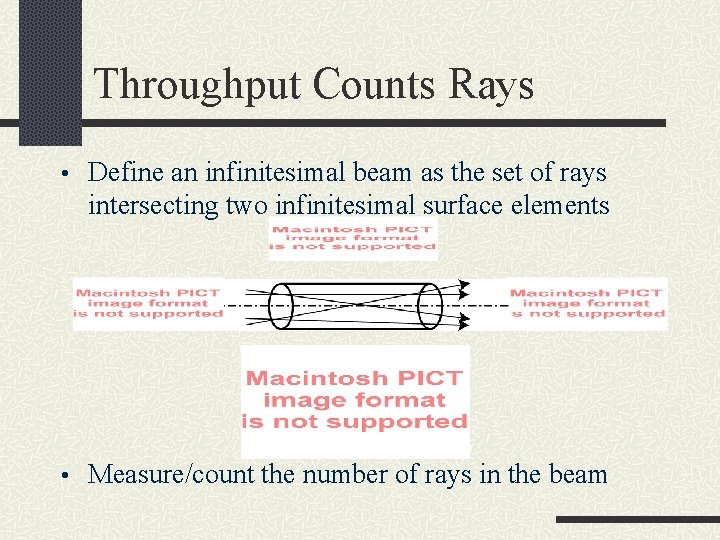
Throughput Counts Rays • Define an infinitesimal beam as the set of rays intersecting two infinitesimal surface elements • T measures/count the number of rays in the beam
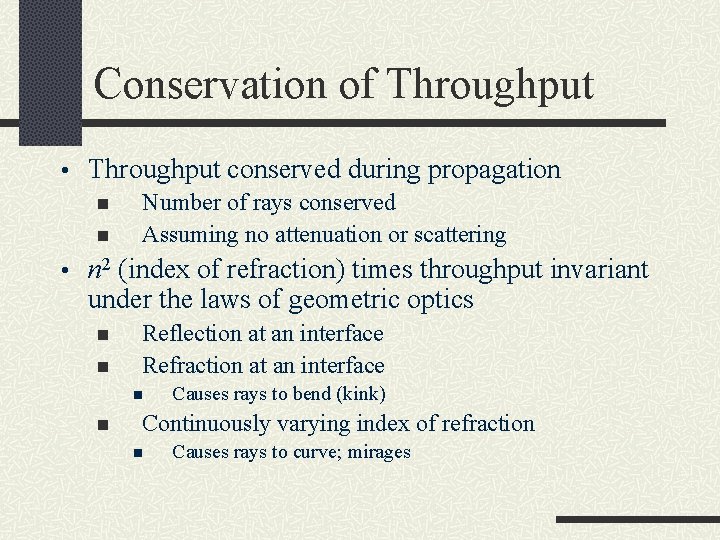
Conservation of Throughput • Throughput conserved during propagation n Number of rays conserved n Assuming no attenuation or scattering • n 2 (index of refraction) times throughput invariant under the laws of geometric optics n n Reflection at an interface Refraction at an interface n n Causes rays to bend (kink) Continuously varying index of refraction n Causes rays to curve; mirages
Conservation of Radiance is the ratio of two quantities: 1. Power 2. Throughput Since power and throughput are conserved, Radiance conserved
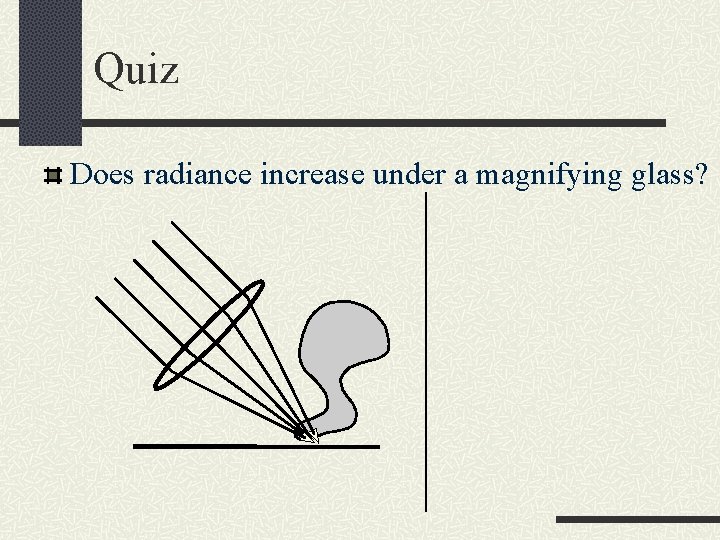
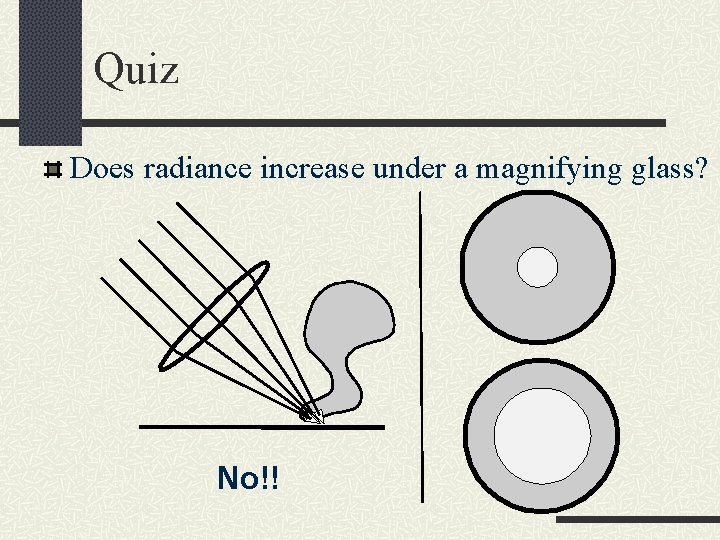
Quiz Does radiance increase under a magnifying glass?
Quiz Does radiance increase under a magnifying glass? No!!
Radiance: 2 nd Law The response of a sensor is proportional to the radiance of the surface visible to the sensor. Aperture Sensor L is what should be computed and displayed. T quantifies the gathering power of the device; the higher the throughput the greater the amount of light gathered
Quiz Does the brightness that a wall appears to the sensor depend on the distance?
Measuring Rays = Throughput
Throughput Counts Rays • Define an infinitesimal beam as the set of rays intersecting two infinitesimal surface elements • Measure/count the number of rays in the beam
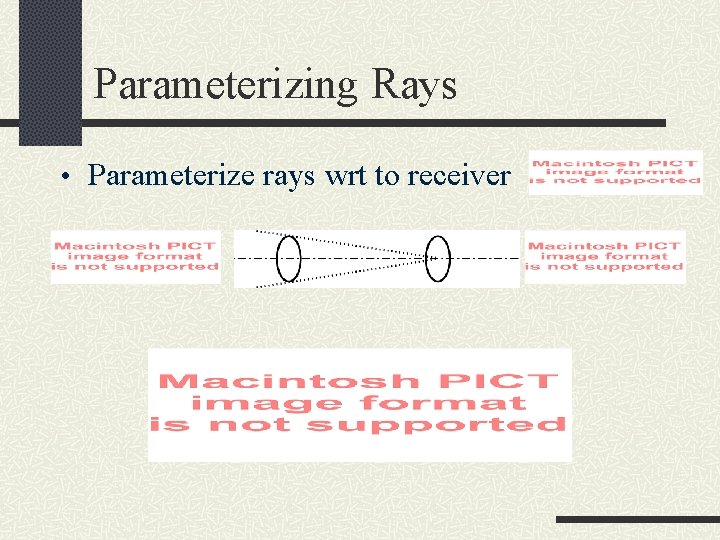
Parameterizing Rays • Parameterize rays wrt to receiver
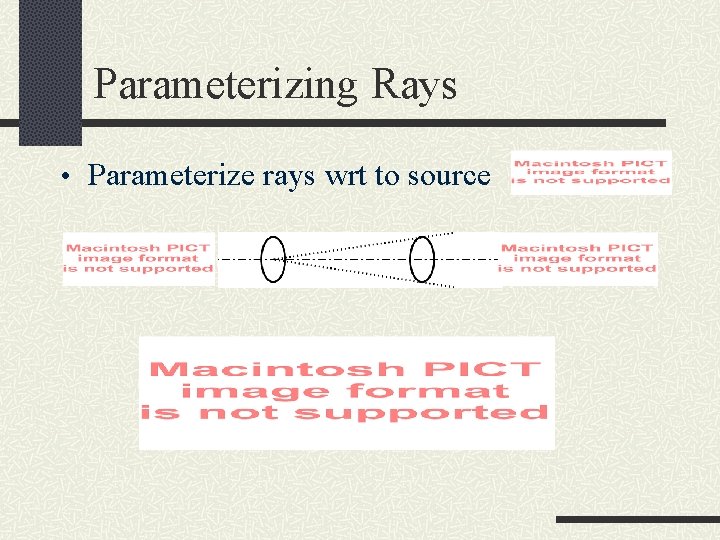
Parameterizing Rays • Parameterize rays wrt to source
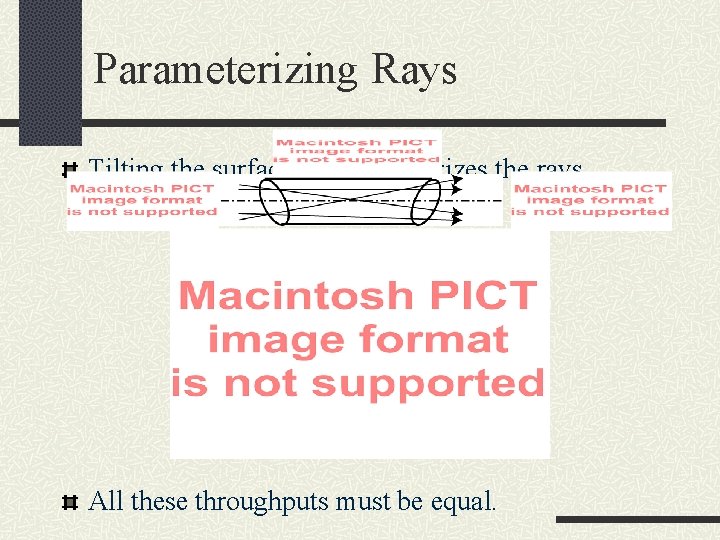
Parameterizing Rays Tilting the surfaces reparameterizes the rays All these throughputs must be equal.
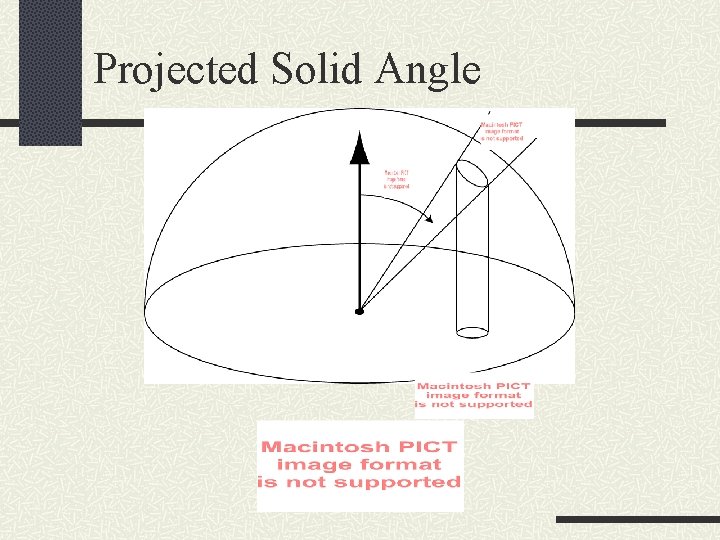
Projected Solid Angle
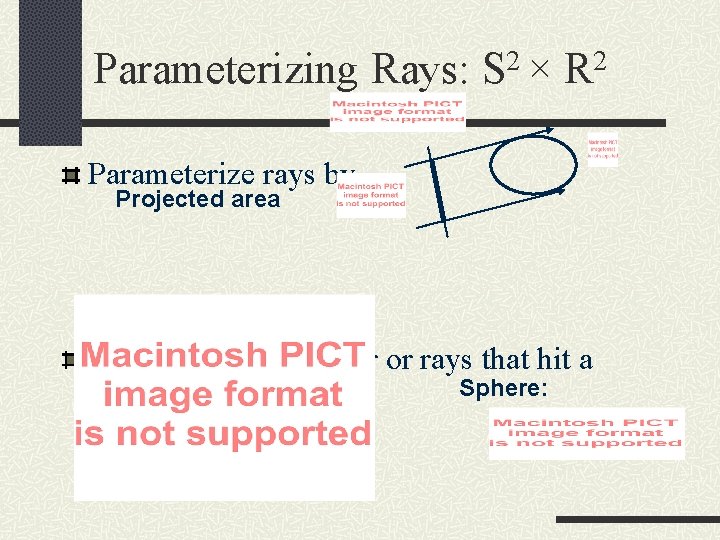
Parameterizing Rays: S 2 × R 2 Parameterize rays by Projected area Measuring the number or rays that hit a Sphere: shape
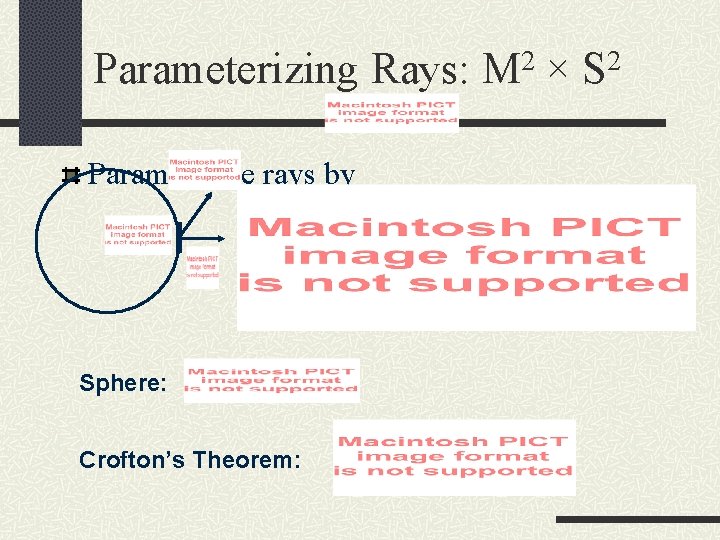
Parameterizing Rays: M 2 × S 2 Parameterize rays by Sphere: Crofton’s Theorem:
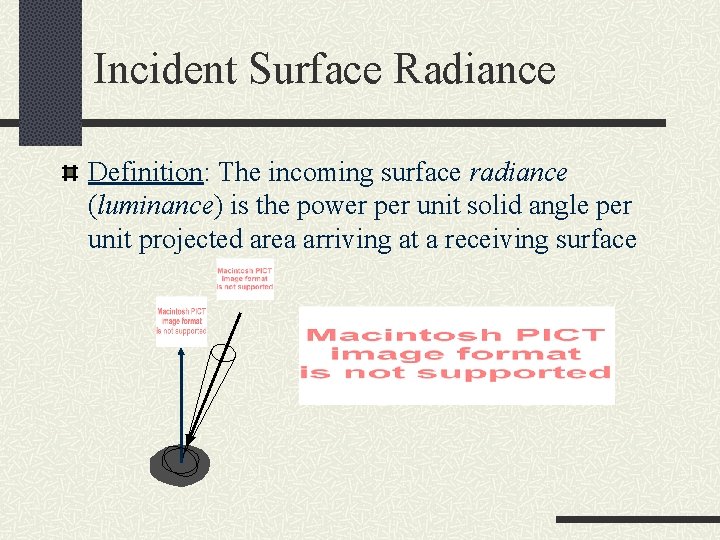
Incident Surface Radiance Definition: The incoming surface radiance (luminance) is the power per unit solid angle per unit projected area arriving at a receiving surface
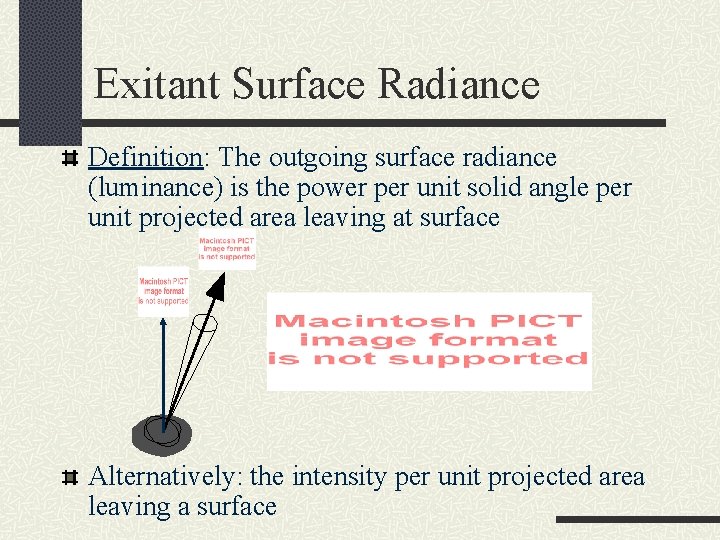
Exitant Surface Radiance Definition: The outgoing surface radiance (luminance) is the power per unit solid angle per unit projected area leaving at surface Alternatively: the intensity per unit projected area leaving a surface
Irradiance from a Uniform Area Source
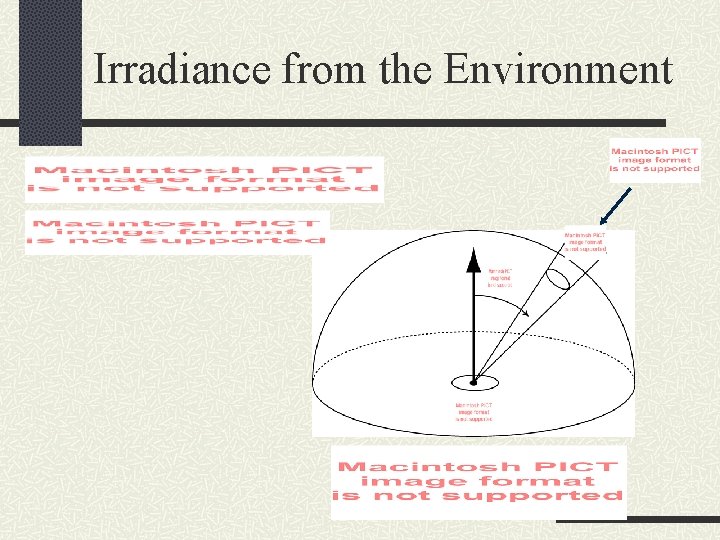
Irradiance from the Environment
Uniform Area Source
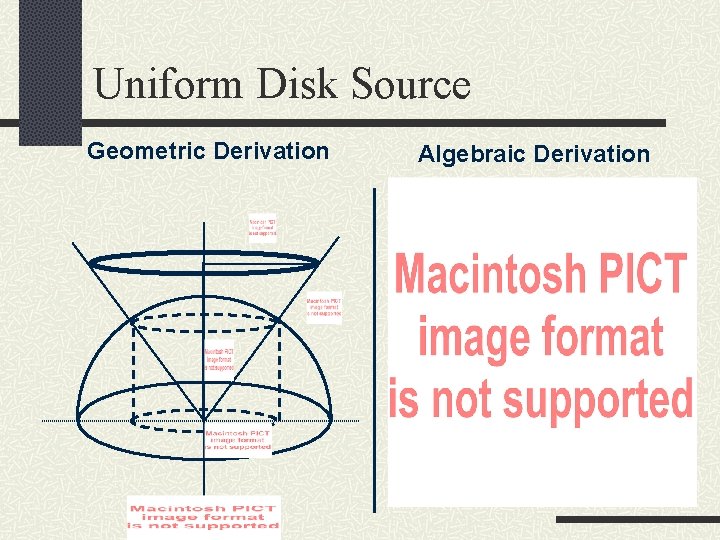
Uniform Disk Source Geometric Derivation Algebraic Derivation
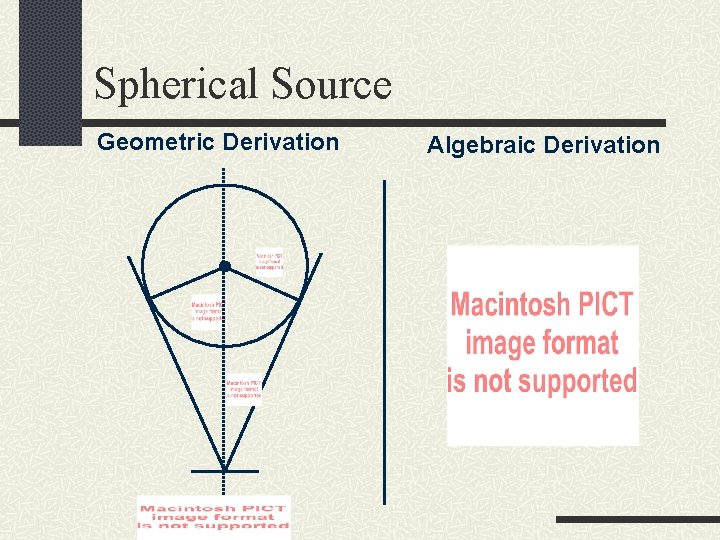
Spherical Source Geometric Derivation Algebraic Derivation
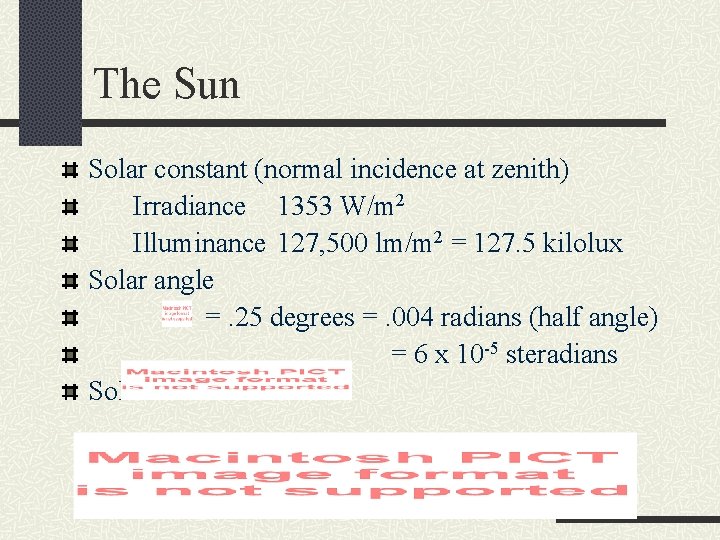
The Sun Solar constant (normal incidence at zenith) Irradiance 1353 W/m 2 Illuminance 127, 500 lm/m 2 = 127. 5 kilolux Solar angle =. 25 degrees =. 004 radians (half angle) = 6 x 10 -5 steradians Solar radiance
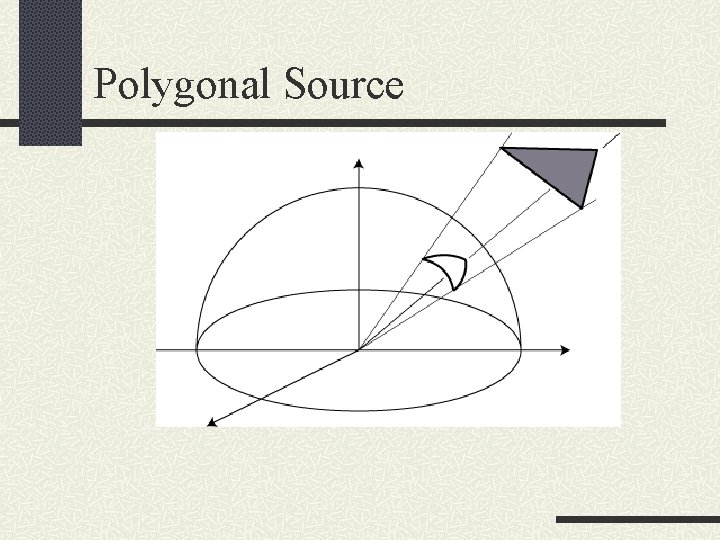
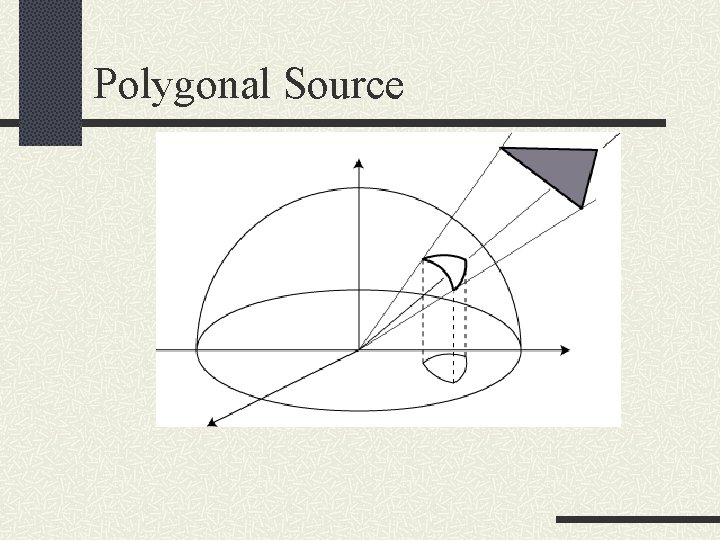
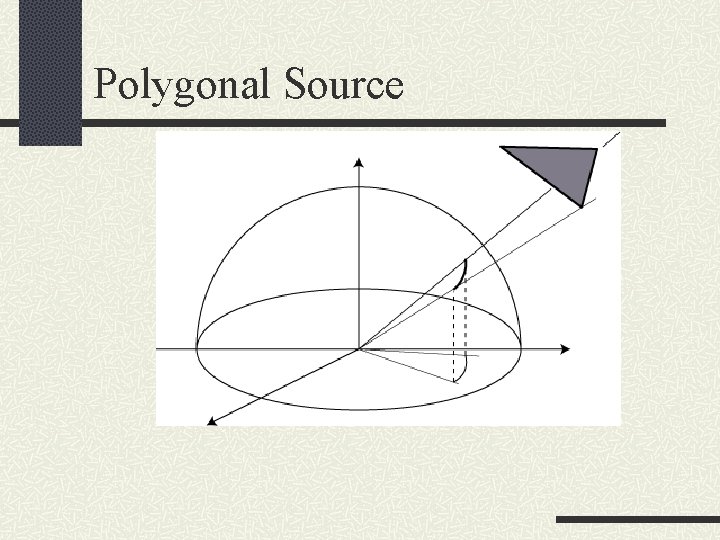
Polygonal Source
Polygonal Source
Polygonal Source
Form Factors
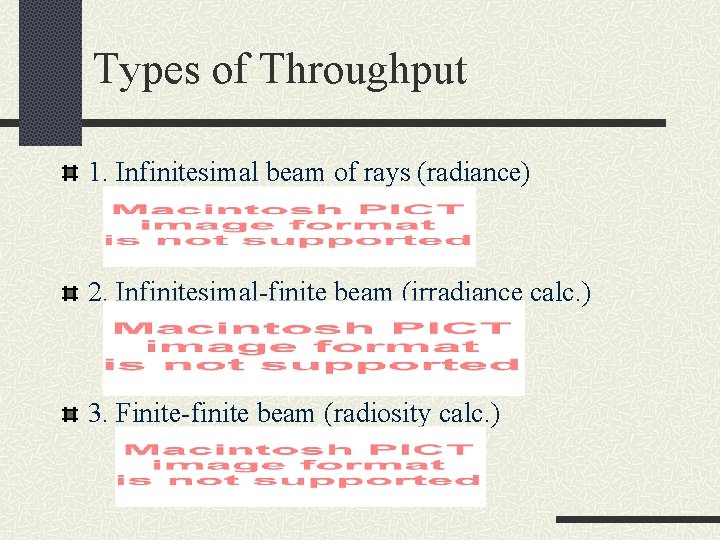
Types of Throughput 1. Infinitesimal beam of rays (radiance) 2. Infinitesimal-finite beam (irradiance calc. ) 3. Finite-finite beam (radiosity calc. )
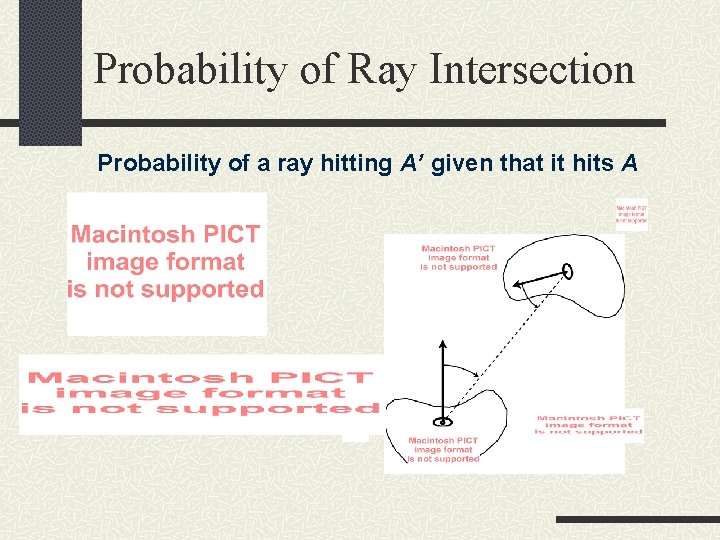
Probability of Ray Intersection Probability of a ray hitting A’ given that it hits A
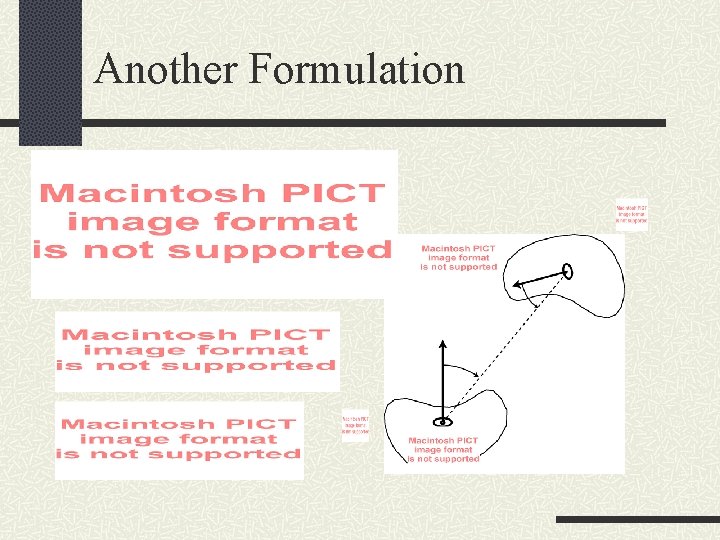
Another Formulation
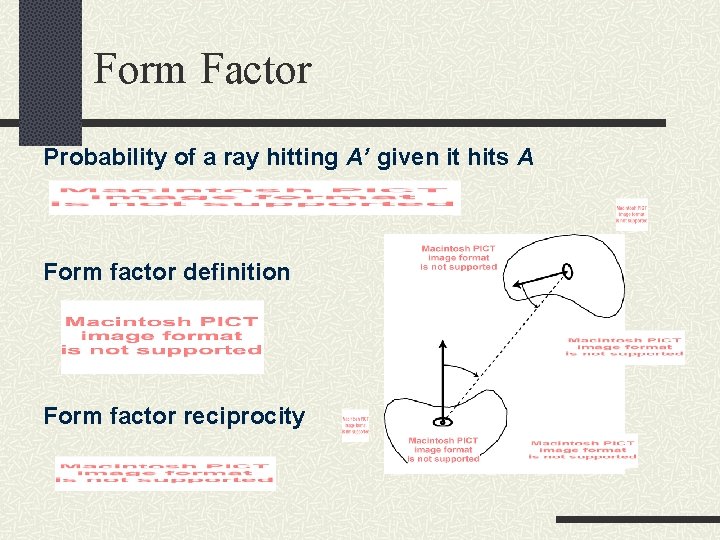
Form Factor Probability of a ray hitting A’ given it hits A Form factor definition Form factor reciprocity
Radiosity • Power transfer from a constant radiance source • Set up system of equations representing power transfers between objects
Form Factors and Throughput Form factors represent the probability of ray leaving a surface intersecting another surface n Only a function of surface geometry Differential form factor n Irradiance calculations Form factors n Radiosity calculations (energy balance)