
The Lifecycle and Cascade of We Chat Social
- Slides: 22
The Lifecycle and Cascade of We. Chat Social Messaging Groups Jiezhong Qiu† , Yixuan Li#, Jie Tang† , Zheng Lu‡ , Hao Ye‡ , Bo Chen‡, Qiang Yang* and John E. Hopcroft# † Tsinghua University # Cornell University ‡ Tencent Corporation, Beijing, China * Hong Kong University of Science and Technology 1
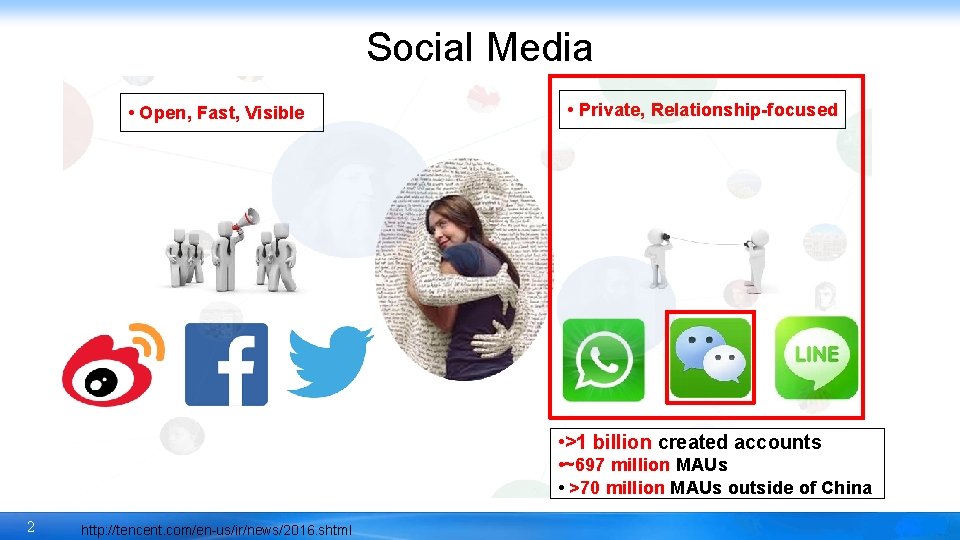
Social Media • Open, Fast, Visible • Private, Relationship-focused • >1 billion created accounts • ~697 million MAUs • >70 million MAUs outside of China 2 http: //tencent. com/en-us/ir/news/2016. shtml
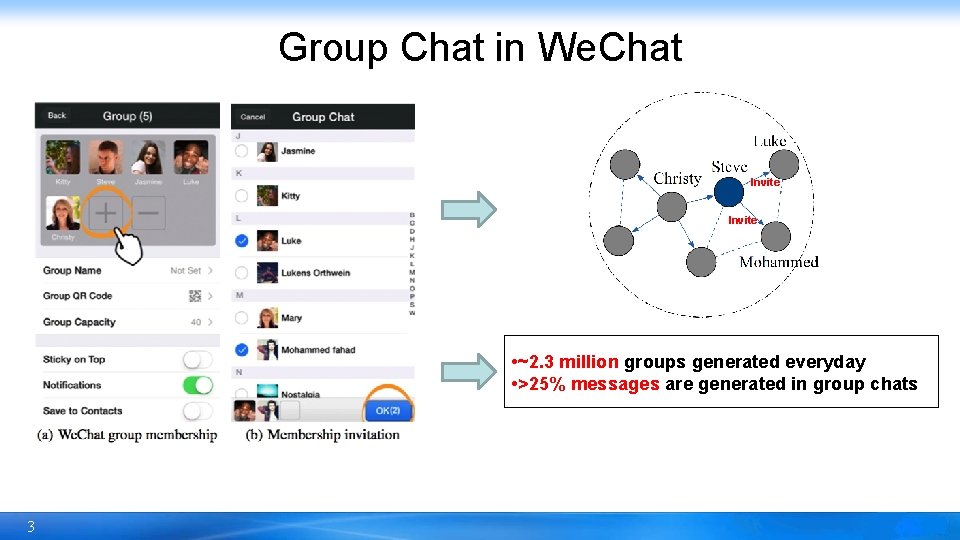
Group Chat in We. Chat Invite • ~2. 3 million groups generated everyday • >25% messages are generated in group chats 3
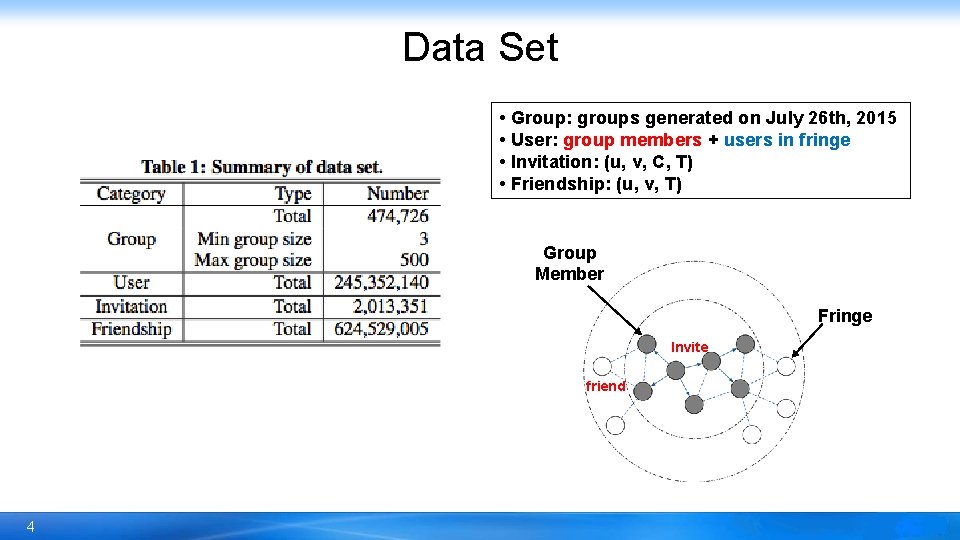
Data Set • Group: groups generated on July 26 th, 2015 • User: group members + users in fringe • Invitation: (u, v, C, T) • Friendship: (u, v, T) Group Member Fringe Invite friend 4
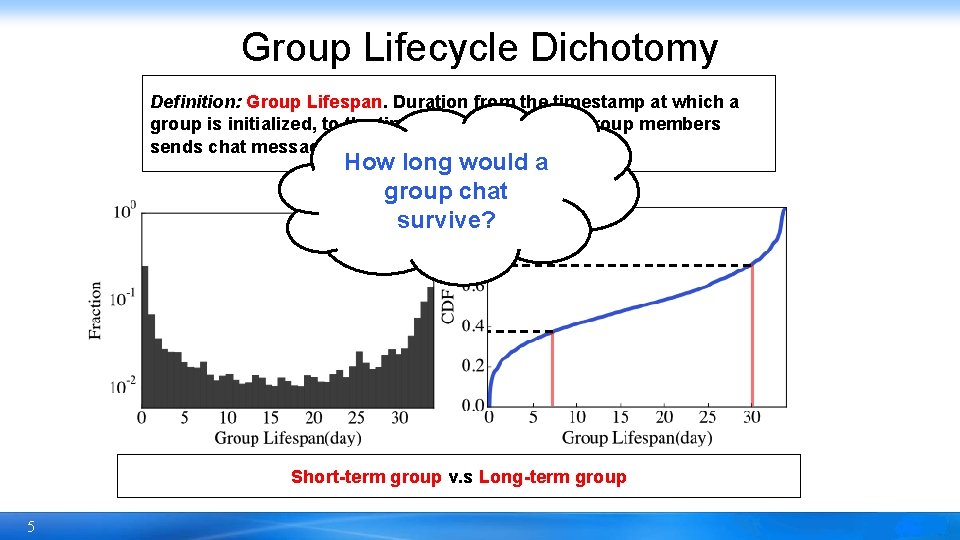
Group Lifecycle Dichotomy Definition: Group Lifespan. Duration from the timestamp at which a group is initialized, to the timestamp at which no group members sends chat messages anymore. How long would a group chat survive? Short-term group v. s Long-term group 5
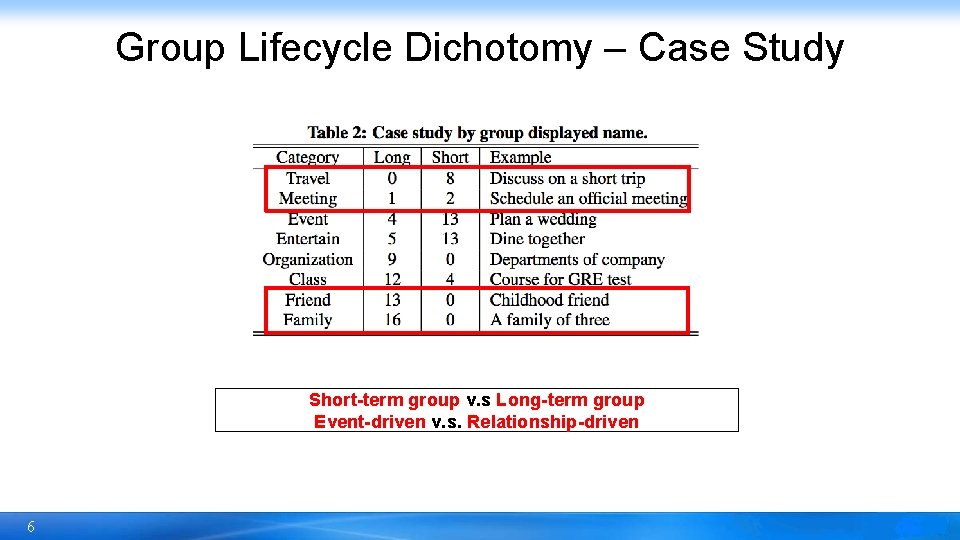
Group Lifecycle Dichotomy – Case Study Short-term group v. s Long-term group Event-driven v. s. Relationship-driven 6
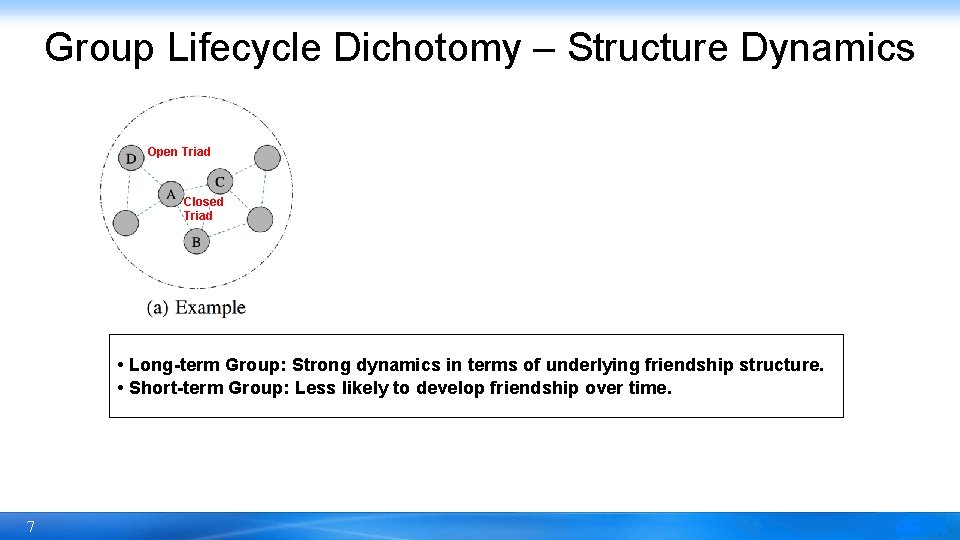
Group Lifecycle Dichotomy – Structure Dynamics Open Triad Closed Triad • Long-term Group: Strong dynamics in terms of underlying friendship structure. • Short-term Group: Less likely to develop friendship over time. 7
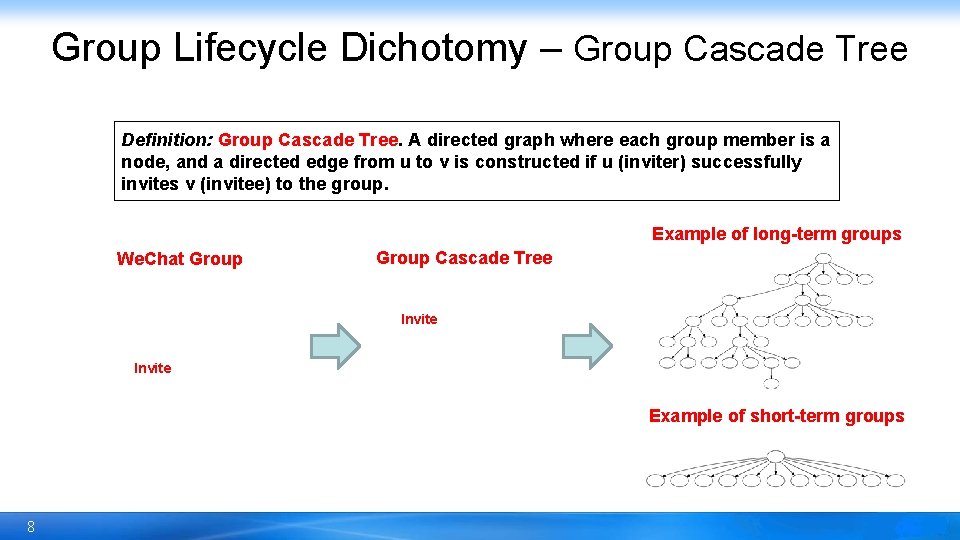
Group Lifecycle Dichotomy – Group Cascade Tree Definition: Group Cascade Tree. A directed graph where each group member is a node, and a directed edge from u to v is constructed if u (inviter) successfully invites v (invitee) to the group. Example of long-term groups We. Chat Group Cascade Tree Invite Example of short-term groups 8
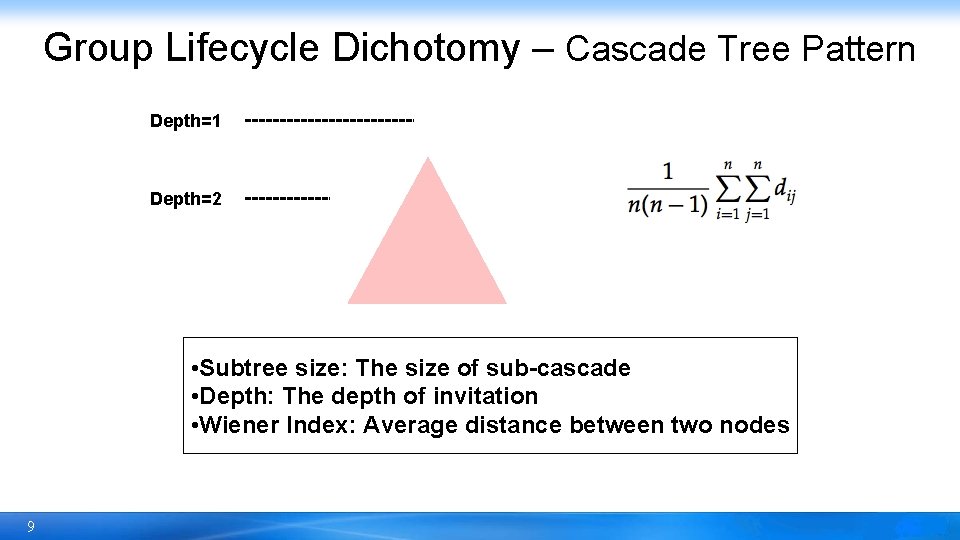
Group Lifecycle Dichotomy – Cascade Tree Pattern Depth=1 Depth=2 • Subtree size: The size of sub-cascade • Depth: The depth of invitation • Wiener Index: Average distance between two nodes 9
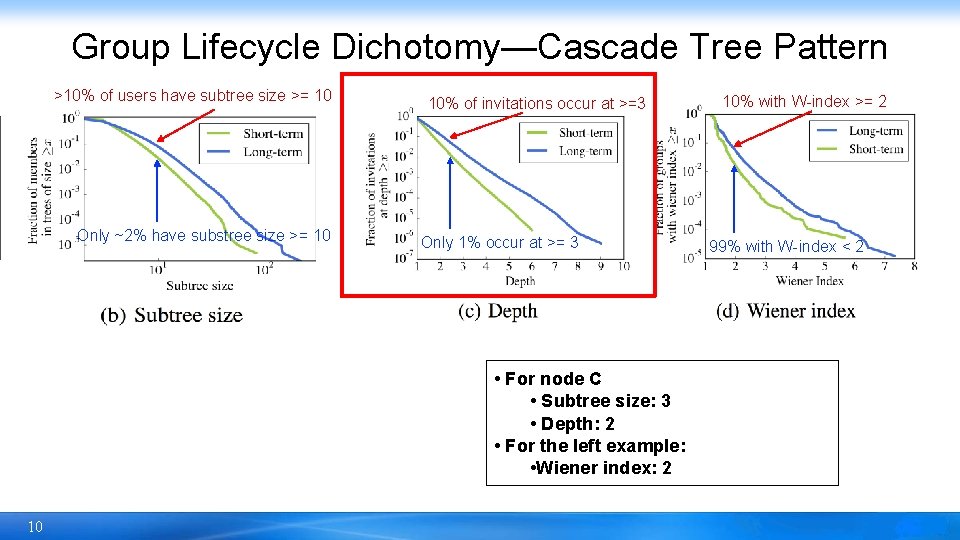
Group Lifecycle Dichotomy—Cascade Tree Pattern >10% of users have subtree size >= 10 Only ~2% have substree size >= 10 10% of invitations occur at >=3 Only 1% occur at >= 3 • For node C • Subtree size: 3 • Depth: 2 • For the left example: • Wiener index: 2 10 10% with W-index >= 2 99% with W-index < 2
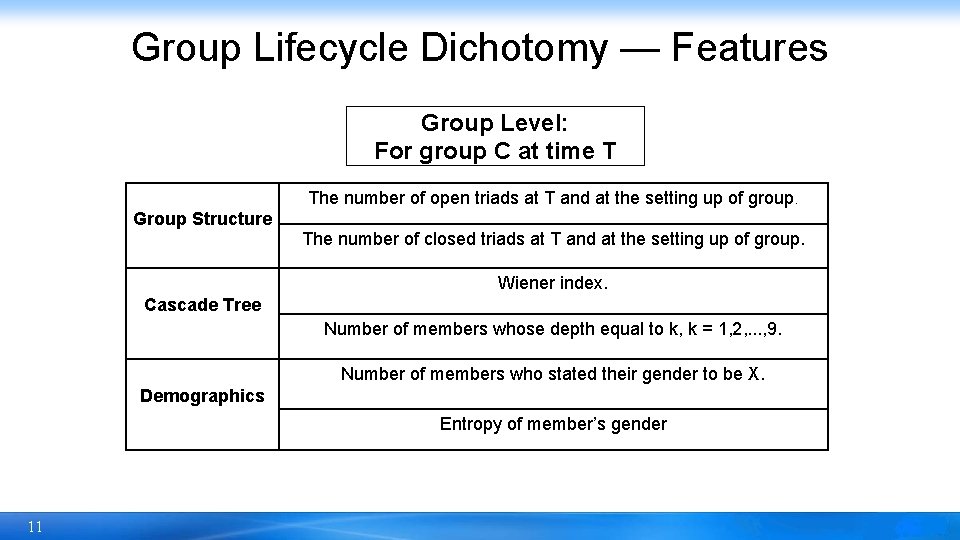
Group Lifecycle Dichotomy — Features Group Level: For group C at time T The number of open triads at T and at the setting up of group. Group Structure The number of closed triads at T and at the setting up of group. Wiener index. Cascade Tree Number of members whose depth equal to k, k = 1, 2, . . . , 9. Number of members who stated their gender to be X. Demographics Entropy of member’s gender 11
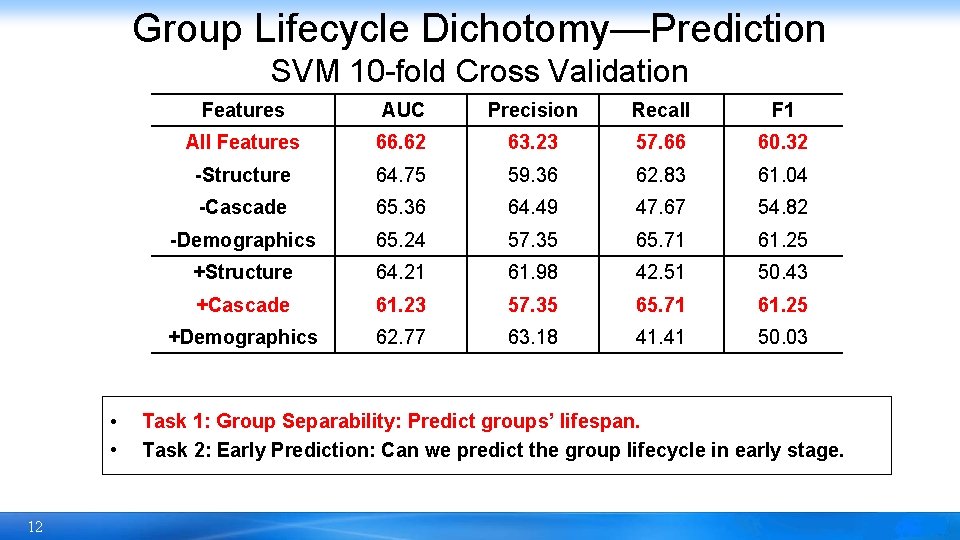
Group Lifecycle Dichotomy—Prediction SVM 10 -fold Cross Validation • • 12 Features AUC Precision Recall F 1 All Features 66. 62 63. 23 57. 66 60. 32 -Structure 64. 75 59. 36 62. 83 61. 04 -Cascade 65. 36 64. 49 47. 67 54. 82 -Demographics 65. 24 57. 35 65. 71 61. 25 +Structure 64. 21 61. 98 42. 51 50. 43 +Cascade 61. 23 57. 35 65. 71 61. 25 +Demographics 62. 77 63. 18 41. 41 50. 03 Task 1: Group Separability: Predict groups’ lifespan. Task 2: Early Prediction: Can we predict the group lifecycle in early stage.
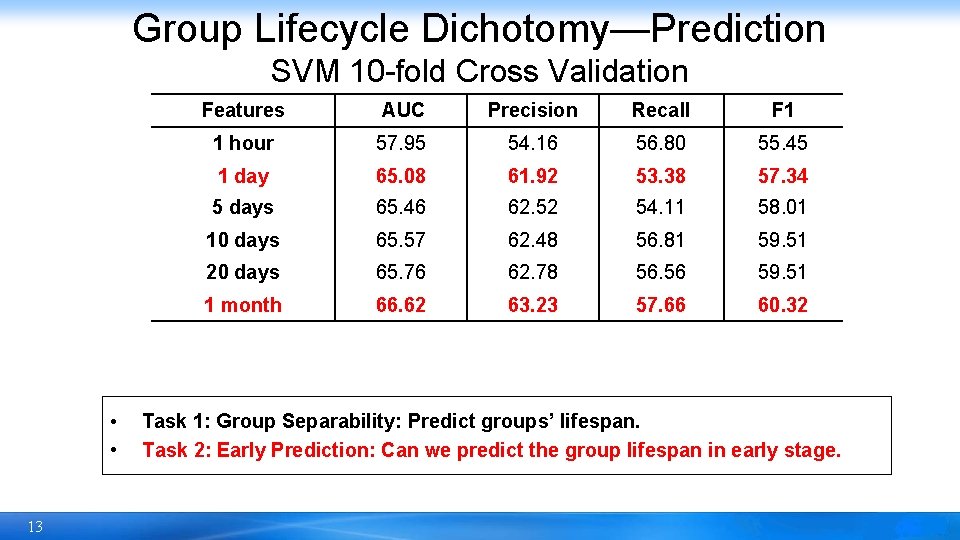
Group Lifecycle Dichotomy—Prediction SVM 10 -fold Cross Validation • • 13 Features AUC Precision Recall F 1 1 hour 57. 95 54. 16 56. 80 55. 45 1 day 65. 08 61. 92 53. 38 57. 34 5 days 65. 46 62. 52 54. 11 58. 01 10 days 65. 57 62. 48 56. 81 59. 51 20 days 65. 76 62. 78 56. 56 59. 51 1 month 66. 62 63. 23 57. 66 60. 32 Task 1: Group Separability: Predict groups’ lifespan. Task 2: Early Prediction: Can we predict the group lifespan in early stage.
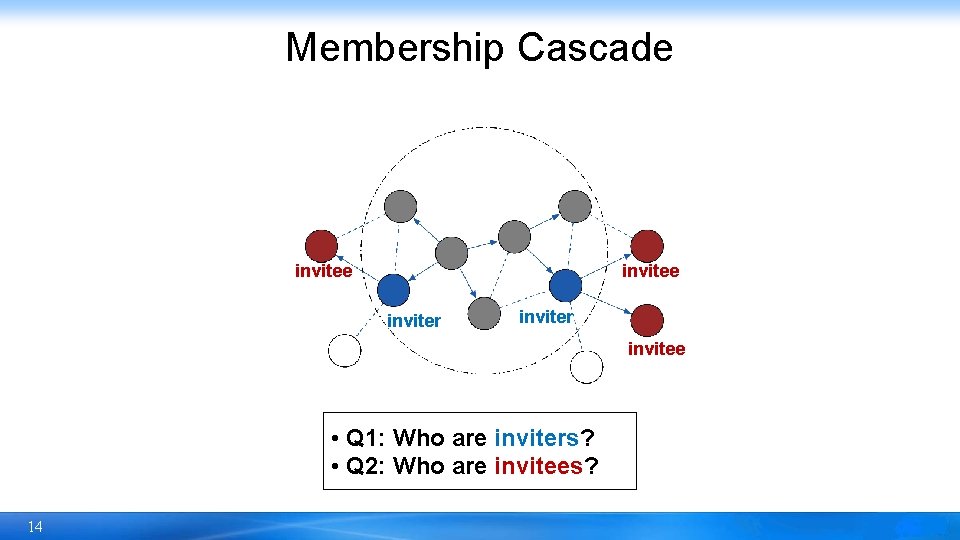
Membership Cascade invitee inviter invitee • Q 1: Who are inviters? • Q 2: Who are invitees? 14
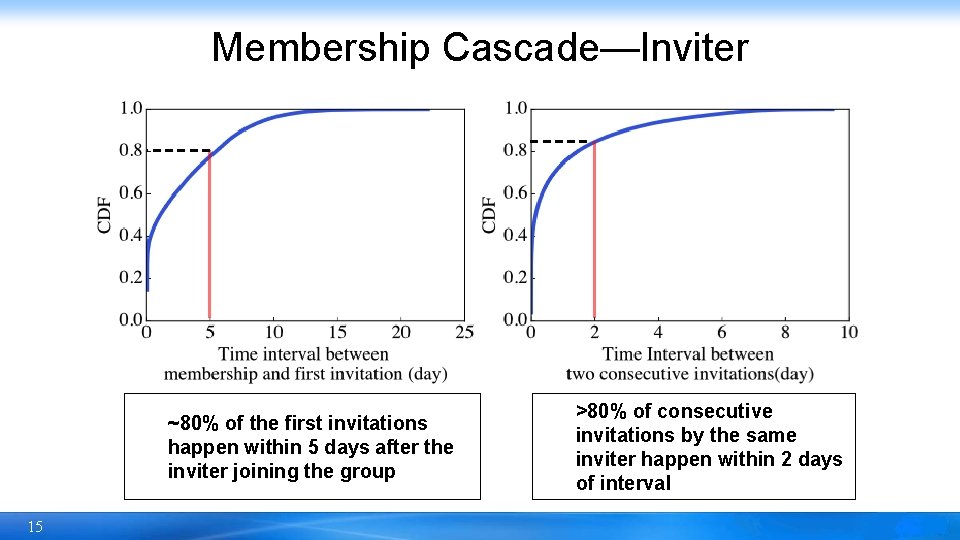
Membership Cascade—Inviter ~80% of the first invitations happen within 5 days after the inviter joining the group 15 >80% of consecutive invitations by the same inviter happen within 2 days of interval
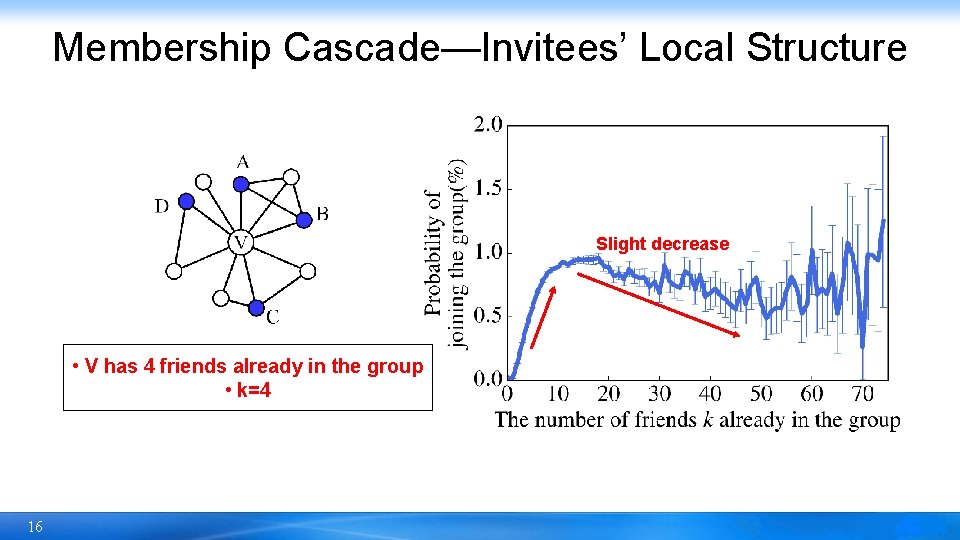
Membership Cascade—Invitees’ Local Structure Slight decrease • V has 4 friends already in the group • k=4 16
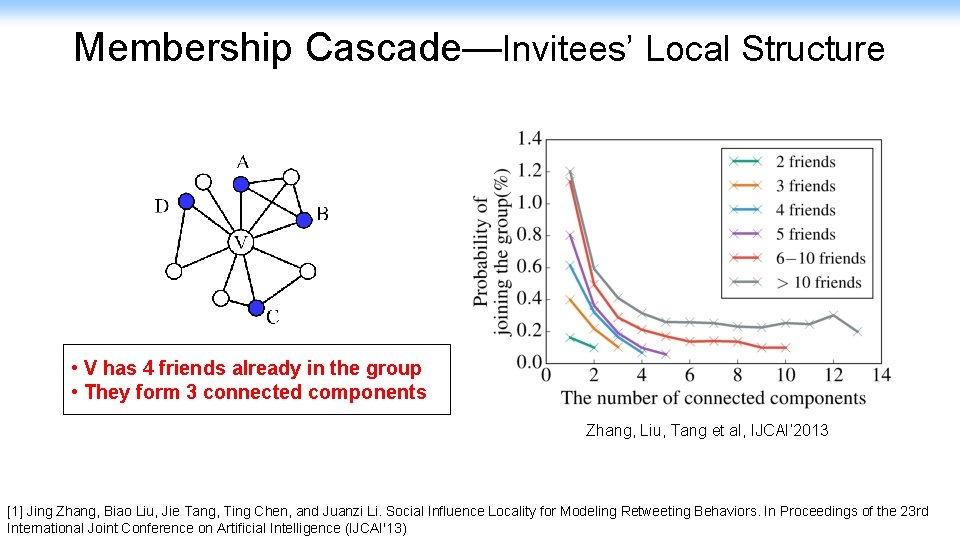
Membership Cascade—Invitees’ Local Structure • V has 4 friends already in the group • They form 3 connected components Zhang, Liu, Tang et al, IJCAI’ 2013 [1] Jing Zhang, Biao Liu, Jie Tang, Ting Chen, and Juanzi Li. Social Influence Locality for Modeling Retweeting Behaviors. In Proceedings of the 23 rd 17 International Joint Conference on Artificial Intelligence (IJCAI'13)
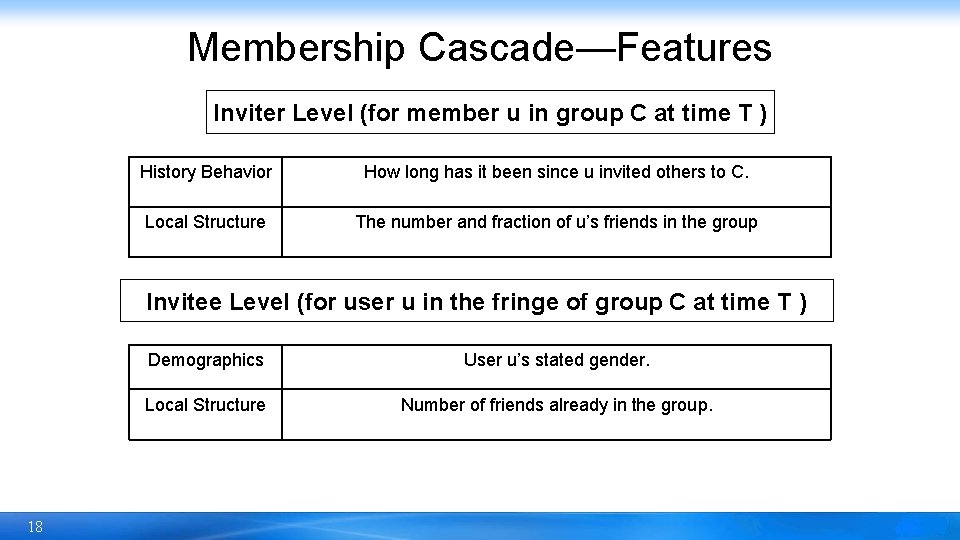
Membership Cascade—Features Inviter Level (for member u in group C at time T ) History Behavior How long has it been since u invited others to C. Local Structure The number and fraction of u’s friends in the group Invitee Level (for user u in the fringe of group C at time T ) 18 Demographics User u’s stated gender. Local Structure Number of friends already in the group.
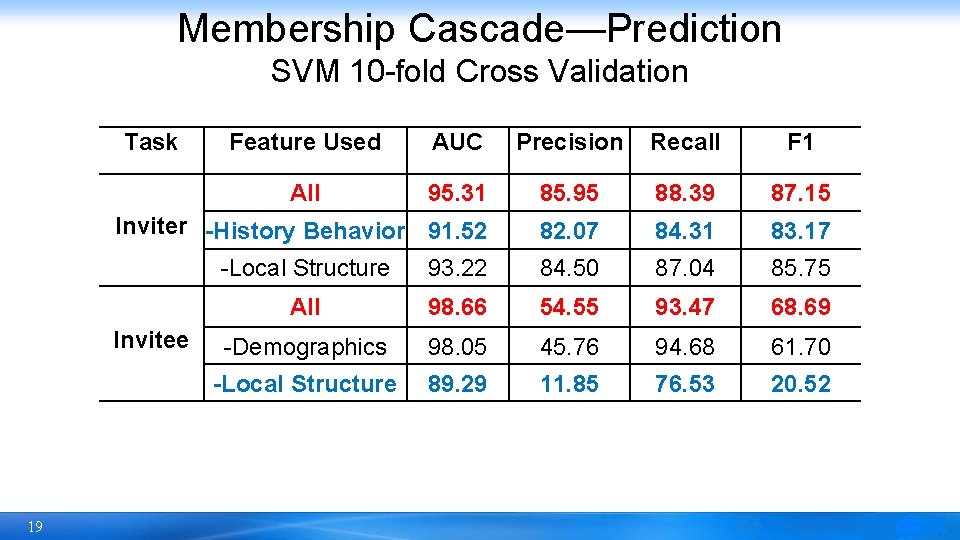
Membership Cascade—Prediction SVM 10 -fold Cross Validation Task Feature Used AUC Precision Recall F 1 All 95. 31 85. 95 88. 39 87. 15 Inviter -History Behavior 91. 52 82. 07 84. 31 83. 17 -Local Structure 93. 22 84. 50 87. 04 85. 75 All 98. 66 54. 55 93. 47 68. 69 -Demographics 98. 05 45. 76 94. 68 61. 70 -Local Structure 89. 29 11. 85 76. 53 20. 52 Invitee 19
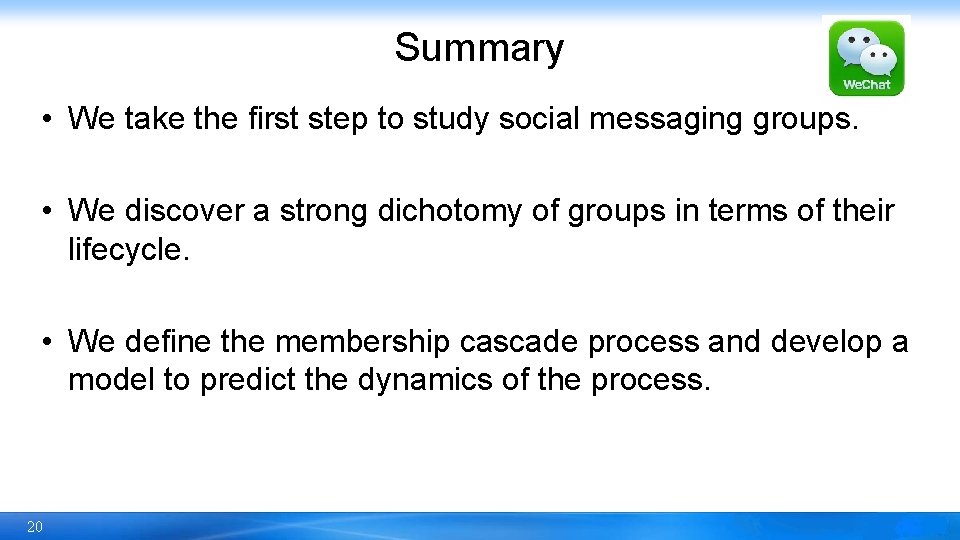
Summary • We take the first step to study social messaging groups. • We discover a strong dichotomy of groups in terms of their lifecycle. • We define the membership cascade process and develop a model to predict the dynamics of the process. 20
Furture Research • Coevolution of chat groups • Comparison between information diffusion and membership cascade process. • Role of chat group in the whole We. Chat ecosystem 21
Thank you! Collaborators: Yixuan Li, John E. Hopcroft (Cornell) Jie Tang (THU) Qiang Yang (HKUST) Zheng Lu, Hao Ye, Bo Chen (Tencent) 22