
The Life cycle of a Star The Earth
- Slides: 19
The Life cycle of a Star The Earth and Beyond… GCSE Physics Notes LOJ March 2004
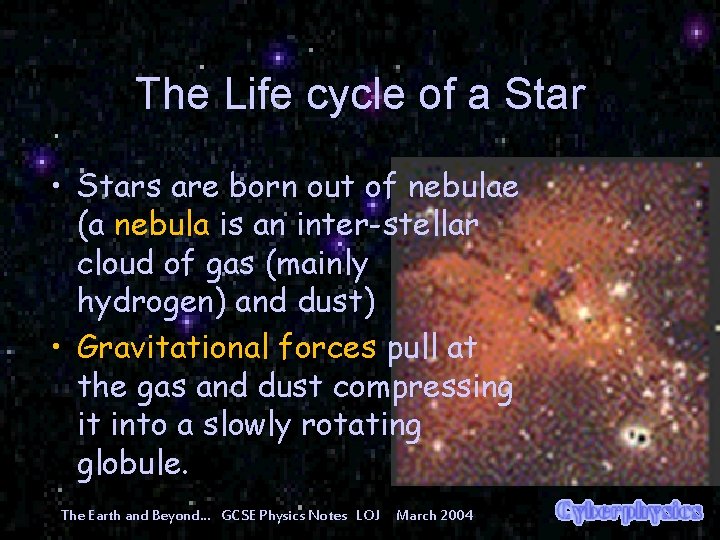
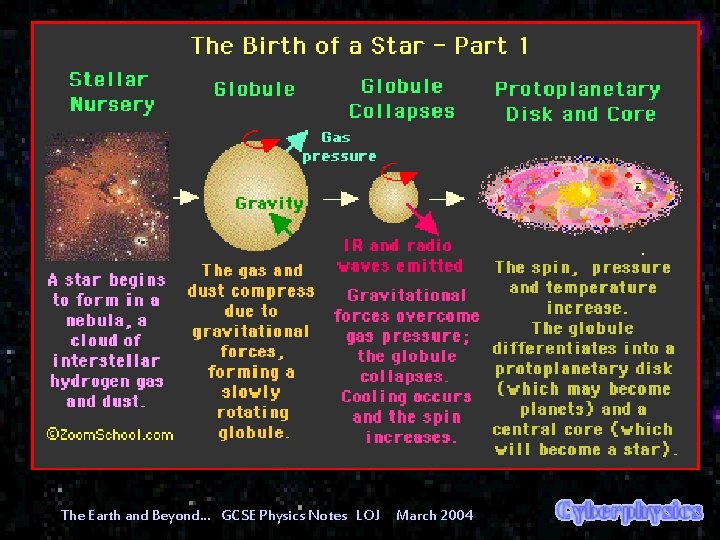
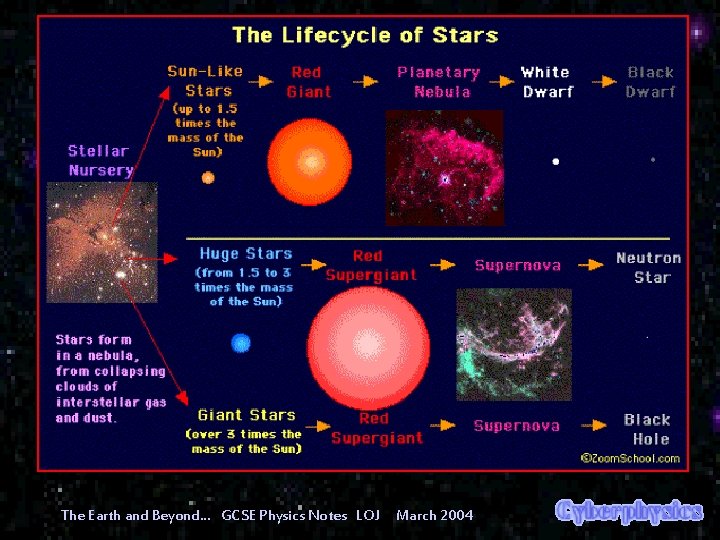
The Life cycle of a Star • Stars are born out of nebulae (a nebula is an inter-stellar cloud of gas (mainly hydrogen) and dust) • Gravitational forces pull at the gas and dust compressing it into a slowly rotating globule. The Earth and Beyond… GCSE Physics Notes LOJ March 2004
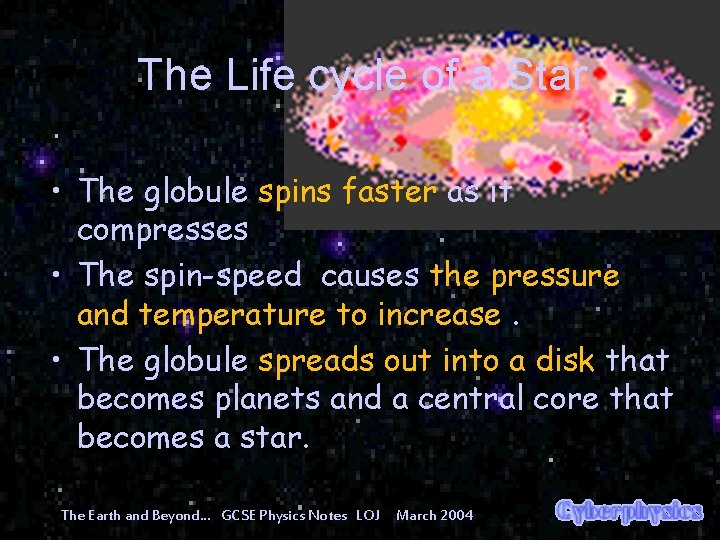
The Life cycle of a Star • The globule spins faster as it compresses • The spin-speed causes the pressure and temperature to increase. • The globule spreads out into a disk that becomes planets and a central core that becomes a star. The Earth and Beyond… GCSE Physics Notes LOJ March 2004
The Earth and Beyond… GCSE Physics Notes LOJ March 2004
Fusion stage • When a temperature of about 27, 000, 000°F is reached, nuclear fusion begins. • This is the nuclear reaction in which hydrogen atoms are fused together to make helium atoms. • A lot of energy is given out as this happens. The Earth and Beyond… GCSE Physics Notes LOJ March 2004
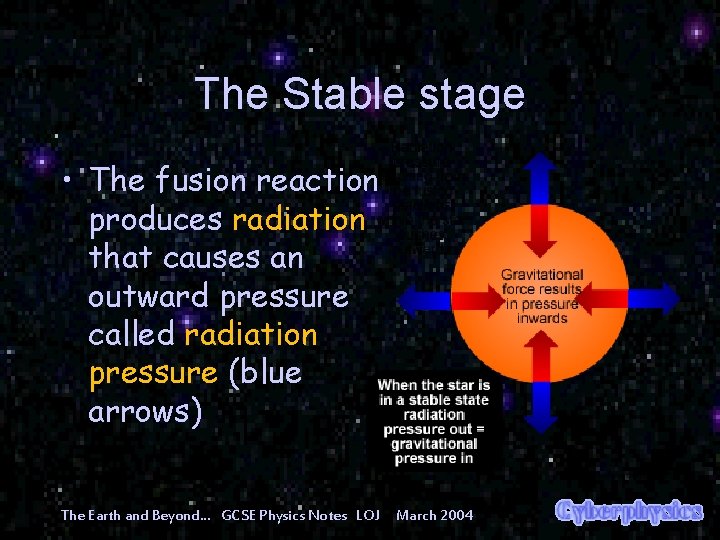
The Stable stage • The fusion reaction produces radiation that causes an outward pressure called radiation pressure (blue arrows) The Earth and Beyond… GCSE Physics Notes LOJ March 2004
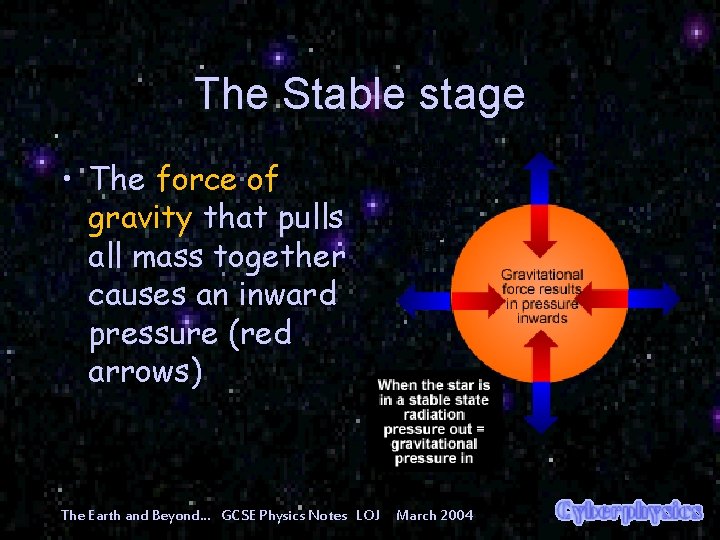
The Stable stage • The force of gravity that pulls all mass together causes an inward pressure (red arrows) The Earth and Beyond… GCSE Physics Notes LOJ March 2004
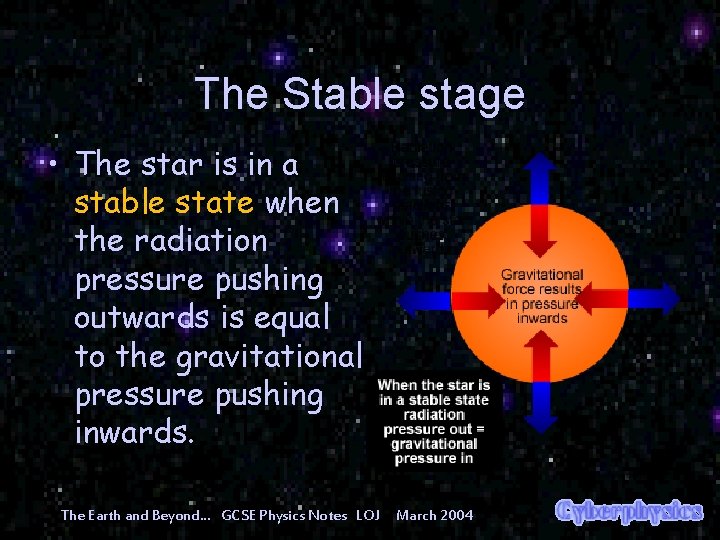
The Stable stage • The star is in a stable state when the radiation pressure pushing outwards is equal to the gravitational pressure pushing inwards. The Earth and Beyond… GCSE Physics Notes LOJ March 2004
The bigger the Star the smaller its lifespan • The most massive stars have the shortest lives. • Stars that are 25 to 50 times that of the Sun live for only a few million years. • Stars like our Sun live for about 10 billion years (our Sun is about half way through its life cycle!) • Stars less massive than the Sun have even longer life spans. The Earth and Beyond… GCSE Physics Notes LOJ March 2004
Death of a Star • Size also determines what happens in death …… • When stars run out of fuel, they expand to become Red Giants (larger ones into Super Red Giants!). • This happens because the radiation pressure is greater than the gravitational pull The Earth and Beyond… GCSE Physics Notes LOJ March 2004
Death of a Star • Larger stars then explode into a Supernova, smaller stars become a gas cloud. • Large stars then shrink into black holes whereas • Medium stars shrink into neutron stars and • Small stars shrink into white dwarfs and then cool into black dwarfs The Earth and Beyond… GCSE Physics Notes LOJ March 2004
The size of the star determines the rest of it’s fate The Earth and Beyond… GCSE Physics Notes LOJ March 2004
Galaxies • Stars gather together in galaxies. • There are billions of stars in each galaxy • There are millions of galaxies in the Universe The Earth and Beyond… GCSE Physics Notes LOJ March 2004
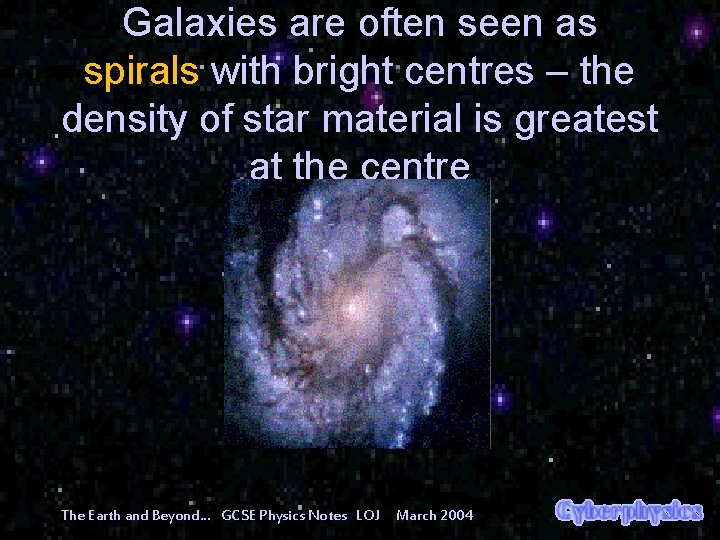
Galaxies are often seen as spirals with bright centres – the density of star material is greatest at the centre The Earth and Beyond… GCSE Physics Notes LOJ March 2004
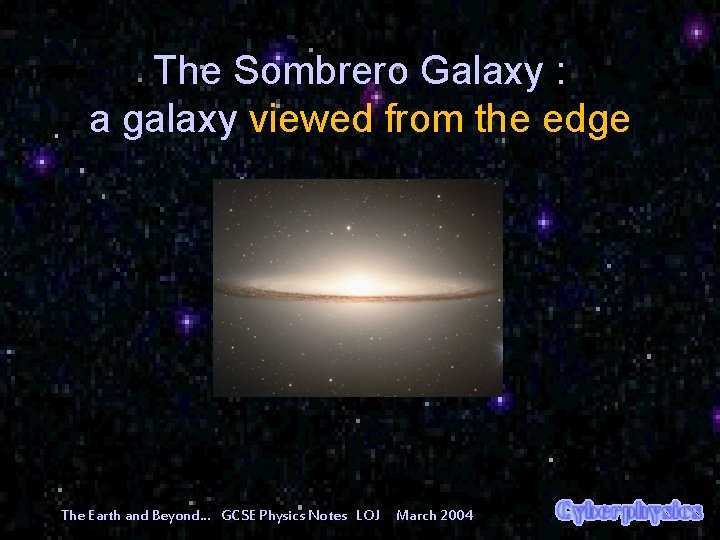
The Sombrero Galaxy : a galaxy viewed from the edge The Earth and Beyond… GCSE Physics Notes LOJ March 2004
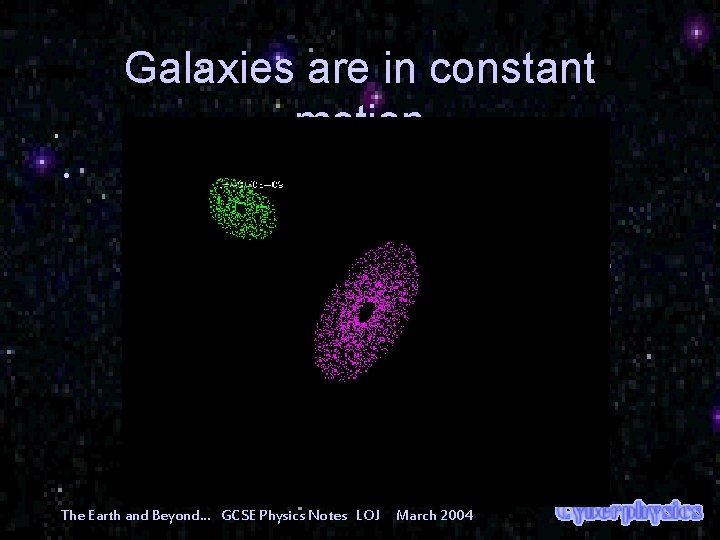
Galaxies are in constant motion • The Earth and Beyond… GCSE Physics Notes LOJ March 2004
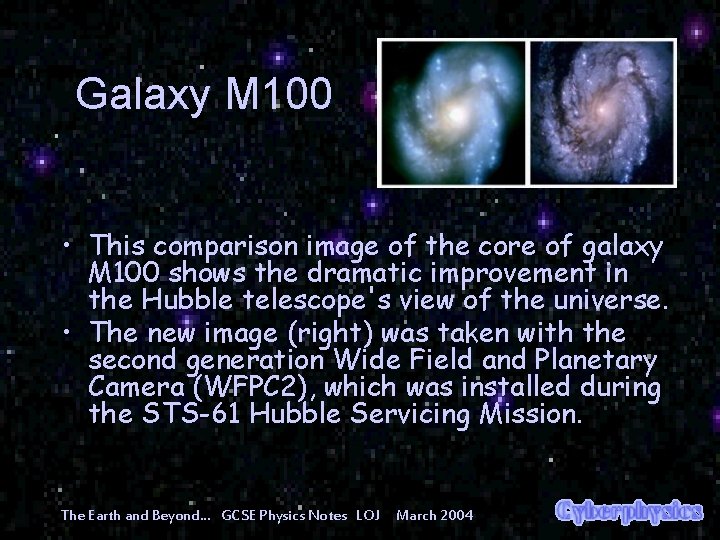
Galaxy M 100 • This comparison image of the core of galaxy M 100 shows the dramatic improvement in the Hubble telescope's view of the universe. • The new image (right) was taken with the second generation Wide Field and Planetary Camera (WFPC 2), which was installed during the STS-61 Hubble Servicing Mission. The Earth and Beyond… GCSE Physics Notes LOJ March 2004
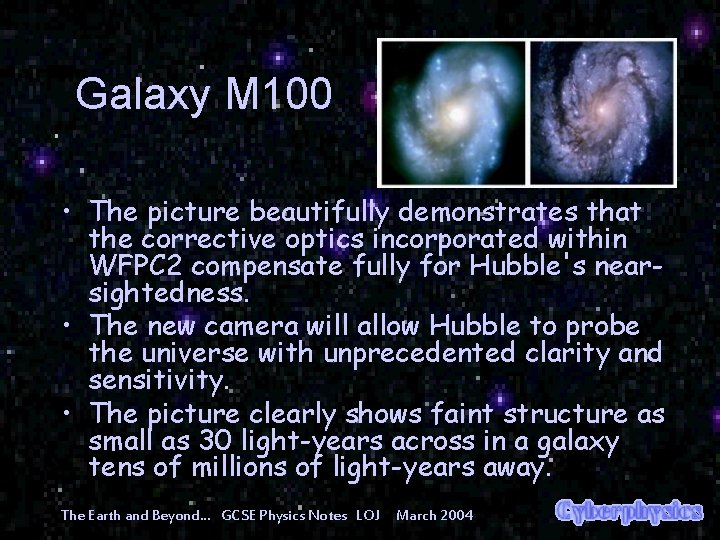
Galaxy M 100 • The picture beautifully demonstrates that the corrective optics incorporated within WFPC 2 compensate fully for Hubble's nearsightedness. • The new camera will allow Hubble to probe the universe with unprecedented clarity and sensitivity. • The picture clearly shows faint structure as small as 30 light-years across in a galaxy tens of millions of light-years away. The Earth and Beyond… GCSE Physics Notes LOJ March 2004
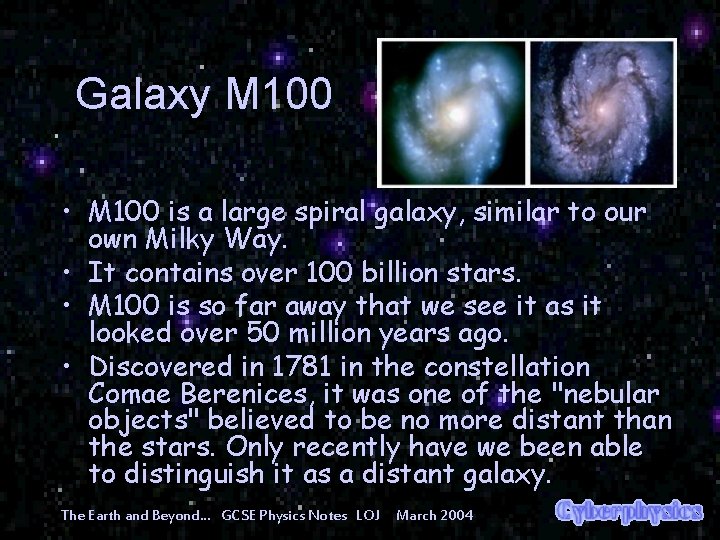
Galaxy M 100 • M 100 is a large spiral galaxy, similar to our own Milky Way. • It contains over 100 billion stars. • M 100 is so far away that we see it as it looked over 50 million years ago. • Discovered in 1781 in the constellation Comae Berenices, it was one of the "nebular objects" believed to be no more distant than the stars. Only recently have we been able to distinguish it as a distant galaxy. The Earth and Beyond… GCSE Physics Notes LOJ March 2004