
The Life Cycle of a Star A Really
- Slides: 19
The Life Cycle of a Star A Really “Hot” Topic By Samantha Edgington
Objectives • • • Describe how stars are formed. Explain the concept of equilibrium. Define the “death” of a star. Identify the different types of stars. Describe how the process of nuclear fusion works within a star.
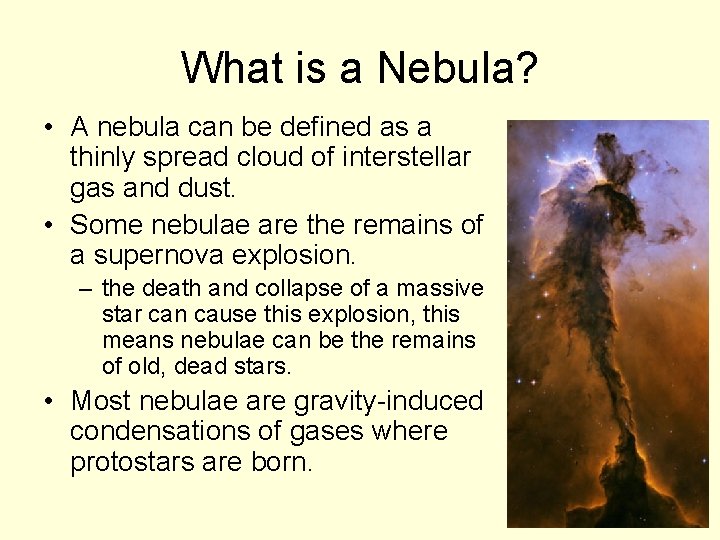
What is a Nebula? • A nebula can be defined as a thinly spread cloud of interstellar gas and dust. • Some nebulae are the remains of a supernova explosion. – the death and collapse of a massive star can cause this explosion, this means nebulae can be the remains of old, dead stars. • Most nebulae are gravity-induced condensations of gases where protostars are born.
How is a Protostar Formed? • Inside a nebula, there areas where gravity causes dust and gas to “clump” together. • As these “clumps” gather more and more mass their gravitational pull increases, forcing more atoms together. • This process is known as accretion, and the result is a protostar.
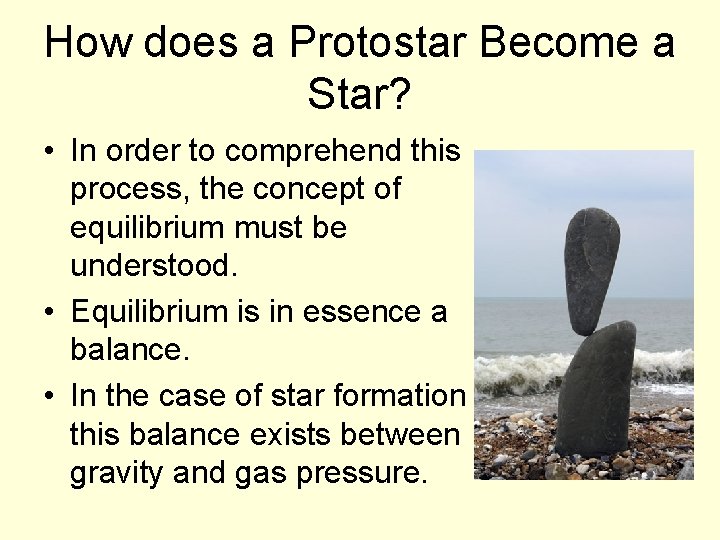
How does a Protostar Become a Star? • In order to comprehend this process, the concept of equilibrium must be understood. • Equilibrium is in essence a balance. • In the case of star formation this balance exists between gravity and gas pressure.
Achieving Equilibrium • First gravity pulls gas and dust inward towards the core of the prospective star. • Inside the core, density and temperature increases as atomic collisions increase, causing a rise in gas pressure. • Finally when gas pressure is equal to gravity, the protostar has reached equilibrium and is therefore reached a reasonably stable size.
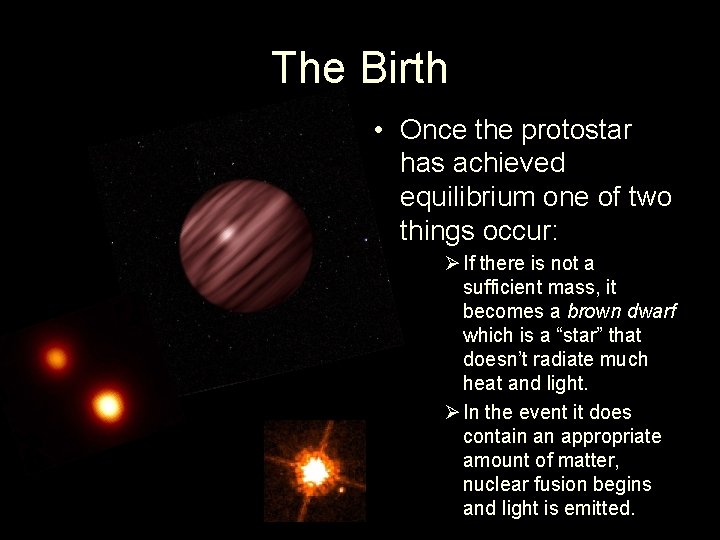
The Birth • Once the protostar has achieved equilibrium one of two things occur: Ø If there is not a sufficient mass, it becomes a brown dwarf which is a “star” that doesn’t radiate much heat and light. Ø In the event it does contain an appropriate amount of matter, nuclear fusion begins and light is emitted.
The Main Sequence • A star is basically a huge ball of gas undergoing nuclear fusion. • The main sequence phase is where stars spend the majority of their “life” by fusing hydrogen into helium. • There are two types of main sequence stars: Ø a red giant which is a large bright star with a cool surface. Ø a red dwarf which are very cool, faint and small stars
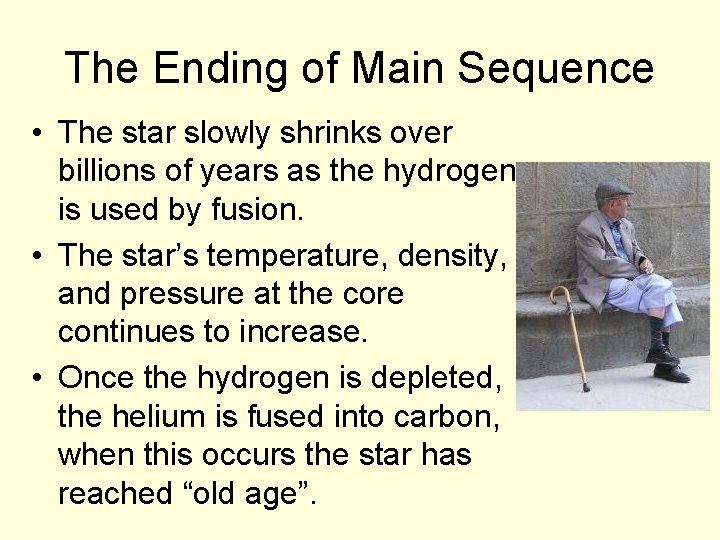
The Ending of Main Sequence • The star slowly shrinks over billions of years as the hydrogen is used by fusion. • The star’s temperature, density, and pressure at the core continues to increase. • Once the hydrogen is depleted, the helium is fused into carbon, when this occurs the star has reached “old age”.
The Death • There are one of two ways a star can die depending on its size. • If the star is of low mass, it expands its outer layers, creating nebulae and a white dwarf forms from the core. • If it is of high mass, death occurs in a massive explosion known as a supernova, the remaining core then transforms into a neutron star or a black hole.
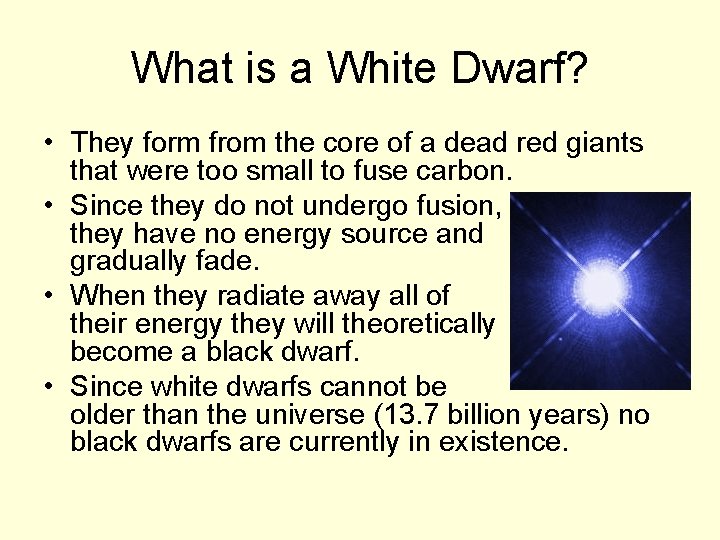
What is a White Dwarf? • They form from the core of a dead red giants that were too small to fuse carbon. • Since they do not undergo fusion, they have no energy source and gradually fade. • When they radiate away all of their energy they will theoretically become a black dwarf. • Since white dwarfs cannot be older than the universe (13. 7 billion years) no black dwarfs are currently in existence.
What is a Supernova? • They can form when the gravitational potential energy—created by a sudden gravitational collapse of a large red giant—heats and expels the star's outer layers, resulting in an explosion. • Also, they can form when a white dwarf ignites carbon fusion, which results in a runaway nuclear fusion reaction and causes a supernova. • Supernovae can be so immense that the energy produced can equal the energy the Sun creates over a time period of 10 billion years!
What is a Neutron Star? • A neutron star is formed as a result of a massive star being compressed. • The core material, known as neutron degenerate matter, mostly consists of neutrons with a few protons and electrons. • The gravity is so intense that if an object were to reach the surface it would disperse all of its subatomic particles and merge with the star! • The matter is so dense that a teaspoon would weigh billions of tonnes! • Some people view neutron stars as giant atoms.
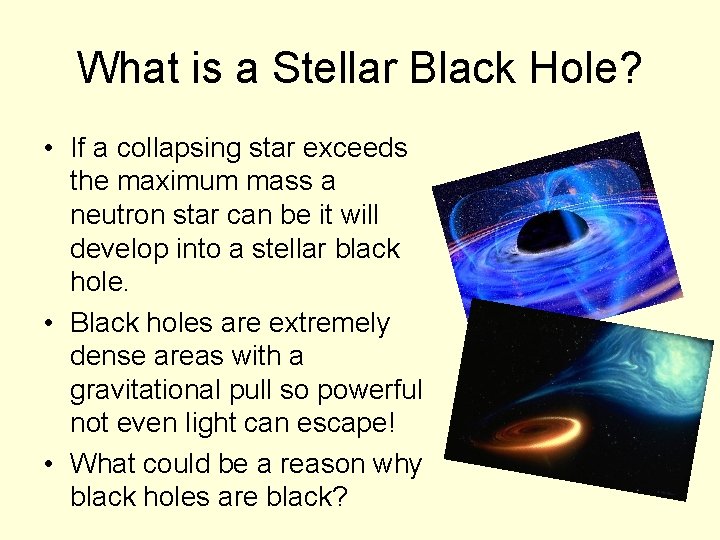
What is a Stellar Black Hole? • If a collapsing star exceeds the maximum mass a neutron star can be it will develop into a stellar black hole. • Black holes are extremely dense areas with a gravitational pull so powerful not even light can escape! • What could be a reason why black holes are black?
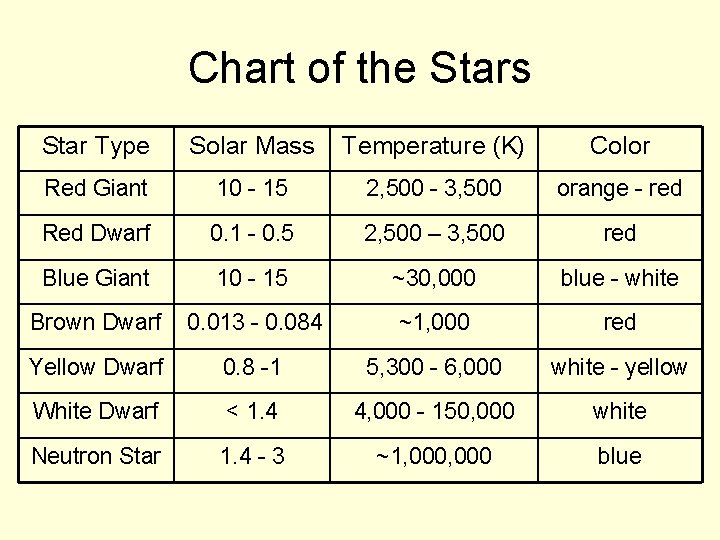
Chart of the Stars Star Type Solar Mass Temperature (K) Color Red Giant 10 - 15 2, 500 - 3, 500 orange - red Red Dwarf 0. 1 - 0. 5 2, 500 – 3, 500 red Blue Giant 10 - 15 ~30, 000 blue - white Brown Dwarf 0. 013 - 0. 084 ~1, 000 red Yellow Dwarf 0. 8 -1 5, 300 - 6, 000 white - yellow White Dwarf < 1. 4 4, 000 - 150, 000 white Neutron Star 1. 4 - 3 ~1, 000 blue
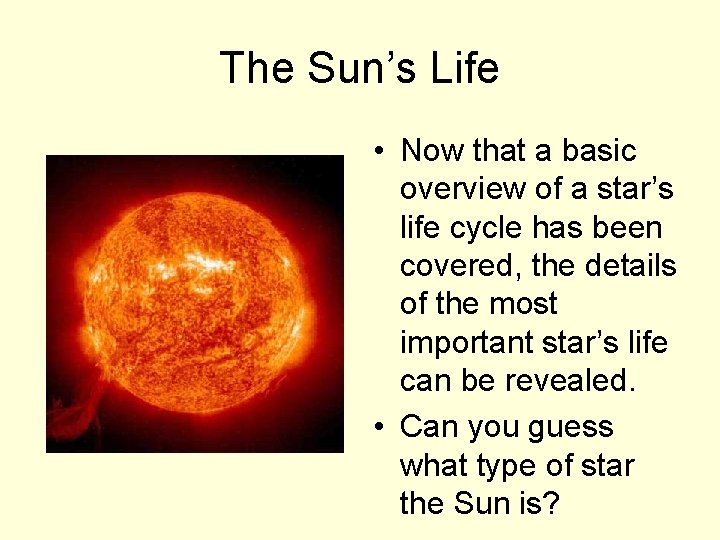
The Sun’s Life • Now that a basic overview of a star’s life cycle has been covered, the details of the most important star’s life can be revealed. • Can you guess what type of star the Sun is?
The Sun in Main Sequence • The Sun was born like any other star, out of a nebulae and into a protostar. • It is now in its main sequence and can be classified as a yellow dwarf. • The Star is about 4. 57 billion years old, about halfway through its complete lifecycle.
The Sun’s Death • Since the Sun is considerably smaller it will not explode in a supernova. • Instead it is predicted that it will become a red giant in about ~6 billion years. • When this occurs, all the water on earth will be vaporized and life will cease to exist. • In the final phase the Sun will form a white dwarf and slowly fade out of existence.
Works Cited • • • www. dictionary. com aspire. cosmicray. org/labs/star_life/starlife_proto. html www. astro. keele. ac. uk/workx/starlife/Starpage. S_26 M. html http: //www. telescope. org/pparc/res 8. html www. antonine-education. co. uk www. darkstar 1. co. uk www. pbs. org outreach. jach. hawaii. edu www. spaceflightnow. com wikipedia. org • www. cosmographica. com