
The Life Cycle Management Navigator Carbon Footprinting Training
The Life Cycle Management Navigator Carbon Footprinting Training Session 10 Life Cycle Management Navigator: 10_PR_CF_ 1 CSCP, UNEP, WBCSD, WI, In. WEnt, UNIDO, UEAP ME
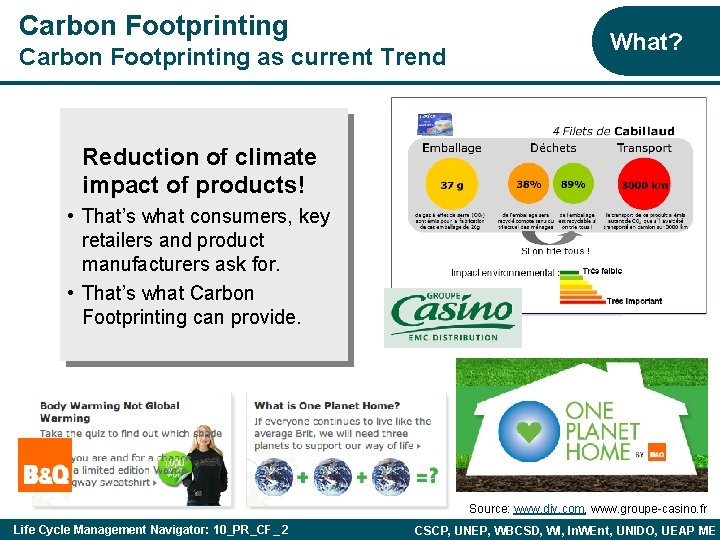
Carbon Footprinting as current Trend What? Reduction of climate impact of products! • That’s what consumers, key retailers and product manufacturers ask for. • That’s what Carbon Footprinting can provide. Source: www. diy. com, www. groupe-casino. fr Life Cycle Management Navigator: 10_PR_CF_ 2 CSCP, UNEP, WBCSD, WI, In. WEnt, UNIDO, UEAP ME
Carbon Footprinting What? What is a Carbon Footprint? A CARBON FOOTPRINT is. . . the total set of greenhouse gas emissions caused directly and indirectly by an individual, event, organisation, or product expressed as CO 2 equivalents. It encompasses e. g. • use of fuels • employee travel or • emissions from other organisations within the supply chain. Source: www. carbontrust. co. uk Life Cycle Management Navigator: 10_PR_CF_ 3 CSCP, UNEP, WBCSD, WI, In. WEnt, UNIDO, UEAP ME
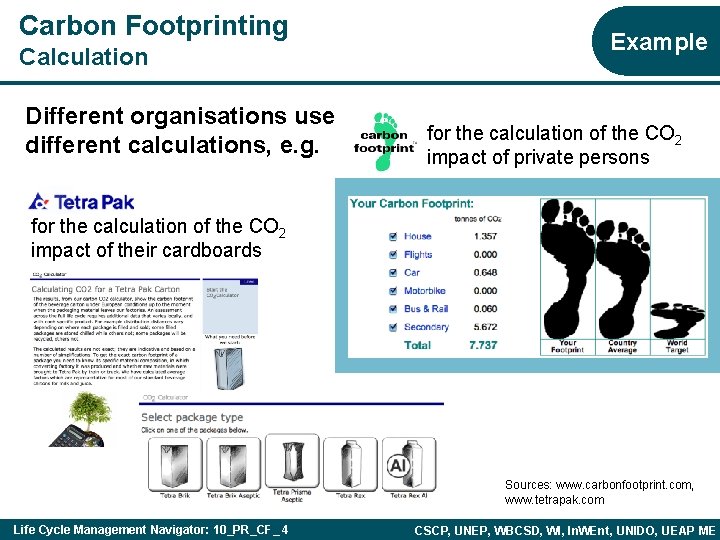
Carbon Footprinting Calculation Different organisations use different calculations, e. g. Example for the calculation of the CO 2 impact of private persons for the calculation of the CO 2 impact of their cardboards Sources: www. carbonfootprint. com, www. tetrapak. com Life Cycle Management Navigator: 10_PR_CF_ 4 CSCP, UNEP, WBCSD, WI, In. WEnt, UNIDO, UEAP ME
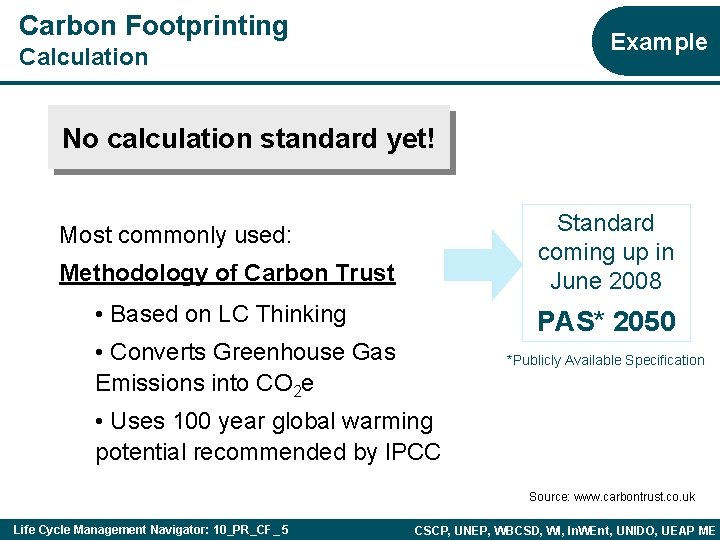
Carbon Footprinting Example Calculation No calculation standard yet! Methodology of Carbon Trust Standard coming up in June 2008 • Based on LC Thinking PAS* 2050 Most commonly used: • Converts Greenhouse Gas Emissions into CO 2 e *Publicly Available Specification • Uses 100 year global warming potential recommended by IPCC Source: www. carbontrust. co. uk Life Cycle Management Navigator: 10_PR_CF_ 5 CSCP, UNEP, WBCSD, WI, In. WEnt, UNIDO, UEAP ME
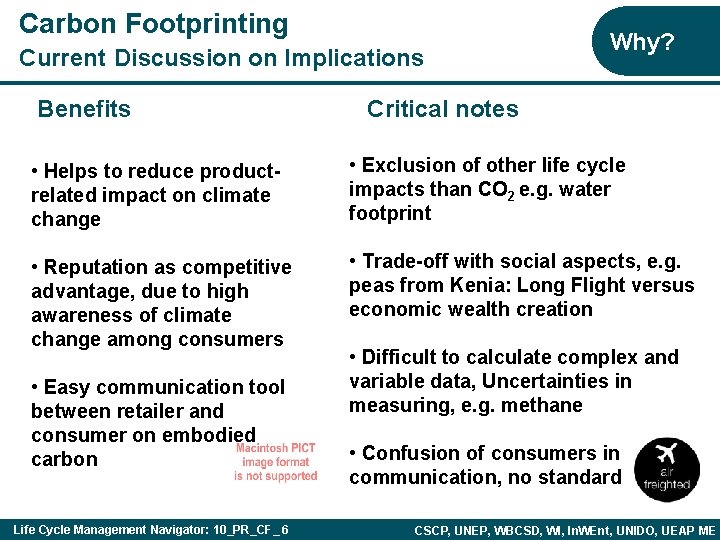
Carbon Footprinting Current Discussion on Implications Benefits Why? Critical notes • Helps to reduce productrelated impact on climate change • Exclusion of other life cycle impacts than CO 2 e. g. water footprint • Reputation as competitive advantage, due to high awareness of climate change among consumers • Trade-off with social aspects, e. g. peas from Kenia: Long Flight versus economic wealth creation • Easy communication tool between retailer and consumer on embodied carbon Life Cycle Management Navigator: 10_PR_CF_ 6 • Difficult to calculate complex and variable data, Uncertainties in measuring, e. g. methane • Confusion of consumers in communication, no standard CSCP, UNEP, WBCSD, WI, In. WEnt, UNIDO, UEAP ME
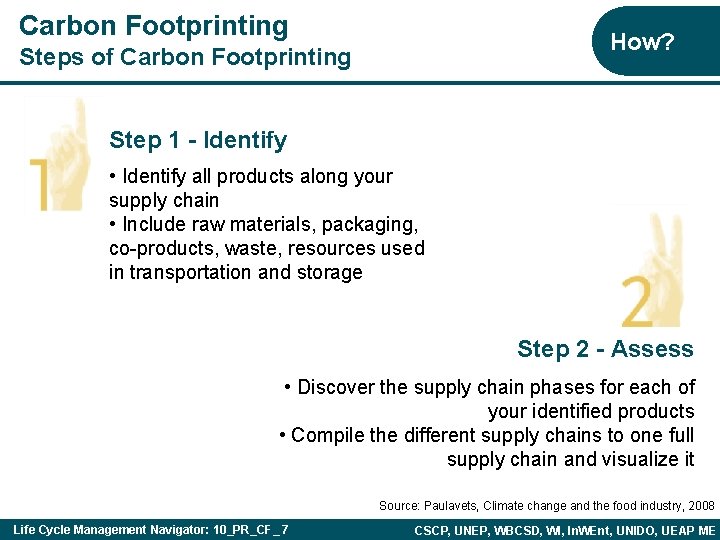
Carbon Footprinting How? Steps of Carbon Footprinting Step 1 - Identify • Identify all products along your supply chain • Include raw materials, packaging, co-products, waste, resources used in transportation and storage Step 2 - Assess • Discover the supply chain phases for each of your identified products • Compile the different supply chains to one full supply chain and visualize it Source: Paulavets, Climate change and the food industry, 2008 Life Cycle Management Navigator: 10_PR_CF_ 7 CSCP, UNEP, WBCSD, WI, In. WEnt, UNIDO, UEAP ME
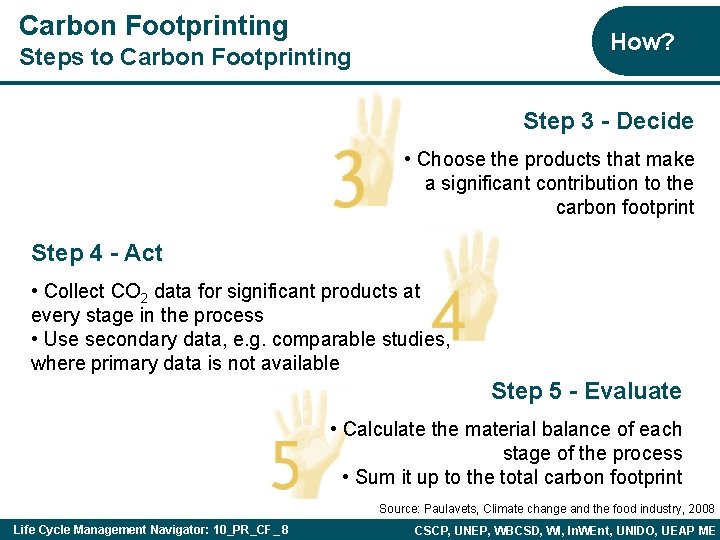
Carbon Footprinting How? Steps to Carbon Footprinting Step 3 - Decide • Choose the products that make a significant contribution to the carbon footprint Step 4 - Act • Collect CO 2 data for significant products at every stage in the process • Use secondary data, e. g. comparable studies, where primary data is not available Step 5 - Evaluate • Calculate the material balance of each stage of the process • Sum it up to the total carbon footprint Source: Paulavets, Climate change and the food industry, 2008 Life Cycle Management Navigator: 10_PR_CF_ 8 CSCP, UNEP, WBCSD, WI, In. WEnt, UNIDO, UEAP ME
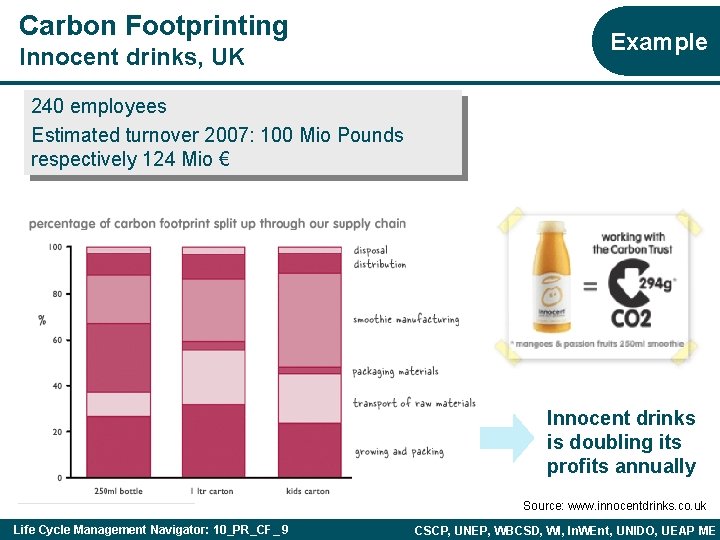
Carbon Footprinting Innocent drinks, UK Example 240 employees Estimated turnover 2007: 100 Mio Pounds respectively 124 Mio € Innocent drinks is doubling its profits annually Source: www. innocentdrinks. co. uk Life Cycle Management Navigator: 10_PR_CF_ 9 CSCP, UNEP, WBCSD, WI, In. WEnt, UNIDO, UEAP ME
Carbon Footprinting Tips for Action! • A good tool to communicate the carbon impact of products to customers • Gain competitive advantage among other suppliers • Do not forget about other life cycle impacts when concentrating on carbon footprinting Life Cycle Management Navigator: 10_PR_CF_ 10 CSCP, UNEP, WBCSD, WI, In. WEnt, UNIDO, UEAP ME
- Slides: 10