
The LHCb experiment Walter Bonivento I N F
The LHCb experiment Walter Bonivento – I. N. F. N. Sezione di Cagliari - Italy Walter Bonivento INFN Cagliari The LHCb experiment 1
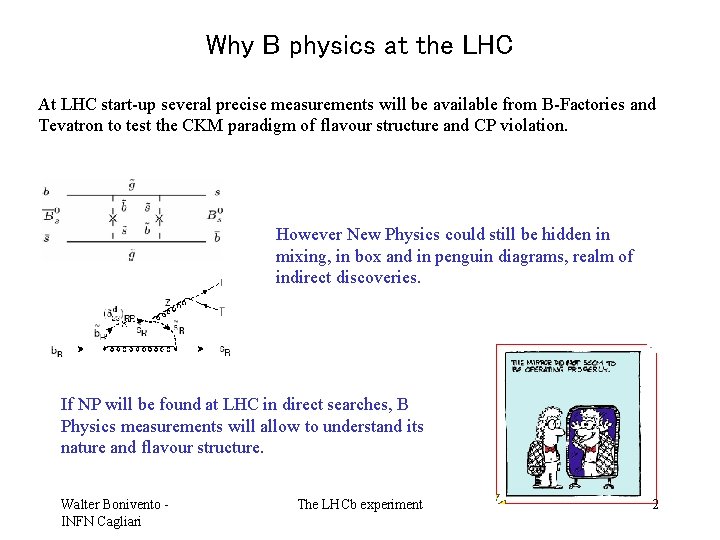
Why B physics at the LHC At LHC start-up several precise measurements will be available from B-Factories and Tevatron to test the CKM paradigm of flavour structure and CP violation. However New Physics could still be hidden in mixing, in box and in penguin diagrams, realm of indirect discoveries. If NP will be found at LHC in direct searches, B Physics measurements will allow to understand its nature and flavour structure. Walter Bonivento INFN Cagliari The LHCb experiment 2
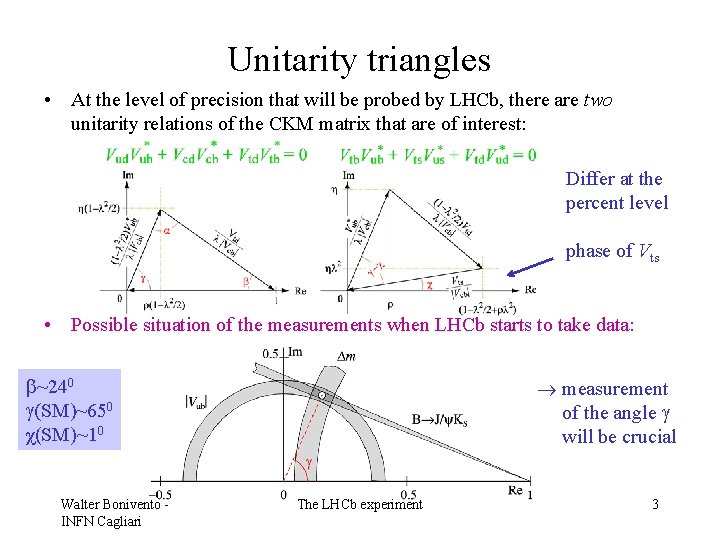
Unitarity triangles • At the level of precision that will be probed by LHCb, there are two unitarity relations of the CKM matrix that are of interest: Differ at the percent level phase of Vts • Possible situation of the measurements when LHCb starts to take data: b~240 g(SM)~650 χ(SM)~10 Walter Bonivento INFN Cagliari measurement of the angle g will be crucial The LHCb experiment 3
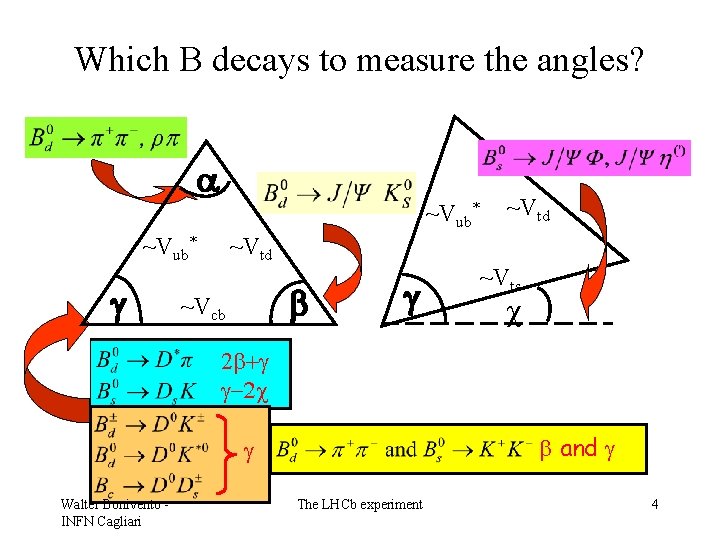
Which B decays to measure the angles? a ~Vub* g ~Vtd b ~Vcb g ~Vts χ 2 b+g g-2χ b and g g Walter Bonivento INFN Cagliari The LHCb experiment 4
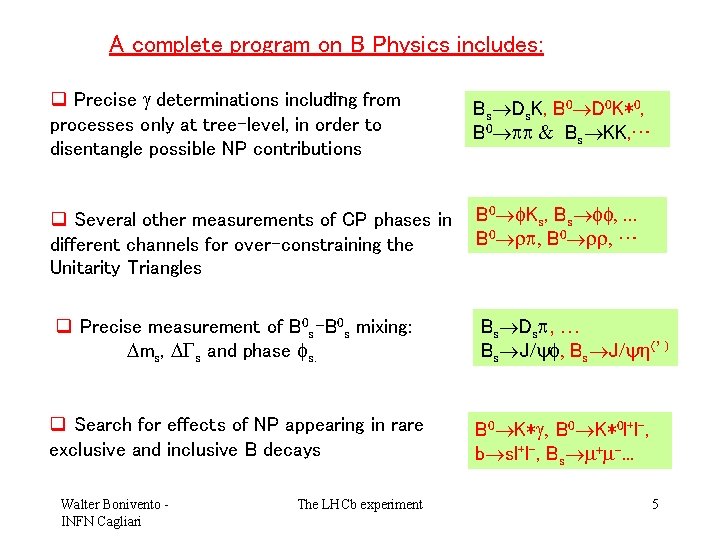
A complete program on B Physics includes: q Precise g determinations including from processes only at tree-level, in order to disentangle possible NP contributions Bs Ds. K, B 0 D 0 K*0, B 0 pp & Bs KK, … q Several other measurements of CP phases in different channels for over-constraining the Unitarity Triangles B 0 f. Ks, Bs ff, . . . B 0 rp, B 0 rr, … q Precise measurement of B 0 s-B 0 s mixing: Dms, DGs and phase fs. Bs Dsp, … Bs J/yf, Bs J/yh(’) q Search for effects of NP appearing in rare exclusive and inclusive B decays Walter Bonivento INFN Cagliari The LHCb experiment B 0 K*g, B 0 K*0 l+l-, b sl+l-, Bs m+m-. . . 5
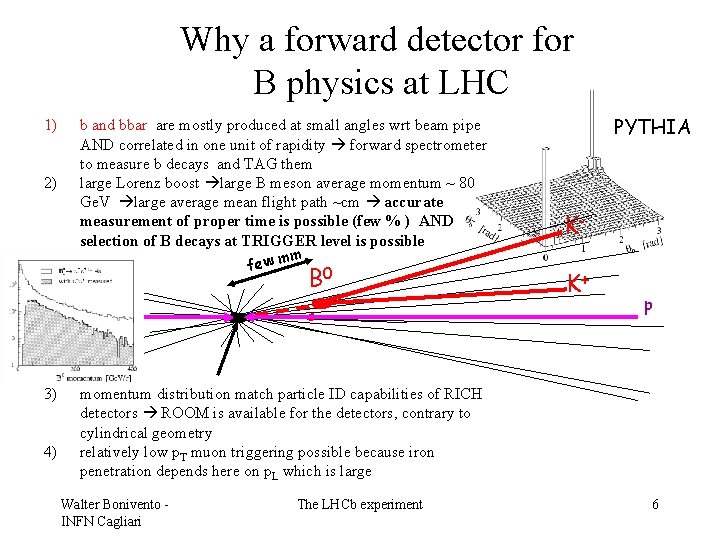
Why a forward detector for B physics at LHC 1) 2) b and bbar are mostly produced at small angles wrt beam pipe AND correlated in one unit of rapidity forward spectrometer to measure b decays and TAG them large Lorenz boost large B meson average momentum ~ 80 Ge. V large average mean flight path ~cm accurate measurement of proper time is possible (few % ) AND selection of B decays at TRIGGER level is possible m few m B 0 p 3) 4) s PYTHIA KK+ p momentum distribution match particle ID capabilities of RICH detectors ROOM is available for the detectors, contrary to cylindrical geometry relatively low p. T muon triggering possible because iron penetration depends here on p. L which is large Walter Bonivento INFN Cagliari The LHCb experiment 6
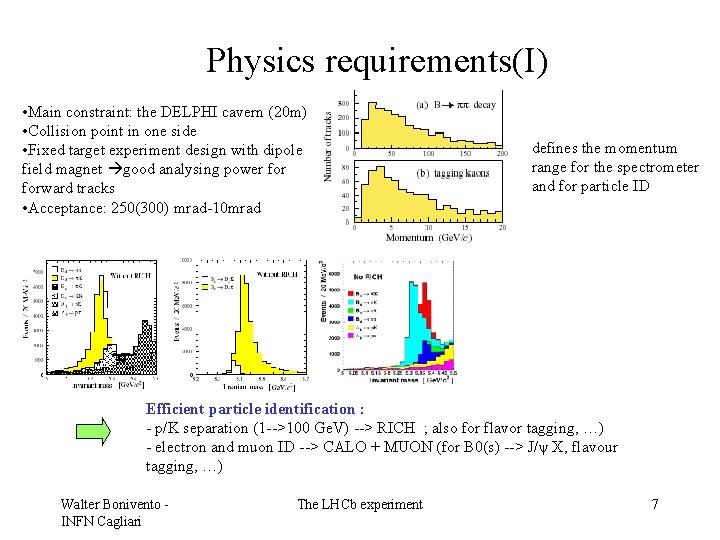
Detector requirements(I) Physics requirements(I) • Main constraint: the DELPHI cavern (20 m) • Collision point in one side • Fixed target experiment design with dipole field magnet good analysing power forward tracks • Acceptance: 250(300) mrad-10 mrad defines the momentum range for the spectrometer and for particle ID Efficient particle identification : - p/K separation (1 -->100 Ge. V) --> RICH ; also for flavor tagging, …) - electron and muon ID --> CALO + MUON (for B 0(s) --> J/ψ X, flavour tagging, …) Walter Bonivento INFN Cagliari The LHCb experiment 7
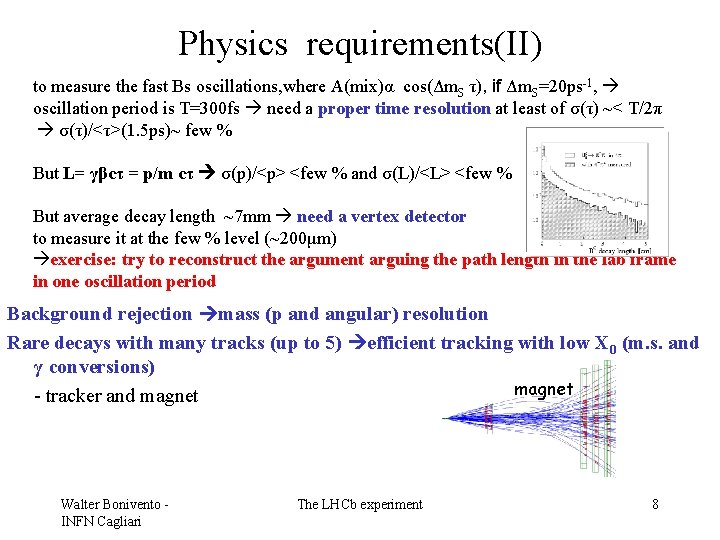
Physics requirements(II) to measure the fast Bs oscillations, where A(mix)α cos(Δm. S τ), if Δm. S=20 ps-1, oscillation period is T=300 fs need a proper time resolution at least of σ(τ) ~< T/2π σ(τ)/<τ>(1. 5 ps)~ few % But L= γβcτ = p/m cτ σ(p)/<p> <few % and σ(L)/<L> <few % But average decay length ~7 mm need a vertex detector to measure it at the few % level (~200μm) exercise: try to reconstruct the argument arguing the path length in the lab frame in one oscillation period Background rejection mass (p and angular) resolution Rare decays with many tracks (up to 5) efficient tracking with low X 0 (m. s. and γ conversions) magnet - tracker and magnet Walter Bonivento INFN Cagliari The LHCb experiment 8
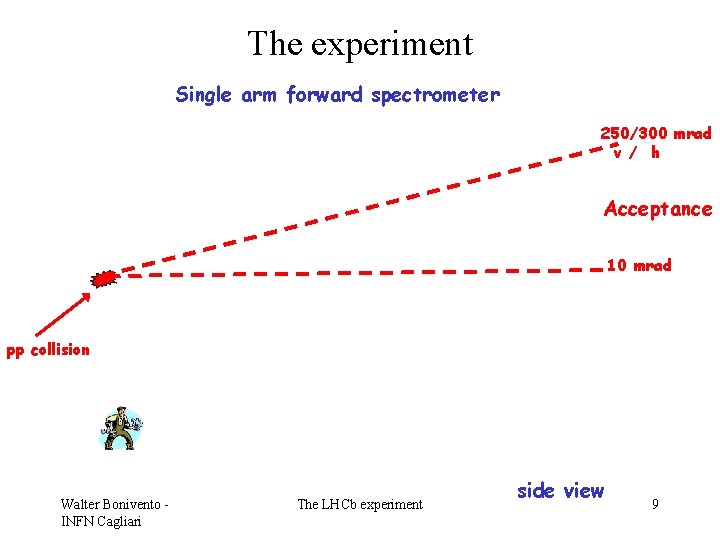
The experiment Single arm forward spectrometer 250/300 mrad v / h Acceptance 10 mrad pp collision Walter Bonivento INFN Cagliari The LHCb experiment side view 9
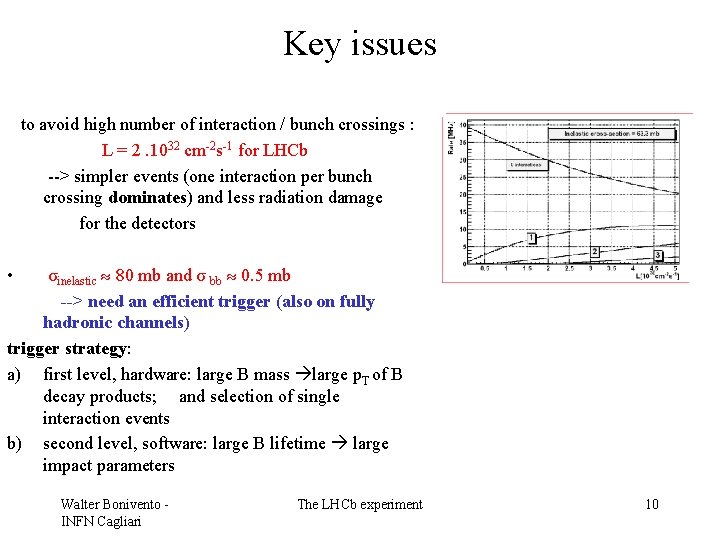
Key issues to avoid high number of interaction / bunch crossings : L = 2. 1032 cm-2 s-1 for LHCb --> simpler events (one interaction per bunch crossing dominates) and less radiation damage for the detectors σinelastic 80 mb and σ bb 0. 5 mb --> need an efficient trigger (also on fully hadronic channels) trigger strategy: a) first level, hardware: large B mass large p. T of B decay products; and selection of single interaction events b) second level, software: large B lifetime large impact parameters • Walter Bonivento INFN Cagliari The LHCb experiment 10
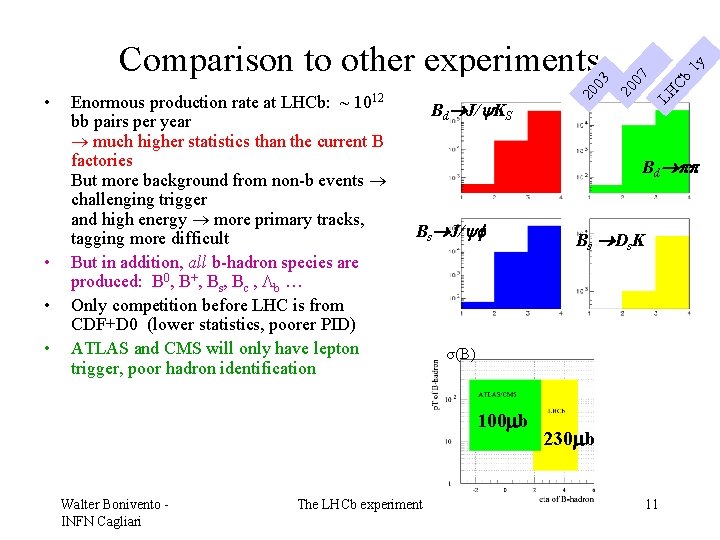
• • • Bd J/y. KS 1 y 07 Bd Bs J/yf The LHCb experiment B s Ds. K σ(B) 100 mb Walter Bonivento INFN Cagliari LH Cb Enormous production rate at LHCb: ~ 1012 bb pairs per year much higher statistics than the current B factories But more background from non-b events challenging trigger and high energy more primary tracks, tagging more difficult But in addition, all b-hadron species are produced: B 0, B+, Bs, Bc , Lb … Only competition before LHC is from CDF+D 0 (lower statistics, poorer PID) ATLAS and CMS will only have lepton trigger, poor hadron identification 20 • 20 03 Comparison to other experiments 230 mb 11
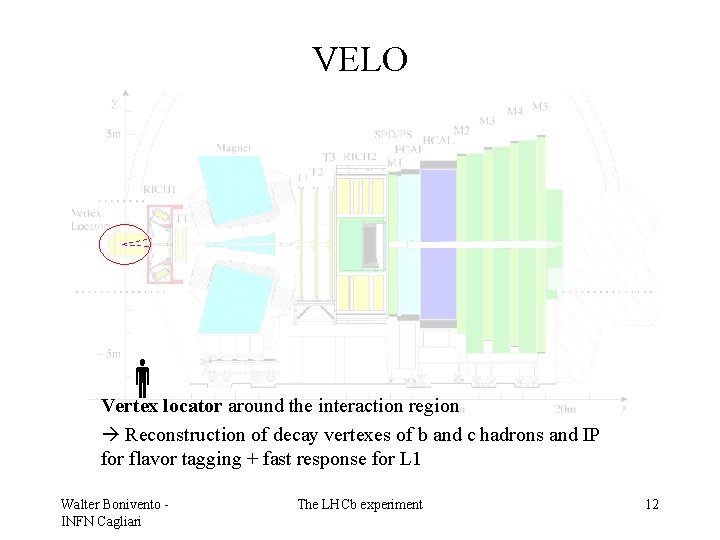
VELO Vertex locator around the interaction region Reconstruction of decay vertexes of b and c hadrons and IP for flavor tagging + fast response for L 1 Walter Bonivento INFN Cagliari The LHCb experiment 12
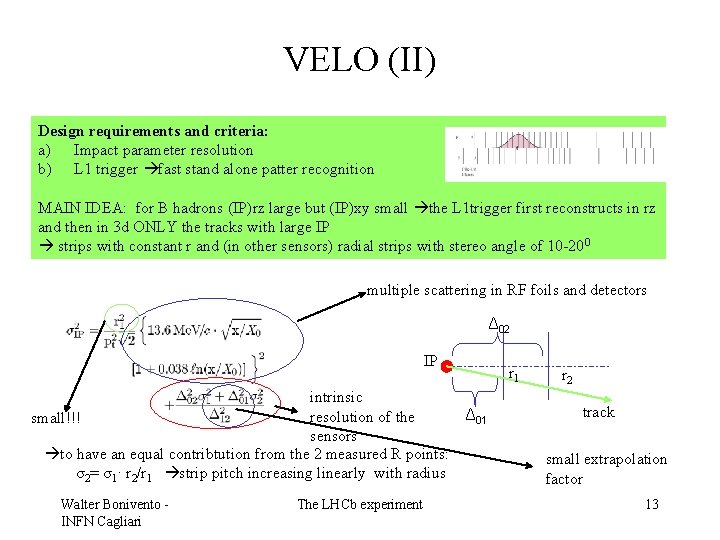
VELO (II) Design requirements and criteria: a) Impact parameter resolution b) L 1 trigger fast stand alone patter recognition MAIN IDEA: for B hadrons (IP)rz large but (IP)xy small the L 1 trigger first reconstructs in rz and then in 3 d ONLY the tracks with large IP strips with constant r and (in other sensors) radial strips with stereo angle of 10 -200 multiple scattering in RF foils and detectors Δ 02 IP intrinsic Δ 01 resolution of the small!!! sensors to have an equal contribtution from the 2 measured R points: σ2= σ1· r 2/r 1 strip pitch increasing linearly with radius Walter Bonivento INFN Cagliari The LHCb experiment r 1 r 2 track small extrapolation factor 13
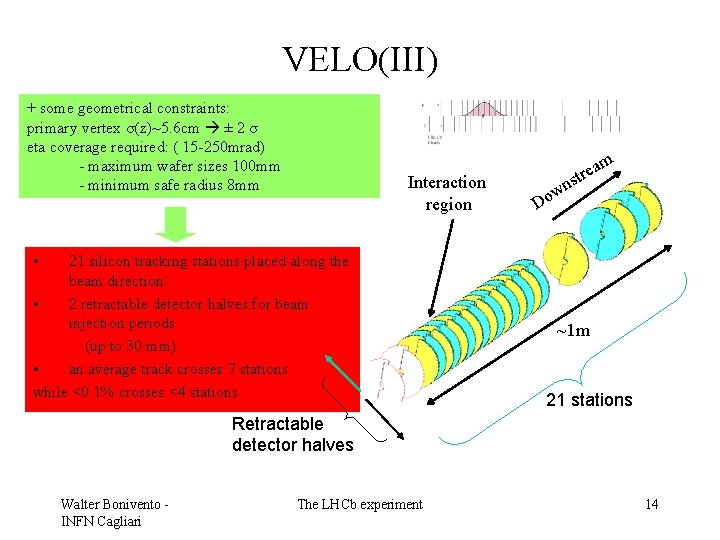
VELO(III) + some geometrical constraints: primary vertex σ(z)~5. 6 cm ± 2 σ eta coverage required: ( 15 -250 mrad) - maximum wafer sizes 100 mm - minimum safe radius 8 mm Interaction region am re nst w Do • 21 silicon tracking stations placed along the beam direction • 2 retractable detector halves for beam injection periods (up to 30 mm) • an average track crosses 7 stations while <0. 1% crosses <4 stations ~1 m 21 stations Retractable detector halves Walter Bonivento INFN Cagliari The LHCb experiment 14
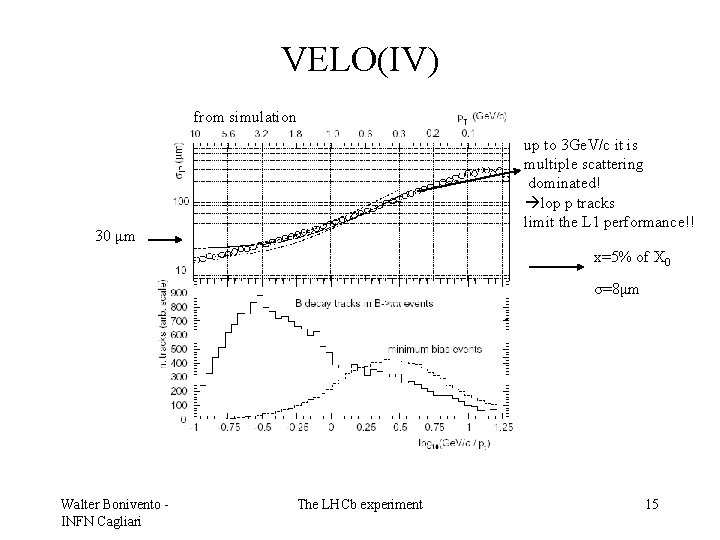
VELO(IV) from simulation up to 3 Ge. V/c it is multiple scattering dominated! lop p tracks limit the L 1 performance!! 30 μm x=5% of X 0 σ=8μm Walter Bonivento INFN Cagliari The LHCb experiment 15
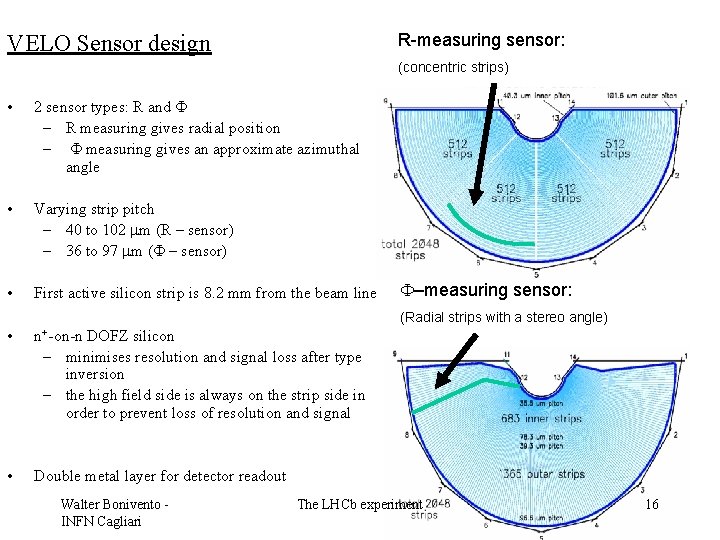
VELO Sensor design R-measuring sensor: (concentric strips) • 2 sensor types: R and F – R measuring gives radial position – F measuring gives an approximate azimuthal angle • Varying strip pitch – 40 to 102 mm (R – sensor) – 36 to 97 mm (F – sensor) • First active silicon strip is 8. 2 mm from the beam line • n+-on-n • Double metal layer for detector readout F–measuring sensor: (Radial strips with a stereo angle) DOFZ silicon – minimises resolution and signal loss after type inversion – the high field side is always on the strip side in order to prevent loss of resolution and signal Walter Bonivento INFN Cagliari The LHCb experiment 16
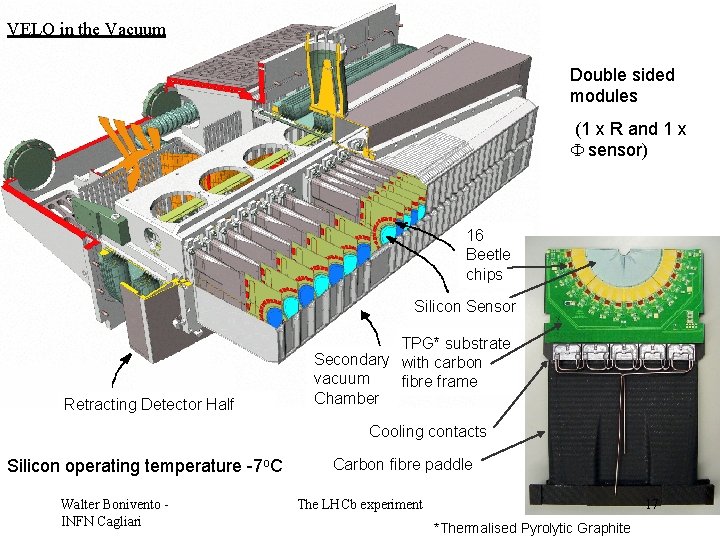
VELO in the Vacuum Double sided modules (1 x R and 1 x F sensor) 16 Beetle chips Silicon Sensor Retracting Detector Half TPG* substrate Secondary with carbon vacuum fibre frame Chamber Cooling contacts Silicon operating temperature -7 o. C Walter Bonivento INFN Cagliari Carbon fibre paddle The LHCb experiment 17 *Thermalised Pyrolytic Graphite
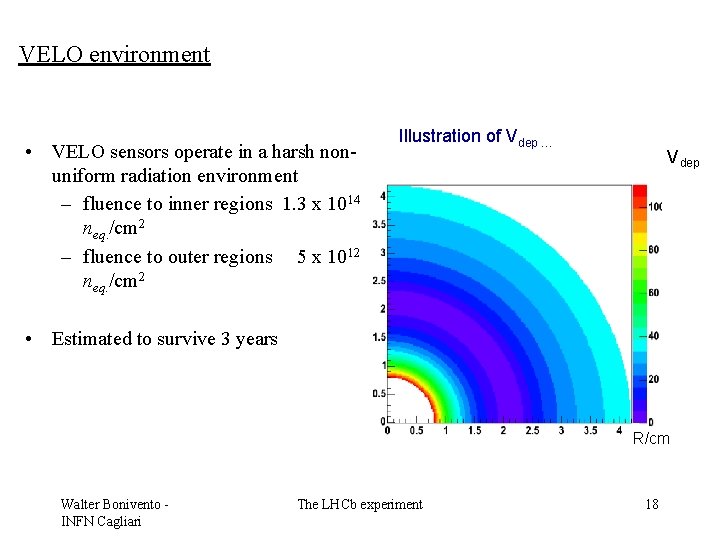
VELO environment • VELO sensors operate in a harsh nonuniform radiation environment – fluence to inner regions 1. 3 x 10¹⁴ neq. /cm 2 – fluence to outer regions 5 x 10¹² neq. /cm 2 Illustration of Vdep … Vdep • Estimated to survive 3 years R/cm Walter Bonivento INFN Cagliari The LHCb experiment 18
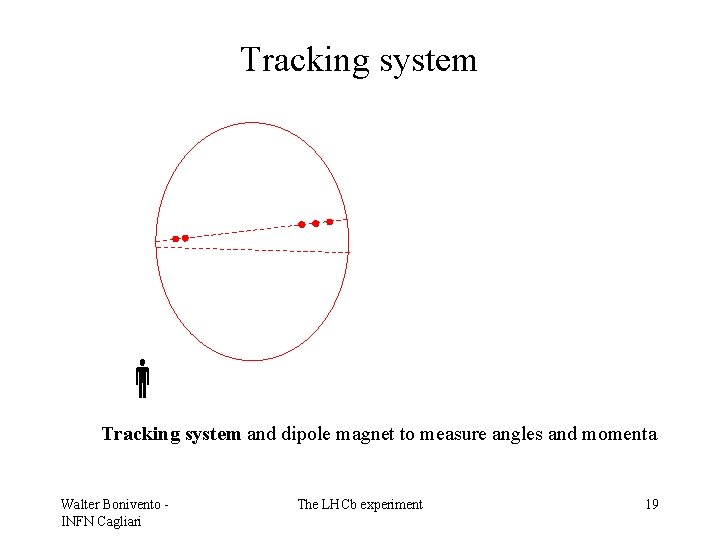
Tracking system and dipole magnet to measure angles and momenta Walter Bonivento INFN Cagliari The LHCb experiment 19
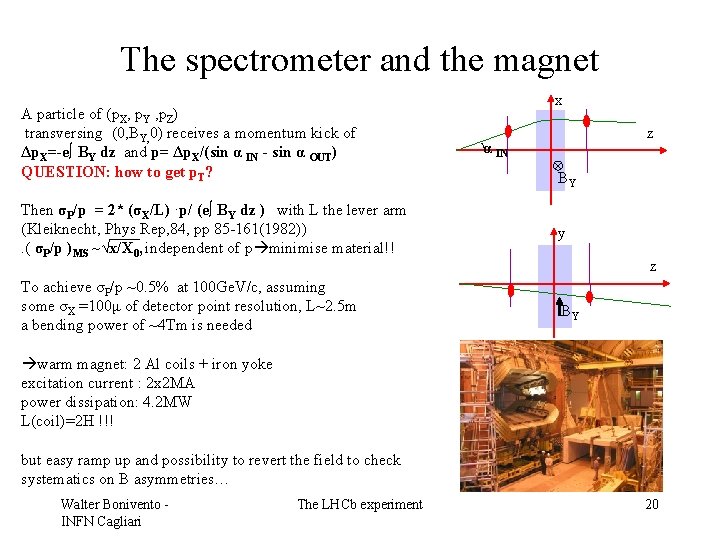
The spectrometer and the magnet A particle of (p. X, p. Y , p. Z) transversing (0, BY, 0) receives a momentum kick of Δp. X=-e∫ BY dz and p= Δp. X/(sin α IN - sin α OUT) QUESTION: how to get p. T? x z α IN BY Then σP/p = 2* (σX/L) ·p/ (e∫ BY dz ) with L the lever arm (Kleiknecht, Phys Rep, 84, pp 85 -161(1982)). ( σP/p )MS ~√x/X 0, independent of p minimise material!! y To achieve σP/p ~0. 5% at 100 Ge. V/c, assuming some σX =100μ of detector point resolution, L~2. 5 m a bending power of ~4 Tm is needed BY z warm magnet: 2 Al coils + iron yoke excitation current : 2 x 2 MA power dissipation: 4. 2 MW L(coil)=2 H !!! but easy ramp up and possibility to revert the field to check systematics on B asymmetries… Walter Bonivento INFN Cagliari The LHCb experiment 20
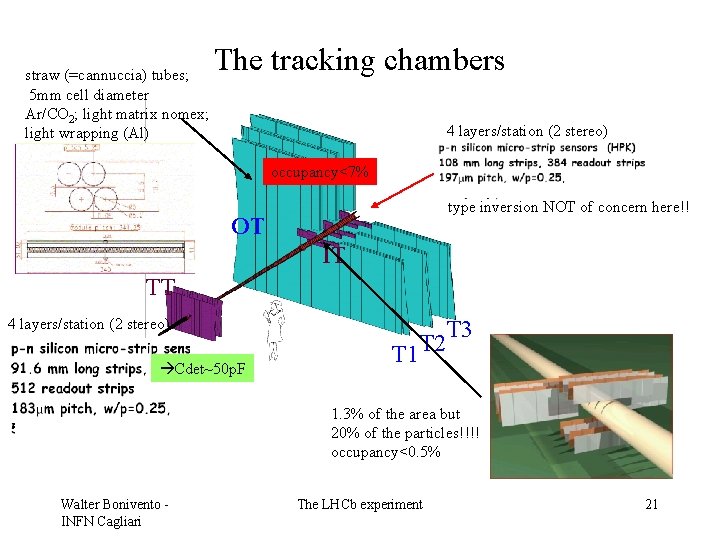
straw (=cannuccia) tubes; 5 mm cell diameter Ar/CO 2; light matrix nomex; light wrapping (Al) The tracking chambers 4 layers/station (2 stereo) occupancy<7% type inversion NOT of concern here!! OT IT TT 4 layers/station (2 stereo) Cdet~50 p. F T 1 T 2 T 3 1. 3% of the area but 20% of the particles!!!! occupancy<0. 5% Walter Bonivento INFN Cagliari The LHCb experiment 21
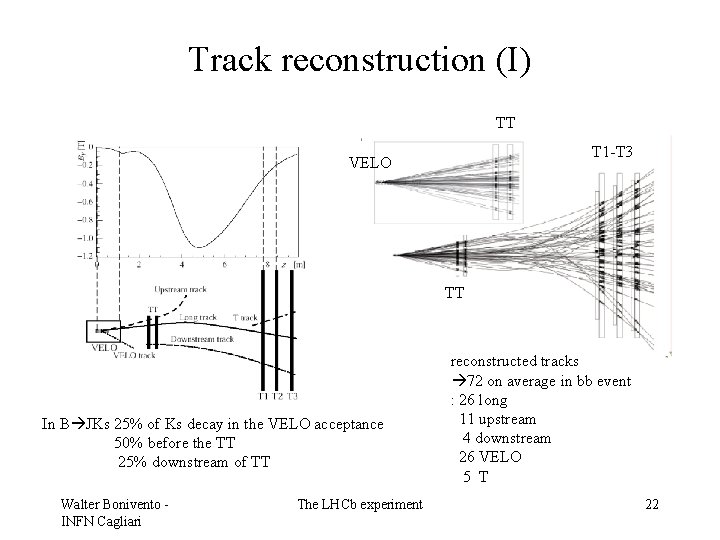
Track reconstruction (I) TT T 1 -T 3 VELO TT In B JKs 25% of Ks decay in the VELO acceptance 50% before the TT 25% downstream of TT Walter Bonivento INFN Cagliari The LHCb experiment reconstructed tracks 72 on average in bb event : 26 long 11 upstream 4 downstream 26 VELO 5 T 22
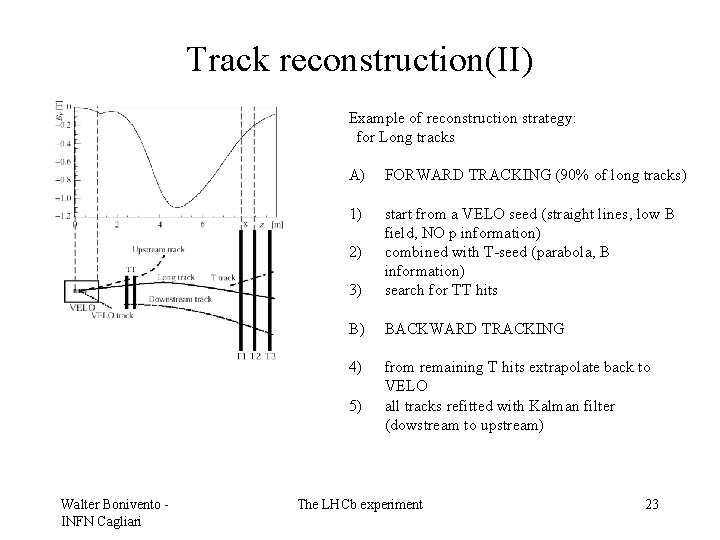
Track reconstruction(II) Example of reconstruction strategy: for Long tracks A) FORWARD TRACKING (90% of long tracks) 1) 3) start from a VELO seed (straight lines, low B field, NO p information) combined with T-seed (parabola, B information) search for TT hits B) BACKWARD TRACKING 4) from remaining T hits extrapolate back to VELO all tracks refitted with Kalman filter (dowstream to upstream) 2) 5) Walter Bonivento INFN Cagliari The LHCb experiment 23
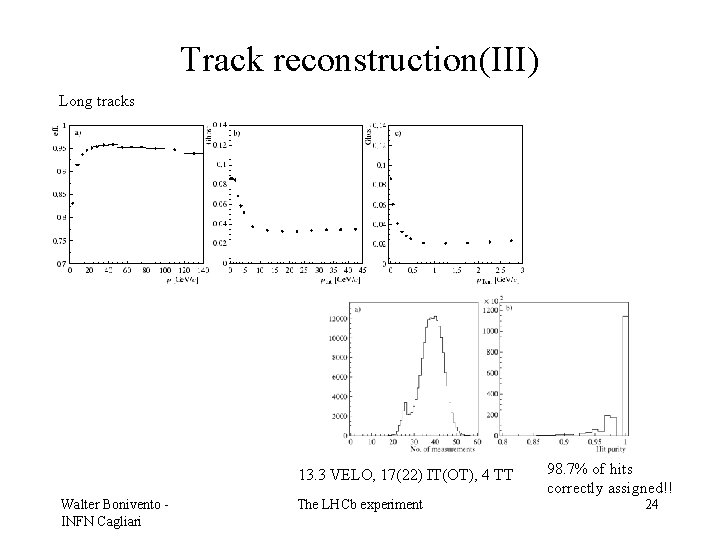
Track reconstruction(III) Long tracks 13. 3 VELO, 17(22) IT(OT), 4 TT Walter Bonivento INFN Cagliari The LHCb experiment 98. 7% of hits correctly assigned!! 24
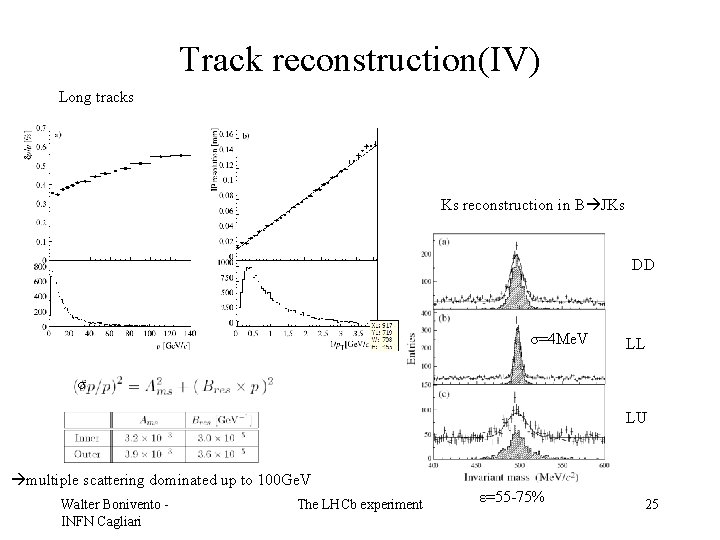
Track reconstruction(IV) Long tracks Ks reconstruction in B JKs DD σ=4 Me. V LL σ LU multiple scattering dominated up to 100 Ge. V Walter Bonivento INFN Cagliari The LHCb experiment ε=55 -75% 25
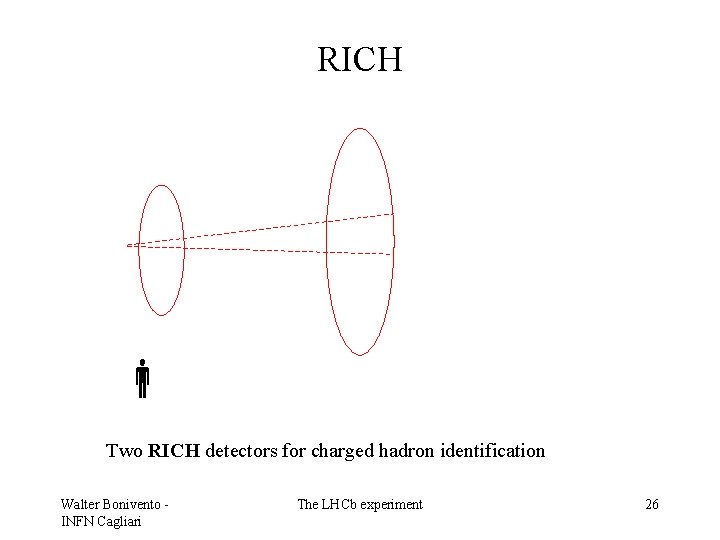
RICH Two RICH detectors for charged hadron identification Walter Bonivento INFN Cagliari The LHCb experiment 26
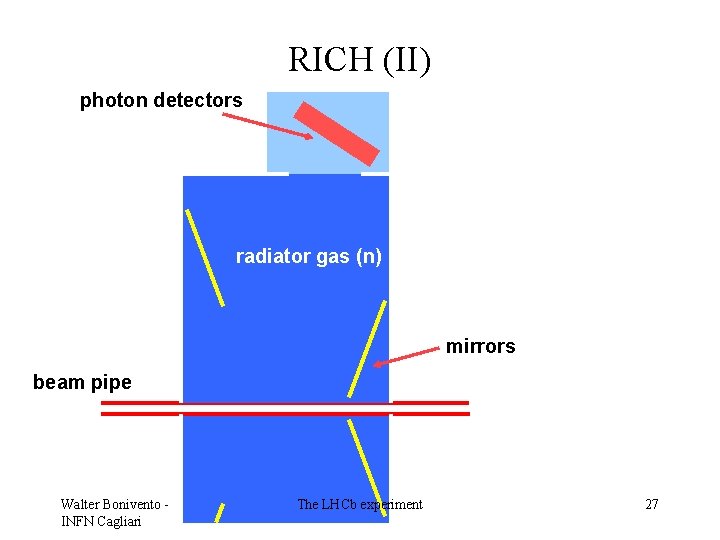
RICH (II) photon detectors radiator gas (n) mirrors beam pipe Walter Bonivento INFN Cagliari The LHCb experiment 27
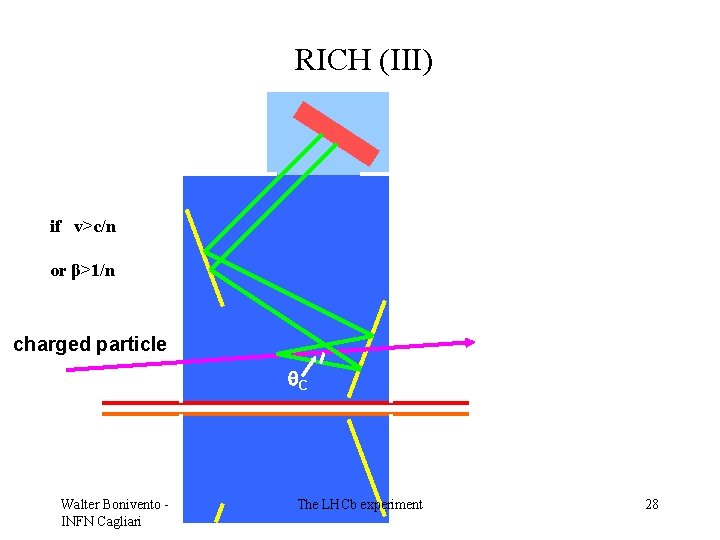
RICH (III) if v>c/n or β>1/n charged particle C Walter Bonivento INFN Cagliari The LHCb experiment 28
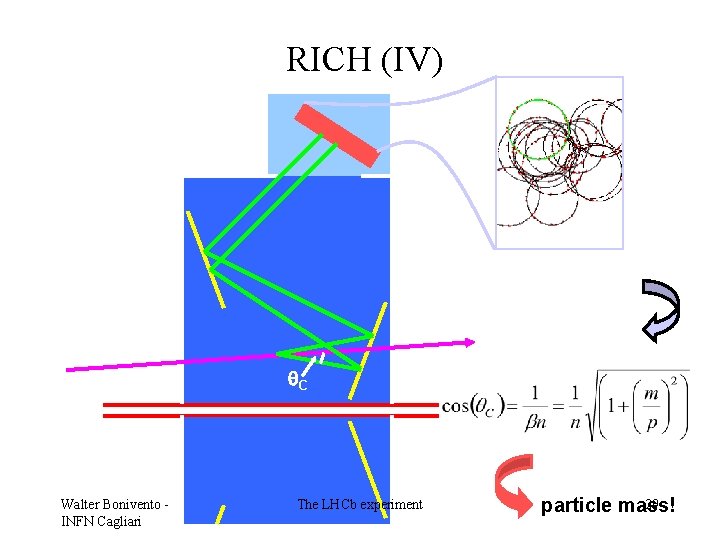
RICH (IV) charged particle C Walter Bonivento INFN Cagliari The LHCb experiment 29 particle mass!
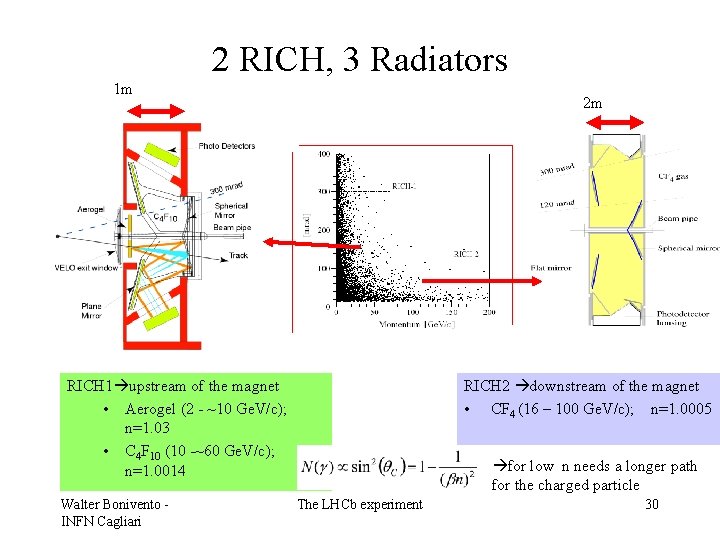
2 RICH, 3 Radiators 1 m 2 m RICH 2 downstream of the magnet • CF 4 (16 – 100 Ge. V/c); n=1. 0005 RICH 1 upstream of the magnet • Aerogel (2 - ~10 Ge. V/c); n=1. 03 • C 4 F 10 (10 -~60 Ge. V/c); n=1. 0014 Walter Bonivento INFN Cagliari for low n needs a longer path for the charged particle The LHCb experiment 30
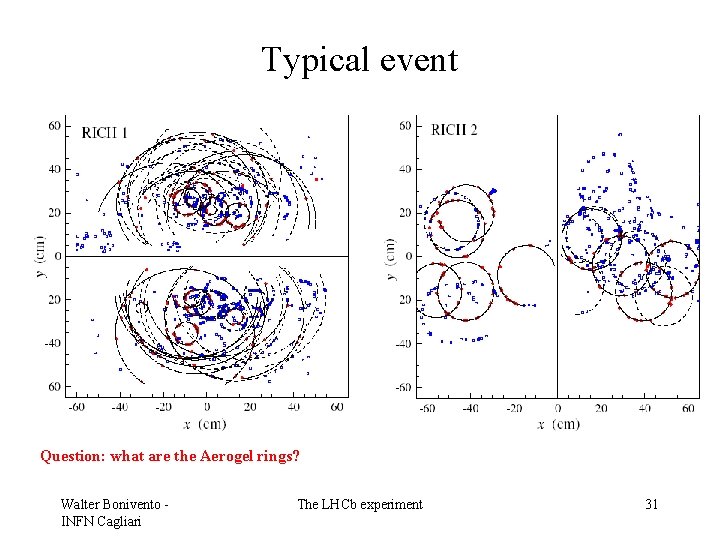
Typical event Question: what are the Aerogel rings? Walter Bonivento INFN Cagliari The LHCb experiment 31
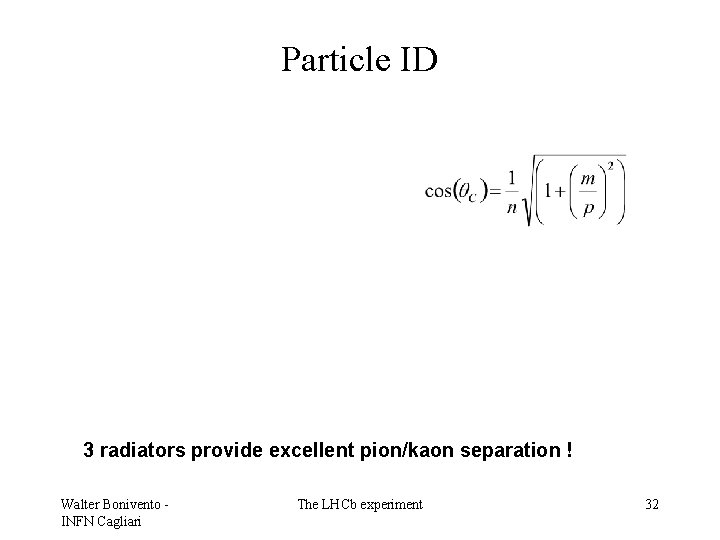
Particle ID 3 radiators provide excellent pion/kaon separation ! Walter Bonivento INFN Cagliari The LHCb experiment 32
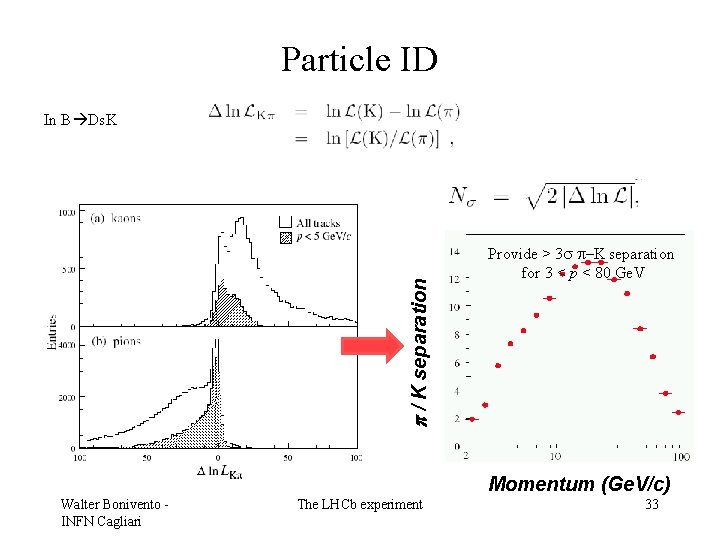
Particle ID / K separation In B Ds. K Provide > 3 s p–K separation for 3 < p < 80 Ge. V Momentum (Ge. V/c) Walter Bonivento INFN Cagliari The LHCb experiment 33
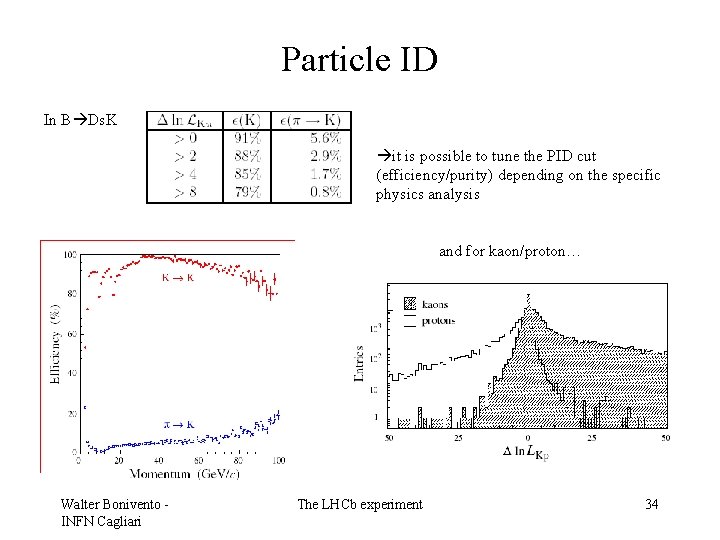
Particle ID In B Ds. K it is possible to tune the PID cut (efficiency/purity) depending on the specific physics analysis and for kaon/proton… Walter Bonivento INFN Cagliari The LHCb experiment 34
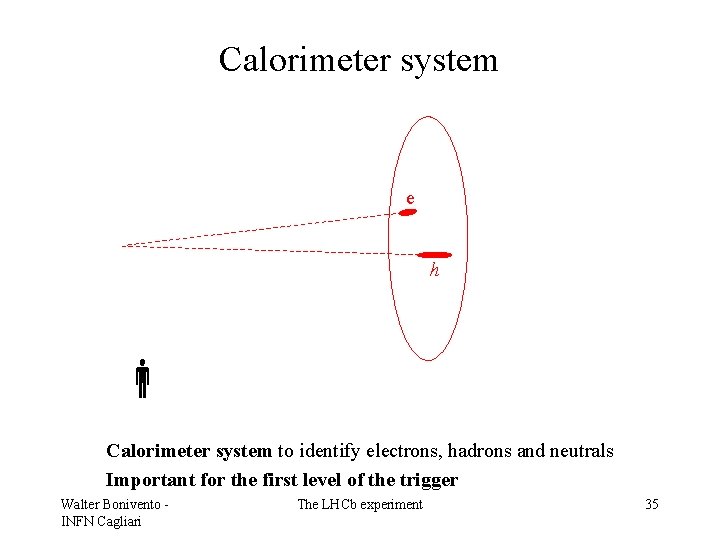
Calorimeter system e h Calorimeter system to identify electrons, hadrons and neutrals Important for the first level of the trigger Walter Bonivento INFN Cagliari The LHCb experiment 35
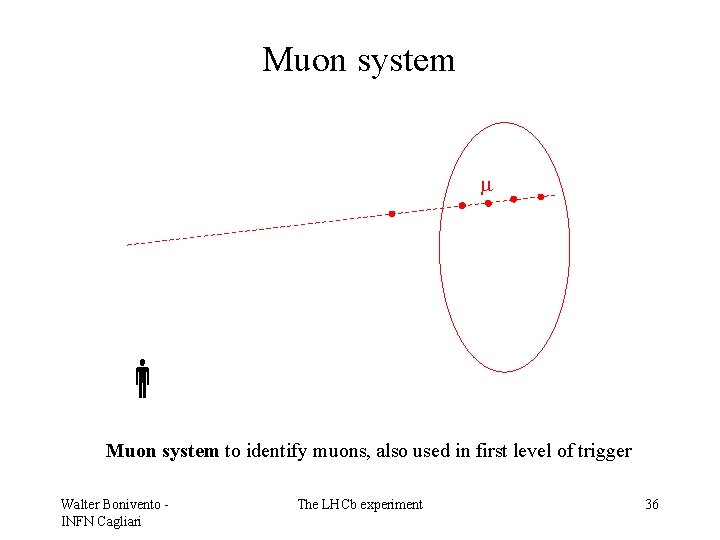
Muon system m Muon system to identify muons, also used in first level of trigger Walter Bonivento INFN Cagliari The LHCb experiment 36
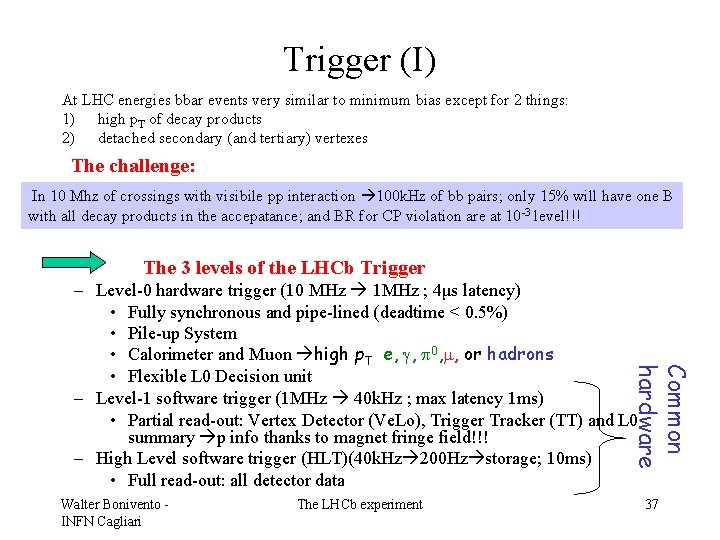
Trigger (I) At LHC energies bbar events very similar to minimum bias except for 2 things: 1) high p. T of decay products 2) detached secondary (and tertiary) vertexes The challenge: In 10 Mhz of crossings with visibile pp interaction 100 k. Hz of bb pairs; only 15% will have one B with all decay products in the accepatance; and BR for CP violation are at 10 -3 level!!! The 3 levels of the LHCb Trigger Common hardware – Level-0 hardware trigger (10 MHz 1 MHz ; 4μs latency) • Fully synchronous and pipe-lined (deadtime < 0. 5%) • Pile-up System • Calorimeter and Muon high p. T e, g, p 0, m, or hadrons • Flexible L 0 Decision unit – Level-1 software trigger (1 MHz 40 k. Hz ; max latency 1 ms) • Partial read-out: Vertex Detector (Ve. Lo), Trigger Tracker (TT) and L 0 summary p info thanks to magnet fringe field!!! – High Level software trigger (HLT)(40 k. Hz 200 Hz storage; 10 ms) • Full read-out: all detector data Walter Bonivento INFN Cagliari The LHCb experiment 37
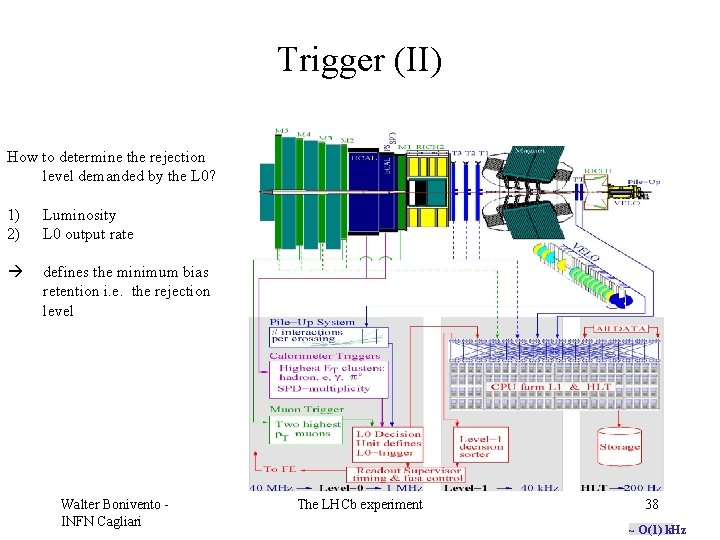
Trigger (II) How to determine the rejection level demanded by the L 0? 1) 2) Luminosity L 0 output rate defines the minimum bias retention i. e. the rejection level Walter Bonivento INFN Cagliari The LHCb experiment 38 ~ O(1) k. Hz
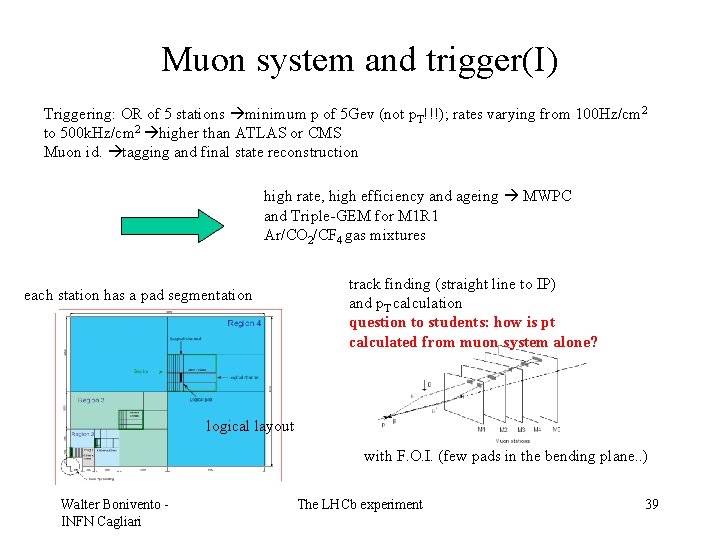
Muon system and trigger(I) Triggering: OR of 5 stations minimum p of 5 Gev (not p. T!!!); rates varying from 100 Hz/cm 2 to 500 k. Hz/cm 2 higher than ATLAS or CMS Muon id. tagging and final state reconstruction high rate, high efficiency and ageing MWPC and Triple-GEM for M 1 R 1 Ar/CO 2/CF 4 gas mixtures each station has a pad segmentation track finding (straight line to IP) and p. T calculation question to students: how is pt calculated from muon system alone? logical layout with F. O. I. (few pads in the bending plane. . ) Walter Bonivento INFN Cagliari The LHCb experiment 39
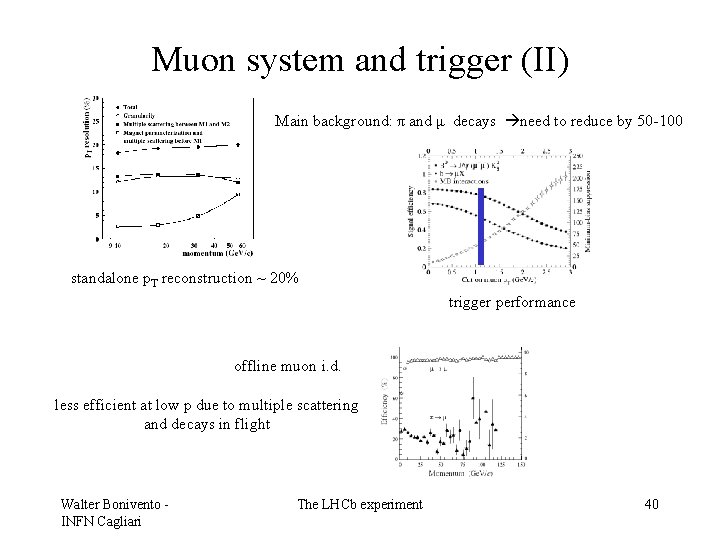
Muon system and trigger (II) Main background: π and μ decays need to reduce by 50 -100 standalone p. T reconstruction ~ 20% trigger performance offline muon i. d. less efficient at low p due to multiple scattering and decays in flight Walter Bonivento INFN Cagliari The LHCb experiment 40
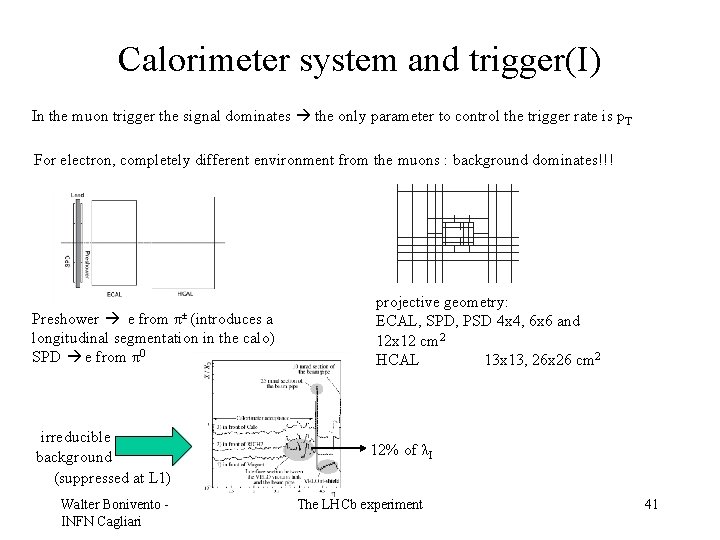
Calorimeter system and trigger(I) In the muon trigger the signal dominates the only parameter to control the trigger rate is p. T For electron, completely different environment from the muons : background dominates!!! Preshower e from a longitudinal segmentation in the calo) SPD e from π0 π± (introduces irreducible background (suppressed at L 1) Walter Bonivento INFN Cagliari projective geometry: ECAL, SPD, PSD 4 x 4, 6 x 6 and 12 x 12 cm 2 HCAL 13 x 13, 26 x 26 cm 2 12% of λI The LHCb experiment 41
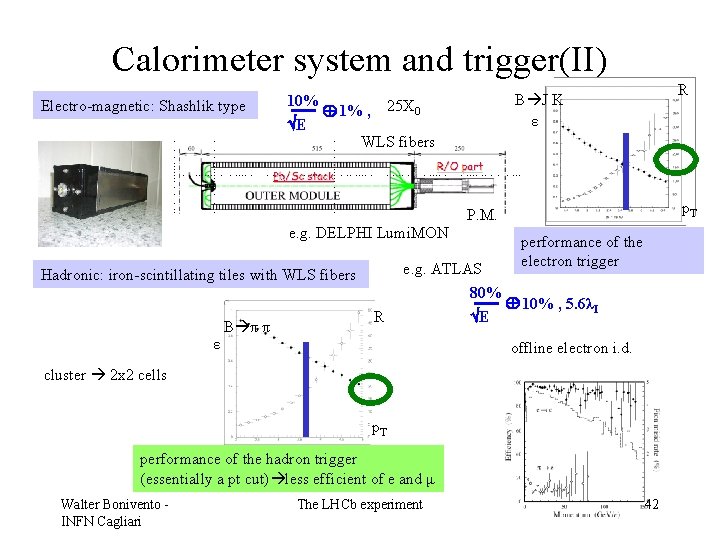
Calorimeter system and trigger(II) Electro-magnetic: Shashlik type R B J K ε 10% 1% , 25 X 0 E WLS fibers p. T P. M. e. g. DELPHI Lumi. MON e. g. ATLAS Hadronic: iron-scintillating tiles with WLS fibers ε B π π R performance of the electron trigger 80% 10% , 5. 6λI E offline electron i. d. cluster 2 x 2 cells p. T performance of the hadron trigger (essentially a pt cut) less efficient of e and μ Walter Bonivento INFN Cagliari The LHCb experiment 42
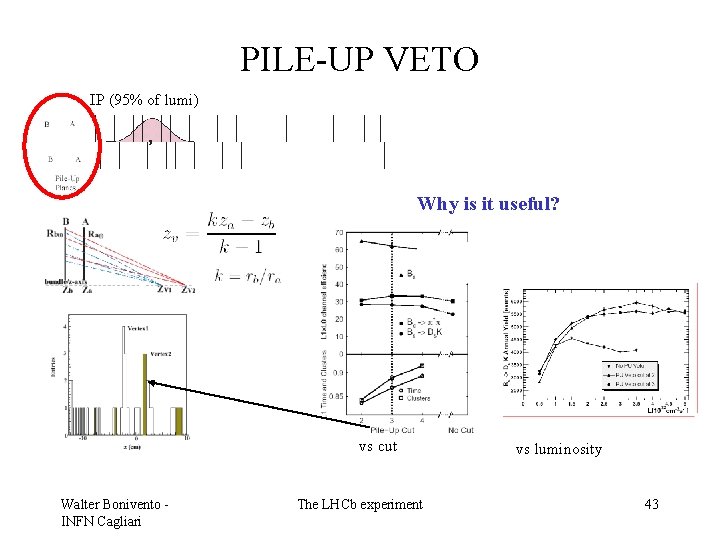
PILE-UP VETO IP (95% of lumi) Why is it useful? vs cut Walter Bonivento INFN Cagliari The LHCb experiment vs luminosity 43
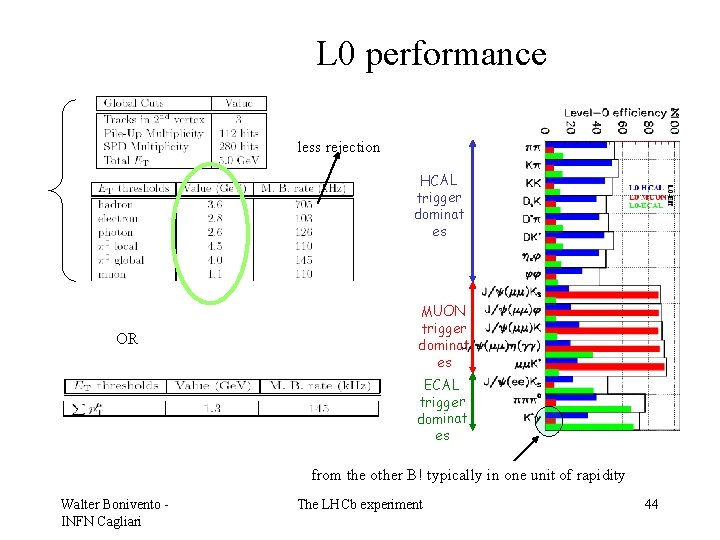
L 0 performance less rejection HCAL trigger dominat es OR MUON trigger dominat es ECAL trigger dominat es from the other B! typically in one unit of rapidity Walter Bonivento INFN Cagliari The LHCb experiment 44
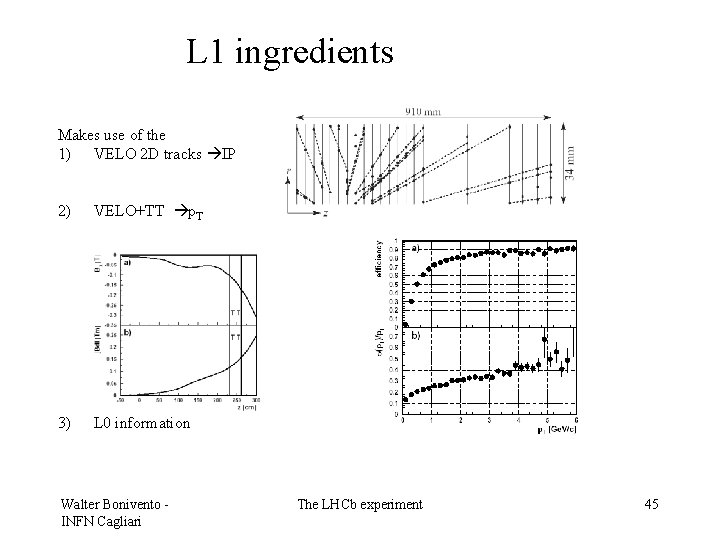
L 1 ingredients Makes use of the 1) VELO 2 D tracks IP 2) VELO+TT p. T 3) L 0 information Walter Bonivento INFN Cagliari The LHCb experiment 45
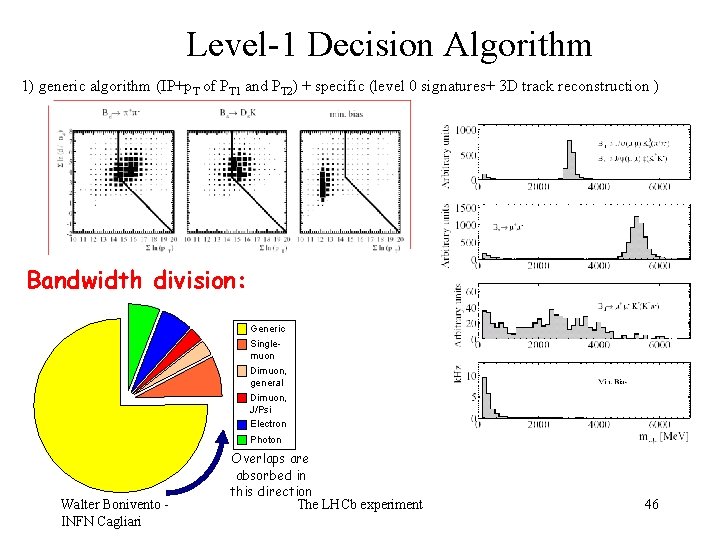
Level-1 Decision Algorithm 1) generic algorithm (IP+p. T of PT 1 and PT 2) + specific (level 0 signatures+ 3 D track reconstruction ) Bandwidth division: Generic Singlemuon Dimuon, general Dimuon, J/Psi Electron Photon Walter Bonivento INFN Cagliari Overlaps are absorbed in this direction The LHCb experiment 46
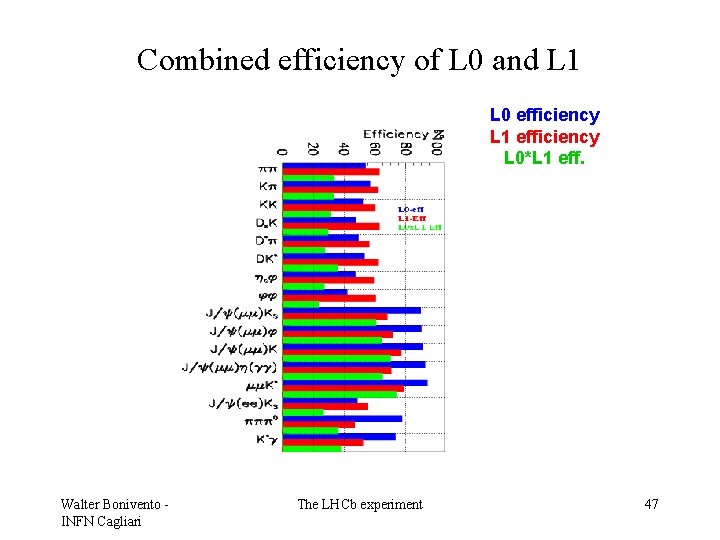
Combined efficiency of L 0 and L 1 L 0 efficiency L 1 efficiency L 0*L 1 eff. Walter Bonivento INFN Cagliari The LHCb experiment 47
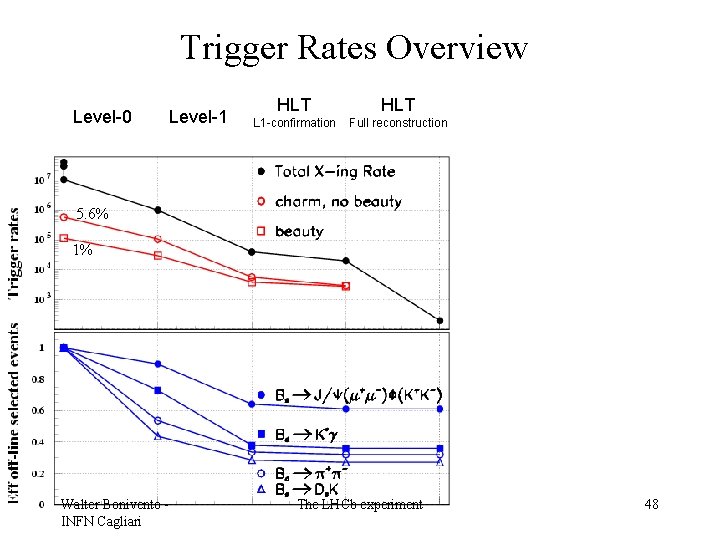
Trigger Rates Overview Level-0 Level-1 HLT L 1 -confirmation Full reconstruction 5. 6% 1% Walter Bonivento INFN Cagliari The LHCb experiment 48
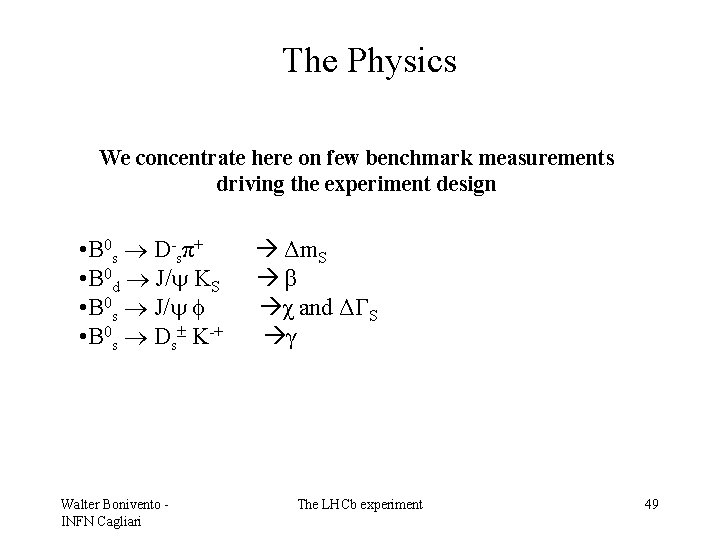
The Physics We concentrate here on few benchmark measurements driving the experiment design • B 0 s D-sπ+ • B 0 d J/y KS • B 0 s J/y f • B 0 s Ds K-+ Walter Bonivento INFN Cagliari Δm. S β χ and ΔΓS γ The LHCb experiment 49
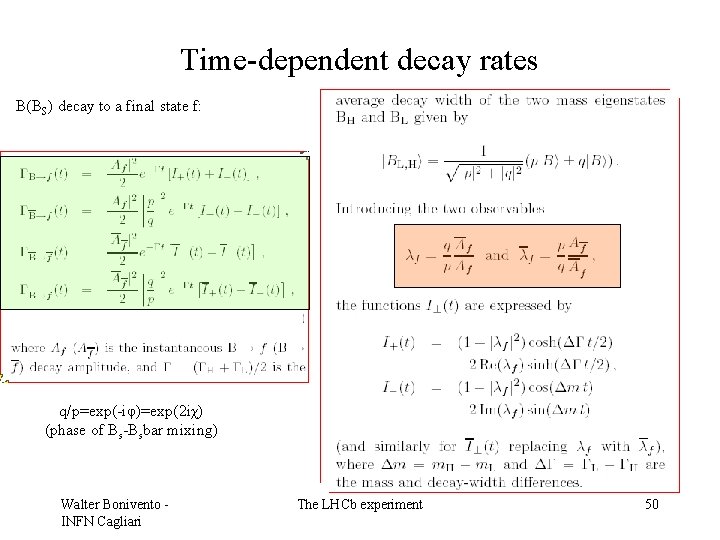
Time-dependent decay rates B(BS) decay to a final state f: q/p=exp(-iφ)=exp(2 iχ) (phase of Bs-Bsbar mixing) Walter Bonivento INFN Cagliari The LHCb experiment 50
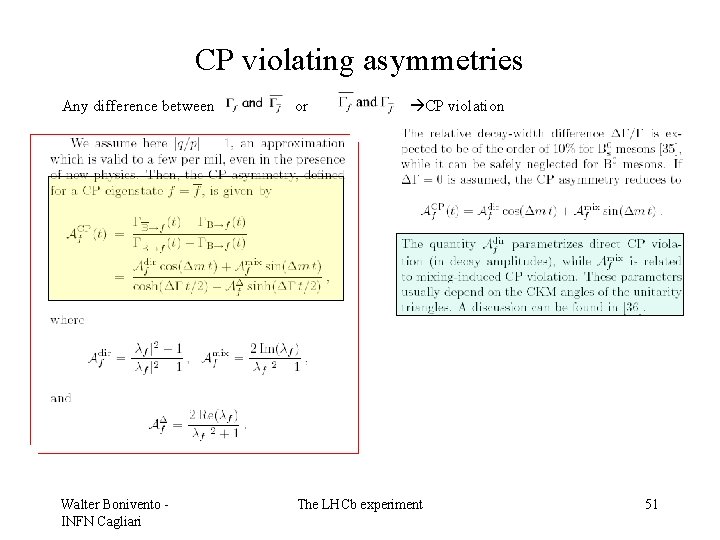
CP violating asymmetries CP violation Any difference between or Walter Bonivento INFN Cagliari The LHCb experiment 51
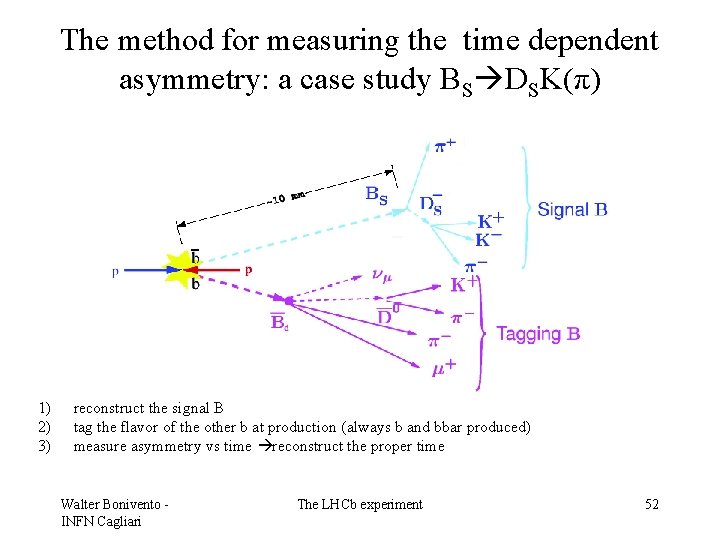
The method for measuring the time dependent asymmetry: a case study BS DSK(π) 1) 2) 3) reconstruct the signal B tag the flavor of the other b at production (always b and bbar produced) measure asymmetry vs time reconstruct the proper time Walter Bonivento INFN Cagliari The LHCb experiment 52
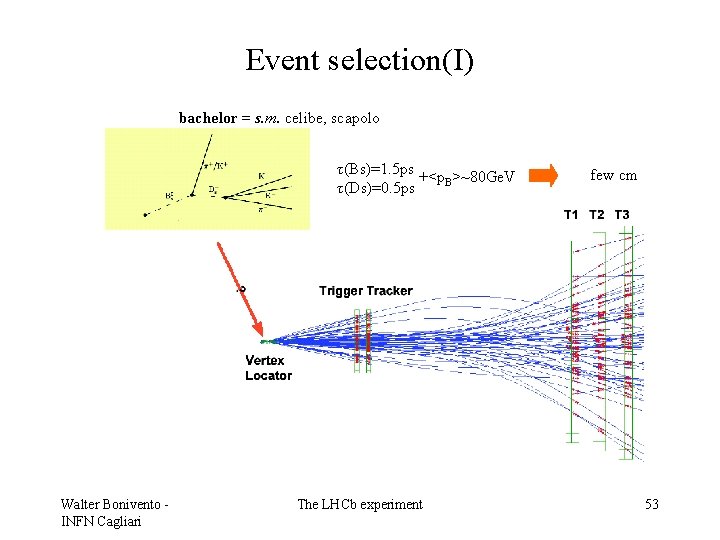
Event selection(I) bachelor = s. m. celibe, scapolo τ(Bs)=1. 5 ps +<p. B>~80 Ge. V τ(Ds)=0. 5 ps Walter Bonivento INFN Cagliari The LHCb experiment few cm 53
Event selection(II) Two types of background: 1) from other B decays similar to the one considered 2) combinatorial: the dominant contribution assumed from forward bb events 107 generated (only few minutes of LHCb data taking) estimates statistically limited upper limits derived on S/B sometimes some cuts relaxed (e. g. invariant massof B) to increase statistics it will be determined from the data using sidebands of mass distributions Walter Bonivento INFN Cagliari The LHCb experiment 54
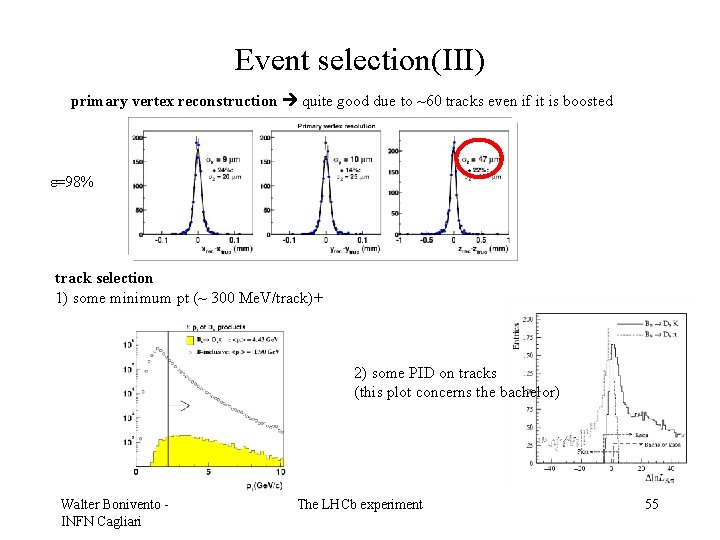
Event selection(III) primary vertex reconstruction quite good due to ~60 tracks even if it is boosted ε=98% track selection 1) some minimum pt (~ 300 Me. V/track)+ 2) some PID on tracks (this plot concerns the bachelor) Walter Bonivento INFN Cagliari The LHCb experiment 55
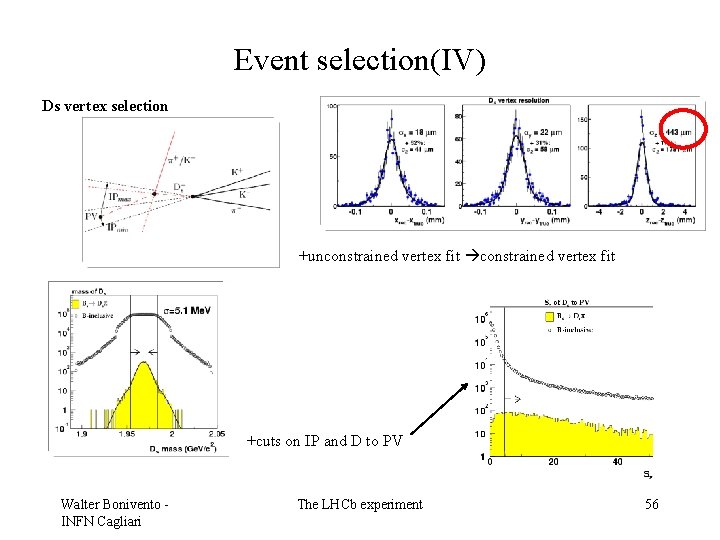
Event selection(IV) Ds vertex selection +unconstrained vertex fit +cuts on IP and D to PV Walter Bonivento INFN Cagliari The LHCb experiment 56
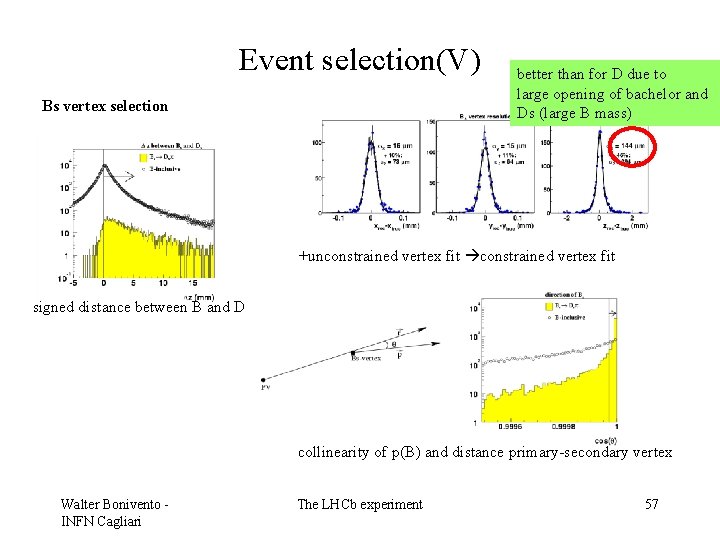
Event selection(V) Bs vertex selection better than for D due to large opening of bachelor and Ds (large B mass) +unconstrained vertex fit signed distance between B and D collinearity of p(B) and distance primary-secondary vertex Walter Bonivento INFN Cagliari The LHCb experiment 57
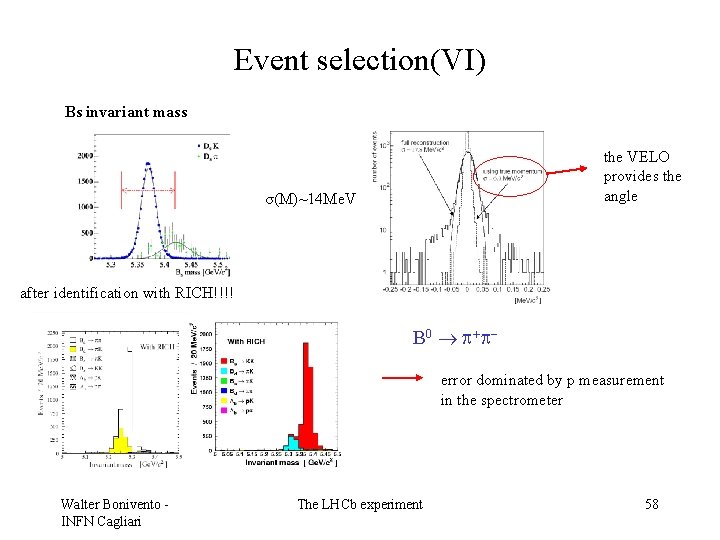
Event selection(VI) Bs invariant mass the VELO provides the angle σ(M)~14 Me. V after identification with RICH!!!! B 0 p+perror dominated by p measurement in the spectrometer Walter Bonivento INFN Cagliari The LHCb experiment 58
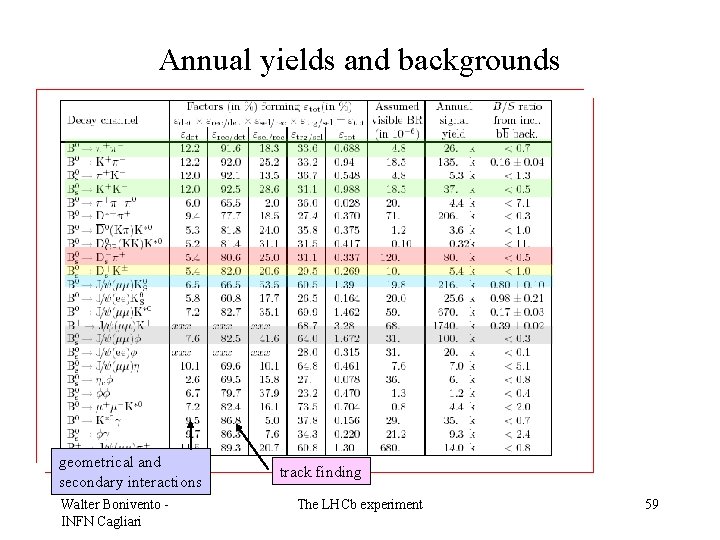
Annual yields and backgrounds geometrical and secondary interactions Walter Bonivento INFN Cagliari track finding The LHCb experiment 59
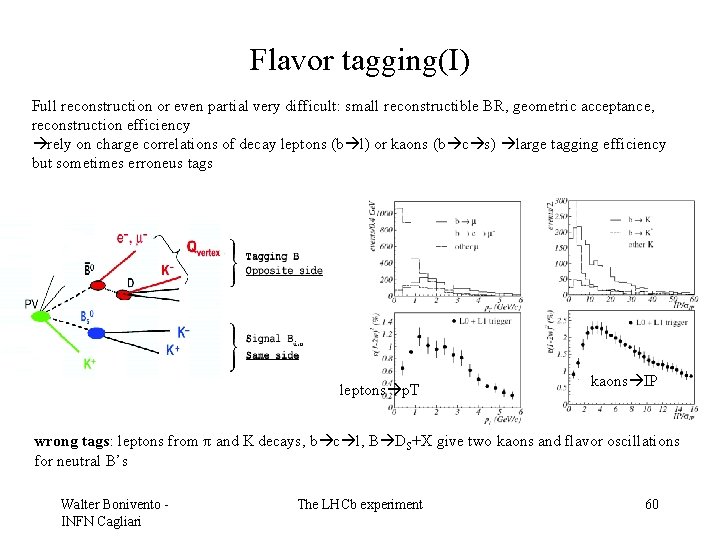
Flavor tagging(I) Full reconstruction or even partial very difficult: small reconstructible BR, geometric acceptance, reconstruction efficiency rely on charge correlations of decay leptons (b l) or kaons (b c s) large tagging efficiency but sometimes erroneus tags leptons p. T kaons IP wrong tags: leptons from π and K decays, b c l, B DS+X give two kaons and flavor oscillations for neutral B’s Walter Bonivento INFN Cagliari The LHCb experiment 60
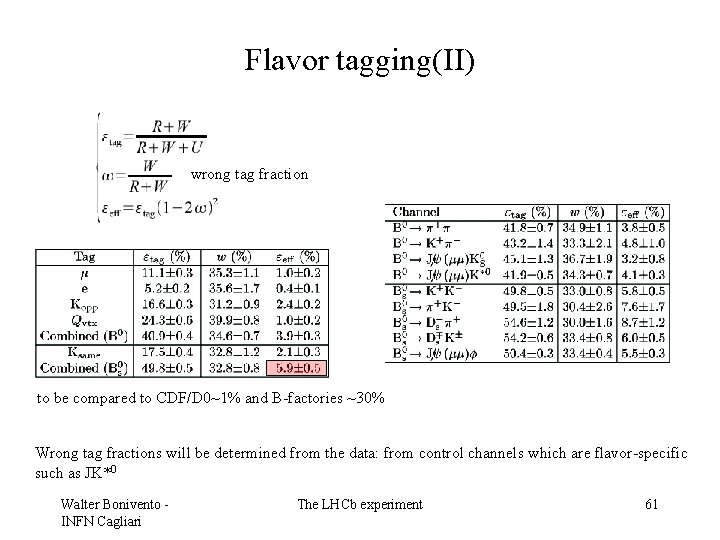
Flavor tagging(II) wrong tag fraction to be compared to CDF/D 0~1% and B-factories ~30% Wrong tag fractions will be determined from the data: from control channels which are flavor-specific such as JK*0 Walter Bonivento INFN Cagliari The LHCb experiment 61
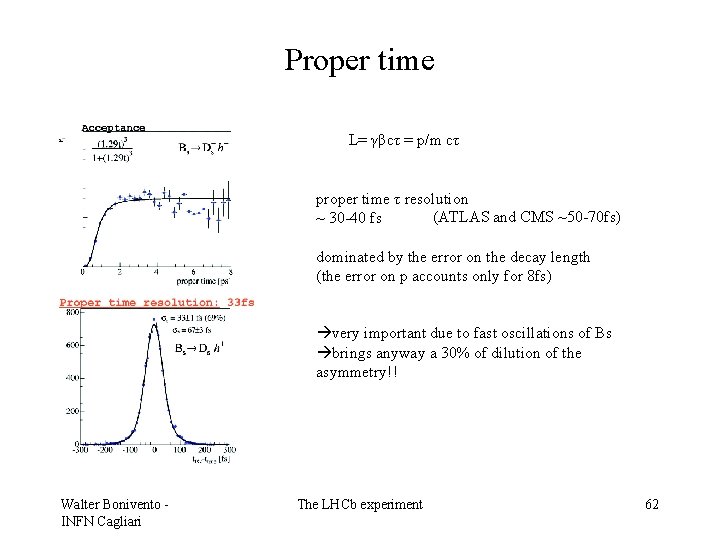
Proper time L= γβcτ = p/m cτ proper time τ resolution (ATLAS and CMS ~50 -70 fs) ~ 30 -40 fs dominated by the error on the decay length (the error on p accounts only for 8 fs) very important due to fast oscillations of Bs brings anyway a 30% of dilution of the asymmetry!! Walter Bonivento INFN Cagliari The LHCb experiment 62
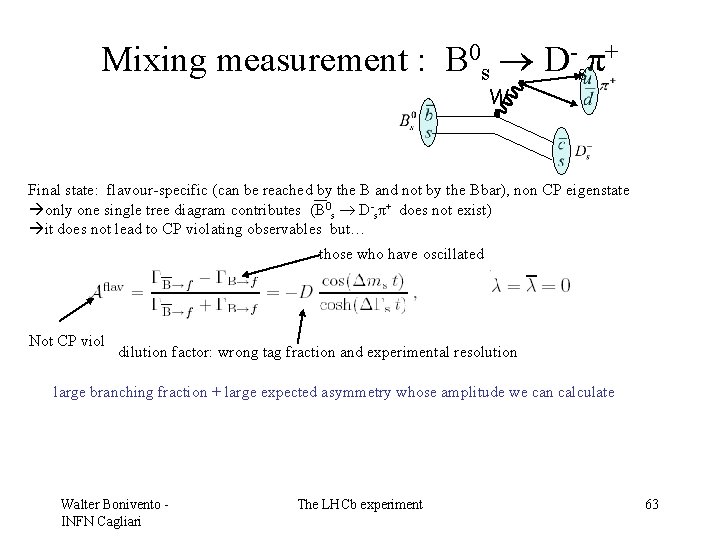
Mixing measurement : B 0 s D-sπ+ W Final state: flavour-specific (can be reached by the B and not by the Bbar), non CP eigenstate only one single tree diagram contributes (B 0 s D-sπ+ does not exist) it does not lead to CP violating observables but… those who have oscillated Not CP viol dilution factor: wrong tag fraction and experimental resolution large branching fraction + large expected asymmetry whose amplitude we can calculate Walter Bonivento INFN Cagliari The LHCb experiment 63
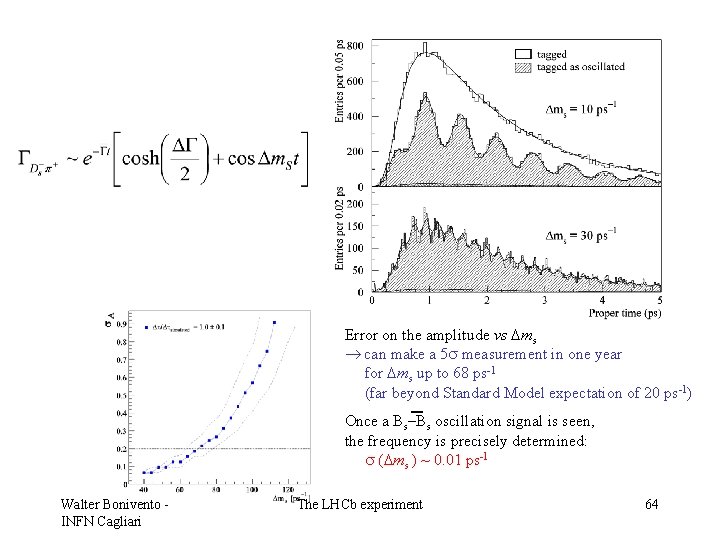
Error on the amplitude vs Dms can make a 5 s measurement in one year for Dms up to 68 ps-1 (far beyond Standard Model expectation of 20 ps-1) Once a Bs–Bs oscillation signal is seen, the frequency is precisely determined: s (Dms ) ~ 0. 01 ps-1 Walter Bonivento INFN Cagliari The LHCb experiment 64
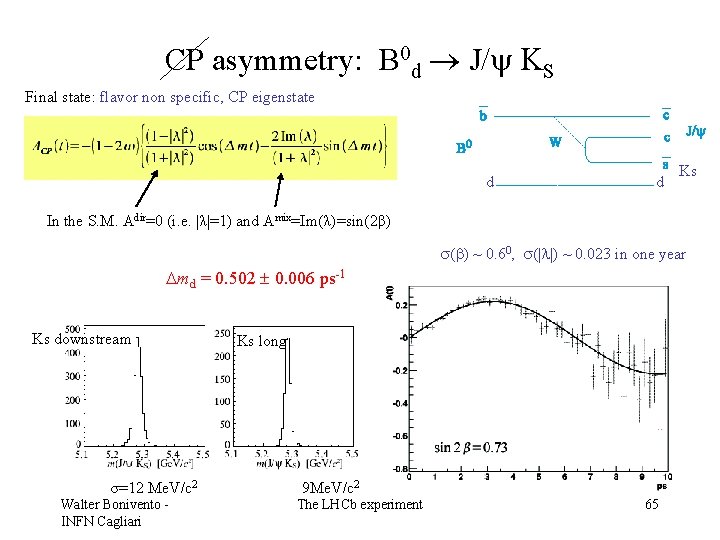
CP asymmetry: B 0 d J/y KS Final state: flavor non specific, CP eigenstate d d Ks In the S. M. Adir=0 (i. e. |λ|=1) and Amix=Im(λ)=sin(2β) s(b) ~ 0. 60, s(|l|) ~ 0. 023 in one year Dmd = 0. 502 0. 006 ps-1 Ks downstream σ=12 Me. V/c 2 Walter Bonivento INFN Cagliari Ks long 9 Me. V/c 2 The LHCb experiment 65
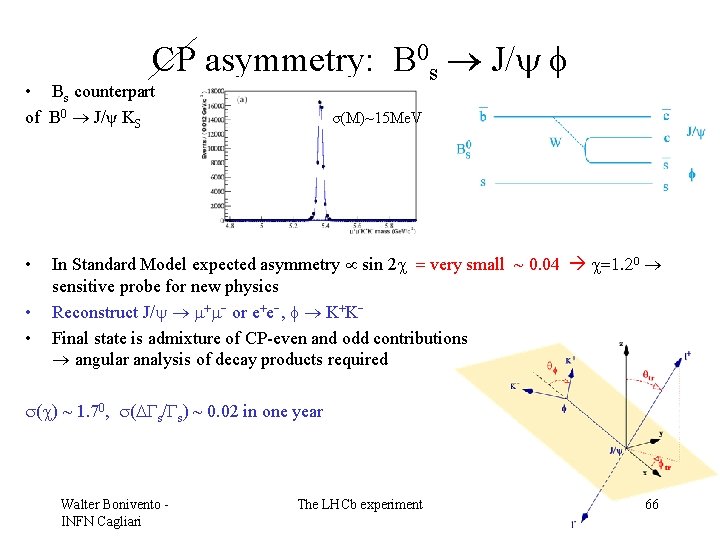
CP asymmetry: B 0 s J/y f • Bs counterpart of B 0 J/ψ KS • • • σ(M)~15 Me. V In Standard Model expected asymmetry sin 2 c = very small ~ 0. 04 c=1. 20 sensitive probe for new physics Reconstruct J/y m+m- or e+e-, f K+KFinal state is admixture of CP-even and odd contributions angular analysis of decay products required s(c) ~ 1. 70, s(DGs/Gs) ~ 0. 02 in one year Walter Bonivento INFN Cagliari The LHCb experiment 66
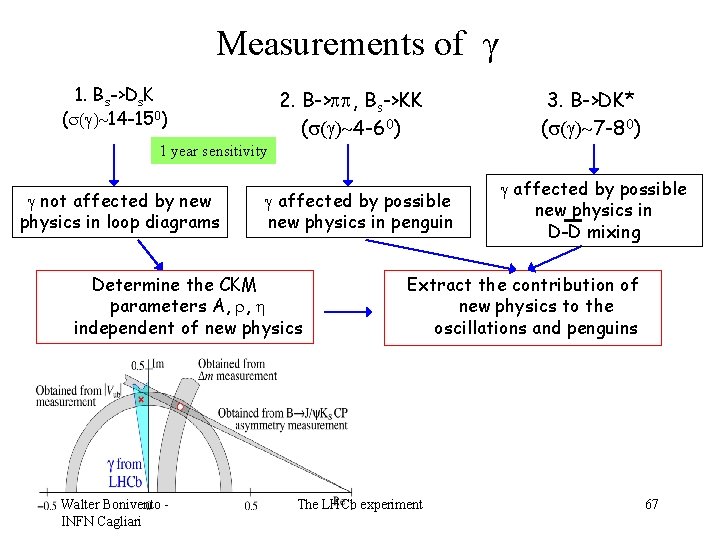
Measurements of γ 1. Bs->Ds. K (s(g) 14 -150) 2. B->pp, Bs->KK (s(g) 4 -60) 3. B->DK* (s(g) 7 -80) 1 year sensitivity g not affected by new physics in loop diagrams g affected by possible new physics in penguin Determine the CKM parameters A, r, h independent of new physics Walter Bonivento INFN Cagliari g affected by possible new physics in D-D mixing Extract the contribution of new physics to the oscillations and penguins The LHCb experiment 67
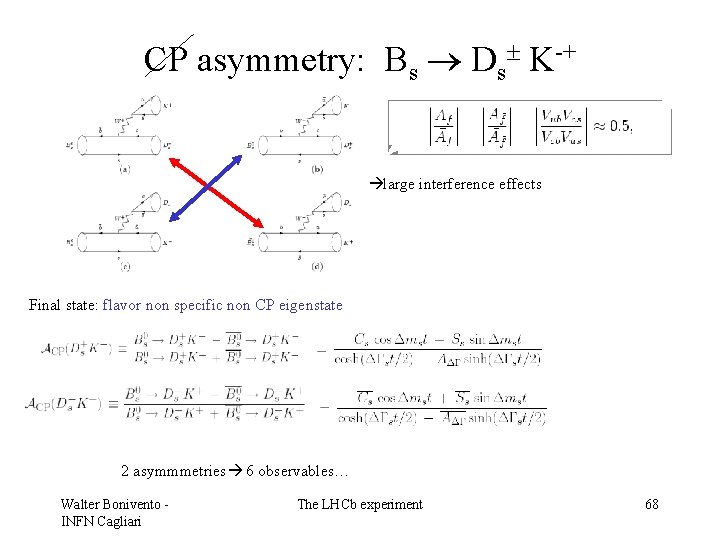
CP asymmetry: Bs Ds K-+ large interference effects Final state: flavor non specific non CP eigenstate 2 asymmmetries 6 observables… Walter Bonivento INFN Cagliari The LHCb experiment 68
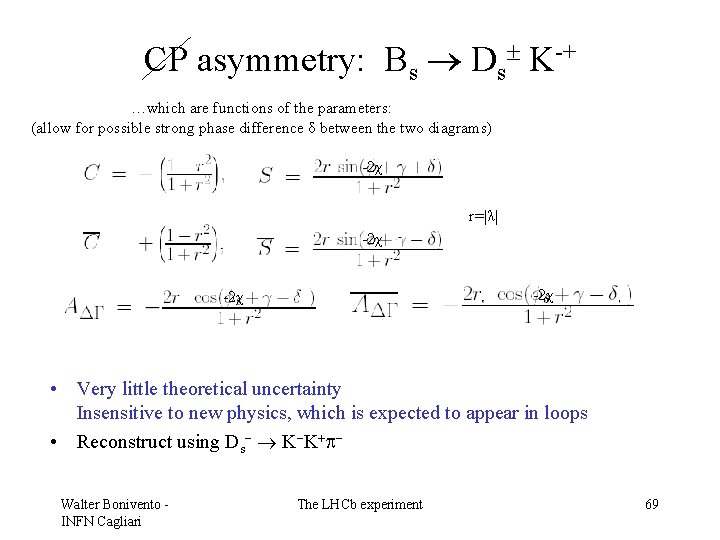
CP asymmetry: Bs Ds K-+ …which are functions of the parameters: (allow for possible strong phase difference δ between the two diagrams) -2χ r=|λ| -2χ -2χ • Very little theoretical uncertainty Insensitive to new physics, which is expected to appear in loops • Reconstruct using Ds- K-K+p. Walter Bonivento INFN Cagliari The LHCb experiment 69
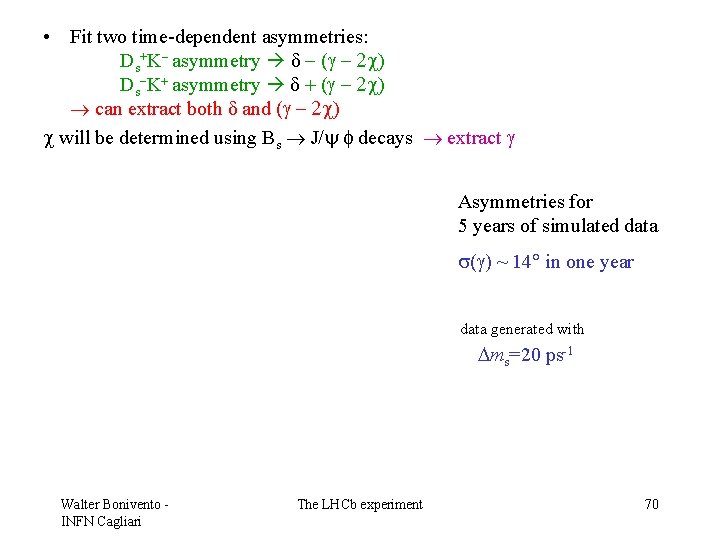
• Fit two time-dependent asymmetries: Ds+K- asymmetry δ - (g - 2 c) Ds-K+ asymmetry δ + (g - 2 c) can extract both δ and (g - 2 c) c will be determined using Bs J/y f decays extract g Asymmetries for 5 years of simulated data s(g) ~ 14 in one year data generated with Dms=20 ps-1 Walter Bonivento INFN Cagliari The LHCb experiment 70

THE END Walter Bonivento INFN Cagliari The LHCb experiment 71
- Slides: 71