
The Level of Interest Rates Chapter 4 Kidwell
- Slides: 37
The Level of Interest Rates Chapter 4 Kidwell, Blackwell, Whidbee and Sias 2/22/2021 Chapter 4 Kidwell, Blackwell, Whidbee & Sias 1
What are Interest Rates • Rental price for money • Price to borrowers for consuming before earning • Reward to savers for postponing consumption • Expressed in terms of annual rates • As with any price, interest rates serve to allocate resources 2/22/2021 Chapter 4 Kidwell, Blackwell, Whidbee & Sias 2
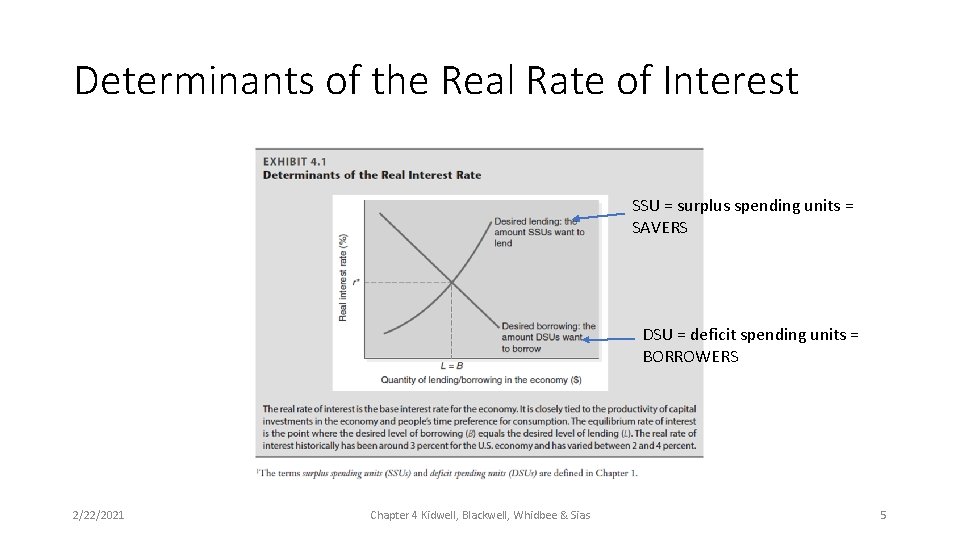
The real rate of interest • The rate of interest determined by: • The returns earned on investments in productive assets (capital investment) • The returns to individuals for postponing consumption • The real rate of interest is the return on real assets, and ignores inflation • The interest rate we observe in the market is the nominal rate of interest. 2/22/2021 Chapter 4 Kidwell, Blackwell, Whidbee & Sias 3
The Real Rate of Interest • Producers seek financing for real assets. Expected return on investment is the upper limit on interest rate producers can pay for financing. • Savers require compensation for deferring consumption. Time value of consumption is the lower limit on interest rate at which savers will provide financing. • Real rate occurs at equilibrium between desired real investment and desired saving. 2/22/2021 Chapter 4 Kidwell, Blackwell, Whidbee & Sias 4
Determinants of the Real Rate of Interest SSU = surplus spending units = SAVERS DSU = deficit spending units = BORROWERS 2/22/2021 Chapter 4 Kidwell, Blackwell, Whidbee & Sias 5
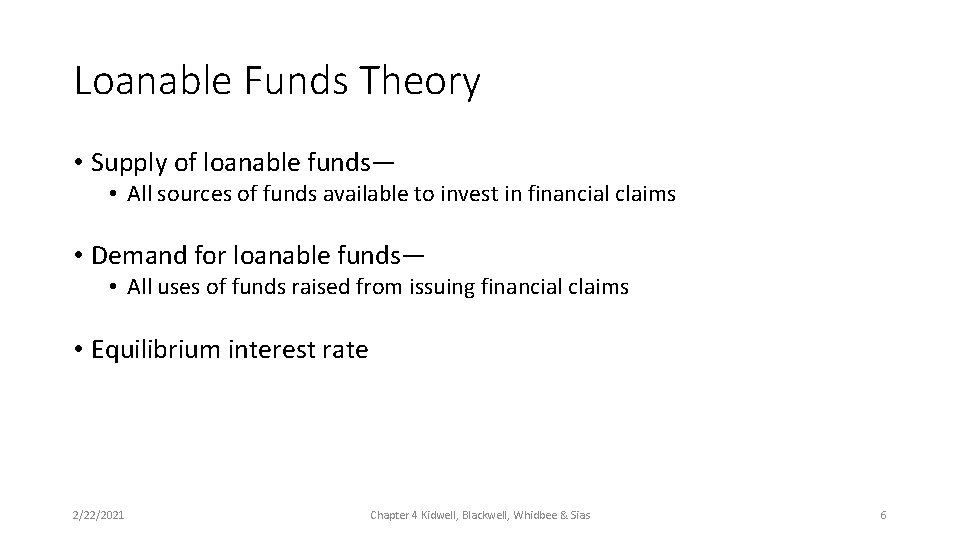
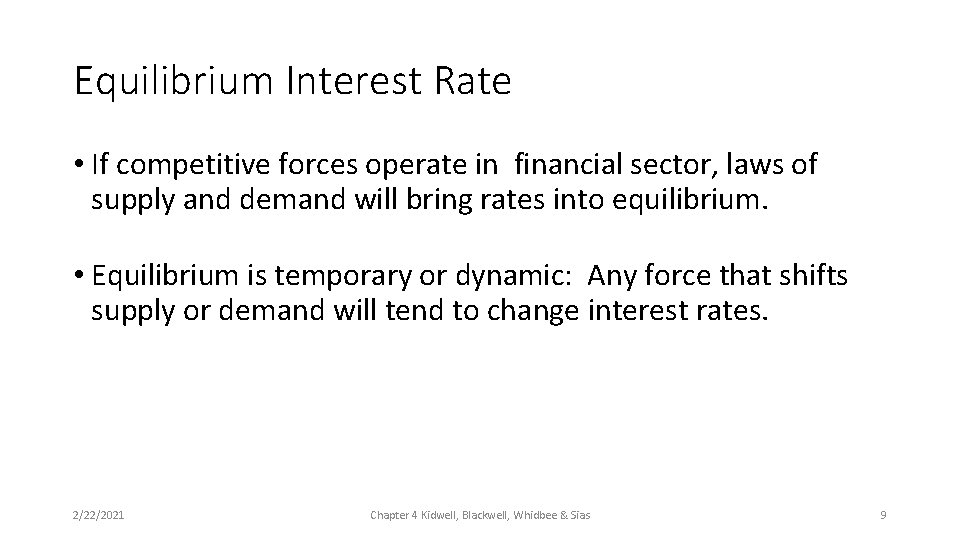
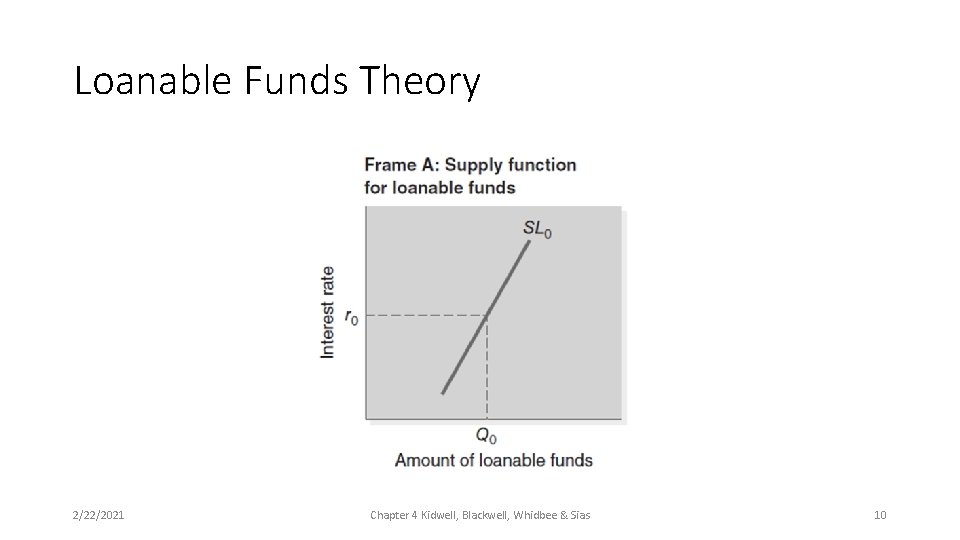
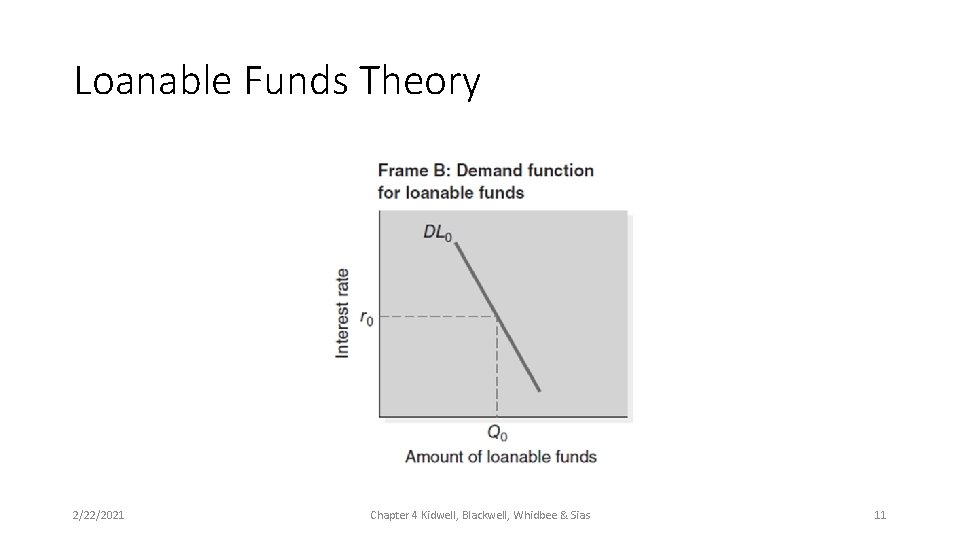
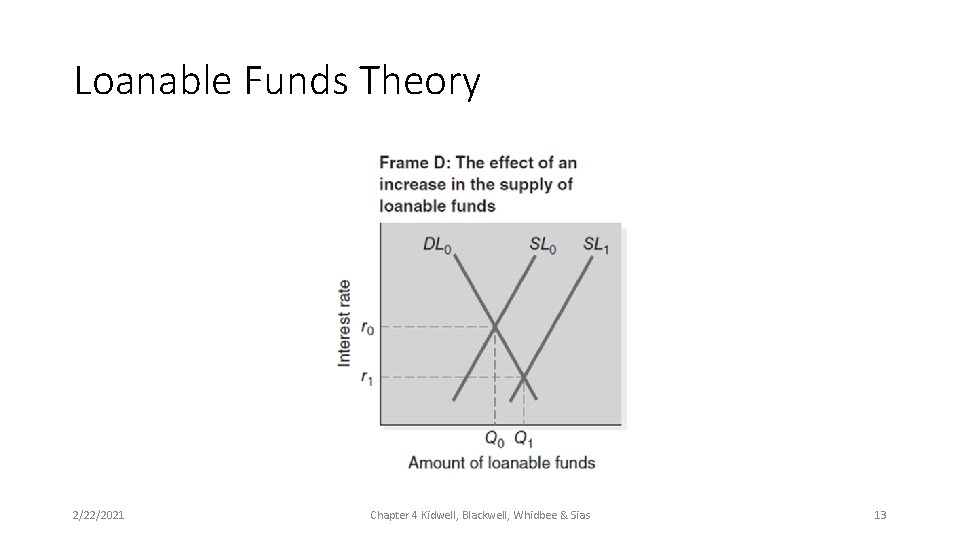
Loanable Funds Theory • Supply of loanable funds— • All sources of funds available to invest in financial claims • Demand for loanable funds— • All uses of funds raised from issuing financial claims • Equilibrium interest rate 2/22/2021 Chapter 4 Kidwell, Blackwell, Whidbee & Sias 6
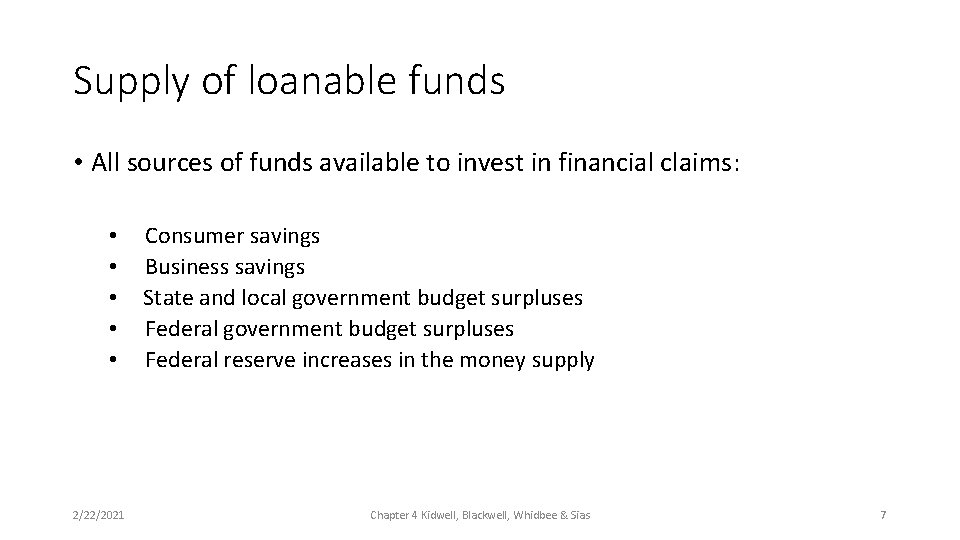
Supply of loanable funds • All sources of funds available to invest in financial claims: • Consumer savings • Business savings • State and local government budget surpluses • Federal reserve increases in the money supply 2/22/2021 Chapter 4 Kidwell, Blackwell, Whidbee & Sias 7
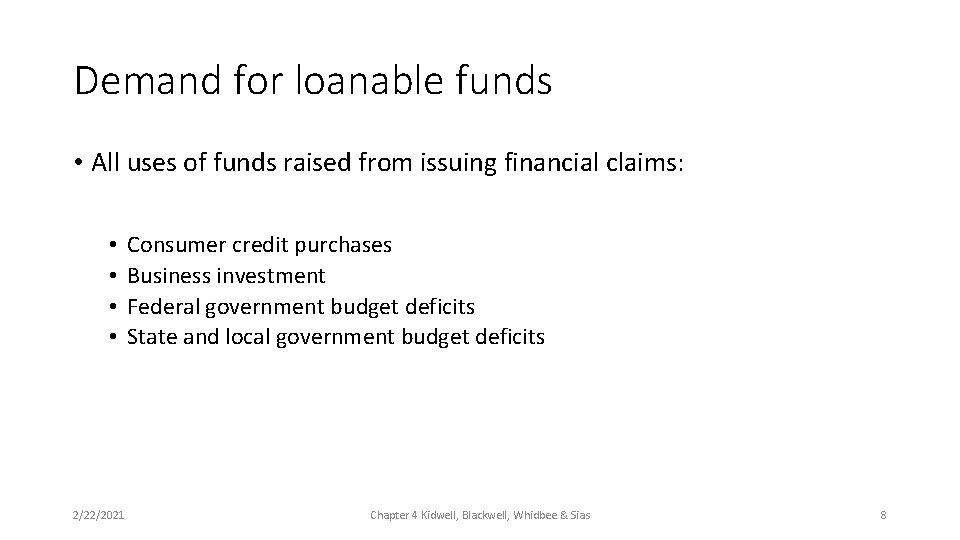
Demand for loanable funds • All uses of funds raised from issuing financial claims: • • 2/22/2021 Consumer credit purchases Business investment Federal government budget deficits State and local government budget deficits Chapter 4 Kidwell, Blackwell, Whidbee & Sias 8
Equilibrium Interest Rate • If competitive forces operate in financial sector, laws of supply and demand will bring rates into equilibrium. • Equilibrium is temporary or dynamic: Any force that shifts supply or demand will tend to change interest rates. 2/22/2021 Chapter 4 Kidwell, Blackwell, Whidbee & Sias 9
Loanable Funds Theory 2/22/2021 Chapter 4 Kidwell, Blackwell, Whidbee & Sias 10
Loanable Funds Theory 2/22/2021 Chapter 4 Kidwell, Blackwell, Whidbee & Sias 11
Loanable Funds Theory 2/22/2021 Chapter 4 Kidwell, Blackwell, Whidbee & Sias 12
Loanable Funds Theory 2/22/2021 Chapter 4 Kidwell, Blackwell, Whidbee & Sias 13
Price Expectations and Interest Rates • Have to also consider the impact of price-level changes on the level of interest rates • Unanticipated inflation benefits borrowers at expense of lenders. • Lenders charge added interest to offset anticipated decreases in purchasing power. • Expected inflation is embodied in nominal interest rates: The Fisher Effect. 2/22/2021 Chapter 4 Kidwell, Blackwell, Whidbee & Sias 14
Loan contracts and inflation • Suppose you agree that 5% is a fair price to borrow money in a world with no inflation • But, you expect 7% inflation. • The lender should be compensated for both the delay in consumption (at 5%) and for the loss of purchasing power (at 7%) • Thus, if you borrow $1000 for a year • Pay $50 for spending now rather than later • Pay $70 for loss of purchasing power 2/22/2021 Chapter 4 Kidwell, Blackwell, Whidbee & Sias 15
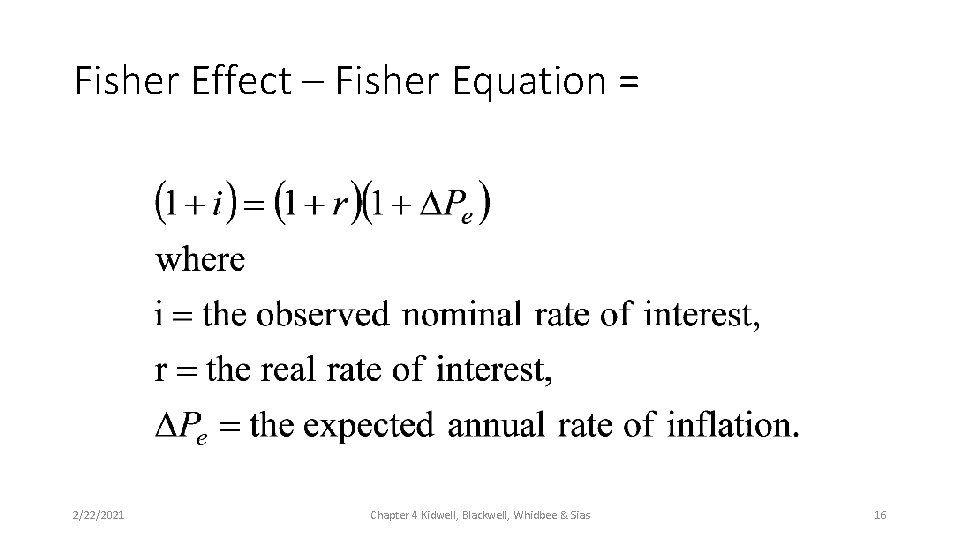
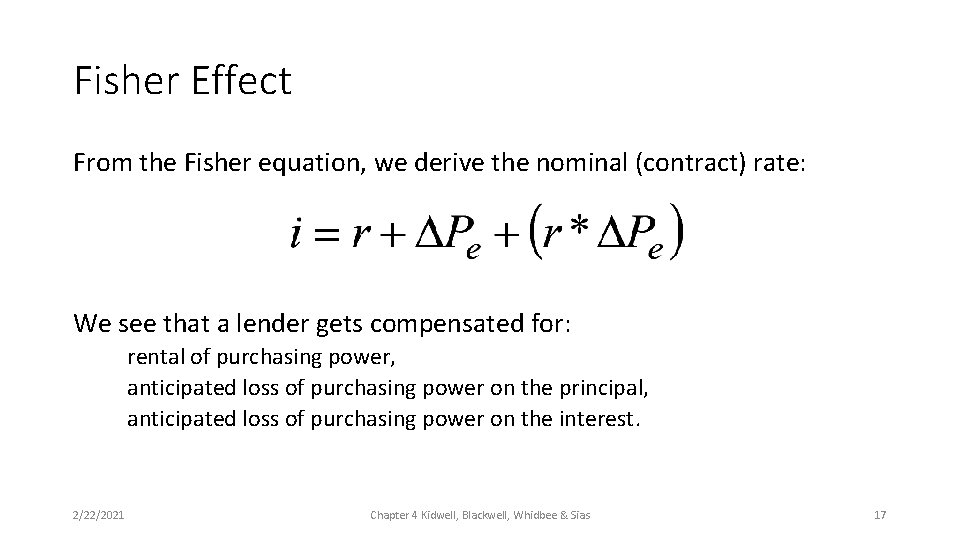
Fisher Effect – Fisher Equation = 2/22/2021 Chapter 4 Kidwell, Blackwell, Whidbee & Sias 16
Fisher Effect From the Fisher equation, we derive the nominal (contract) rate: We see that a lender gets compensated for: rental of purchasing power, anticipated loss of purchasing power on the principal, anticipated loss of purchasing power on the interest. 2/22/2021 Chapter 4 Kidwell, Blackwell, Whidbee & Sias 17
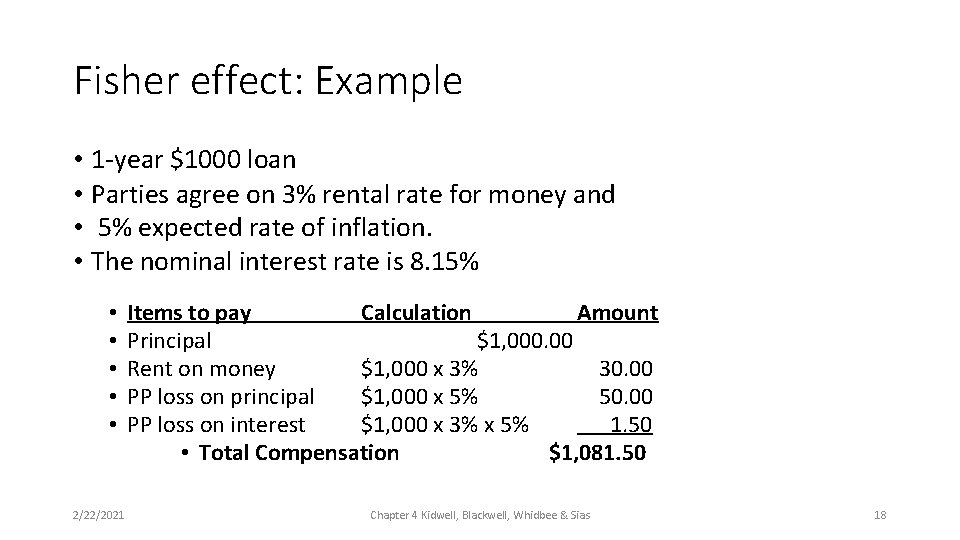
Fisher effect: Example • 1 -year $1000 loan • Parties agree on 3% rental rate for money and • 5% expected rate of inflation. • The nominal interest rate is 8. 15% • • • 2/22/2021 Items to pay Calculation Amount Principal $1, 000. 00 Rent on money $1, 000 x 3% 30. 00 PP loss on principal $1, 000 x 5% 50. 00 PP loss on interest $1, 000 x 3% x 5% 1. 50 • Total Compensation $1, 081. 50 Chapter 4 Kidwell, Blackwell, Whidbee & Sias 18
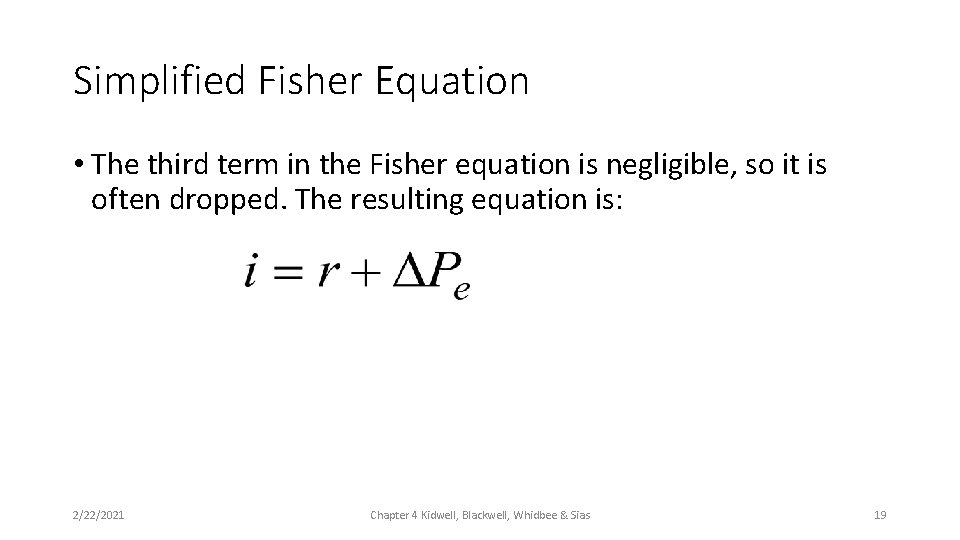
Simplified Fisher Equation • The third term in the Fisher equation is negligible, so it is often dropped. The resulting equation is: 2/22/2021 Chapter 4 Kidwell, Blackwell, Whidbee & Sias 19
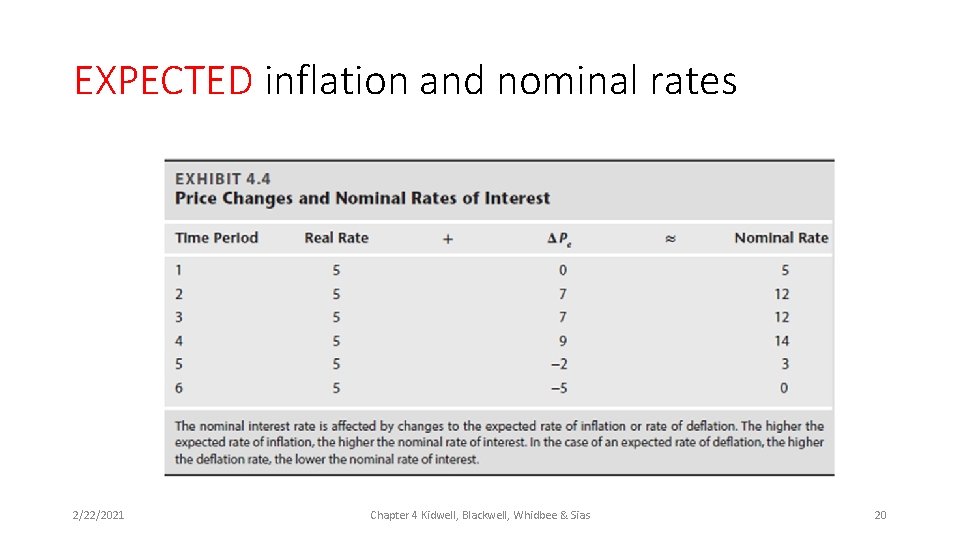
EXPECTED inflation and nominal rates 2/22/2021 Chapter 4 Kidwell, Blackwell, Whidbee & Sias 20
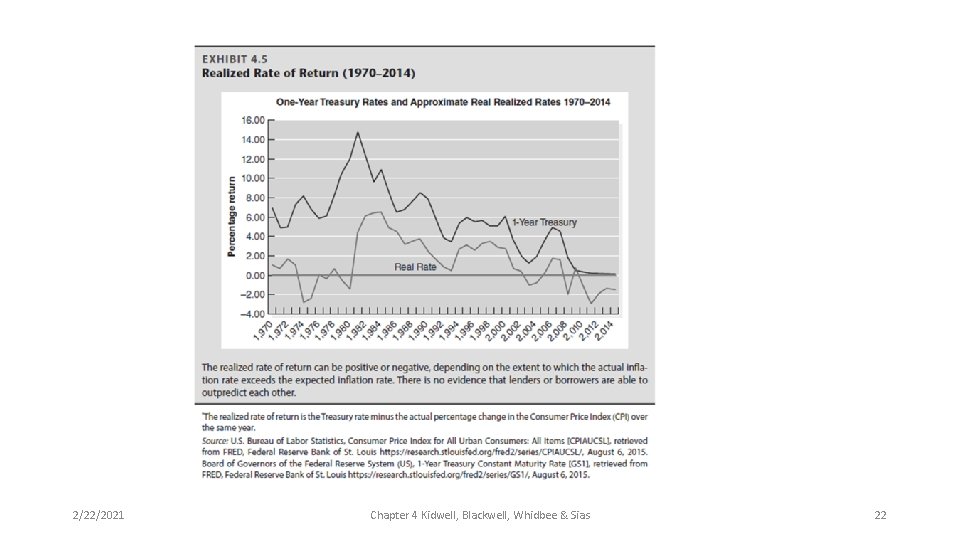
Expectations ex ante vs. Experience ex post Realized rates of return reflect impact of inflation on past investments. r = i - Pa, where the "realized" rate of return from past transactions, r, equals the nominal rate minus the actual annual rate of inflation. As inflation increases, expected inflation premiums, Pe, may lag actual rates of inflation, Pa, yielding low or even negative actual returns. 2/22/2021 Chapter 4 Kidwell, Blackwell, Whidbee & Sias 21
2/22/2021 Chapter 4 Kidwell, Blackwell, Whidbee & Sias 22
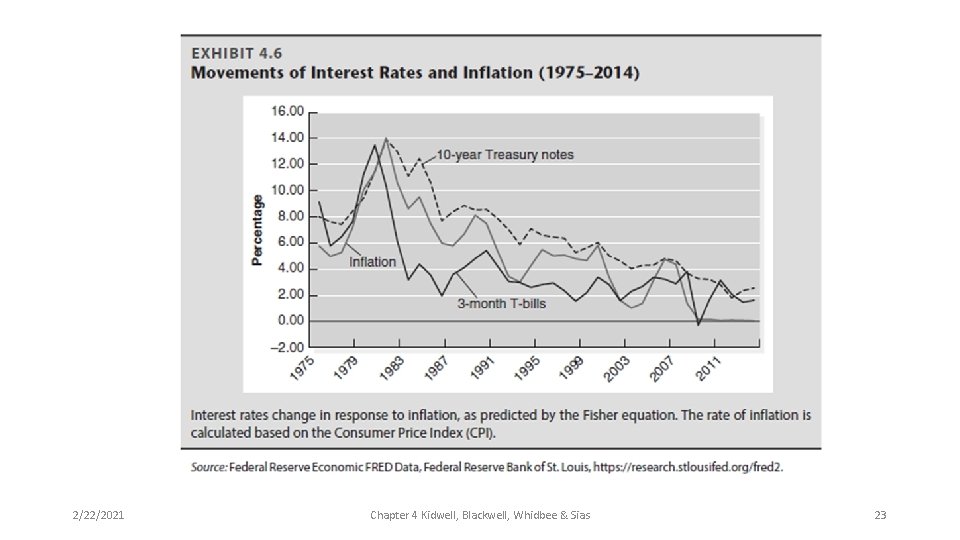
2/22/2021 Chapter 4 Kidwell, Blackwell, Whidbee & Sias 23
Interest Rate Movements and Inflation • Historically, interest rates tend to change with changes in the rate of inflation, substantiating the Fisher equation. • Short-term rates are more responsive to changes in inflation than long-term rates. 2/22/2021 Chapter 4 Kidwell, Blackwell, Whidbee & Sias 24
Negative Interest Rates • Negative interest rates are difficult to think about. However, they may represent a “storage cost” for safety or a specific monetary policy • Japan – 1998 – by buying Japanese Treasury securities with negative returns, investors were securing a safe place to store their funds instead of placing in banks that might default. • US – October 2010 – investors concerned that stimulative monetary policy on the part of the Fed would lead to rapid inflation. TIPS (Treasury Inflation -Protected Securities) allowed investors to look in a security whose value would increase with inflation. Bought at a discount. • European Central Bank – September 2014 – ECB attempting to decrease bank excess reserves to stimulate lending and economic growth. Thus, charged an interest rate on deposits 2/22/2021 Chapter 4 Kidwell, Blackwell, Whidbee & Sias 25
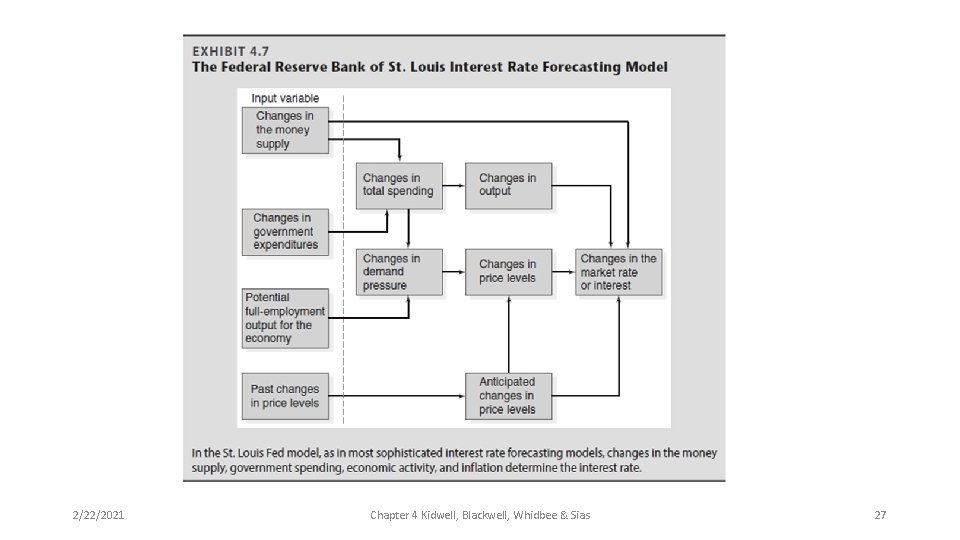
Forecasting Interest Rates • Firms and individuals are exposed to interest rate risk. I. e. , the idea that they may be locked into contracts at incorrect costs of capital. • Thus, there is a value in being able to predict future interest rates. • Many models for interest rate forecasting. • Generally, very complex. Multiple equations, simultaneously estimated, assume past relations will continue into the future • In general, do a poor job… • The Federal Reserve Bank of St. Louis offers the following model… • Emphasizes the importance of the money supply (and inflation) on interest rates 2/22/2021 Chapter 4 Kidwell, Blackwell, Whidbee & Sias 26
2/22/2021 Chapter 4 Kidwell, Blackwell, Whidbee & Sias 27
Inflation and Interest Rates • Inflation causes a distortion in the price level that allocates the resources of the economy. • If there is no inflation, i. e. , a zero inflation rate, the nominal interest rate equals the real interest rate. • However, the Fisher Theory tends to indicate that the nominal interest rate will adjust to expected inflation. We may see movement in the nominal rate if there is a perception that inflation is on the horizon. • In general, the Fisher theory has received credibility among practitioners and policymakers 2/22/2021 Chapter 4 Kidwell, Blackwell, Whidbee & Sias 28
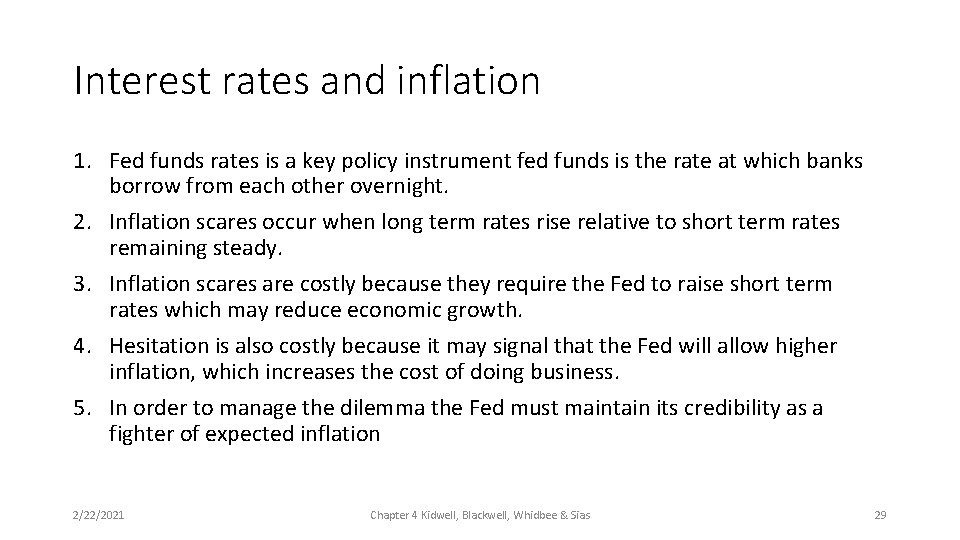
Interest rates and inflation 1. Fed funds rates is a key policy instrument fed funds is the rate at which banks borrow from each other overnight. 2. Inflation scares occur when long term rates rise relative to short term rates remaining steady. 3. Inflation scares are costly because they require the Fed to raise short term rates which may reduce economic growth. 4. Hesitation is also costly because it may signal that the Fed will allow higher inflation, which increases the cost of doing business. 5. In order to manage the dilemma the Fed must maintain its credibility as a fighter of expected inflation 2/22/2021 Chapter 4 Kidwell, Blackwell, Whidbee & Sias 29
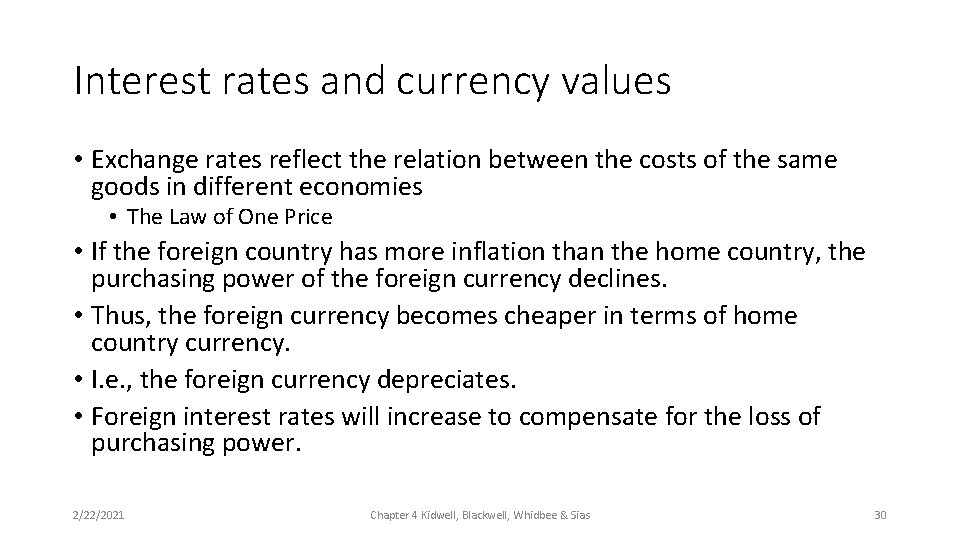
Interest rates and currency values • Exchange rates reflect the relation between the costs of the same goods in different economies • The Law of One Price • If the foreign country has more inflation than the home country, the purchasing power of the foreign currency declines. • Thus, the foreign currency becomes cheaper in terms of home country currency. • I. e. , the foreign currency depreciates. • Foreign interest rates will increase to compensate for the loss of purchasing power. 2/22/2021 Chapter 4 Kidwell, Blackwell, Whidbee & Sias 30
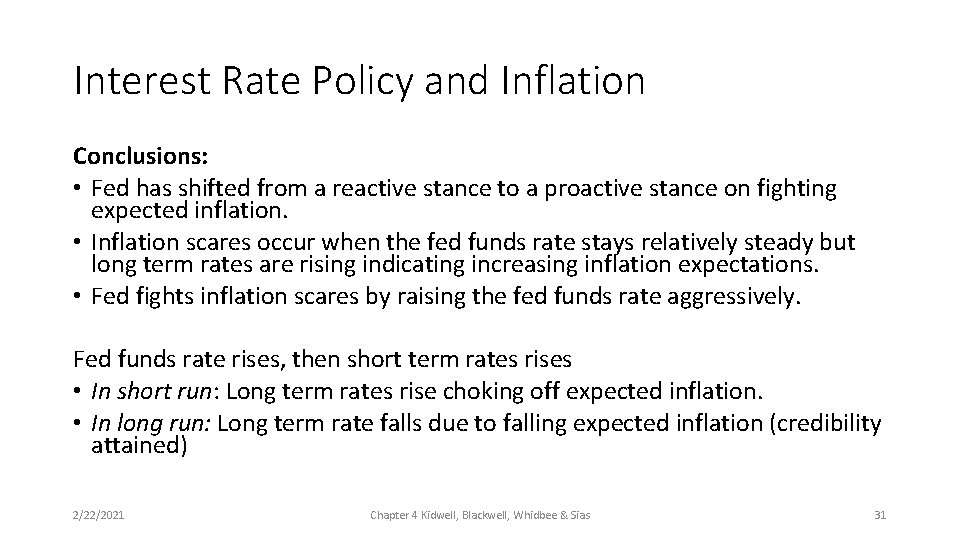
Interest Rate Policy and Inflation Conclusions: • Fed has shifted from a reactive stance to a proactive stance on fighting expected inflation. • Inflation scares occur when the fed funds rate stays relatively steady but long term rates are rising indicating increasing inflation expectations. • Fed fights inflation scares by raising the fed funds rate aggressively. Fed funds rate rises, then short term rates rises • In short run: Long term rates rise choking off expected inflation. • In long run: Long term rate falls due to falling expected inflation (credibility attained) 2/22/2021 Chapter 4 Kidwell, Blackwell, Whidbee & Sias 31
• If the money supply is increased, what happens to the level of interest rates? • An increase in the money supply shifts the supply of loanable funds to the right, lowering interest rates (at least in the short term). • 2/22/2021 Chapter 4 Kidwell, Blackwell, Whidbee & Sias 32
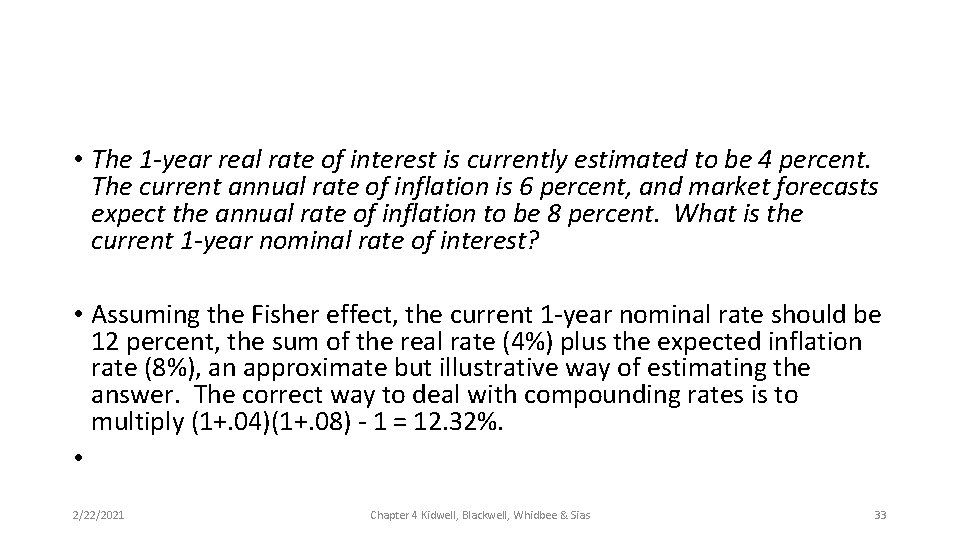
• The 1 -year real rate of interest is currently estimated to be 4 percent. The current annual rate of inflation is 6 percent, and market forecasts expect the annual rate of inflation to be 8 percent. What is the current 1 -year nominal rate of interest? • Assuming the Fisher effect, the current 1 -year nominal rate should be 12 percent, the sum of the real rate (4%) plus the expected inflation rate (8%), an approximate but illustrative way of estimating the answer. The correct way to deal with compounding rates is to multiply (1+. 04)(1+. 08) - 1 = 12. 32%. • 2/22/2021 Chapter 4 Kidwell, Blackwell, Whidbee & Sias 33
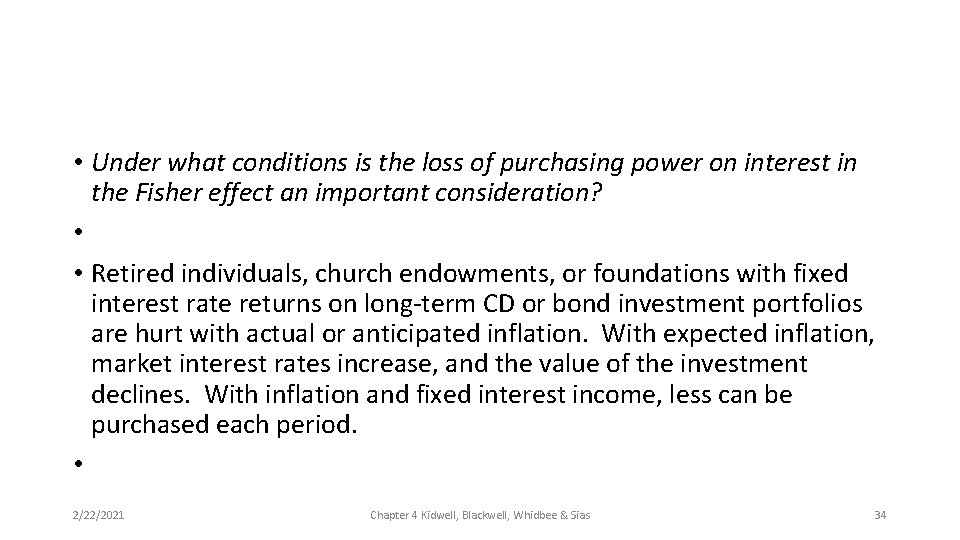
• Under what conditions is the loss of purchasing power on interest in the Fisher effect an important consideration? • • Retired individuals, church endowments, or foundations with fixed interest rate returns on long-term CD or bond investment portfolios are hurt with actual or anticipated inflation. With expected inflation, market interest rates increase, and the value of the investment declines. With inflation and fixed interest income, less can be purchased each period. • 2/22/2021 Chapter 4 Kidwell, Blackwell, Whidbee & Sias 34
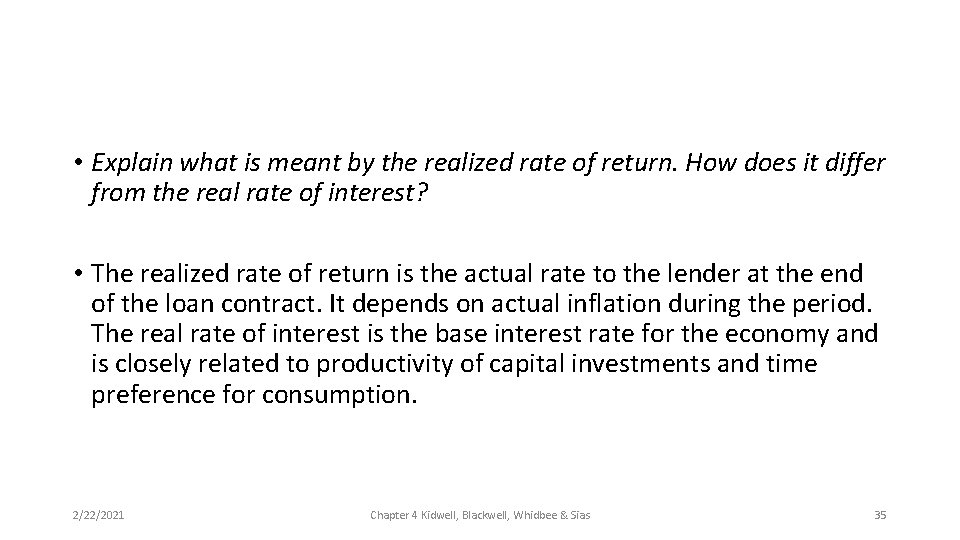
• Explain what is meant by the realized rate of return. How does it differ from the real rate of interest? • The realized rate of return is the actual rate to the lender at the end of the loan contract. It depends on actual inflation during the period. The real rate of interest is the base interest rate for the economy and is closely related to productivity of capital investments and time preference for consumption. 2/22/2021 Chapter 4 Kidwell, Blackwell, Whidbee & Sias 35
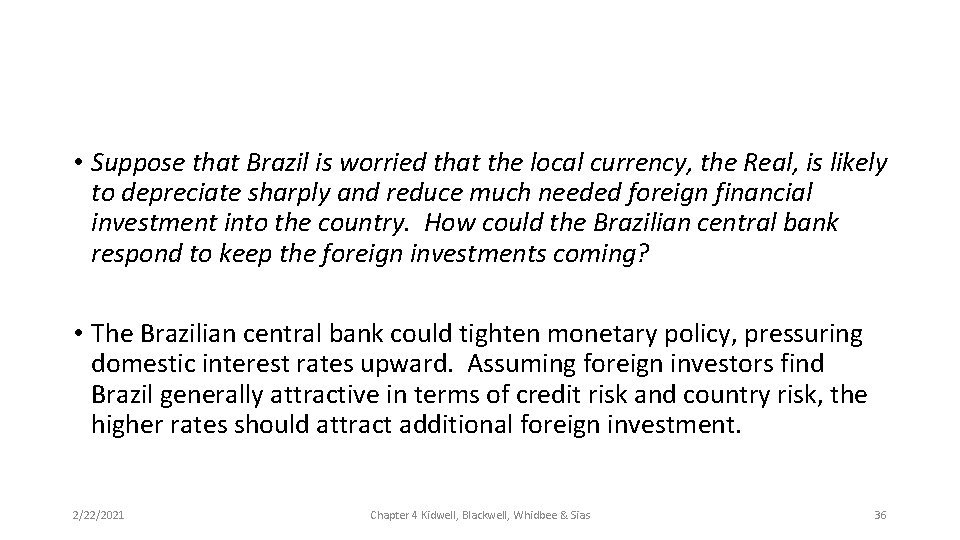
• Suppose that Brazil is worried that the local currency, the Real, is likely to depreciate sharply and reduce much needed foreign financial investment into the country. How could the Brazilian central bank respond to keep the foreign investments coming? • The Brazilian central bank could tighten monetary policy, pressuring domestic interest rates upward. Assuming foreign investors find Brazil generally attractive in terms of credit risk and country risk, the higher rates should attract additional foreign investment. 2/22/2021 Chapter 4 Kidwell, Blackwell, Whidbee & Sias 36
• Consider a loan for which the real interest rate is to be 3% and there is to be full protection against inflation which is forecast to be 4%. Using the exact version of the Fisher equation, what is to be the nominal interest rate? • . 03 +. 04 + (. 03)(. 04) =. 0712 or 7. 12% • A one-year project is over and inflation was 5%. If the nominal interest rate was 12%, what was the real rate? • (1+real rate) * (1 + change in price level) = 1+ nominal rate • (1+r) * (1. 05) = 1. 12 r =. 0667 or 6. 67% 2/22/2021 Chapter 4 Kidwell, Blackwell, Whidbee & Sias 37