
The Lemniscate of Bernoulli Jacob Bernoulli first described
The Lemniscate of Bernoulli
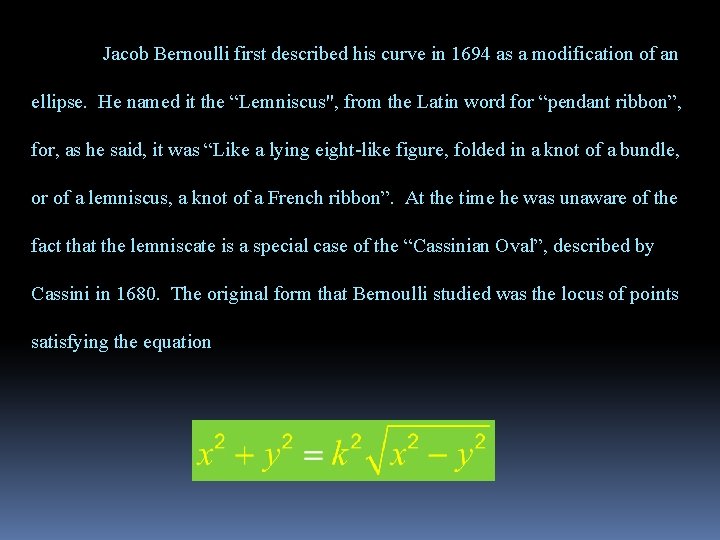
Jacob Bernoulli first described his curve in 1694 as a modification of an ellipse. He named it the “Lemniscus", from the Latin word for “pendant ribbon”, for, as he said, it was “Like a lying eight-like figure, folded in a knot of a bundle, or of a lemniscus, a knot of a French ribbon”. At the time he was unaware of the fact that the lemniscate is a special case of the “Cassinian Oval”, described by Cassini in 1680. The original form that Bernoulli studied was the locus of points satisfying the equation
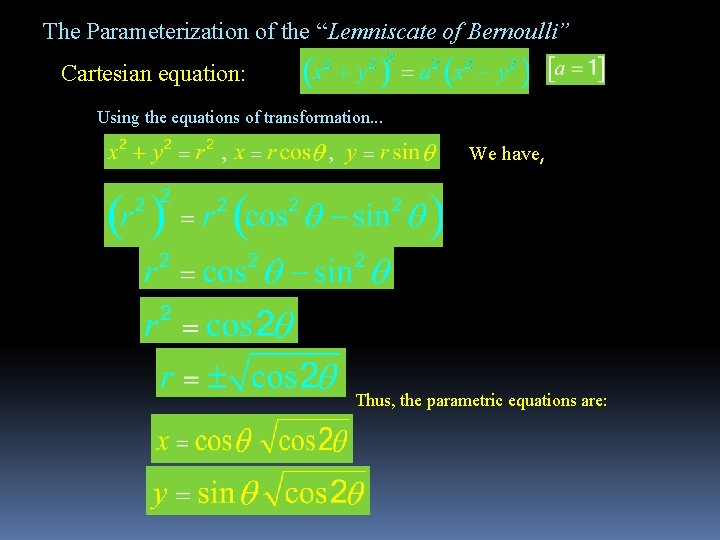
The Parameterization of the “Lemniscate of Bernoulli” Cartesian equation: Using the equations of transformation. . . We have, Thus, the parametric equations are:
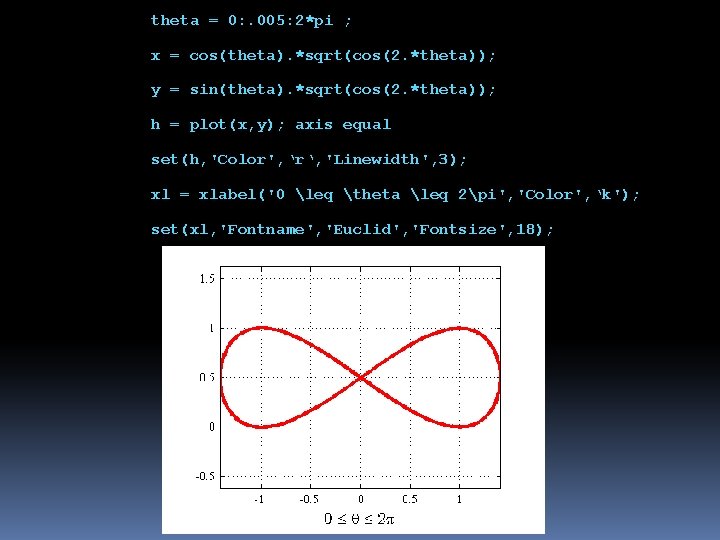
theta = 0: . 005: 2*pi ; x = cos(theta). *sqrt(cos(2. *theta)); y = sin(theta). *sqrt(cos(2. *theta)); h = plot(x, y); axis equal set(h, 'Color', ‘r‘, 'Linewidth', 3); xl = xlabel('0 leq theta leq 2pi', 'Color', ‘k'); set(xl, 'Fontname', 'Euclid', 'Fontsize', 18);
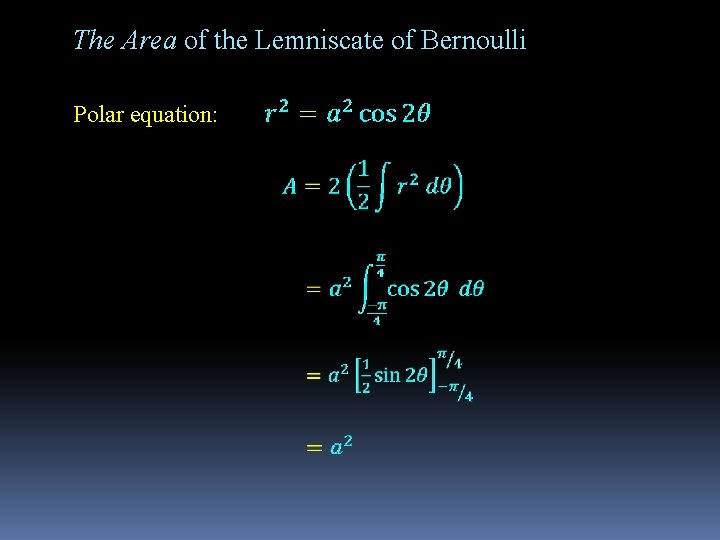
The Area of the Lemniscate of Bernoulli Polar equation:
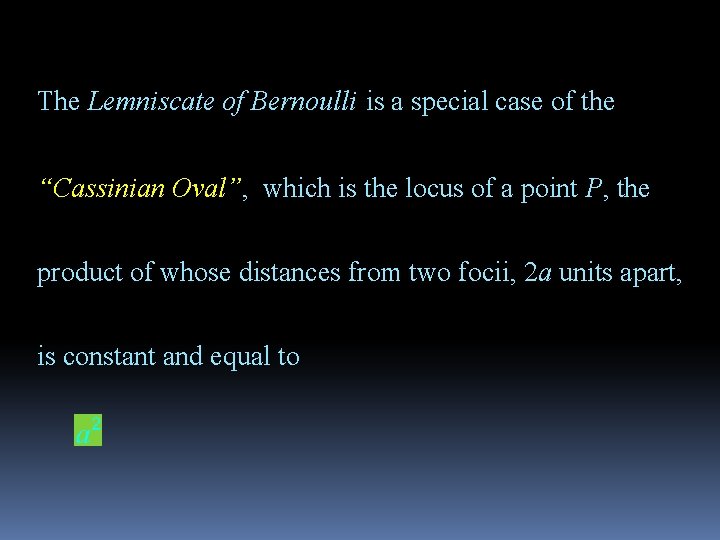
The Lemniscate of Bernoulli is a special case of the “Cassinian Oval”, which is the locus of a point P, the product of whose distances from two focii, 2 a units apart, is constant and equal to
![[x, y] = meshgrid(-2*pi: . 01: 2*pi); a = 5; z = sqrt((x-a). ^2+y.](http://slidetodoc.com/presentation_image_h2/5b2993930b053b3030ef409abe05198a/image-8.jpg "[x, y] = meshgrid(-2*pi: . 01: 2*pi); a = 5; z = sqrt((x-a). ^2+y.")
[x, y] = meshgrid(-2*pi: . 01: 2*pi); a = 5; z = sqrt((x-a). ^2+y. ^2). *sqrt((x+a). ^2+y. ^2); contour(x, y, z, 25); axis('equal’, ’square’); xl = xlabel('-2pi leq {it{x, y}} leq 2pi'); set(xl, 'Fontname', 'Euclid', 'Fontsize', 14); title('The Cassinian Oval', 'Fontsize', 12)
![a = 2; b = 2; [x, y] = meshgrid(-5: . 01: 5); colormap('jet');](http://slidetodoc.com/presentation_image_h2/5b2993930b053b3030ef409abe05198a/image-9.jpg "a = 2; b = 2; [x, y] = meshgrid(-5: . 01: 5); colormap('jet');")
a = 2; b = 2; [x, y] = meshgrid(-5: . 01: 5); colormap('jet'); axis equal z = ((x-a). ^2+y. ^2). *((x+a). ^2+y. ^2)-b^4; contour(x, y, z, 0: 6: 60); set(gca, 'xtick', [], 'ytick', []); xl = xlabel('-2pi leq {it{x, y}} leq 2pi'); set(xl, 'Fontname', 'Euclid', 'Fontsize', 14); title('The Cassinian Oval'Fontsize', 12)
The “Lemniscate of Gerono” is named for the French mathematician Camille – Christophe Gerono (1799 – 1891). Though it was not discovered by Gerono, he studied it extensively. The name was officially given in 1895 by Aubry.
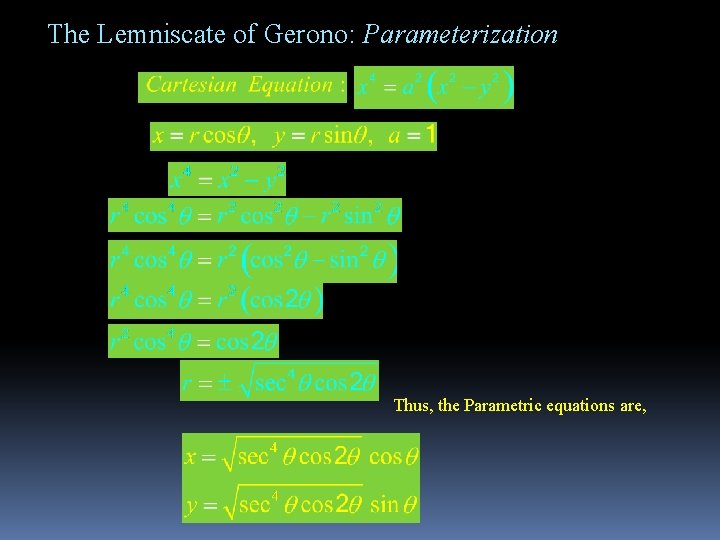
The Lemniscate of Gerono: Parameterization Thus, the Parametric equations are,
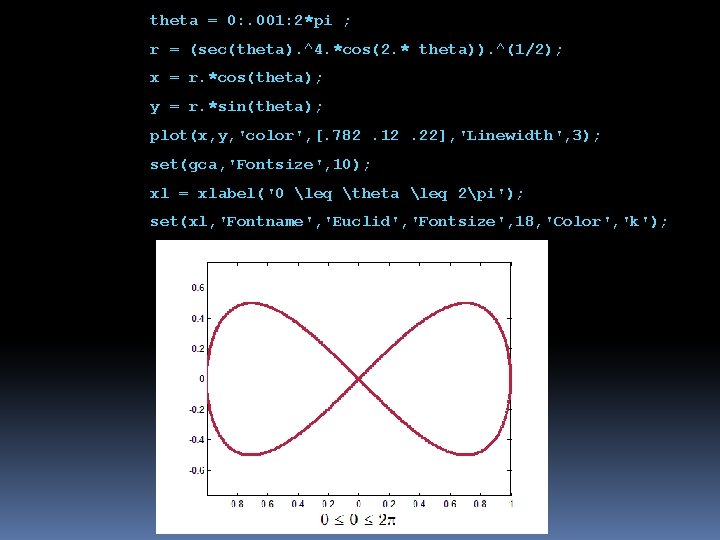
theta = 0: . 001: 2*pi ; r = (sec(theta). ^4. *cos(2. * theta)). ^(1/2); x = r. *cos(theta); y = r. *sin(theta); plot(x, y, 'color', [. 782. 12. 22], 'Linewidth', 3); set(gca, 'Fontsize', 10); xl = xlabel('0 leq theta leq 2pi'); set(xl, 'Fontname', 'Euclid', 'Fontsize', 18, 'Color', 'k');
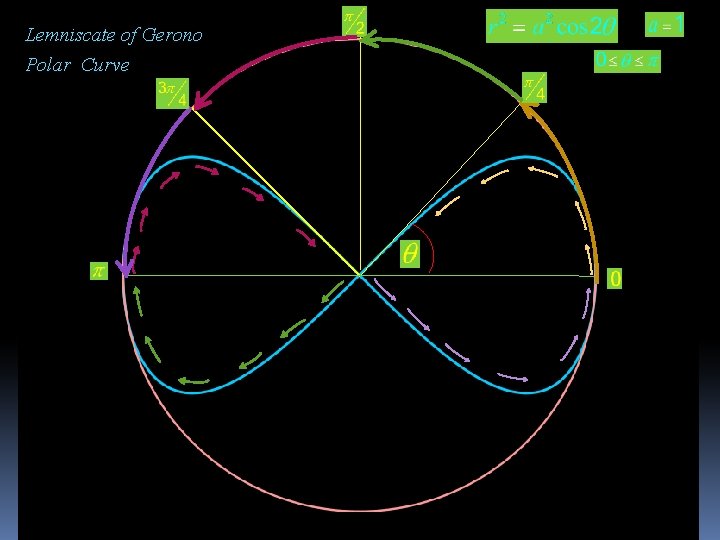
Lemniscate of Gerono Polar Curve
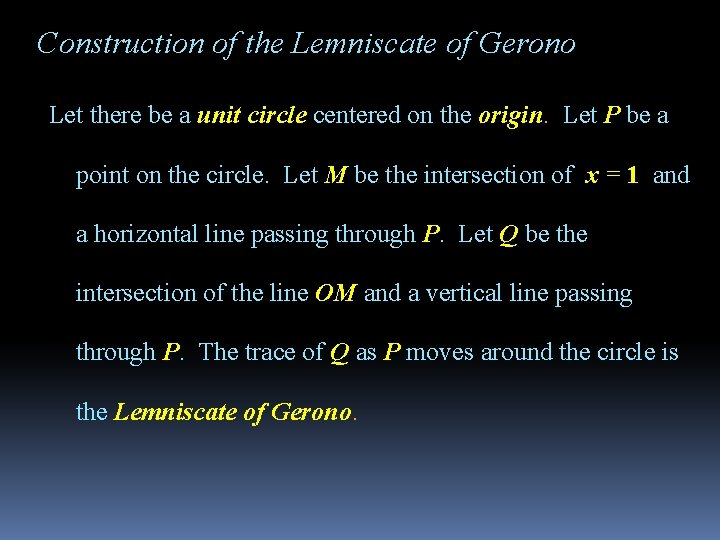
Construction of the Lemniscate of Gerono Let there be a unit circle centered on the origin. Let P be a point on the circle. Let M be the intersection of x = 1 and a horizontal line passing through P. Let Q be the intersection of the line OM and a vertical line passing through P. The trace of Q as P moves around the circle is the Lemniscate of Gerono.
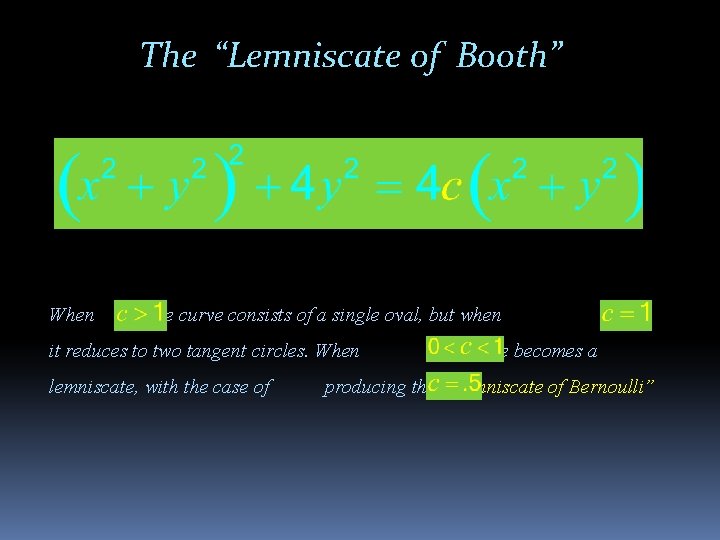
The “Lemniscate of Booth” When the curve consists of a single oval, but when it reduces to two tangent circles. When lemniscate, with the case of the curve becomes a producing the “Lemniscate of Bernoulli”
![[x, y] = meshgrid(-pi: . 01: pi); c = (1/4)*((x. ^2+y. ^2)+(4. *y. ^2.](http://slidetodoc.com/presentation_image_h2/5b2993930b053b3030ef409abe05198a/image-16.jpg "[x, y] = meshgrid(-pi: . 01: pi); c = (1/4)*((x. ^2+y. ^2)+(4. *y. ^2.")
[x, y] = meshgrid(-pi: . 01: pi); c = (1/4)*((x. ^2+y. ^2)+(4. *y. ^2. /(x. ^2+y. ^2))); contour(x, y, c, 12); axis(‘equal’, ’square’); set(gca, 'xtick', [], 'ytick', []); xl = xlabel('-pi leq {it{x, y}} leq pi'); set(xl, 'Fontname', 'Euclid', 'Fontsize', 9);
- Slides: 16