
The Legislative Process Learning Objectives To understand key
The Legislative Process
Learning Objectives • To understand key terms and vocabulary related to the legislative process • To identify and explain the different stages in the legislative process • To find contemporary examples to illustrate aspects of the legislative process
Key Terms Using your textbook, find definitions for the following; • Private Member’s Bill • White Paper • Green Paper • Committee of the Whole House
Private Member’s Bill • Private Members' Bills are Public Bills introduced by MPs and Lords who aren't government ministers. • As with other Public Bills their purpose is to change the law as it applies to the general population. • A minority of Private Members' Bills become law but, by creating publicity around an issue, they may affect legislation indirectly.
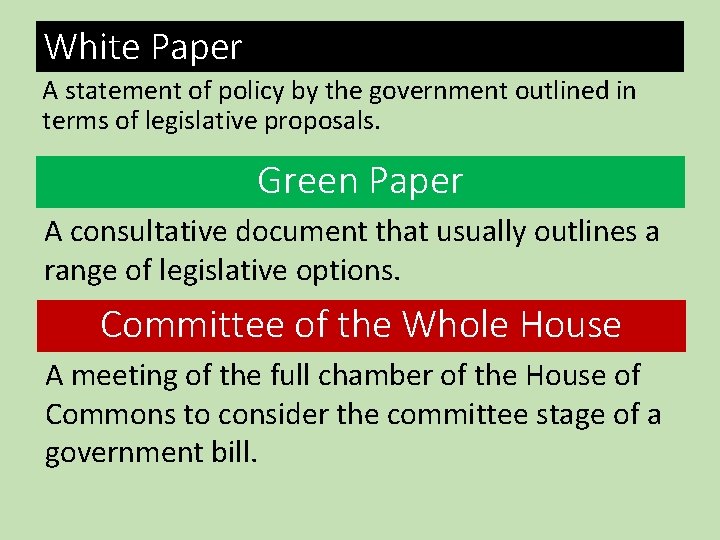
White Paper A statement of policy by the government outlined in terms of legislative proposals. Green Paper A consultative document that usually outlines a range of legislative options. Committee of the Whole House A meeting of the full chamber of the House of Commons to consider the committee stage of a government bill.
How a law is made in the UK https: //www. youtube. com/watch? v=i. M 4 CKYCr. W 7 Y https: //www. youtube. com/watch? v=1 KFGt 9 M-j 28
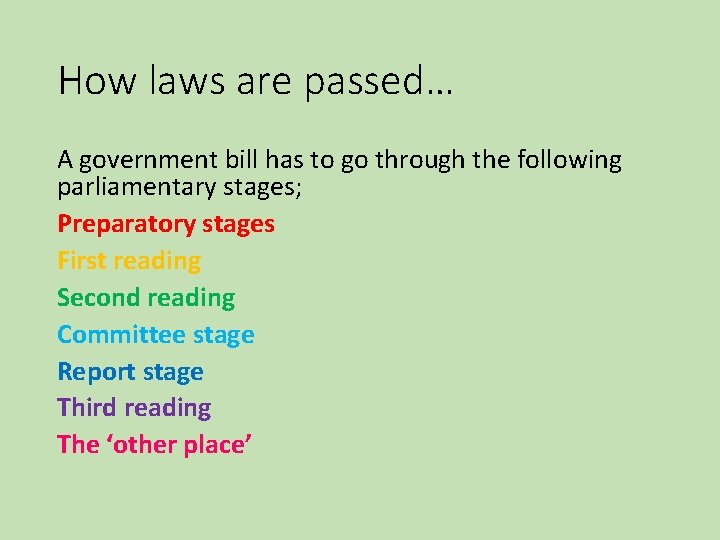
How laws are passed… A government bill has to go through the following parliamentary stages; Preparatory stages First reading Second reading Committee stage Report stage Third reading The ‘other place’
Preparatory stages • Before bills are passed, their provisions may have been outlined in a White Paper or a Green Paper. • Since 2002, most government bills have been published in draft for what is called pre-legislative scrutiny, which is carried out by select committees.
First reading • The bill is introduced to Parliament through the formal reading of its title and (usually) the setting of a date for its second reading. • There is no debate or vote at this stage.
Second reading • This is the first substantive stage. • It involves a full debate that considers the principles of (rather than the details) of the bill. • It is the first stage at which the bill can be defeated.
Committee stage • This is when the details of the bill are considered line by line. • It is carried out by a public bill committee (formerly known as a standing committee) consisting of about 18 MPs, but it may be considered by a Committee of the Whole House. • Most amendments are made at this stage, and new provisions can be included.
Pause for thought… Public Bill Committee • A Public Bill Committee is a committee set up by the House of Commons to consider the details of a particular Bill. • All Bills, other than Money Bills, are automatically sent to a Public Bill Committee following their second reading unless they are committed to a committee of the Whole House. • Public Bill Committees only last for the duration of the Bill concerned. • The composition of the committees must match the size of the parties in the House. • If a party has 60% of the seats in the Commons then the party will have 60% of the membership of the Public Bill Committee. • Public Bill Committees can, like a Select Committee, take oral evidence as part of its scrutiny of the Bill.
Report stage • This is when the committee reports back to the full House of Commons on any changes made during the committee stage. • The Commons may amend or reverse changes at the report stage.
Third reading • This replicates the second reading in that it is a debate of the full chamber, enabling the House to take an overview of the bill in its amended state. • No amendments may be made at this stage, and it is very unusual for bills to be defeated at the third reading.
The ‘other place’ • Major bills are considered first by the Commons, but other bills may start in the Lords. • Once passed by one chamber, the bill goes through essentially the same process in what is referred to as the ‘other place’, before finally going to the monarch for the Royal Assent.
Is each stage essential? a) Which stage is important to the least extent? b) Which stage is important to the greatest extent? c) What are the advantages of so many stages? Explain and support your answer thoroughly. We know that belonging to the same party does not guarantee similar views Is there a way that each party can guarantee that its members will support the party line on a vote?
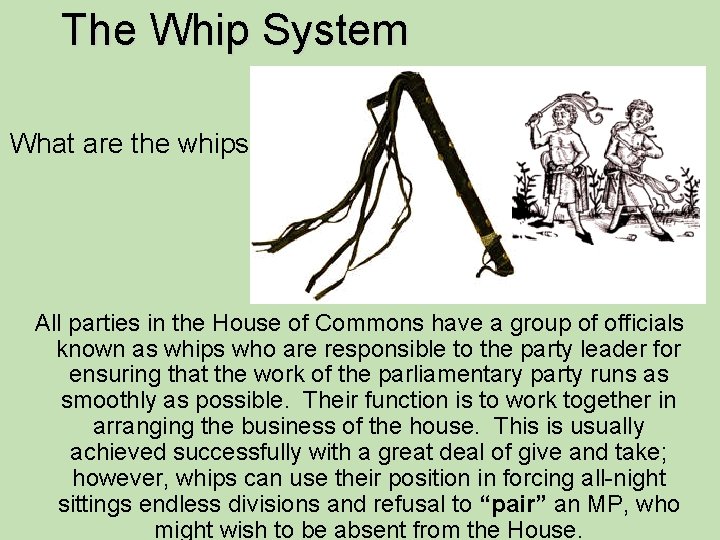
The Whip System What are the whips? All parties in the House of Commons have a group of officials known as whips who are responsible to the party leader for ensuring that the work of the parliamentary party runs as smoothly as possible. Their function is to work together in arranging the business of the house. This is usually achieved successfully with a great deal of give and take; however, whips can use their position in forcing all-night sittings endless divisions and refusal to “pair” an MP, who might wish to be absent from the House.

Why are the whips named so? ? ? The whips send out a memo stating the business of parliament to be considered during the week ahead. The importance of each issue is shown by the number of lines drawn under each issue. üThree line whip – means that attendance is absolutely essential. Non-attendance may result in the ‘whip being withdrawn’ üTwo line whip – means that attendance is important but not essential
Are whips too powerful? NO: • Whips don’t always get their way = revolts/rebellions i. e. Occasionally an individual MP or group of MPs refuse to comply with the whips instructions = Maastricht YES: • This can result in MPs being disciplined or the ultimate sanction; the whip being withdrawn = expulsion from the party! • Can MPs really scrutinize a bill when they are whipped?
Reflection • What are the advantages of having so many stages in passing a bill? • Include: • What impact does the whip system have on scrutiny?
Task; The Legislative Process for Dummies Create a typed A 4 Dummies’ Guide to the Legislative Process covering the following; • • Why are new laws needed? Draft Bills Passage of a Bill Acts Delegated legislation The Parliament Acts http: //www. parliament. uk/about/how/laws/
The Hunt for Examples • In exam answers you will be expected to illustrate your answers with contemporary examples. • Find examples for each of the sections of your Dummies’ Guide. • Compile a table of examples and add it to your Dummies’ Guide. • When you have completed your Dummies’ Guide, upload it to the VLE. http: //www. parliament. uk/business/bills-and-legislation/
- Slides: 22