
The Legislative Branch The Senate and House of

The Legislative Branch The Senate and House of Representatives
Congress in a Nutshell • Lawmaking body of the Federal government • Composed of two houses/parts – Wanted to make sure that large and small states would be fairly represented • Often referred to as bicameral; meaning two houses • House of representatives is determined by population • Senate has equal representation • System allows each house to check the actions of the other
House of Representatives • Based on the population of each state – Larger states have more representatives, smaller states have fewer. • Generally 1 representative per 700, 000 members of the population • Currently there are 435 Representatives in the House and that is the limit. – As population grows, the ratio of representatives to members of the population will change • Representatives are elected to 2 Year Terms – If a representative dies, the governor of the home state is required to call a special election to fill the vacancy.
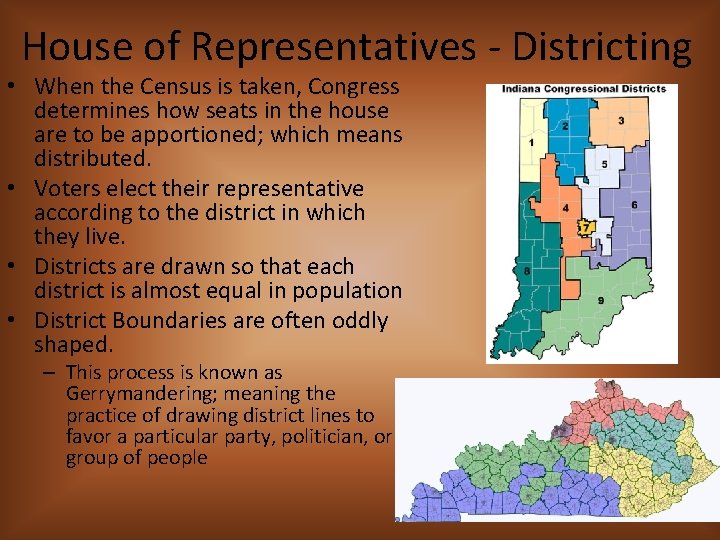
House of Representatives - Districting • When the Census is taken, Congress determines how seats in the house are to be apportioned; which means distributed. • Voters elect their representative according to the district in which they live. • Districts are drawn so that each district is almost equal in population • District Boundaries are often oddly shaped. – This process is known as Gerrymandering; meaning the practice of drawing district lines to favor a particular party, politician, or group of people
The Senate • Each state is represented by two senators • Elected to Congress for 6 year terms. • 1/3 of the Senate’s membership comes up for election every two years. – Ensures 2/3 have prior experience. • If a senator dies, the Governor will appoint a person to fill the vacancy • Senators do not have term limits. If they continue to get re-elected, they can stay in office for life.
Qualifications • House of Representatives – Be at least 25 years old – Been a citizen for at least 7 years – Be a legal resident of the state you represent • Senate – Be at least 30 years old – Been a citizen for at least 9 years – Be a legal resident of the state you represent
Salary and Benefits • • Yearly salary of $165, 200 Receive an allowance to pay staff members Franking Privilege – Send mail for free Immunity or legal protection – When Congress is in session, its members cannot be arrested in or on their way to or from a meeting in Congress. – Purpose is to ensure that they are not unnecessarily kept from performing their duties

Conduct of Congress • Members of Congress can challenge or question the qualifications of a newly elected member of Congress – Rarely happens – Most recent was 1996 • There is a limit to the amount of outside income a member of Congress can earn • Serious offenses can cause a member to be expelled – Requires a 2/3 vote in both Houses • Less serious offenses can bring a vote of censure which is a formal disapproval of a member’s actions – A censured member must stand alone at the front and listen to the charges against him or her.
Terms and Sessions • Constitution requires Congress to meet once a year • Meetings start at noon on January 3 rd of every odd-numbered year • Each term of Congress is divided into two sessions. – When the legislative work is finished, both houses adjourn and the session is ended. – Both houses can meet together in a Joint Session – The President can call Congress into a Special Session for immediate and necessary action
Organization of Congress • 3 Rules about how Congress should be organized – Directs the House of Representatives to select presiding officers – Names the Vice President of the United States as President of the Senate – Calls for the selection of a senator to preside in the vice president’s absence • The Republicans and Democrats in each house gather separately in private meetings called Caucuses to choose their leaders • A political party with the most members is known as the majority party and the political party with the least members is known as the minority party.
Organization of Senate • Majority party elects one of its members to be the “President Pro Tempore” – Meaning “For the time being” • Each party has its floor leaders known as the majority and minority leader • Each party’s floor leader is assisted by a party whip – Their job is to count votes, encourage party loyalty, and ensure party members are present for important votes • Has about 20 committees that consider legislation and hold hearings – Each committee has one or more subcommittees that may consider legislation before it is taken up by the full committee – Each has a chairperson who is a member of the majority party and a ranking minority member • Generally the longest serving member of the minority party.
Organization of the House of Representatives • The Speaker of the House is the person who presides over the House when Congress is in session. – Always a member of the majority party – Most powerful officer in the House of Representatives – Influences the order of business in the House • Organization of Committees is the same as the Senate, although some names of committees might be different.
Powers of Congress Delegated Powers • Found in Section I, Article 8 of the Constitution include: – Financing Government – Authority to raise and collect taxes, to borrow money, and to print or coin money – Regulating and Encouraging American Trade and Industry – Passing laws that protect the rights of inventors – Defending the Country – Declare war and maintain armed forces – Creating Lower Courts – Providing for Growth – Laws to regulate immigration and naturalization
Powers of Congress Implied Powers • Congress has the power “to make all laws which shall be necessary and proper for carrying into execution the foregoing powers. – Necessary and Proper Clause or Elastic Clause because of the flexibility this provides Congress – Example: Establish military academies to train officers
Powers of Congress Impeachment Power • Impeachment is to accuse an officeholder of misconduct. – A serious offense is Treason • Charges of the accused are drawn up in the House of Representatives • Trial of the accused if passed in House is held in the Senate. – Vice President will act as the judge • 2/3 of the Senate must find the official guilty
Limits on Powers • Constitution forbids Congress from: – Passing “Ex Post Facto” Laws which are laws that apply to actions that occurred before laws were passed – Passing bills of attainder – Laws that sentence people to prison without a trial – Suspending Habeas Corpus – Taxing Exports – Passing laws that violate Bill of Rights – Favoring trade of a state – Granting titles of nobility – Withdrawing money without law
- Slides: 16