
The Legislative Branch Article I Congress Introduction o
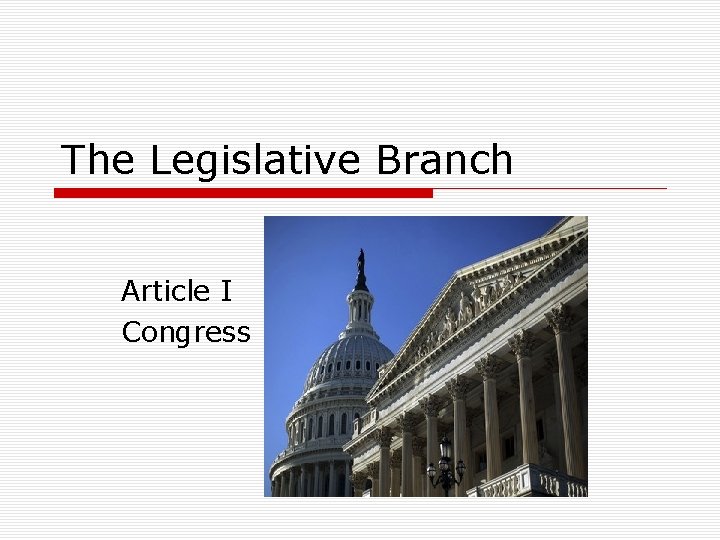
The Legislative Branch Article I Congress
Introduction o Congress’ job is to transfer public will into public policy through law. o The Framers created a bicameral legislature in the Constitution. n That is TWO houses.
Bicameralism o Congress consists of two houses, the House of Representatives and the Senate, that act to check and balance each other. o Congress has its roots in British and Colonial history. o Our bicameral legislature is a reflection of federalism, and was part of the Connecticut Compromise of 1787.
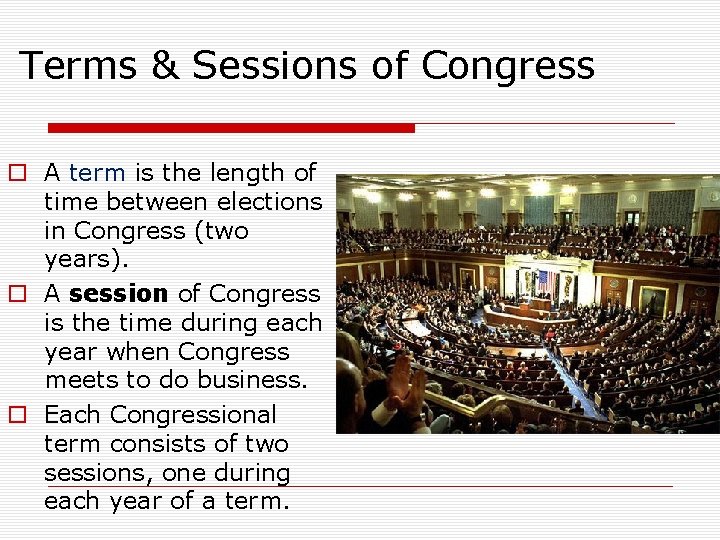
Terms & Sessions of Congress o A term is the length of time between elections in Congress (two years). o A session of Congress is the time during each year when Congress meets to do business. o Each Congressional term consists of two sessions, one during each year of a term.
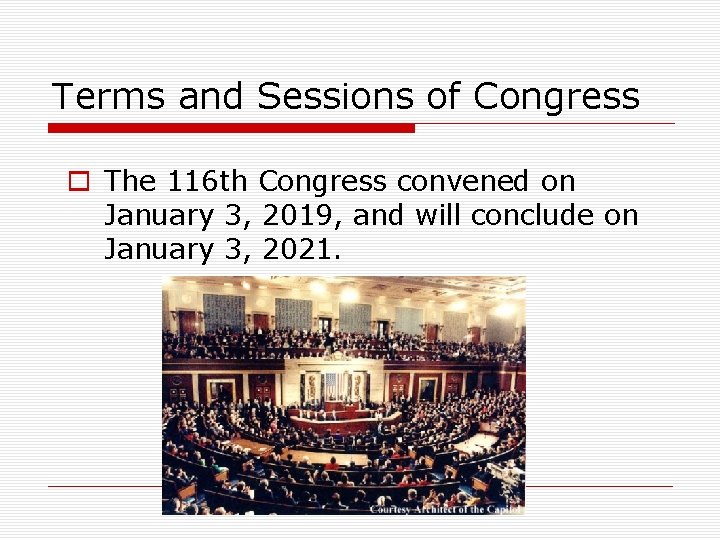
Terms and Sessions of Congress o The 116 th Congress convened on January 3, 2019, and will conclude on January 3, 2021.
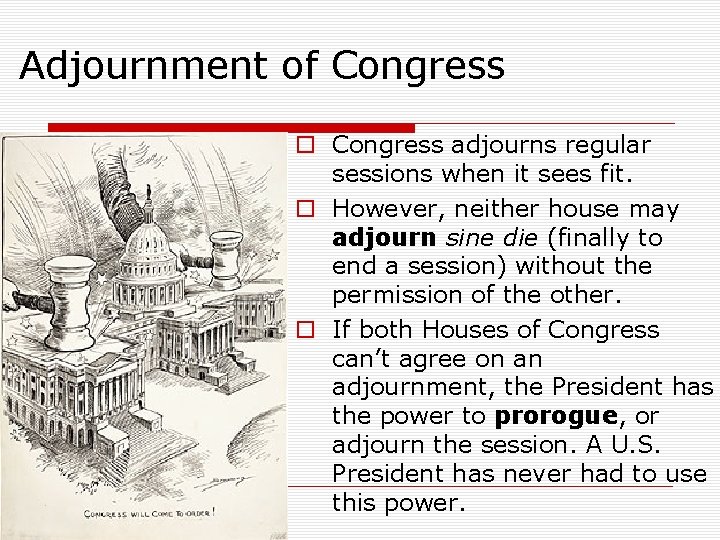
Adjournment of Congress o Congress adjourns regular sessions when it sees fit. o However, neither house may adjourn sine die (finally to end a session) without the permission of the other. o If both Houses of Congress can’t agree on an adjournment, the President has the power to prorogue, or adjourn the session. A U. S. President has never had to use this power.
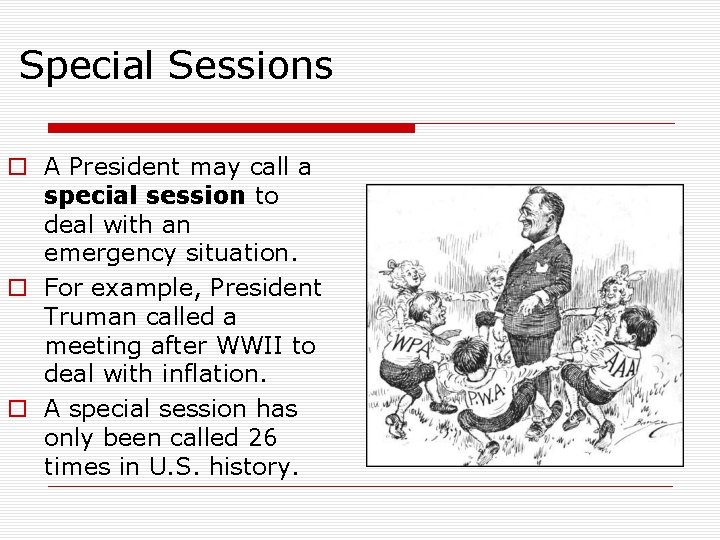
Special Sessions o A President may call a special session to deal with an emergency situation. o For example, President Truman called a meeting after WWII to deal with inflation. o A special session has only been called 26 times in U. S. history.
Why Congress Matters?
House of Representatives o Number of representatives: 435 o Representation based on population
Apportionment o Article I of the Constitution says that Congress must reapportion (redistribute) the seats in the House after each census. o A census is held every 10 years.
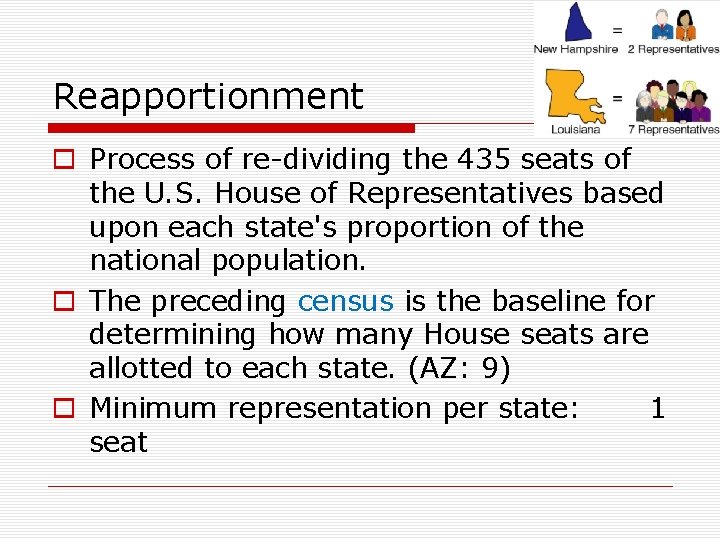
Reapportionment o Process of re-dividing the 435 seats of the U. S. House of Representatives based upon each state's proportion of the national population. o The preceding census is the baseline for determining how many House seats are allotted to each state. (AZ: 9) o Minimum representation per state: 1 seat
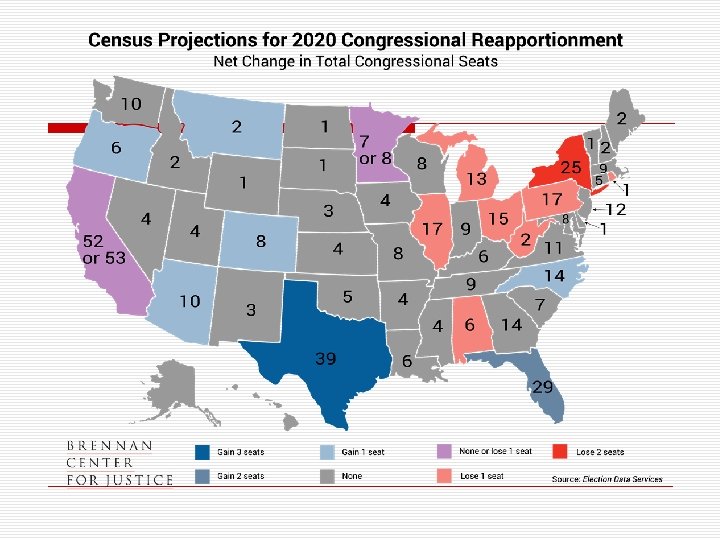
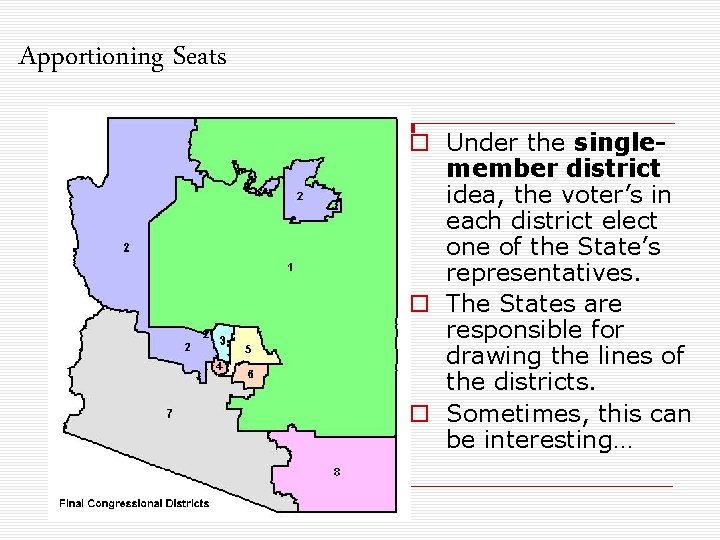
Apportioning Seats o Under the singlemember district idea, the voter’s in each district elect one of the State’s representatives. o The States are responsible for drawing the lines of the districts. o Sometimes, this can be interesting…
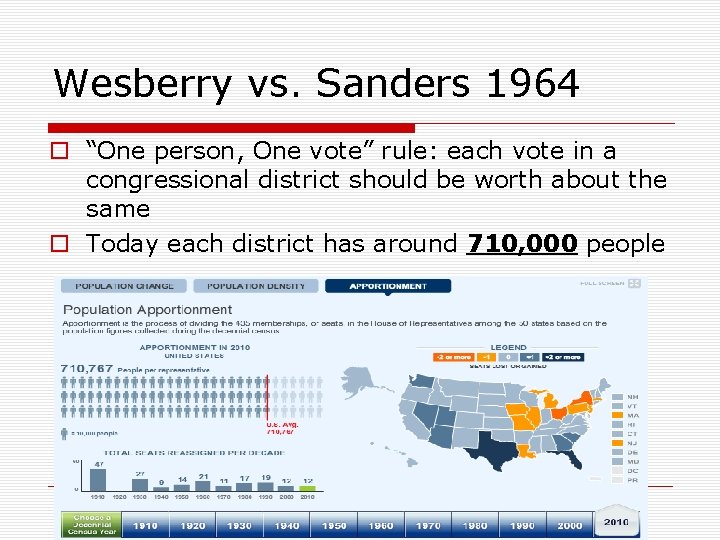
Wesberry vs. Sanders 1964 o “One person, One vote” rule: each vote in a congressional district should be worth about the same o Today each district has around 710, 000 people
Redistricting o process of redrawing legislative district boundaries every 10 years based upon changes in population. o State legislatures determine district boundaries. o Drawing boundaries of legislative districts to benefit one party or group and handicap another is called “gerrymandering. ”

Gerrymandering o Gerrymandering seeks to draw legislative districts that isolate members of a particular political party so that a maximum number of representatives of that party will be elected.
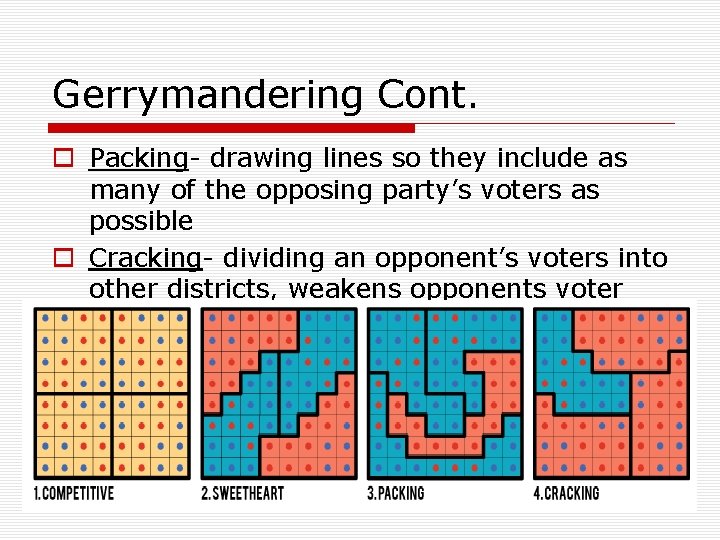
Gerrymandering Cont. o Packing- drawing lines so they include as many of the opposing party’s voters as possible o Cracking- dividing an opponent’s voters into other districts, weakens opponents voter base
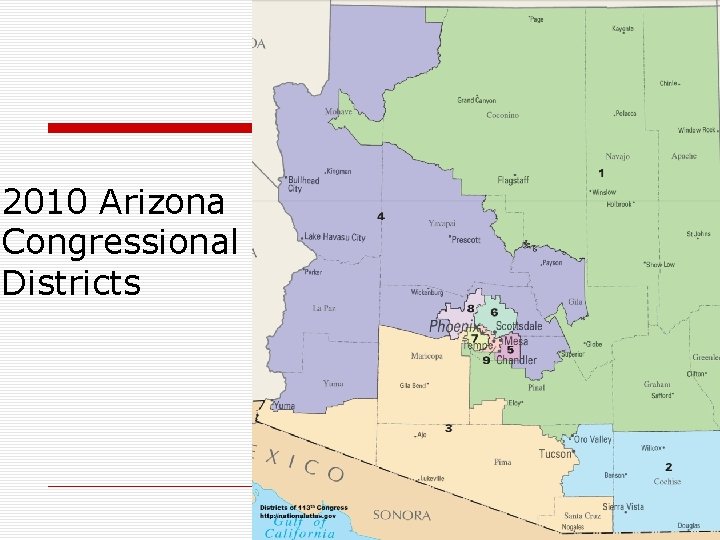
2010 Arizona Congressional Districts
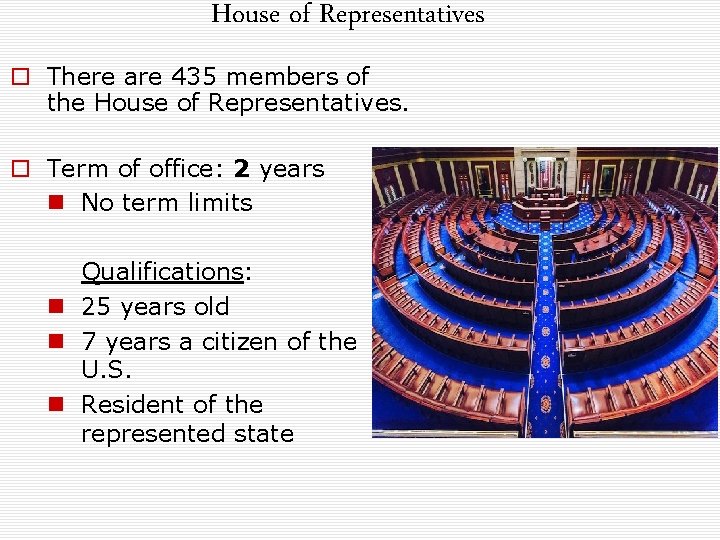
House of Representatives o There are 435 members of the House of Representatives. o Term of office: 2 years n No term limits Qualifications: n 25 years old n 7 years a citizen of the U. S. n Resident of the represented state
House of Representatives o Emphasizes fiscal policy (government expenditures, revenues, and debt. ) o Special Powers of House of Rep. n All money (appropriations) bills start here n Select the President if no majority in Electoral College n Write the articles of impeachment against high ranking officials
Speaker of the House o Head of House of Representatives -Presides over the full House. -Decides on which committees each member of his/her party will serve. -Assigns bills to committees -Decides the order in which bills will be heard and time limits for debate on House Floor. -Follows the Vice President in the line of succession to the presidency
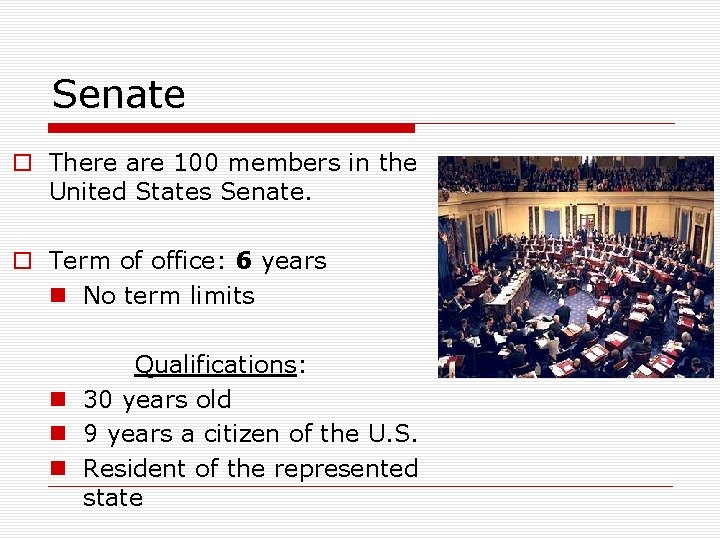
Senate o There are 100 members in the United States Senate. o Term of office: 6 years n No term limits Qualifications: n 30 years old n 9 years a citizen of the U. S. n Resident of the represented state
o Originally the Constitution said that members of the Senate were to be chosen by the State Legislatures. o But the 17 th Amendment changed that, & now Senators are chosen directly by the people in the regular November elections.

Senators are Special! o Senators are elected by the WHOLE state. o They are elected for 6 years. o For this reason, we call them a “continuous body”. n This means that never will all of the seats be up for election at the same time.
Senate o Number of Senators: 100 o Representation equal (2 per State) o Filibuster (unlimited debate) unless cloture is invoked. o President of the Senate: U. S. Vice President o Day-to-day head of Senate: President Pro Tempore
Senate o Emphasizes foreign policy o Special Powers n Approves all treaties n Approves all appointments n Chooses the Vice President in an Electoral College tie n Acts as the jury in all trials of impeachment
Vocab: o Constituencies: the people & interests the senators represent. o Colleagues: coworkers (Senators & Representatives in the House are colleagues).
Congress Both houses: o Must keep a Journal: n The Congressional Record o Must hold sessions at the same time: n Sessions begin January 3 rd each year o Must have a quorum to do business: n 51% of members present on the floor
Congress o Both houses make their own rules for behavior and punishments n Censure: formally reprimand, written in the record n Fines and penalties may be set for some offenses n Expulsion: members with gross misconduct may be thrown out of office (requires 2/3 vote)
Privileges and Compensation of Congress members: -Salary $174, 200 per year (Leadership: $212, 000) -Medical and dental benefits -Free office, parking, and trips to home state -Staff budget -Tax break on second home -Franking privilege- free postage on all mail to constituents
Privileges and Compensation of Congress members: Immunity or legal protection: -Cannot be sued of anything they say or write while carrying out their duties -Cannot be arrested for minor offenses while Congress is in session Restriction: May not hold another political office at same time
Demographics of the 113 th Congress (2013 -14) o The Congress is becoming more diverse, but it still doesn’t look much like the voters who pick its members. Of 535 members of the House and Senate, 83% are white and 17% are nonwhite, compared to a 2012 electorate (block of people who vote) that was 72% white and 28% nonwhite according to exit polls. o Women made up 53% of the 2012 electorate, but make up only 18% of the members of Congress.
ELASTIC CLAUSE o The necessary and proper clause gives Congress the power to make laws “necessary and proper” to carry out its delegated duties (expressed powers. ) o Also known as the ‘elastic clause’, it stretches the power given Congress. o Mc. Culloch v. Maryland supported this concept of ‘implied powers’, leading to larger government over time.
Powers denied Congress o Cannot suspend the writ of Habeas Corpusmust show cause for holding a suspect except in wartime. o No ex post facto laws: cannot punish a person for an act committed before there was a law against it. o No bills of attainder: laws that punish people without a trial.
Powers denied Congress o No tax on exports o No titles of nobility o All states must be treated equally
State Powers Tenth Amendment: Powers not granted to the national gov’t or denied to States are reserved to the States and the people. (“reserved powers”) States cannot: o o coin money have a state militia, troops, or navy collect import or export taxes pass any law that the Federal government is not allowed to pass
Congressional Elections o Elections are held in November of even numbered years. o Off-Year (mid-term) elections occur during nonpresidential years. o All of the House and 1/3 of the Senate are up for re-election every 2 years
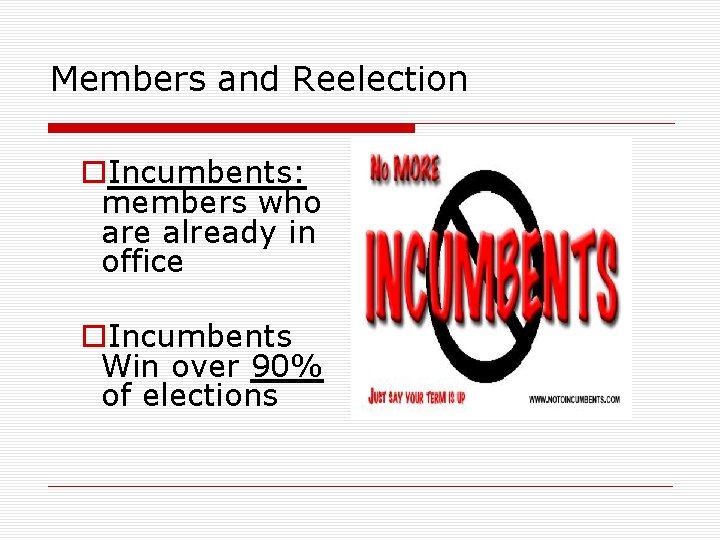
Members and Reelection o. Incumbents: members who are already in office o. Incumbents Win over 90% of elections
Essential Question o Why is it easier for incumbents to win reelection than it is for someone new to beat them?
Reasons for Incumbent Reelection 1. Easier to raise campaign funds 2. Many districts have been gerrymandered in the incumbent’s favored 3. Have better name recognition than their opponents 4. Use position to help solve voters’ problems (casework)
- Slides: 40