
The Legal Environment Business Law and Government Regulation
The Legal Environment: Business Law and Government Regulation Chapter 22 Business Law & Govt Regulation Copyright 2006 Prentice Hall Publishing Company 1
Elements of a Valid Contract n Agreement Offer Ø Acceptance Ø n n n Contract Consideration Contractual capacity Legality Plus Two Supplemental Requirements: n Genuineness of Assent n Form Copyright 2006 Prentice Hall Publishing Company 2
Agreement Governed by the objective theory of contracts, which states that a party’s intent to enter into a contract is measured by outward facts – words, conduct, and circumstances - rather than by subjective intentions. n Comprised of an offer and an acceptance. n Chapter 22 Business Law & Govt Regulation Copyright 2006 Prentice Hall Publishing Company 3
Offer A promise to do or to refrain from doing something in the future. n For a valid offer to exist, there must be: n Ø Serious objective intent Ø Reasonably certain terms Ø Communication of the offer Chapter 22 Business Law & Govt Regulation Copyright 2006 Prentice Hall Publishing Company 4
Offer n n Generally, an offeror can revoke an offer at any time before the offeree accepts it. Two exceptions: Ø Option contract – A separate contract in which a potential buyer purchases the right to keep an offer open for a specific time period. Ø Merchant’s firm offer – Under the UCC, a merchant who makes an offer in a signed writing to sell goods cannot revoke that offer for the stated period, which cannot exceed 3 months. Chapter 22 Business Law & Govt Regulation Copyright 2006 Prentice Hall Publishing Company 5
Acceptance n n n Mirror image rule - Common law requires the offeree’s acceptance to exactly match the offeror’s offer. If offeree changes the terms in the offeror’s offer, he or she is making a counteroffer, which is a rejection of the original offer. Generally, silence by an offeree does not indicate acceptance. Chapter 22 Business Law & Govt Regulation Copyright 2006 Prentice Hall Publishing Company 6
Consideration Something of legal value, bargained for, and given in exchange for an act or a promise. n Consideration does not have to have any economic value – just legal value. n Exception: Promissory estoppel: n Ø Promise must be likely to induce reliance Ø Justifiable reliance on the promise Ø Justice is better served by enforcing the promise Chapter 22 Business Law & Govt Regulation Copyright 2006 Prentice Hall Publishing Company 7
Contractual Capacity n n The ability to enter into a contract. Three groups: 1. 2. Minors – Most contracts that minors (those under the age of 18) create are voidable at the minor’s option. Intoxicated people – If a person’s reason and judgment were so impaired by alcohol or drugs at the time of creating a contract that he cannot understand its consequences, the contract is voidable. Chapter 22 Business Law & Govt Regulation Copyright 2006 Prentice Hall Publishing Company 8
Contractual Capacity n n The ability to enter into a contract. Three groups: 3. Insane people – A person who is insane cannot create a valid contract; these contracts are void. Chapter 22 Business Law & Govt Regulation Copyright 2006 Prentice Hall Publishing Company 9
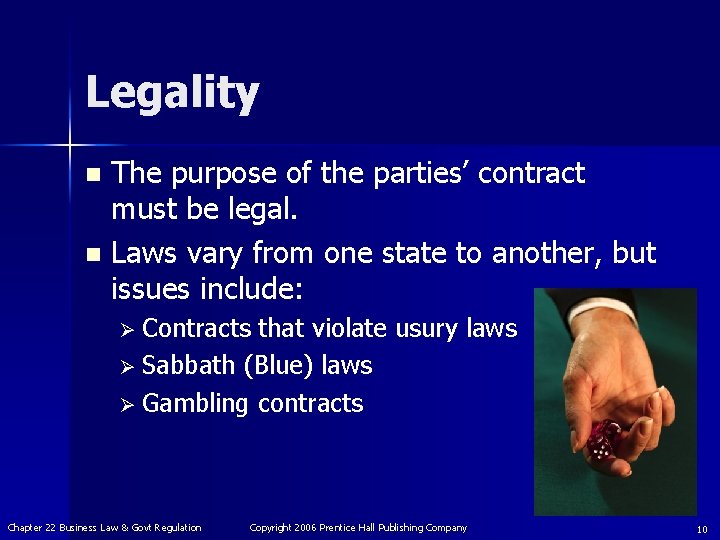
Legality The purpose of the parties’ contract must be legal. n Laws vary from one state to another, but issues include: n Ø Contracts that violate usury laws Ø Sabbath (Blue) laws Ø Gambling contracts Chapter 22 Business Law & Govt Regulation Copyright 2006 Prentice Hall Publishing Company 10
Contract Principles n n n A written contract is preferred to an oral contract; however, most oral contracts are just as enforceable as written ones. Oral agreements should be followed up by written confirmations. A contract for the sale of goods priced at $500 or more must be in writing. Contract terms should be clear and specific. Any handwritten changes to a written contract should be initialed by both parties. Chapter 22 Business Law & Govt Regulation Copyright 2006 Prentice Hall Publishing Company 11
Contract Principles n n n A complete contract covers all material items to be enforced. Past contractual practices have legal weight in a contract dispute. As a buyer, you can reject goods that do not meet specifications or are defective. As a seller, you are entitled to prompt notification of shipment acceptance or rejection. Courts will likely interpret unclear terms against the party who wrote the contract. Chapter 22 Business Law & Govt Regulation Copyright 2006 Prentice Hall Publishing Company 12
Breach of Contract n n Failure to perform a contract as promised constitutes breach. Damages: Compensatory – monetary damages that place a party in the same position had the contract been performed. Ø Consequential – monetary damages that a plaintiff suffers as a result of the lasting effects of the damage. Ø Punitive damages – monetary damages awarded in blatant cases of intentional neglect or reckless endangerment. Ø Chapter 22 Business Law & Govt Regulation Copyright 2006 Prentice Hall Publishing Company 13
The Uniform Commercial Code (UCC) n n A comprehensive document drafted in the 1940 s that assembled a uniform set of laws across the states to govern routine business transaction. Its provisions reflect the way people conduct business. The UCC contains ten articles, but Article 2, which governs the sale of goods, affects many small businesses. Chapter 22 Business Law & Govt Regulation Copyright 2006 Prentice Hall Publishing Company 14
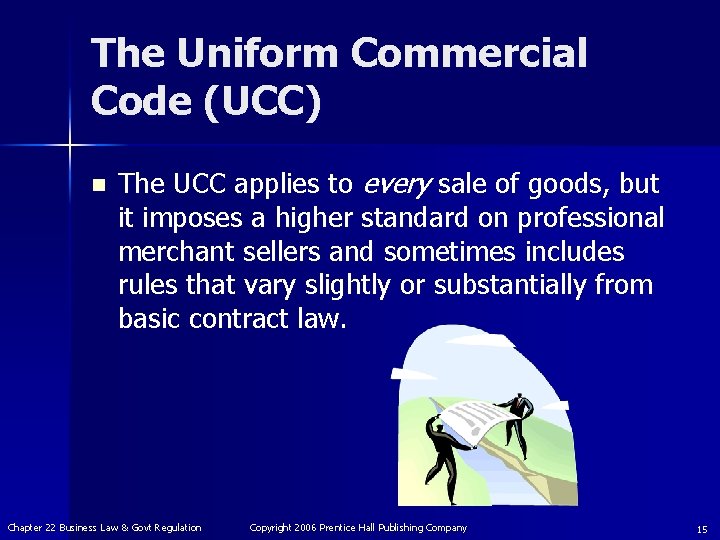
The Uniform Commercial Code (UCC) n The UCC applies to every sale of goods, but it imposes a higher standard on professional merchant sellers and sometimes includes rules that vary slightly or substantially from basic contract law. Chapter 22 Business Law & Govt Regulation Copyright 2006 Prentice Hall Publishing Company 15
Who Is a Merchant? The UCC defines a merchant in three ways: 1. A merchant is one who deals in goods of the kind involved in the sales contract (e. g. a sporting goods retailer buying sporting goods). 2. A merchant is one who, by occupation, holds himself out as having knowledge or skill pertaining to the practices or goods in the sale (e. g. a bank selling a repossessed car). 3. A person who employs a merchant as a broker or an agent has merchant status for that transaction (e. g. “gentleman farmer” who hires a broker to buy livestock for him). Chapter 22 Business Law & Govt Regulation Copyright 2006 Prentice Hall Publishing Company 16
Sales Warranty n. A promise or a statement of fact by a seller that a product will meet certain standards. n Types of warranties: Ø Express warranties Ø Implied warranties n Warranty of title n Warranty of merchantability n Warranty of fitness for a particular purpose Chapter 22 Business Law & Govt Regulation Copyright 2006 Prentice Hall Publishing Company 17
Product Liability n Negligence - when a manufacturer or seller fails to do something that a reasonable person would do. Negligent design Ø Negligent manufacturing Ø Failure to warn Ø n Strict liability – when a manufacturer is liable for its actions no matter what its intentions or the extent of its negligence. Chapter 22 Business Law & Govt Regulation Copyright 2006 Prentice Hall Publishing Company 18
Protecting Intellectual Property Rights Three important tools: n Patents n Trademarks and service marks n Copyrights Chapter 22 Business Law & Govt Regulation Copyright 2006 Prentice Hall Publishing Company 19
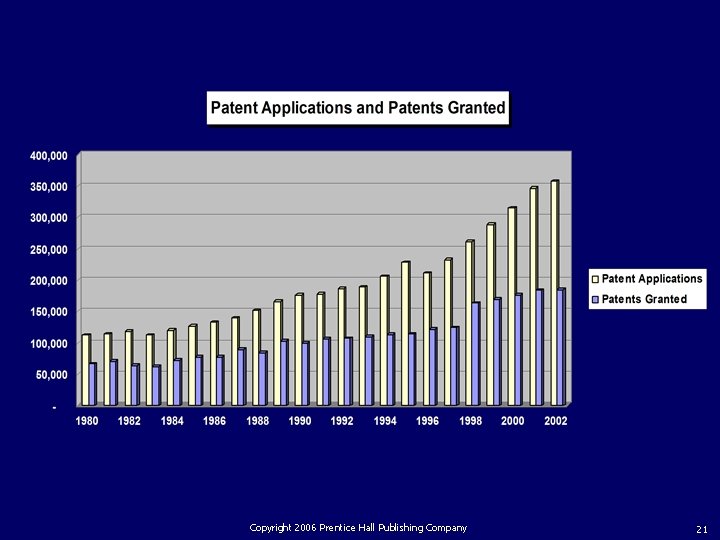
Patents n n Patent - a grant from the U. S. Patent and Trademark Office (PTO) to the inventor of a product, giving the exclusive right to make, use, or sell the invention in the U. S. for 20 years from the date of filing the patent application. P. T. O. has issued more than 7 million patents to date. Chapter 22 Business Law & Govt Regulation Copyright 2006 Prentice Hall Publishing Company 20
Copyright 2006 Prentice Hall Publishing Company 21
Obtaining A Patent Establish novelty. n Document the device. n Search existing patents. n Study search results. n Submit the patent application. n Prosecute the patent application. n Chapter 22 Business Law & Govt Regulation Copyright 2006 Prentice Hall Publishing Company 22
Trademarks n Trademark - any distinctive word, symbol, name, logo, slogan, or trade dress that a company uses to distinguish its product from other goods on the market. n Any business claiming a trademark can use the symbol. n Only those businesses that have registered their trademarks with the PTO can use the ® symbol. Chapter 22 Business Law & Govt Regulation Copyright 2006 Prentice Hall Publishing Company 23
Trademarks can also cover symbols, shapes, colors, and sounds - all part of “trade dress. ” n A service mark, noted by the SM symbol is the same as a trademark except that it identifies and distinguishes the source of a service. n Chapter 22 Business Law & Govt Regulation Copyright 2006 Prentice Hall Publishing Company 24
Copyrights n Copyright - an exclusive right that protects the creator of original works of authorship, such as literary, dramatic, musical, and artistic works – e. g. , a video game. n The symbol denotes a copyrighted work. Chapter 22 Business Law & Govt Regulation Copyright 2006 Prentice Hall Publishing Company 25
The Law of Agency Agent’s duties: n Loyalty n Performance n Notification n Duty of Care n Accounting Chapter 22 Business Law & Govt Regulation Copyright 2006 Prentice Hall Publishing Company 26
The Law of Agency Principal’s duties: n Compensation n Reimbursement n Cooperation n Safe working conditions Chapter 22 Business Law & Govt Regulation Copyright 2006 Prentice Hall Publishing Company 27
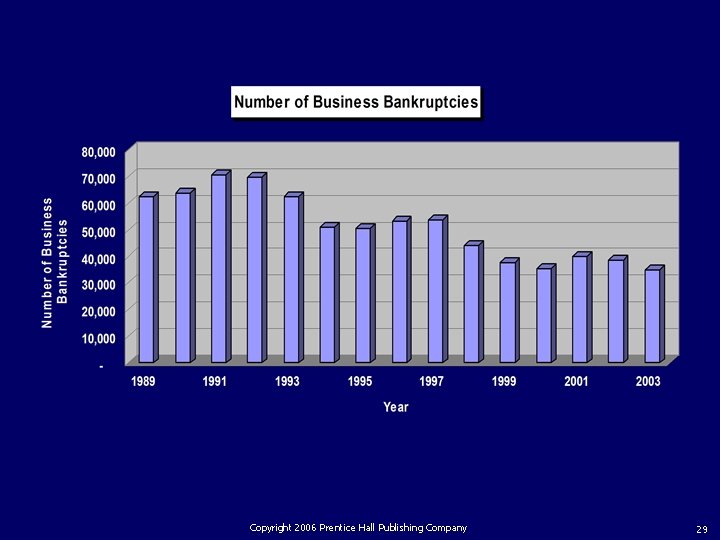
Bankruptcy n Chapter 7: Liquidation - Most common type (72% of all filings) Ø n n Business ceases to exist after bankruptcy proceeding is completed. Chapter 11: Reorganization - Company is protected from creditors' legal actions while formulating a “reorganization” plan. Chapter 13: Individual debtors – Consumer version of Chapter 11 bankruptcy. Ø Less complex and less expensive. Chapter 22 Business Law & Govt Regulation Copyright 2006 Prentice Hall Publishing Company 28
Copyright 2006 Prentice Hall Publishing Company 29
Government Regulation Code of Federal Regulations now consists of 201 volumes with 134, 723 pages! n NFIB study: For companies with fewer than 20 employees, costs of complying with government regulations is $5, 532 per employee vs. $2, 979 per employee for large companies. n Chapter 22 Business Law & Govt Regulation Copyright 2006 Prentice Hall Publishing Company 30
Government Regulation n Trade Practices Ø Sherman Antitrust Act Ø Clayton Act Ø Federal Trade Commission Act Ø Robinson-Patman Act n Consumer Protection Chapter 22 Business Law & Govt Regulation Copyright 2006 Prentice Hall Publishing Company 31
Government Regulation n Consumer Credit Ø Consumer Credit Protection Act (Truth-in-Lending Act) Ø Fair Credit Billing Act Ø Equal Credit Opportunity Act Ø Fair Credit Reporting Act Ø Fair Debt Collection Practices Act Chapter 22 Business Law & Govt Regulation Copyright 2006 Prentice Hall Publishing Company 32
Government Regulation n Environment Ø Clean Air Act Ø Clean Water Act Ø Resource Conservation and Recovery Act Chapter 22 Business Law & Govt Regulation Copyright 2006 Prentice Hall Publishing Company 33
- Slides: 33