
The Left Atrial Appendage Closure by Surgery study
The Left Atrial Appendage Closure by Surgery study (LAACS) Jesper Park-Hansen, MD Bispebjerg-Frederiksberg University Hospital Copenhagen, Denmark Department of Cardiology.
Background • Atrial fibrillation (AFIB) occurs in 30 -67 % heart surgery Rader. Am Heart J. 2010 Lahtinen. Ann Thorac Surg, 2004 Almasssi. Ann Surg, 1997 • Stroke occurs in 1 -3% of all CABG during the 1 st year Crystal Circulation. 2002 Mack MJ JACC 2013 • Risk of stroke is at least 4% per year for most heart-operated patients with AFIB (according to their CHADS-score) Bianchari. Scan Cardiovasc. J 2011

Background • 15 -20% of patients with AFIB have clots in the left atrium à 90% af those are evident in the left atrial appendage Manning Ann Intern Med. 1995 Pearson JACC 1991
Background Evidence behind Left Atrial Appendage Closure with device PROTECT-AF – non-inferiority to warfarin. PREVAIL-AF – non-inferiority to warfarin >7 days What about surgical closure? Reddy, Circulation 2013 Holmes, JACC 2014
Hypothesis Left Atrial Appendage Closure at the time of Surgery may protect from post-operative cerebral ischemia, regardless of AF status at time of surgery
Methods • Screening all patients referred for first time heart surgery 2010 -2015 • Block-randomization 1: 1 LAACS vs Control • Stratified by expected anticoagulation 3 first months post-op • Recommended double closure – purse-string + single running suture
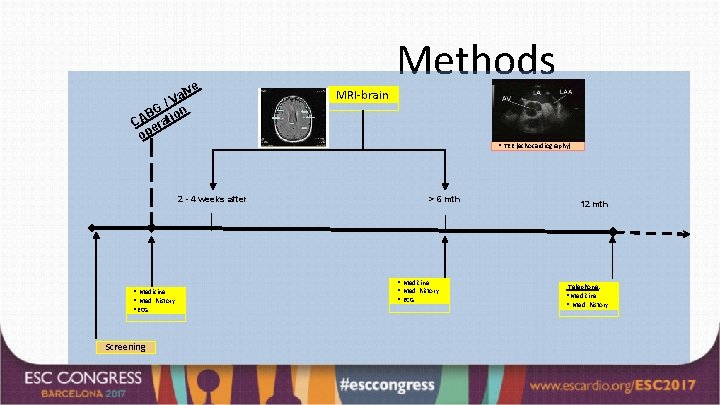
e alv /V BG ion CA erat op 2 - 4 weeks after • Medicine • Med. history • ECG Screening Methods MRI-brain • TEE (echocardiography) > 6 mth • Medicine • Med. history • ECG 12 mth Telephone: • Medicine • Med. history
Endpoint definition • Post-operative cerebral ischemic events Composite endpoint of first ischemic stroke/TIA or silent cerebral infarcts (SCI) after surgery • • Increase in the numbers of SCI between MRI-1 to MRI-2 or post-operative findings of fresh SCI by clinical brain imaging unrelated to study enrollment. SCI as a precursor for larger stroke All stroke/TIA were diagnosed by neurologists in clinical setting. Radiologists were blinded to randomization.
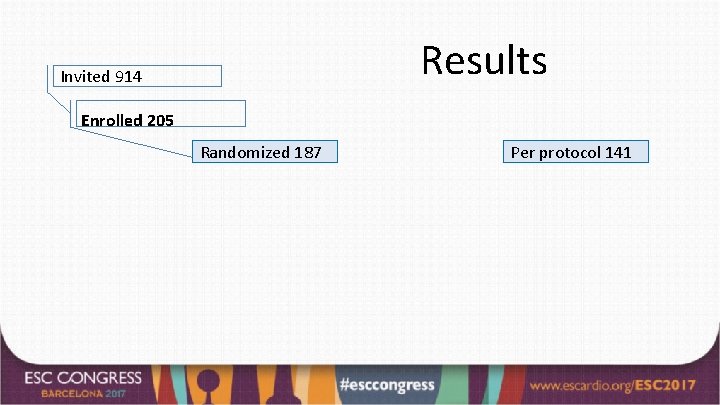
Results Invited 914 Enrolled 205 Randomized 187 Per protocol 141
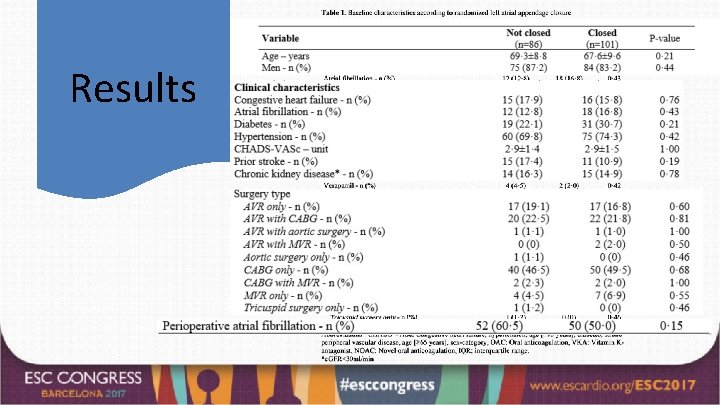
Results
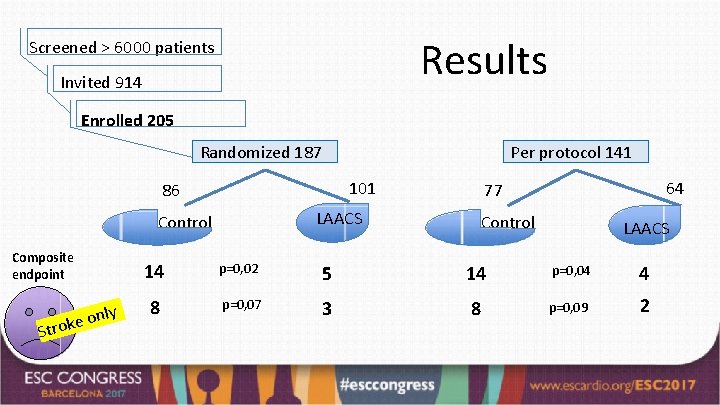
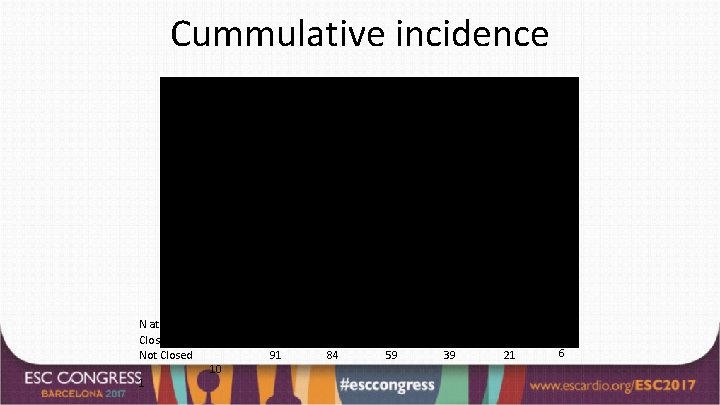
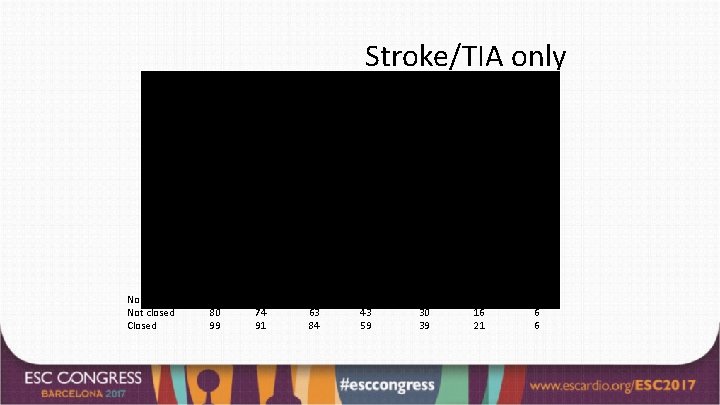
Results Screened > 6000 patients Invited 914 Enrolled 205 Randomized 187 Per protocol 141 101 86 LAACS Control Composite endpoint Str nly o e k o 64 77 Control LAACS 14 p=0, 02 5 14 p=0, 04 4 8 p=0, 07 3 8 p=0, 09 2
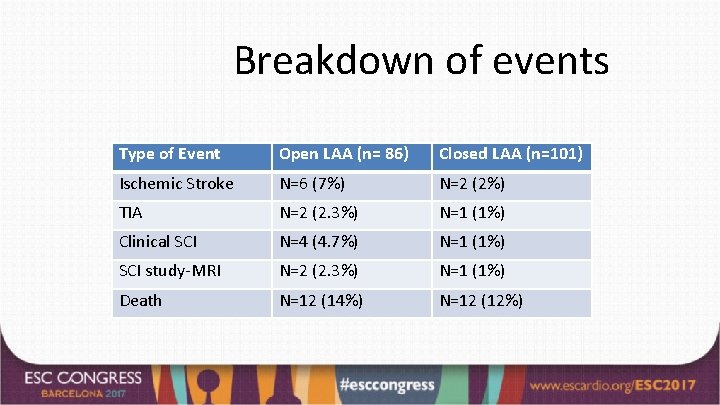
Breakdown of events Type of Event Open LAA (n= 86) Closed LAA (n=101) Ischemic Stroke N=6 (7%) N=2 (2%) TIA N=2 (2. 3%) N=1 (1%) Clinical SCI N=4 (4. 7%) N=1 (1%) SCI study-MRI N=2 (2. 3%) N=1 (1%) Death N=12 (14%) N=12 (12%)
Cummulative incidence t 25% en d ci n I l 20% ra Cereb f 15% o yt li ib a b 10% Pr o ve it la 5% mmu Cu 0% N at Close Not Closed 1 Not closed Closed 0 10 1 2 91 84 3 6 Years in Study 59 4 39 5 21 6
Stroke/TIA only No. Not closed Closed 80 99 74 91 63 84 43 59 30 39 16 21 6 6
Conclusion Left atrial appendage closure on occasion to open heart surgery seems to protect against cerebral ischemic events in the years following surgery.
Acknowledgements – The LAACS team My supervisor: Helena Domínguez Heart Surgeons: Susanne Holme Akhmadjon Irmukhamedov Christian Carranza Anestesia: Christian Hagdrup Neurologists: Christina Rostrup Kruuse Thomas Truelsen Cardiologists: Imaging Team: Brian Nilsson Gina Al-Farra Anders M. Greve Jakob Møller Jesper Hastrup Svendsen Robert Riis Ulrik Dixen Bodil Damgaard Nadia Lander Landex Egill Rostrup Medicine students: Anne Nørskov Johan Clausen Lubna Sabah Qing Ling Anne Sofie Madsen Mads Svane Liljequist Mie Jonsson
Supplementary slides LAACS study - Denmark
Cross-over We were concerned with potential cross-over. Either too many randomized to LAA closure that did not undergo the procedure or the opposite. This could be due to communication of randomization or deliberate protocol violation (not wishing to perform LAACS procedure or convincement of LAACS benefit) Therefore: Closure of the LAA was continously monitored. If there was a difference between actually performed and allocation of 4, the next block (n 16) was randomized 3: 1 to compensate for inequality. This occurred once in the course of the study (with an overweight of patients randomized to LAACS who did not undergo closure)
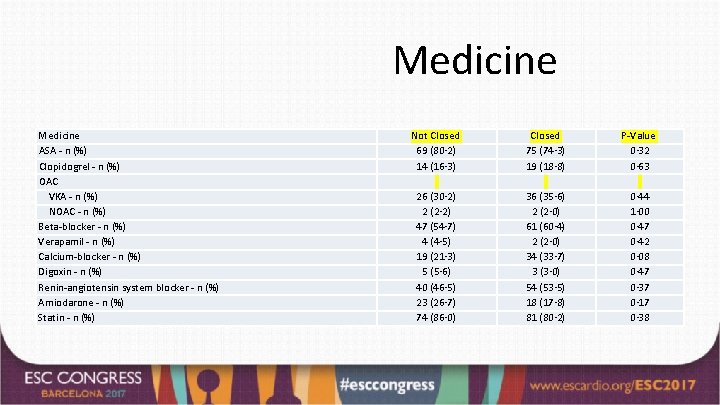
Medicine ASA - n (%) Clopidogrel - n (%) OAC VKA - n (%) NOAC - n (%) Beta-blocker - n (%) Verapamil - n (%) Calcium-blocker - n (%) Digoxin - n (%) Renin-angiotensin system blocker - n (%) Amiodarone - n (%) Statin - n (%) Not Closed 69 (80· 2) 14 (16· 3) Closed 75 (74· 3) 19 (18· 8) P-Value 0· 32 0· 63 26 (30· 2) 2 (2· 2) 47 (54· 7) 4 (4· 5) 19 (21· 3) 5 (5· 6) 40 (46· 5) 23 (26· 7) 74 (86· 0) 36 (35· 6) 2 (2· 0) 61 (60· 4) 2 (2· 0) 34 (33· 7) 3 (3· 0) 54 (53· 5) 18 (17· 8) 81 (80· 2) 0· 44 1· 00 0· 47 0· 42 0· 08 0· 47 0· 37 0· 17 0· 38
Supplemental results -There were no adverse events associated with the procedure. -In the group with open LAACS according to the protocol, 9 (64%) of the 14 primary events occurred beyond the first year of follow-up -Tests of interaction revealed no dependency of the preventative effect of LAACS on baseline AF status, CHA 2 DS 2 -VASc score or use of OAC (p=0· 55, p=0· 56 and p=0· 49 for interaction, respectively).
Study limitations -It was only possible to perform full sets of MRI scans in 75 patients – Possible selection bias. However the signal from MRI was weak. 2 vs 1. -The TEE sample size of 10 patients was relatively small, since many patients turned down an additional TEE. However; 10/10 was complete. (mean 524 days)
- Slides: 22