
The Lecture Series in Athletic Training and Sports


- Slides: 34
The Lecture Series in Athletic Training and Sports Medicine Jim Berry, MEd, ATC, SCAT/NREMT Director of Sports Medicine Head Athletic Trainer Myrtle Beach High School Myrtle Beach, South Carolina © 2003
Chapter 1: Fitness Professionals, Coaches, and the Sports Medicine Team: Defining Roles © 2007 Mc. Graw-Hill Higher Education. All rights reserved.
A Brief History of Sports Medicine H H Sports medicine & Athletic Training dates back to ancient Rome The first “athletic trainers” were actually physicians who worked with the gladiators – The most famous of these ancient “trainers” was Herodicus of Megara, who is perhaps more famous for being the teacher of Hippocrates who is considered to be the father of modern medicine
A Brief History of Sports Medicine – When the Roman Empire fell, interest in athletics declined and athletic training did not again emerge in history until the early 20 th Century with the development of collegiate and professional athletic teams in the United States – Many of the early athletic trainers were also the team managers, who happened to have an interest in medicine. Many of these people were “self taught” and are responsible for many of the athletic training techniques still used today.
A Brief History of Sports Medicine – Today athletic trainers are the “jack of all trades” individuals that founded the profession, but rather highly trained professionals with a wide variety of specialized skills – Today, the NATA-BOC Certified Athletic Trainer plays a vital role in the daily health care of high school, collegiate, world class amateur, and professional athletes – As illustrated in the NATA video, Memories and Souvenirs, the history of athletic training in the United States is storied and rich
What Is Sports Medicine ?
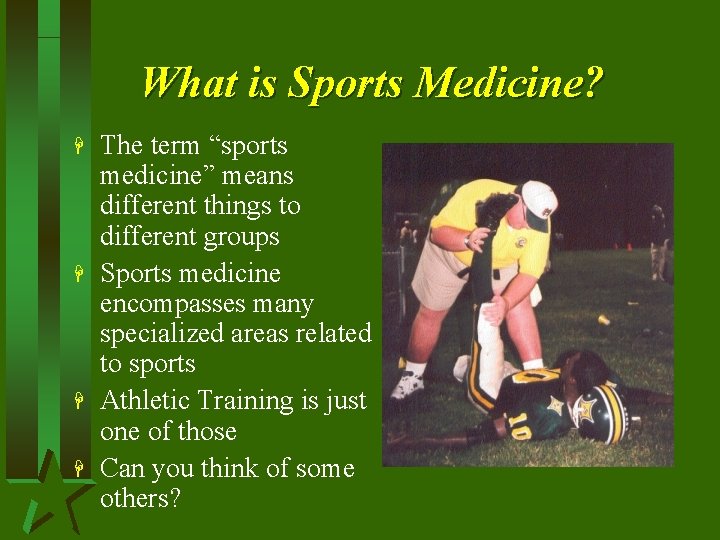
What is Sports Medicine? H H The term “sports medicine” means different things to different groups Sports medicine encompasses many specialized areas related to sports Athletic Training is just one of those Can you think of some others?
H Injury is a part of athletics – Athletes have a right to expect that those that are overseeing their particular view their health and safety as a priority – Critical to have individuals that are aware of both treatment and prevention u Should be able to recognize injury, provide basic medical assistance and refer injured individual to appropriate medical personnel u Well-trained professionals are not always healthcare professionals and may be in violation if they attempt to provide treatment and care
Sports Medicine Organizations H H A number of professional organizations are dedicated to sports medicine and athletic training Some of these are noted here
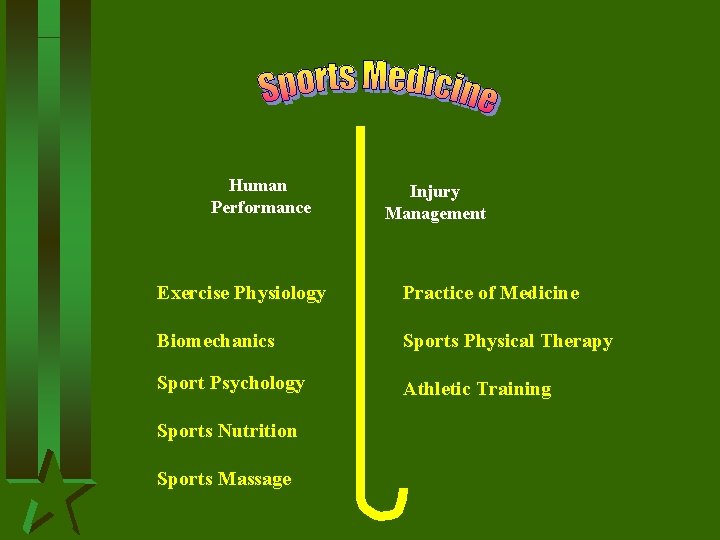
Human Performance Injury Management Exercise Physiology Practice of Medicine Biomechanics Sports Physical Therapy Sport Psychology Athletic Training Sports Nutrition Sports Massage
Sports Medicine Organizations H Professional organizations have many goals: 1. To upgrade the field by devising and maintaining professional standards, including a Code of Ethics **Critical Thought…. What is a Code of Ethics? 2. To bring together professionally competent individuals to exchange ideas, stimulate research, and promote critical thought 3. To give individuals an opportunity to work as a group towards a single professional goal or purpose that they would not likely achieve as an individual
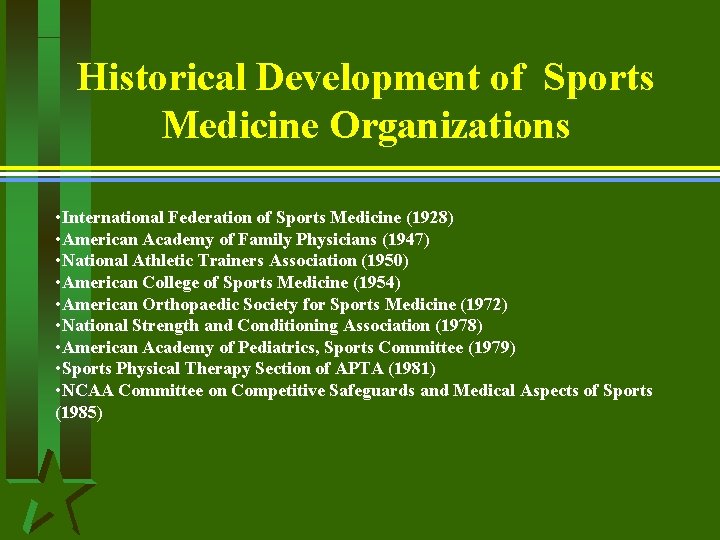
Historical Development of Sports Medicine Organizations • International Federation of Sports Medicine (1928) • American Academy of Family Physicians (1947) • National Athletic Trainers Association (1950) • American College of Sports Medicine (1954) • American Orthopaedic Society for Sports Medicine (1972) • National Strength and Conditioning Association (1978) • American Academy of Pediatrics, Sports Committee (1979) • Sports Physical Therapy Section of APTA (1981) • NCAA Committee on Competitive Safeguards and Medical Aspects of Sports (1985)
The National Athletic Trainers’ Association H H Most athletic trainers belong to this organization The NATA only accepts individuals into its membership who have subscribed to certain rules, regulations, and are prepared to uphold the standards of the profession
Athletic Healthcare in Organized vs. Recreational Sports Activities H H Delivery of healthcare is dependent on whether the event is organized or recreational Organized activity – Generally competitive – Involves teams, leagues (secondary schools, collegiate and professional teams) – Players of the sports medicine team (coach, athletic trainer, physician) are employed on full- or parttime – College setting may also have nutritionist, sports psychologist, strength & conditioning coach, massage therapist
H Recreational activity – Can be competitive but often times is done more for leisure and is much less formal – City and community-based recreational leagues and teams – Often include fitness-oriented events – Sometimes recreational athlete will hire a personal fitness trainer – If injury occurs they are more likely to consult with a family physician, sports chiropractor or a sports physical therapist u Typically, care provided on a fee for care basis
The Players on the Sports Medicine Team
The Players on the Sports Medicine Team H H H The primary athletic training team consists of the coach, the athletic trainer, and the team physician The major concern of everyone on this team should be the health and welfare of the athlete The physician always has the final decision regarding the health care of athletes. The athletic trainer works in cooperation with the physician in making these decisions and caring for injuries/illnesses. The coach should always defer and support the medical staff in matters of athletic health care.
The Players on the Sports Medicine Team H H This is not to say that the coach should have no role in the decisions that are made. There may be particular drills or activities that an athlete should be doing in the course of recovering from an injury that coaches should assist with Likewise, communication is vital between the coach and medical staff to insure everyone is always on the same page
The Players on the Sports Medicine Team H Another important part of the sports medicine team at the secondary school level is the athlete’s family – ATCs must always be sure to keep parents informed of injuries suffered by their children – ATCs must also accept the fact that parents may insist on having their children examined by physicians other than the school’s team physicians
Responsibilities of the Coach H H H All coaches should be certified in CPR and First Aid, especially if the school does not employ an ATC full-time They should have a thorough knowledge or proper training and skill techniques for the sport they are coaching Finally, coaches must work with ATCs to develop and understanding and awareness of each other’s responsibilities and difficulties in doing their jobs in order to function effectively
Roles and Responsibilities of the ATC H The ATC is most directly responsible for all phases of health care in the athletic environment. Their responsibilities include: – Preventing injuries – Providing initial first aid and injury management – Evaluating injuries – Designing and implementing timely rehab programs that can return an athlete to participation
Roles and Responsibilities of the ATC H Qualifications for an ATC – The ATC must be knowledgeable and competent in a variety of sports medicine specialties if he or she is to be effective in doing their job – The NATA has established specific requirements that must be met for an individual to become an ATC, including specific academic and clinical course work in athletic training settings – All ATCs take and pass the NATA BOC national certification examination
Roles and Responsibilities of the ATC H The major roles and responsibilities of the athletic trainer include… – Athletic injury prevention/risk management – Recognition, evaluation, and assessment of injuries – Immediate care of injuries and illnesses – Rehabilitation of injuries – Health care organization and administration – Professional development and responsibility
How does the Fitness Professional Relate to the Sports Medicine Team? H H H Focus of the group is on improving performance Argument can be made that by an athlete achieving a higher level of fitness, injuries are less likely to occur The relationship between performance enhancement and injury prevention is critical
H Personal Fitness Trainer – Responsible for designing a comprehensive exercise program to meet an individuals needs and goals while also considering a person’s health history – Field emerged in the 1970’s and expanded tremendously in the 1980’s u Become an incredibly fast growing and expansive field u Work with all types of individuals – No single standard qualification for a person to practice as a fitness trainer
How does a Recreation Specialist Relate to the Sports Medicine Team? H H A recreation specialist plans, organizes, and oversees leisure activities and athletic programs in local recreation camp and park areas; in playground; in health clubs and fitness centers; in the workplace; and in theme parks Required to ensure that the environment is safe.
H H Should an injury occur to a participant, they should be able to provide immediate and correct first aid and then refer for additional medical assistance All recreation specialist should be certified in CPR 1, 2, 3 and in basic First Aid 1, 2 (Red Cross 1, National Safety Council 2 or American Heart Association 3)
The Role of the Athletic Administrator in the Sports Medicine Team H H Has a significant impact on the sports medicine team Responsible for hiring personnel (i. e. coaches, ATCs, strength coaches, nutritionists, team physician) – Must be sure that all individuals have the necessary credentials and are willing to work as a team
Responsibilities of the Team Physician H H Athletic trainer works under direct supervision of physician Physician assumes a number of roles – Serves to advise and supervise ATC H Physician and ATC must be able to work together
H Compiling medical histories and conducting physical exams – Pre-participation screening H H Diagnosing injury Deciding on disqualifications – Physician must have the final say on when the athlete should return to activity H H Attending practice and games It is imperative that the team physician promote and maintain consistently high quality care
Relationship Between the Sports Medicine Team and Athlete H Primary concern should be that of the athlete – All individuals must work cooperatively in the best interest of the athlete – Coach should differ to the medical staff and support decisions regarding athlete health care H Close communication between all parties involved is critical
Other Members of the Sports Medicine Team • Physicians • Dentist • Podiatrist • Nurse • Physicians Assistant • Sports Chiropractors • Physical Therapist • Massage Therapist • Orthotist/prosthetist • Equipment Personnel • Exercise Physiologist • Biomechanist • Nutritionist • Sport Psychologist • Emergency Medical Specialists • Strength & Conditioning Coach • Referees
Physician Specialists H H H H H Orthopedist Neurologist Internist Ophthalmologist Pediatrician Psychiatrist Dentist Podiatrist Chiropractor (? )
Summing up… H Sports medicine team consists of whom? – Coach, ATC, Team Physician H Primary responsibility of the coach? – Insuring safe environment and equipment H Primary responsibility of ATC? – Prevention, care, and rehab of injuries H Primary responsibility of Team Physician? – PPE’s, diagnosis & treatment, supervising ATC H Name at least 4 other health care providers who may be members of the sports medicine team