
THE LECTURE 3 Part of speech tagging Outline
- Slides: 37
THE LECTURE 3 Part of speech tagging
Outline ■ Tag sets and problem definition ■ Automatic approaches 1: rule-based tagging ■ Automatic approaches 2: stochastic tagging
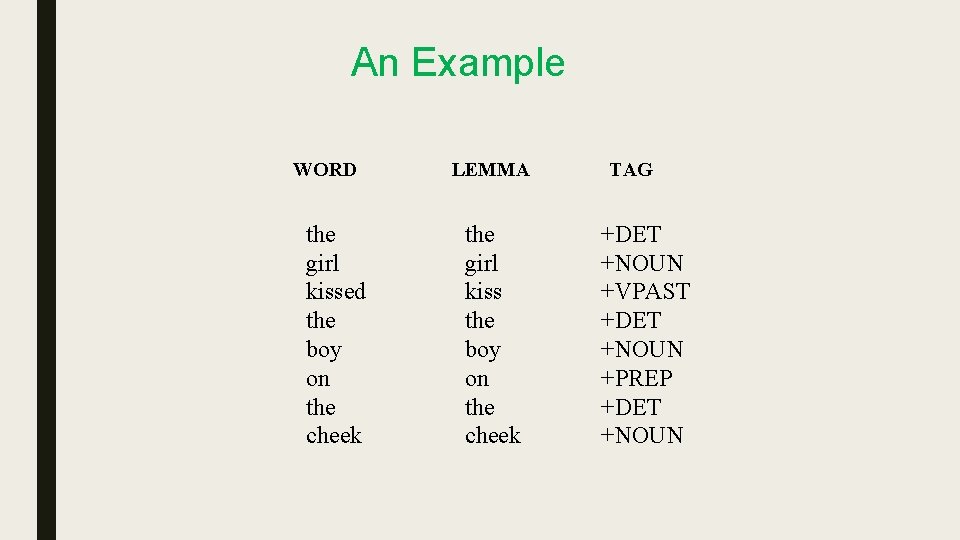
An Example WORD the girl kissed the boy on the cheek LEMMA the girl kiss the boy on the cheek TAG +DET +NOUN +VPAST +DET +NOUN +PREP +DET +NOUN
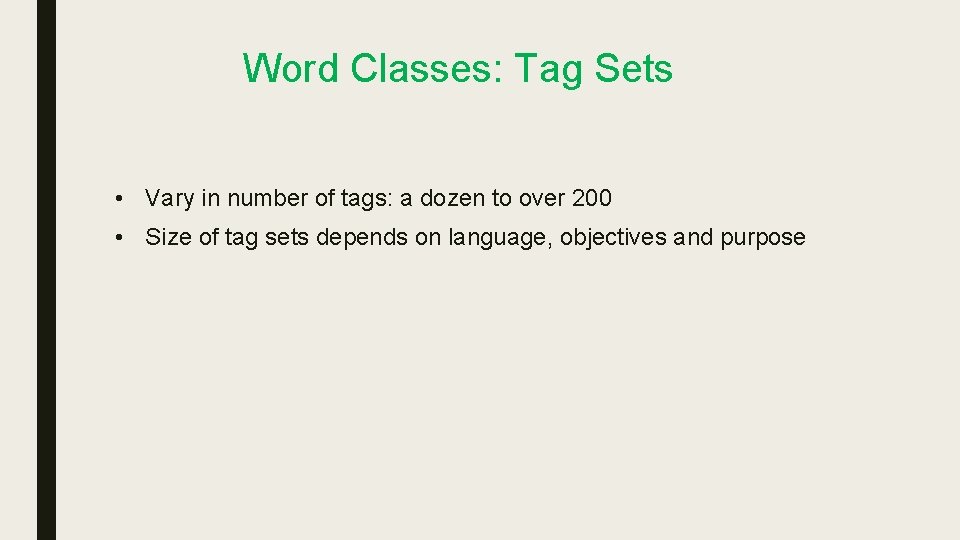
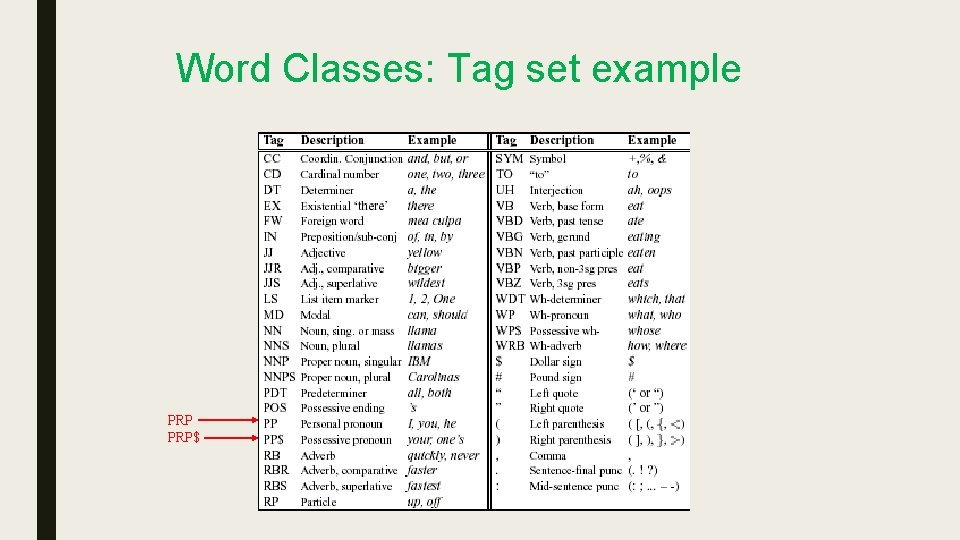
Word Classes: Tag Sets • Vary in number of tags: a dozen to over 200 • Size of tag sets depends on language, objectives and purpose
Word Classes: Tag set example PRP$
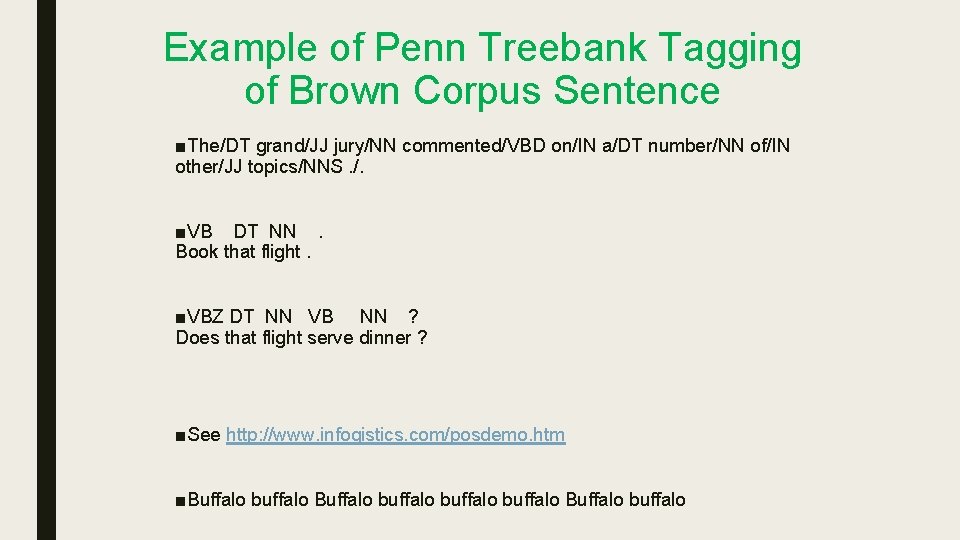
Example of Penn Treebank Tagging of Brown Corpus Sentence ■The/DT grand/JJ jury/NN commented/VBD on/IN a/DT number/NN of/IN other/JJ topics/NNS. /. ■VB DT NN. Book that flight. ■VBZ DT NN VB NN ? Does that flight serve dinner ? ■See http: //www. infogistics. com/posdemo. htm ■Buffalo buffalo Buffalo buffalo
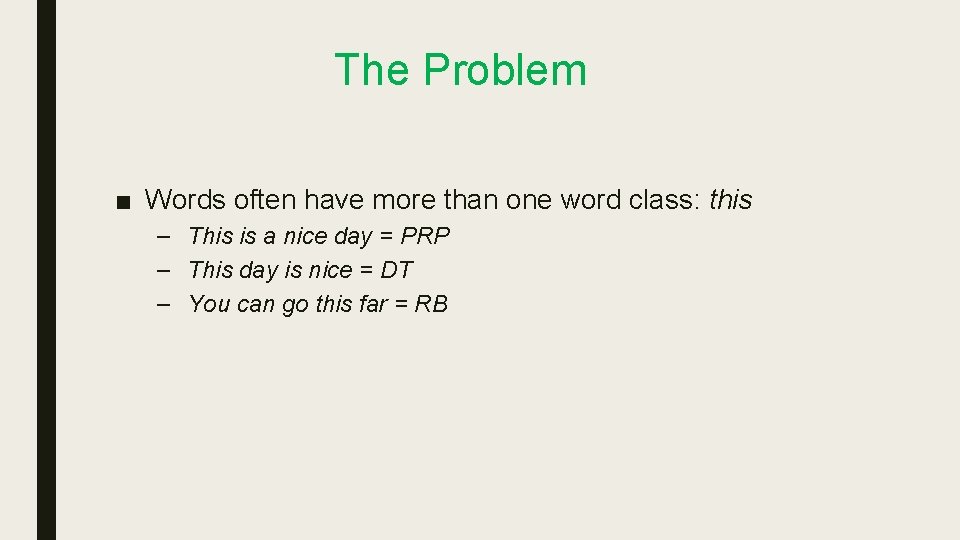
The Problem ■ Words often have more than one word class: this – This is a nice day = PRP – This day is nice = DT – You can go this far = RB
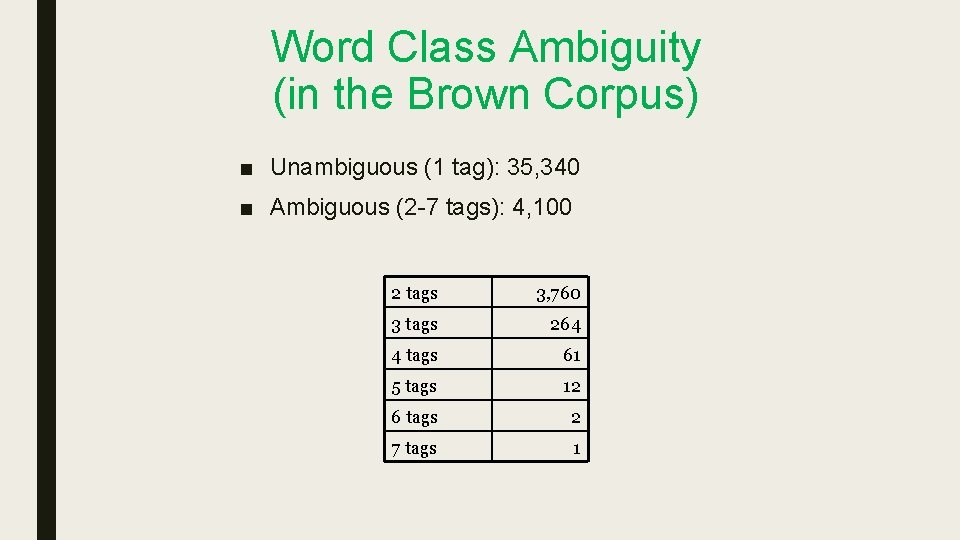
Word Class Ambiguity (in the Brown Corpus) ■ Unambiguous (1 tag): 35, 340 ■ Ambiguous (2 -7 tags): 4, 100 2 tags 3, 760 3 tags 264 4 tags 61 5 tags 12 6 tags 2 7 tags 1
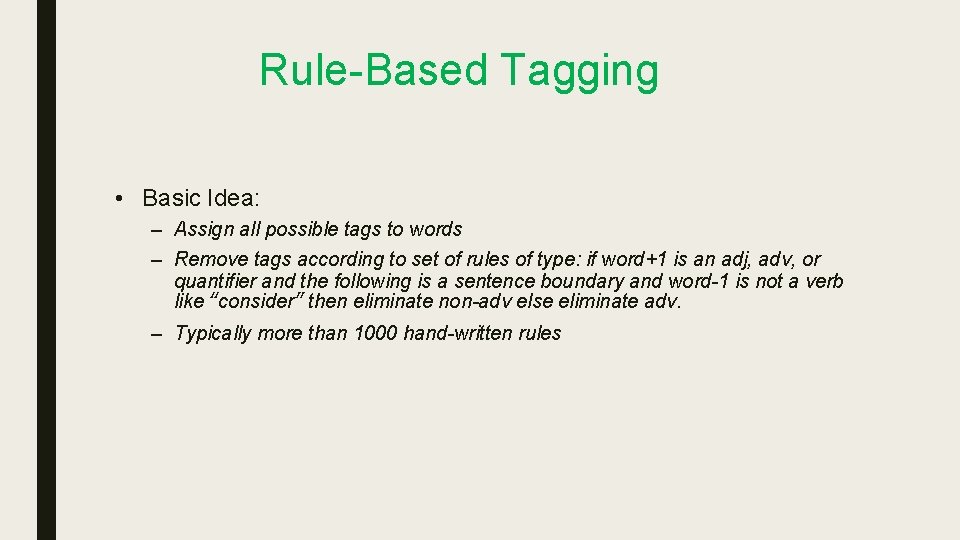
Rule-Based Tagging • Basic Idea: – Assign all possible tags to words – Remove tags according to set of rules of type: if word+1 is an adj, adv, or quantifier and the following is a sentence boundary and word-1 is not a verb like “consider” then eliminate non-adv else eliminate adv. – Typically more than 1000 hand-written rules
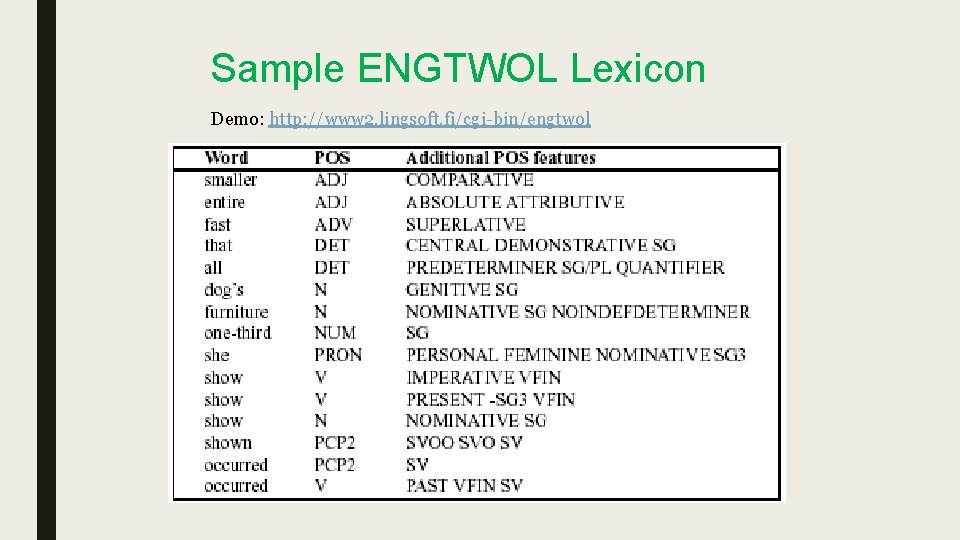
Sample ENGTWOL Lexicon Demo: http: //www 2. lingsoft. fi/cgi-bin/engtwol
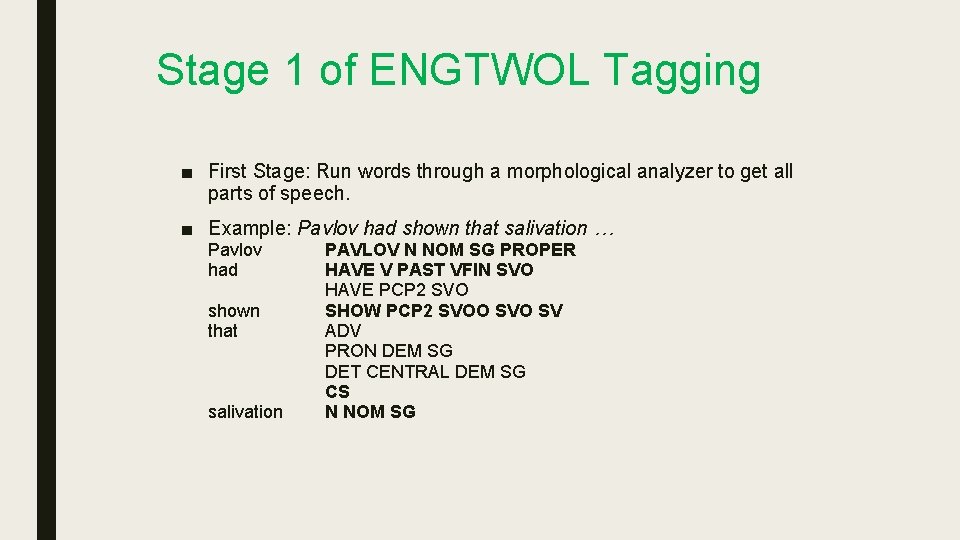
Stage 1 of ENGTWOL Tagging ■ First Stage: Run words through a morphological analyzer to get all parts of speech. ■ Example: Pavlov had shown that salivation … Pavlov had shown that salivation PAVLOV N NOM SG PROPER HAVE V PAST VFIN SVO HAVE PCP 2 SVO SHOW PCP 2 SVOO SV ADV PRON DEM SG DET CENTRAL DEM SG CS N NOM SG
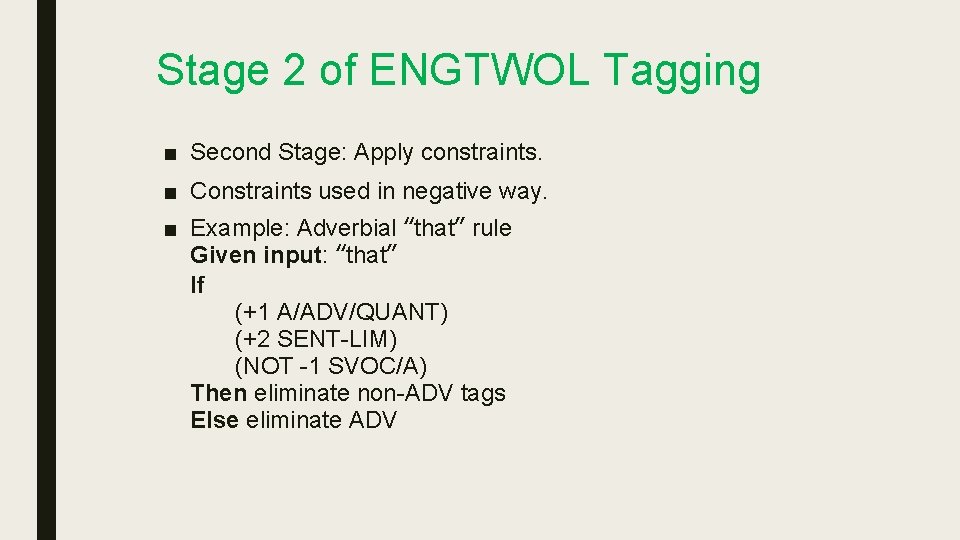
Stage 2 of ENGTWOL Tagging ■ Second Stage: Apply constraints. ■ Constraints used in negative way. ■ Example: Adverbial “that” rule Given input: “that” If (+1 A/ADV/QUANT) (+2 SENT-LIM) (NOT -1 SVOC/A) Then eliminate non-ADV tags Else eliminate ADV
Stochastic Tagging • Based on probability of certain tag occurring given various possibilities • Requires a training corpus • No probabilities for words not in corpus.
Stochastic Tagging (cont. ) • Simple Method: Choose most frequent tag in training text for each word! – – Result: 90% accuracy Baseline Others will do better HMM is an example
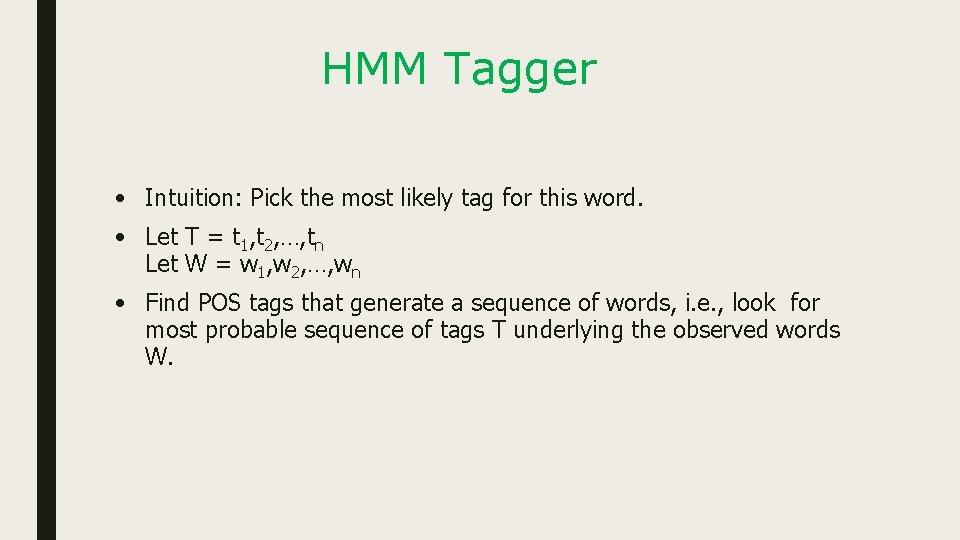
HMM Tagger • Intuition: Pick the most likely tag for this word. • Let T = t 1, t 2, …, tn Let W = w 1, w 2, …, wn • Find POS tags that generate a sequence of words, i. e. , look for most probable sequence of tags T underlying the observed words W.
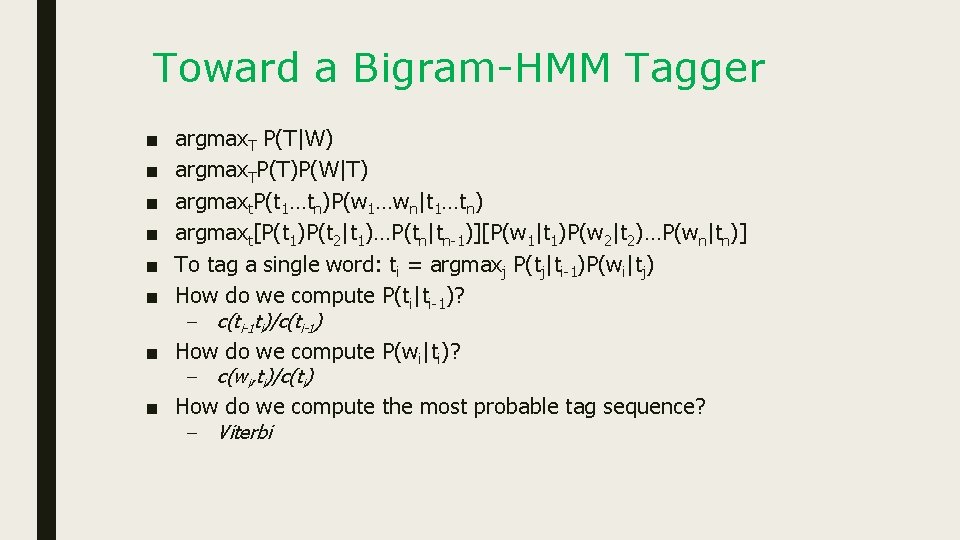
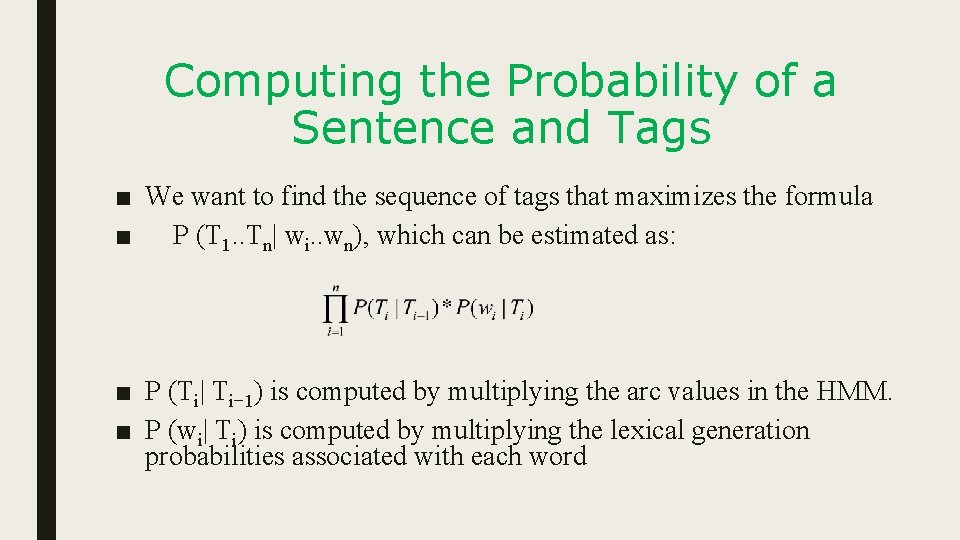
Toward a Bigram-HMM Tagger ■ ■ ■ argmax. T P(T|W) argmax. TP(T)P(W|T) argmaxt. P(t 1…tn)P(w 1…wn|t 1…tn) argmaxt[P(t 1)P(t 2|t 1)…P(tn|tn-1)][P(w 1|t 1)P(w 2|t 2)…P(wn|tn)] To tag a single word: ti = argmaxj P(tj|ti-1)P(wi|tj) How do we compute P(ti|ti-1)? – c(ti-1 ti)/c(ti-1) ■ How do we compute P(wi|ti)? – c(wi, ti)/c(ti) ■ How do we compute the most probable tag sequence? – Viterbi
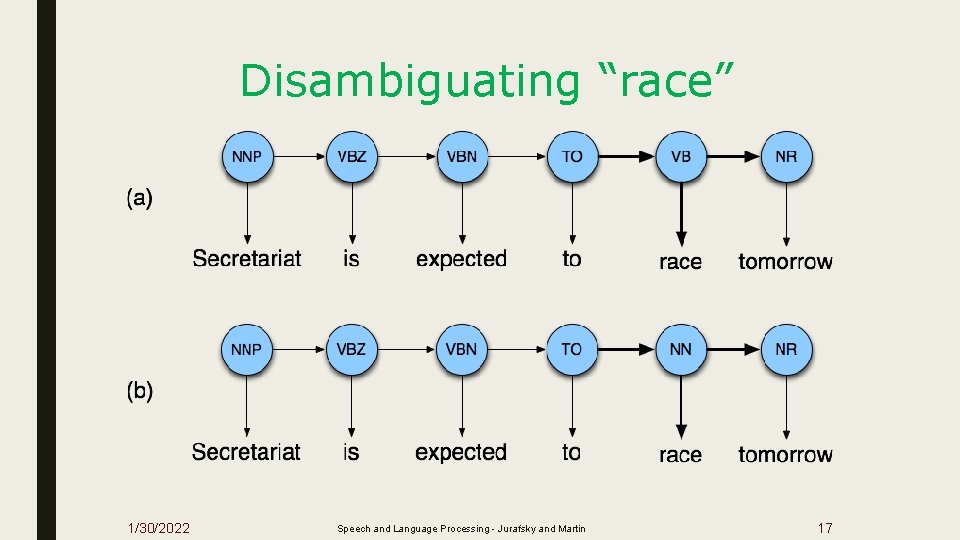
Disambiguating “race” 1/30/2022 Speech and Language Processing - Jurafsky and Martin 17
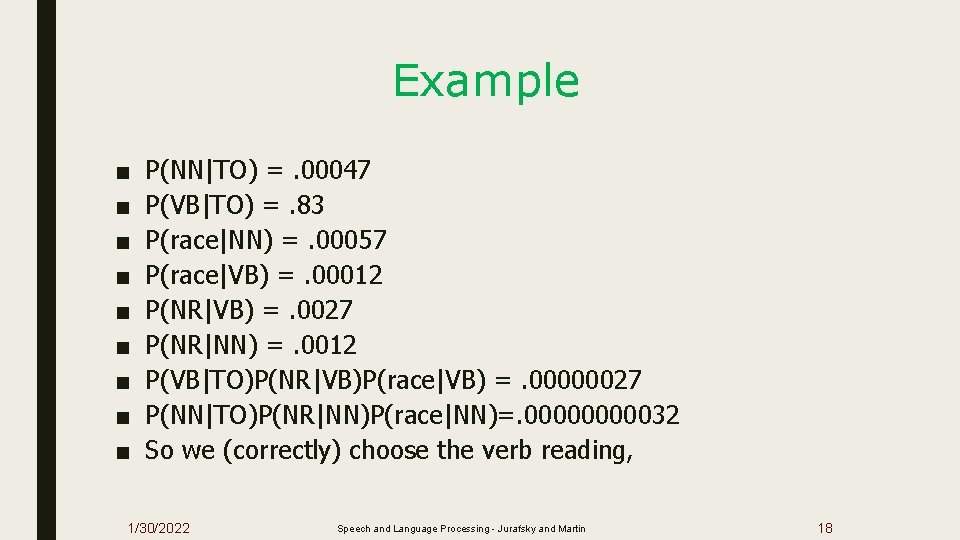
Example ■ ■ ■ ■ ■ P(NN|TO) =. 00047 P(VB|TO) =. 83 P(race|NN) =. 00057 P(race|VB) =. 00012 P(NR|VB) =. 0027 P(NR|NN) =. 0012 P(VB|TO)P(NR|VB)P(race|VB) =. 00000027 P(NN|TO)P(NR|NN)P(race|NN)=. 0000032 So we (correctly) choose the verb reading, 1/30/2022 Speech and Language Processing - Jurafsky and Martin 18
Hidden Markov Models ■ What we’ve described with these two kinds of probabilities is a Hidden Markov Model (HMM) 1/30/2022 Speech and Language Processing - Jurafsky and Martin 19
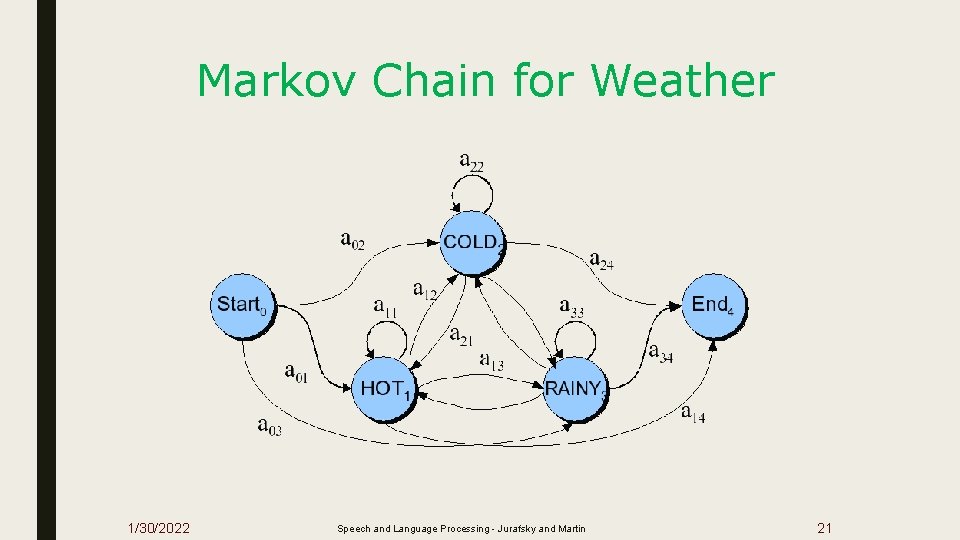
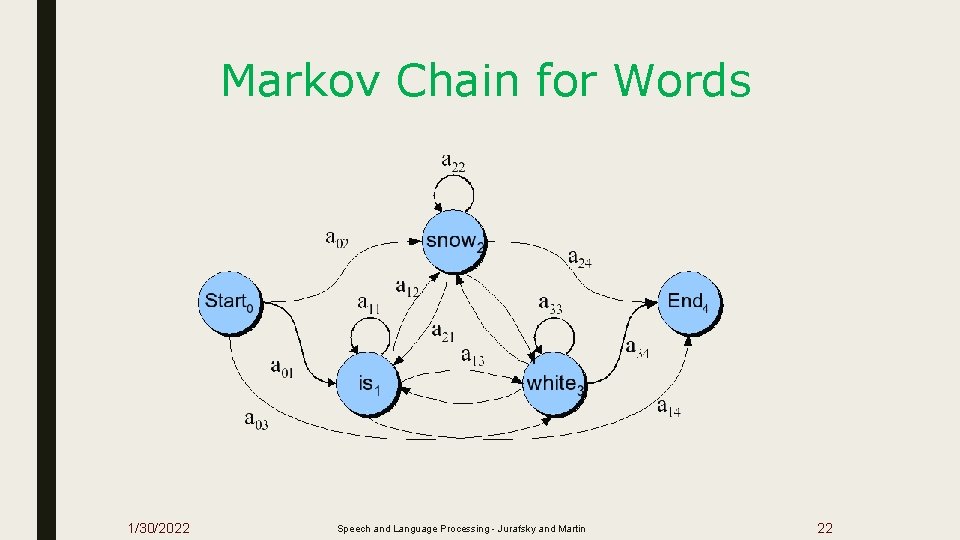
Definitions ■ A weighted finite-state automaton adds probabilities to the arcs – The sum of the probabilities on arcs leaving a node must sum to one ■ A Markov chain is a special case of a WFST in which the input sequence uniquely determines which states the automaton will go through ■ Markov chains can’t represent ambiguous problems – Useful for assigning probabilities to unambiguous sequences 1/30/2022 Speech and Language Processing - Jurafsky and Martin 20
Markov Chain for Weather 1/30/2022 Speech and Language Processing - Jurafsky and Martin 21
Markov Chain for Words 1/30/2022 Speech and Language Processing - Jurafsky and Martin 22
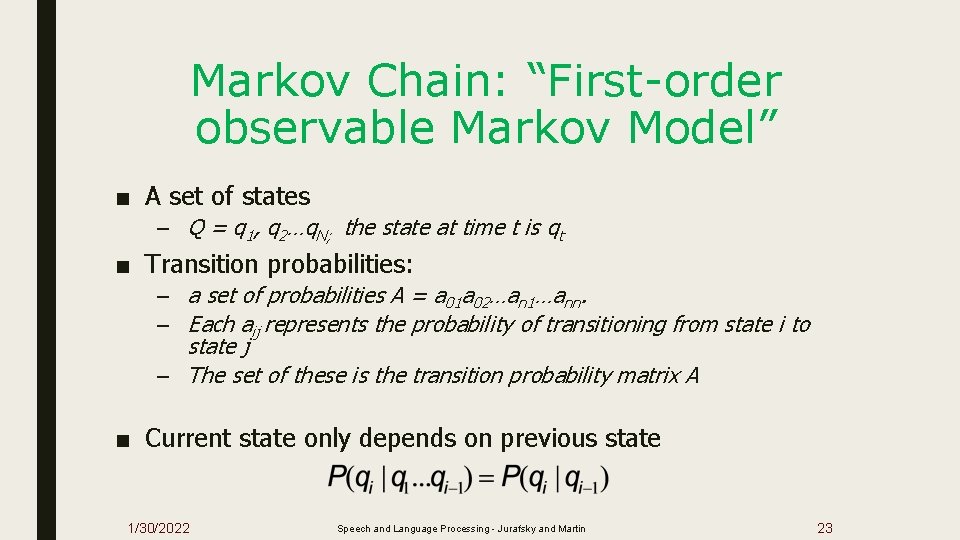
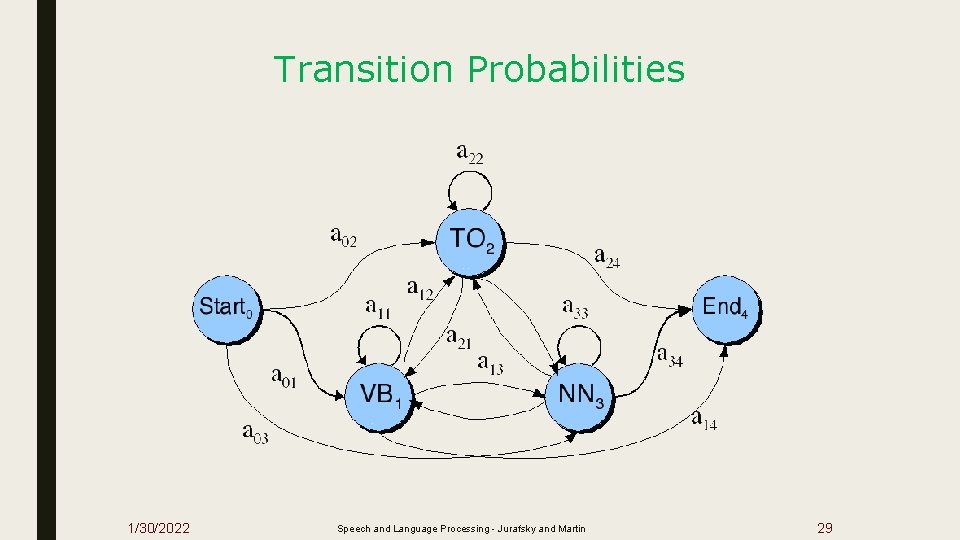
Markov Chain: “First-order observable Markov Model” ■ A set of states – Q = q 1, q 2…q. N; the state at time t is qt ■ Transition probabilities: – a set of probabilities A = a 01 a 02…an 1…ann. – Each aij represents the probability of transitioning from state i to state j – The set of these is the transition probability matrix A ■ Current state only depends on previous state 1/30/2022 Speech and Language Processing - Jurafsky and Martin 23
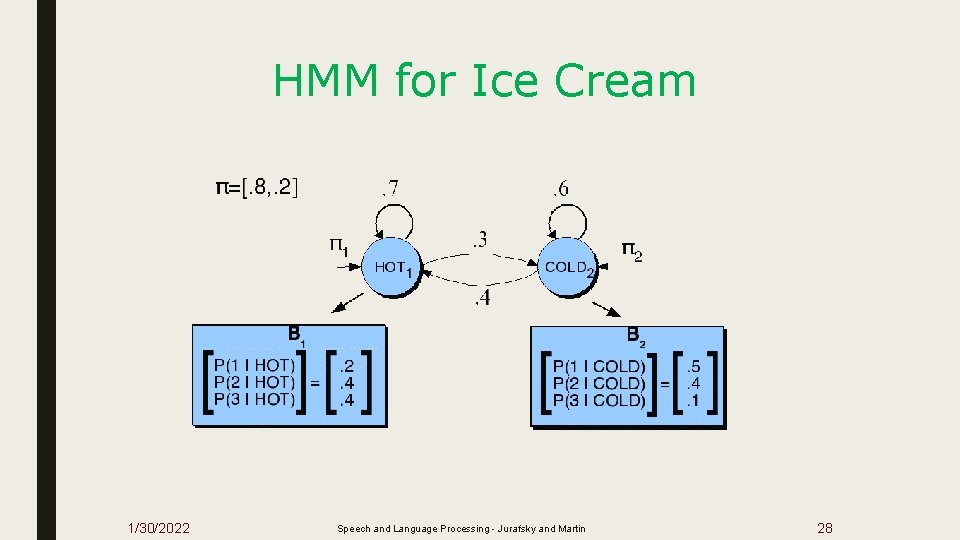
HMM for Ice Cream ■ You are a climatologist in the year 2799 ■ Studying global warming ■ You can’t find any records of the weather in Baltimore, MA for summer of 2007 ■ But you find Jason Eisner’s diary ■ Which lists how many ice-creams Jason ate every date that summer ■ Our job: figure out how hot it was 1/30/2022 Speech and Language Processing - Jurafsky and Martin 24
Hidden Markov Model ■ For Markov chains, the symbols are the same as the states. – See hot weather: we’re in state hot ■ But in part-of-speech tagging – The output symbols are words – But the hidden states are part-of-speech tags ■ A Hidden Markov Model is an extension of a Markov chain in which the input symbols are not the same as the states. ■ This means we don’t know which state we are in. 1/30/2022 Speech and Language Processing - Jurafsky and Martin 25
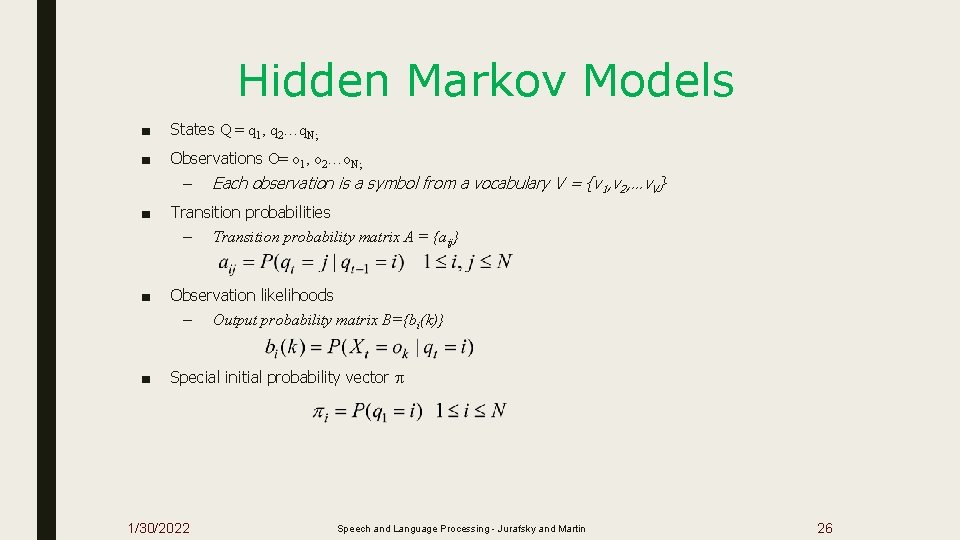
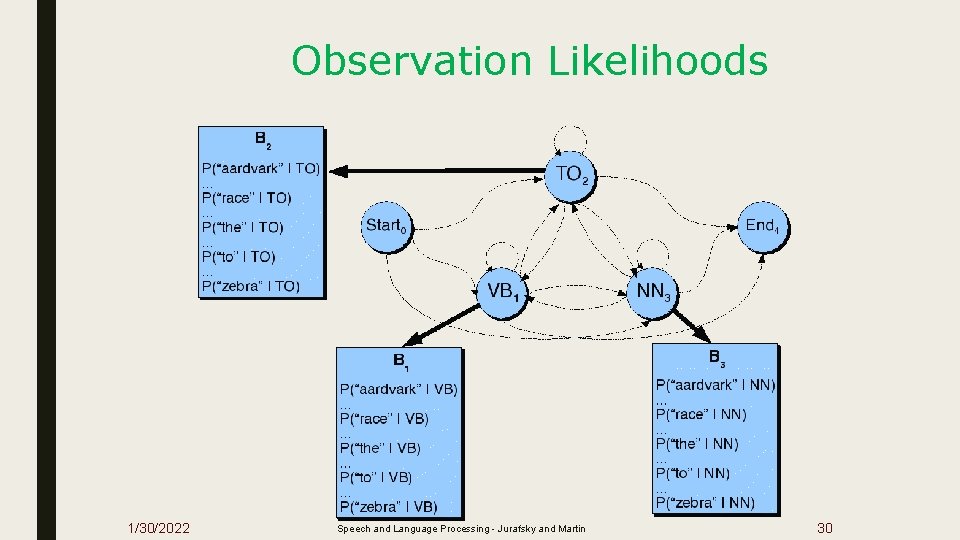
Hidden Markov Models ■ States Q = q 1, q 2…q. N; ■ Observations O= o 1, o 2…o. N; – Each observation is a symbol from a vocabulary V = {v 1, v 2, …v. V} ■ Transition probabilities – Transition probability matrix A = {aij} ■ Observation likelihoods – Output probability matrix B={bi(k)} ■ Special initial probability vector 1/30/2022 Speech and Language Processing - Jurafsky and Martin 26
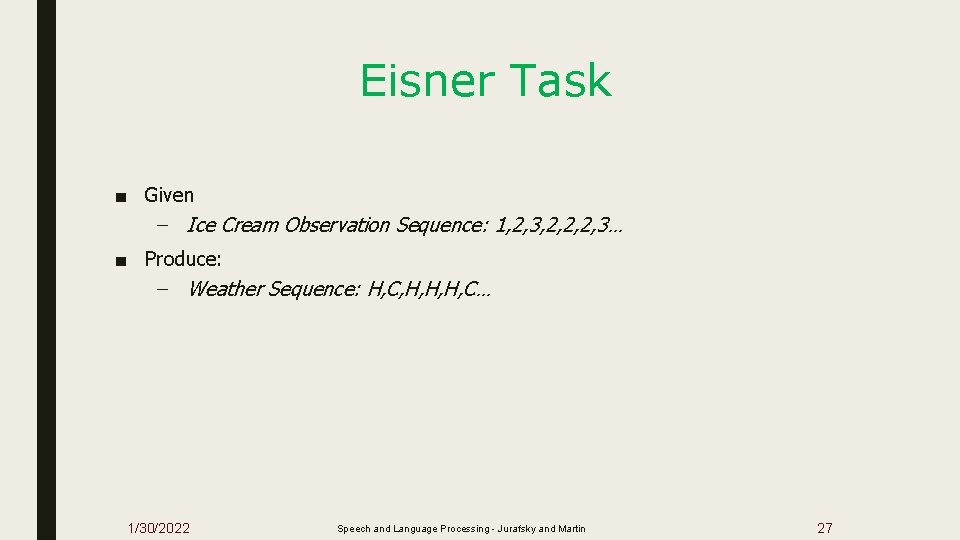
Eisner Task ■ Given – Ice Cream Observation Sequence: 1, 2, 3, 2, 2, 2, 3… ■ Produce: – Weather Sequence: H, C, H, H, H, C… 1/30/2022 Speech and Language Processing - Jurafsky and Martin 27
HMM for Ice Cream 1/30/2022 Speech and Language Processing - Jurafsky and Martin 28
Transition Probabilities 1/30/2022 Speech and Language Processing - Jurafsky and Martin 29
Observation Likelihoods 1/30/2022 Speech and Language Processing - Jurafsky and Martin 30
Decoding ■ Ok, now we have a complete model that can give us what we need. ■ We could just enumerate all paths given the input and use the model to assign probabilities to each. – Not a good idea. – Luckily dynamic programming (also seen in Ch. 3 with minimum edit distance, but we didn’t cover it) helps us here 1/30/2022 Speech and Language Processing - Jurafsky and Martin 31
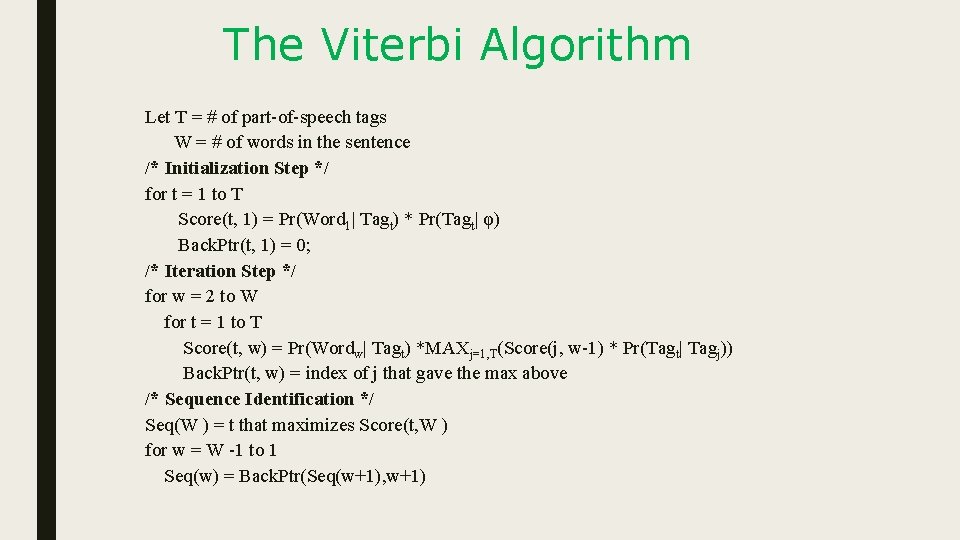
Viterbi Algorithm • The Viterbi algorithm is used to compute the most likely tag sequence in O(W x T 2) time, where T is the number of possible part-of-speech tags and W is the number of words in the sentence. ■ The algorithm sweeps through all the tag possibilities for each word, computing the best sequence leading to each possibility. The key that makes this algorithm efficient is that we only need to know the best sequences leading to the previous word because of the Markov assumption.
Computing the Probability of a Sentence and Tags ■ We want to find the sequence of tags that maximizes the formula ■ P (T 1. . Tn| wi. . wn), which can be estimated as: ■ P (Ti| Ti− 1) is computed by multiplying the arc values in the HMM. ■ P (wi| Ti) is computed by multiplying the lexical generation probabilities associated with each word
The Viterbi Algorithm Let T = # of part-of-speech tags W = # of words in the sentence /* Initialization Step */ for t = 1 to T Score(t, 1) = Pr(Word 1| Tagt) * Pr(Tagt| φ) Back. Ptr(t, 1) = 0; /* Iteration Step */ for w = 2 to W for t = 1 to T Score(t, w) = Pr(Wordw| Tagt) *MAXj=1, T(Score(j, w-1) * Pr(Tagt| Tagj)) Back. Ptr(t, w) = index of j that gave the max above /* Sequence Identification */ Seq(W ) = t that maximizes Score(t, W ) for w = W -1 to 1 Seq(w) = Back. Ptr(Seq(w+1), w+1)
Evaluation ■ Once you have you POS tagger running how do you evaluate it? – Overall error rate with respect to a gold-standard test set. – Error rates on particular tags – Error rates on particular words – Tag confusions. . . 1/30/2022 Speech and Language Processing - Jurafsky and Martin 35
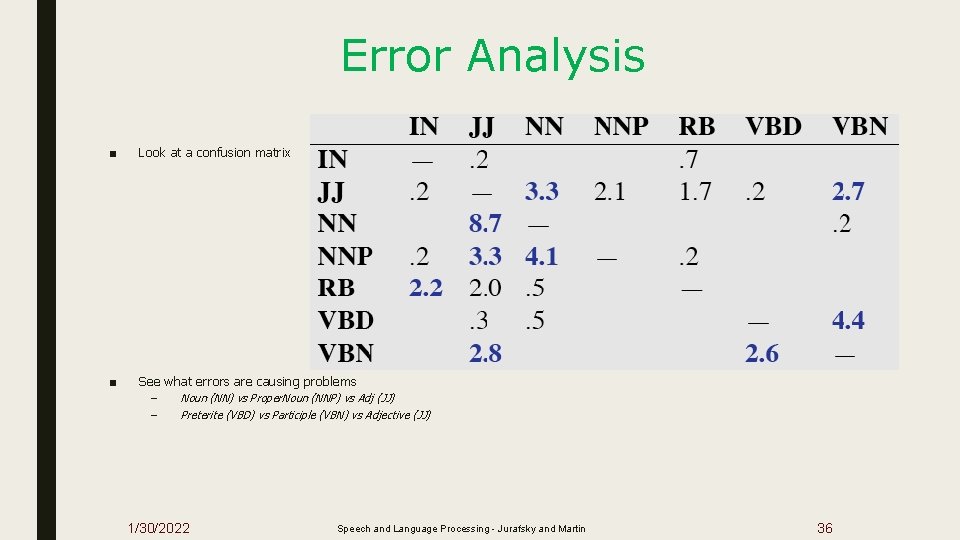
Error Analysis ■ Look at a confusion matrix ■ See what errors are causing problems – – Noun (NN) vs Proper. Noun (NNP) vs Adj (JJ) Preterite (VBD) vs Participle (VBN) vs Adjective (JJ) 1/30/2022 Speech and Language Processing - Jurafsky and Martin 36
Evaluation ■ The result is compared with a manually coded “Gold Standard” – Typically accuracy reaches 96 -97% – This may be compared with result for a baseline tagger (one that uses no context). ■ Important: 100% is impossible even for human annotators. 1/30/2022 Speech and Language Processing - Jurafsky and Martin 37