
The LEAN Sourcing Approach Briefing selfstarter pack for
The LEAN Sourcing Approach Briefing & self-starter pack for procurement staff Version 1. 0 UNCLASSIFIED
The Procurement Reform Agenda • The Coalition Government has set out the requirement to support the implementation of the Growth Agenda and to ensure that more Small & Medium Sized Enterprises (SMEs) /Voluntary, Community Social Enterprises (VCSEs) win government contracts. The requirement includes a new approach to the way central government departments carry out procurement. • This requires departments to think very differently about how procurements are planned and delivered. • Subsequently, this requires a much closer working relationship between procurement staff and colleagues from policy areas and project management functions than has previously been the case. • The new approach has been endorsed by Francis Maude, the Minister for the Cabinet Office and all central government departments and their ALBs are required to adopt it.
The new policy requirements • The new approach comprises the following new government policy requirements: – Adoption of a LEAN sourcing approach that strips out waste and reduces costs – A requirement to carry out significant levels of pre-procurement market engagement with diverse range of prospective suppliers, including SMEs in order to warm-up the market, test our thinking and generate ideas for innovation as part of the development of outcome-based specifications. – Contracts should be broken down into lots where appropriate, and requirements that are below the value of £ 100 K should be rapidly sourced through the new Government Dynamic Market place. – All Government procurements are strongly encouraged to use the Open Procedure. – There is now a presumption against the use of the Competitive Dialogue procedure which has often resulted in slowing things up unnecessarily and typically incurs huge costs on both sides. – There is an expectation that all but the most complex procurements are completed within 120 working days (publication of the advert to the contract award decision date).
What this means for our department • Collectively, we need to develop: – A detailed understanding of what the pipeline of potential procurements is so that these can be planned and resourced effectively – Strong recognition within business areas that early engagement and joint working with the procurement function (as part of a multi-disciplined procurement team) is a critical success factor – A full understanding of the key principles of the LEAN sourcing process and how engagement with suppliers in the market before establishing a formal procurement process has to become standard practice (we can no longer rush out with an advert) – Strong acceptance that large complex contracts with large suppliers are no longer going to be permitted (in the vast majority of cases) and that increasing the number of contracts awarded to SMEs/VCSEs (through breaking down requirements into lots) is the new way forward (where appropriate). – Strong recognition that departmental performance in delivering procurements within 120 days will be subject to ongoing scrutiny by ERG and No 10 and that we can only achieve this by working together. – More efficient and effective approaches to taking business decisions to ensure that we do not incur any unnecessary delays.
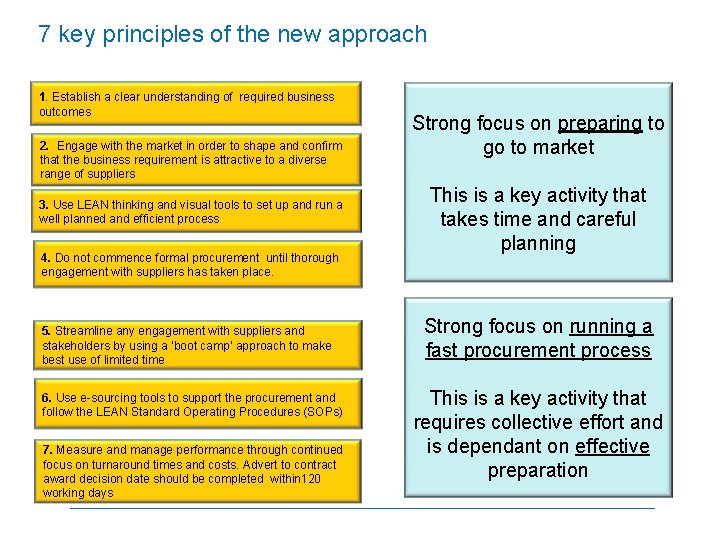
7 key principles of the new approach 1. Establish a clear understanding of required business outcomes 2. Engage with the market in order to shape and confirm that the business requirement is attractive to a diverse range of suppliers 3. Use LEAN thinking and visual tools to set up and run a well planned and efficient process 4. Do not commence formal procurement until thorough engagement with suppliers has taken place. 5. Streamline any engagement with suppliers and stakeholders by using a ‘boot camp’ approach to make best use of limited time 6. Use e-sourcing tools to support the procurement and follow the LEAN Standard Operating Procedures (SOPs) 7. Measure and manage performance through continued focus on turnaround times and costs. Advert to contract award decision date should be completed within 120 working days Strong focus on preparing to go to market This is a key activity that takes time and careful planning Strong focus on running a fast procurement process This is a key activity that requires collective effort and is dependant on effective preparation
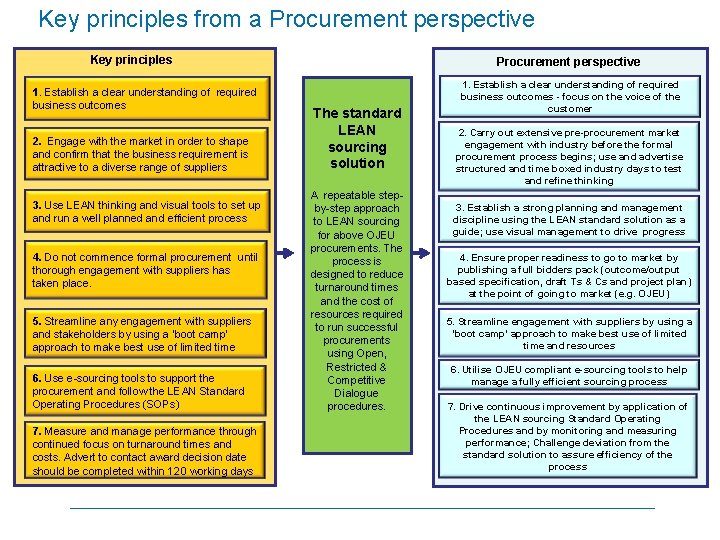
Key principles from a Procurement perspective Key principles 1. Establish a clear understanding of required business outcomes 2. Engage with the market in order to shape and confirm that the business requirement is attractive to a diverse range of suppliers 3. Use LEAN thinking and visual tools to set up and run a well planned and efficient process 4. Do not commence formal procurement until ctc thorough engagement with suppliers has taken place. 5. Streamline any engagement with suppliers and stakeholders by using a ‘boot camp’ approach to make best use of limited time 6. Use e-sourcing tools to support the procurement and follow the LEAN Standard Operating Procedures (SOPs) 7. Measure and manage performance through continued focus on turnaround times and costs. Advert to contact award decision date should be completed within 120 working days Procurement perspective The standard LEAN sourcing solution A repeatable stepby-step approach to LEAN sourcing for above OJEU procurements. The process is designed to reduce turnaround times and the cost of resources required to run successful procurements using Open, Restricted & Competitive Dialogue procedures. 1. Establish a clear understanding of required business outcomes - focus on the voice of the customer 2. Carry out extensive pre-procurement market engagement with industry before the formal procurement process begins; use and advertise structured and time boxed industry days to test and refine thinking 3. Establish a strong planning and management discipline using the LEAN standard solution as a guide; use visual management to drive progress 4. Ensure proper readiness to go to market by publishing a full bidders pack (outcome/output based specification, draft Ts & Cs and project plan) at the point of going to market (e. g. OJEU) 5. Streamline engagement with suppliers by using a ‘boot camp’ approach to make best use of limited time and resources 6. Utilise OJEU compliant e-sourcing tools to help manage a fully efficient sourcing process 7. Drive continuous improvement by application of the LEAN sourcing Standard Operating Procedures and by monitoring and measuring performance; Challenge deviation from the standard solution to assure efficiency of the process
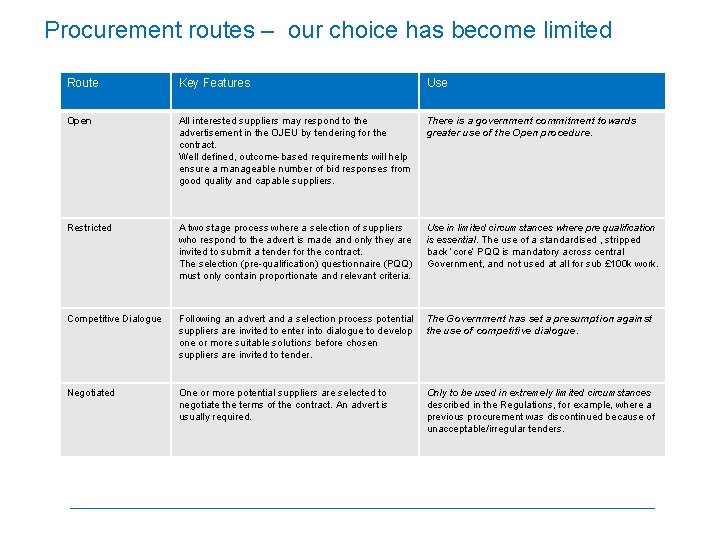
Procurement routes – our choice has become limited Route Key Features Use Open All interested suppliers may respond to the advertisement in the OJEU by tendering for the contract. Well defined, outcome-based requirements will help ensure a manageable number of bid responses from good quality and capable suppliers. There is a government commitment towards greater use of the Open procedure. Restricted A two stage process where a selection of suppliers who respond to the advert is made and only they are invited to submit a tender for the contract. The selection (pre-qualification) questionnaire (PQQ) must only contain proportionate and relevant criteria. Use in limited circumstances where pre qualification is essential. The use of a standardised , stripped back ‘core’ PQQ is mandatory across central Government, and not used at all for sub £ 100 k work. Competitive Dialogue Following an advert and a selection process potential suppliers are invited to enter into dialogue to develop one or more suitable solutions before chosen suppliers are invited to tender. The Government has set a presumption against the use of competitive dialogue. Negotiated One or more potential suppliers are selected to negotiate the terms of the contract. An advert is usually required. Only to be used in extremely limited circumstances described in the Regulations, for example, where a previous procurement was discontinued because of unacceptable/irregular tenders.
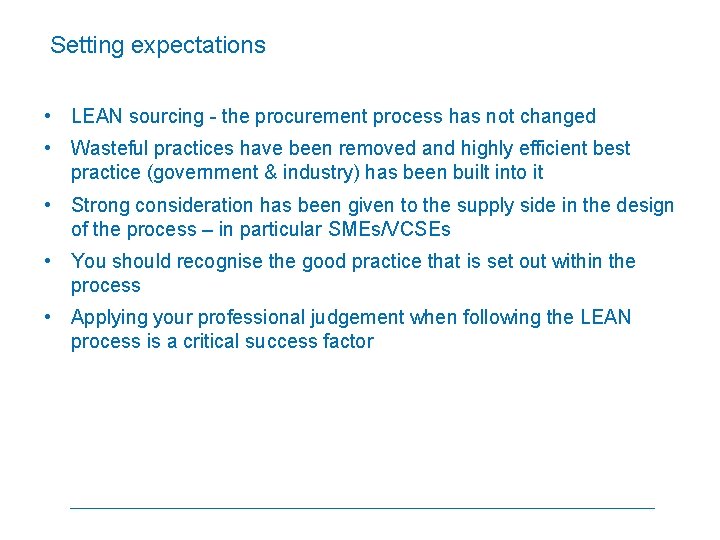
Setting expectations • LEAN sourcing - the procurement process has not changed • Wasteful practices have been removed and highly efficient best practice (government & industry) has been built into it • Strong consideration has been given to the supply side in the design of the process – in particular SMEs/VCSEs • You should recognise the good practice that is set out within the process • Applying your professional judgement when following the LEAN process is a critical success factor
What you should get from this briefing. . . • Good awareness of the LEAN sourcing process and how the Government’s SME policy requirements fit into it • An insight into the components of the LEAN standard solution and the benefits of applying it • Sufficient knowledge and confidence to start to apply the standard solution on forthcoming procurements
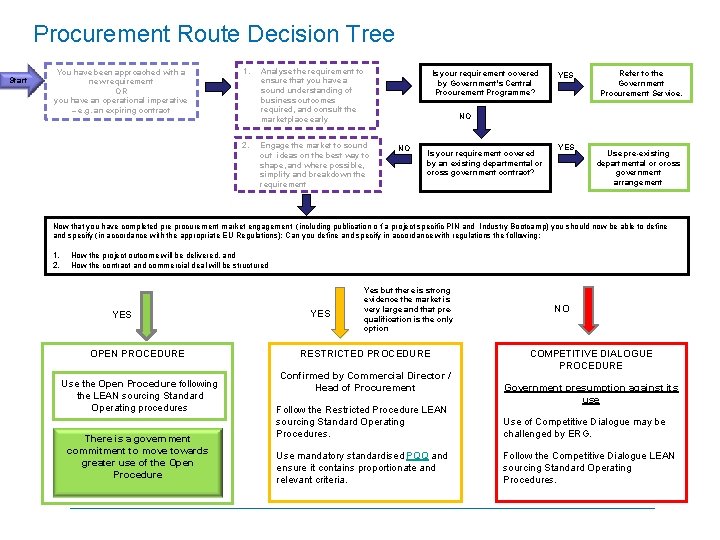
Procurement Route Decision Tree Start You have been approached with a new requirement OR you have an operational imperative – e. g. an expiring contract 1. 2. Analyse the requirement to ensure that you have a sound understanding of business outcomes required, and consult the marketplace early Is your requirement covered by Government's Central Procurement Programme? YES Refer to the Government Procurement Service. NO Engage the market to sound out ideas on the best way to shape, and where possible, simplify and breakdown the requirement NO Is your requirement covered by an existing departmental or cross government contract? YES Use pre-existing departmental or cross government arrangement Now that you have completed pre procurement market engagement (including publication o f a project specific PIN and Industry Bootcamp) you should now be able to define and specify (in accordance with the appropriate EU Regulations): Can you define and specify in accordance with regulations the following: 1. 2. How the project outcome will be delivered, and How the contract and commercial deal will be structured YES OPEN PROCEDURE Use the Open Procedure following the LEAN sourcing Standard Operating procedures There is a government commitment to move towards greater use of the Open Procedure YES Yes but there is strong evidence the market is very large and that prequalification is the only option RESTRICTED PROCEDURE Confirmed by Commercial Director / Head of Procurement NO COMPETITIVE DIALOGUE PROCEDURE Government presumption against its use Follow the Restricted Procedure LEAN sourcing Standard Operating Procedures. Use of Competitive Dialogue may be challenged by ERG. Use mandatory standardised PQQ and ensure it contains proportionate and relevant criteria. Follow the Competitive Dialogue LEAN sourcing Standard Operating Procedures.
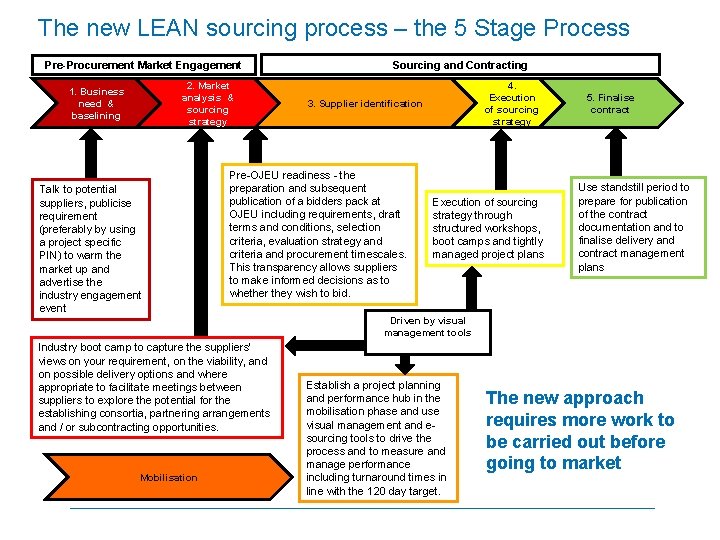
The new LEAN sourcing process – the 5 Stage Process Pre-Procurement Market Engagement 2. Market analysis & sourcing strategy 1. Business need & baselining Talk to potential suppliers, publicise requirement (preferably by using a project specific PIN) to warm the market up and advertise the industry engagement event Sourcing and Contracting 4. Execution of sourcing strategy 3. Supplier identification Pre-OJEU readiness - the preparation and subsequent publication of a bidders pack at OJEU including requirements, draft terms and conditions, selection criteria, evaluation strategy and criteria and procurement timescales. This transparency allows suppliers to make informed decisions as to whether they wish to bid. Execution of sourcing strategy through structured workshops, boot camps and tightly managed project plans 5. Finalise contract Use standstill period to prepare for publication of the contract documentation and to finalise delivery and contract management plans Driven by visual management tools Industry boot camp to capture the suppliers’ views on your requirement, on the viability, and on possible delivery options and where appropriate to facilitate meetings between suppliers to explore the potential for the establishing consortia, partnering arrangements and / or subcontracting opportunities. Mobilisation Establish a project planning and performance hub in the mobilisation phase and use visual management and esourcing tools to drive the process and to measure and manage performance including turnaround times in line with the 120 day target. The new approach requires more work to be carried out before going to market
Pre-procurement market engagement • The LEAN sourcing process has a strong focus on pre-procurement market engagement: Market analysis - engaging early with the market: • Encourages innovation – buyers get to hear what potential solutions suppliers can offer and suppliers are aware of the requirements. • Enables buyers to test the market’s response to their high level requirements, (including any socio economic factors) • Saves time and cost when the procurement process begins; suppliers can deselect themselves for opportunities they know they are not suitable for • Allows for consortia formation Questions we need to ask ourselves: • Have we consulted with a broad range of suppliers through interactive supplier days? • What is the supplier makeup of the market? Particularly those markets where there is a high SME prevalence?
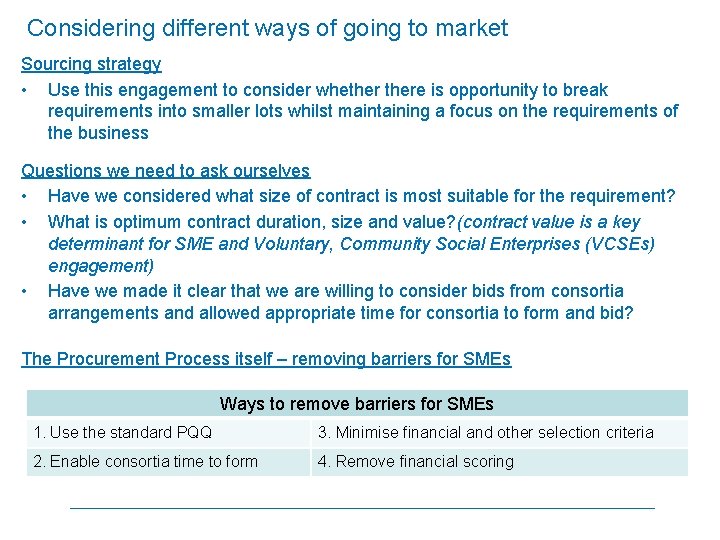
Considering different ways of going to market Sourcing strategy • Use this engagement to consider whethere is opportunity to break requirements into smaller lots whilst maintaining a focus on the requirements of the business Questions we need to ask ourselves • Have we considered what size of contract is most suitable for the requirement? • What is optimum contract duration, size and value? (contract value is a key determinant for SME and Voluntary, Community Social Enterprises (VCSEs) engagement) • Have we made it clear that we are willing to consider bids from consortia arrangements and allowed appropriate time for consortia to form and bid? The Procurement Process itself – removing barriers for SMEs Ways to remove barriers for SMEs 1. Use the standard PQQ 3. Minimise financial and other selection criteria 2. Enable consortia time to form 4. Remove financial scoring
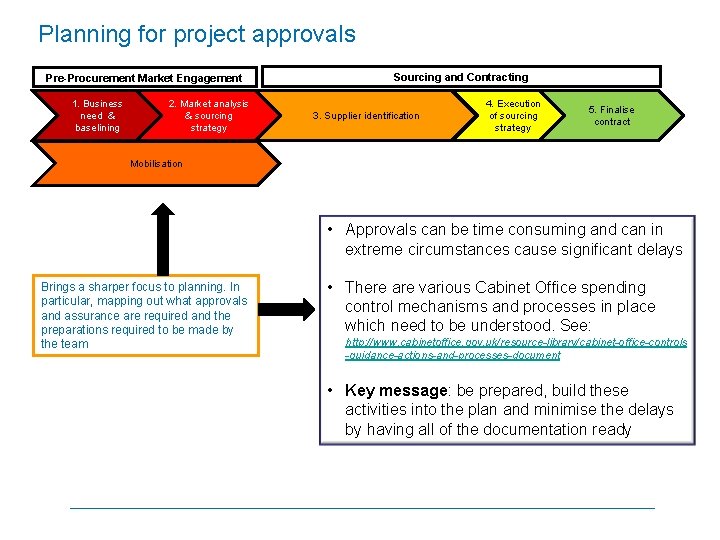
Planning for project approvals Pre-Procurement Market Engagement 1. Business need & baselining 2. Market analysis & sourcing strategy Sourcing and Contracting 3. Supplier identification 4. Execution of sourcing strategy 5. Finalise contract Mobilisation • Approvals can be time consuming and can in extreme circumstances cause significant delays Brings a sharper focus to planning. In particular, mapping out what approvals and assurance are required and the preparations required to be made by the team • There are various Cabinet Office spending control mechanisms and processes in place which need to be understood. See: http: //www. cabinetoffice. gov. uk/resource-library/cabinet-office-controls -guidance-actions-and-processes-document • Key message: be prepared, build these activities into the plan and minimise the delays by having all of the documentation ready.
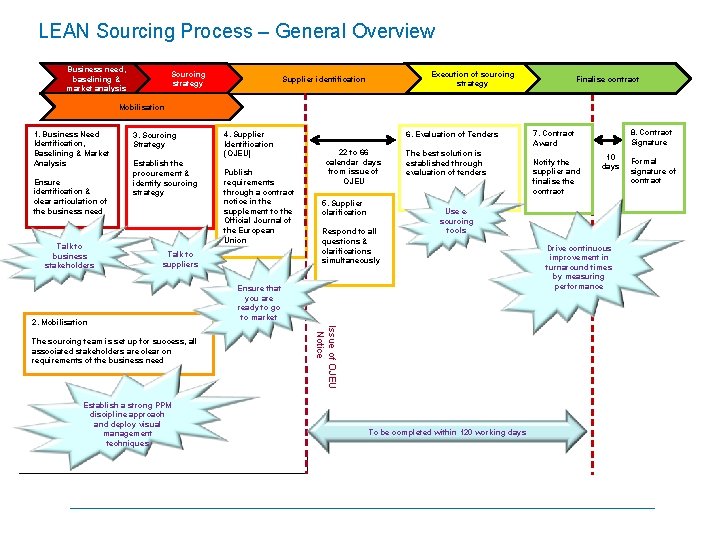
LEAN Sourcing Process – General Overview Business need, baselining & market analysis Sourcing strategy Execution of sourcing strategy Supplier identification Finalise contract Mobilisation 1. Business Need Identification, Baselining & Market Analysis Ensure identification & clear articulation of the business need Talk to business stakeholders 3. Sourcing Strategy Establish the procurement & identify sourcing strategy 4. Supplier Identification (OJEU) Publish requirements through a contract notice in the supplement to the Official Journal of the European Union Talk to suppliers The sourcing team is set up for success, all associated stakeholders are clear on requirements of the business need Establish a strong PPM discipline approach and deploy visual management techniques 22 to 66 calendar days from issue of OJEU 5. Supplier clarification Respond to all questions & clarifications simultaneously The best solution is established through evaluation of tenders 8. Contract Signature 7. Contract Award Notify the supplier and finalise the contract 10 days Use esourcing tools Ensure that you are ready to go to market Issue of OJEU Notice 2. Mobilisation 6. Evaluation of Tenders To be completed within 120 working days Drive continuous improvement in turnaround times by measuring performance Formal signature of contract
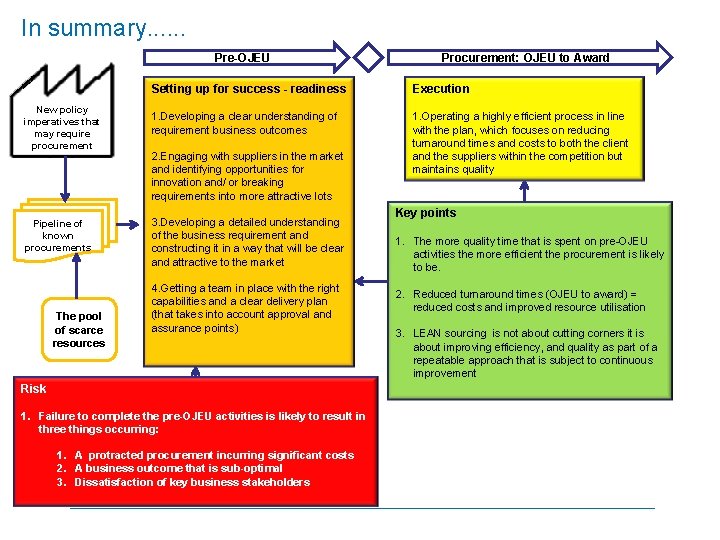
In summary. . . Pre-OJEU New policy imperatives that may require procurement Pipeline of known procurements The pool of scarce resources Procurement: OJEU to Award Setting up for success - readiness Execution 1. Developing a clear understanding of requirement business outcomes 1. Operating a highly efficient process in line with the plan, which focuses on reducing turnaround times and costs to both the client and the suppliers within the competition but maintains quality 2. Engaging with suppliers in the market and identifying opportunities for innovation and/ or breaking requirements into more attractive lots 3. Developing a detailed understanding of the business requirement and constructing it in a way that will be clear and attractive to the market 4. Getting a team in place with the right capabilities and a clear delivery plan (that takes into account approval and assurance points) Risk 1. Failure to complete the pre-OJEU activities is likely to result in three things occurring: 1. A protracted procurement incurring significant costs 2. A business outcome that is sub-optimal 3. Dissatisfaction of key business stakeholders Key points 1. The more quality time that is spent on pre-OJEU activities the more efficient the procurement is likely to be. 2. Reduced turnaround times (OJEU to award) = reduced costs and improved resource utilisation 3. LEAN sourcing is not about cutting corners it is about improving efficiency, and quality as part of a repeatable approach that is subject to continuous improvement
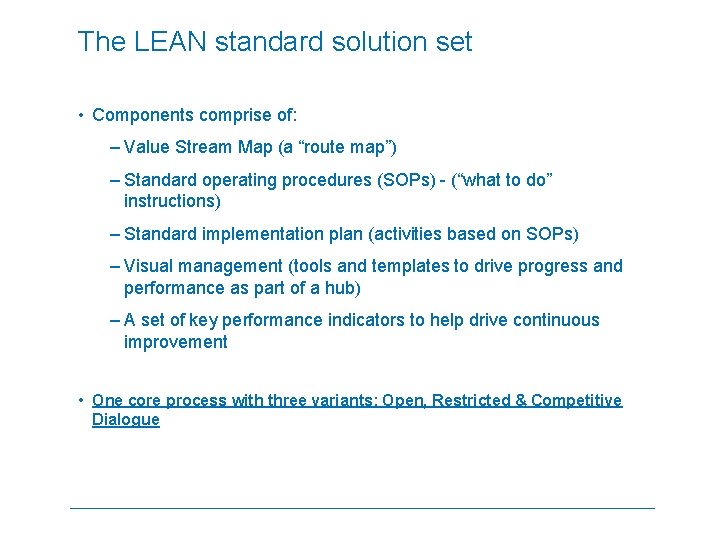
The LEAN standard solution set • Components comprise of: – Value Stream Map (a “route map”) – Standard operating procedures (SOPs) - (“what to do” instructions) – Standard implementation plan (activities based on SOPs) – Visual management (tools and templates to drive progress and performance as part of a hub) – A set of key performance indicators to help drive continuous improvement • One core process with three variants: Open, Restricted & Competitive Dialogue
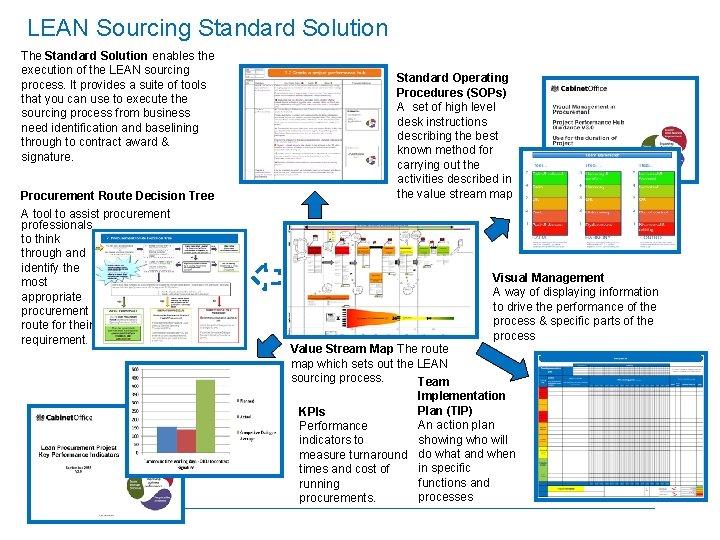
LEAN Sourcing Standard Solution The Standard Solution enables the execution of the LEAN sourcing process. It provides a suite of tools that you can use to execute the sourcing process from business need identification and baselining through to contract award & signature. Procurement Route Decision Tree A tool to assist procurement professionals to think through and identify the most appropriate procurement route for their requirement. Standard Operating Procedures (SOPs) A set of high level desk instructions describing the best known method for carrying out the activities described in the value stream map Visual Management A way of displaying information to drive the performance of the process & specific parts of the process Value Stream Map The route map which sets out the LEAN sourcing process. Team KPIs Performance indicators to measure turnaround times and cost of running procurements. Implementation Plan (TIP) An action plan showing who will do what and when in specific functions and processes
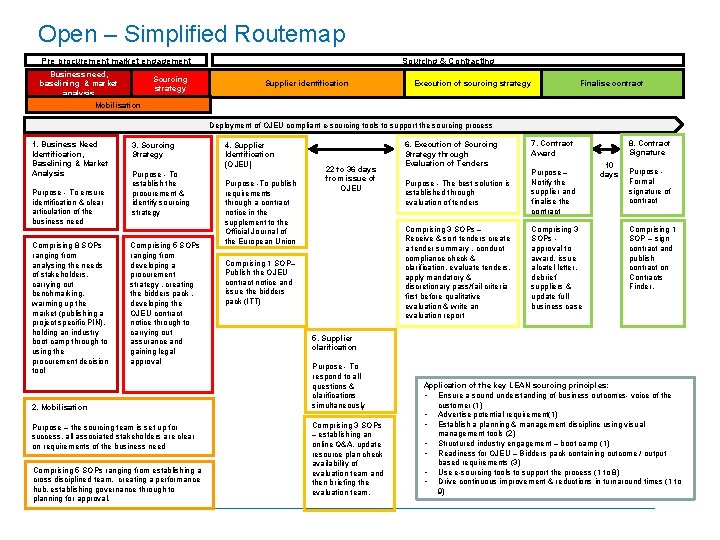
7. Overview Open – Simplified Routemap Pre procurement market engagement Business need, baselining & market analysis Mobilisation Sourcing strategy Sourcing & Contracting Supplier identification Execution of sourcing strategy Finalise contract Deployment of OJEU compliant e-sourcing tools to support the sourcing process 1. Business Need Identification, Baselining & Market Analysis Purpose - To ensure identification & clear articulation of the business need Comprising 8 SOPs ranging from analysing the needs of stakeholders, carrying out benchmarking, warming up the market (publishing a project specific PIN), holding an industry boot camp through to using the procurement decision tool 3. Sourcing Strategy Purpose - To establish the procurement & identify sourcing strategy Comprising 5 SOPs ranging from developing a procurement strategy , creating the bidders pack , developing the OJEU contract notice through to carrying out assurance and gaining legal approval 2. Mobilisation Purpose – the sourcing team is set up for success, all associated stakeholders are clear on requirements of the business need Comprising 5 SOPs ranging from establishing a cross disciplined team, creating a performance hub, establishing governance through to planning for approval. 4. Supplier Identification (OJEU) Purpose -To publish requirements through a contract notice in the supplement to the Official Journal of the European Union 22 to 36 days from issue of OJEU 6. Execution of Sourcing Strategy through Evaluation of Tenders Purpose - The best solution is established through evaluation of tenders Comprising 3 SOPs – Receive & sort tenders create a tender summary , conduct compliance check & clarification, evaluate tenders, apply mandatory & discretionary pass/fail criteria first before qualitative evaluation & write an evaluation report Comprising 1 SOP– Publish the OJEU contract notice and issue the bidders pack (ITT) 8. Contract Signature 7. Contract Award Purpose – Notify the supplier and finalise the contract Comprising 3 SOPs - approval to award, issue alcatel letter, debrief suppliers & update full business case 10 days Purpose - Formal signature of contract Comprising 1 SOP – sign contract and publish contract on Contracts Finder. 5. Supplier clarification Purpose - To respond to all questions & clarifications simultaneously Comprising 3 SOPs – establishing an online Q&A, update resource plan check availability of evaluation team and then briefing the evaluation team. Application of the key LEAN sourcing principles: • Ensure a sound understanding of business outcomes- voice of the customer (1) • Advertise potential requirement(1) • Establish a planning & management discipline using visual management tools (2) • Structured industry engagement – boot camp (1) • Readiness for OJEU – Bidders pack containing outcome / output based requirements (3) • Use e-sourcing tools to support the process (1 to 8) • Drive continuous improvement & reductions in turnaround times (1 to 9)
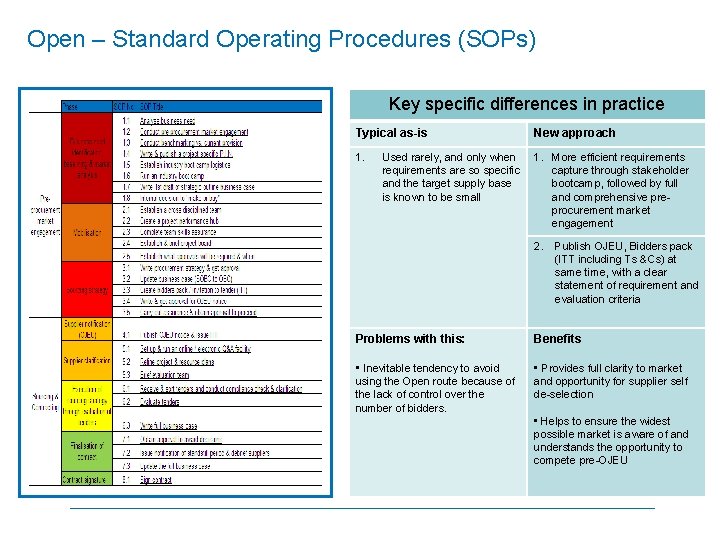
Open – Standard Operating Procedures (SOPs) Key specific differences in practice Typical as-is New approach 1. More efficient requirements capture through stakeholder bootcamp, followed by full and comprehensive preprocurement market engagement Used rarely, and only when requirements are so specific and the target supply base is known to be small 2. Publish OJEU, Bidders pack (ITT including Ts &Cs) at same time, with a clear statement of requirement and evaluation criteria Problems with this: Benefits • Inevitable tendency to avoid • Provides full clarity to market using the Open route because of the lack of control over the number of bidders. and opportunity for supplier self de-selection • Helps to ensure the widest possible market is aware of and understands the opportunity to compete pre-OJEU
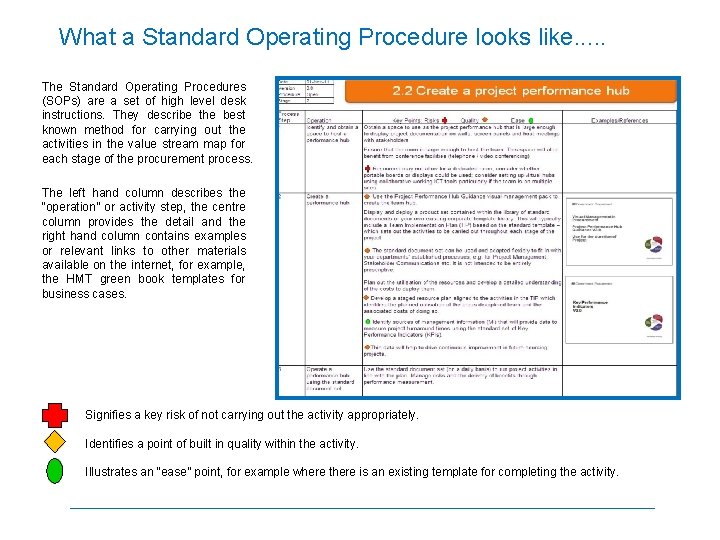
What a Standard Operating Procedure looks like. . . The Standard Operating Procedures (SOPs) are a set of high level desk instructions. They describe the best known method for carrying out the activities in the value stream map for each stage of the procurement process. The left hand column describes the “operation” or activity step, the centre column provides the detail and the right hand column contains examples or relevant links to other materials available on the internet, for example, the HMT green book templates for business cases. Signifies a key risk of not carrying out the activity appropriately. Identifies a point of built in quality within the activity. Illustrates an “ease” point, for example where there is an existing template for completing the activity.
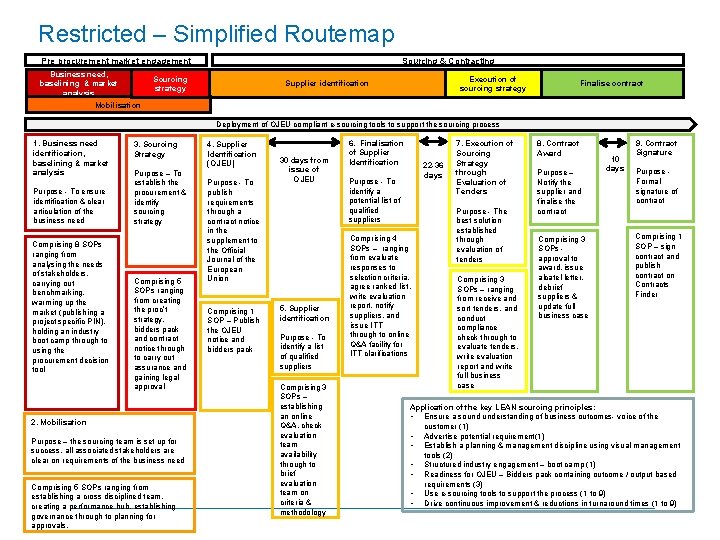
Restricted – Simplified Routemap Pre procurement market engagement Business need, baselining & market analysis Mobilisation Sourcing & Contracting Sourcing strategy Execution of sourcing strategy Supplier identification Finalise contract Deployment of OJEU compliant e-sourcing tools to support the sourcing process 1. Business need identification, baselining & market analysis Purpose - To ensure identification & clear articulation of the business need Comprising 8 SOPs ranging from analysing the needs of stakeholders, carrying out benchmarking, warming up the market (publishing a project specific PIN), holding an industry boot camp through to using the procurement decision tool 3. Sourcing Strategy Purpose – To establish the procurement & identify sourcing strategy Comprising 5 SOPs ranging from creating the proc’t strategy, bidders pack and contract notice through to carry out assurance and gaining legal approval 2. Mobilisation Purpose – the sourcing team is set up for success, all associated stakeholders are clear on requirements of the business need Comprising 5 SOPs ranging from establishing a cross disciplined team, creating a performance hub, establishing governance through to planning for approvals. 4. Supplier Identification (OJEU) Purpose - To publish requirements through a contract notice in the supplement to the Official Journal of the European Union Comprising 1 SOP – Publish the OJEU notice and bidders pack 30 days from issue of OJEU 5. Supplier identification Purpose - To identify a list of qualified suppliers Comprising 3 SOPs – establishing an online Q&A, check evaluation team availability through to brief evaluation team on criteria & methodology 6. Finalisation of Supplier Identification 22 -36 days Purpose - To identify a potential list of qualified suppliers Comprising 4 SOPs – ranging from evaluate responses to selection criteria, agree ranked list, write evaluation report, notify suppliers, and issue ITT through to online Q&A facility for ITT clarifications 7. Execution of Sourcing Strategy through Evaluation of Tenders Purpose - The best solution established through evaluation of tenders Comprising 3 SOPs – ranging from receive and sort tenders, and conduct compliance check through to evaluate tenders, write evaluation report and write full business case 8. Contract Award Purpose – Notify the supplier and finalise the contract Comprising 3 SOPs - approval to award, issue alcatel letter, debrief suppliers & update full business case 10 days 9. Contract Signature Purpose - Formal signature of contract Comprising 1 SOP – sign contract and publish contract on Contracts Finder Application of the key LEAN sourcing principles: • Ensure a sound understanding of business outcomes- voice of the customer (1) • Advertise potential requirement(1) • Establish a planning & management discipline using visual management tools (2) • Structured industry engagement – boot camp (1) • Readiness for OJEU – Bidders pack containing outcome / output based requirements (3) • Use e-sourcing tools to support the process (1 to 9) • Drive continuous improvement & reductions in turnaround times (1 to 9)
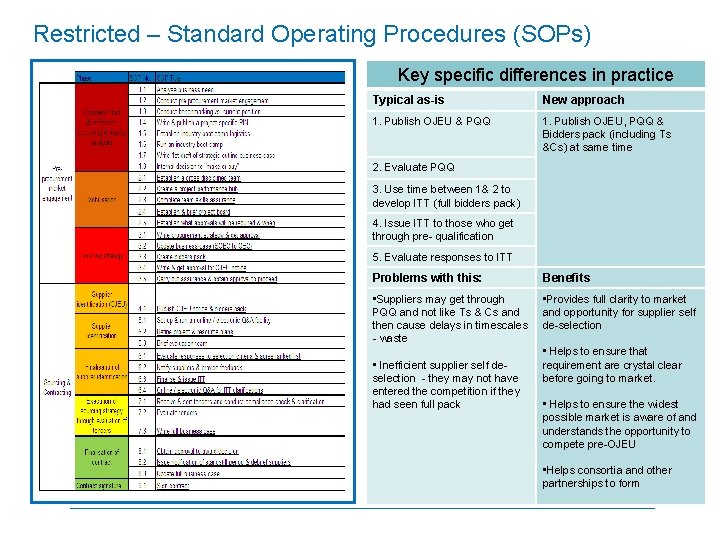
Restricted – Standard Operating Procedures (SOPs) Key specific differences in practice Typical as-is New approach 1. Publish OJEU & PQQ 1. Publish OJEU, PQQ & Bidders pack (including Ts &Cs) at same time 2. Evaluate PQQ 3. Use time between 1& 2 to develop ITT (full bidders pack) 4. Issue ITT to those who get through pre- qualification 5. Evaluate responses to ITT Problems with this: Benefits • Suppliers may get through PQQ and not like Ts & Cs and then cause delays in timescales - waste • Provides full clarity to market and opportunity for supplier self de-selection • Inefficient supplier self deselection - they may not have entered the competition if they had seen full pack • Helps to ensure that requirement are crystal clear before going to market. • Helps to ensure the widest possible market is aware of and understands the opportunity to compete pre-OJEU • Helps consortia and other partnerships to form
Formal training • GPS is rolling out training across central government which will comprise: – 1 day LEAN Sourcing Awareness course – 3 day LEAN Sourcing Simulation workshop • Initially the both course types will be classroom based but an e - learning package is being developed to replace the 1 day course. This should be available by June 2012. • Further information will be available from GPS by phoning the service desk on 0345 4102222 or by emailing training@gps. gsi. gov. uk
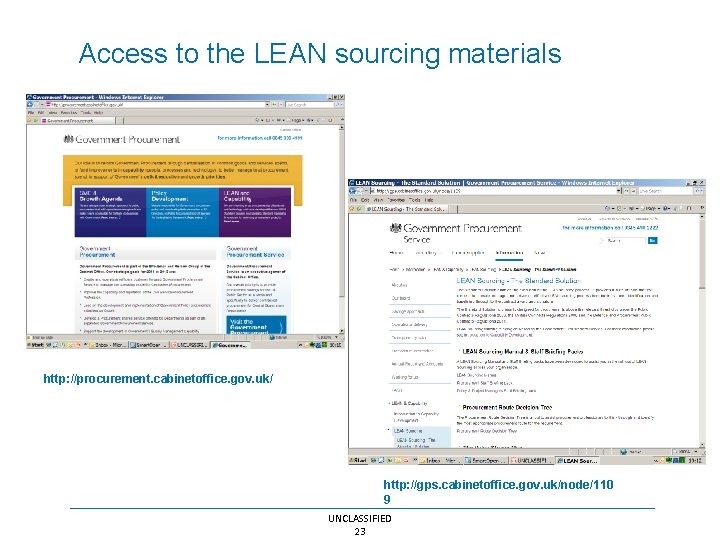
Access to the LEAN sourcing materials http: //procurement. cabinetoffice. gov. uk/ http: //gps. cabinetoffice. gov. uk/node/110 9 UNCLASSIFIED 23
Next steps • Gain access to the LEAN sourcing materials • Download and read the Standard Operating Procedures – your starting point should be the set that covers the Open procedure • Consider how these procedures and the key LEAN principles can be applied to forthcoming procurements • Apply the principles to your procurement using the Standard Operating Procedures as a mechanism to ensure that you are following the LEAN process • Note – It will be important to capture turnaround times (the time taken in working days from the publication of the Advert to Contract Award) – as our department’s performance against the 120 day target will be subject to ongoing scrutiny from the department, ERG & No 10.
- Slides: 26