
THE LEAN ENTERPRISE Cell Manufacturing Line Balancing for

THE LEAN ENTERPRISE Cell Manufacturing & Line Balancing for Flexibility Jeff Strabala
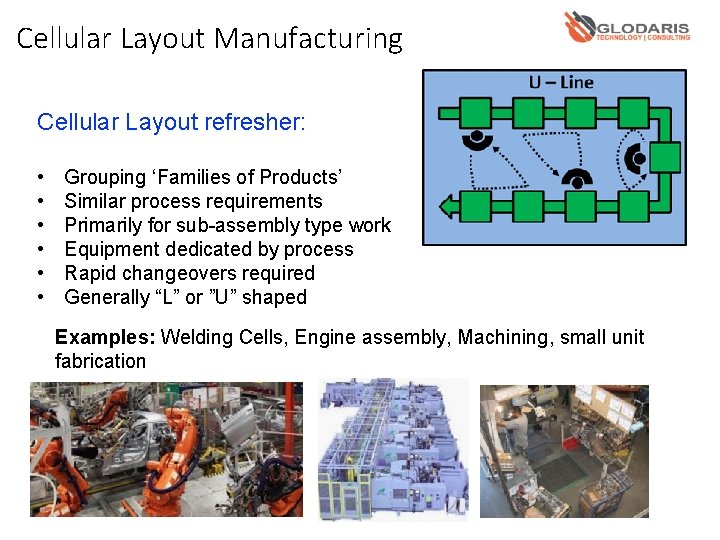
Cellular Layout Manufacturing Cellular Layout refresher: • • • Grouping ‘Families of Products’ Similar process requirements Primarily for sub-assembly type work Equipment dedicated by process Rapid changeovers required Generally “L” or ”U” shaped Examples: Welding Cells, Engine assembly, Machining, small unit fabrication
Cellular Layout Manufacturing Cellular Layout refresher: Advantages: Disadvantages: • Unit Cost low due to high volume, • Low changeover times • Lower Inventory • Flexibility within ‘family’ • Employee motivation & ownership of work • Material Flow efficient • System DT risk due to: equip / maint. needs / absenteeism • Limited Flexibility of equipment for • Multiple ‘Families’ & variation • New / discontinued model coordination
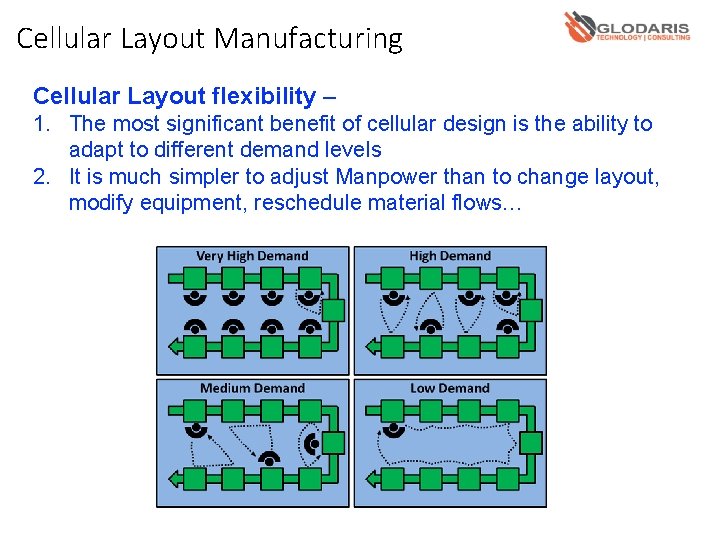
Cellular Layout Manufacturing Cellular Layout flexibility – 1. The most significant benefit of cellular design is the ability to adapt to different demand levels 2. It is much simpler to adjust Manpower than to change layout, modify equipment, reschedule material flows…
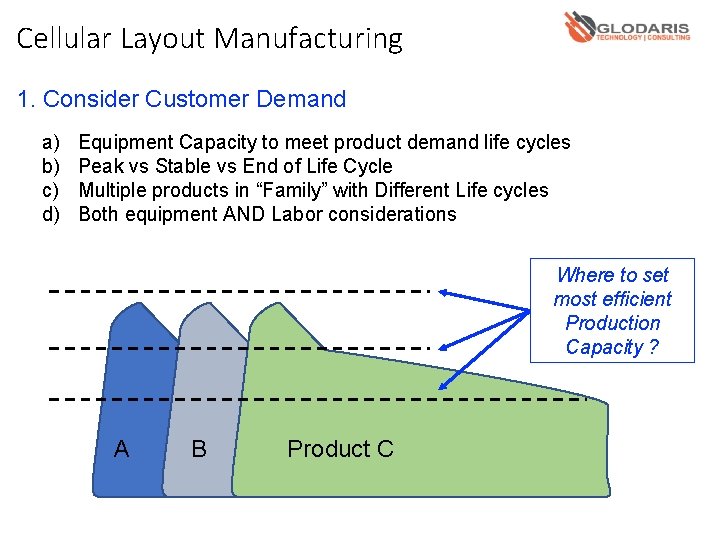
Cellular Layout Manufacturing 1. Consider Customer Demand a) b) c) d) Equipment Capacity to meet product demand life cycles Peak vs Stable vs End of Life Cycle Multiple products in “Family” with Different Life cycles Both equipment AND Labor considerations Where to set most efficient Production Capacity ? A B Product C
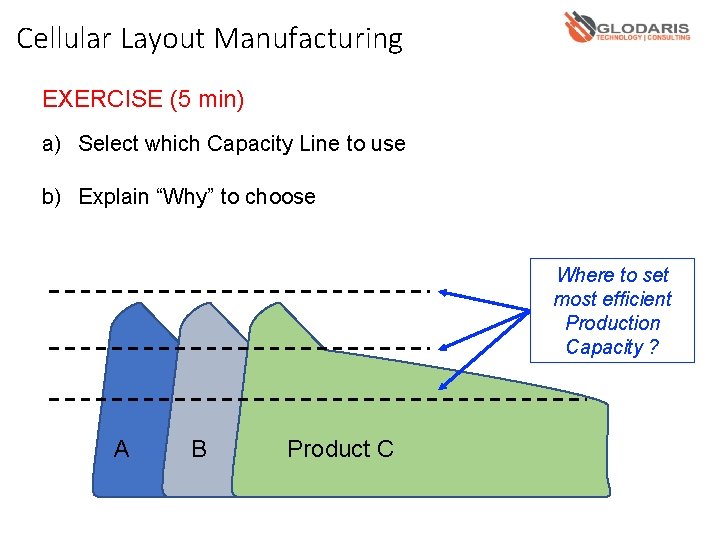
Cellular Layout Manufacturing EXERCISE (5 min) a) Select which Capacity Line to use b) Explain “Why” to choose Where to set most efficient Production Capacity ? A B Product C
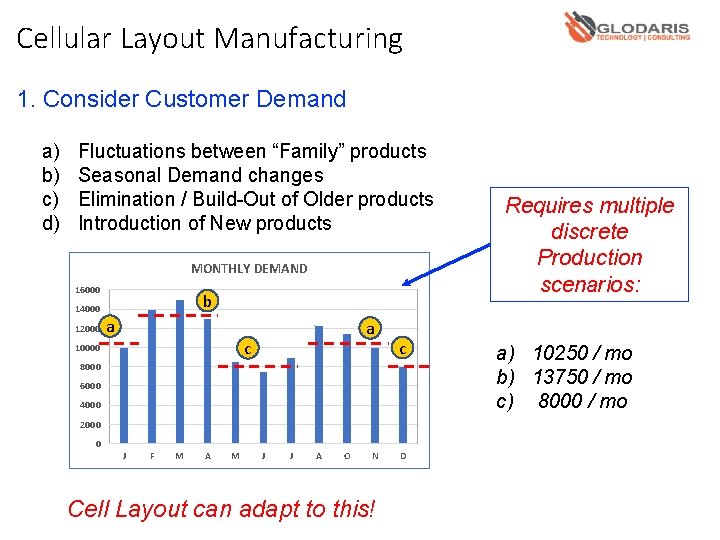
Cellular Layout Manufacturing 1. Consider Customer Demand a) b) c) d) Fluctuations between “Family” products Seasonal Demand changes Elimination / Build-Out of Older products Introduction of New products MONTHLY DEMAND 16000 b 14000 12000 a a c 10000 c 8000 6000 4000 2000 0 J F M A M J J A O N Cell Layout can adapt to this! D Requires multiple discrete Production scenarios: a) 10250 / mo b) 13750 / mo c) 8000 / mo
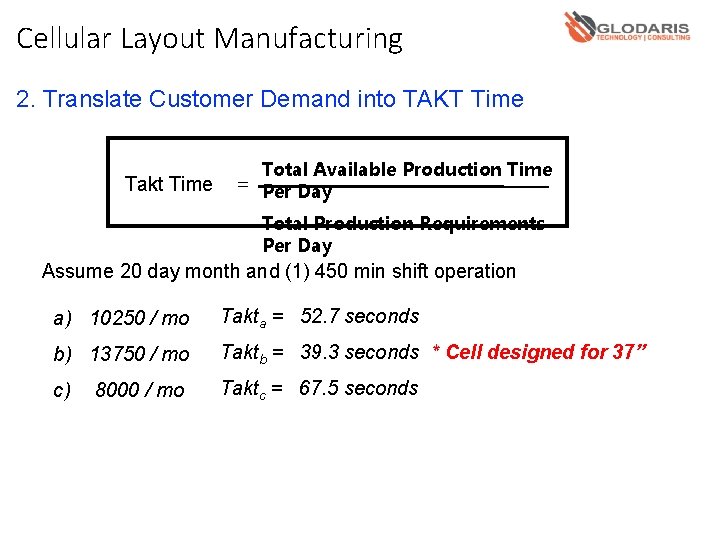
Cellular Layout Manufacturing 2. Translate Customer Demand into TAKT Time Takt Time Total Available Production Time = Per Day Total Production Requirements Per Day Assume 20 day month and (1) 450 min shift operation a) 10250 / mo Takta = 52. 7 seconds b) 13750 / mo Taktb = 39. 3 seconds * Cell designed for 37” c) Taktc = 67. 5 seconds 8000 / mo
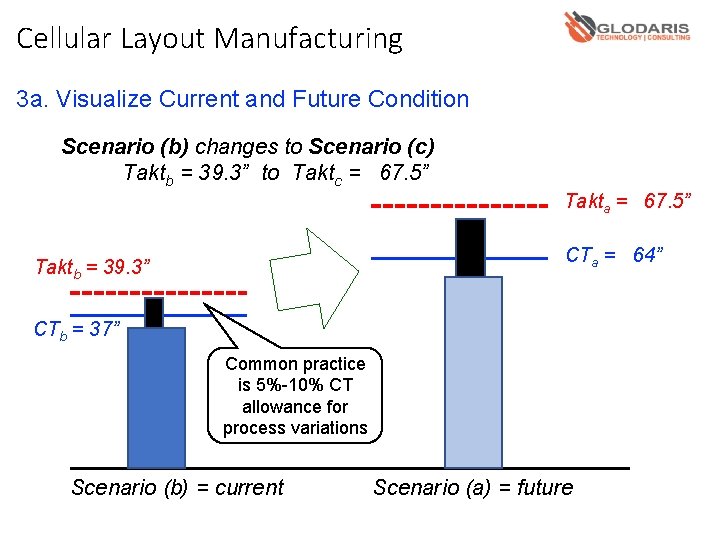
Cellular Layout Manufacturing 3 a. Visualize Current and Future Condition Scenario (b) changes to Scenario (c) Taktb = 39. 3” to Taktc = 67. 5” Takta = 67. 5” CTa = 64” Taktb = 39. 3” CTb = 37” Common practice is 5%-10% CT allowance for process variations Scenario (b) = current Scenario (a) = future
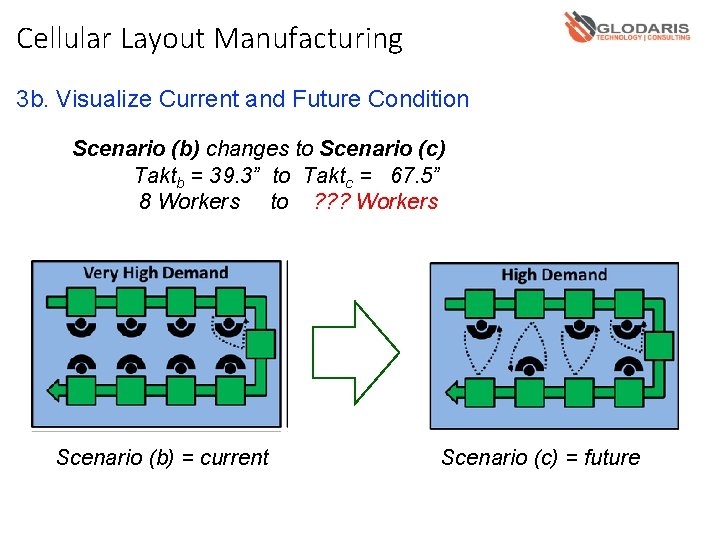
Cellular Layout Manufacturing 3 b. Visualize Current and Future Condition Scenario (b) changes to Scenario (c) Taktb = 39. 3” to Taktc = 67. 5” 8 Workers to ? ? ? Workers Scenario (b) = current Scenario (c) = future
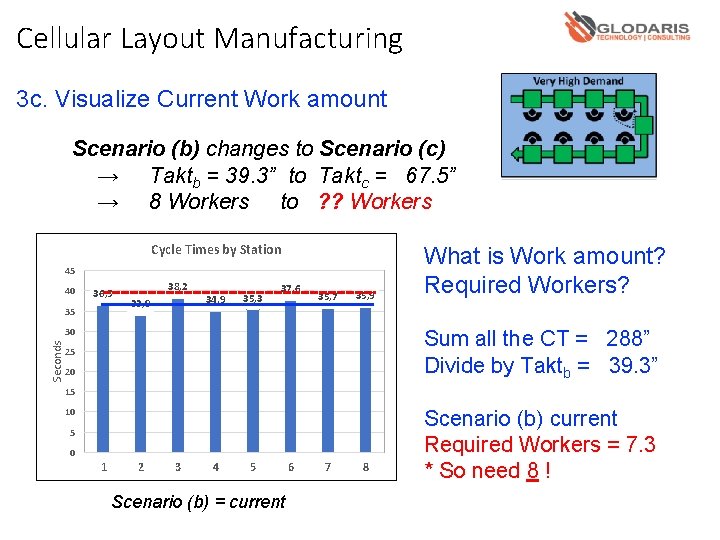
Cellular Layout Manufacturing 3 c. Visualize Current Work amount Scenario (b) changes to Scenario (c) → Taktb = 39. 3” to Taktc = 67. 5” → 8 Workers to ? ? Workers Cycle Times by Station 45 40 36, 5 35 38, 2 33, 9 34, 9 35, 3 37, 6 35, 7 35, 9 Seconds 30 What is Work amount? Required Workers? Sum all the CT = 288” Divide by Taktb = 39. 3” 25 20 15 10 5 0 1 2 3 4 5 Scenario (b) = current 6 7 8 Scenario (b) current Required Workers = 7. 3 * So need 8 !
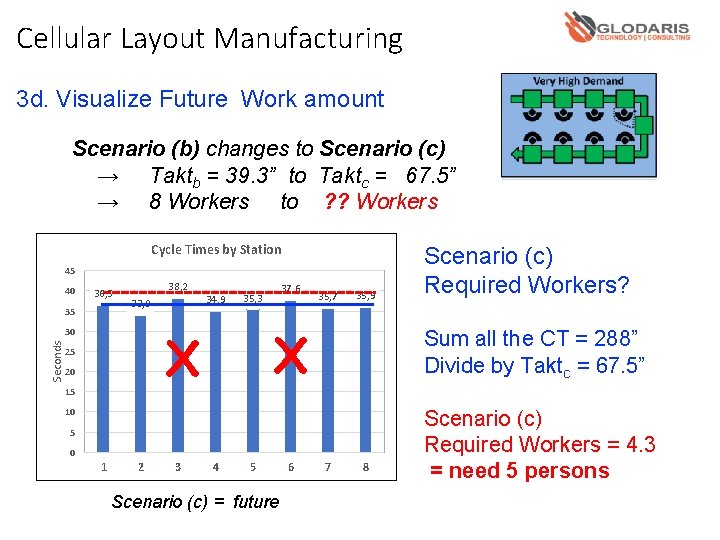
Cellular Layout Manufacturing 3 d. Visualize Future Work amount Scenario (b) changes to Scenario (c) → Taktb = 39. 3” to Taktc = 67. 5” → 8 Workers to ? ? Workers Cycle Times by Station 45 40 36, 5 35 38, 2 33, 9 25 20 15 37, 6 35, 3 35, 7 35, 9 X X 30 Seconds 34, 9 Sum all the CT = 288” Divide by Taktc = 67. 5” 10 5 0 1 2 3 4 5 Scenario (c) = future 6 Scenario (c) Required Workers? 7 8 Scenario (c) Required Workers = 4. 3 = need 5 persons
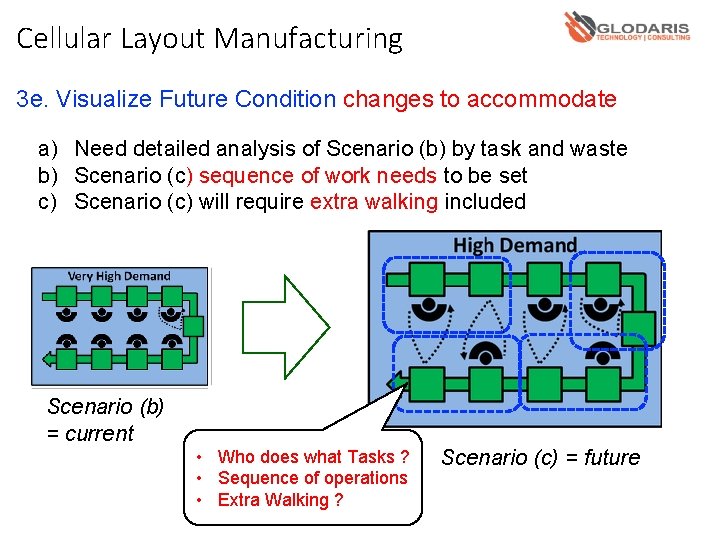
Cellular Layout Manufacturing 3 e. Visualize Future Condition changes to accommodate a) Need detailed analysis of Scenario (b) by task and waste b) Scenario (c) sequence of work needs to be set c) Scenario (c) will require extra walking included Scenario (b) = current • Who does what Tasks ? • Sequence of operations • Extra Walking ? Scenario (c) = future
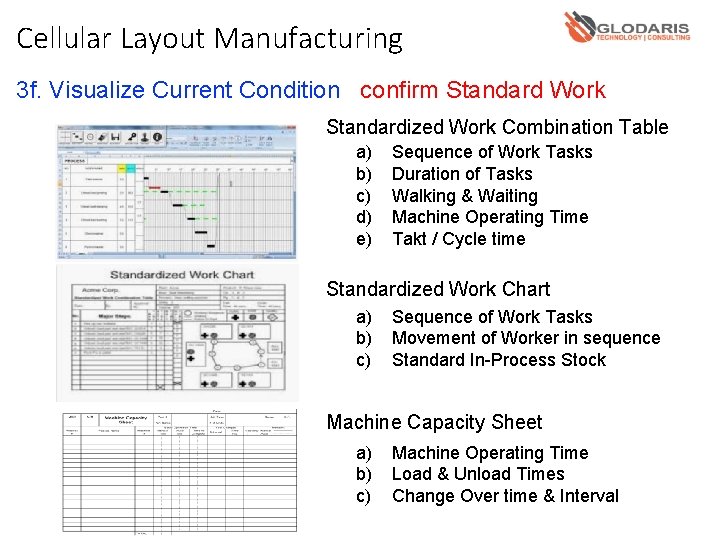
Cellular Layout Manufacturing 3 f. Visualize Current Condition confirm Standard Work Standardized Work Combination Table a) b) c) d) e) Sequence of Work Tasks Duration of Tasks Walking & Waiting Machine Operating Time Takt / Cycle time Standardized Work Chart a) b) c) Sequence of Work Tasks Movement of Worker in sequence Standard In-Process Stock Machine Capacity Sheet a) b) c) Machine Operating Time Load & Unload Times Change Over time & Interval
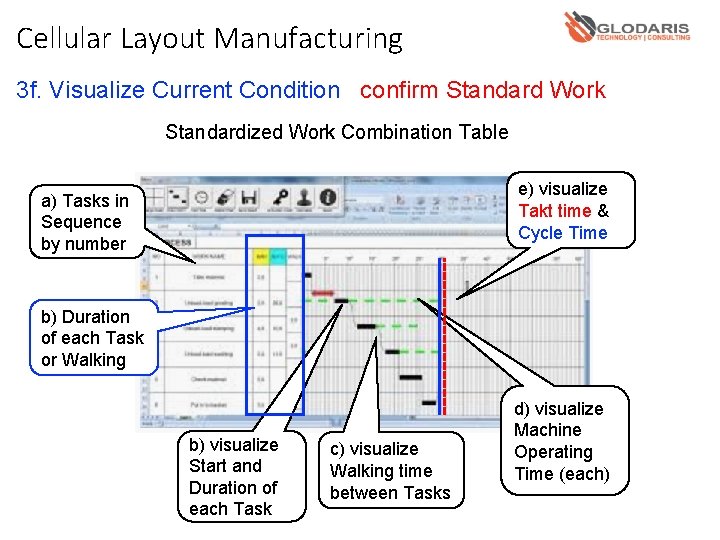
Cellular Layout Manufacturing 3 f. Visualize Current Condition confirm Standard Work Standardized Work Combination Table e) visualize Takt time & Cycle Time a) Tasks in Sequence by number b) Duration of each Task or Walking b) visualize Start and Duration of each Task c) visualize Walking time between Tasks d) visualize Machine Operating Time (each)
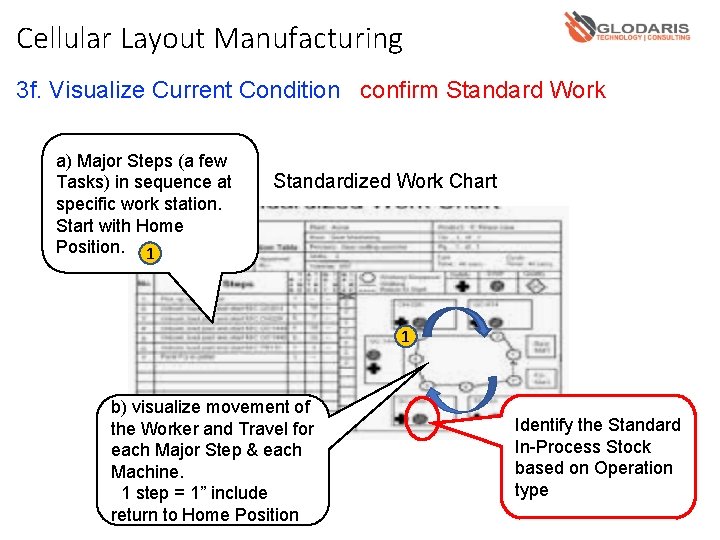
Cellular Layout Manufacturing 3 f. Visualize Current Condition confirm Standard Work a) Major Steps (a few Tasks) in sequence at specific work station. Start with Home Position. 1 Standardized Work Chart 1 b) visualize movement of the Worker and Travel for each Major Step & each Machine. 1 step = 1” include return to Home Position Identify the Standard In-Process Stock based on Operation type
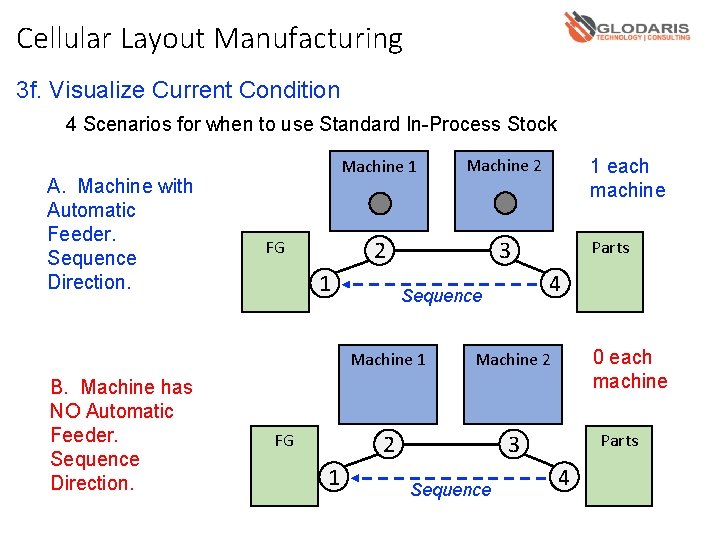
Cellular Layout Manufacturing 3 f. Visualize Current Condition 4 Scenarios for when to use Standard In-Process Stock A. Machine with Automatic Feeder. Sequence Direction. B. Machine has NO Automatic Feeder. Sequence Direction. FG Machine 1 Machine 2 2 3 1 FG 1 1 each machine Parts 4 Sequence Machine 1 Machine 2 2 3 Sequence 0 each machine Parts 4
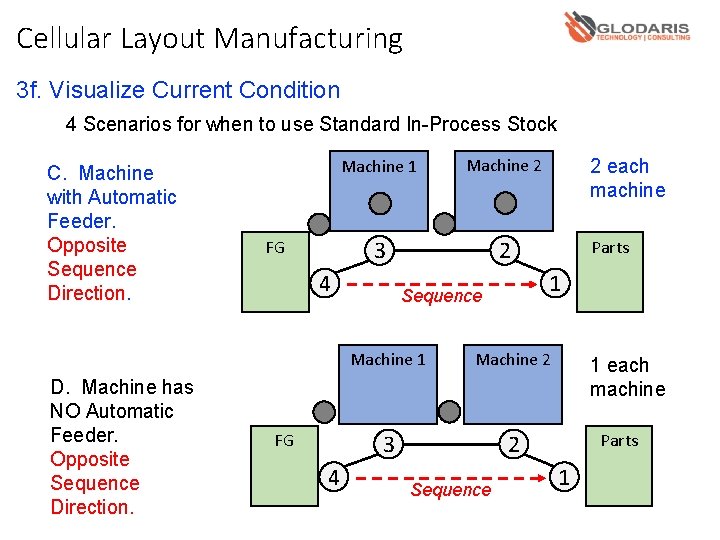
Cellular Layout Manufacturing 3 f. Visualize Current Condition 4 Scenarios for when to use Standard In-Process Stock C. Machine with Automatic Feeder. Opposite Sequence Direction. D. Machine has NO Automatic Feeder. Opposite Sequence Direction. FG Machine 1 Machine 2 3 2 4 FG 4 2 each machine Parts 1 Sequence Machine 1 Machine 2 3 2 Sequence 1 each machine Parts 1
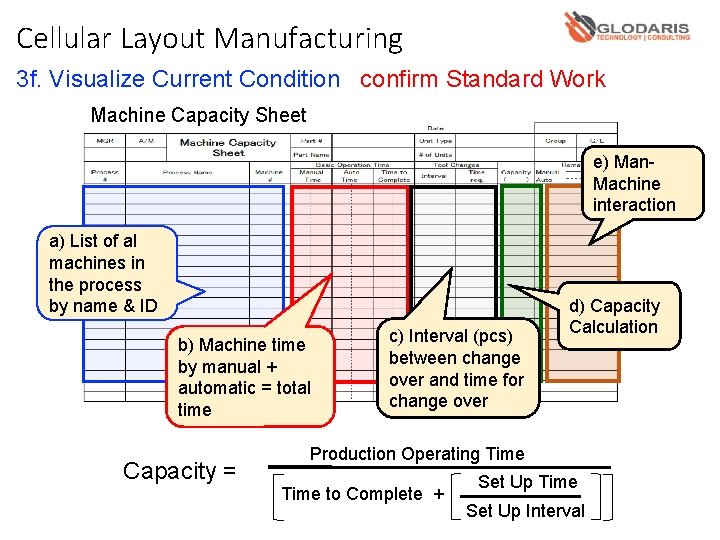
Cellular Layout Manufacturing 3 f. Visualize Current Condition confirm Standard Work Machine Capacity Sheet e) Man. Machine interaction a) List of al machines in the process by name & ID b) Machine time by manual + automatic = total time Capacity = c) Interval (pcs) between change over and time for change over d) Capacity Calculation Production Operating Time to Complete + Set Up Time Set Up Interval
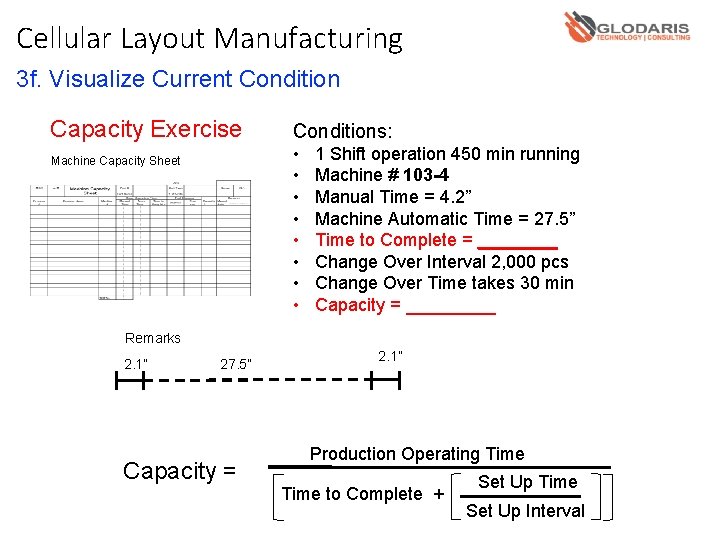
Cellular Layout Manufacturing 3 f. Visualize Current Condition Capacity Exercise Conditions: • • Machine Capacity Sheet 1 Shift operation 450 min running Machine # 103 -4 Manual Time = 4. 2” Machine Automatic Time = 27. 5” Time to Complete = ____ Change Over Interval 2, 000 pcs Change Over Time takes 30 min Capacity = _____ Remarks 2. 1” 27. 5” Capacity = 2. 1” Production Operating Time to Complete + Set Up Time Set Up Interval
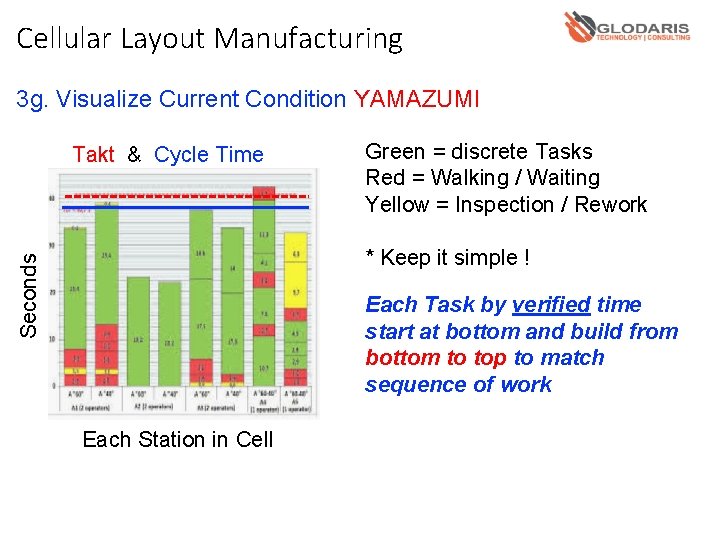
Cellular Layout Manufacturing 3 g. Visualize Current Condition YAMAZUMI Takt & Cycle Time Green = discrete Tasks Red = Walking / Waiting Yellow = Inspection / Rework Seconds * Keep it simple ! Each Task by verified time start at bottom and build from bottom to top to match sequence of work Each Station in Cell
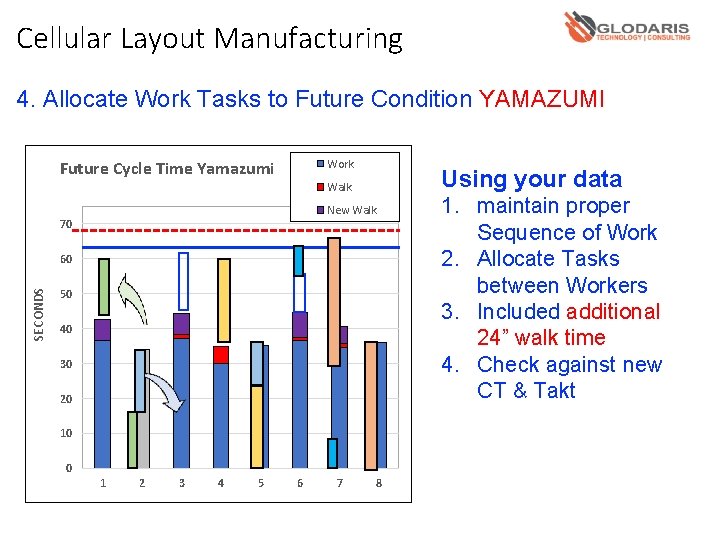
Cellular Layout Manufacturing 4. Allocate Work Tasks to Future Condition YAMAZUMI Work Future Cycle Time Yamazumi Using your data Walk New Walk 70 SECONDS 60 50 40 30 20 10 0 1 2 3 4 5 6 7 8 1. maintain proper Sequence of Work 2. Allocate Tasks between Workers 3. Included additional 24” walk time 4. Check against new CT & Takt
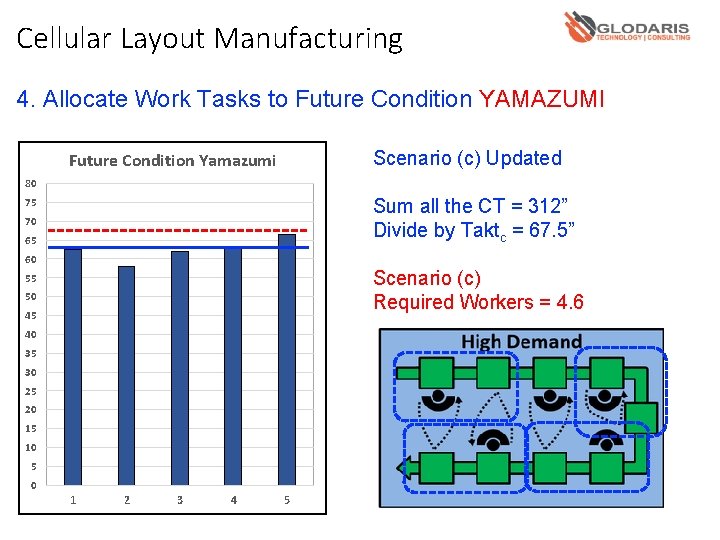
Cellular Layout Manufacturing 4. Allocate Work Tasks to Future Condition YAMAZUMI Scenario (c) Updated Future Condition Yamazumi 80 Sum all the CT = 312” Divide by Taktc = 67. 5” 75 70 65 60 Scenario (c) Required Workers = 4. 6 55 50 45 40 35 30 25 20 15 10 5 0 1 2 3 4 5
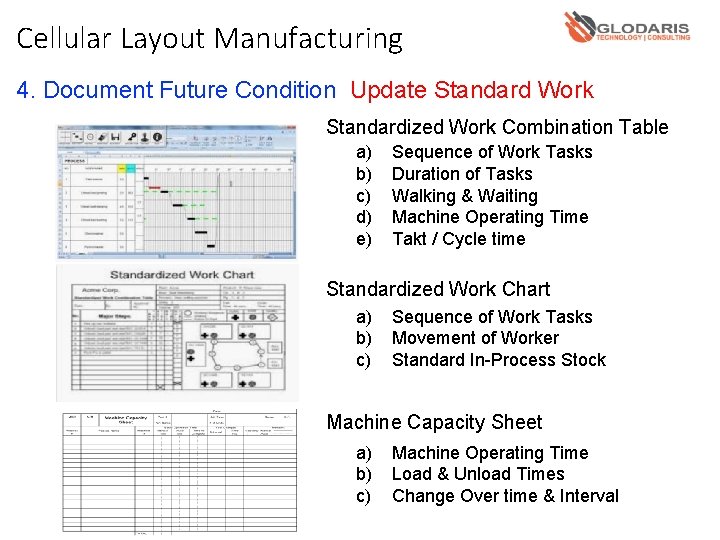
Cellular Layout Manufacturing 4. Document Future Condition Update Standard Work Standardized Work Combination Table a) b) c) d) e) Sequence of Work Tasks Duration of Tasks Walking & Waiting Machine Operating Time Takt / Cycle time Standardized Work Chart a) b) c) Sequence of Work Tasks Movement of Worker Standard In-Process Stock Machine Capacity Sheet a) b) c) Machine Operating Time Load & Unload Times Change Over time & Interval
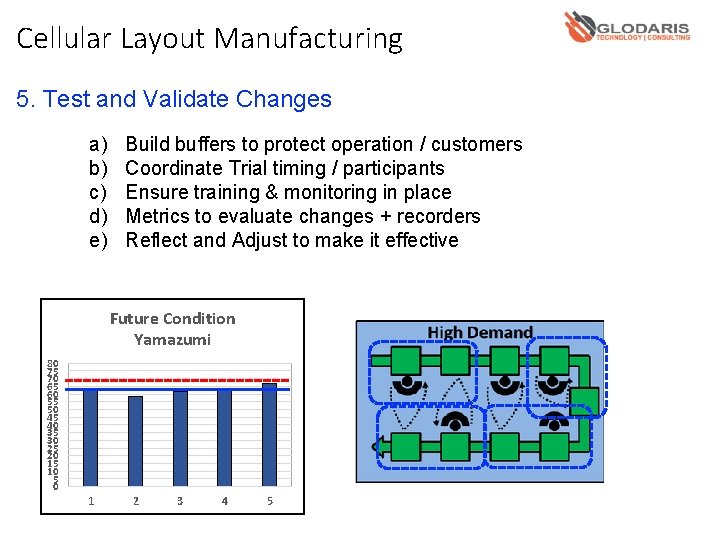
Cellular Layout Manufacturing 5. Test and Validate Changes a) b) c) d) e) Build buffers to protect operation / customers Coordinate Trial timing / participants Ensure training & monitoring in place Metrics to evaluate changes + recorders Reflect and Adjust to make it effective Future Condition Yamazumi 80 75 70 65 60 55 50 45 40 35 30 25 20 15 10 5 0 1 2 3 4 5
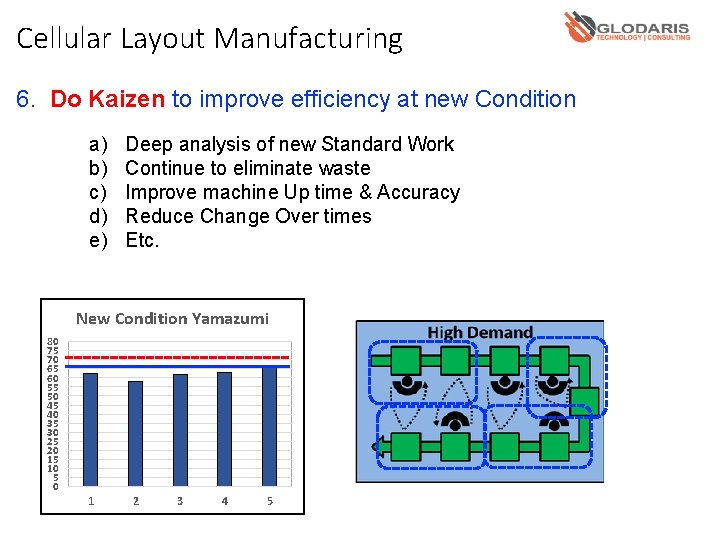
Cellular Layout Manufacturing 6. Do Kaizen to improve efficiency at new Condition a) b) c) d) e) Deep analysis of new Standard Work Continue to eliminate waste Improve machine Up time & Accuracy Reduce Change Over times Etc. New Condition Yamazumi 80 75 70 65 60 55 50 45 40 35 30 25 20 15 10 5 0 1 2 3 4 5
Cellular Layout Manufacturing 7. Train Others on how to perform this Activity a) Make a Standard ! b) Determine How fast Transition can be for different volume Scenarios (Up/Down) c) Still need to create for Scenario (a) a) New ‘Work Total” is 312” @ 67. 5” takt b) What is necessary manpower @ 52. 7” Takt ? 312” total working time 52. 7” Scenario (a) Takt = x. x Persons Which is more efficient from ‘manpower perspective’ Scenario (a), (b) or (c) ?
- Slides: 27